



Micro Fulfillment Market Size 2024-2028
The micro fulfillment market size is forecast to increase by USD 67.31 billion at a CAGR of 68.33% between 2023 and 2028. The market is experiencing significant growth due to the increasing demand for faster delivery times and urbanization. E-commerce sales continue to rise, leading to a tide in the need for efficient and compact fulfillment solutions. However, the high initial investment required for implementing micro fulfillment systems can be a challenge for some businesses. Operational costs, including safety measures and specialized consulting services, must also be considered. To address these challenges, micro fulfillment systems are being designed with scalability and flexibility in mind, using components such as automated storage and retrieval systems and operational workflows optimized for small footprints. Standalone micro fulfillment centers offer an attractive solution for businesses seeking to streamline their supply chain and improve customer satisfaction.
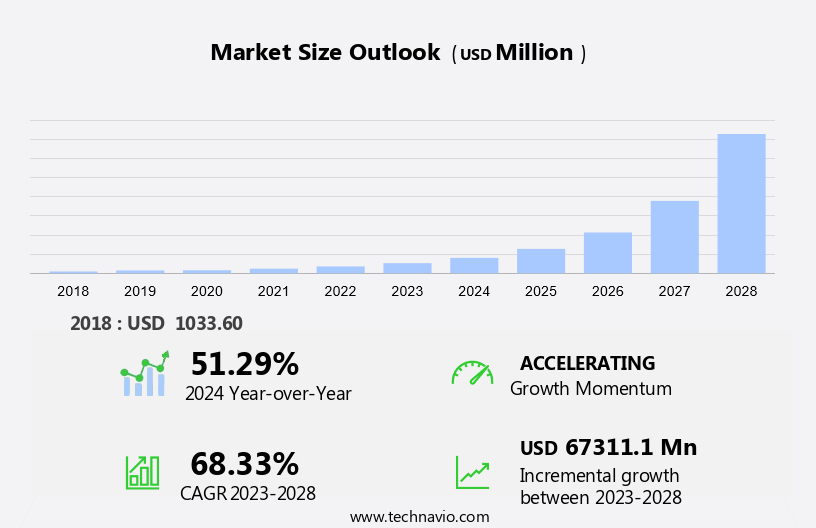
The market is witnessing significant growth as traditional retailers adopt advanced technologies to enhance their order fulfillment processes. Robotics and software solutions are at the forefront of this transformation, enabling retailers to provide superior customer engagement and meet the demands of ecommerce niches. Traditional retailers are recognizing the need for a more agile and efficient order fulfillment system to remain competitive in today's market. Micro fulfillment centers offer a solution by utilizing smaller, standalone facilities that are strategically located close to population centers. These facilities are equipped with racking systems, conveyor belts, and sorting systems to streamline the picking, packing, and shipping process.
Additionally, the implementation of software solutions may require significant IT resources and training for employees. Despite the initial investment, the benefits of micro fulfillment far outweigh the costs. Retailers can reduce long delivery times and provide faster, more reliable order fulfillment, leading to increased customer satisfaction and loyalty. Furthermore, the use of robotics and automation in micro fulfillment centers allows for the handling of perishable products and fluctuations in demand, ensuring a consistent customer experience. The market is also addressing the issue of last-mile emissions and greenhouse gases by utilizing alternative delivery methods, such as bicycle messengers and electric vehicles. These initiatives contribute to a more sustainable business model and align with consumer preferences for eco-friendly practices.
In conclusion, the market is revolutionizing the retail industry by providing retailers with a more agile and efficient order fulfillment solution. Advanced robotics and software solutions are transforming traditional warehouses into micro fulfillment centers, enabling retailers to meet the demands of ecommerce niches and provide a superior customer experience. While the upfront investment may be substantial, the long-term benefits, such as improved purchase conversion rates, reduced delivery times, and increased customer satisfaction, make micro fulfillment a worthwhile investment for retailers.
Market Segmentation
The market research report provides comprehensive data (region-wise segment analysis), with forecasts and estimates in "USD million" for the period 2024-2028, as well as historical data from 2018-2022 for the following segments.
- Component
- Hardware
- Software
- Services
- Type
- Store-integrated/in-store
- Standalone
- Dark stores
- Geography
- North America
- Canada
- US
- Europe
- Germany
- UK
- APAC
- China
- Middle East and Africa
- South America
- North America
By Component Insights
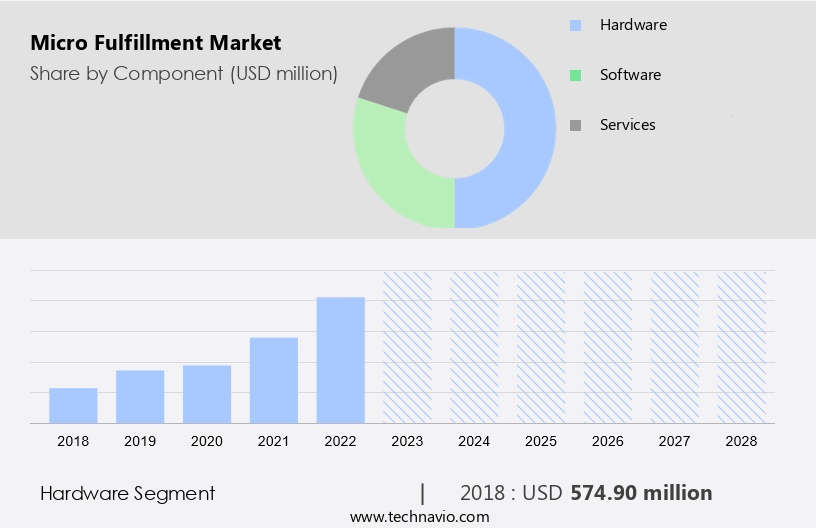
The hardware segment is estimated to witness significant growth during the forecast period. Micro fulfillment centers, characterized by small-scale distribution facilities, are revolutionizing the way businesses handle e-commerce and grocery orders. These automated warehouses, equipped with advanced technology, are strategically located in residential complexes to minimize delivery times. The primary hardware components of micro fulfillment centers include robotics, conveyor systems, shelving, sensors, and other machinery. Autonomous robots are a pivotal part of these facilities, navigating the warehouse, retrieving items from designated areas, and delivering them to human packers or shipping stations. The swell in internet penetration and the growing consumer expectation for quick order turnaround are major factors fueling the demand for micro-fulfillment hardware.
Get a glance at the market share of various segments Request Free Sample
The hardware segment accounted for USD 574.90 million in 2018 and showed a gradual increase during the forecast period.
Regional Insights
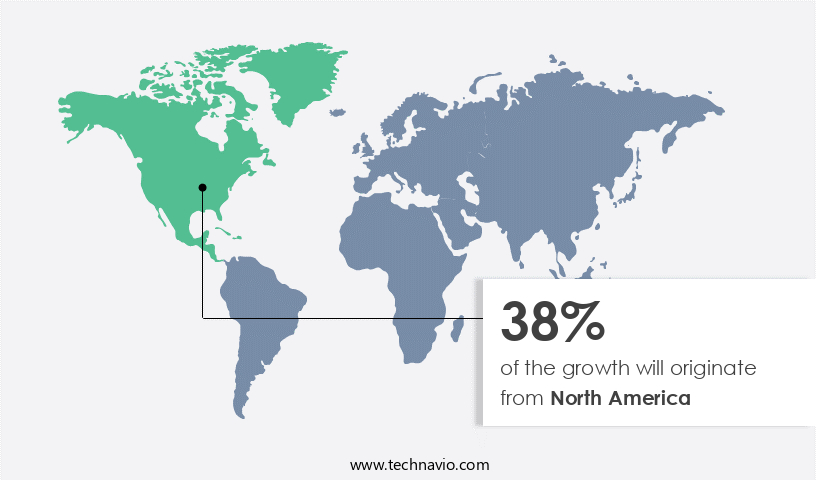
North America is estimated to contribute 38% to the growth of the global market during the forecast period. Technavio's analysts have elaborately explained the regional trends and drivers that shape the market during the forecast period.
For more insights on the market share of various regions Request Free Sample
In North America, the market experienced significant growth in 2023, accounting for the largest share of the global market. The tide in e-commerce and online shopping has driven the demand for micro fulfillment solutions in this region. With North American consumers increasingly opting for online purchases, retailers are seeking efficient and cost-effective methods for order fulfillment. The adoption of online grocery shopping saw a notable increase, especially during the COVID-19 pandemic. Micro fulfillment centers have proven particularly effective in managing the unique challenges of perishable product handling in this sector. The trend toward fast delivery, with options for same-day and next-day services, has intensified consumer demand for micro fulfillment.
Our researchers analyzed the data with 2023 as the base year, along with the key drivers, trends, and challenges. A holistic analysis of drivers will help companies refine their marketing strategies to gain a competitive advantage.
Market Driver
Increasing demand for micro fulfillment due to urbanization is the key driver of the market. In today's urbanized world, the demand for micro fulfillment solutions is on the rise. As population growth in cities continues, traditional retailers are adapting to omnichannel strategies to meet consumer expectations for faster and more efficient order fulfillment. Micro fulfillment centers, equipped with advanced robotics and software, are strategically located near end-users to minimize the distance products travel during the last mile of delivery. This proximity is crucial in densely populated areas, where heavy traffic congestion can make deliveries challenging and time-consuming. By positioning fulfillment centers closer to consumers, retailers can offer quicker and more reliable deliveries, enhancing customer engagement and satisfaction.
Micro fulfillment centers are an essential investment for retailers seeking to remain competitive in the market, despite the upfront costs associated with suitable facilities and technology.
Market Trends
Strong e-commerce growth boosting the micro fulfillment market is the upcoming trend in the market. Micro fulfillment centers have gained popularity in the US retail sector due to the wave in e-commerce sales and the need for swift order delivery to customers. These centers, designed to efficiently manage small-scale inventory and order processing, are strategically located in urban areas to minimize delivery times. The advanced automation systems employed in micro fulfillment centers enable them to effectively handle the fluctuating demand patterns characteristic of e-commerce businesses. Operational costs are a significant concern for e-commerce retailers, and micro fulfillment centers offer a cost-effective solution. Safety measures are prioritized in these centers to ensure the secure handling of inventory and the safety of employees.
The components of micro fulfillment systems are customizable and scalable, allowing businesses to tailor their operations to their specific needs. Consulting services are available to help businesses optimize their micro fulfillment operations, from designing operational workflows to implementing specialized knowledge in automation and robotics. The flexibility of micro fulfillment centers enables businesses to expand or contract their operations as needed to efficiently handle peak seasons and promotional periods. Overall, micro fulfillment centers are a valuable investment for e-commerce businesses seeking to streamline their order fulfillment processes and enhance customer satisfaction.
Market Challenge
High initial investment associated with micro fulfillment is a key challenge affecting the market growth. Micro fulfillment centers, a growing trend in logistics and supply chain management, utilize advanced technology such as racking systems, conveyor belts, sorting systems, software solutions, and hardware infrastructure. Retailers are increasingly adopting these centers to streamline their operations and reduce costs in the face of budget cuts. However, the high initial investment required for implementing these systems poses a significant challenge. Automated storage and retrieval systems (AS/RS), robotics, conveyor belts, and sorting equipment are essential components of micro fulfillment centers, but they come with substantial upfront costs. The complexity of the chosen automation solutions also influences the overall investment. Construction or renovation of a facility to accommodate the equipment and meet operational requirements can be expensive, involving costs for leasing or purchasing the facility, infrastructure improvements (such as electrical systems and HVAC), and potential software licensing fees.
Exclusive Customer Landscape
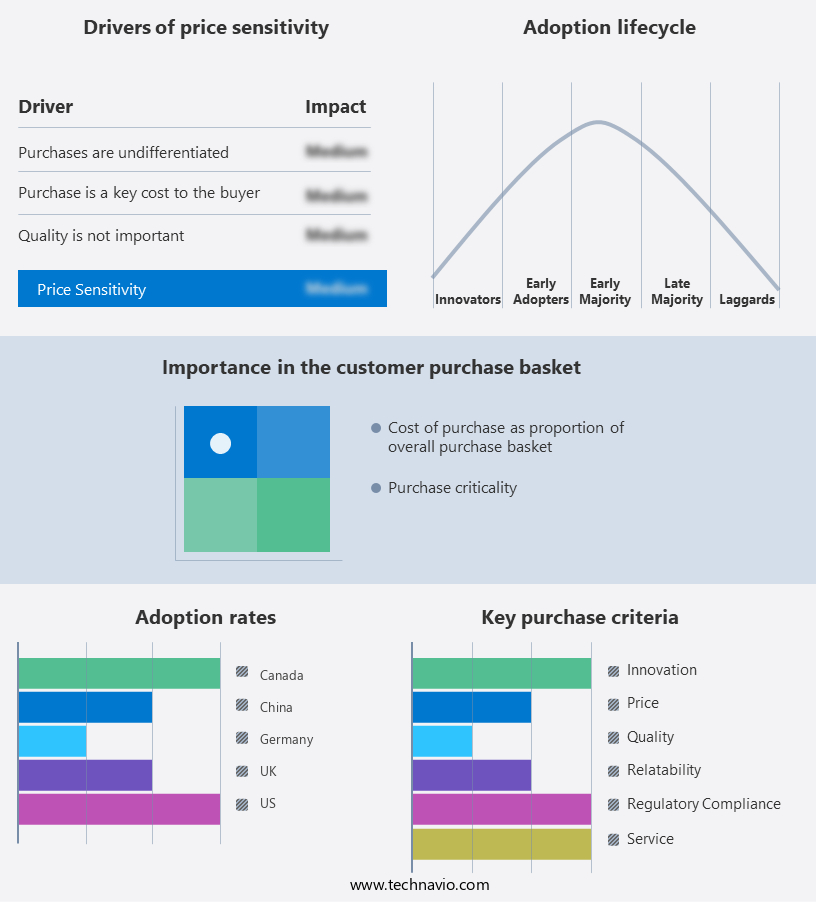
The market forecasting report includes the adoption lifecycle of the market, covering from the innovator's stage to the laggard's stage. It focuses on adoption rates in different regions based on penetration. Furthermore, the report also includes key purchase criteria and drivers of price sensitivity to help companies evaluate and develop their market growth analysis strategies.
Customer Landscape
Key Companies & Market Insights
Companies are implementing various strategies, such as strategic alliances, partnerships, mergers and acquisitions, geographical expansion, and product/service launches, to enhance their presence in the market.
Toyota Motor Corp.: The company offers micro fulfillment for grocery micro-fulfillment stores and same day delivery, through its subsidiary called BASTIAN SOLUTIONS, LLC.
The market research and growth report includes detailed analyses of the competitive landscape of the market and information about key companies, including:
- Attabotics
- DAVINCI MICRO FULFILLMENT
- Flowspace Inc.
- FORTNA Inc.
- Get Fabric Inc.
- Honeywell International Inc.
- KION GROUP AG
- KPI Solutions
- Logistech Solutions Pte. Ltd.
- Ocado Group Plc
- OPEX Corp.
- PackageX Inc.
- Pacline Conveyors Inc.
- Redwood Logistics
- Takeoff Technologies Inc.
- TGW LOGISTICS GROUP GmbH
- United Parcel Service Inc.
- Walmart Inc.
- WareIQ Pvt. Ltd.
Qualitative and quantitative analysis of companies has been conducted to help clients understand the wider business environment as well as the strengths and weaknesses of key market players. Data is qualitatively analyzed to categorize companies as pure play, category-focused, industry-focused, and diversified; it is quantitatively analyzed to categorize companies as dominant, leading, strong, tentative, and weak.
Research Analyst Overview
Micro fulfillment, a game-changer in logistics and distribution, is revolutionizing the retail industry with the integration of robotics and advanced software. Omnichannel strategies have pushed traditional retailers to rethink their approaches to customer engagement, leading to the adoption of micro fulfillment in small warehouses and distribution facilities. Robotic technology, a key component of micro fulfillment, automates material handling and order fulfillment, reducing operational costs and enhancing efficiency. Hardware infrastructure includes racking systems, conveyor belts, and sorting systems, which optimize space utilization and improve picking lists' accuracy. Software solutions manage communication protocols, control systems, and operational workflows, ensuring seamless integration with ecommerce platforms and enabling real-time inventory management.
Further, upfront investment in micro fulfillment centers can be cost-saving measures for retailers, offsetting budget cuts in other areas. Micro fulfillment centers can be standalone facilities or integrated into residential complexes, making them suitable for various industries, including grocery and merchandise. Robotics and automation enable scalability and flexibility, allowing retailers to adapt to fluctuations in demand and ecommerce niches. Safety measures are essential in micro fulfillment, ensuring the safety of components and employees. Technology companies are addressing ecological footprint concerns by developing eco-friendly solutions, such as electric delivery vehicles and last-mile emissions reduction strategies. Perishable products, vaccines, and last-mile delivery require specialized knowledge and consulting services to optimize micro fulfillment operations.
|
Market Scope |
|
|
Report Coverage |
Details |
|
Page number |
168 |
|
Base year |
2023 |
|
Historic period |
2018-2022 |
|
Forecast period |
2024-2028 |
|
Growth momentum & CAGR |
Accelerate at a CAGR of 68.33% |
|
Market growth 2024-2028 |
USD 67.31 billion |
|
Market structure |
Fragmented |
|
YoY growth 2023-2024(%) |
51.29 |
|
Regional analysis |
North America, Europe, APAC, Middle East and Africa, and South America |
|
Performing market contribution |
North America at 38% |
|
Key countries |
US, UK, China, Germany, and Canada |
|
Competitive landscape |
Leading Companies, Market Positioning of Companies, Competitive Strategies, and Industry Risks |
|
Key companies profiled |
Attabotics, DAVINCI MICRO FULFILLMENT, Flowspace Inc., FORTNA Inc., Get Fabric Inc., Honeywell International Inc., KION GROUP AG, KPI Solutions, Logistech Solutions Pte. Ltd., Ocado Group Plc, OPEX Corp., PackageX Inc., Pacline Conveyors Inc., Redwood Logistics, Takeoff Technologies Inc., TGW LOGISTICS GROUP GmbH, Toyota Motor Corp., United Parcel Service Inc., Walmart Inc., and WareIQ Pvt. Ltd. |
|
Market dynamics |
Parent market analysis, market growth inducers and obstacles, market forecast, fast-growing and slow-growing segment analysis, COVID-19 impact and recovery analysis and future consumer dynamics, market condition analysis for the forecast period |
|
Customization purview |
If our market report has not included the data that you are looking for, you can reach out to our analysts and get segments customized. |
What are the Key Data Covered in this Market Research and Growth Report?
- CAGR of the market during the forecast period
- Detailed information on factors that will drive the market growth and forecasting between 2024 and 2028
- Precise estimation of the size of the market and its contribution of the market in focus to the parent market
- Accurate predictions about upcoming market growth and trends and changes in consumer behaviour
- Growth of the market across North America, Europe, APAC, Middle East and Africa, and South America
- Thorough analysis of the market's competitive landscape and detailed information about companies
- Comprehensive analysis of factors that will challenge the growth of market companies
We can help! Our analysts can customize this market research report to meet your requirements. Get in touch
 RIA -
RIA - 
