
Neural Processor Market Analysis, Size, and Forecast 2026-2030: North America (US, Canada, and Mexico), APAC (China, Japan, and India), Europe (Germany, UK, and France), Middle East and Africa (UAE, Israel, and Saudi Arabia), South America (Brazil, Argentina, and Colombia), and Rest of World (ROW)

Neural Processor Market Analysis, Size, and Forecast 2026-2030:
North America (US, Canada, and Mexico), APAC (China, Japan, and India), Europe (Germany, UK, and France), Middle East and Africa (UAE, Israel, and Saudi Arabia), South America (Brazil, Argentina, and Colombia), and Rest of World (ROW)

Published: Apr 2026 313 Pages SKU: IRTNTR81399

Market Overview at a Glance

$272.06 Mn
Market Opportunity
20.2%
CAGR 2025 - 2030
32.6%
APAC Growth
$89.65 Mn
Cloud based processing segment 2024

Neural Processor Market Size 2026-2030

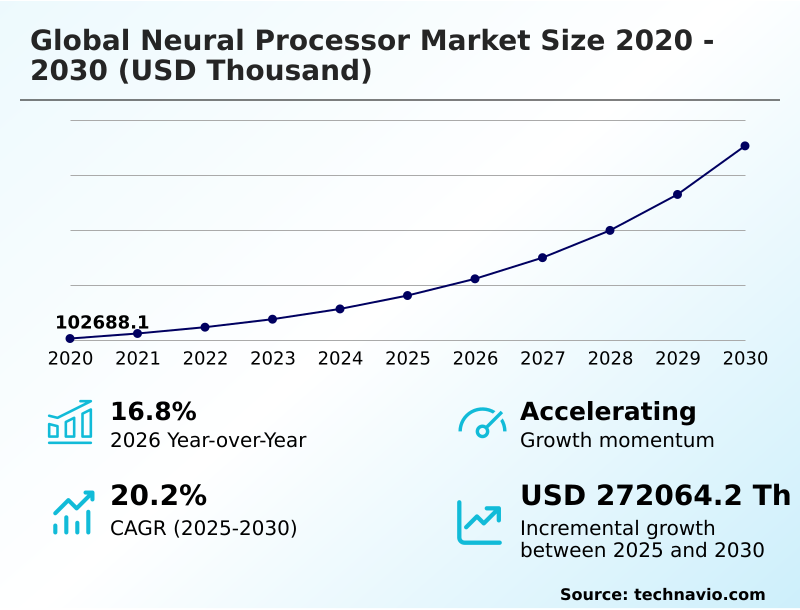
The neural processor market size is valued to increase by USD 272.06 million, at a CAGR of 20.2% from 2025 to 2030. Escalating demand for edge computing capabilities will drive the neural processor market.

Major Market Trends & Insights

  • APAC dominated the market and accounted for a 32.6% growth during the forecast period.
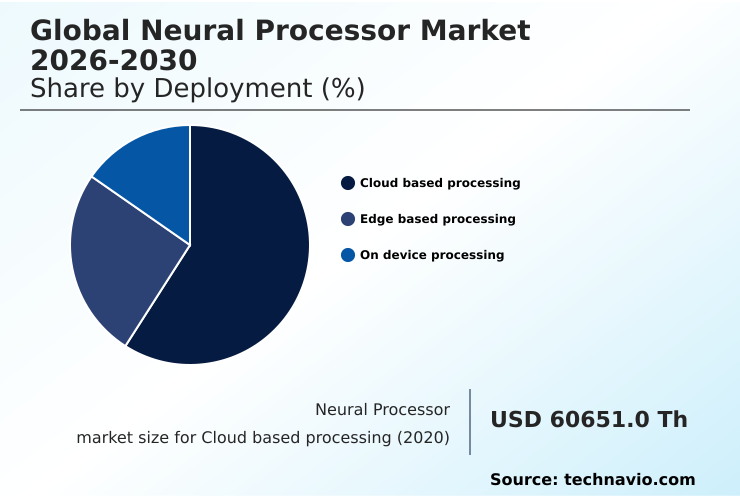
  • By Deployment - Cloud based processing segment was valued at USD 89.65 million in 2024
  • By End-user - Consumer electronics segment accounted for the largest market revenue share in 2024

Market Size & Forecast

  • Market Opportunities:
  • Market Future Opportunities: USD 272.06 million
  • CAGR from 2025 to 2030 : 20.2%

Market Summary

  • The neural processor market is undergoing significant expansion, fueled by the escalating integration of AI across industries. This growth is propelled by the increasing need for specialized hardware capable of efficiently executing complex computational tasks.
  • Key drivers include the proliferation of edge computing, which requires localized data processing for applications like industrial automation and autonomous vehicles, and the surge in AI-powered features within consumer electronics. Market trends are shifting toward novel designs such as neuromorphic and photonic architectures to overcome the power and latency limitations of traditional silicon.
  • For instance, a logistics company might deploy edge devices with neural processors for real-time route optimization, reducing fuel consumption and delivery times without constant cloud dependency. However, the market's trajectory is moderated by substantial challenges, including the immense capital investment required for semiconductor fabrication and the rapid pace of algorithmic evolution, which can quickly render specialized hardware obsolete.
  • Navigating this dynamic landscape requires a strategic balance between performance optimization and architectural flexibility. The continuous innovation in AI-specific silicon, including advancements in on-chip AI and inference acceleration, ensures that these processors remain fundamental to future technological progress, enabling sophisticated capabilities from natural language processing to advanced computer vision.

What will be the Size of the Neural Processor Market during the forecast period?

Get Key Insights on Market Forecast (PDF) Request Free Sample

How is the Neural Processor Market Segmented?

The neural processor industry research report provides comprehensive data (region-wise segment analysis), with forecasts and estimates in "USD thousand" for the period 2026-2030, as well as historical data from 2020-2024 for the following segments.

  • Deployment
    • Cloud based processing
    • Edge based processing
    • On device processing
  • End-user
    • Consumer electronics
    • Automotive
    • IT and telecom
    • Industrial automation
    • Healthcare
  • Application
    • Computer vision
    • Natural language processing
    • Autonomous systems
    • Speech recognition
  • Geography
    • North America
      • US
      • Canada
      • Mexico
    • APAC
      • China
      • Japan
      • India
    • Europe
      • Germany
      • UK
      • France
    • Middle East and Africa
      • UAE
      • Israel
      • Saudi Arabia
    • South America
      • Brazil
      • Argentina
      • Colombia
    • Rest of World (ROW)

By Deployment Insights

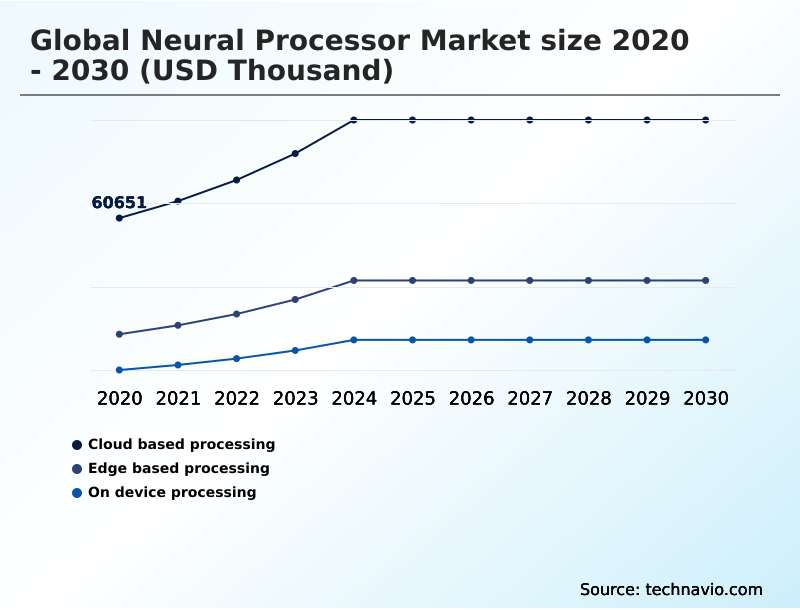
The cloud based processing segment is estimated to witness significant growth during the forecast period.

Cloud-based processing remains integral for enterprises, facilitating the training of massive artificial neural networks and machine learning algorithms that demand extensive computational resources.

This model excels in handling petabytes of data for complex tasks like generative AI development, where custom silicon and wafer-scale engine deployments in data centers reduce model training cycles by over 40%.

The architecture relies on clusters of specialized hardware, including data center accelerator chips, to perform tensor operations and optimize memory bandwidth optimization.

While offering immense scalability for enterprise computing, inherent latency makes it less suitable for mission-critical applications requiring real-time data interpretation. The approach supports high-frequency trading and genomic sequencing but presents supply chain vulnerabilities tied to hardware access.

Request Free Sample

The Cloud based processing segment was valued at USD 89.65 million in 2024 and showed a gradual increase during the forecast period.
Request Free Sample

Regional Analysis

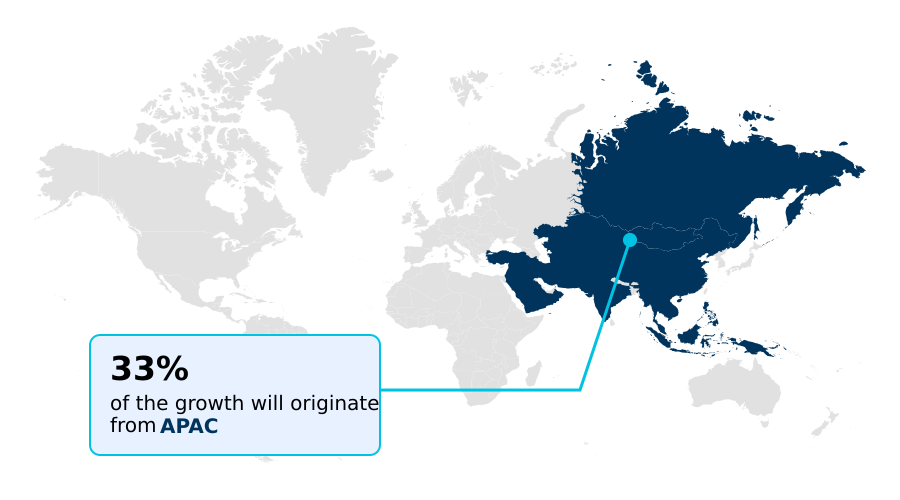
APAC is estimated to contribute 32.6% to the growth of the global market during the forecast period.Technavio’s analysts have elaborately explained the regional trends and drivers that shape the market during the forecast period.

See How Neural Processor Market Demand is Rising in APAC Request Free Sample

The global landscape is characterized by distinct regional dynamics and technological specializations.

The APAC region is projected to account for over 32% of the market's incremental growth, driven by its dominance in semiconductor fabrication and massive domestic demand for consumer electronics featuring on-chip AI.

Meanwhile, North America leads in innovation, with its concentration of hyperscale data centers pioneering the development of tensor processing units and driving advancements in cloud-based processing.

The region's focus on autonomous systems and AI hardware has spurred significant investment in domestic manufacturing.

In Europe, the emphasis on industrial automation and stringent data privacy regulations has accelerated the adoption of edge AI hardware, with deployments in smart factories achieving a 15% reduction in production errors through automated quality control and predictive maintenance.

Market Dynamics

Our researchers analyzed the data with 2025 as the base year, along with the key drivers, trends, and challenges. A holistic analysis of drivers will help companies refine their marketing strategies to gain a competitive advantage.

  • The strategic deployment of specialized hardware is becoming critical for achieving competitive advantages across various sectors. Optimizing AI workloads with NPUs is no longer a niche concern but a central pillar of digital transformation.
  • The development of energy-efficient neural processing units enables powerful AI acceleration in consumer electronics, where balancing performance and power in AI chips is paramount for battery life and user experience. In large-scale enterprise environments, neuromorphic computing for data centers and the exploration of photonic interconnects for AI hardware are addressing critical bottlenecks in data-intensive applications.
  • Similarly, the hardware requirements for transformer models are pushing the boundaries of chip design, with a focus on custom silicon for AI workloads to handle large language model hardware acceleration efficiently. For industrial applications, the focus is on AI hardware for predictive maintenance and real-time computer vision processing, where low-latency inference on device is crucial.
  • These autonomous systems processing requirements demand robust solutions, and deploying AI models on edge devices helps meet these needs locally. As the industry matures, the focus shifts toward overcoming challenges in neural processor manufacturing and defining the future of AI-specific integrated circuits, including advancements in neural network acceleration on chip and on-device natural language processing.
  • For instance, shifting certain AI tasks from the cloud to the device can reduce operational data transfer costs by more than 50% in distributed fleet management systems.

What are the key market drivers leading to the rise in the adoption of Neural Processor Industry?

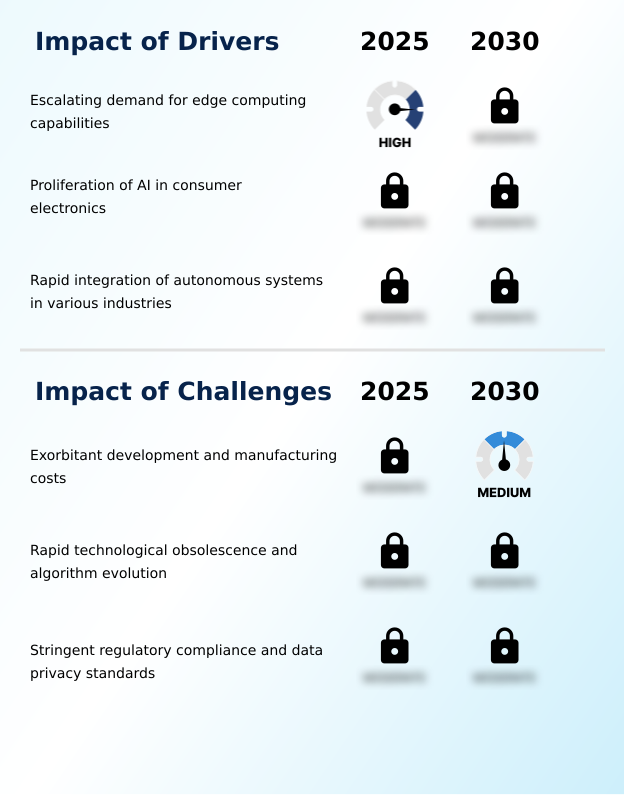
  • The escalating demand for edge computing capabilities is a key driver of market growth.

  • Market growth is fundamentally driven by the expanding need for localized, real-time intelligence. The proliferation of edge computing is a primary catalyst, as applications in smart grid management and industrial automation cannot tolerate cloud latency.
  • Deploying edge-based processing solutions with neural hardware has been shown to reduce decision latency by over 95% compared to round-trip cloud communication.
  • In parallel, the consumer electronics sector is embedding advanced neural processors for tasks like augmented reality and computational photography, which has improved battery efficiency for AI-intensive operations by up to 20%.
  • The rapid integration of autonomous systems, ranging from robotic manufacturing to autonomous navigation, further fuels demand for powerful, on-device hardware capable of spatial awareness algorithms and split-second decision-making.

What are the market trends shaping the Neural Processor Industry?

  • The accelerated adoption of neuromorphic engineering and energy-proportional architectures is emerging as a significant market trend, driven by the need for more efficient processing.

  • Key market trends are reshaping the fundamental architecture of processing hardware. The accelerated adoption of neuromorphic engineering and energy-proportional architectures is a direct response to the unsustainable power consumption of traditional data centers, with early deployments demonstrating a potential 50% reduction in energy usage for comparable workloads.
  • Simultaneously, the emergence of photonic neural networks and optical interconnects promises to eliminate data transfer bottlenecks, with silicon photonics enabling a tenfold increase in inter-chip bandwidth. This is critical for next-generation AI models.
  • In specialized sectors like healthcare, the integration of advanced neural processing units into diagnostic equipment is enhancing predictive patient care, while digital assistants and biometric facial recognition are becoming standard in enterprise computing.

What challenges does the Neural Processor Industry face during its growth?

  • Exorbitant development and manufacturing costs represent a key challenge affecting the industry's growth trajectory.

  • Navigating the market's challenges requires significant strategic foresight and capital investment. The exorbitant cost of advanced semiconductor fabrication creates high barriers to entry, while the relentless pace of algorithmic evolution introduces substantial risk.
  • For example, a custom-designed application-specific integrated circuit optimized for today's deep learning networks may become inefficient for transformer models, with the rapid hardware obsolescence cycle now shrinking to as little as 18 months.
  • Furthermore, adhering to a fragmented landscape of global data privacy regulations can increase development overhead by more than 25% for companies creating hardware for both on-device processing and cloud deployments. These factors, combined with ongoing supply chain vulnerabilities and the complexity of creating language processing units and reconfigurable dataflow units, temper the market's otherwise explosive growth potential.

Exclusive Technavio Analysis on Customer Landscape

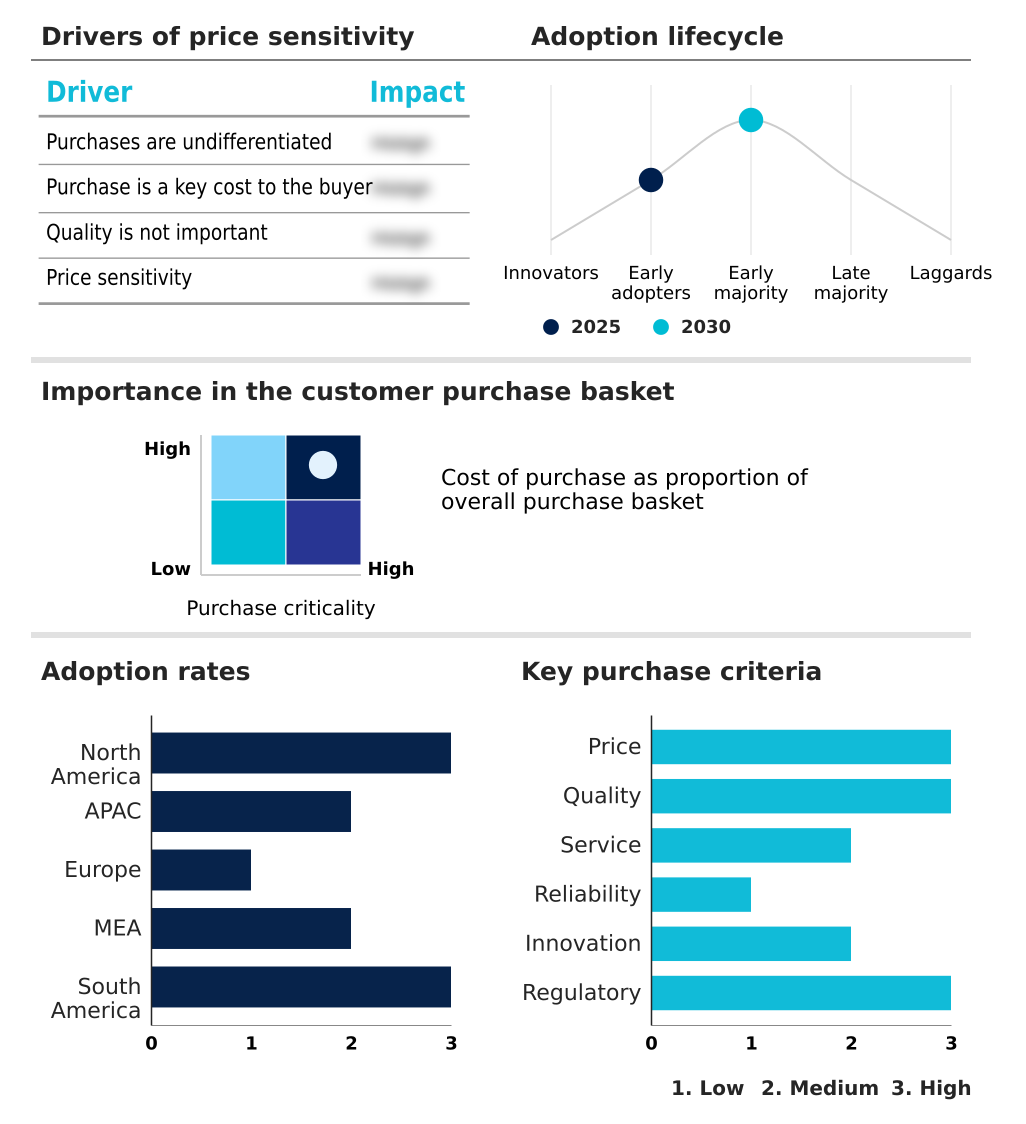
The neural processor market forecasting report includes the adoption lifecycle of the market, covering from the innovator’s stage to the laggard’s stage. It focuses on adoption rates in different regions based on penetration. Furthermore, the neural processor market report also includes key purchase criteria and drivers of price sensitivity to help companies evaluate and develop their market growth analysis strategies.
Customer Landscape of Neural Processor Industry

Competitive Landscape

Companies are implementing various strategies, such as strategic alliances, neural processor market forecast, partnerships, mergers and acquisitions, geographical expansion, and product/service launches, to enhance their presence in the industry.

Advanced Micro Devices Inc. - Specialized silicon designs, from custom ASICs to integrated neural processing units, are accelerating AI workloads across cloud, edge, and on-device deployments to enhance computational efficiency.

The industry research and growth report includes detailed analyses of the competitive landscape of the market and information about key companies, including:

  • Advanced Micro Devices Inc.
  • Amazon.com Inc.
  • Apple Inc.
  • Arm Ltd.
  • Broadcom Inc.
  • Cerebras Systems Inc.
  • Google LLC
  • Groq Inc.
  • Hailo Technologies Ltd.
  • Huawei Technologies Co. Ltd.
  • Intel Corp.
  • Marvell Technology Inc.
  • MediaTek Inc.
  • Meta Platforms Inc.
  • Microsoft Corp.
  • NVIDIA Corp.
  • Qualcomm Inc.
  • SambaNova Systems Inc.
  • Samsung Electronics Co. Ltd.
  • Tenstorrent Inc.

Qualitative and quantitative analysis of companies has been conducted to help clients understand the wider business environment as well as the strengths and weaknesses of key industry players. Data is qualitatively analyzed to categorize companies as pure play, category-focused, industry-focused, and diversified; it is quantitatively analyzed to categorize companies as dominant, leading, strong, tentative, and weak.

Recent Development and News in Neural processor market

  • In January 2025, Advanced Micro Devices Inc. introduced its Ryzen AI 300 series processors, integrating the second-generation XDNA architecture to deliver over 50 TOPS of AI compute for next-generation AI-enabled laptops.
  • In October 2024, NVIDIA Corp. announced a major collaboration with a leading automotive consortium to deploy its Blackwell neural processors in the development of a shared Level 4 autonomous driving platform.
  • In April 2025, Google LLC revealed the next generation of its Tensor Processing Units (TPUs), featuring a significant architecture overhaul with integrated optical interconnects to drastically reduce latency in large-scale language model training within its cloud infrastructure.
  • In September 2024, Intel Corp. received substantial government funding under a new domestic manufacturing initiative to expand its fabrication facilities for producing advanced 3-nanometer neural processors, aiming to strengthen the national semiconductor supply chain.

Dive into Technavio’s robust research methodology, blending expert interviews, extensive data synthesis, and validated models for unparalleled Neural Processor Market insights. See full methodology.

Market Scope
Page number 313
Base year 2025
Historic period 2020-2024
Forecast period 2026-2030
Growth momentum & CAGR Accelerate at a CAGR of 20.2%
Market growth 2026-2030 USD 272064.2 thousand
Market structure Fragmented
YoY growth 2025-2026(%) 16.8%
Key countries US, Canada, Mexico, China, Japan, India, South Korea, Australia, Indonesia, Germany, UK, France, Italy, Spain, The Netherlands, UAE, Israel, Saudi Arabia, South Africa, Turkey, Brazil, Argentina and Colombia
Competitive landscape Leading Companies, Market Positioning of Companies, Competitive Strategies, and Industry Risks

Request Free Sample

Research Analyst Overview

  • The neural processor market's evolution is defined by a rapid and continuous cycle of innovation, compelling enterprises to navigate a complex technological landscape. The shift toward transformer models and large language architectures is forcing a strategic re-evaluation at the boardroom level regarding long-term investment in application-specific integrated circuits versus more flexible hardware.
  • This dynamic is fueled by the development of sophisticated AI-specific silicon, including specialized AI cores and system-on-a-chip (SoC) NPU designs that deliver unprecedented performance. These architectures, leveraging parallel computing paradigms and low-precision computing, are essential for tackling workloads in computer vision, speech recognition, and autonomous systems.
  • Advanced designs focusing on memory bandwidth optimization are enabling hardware acceleration for both training and inference acceleration. As a result, companies deploying the latest neural processing unit technology are reporting performance gains of up to 10x on specific machine learning algorithms compared to general-purpose hardware. This performance gap underscores the critical importance of specialized silicon in maintaining a competitive edge.

What are the Key Data Covered in this Neural Processor Market Research and Growth Report?

  • What is the expected growth of the Neural Processor Market between 2026 and 2030?

    • USD 272.06 million, at a CAGR of 20.2%

  • What segmentation does the market report cover?

    • The report is segmented by Deployment (Cloud based processing, Edge based processing, and On device processing), End-user (Consumer electronics, Automotive, IT and telecom, Industrial automation, and Healthcare), Application (Computer vision, Natural language processing, Autonomous systems, and Speech recognition) and Geography (North America, APAC, Europe, Middle East and Africa, South America)

  • Which regions are analyzed in the report?

    • North America, APAC, Europe, Middle East and Africa and South America

  • What are the key growth drivers and market challenges?

    • Escalating demand for edge computing capabilities, Exorbitant development and manufacturing costs

  • Who are the major players in the Neural Processor Market?

    • Advanced Micro Devices Inc., Amazon.com Inc., Apple Inc., Arm Ltd., Broadcom Inc., Cerebras Systems Inc., Google LLC, Groq Inc., Hailo Technologies Ltd., Huawei Technologies Co. Ltd., Intel Corp., Marvell Technology Inc., MediaTek Inc., Meta Platforms Inc., Microsoft Corp., NVIDIA Corp., Qualcomm Inc., SambaNova Systems Inc., Samsung Electronics Co. Ltd. and Tenstorrent Inc.

Market Research Insights

  • The market is shaped by a dynamic interplay between performance demands and deployment environments. The push for edge computing in smart city infrastructure and industrial automation necessitates hardware that balances high throughput with low power consumption. This has led to architectural innovations delivering up to a 40% improvement in energy efficiency for edge-based processing compared to previous generations.
  • In parallel, on-device processing for applications like computational photography and conversational AI in consumer electronics is driving the integration of highly specialized cores into system-on-a-chip designs, enhancing user experience by reducing latency by over 90% for real-time tasks. The requirements for next-generation cellular networks and remote healthcare monitoring are also influencing designs, prioritizing reliable, low-latency connectivity and data interpretation.

We can help! Our analysts can customize this neural processor market research report to meet your requirements.

Get in touch

1. Executive Summary

1.1 Market overview

Executive Summary - Chart on Market Overview
Executive Summary - Data Table on Market Overview
Executive Summary - Chart on Global Market Characteristics
Executive Summary - Chart on Market by Geography
Executive Summary - Chart on Market Segmentation by Deployment
Executive Summary - Chart on Market Segmentation by End-user
Executive Summary - Chart on Market Segmentation by Application
Executive Summary - Chart on Incremental Growth
Executive Summary - Data Table on Incremental Growth
Executive Summary - Chart on Company Market Positioning

2. Technavio Analysis

2.1 Analysis of price sensitivity, lifecycle, customer purchase basket, adoption rates, and purchase criteria

2.2 Criticality of inputs and Factors of differentiation

Chart on Overview on criticality of inputs and factors of differentiation

2.3 Factors of disruption

Chart on Overview on factors of disruption

2.4 Impact of drivers and challenges

Chart on Impact of drivers and challenges in 2025 and 2030

3. Market Landscape

3.1 Market ecosystem

Chart on Parent Market
Data Table on - Parent Market

3.2 Market characteristics

Chart on Market characteristics analysis

3.3 Value chain analysis

Chart on Value chain analysis

4. Market Sizing

4.1 Market definition

Data Table on Offerings of companies included in the market definition

4.2 Market segment analysis

Market segments

4.3 Market size 2025

4.4 Market outlook: Forecast for 2025-2030

Chart on Global - Market size and forecast 2025-2030 ($ thousand)
Data Table on Global - Market size and forecast 2025-2030 ($ thousand)
Chart on Global Market: Year-over-year growth 2025-2030 (%)
Data Table on Global Market: Year-over-year growth 2025-2030 (%)

5. Historic Market Size

5.1 Global Neural Processor Market 2020 - 2024

Historic Market Size - Data Table on Global Neural Processor Market 2020 - 2024 ($ thousand)

5.2 Deployment segment analysis 2020 - 2024

Historic Market Size - Deployment Segment 2020 - 2024 ($ thousand)

5.3 End-user segment analysis 2020 - 2024

Historic Market Size - End-user Segment 2020 - 2024 ($ thousand)

5.4 Application segment analysis 2020 - 2024

Historic Market Size - Application Segment 2020 - 2024 ($ thousand)

5.5 Geography segment analysis 2020 - 2024

Historic Market Size - Geography Segment 2020 - 2024 ($ thousand)

5.6 Country segment analysis 2020 - 2024

Historic Market Size - Country Segment 2020 - 2024 ($ thousand)

6. Qualitative Analysis

6.1 Impact of AI on Global Neural Processor Market

6.2 Impact of Geopolitical Conflicts on Global Neural Processor Market

7. Five Forces Analysis

7.1 Five forces summary

Five forces analysis - Comparison between 2025 and 2030

7.2 Bargaining power of buyers

Bargaining power of buyers - Impact of key factors 2025 and 2030

7.3 Bargaining power of suppliers

Bargaining power of suppliers - Impact of key factors in 2025 and 2030

7.4 Threat of new entrants

Threat of new entrants - Impact of key factors in 2025 and 2030

7.5 Threat of substitutes

Threat of substitutes - Impact of key factors in 2025 and 2030

7.6 Threat of rivalry

Threat of rivalry - Impact of key factors in 2025 and 2030

7.7 Market condition

Chart on Market condition - Five forces 2025 and 2030

8. Market Segmentation by Deployment

8.1 Market segments

Chart on Deployment - Market share 2025-2030 (%)
Data Table on Deployment - Market share 2025-2030 (%)

8.2 Comparison by Deployment

Chart on Comparison by Deployment
Data Table on Comparison by Deployment

8.3 Cloud based processing - Market size and forecast 2025-2030

Chart on Cloud based processing - Market size and forecast 2025-2030 ($ thousand)
Data Table on Cloud based processing - Market size and forecast 2025-2030 ($ thousand)
Chart on Cloud based processing - Year-over-year growth 2025-2030 (%)
Data Table on Cloud based processing - Year-over-year growth 2025-2030 (%)

8.4 Edge based processing - Market size and forecast 2025-2030

Chart on Edge based processing - Market size and forecast 2025-2030 ($ thousand)
Data Table on Edge based processing - Market size and forecast 2025-2030 ($ thousand)
Chart on Edge based processing - Year-over-year growth 2025-2030 (%)
Data Table on Edge based processing - Year-over-year growth 2025-2030 (%)

8.5 On device processing - Market size and forecast 2025-2030

Chart on On device processing - Market size and forecast 2025-2030 ($ thousand)
Data Table on On device processing - Market size and forecast 2025-2030 ($ thousand)
Chart on On device processing - Year-over-year growth 2025-2030 (%)
Data Table on On device processing - Year-over-year growth 2025-2030 (%)

8.6 Market opportunity by Deployment

Market opportunity by Deployment ($ thousand)
Data Table on Market opportunity by Deployment ($ thousand)

9. Market Segmentation by End-user

9.1 Market segments

Chart on End-user - Market share 2025-2030 (%)
Data Table on End-user - Market share 2025-2030 (%)

9.2 Comparison by End-user

Chart on Comparison by End-user
Data Table on Comparison by End-user

9.3 Consumer electronics - Market size and forecast 2025-2030

Chart on Consumer electronics - Market size and forecast 2025-2030 ($ thousand)
Data Table on Consumer electronics - Market size and forecast 2025-2030 ($ thousand)
Chart on Consumer electronics - Year-over-year growth 2025-2030 (%)
Data Table on Consumer electronics - Year-over-year growth 2025-2030 (%)

9.4 Automotive - Market size and forecast 2025-2030

Chart on Automotive - Market size and forecast 2025-2030 ($ thousand)
Data Table on Automotive - Market size and forecast 2025-2030 ($ thousand)
Chart on Automotive - Year-over-year growth 2025-2030 (%)
Data Table on Automotive - Year-over-year growth 2025-2030 (%)

9.5 IT and telecom - Market size and forecast 2025-2030

Chart on IT and telecom - Market size and forecast 2025-2030 ($ thousand)
Data Table on IT and telecom - Market size and forecast 2025-2030 ($ thousand)
Chart on IT and telecom - Year-over-year growth 2025-2030 (%)
Data Table on IT and telecom - Year-over-year growth 2025-2030 (%)

9.6 Industrial automation - Market size and forecast 2025-2030

Chart on Industrial automation - Market size and forecast 2025-2030 ($ thousand)
Data Table on Industrial automation - Market size and forecast 2025-2030 ($ thousand)
Chart on Industrial automation - Year-over-year growth 2025-2030 (%)
Data Table on Industrial automation - Year-over-year growth 2025-2030 (%)

9.7 Healthcare - Market size and forecast 2025-2030

Chart on Healthcare - Market size and forecast 2025-2030 ($ thousand)
Data Table on Healthcare - Market size and forecast 2025-2030 ($ thousand)
Chart on Healthcare - Year-over-year growth 2025-2030 (%)
Data Table on Healthcare - Year-over-year growth 2025-2030 (%)

9.8 Market opportunity by End-user

Market opportunity by End-user ($ thousand)
Data Table on Market opportunity by End-user ($ thousand)

10. Market Segmentation by Application

10.1 Market segments

Chart on Application - Market share 2025-2030 (%)
Data Table on Application - Market share 2025-2030 (%)

10.2 Comparison by Application

Chart on Comparison by Application
Data Table on Comparison by Application

10.3 Computer vision - Market size and forecast 2025-2030

Chart on Computer vision - Market size and forecast 2025-2030 ($ thousand)
Data Table on Computer vision - Market size and forecast 2025-2030 ($ thousand)
Chart on Computer vision - Year-over-year growth 2025-2030 (%)
Data Table on Computer vision - Year-over-year growth 2025-2030 (%)

10.4 Natural language processing - Market size and forecast 2025-2030

Chart on Natural language processing - Market size and forecast 2025-2030 ($ thousand)
Data Table on Natural language processing - Market size and forecast 2025-2030 ($ thousand)
Chart on Natural language processing - Year-over-year growth 2025-2030 (%)
Data Table on Natural language processing - Year-over-year growth 2025-2030 (%)

10.5 Autonomous systems - Market size and forecast 2025-2030

Chart on Autonomous systems - Market size and forecast 2025-2030 ($ thousand)
Data Table on Autonomous systems - Market size and forecast 2025-2030 ($ thousand)
Chart on Autonomous systems - Year-over-year growth 2025-2030 (%)
Data Table on Autonomous systems - Year-over-year growth 2025-2030 (%)

10.6 Speech recognition - Market size and forecast 2025-2030

Chart on Speech recognition - Market size and forecast 2025-2030 ($ thousand)
Data Table on Speech recognition - Market size and forecast 2025-2030 ($ thousand)
Chart on Speech recognition - Year-over-year growth 2025-2030 (%)
Data Table on Speech recognition - Year-over-year growth 2025-2030 (%)

10.7 Market opportunity by Application

Market opportunity by Application ($ thousand)
Data Table on Market opportunity by Application ($ thousand)

11. Customer Landscape

11.1 Customer landscape overview

Analysis of price sensitivity, lifecycle, customer purchase basket, adoption rates, and purchase criteria

12. Geographic Landscape

12.1 Geographic segmentation

Chart on Market share by geography 2025-2030 (%)
Data Table on Market share by geography 2025-2030 (%)

12.2 Geographic comparison

Chart on Geographic comparison
Data Table on Geographic comparison

12.3 North America - Market size and forecast 2025-2030

Chart on North America - Market size and forecast 2025-2030 ($ thousand)
Data Table on North America - Market size and forecast 2025-2030 ($ thousand)
Chart on North America - Year-over-year growth 2025-2030 (%)
Data Table on North America - Year-over-year growth 2025-2030 (%)
Chart on Regional Comparison - North America
Data Table on Regional Comparison - North America

12.3.1 US - Market size and forecast 2025-2030

Chart on US - Market size and forecast 2025-2030 ($ thousand)
Data Table on US - Market size and forecast 2025-2030 ($ thousand)
Chart on US - Year-over-year growth 2025-2030 (%)
Data Table on US - Year-over-year growth 2025-2030 (%)

12.3.2 Canada - Market size and forecast 2025-2030

Chart on Canada - Market size and forecast 2025-2030 ($ thousand)
Data Table on Canada - Market size and forecast 2025-2030 ($ thousand)
Chart on Canada - Year-over-year growth 2025-2030 (%)
Data Table on Canada - Year-over-year growth 2025-2030 (%)

12.3.3 Mexico - Market size and forecast 2025-2030

Chart on Mexico - Market size and forecast 2025-2030 ($ thousand)
Data Table on Mexico - Market size and forecast 2025-2030 ($ thousand)
Chart on Mexico - Year-over-year growth 2025-2030 (%)
Data Table on Mexico - Year-over-year growth 2025-2030 (%)

12.4 APAC - Market size and forecast 2025-2030

Chart on APAC - Market size and forecast 2025-2030 ($ thousand)
Data Table on APAC - Market size and forecast 2025-2030 ($ thousand)
Chart on APAC - Year-over-year growth 2025-2030 (%)
Data Table on APAC - Year-over-year growth 2025-2030 (%)
Chart on Regional Comparison - APAC
Data Table on Regional Comparison - APAC

12.4.1 China - Market size and forecast 2025-2030

Chart on China - Market size and forecast 2025-2030 ($ thousand)
Data Table on China - Market size and forecast 2025-2030 ($ thousand)
Chart on China - Year-over-year growth 2025-2030 (%)
Data Table on China - Year-over-year growth 2025-2030 (%)

12.4.2 Japan - Market size and forecast 2025-2030

Chart on Japan - Market size and forecast 2025-2030 ($ thousand)
Data Table on Japan - Market size and forecast 2025-2030 ($ thousand)
Chart on Japan - Year-over-year growth 2025-2030 (%)
Data Table on Japan - Year-over-year growth 2025-2030 (%)

12.4.3 India - Market size and forecast 2025-2030

Chart on India - Market size and forecast 2025-2030 ($ thousand)
Data Table on India - Market size and forecast 2025-2030 ($ thousand)
Chart on India - Year-over-year growth 2025-2030 (%)
Data Table on India - Year-over-year growth 2025-2030 (%)

12.4.4 South Korea - Market size and forecast 2025-2030

Chart on South Korea - Market size and forecast 2025-2030 ($ thousand)
Data Table on South Korea - Market size and forecast 2025-2030 ($ thousand)
Chart on South Korea - Year-over-year growth 2025-2030 (%)
Data Table on South Korea - Year-over-year growth 2025-2030 (%)

12.4.5 Australia - Market size and forecast 2025-2030

Chart on Australia - Market size and forecast 2025-2030 ($ thousand)
Data Table on Australia - Market size and forecast 2025-2030 ($ thousand)
Chart on Australia - Year-over-year growth 2025-2030 (%)
Data Table on Australia - Year-over-year growth 2025-2030 (%)

12.4.6 Indonesia - Market size and forecast 2025-2030

Chart on Indonesia - Market size and forecast 2025-2030 ($ thousand)
Data Table on Indonesia - Market size and forecast 2025-2030 ($ thousand)
Chart on Indonesia - Year-over-year growth 2025-2030 (%)
Data Table on Indonesia - Year-over-year growth 2025-2030 (%)

12.5 Europe - Market size and forecast 2025-2030

Chart on Europe - Market size and forecast 2025-2030 ($ thousand)
Data Table on Europe - Market size and forecast 2025-2030 ($ thousand)
Chart on Europe - Year-over-year growth 2025-2030 (%)
Data Table on Europe - Year-over-year growth 2025-2030 (%)
Chart on Regional Comparison - Europe
Data Table on Regional Comparison - Europe

12.5.1 Germany - Market size and forecast 2025-2030

Chart on Germany - Market size and forecast 2025-2030 ($ thousand)
Data Table on Germany - Market size and forecast 2025-2030 ($ thousand)
Chart on Germany - Year-over-year growth 2025-2030 (%)
Data Table on Germany - Year-over-year growth 2025-2030 (%)

12.5.2 UK - Market size and forecast 2025-2030

Chart on UK - Market size and forecast 2025-2030 ($ thousand)
Data Table on UK - Market size and forecast 2025-2030 ($ thousand)
Chart on UK - Year-over-year growth 2025-2030 (%)
Data Table on UK - Year-over-year growth 2025-2030 (%)

12.5.3 France - Market size and forecast 2025-2030

Chart on France - Market size and forecast 2025-2030 ($ thousand)
Data Table on France - Market size and forecast 2025-2030 ($ thousand)
Chart on France - Year-over-year growth 2025-2030 (%)
Data Table on France - Year-over-year growth 2025-2030 (%)

12.5.4 Italy - Market size and forecast 2025-2030

Chart on Italy - Market size and forecast 2025-2030 ($ thousand)
Data Table on Italy - Market size and forecast 2025-2030 ($ thousand)
Chart on Italy - Year-over-year growth 2025-2030 (%)
Data Table on Italy - Year-over-year growth 2025-2030 (%)

12.5.5 Spain - Market size and forecast 2025-2030

Chart on Spain - Market size and forecast 2025-2030 ($ thousand)
Data Table on Spain - Market size and forecast 2025-2030 ($ thousand)
Chart on Spain - Year-over-year growth 2025-2030 (%)
Data Table on Spain - Year-over-year growth 2025-2030 (%)

12.5.6 The Netherlands - Market size and forecast 2025-2030

Chart on The Netherlands - Market size and forecast 2025-2030 ($ thousand)
Data Table on The Netherlands - Market size and forecast 2025-2030 ($ thousand)
Chart on The Netherlands - Year-over-year growth 2025-2030 (%)
Data Table on The Netherlands - Year-over-year growth 2025-2030 (%)

12.6 Middle East and Africa - Market size and forecast 2025-2030

Chart on Middle East and Africa - Market size and forecast 2025-2030 ($ thousand)
Data Table on Middle East and Africa - Market size and forecast 2025-2030 ($ thousand)
Chart on Middle East and Africa - Year-over-year growth 2025-2030 (%)
Data Table on Middle East and Africa - Year-over-year growth 2025-2030 (%)
Chart on Regional Comparison - Middle East and Africa
Data Table on Regional Comparison - Middle East and Africa

12.6.1 UAE - Market size and forecast 2025-2030

Chart on UAE - Market size and forecast 2025-2030 ($ thousand)
Data Table on UAE - Market size and forecast 2025-2030 ($ thousand)
Chart on UAE - Year-over-year growth 2025-2030 (%)
Data Table on UAE - Year-over-year growth 2025-2030 (%)

12.6.2 Israel - Market size and forecast 2025-2030

Chart on Israel - Market size and forecast 2025-2030 ($ thousand)
Data Table on Israel - Market size and forecast 2025-2030 ($ thousand)
Chart on Israel - Year-over-year growth 2025-2030 (%)
Data Table on Israel - Year-over-year growth 2025-2030 (%)

12.6.3 Saudi Arabia - Market size and forecast 2025-2030

Chart on Saudi Arabia - Market size and forecast 2025-2030 ($ thousand)
Data Table on Saudi Arabia - Market size and forecast 2025-2030 ($ thousand)
Chart on Saudi Arabia - Year-over-year growth 2025-2030 (%)
Data Table on Saudi Arabia - Year-over-year growth 2025-2030 (%)

12.6.4 South Africa - Market size and forecast 2025-2030

Chart on South Africa - Market size and forecast 2025-2030 ($ thousand)
Data Table on South Africa - Market size and forecast 2025-2030 ($ thousand)
Chart on South Africa - Year-over-year growth 2025-2030 (%)
Data Table on South Africa - Year-over-year growth 2025-2030 (%)

12.6.5 Turkey - Market size and forecast 2025-2030

Chart on Turkey - Market size and forecast 2025-2030 ($ thousand)
Data Table on Turkey - Market size and forecast 2025-2030 ($ thousand)
Chart on Turkey - Year-over-year growth 2025-2030 (%)
Data Table on Turkey - Year-over-year growth 2025-2030 (%)

12.7 South America - Market size and forecast 2025-2030

Chart on South America - Market size and forecast 2025-2030 ($ thousand)
Data Table on South America - Market size and forecast 2025-2030 ($ thousand)
Chart on South America - Year-over-year growth 2025-2030 (%)
Data Table on South America - Year-over-year growth 2025-2030 (%)
Chart on Regional Comparison - South America
Data Table on Regional Comparison - South America

12.7.1 Brazil - Market size and forecast 2025-2030

Chart on Brazil - Market size and forecast 2025-2030 ($ thousand)
Data Table on Brazil - Market size and forecast 2025-2030 ($ thousand)
Chart on Brazil - Year-over-year growth 2025-2030 (%)
Data Table on Brazil - Year-over-year growth 2025-2030 (%)

12.7.2 Argentina - Market size and forecast 2025-2030

Chart on Argentina - Market size and forecast 2025-2030 ($ thousand)
Data Table on Argentina - Market size and forecast 2025-2030 ($ thousand)
Chart on Argentina - Year-over-year growth 2025-2030 (%)
Data Table on Argentina - Year-over-year growth 2025-2030 (%)

12.7.3 Colombia - Market size and forecast 2025-2030

Chart on Colombia - Market size and forecast 2025-2030 ($ thousand)
Data Table on Colombia - Market size and forecast 2025-2030 ($ thousand)
Chart on Colombia - Year-over-year growth 2025-2030 (%)
Data Table on Colombia - Year-over-year growth 2025-2030 (%)

12.8 Market opportunity by geography

Market opportunity by geography ($ thousand)
Data Tables on Market opportunity by geography ($ thousand)

13. Drivers, Challenges, and Opportunity

13.1 Market drivers

Escalating demand for edge computing capabilities
Proliferation of AI in consumer electronics
Rapid integration of autonomous systems in various industries

13.2 Market challenges

Exorbitant development and manufacturing costs
Rapid technological obsolescence and algorithm evolution
Stringent regulatory compliance and data privacy standards

13.3 Impact of drivers and challenges

Impact of drivers and challenges in 2025 and 2030

13.4 Market opportunities

Accelerated adoption of neuromorphic engineering and energy proportional architectures
Deployment of neural processors in advanced healthcare diagnostics
Emergence of photonic neural networks and optical interconnects

14. Competitive Landscape

14.1 Overview

14.2

Overview on criticality of inputs and factors of differentiation

14.3 Landscape disruption

Overview on factors of disruption

14.4 Industry risks

Impact of key risks on business

15. Competitive Analysis

15.1 Companies profiled

Companies covered

15.2 Company ranking index

15.3 Market positioning of companies

Matrix on companies position and classification

15.4 Advanced Micro Devices Inc.

Advanced Micro Devices Inc. - Overview
Advanced Micro Devices Inc. - Business segments
Advanced Micro Devices Inc. - Key news
Advanced Micro Devices Inc. - Key offerings
Advanced Micro Devices Inc. - Segment focus
SWOT

15.5 Amazon.com Inc.

Amazon.com Inc. - Overview
Amazon.com Inc. - Business segments
Amazon.com Inc. - Key news
Amazon.com Inc. - Key offerings
Amazon.com Inc. - Segment focus
SWOT

15.6 Apple Inc.

Apple Inc. - Overview
Apple Inc. - Business segments
Apple Inc. - Key news
Apple Inc. - Key offerings
Apple Inc. - Segment focus
SWOT

15.7 Arm Ltd.

Arm Ltd. - Overview
Arm Ltd. - Product / Service
Arm Ltd. - Key offerings
SWOT

15.8 Broadcom Inc.

Broadcom Inc. - Overview
Broadcom Inc. - Business segments
Broadcom Inc. - Key offerings
Broadcom Inc. - Segment focus
SWOT

15.9 Cerebras Systems Inc.

Cerebras Systems Inc. - Overview
Cerebras Systems Inc. - Product / Service
Cerebras Systems Inc. - Key offerings
SWOT

15.10 Google LLC

Google LLC - Overview
Google LLC - Product / Service
Google LLC - Key offerings
SWOT

15.11 Groq Inc.

Groq Inc. - Overview
Groq Inc. - Product / Service
Groq Inc. - Key offerings
SWOT

15.12 Huawei Technologies Co. Ltd.

Huawei Technologies Co. Ltd. - Overview
Huawei Technologies Co. Ltd. - Product / Service
Huawei Technologies Co. Ltd. - Key offerings
SWOT

15.13 Intel Corp.

Intel Corp. - Overview
Intel Corp. - Business segments
Intel Corp. - Key news
Intel Corp. - Key offerings
Intel Corp. - Segment focus
SWOT

15.14 Meta Platforms Inc.

Meta Platforms Inc. - Overview
Meta Platforms Inc. - Business segments
Meta Platforms Inc. - Key offerings
Meta Platforms Inc. - Segment focus
SWOT

15.15 Microsoft Corp.

Microsoft Corp. - Overview
Microsoft Corp. - Business segments
Microsoft Corp. - Key news
Microsoft Corp. - Key offerings
Microsoft Corp. - Segment focus
SWOT

15.16 NVIDIA Corp.

NVIDIA Corp. - Overview
NVIDIA Corp. - Business segments
NVIDIA Corp. - Key news
NVIDIA Corp. - Key offerings
NVIDIA Corp. - Segment focus
SWOT

15.17 Qualcomm Inc.

Qualcomm Inc. - Overview
Qualcomm Inc. - Business segments
Qualcomm Inc. - Key news
Qualcomm Inc. - Key offerings
Qualcomm Inc. - Segment focus
SWOT

15.18 Samsung Electronics Co. Ltd.

Samsung Electronics Co. Ltd. - Overview
Samsung Electronics Co. Ltd. - Business segments
Samsung Electronics Co. Ltd. - Key news
Samsung Electronics Co. Ltd. - Key offerings
Samsung Electronics Co. Ltd. - Segment focus
SWOT

16. Appendix

16.1 Scope of the report

Market definition
Objectives
Notes and caveats

16.2 Inclusions and exclusions checklist

Inclusions checklist
Exclusions checklist

16.3 Currency conversion rates for US$

16.4 Research methodology

16.5 Data procurement

Information sources

16.6 Data validation

16.7 Validation techniques employed for market sizing

16.8 Data synthesis

16.9 360 degree market analysis

16.10 List of abbreviations

Research Methodology

Technavio presents a detailed picture of the market by way of study, synthesis, and summation of data from multiple sources. The analysts have presented the various facets of the market with a particular focus on identifying the key industry influencers. The data thus presented is comprehensive, reliable, and the result of extensive research, both primary and secondary.

INFORMATION SOURCES

Primary sources

  • Manufacturers and suppliers
  • Channel partners
  • Industry experts
  • Strategic decision makers

Secondary sources

  • Industry journals and periodicals
  • Government data
  • Financial reports of key industry players
  • Historical data
  • Press releases

DATA ANALYSIS

Data Synthesis

  • Collation of data
  • Estimation of key figures
  • Analysis of derived insights

Data Validation

  • Triangulation with data models
  • Reference against proprietary databases
  • Corroboration with industry experts

REPORT WRITING

Qualitative

  • Market drivers
  • Market challenges
  • Market trends
  • Five forces analysis

Quantitative

  • Market size and forecast
  • Market segmentation
  • Geographical insights
  • Competitive landscape

Interested in this report?

Get your sample now to see our research methodology and insights!

Download Now

Frequently Asked Questions

Neural Processor market growth will increase by USD 272064.2 thousand thousand during 2026-2030.

The Neural Processor market is expected to grow at a CAGR of 20.2% during 2026-2030.

Neural Processor market is segmented by Deployment (Cloud based processing, Edge based processing, On device processing) End-user (Consumer electronics, Automotive, IT and telecom, Industrial automation, Healthcare) Application (Computer vision, Natural language processing, Autonomous systems, Speech recognition)

Advanced Micro Devices Inc., Amazon.com Inc., Apple Inc., Arm Ltd., Broadcom Inc., Cerebras Systems Inc., Google LLC, Groq Inc., Hailo Technologies Ltd., Huawei Technologies Co. Ltd., Intel Corp., Marvell Technology Inc., MediaTek Inc., Meta Platforms Inc., Microsoft Corp., NVIDIA Corp., Qualcomm Inc., SambaNova Systems Inc., Samsung Electronics Co. Ltd., Tenstorrent Inc. are a few of the key vendors in the Neural Processor market.

APAC will register the highest growth rate of 32.6% among the other regions. Therefore, the Neural Processor market in APAC is expected to garner significant business opportunities for the vendors during the forecast period.

US, Canada, Mexico, China, Japan, India, South Korea, Australia, Indonesia, Germany, UK, France, Italy, Spain, The Netherlands, UAE, Israel, Saudi Arabia, South Africa, Turkey, Brazil, Argentina, Colombia

  • Escalating demand for edge computing capabilities is the driving factor this market.

The Neural Processor market vendors should focus on grabbing business opportunities from the Deployment segment as it accounted for the largest market share in the base year.
RIA - Research AI Assistant
Ask RIA