


Nutraceutical Packaging Market Size 2026-2030
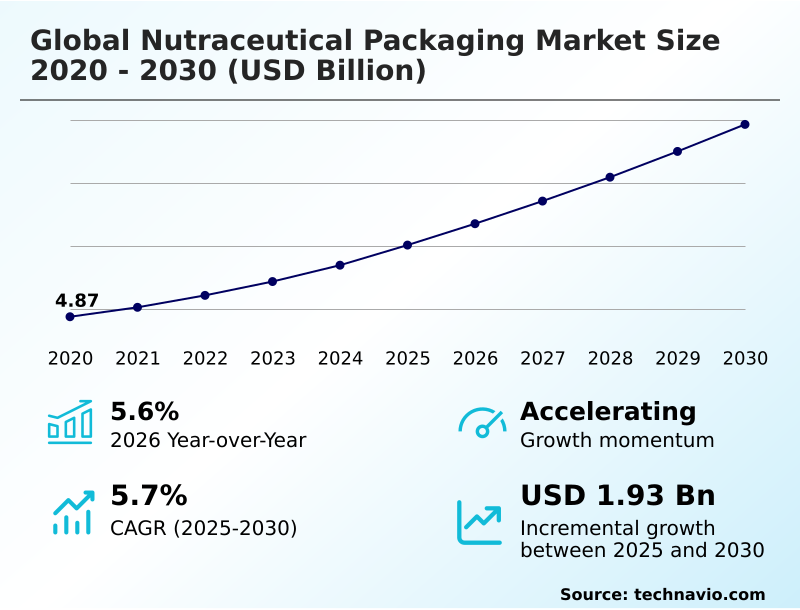
The nutraceutical packaging market size is valued to increase by USD 1.93 billion, at a CAGR of 5.7% from 2025 to 2030. Intensifying global focus on preventive healthcare and personalized nutrition will drive the nutraceutical packaging market.
Major Market Trends & Insights
- APAC dominated the market and accounted for a 38.2% growth during the forecast period.
- By Type of Packaging - Bottles and jars segment was valued at USD 2.08 billion in 2024
- By Material - Plastic segment accounted for the largest market revenue share in 2024
Market Size & Forecast
- Market Opportunities: USD 3.07 billion
- Market Future Opportunities: USD 1.93 billion
- CAGR from 2025 to 2030 : 5.7%
Market Summary
- The nutraceutical packaging market is evolving beyond simple containment, becoming an integral component of product efficacy, consumer trust, and brand strategy. Driven by a global shift towards preventive health, demand is surging for solutions that protect sensitive active ingredients while meeting consumer expectations for convenience and transparency.
- This necessitates the use of advanced formats, from a thermoformed blister pack ensuring unit-dose integrity to flexible pouches optimized for e-commerce. A key dynamic is the tension between functionality and sustainability. Brands must navigate this by adopting innovations like mono-material films and incorporating post-consumer recycled (pcr) content without compromising essential barrier properties.
- For example, a brand manager launching a new probiotic must weigh the superior barrier of a multi-layer pouch against the marketability and regulatory advantages of a recyclable mono-material alternative. This decision impacts material sourcing, manufacturing costs, and brand perception.
- Furthermore, the rise of personalized nutrition is creating demand for complex, dose-specific packaging systems, while smart technologies are transforming packages into platforms for product authentication and digital engagement, fundamentally reshaping the industry's value proposition.
What will be the Size of the Nutraceutical Packaging Market during the forecast period?
Get Key Insights on Market Forecast (PDF) Get Free Sample
How is the Nutraceutical Packaging Market Segmented?
The nutraceutical packaging industry research report provides comprehensive data (region-wise segment analysis), with forecasts and estimates in "USD million" for the period 2026-2030, as well as historical data from 2020-2024 for the following segments.
- Type of packaging
- Bottles and jars
- Blisters and strips
- Bags and pouches
- Boxes and cartons
- Others
- Material
- Plastic
- Paper and paperboard
- Glass
- Others
- Application
- Dietary supplements
- Functional foods
- Functional beverages
- Herbal and botanical extracts
- Geography
- APAC
- China
- India
- Japan
- North America
- US
- Canada
- Mexico
- Europe
- Germany
- UK
- France
- South America
- Brazil
- Argentina
- Colombia
- Middle East and Africa
- South Africa
- Saudi Arabia
- UAE
- Rest of World (ROW)
- APAC
By Type of Packaging Insights
The bottles and jars segment is estimated to witness significant growth during the forecast period.
Bottles and jars represent a foundational segment, where the use of a recyclable PET bottle is standard for ensuring food contact material safety. This rigid format is crucial for maintaining supply chain integrity.
For high-value liquids, glass vial packaging combined with a calibrated glass dropper reinforces a premium product perception. These containers often feature an induction sealed liner and a desiccant-lined closure to protect sensitive ingredients.
A key innovation is the emergence of the molded fiber container and composite canister as sustainable alternatives to plastic tubs, which helps in achieving a reduced carbon footprint.
While less suited for an on-the-go consumption format, these containers offer excellent product protection and branding opportunities in the market, with adoption of lightweighted glass improving shipping efficiency by 15%.
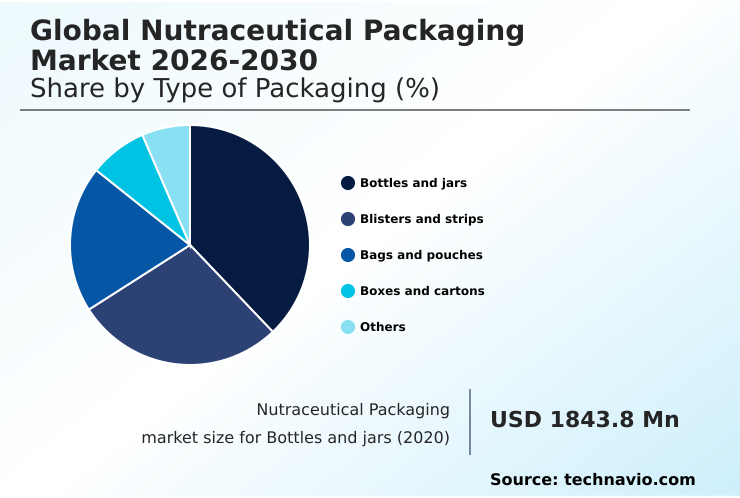
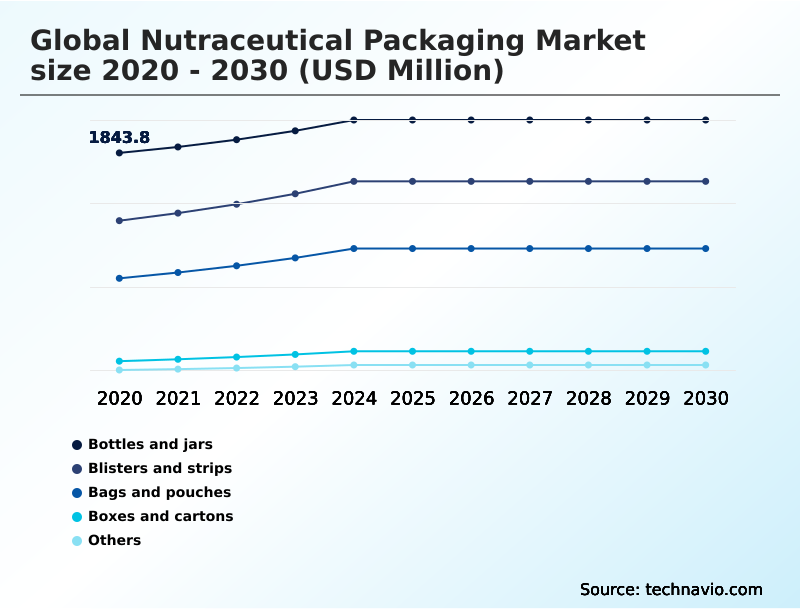
The Bottles and jars segment was valued at USD 2.08 billion in 2024 and showed a gradual increase during the forecast period.
Regional Analysis
APAC is estimated to contribute 38.2% to the growth of the global market during the forecast period.Technavio’s analysts have elaborately explained the regional trends and drivers that shape the market during the forecast period.
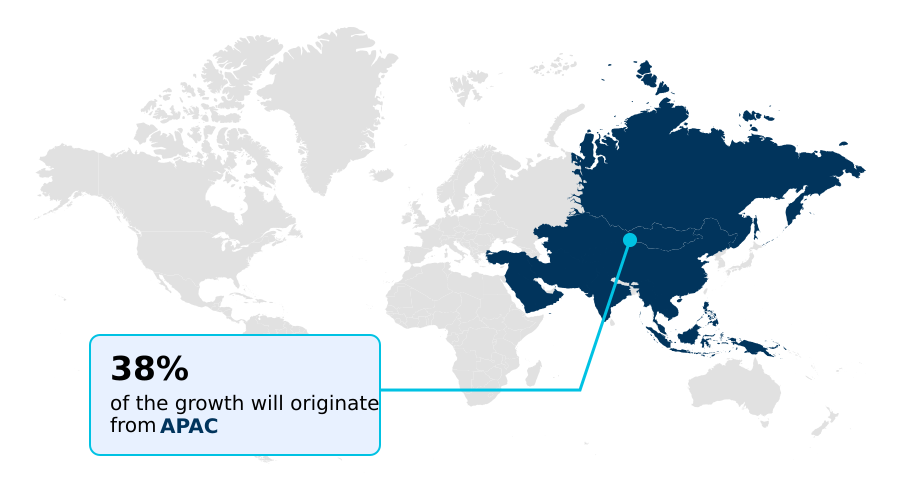
See How Nutraceutical Packaging Market Demand is Rising in APAC Get Free Sample
The geographic landscape is diverse, with regional priorities shaping packaging demand. In APAC, rapid e-commerce growth drives the need for enhanced track-and-trace capability for counterfeit product mitigation.
In this region, firms leveraging automated packaging lines report a 25% operational efficiency gain. Europe's market is defined by stringent regulations and sustainable material sourcing, favoring a clean label design aesthetic and materials compatible with advanced recycling technology.
North America sees high adoption of convenience formats like the unit-dose delivery system and dose-specific packaging. Technologies like modified atmosphere packaging (MAP) and the aseptic filling process are critical globally for shelf-life extension.
All regions are experiencing the geopolitical instability impact on supply chains, which influences brand differentiation strategy as companies seek to secure material inputs.
Market Dynamics
Our researchers analyzed the data with 2025 as the base year, along with the key drivers, trends, and challenges. A holistic analysis of drivers will help companies refine their marketing strategies to gain a competitive advantage.
- Developing effective packaging requires a multifaceted approach, from selecting recyclable high-barrier flexible packaging for supplements to creating sustainable packaging solutions for sensitive nutraceuticals. A crucial business decision involves the cost analysis of pcr content in pet bottles, balancing budget with sustainability goals.
- The impact of e-commerce on nutraceutical packaging design has prioritized robust, lighter solutions, while smart packaging integration for consumer engagement builds brand loyalty. Performance comparisons, such as mono-material pouch versus rigid container performance, guide choices, leveraging the advanced barrier properties of pet plastic bottles where appropriate.
- Innovation in child-resistant closure design and user accessibility and lightweighting strategies for glass nutraceutical containers are ongoing. The rise of adherence packaging for personalized vitamin subscriptions highlights a major trend, addressed by innovations in single-serve stick pack films.
- Security is paramount, driving adoption of anti-counterfeiting technologies in supplement packaging, while aseptic packaging for functional beverage shelf life is essential for drinks. Managing supply chain challenges for packaging raw materials remains a top priority, with disruptions causing delays that are twice as frequent as five years ago.
- The industry is moving toward circular economy models for nutraceutical packaging waste, influenced by consumer perception of sustainable packaging materials. Technical challenges include defining the role of desiccants in moisture-sensitive product packaging, overcoming challenges of recycling multi-layer flexible packaging, and advancing the development of food-grade recycled plastics for supplements. Navigating regulatory compliance for nutraceutical labeling standards underpins all these activities.
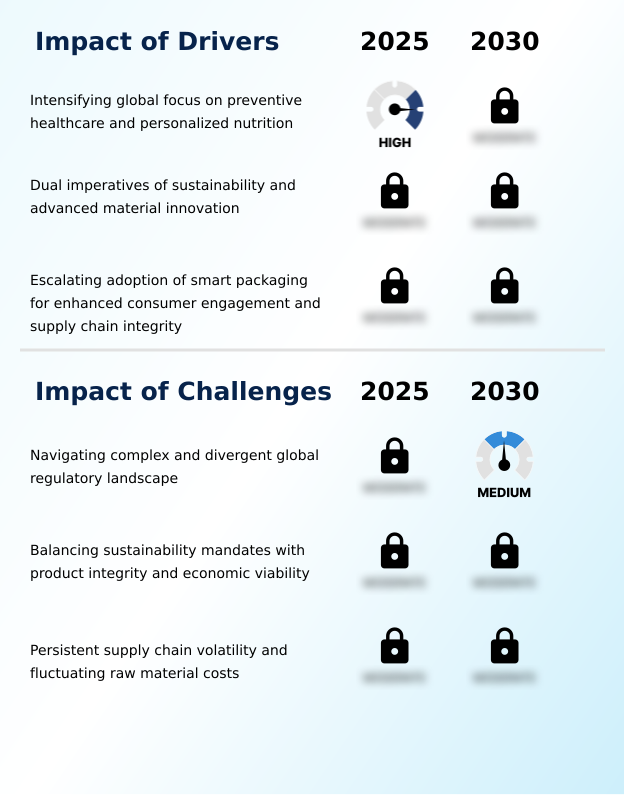
What are the key market drivers leading to the rise in the adoption of Nutraceutical Packaging Industry?
- An intensifying global focus on preventive healthcare and personalized nutrition is a key driver propelling market growth.
- The powerful preventive healthcare trend is a primary market driver, increasing demand for packaging that guarantees product safety. For functional beverages, aseptic carton packaging is crucial for shelf life extension.
- The need for precise dosing and protection drives the use of the thermoformed blister pack and airless pump dispenser. To protect sensitive ingredients, oxygen scavenger technology is integrated directly into materials.
- The push for sustainability fuels adoption of lightweighting design strategy and water-based dispersion coating on paperboard, reducing plastic use. E-commerce packaging optimization also favors lighter formats.
- Simultaneously, the demand for product authenticity verification is met by smart labels, with brands using them as a consumer engagement platform reporting a 15% uplift in trust metrics.
- Use of food-grade pcr plastic has increased by over 25% in certain segments.
What are the market trends shaping the Nutraceutical Packaging Industry?
- The ascendancy of sustainable and circular packaging solutions represents a primary market trend. This movement is driven by increasing regulatory mandates and consumer demand for environmental responsibility.
- Key trends are redefining packaging from a passive container to an active tool. The rise of the personalized nutrition service has fueled demand for adherence improvement packaging, such as the innovative dual-chamber sachet that preserves ingredient stability. Convenience is addressed through the single-serve stick pack and the resealable zipper pouch.
- Material science innovation is enabling smart features; the integration of a flexible integrated circuit facilitates nfc tag integration, turning the package into a digital communication channel for brand loyalty enhancement. An augmented reality (ar) marker can provide immersive experiences, while safety is improved with features like peel-push lidding on blister packs.
- These advancements show a market shift toward user-centric design, with interactive features increasing consumer engagement time by an average of 40%.
What challenges does the Nutraceutical Packaging Industry face during its growth?
- Navigating a complex and divergent global regulatory landscape presents a significant challenge to industry growth.
- Market players face significant challenges in balancing sustainability with performance. Supply chain volatility and raw material cost fluctuation can increase the cost of implementing circular economy principles by up to 20%. While mono-material recyclability is a goal, developing a high-barrier mono-material film that matches the performance of traditional laminates is technically demanding.
- Regulatory compliance management is complex, with extended producer responsibility (epr) schemes and mandates for post-consumer recycled (pcr) content varying globally. Even established technologies like the child-resistant closure (crc) and tamper-evident feature must be redesigned for sustainability. Adopting a mono-material polyethylene pouch or using narrow neck press and blow techniques for glass lightweighting requires capital investment, creating hurdles for smaller firms.
- These factors can delay new product launches by up to six months.
Exclusive Technavio Analysis on Customer Landscape
The nutraceutical packaging market forecasting report includes the adoption lifecycle of the market, covering from the innovator’s stage to the laggard’s stage. It focuses on adoption rates in different regions based on penetration. Furthermore, the nutraceutical packaging market report also includes key purchase criteria and drivers of price sensitivity to help companies evaluate and develop their market growth analysis strategies.
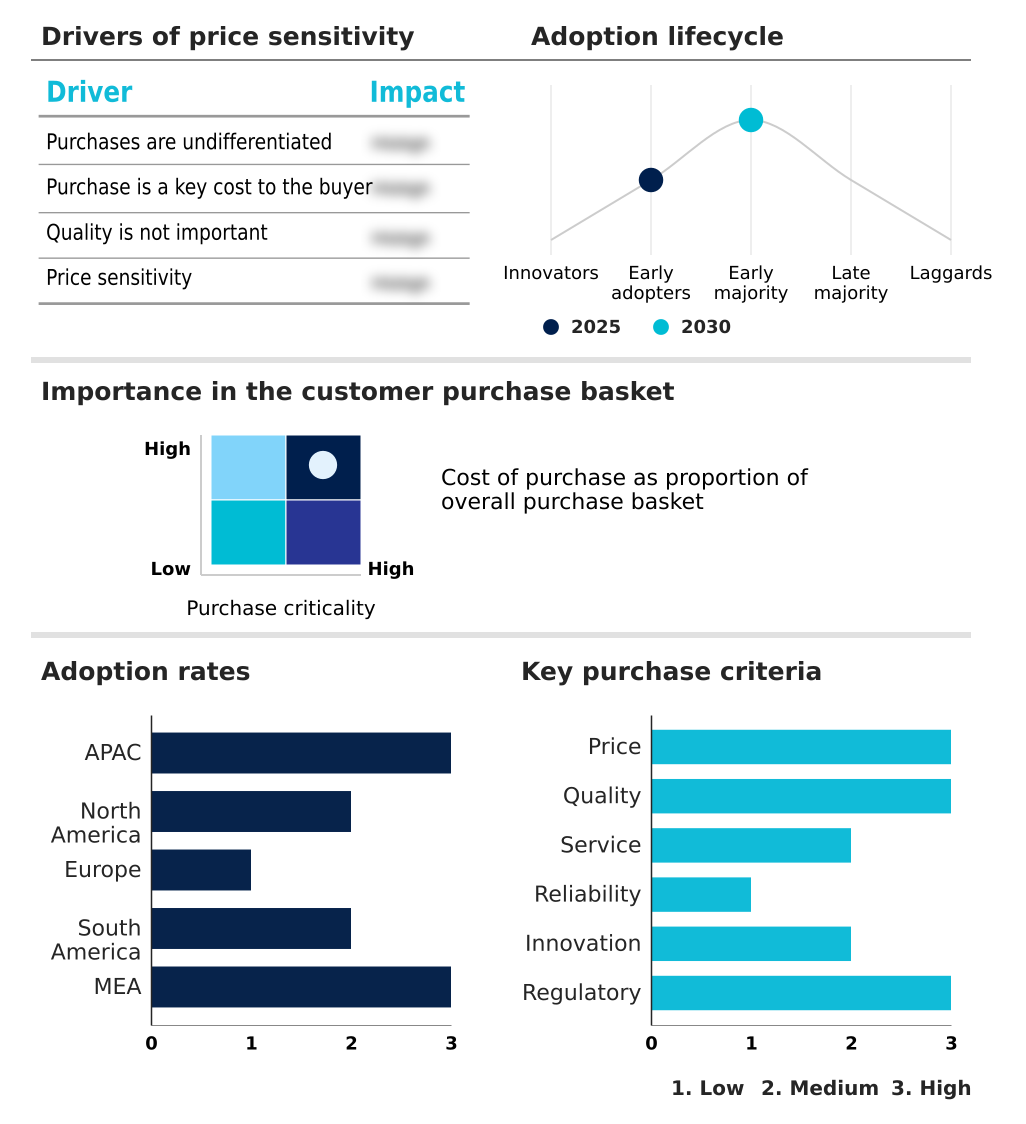
Customer Landscape of Nutraceutical Packaging Industry
Competitive Landscape
Companies are implementing various strategies, such as strategic alliances, nutraceutical packaging market forecast, partnerships, mergers and acquisitions, geographical expansion, and product/service launches, to enhance their presence in the industry.
Alpha Plastics Inc. - A key market offering includes a diverse range of flexible pouches, rigid containers, and sustainable solutions engineered for vitamin and supplement protection.
The industry research and growth report includes detailed analyses of the competitive landscape of the market and information about key companies, including:
- Alpha Plastics Inc.
- Amcor Plc
- Berry Global Inc.
- Bormioli Pharma Spa
- CCL Industries Inc.
- Comar LLC
- Constantia Flexibles GmbH
- Gerresheimer AG
- Glenroy Inc.
- Huhtamaki Oyj
- Mondi Plc
- O.Berk Co. LLC
- ProAmpac Holdings Inc.
- Sealed Air Corp.
- SGD Pharma
- Silgan Holdings Inc.
- Sonoco Products Co.
- Tekni Plex Inc.
- WestRock Co.
Qualitative and quantitative analysis of companies has been conducted to help clients understand the wider business environment as well as the strengths and weaknesses of key industry players. Data is qualitatively analyzed to categorize companies as pure play, category-focused, industry-focused, and diversified; it is quantitatively analyzed to categorize companies as dominant, leading, strong, tentative, and weak.
Recent Development and News in Nutraceutical packaging market
- In September, 2024, Amcor Plc and Dow announced a strategic partnership to commercialize a new high-barrier, recyclable polyethylene-based pouch designed for moisture-sensitive probiotics, aiming to replace non-recyclable multi-material structures.
- In November, 2024, Berry Global Inc. acquired a European smart packaging startup for approximately USD 50 million, gaining access to patented NFC-enabled closure technology for real-time dosage tracking and product authentication.
- In March, 2025, the US Environmental Protection Agency (EPA) proposed new rules under the Resource Conservation and Recovery Act, suggesting mandatory minimums for post-consumer recycled content in rigid plastic nutraceutical containers, starting at 20% by 2028.
- In May, 2025, Gerresheimer AG launched its new line of lightweight, chemically strengthened glass vials (Type I), reducing material usage by 15% while enhancing durability, targeting the premium liquid supplement and extract market.
Dive into Technavio’s robust research methodology, blending expert interviews, extensive data synthesis, and validated models for unparalleled Nutraceutical Packaging Market insights. See full methodology.
| Market Scope | |
|---|---|
| Page number | 319 |
| Base year | 2025 |
| Historic period | 2020-2024 |
| Forecast period | 2026-2030 |
| Growth momentum & CAGR | Accelerate at a CAGR of 5.7% |
| Market growth 2026-2030 | USD 1927.3 million |
| Market structure | Fragmented |
| YoY growth 2025-2026(%) | 5.6% |
| Key countries | China, India, Japan, South Korea, Australia, Indonesia, US, Canada, Mexico, Germany, UK, France, Italy, The Netherlands, Spain, Brazil, Argentina, Colombia, South Africa, Saudi Arabia, UAE, Israel and Turkey |
| Competitive landscape | Leading Companies, Market Positioning of Companies, Competitive Strategies, and Industry Risks |
Research Analyst Overview
- The market is driven by innovations that merge protection with sustainability. A lightweighting design strategy is critical, yet must not compromise the integrity of a high-barrier mono-material film. The standard recyclable pet bottle, secured by a child-resistant closure (crc) and tamper-evident feature, now competes with the mono-material polyethylene pouch.
- For single servings, the thermoformed blister pack with peel-push lidding and the single-serve stick pack are key. Premium liquids use glass vial packaging with a calibrated glass dropper or an airless pump dispenser. Product integrity is ensured by an induction sealed liner, a desiccant-lined closure, and oxygen scavenger technology.
- Using post-consumer recycled (pcr) content, specifically food-grade pcr plastic, has become a critical metric. Smart features include nfc tag integration via a flexible integrated circuit and an augmented reality (ar) marker. Sustainable formats like the molded fiber container and composite canister are emerging. Liquids rely on aseptic carton packaging and its aseptic filling process.
- Extended producer responsibility (epr) laws and modified atmosphere packaging (map) are shaping design, as is narrow neck press and blow technology. The dual-chamber sachet supports the trend toward a unit-dose delivery system and dose-specific packaging. The resealable zipper pouch adds convenience.
What are the Key Data Covered in this Nutraceutical Packaging Market Research and Growth Report?
-
What is the expected growth of the Nutraceutical Packaging Market between 2026 and 2030?
-
USD 1.93 billion, at a CAGR of 5.7%
-
-
What segmentation does the market report cover?
-
The report is segmented by Type of Packaging (Bottles and jars, Blisters and strips, Bags and pouches, Boxes and cartons, and Others), Material (Plastic, Paper and paperboard, Glass, and Others), Application (Dietary supplements, Functional foods, Functional beverages, and Herbal and botanical extracts) and Geography (APAC, North America, Europe, South America, Middle East and Africa)
-
-
Which regions are analyzed in the report?
-
APAC, North America, Europe, South America and Middle East and Africa
-
-
What are the key growth drivers and market challenges?
-
Intensifying global focus on preventive healthcare and personalized nutrition, Navigating complex and divergent global regulatory landscape
-
-
Who are the major players in the Nutraceutical Packaging Market?
-
Alpha Plastics Inc., Amcor Plc, Berry Global Inc., Bormioli Pharma Spa, CCL Industries Inc., Comar LLC, Constantia Flexibles GmbH, Gerresheimer AG, Glenroy Inc., Huhtamaki Oyj, Mondi Plc, O.Berk Co. LLC, ProAmpac Holdings Inc., Sealed Air Corp., SGD Pharma, Silgan Holdings Inc., Sonoco Products Co., Tekni Plex Inc. and WestRock Co.
-
Market Research Insights
- Market dynamics are shaped by the convergence of consumer demands and operational realities. The preventive healthcare trend fuels the need for effective packaging, while the push for circular economy principles challenges material choices.
- Adoption of a brand differentiation strategy often involves innovative packaging, but this is tempered by supply chain volatility and raw material cost fluctuation, which can increase costs by 15-20% unpredictably. Regulatory compliance management is critical, with non-compliance delaying market entry by months. To address this, firms are focused on e-commerce packaging optimization and ensuring food contact material safety.
- Integrating smart features for brand loyalty enhancement has been shown to increase repeat purchase rates by over 10%, showcasing a clear return on investment for technologies that build consumer trust and engagement.
We can help! Our analysts can customize this nutraceutical packaging market research report to meet your requirements.
 RIA -
RIA - 
