


Offshore Wind Maintenance Robots Market Analysis, Size, and Forecast 2026-2030: APAC (China, South Korea, and Japan), Europe (UK, Germany, and The Netherlands), North America (US, Canada, and Mexico), South America (Brazil and Argentina), Middle East and Africa (Saudi Arabia, UAE, and South Africa), and Rest of World (ROW)

Offshore Wind Maintenance Robots Market Analysis, Size, and Forecast 2026-2030:
APAC (China, South Korea, and Japan), Europe (UK, Germany, and The Netherlands), North America (US, Canada, and Mexico), South America (Brazil and Argentina), Middle East and Africa (Saudi Arabia, UAE, and South Africa), and Rest of World (ROW)

Published: Apr 2026 308 Pages SKU: IRTNTR81381

Market Overview at a Glance

$1.37 B
Market Opportunity
17.8%
CAGR 2025 - 2030
41.8%
APAC Growth
$350 Mn
Remotely controlled robots segment 2024

Offshore Wind Maintenance Robots Market Size 2026-2030

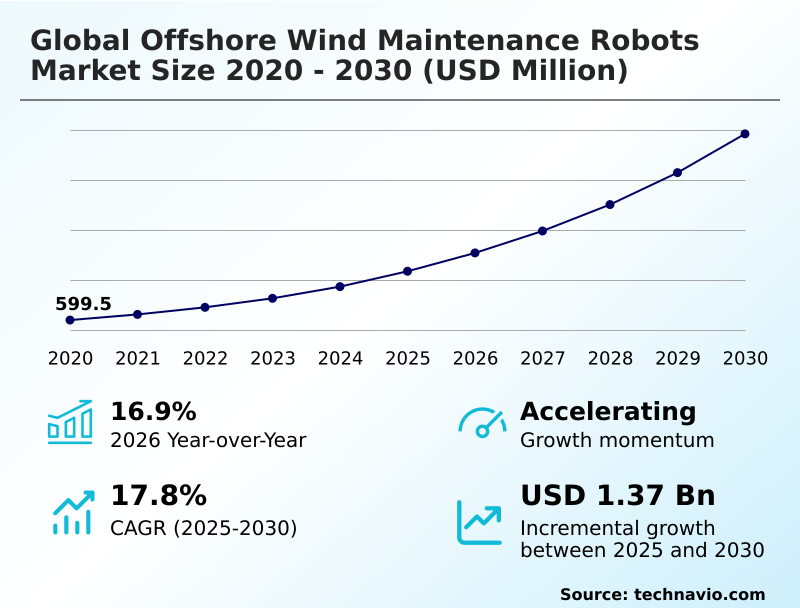
The offshore wind maintenance robots market size is valued to increase by USD 1.37 billion, at a CAGR of 17.8% from 2025 to 2030. Increasing deployment of deep-water and floating offshore wind farms will drive the offshore wind maintenance robots market.

Major Market Trends & Insights

  • APAC dominated the market and accounted for a 41.8% growth during the forecast period.
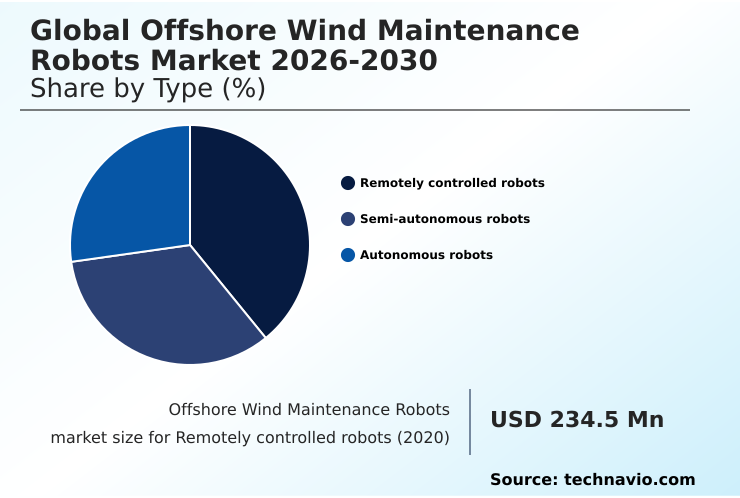
  • By Type - Remotely controlled robots segment was valued at USD 350 million in 2024
  • By End-user - Wind farm operators segment accounted for the largest market revenue share in 2024

Market Size & Forecast

  • Market Opportunities: USD 1.86 billion
  • Market Future Opportunities: USD 1.37 billion
  • CAGR from 2025 to 2030 : 17.8%

Market Summary

  • The offshore wind maintenance robots market is undergoing a significant transformation, driven by the need to ensure asset integrity and reduce operational expenditures in increasingly remote and hazardous maritime environments. The expansion into deep-water zones, where manual maintenance is impractical and unsafe, has created a strong demand for advanced robotic solutions.
  • These systems range from remotely operated vehicles tethered to surface vessels to fully autonomous underwater vehicles capable of performing pre-programmed structural integrity scans without human intervention. A key trend is the integration of on-board edge computing and AI, which allows platforms like robotic blade crawlers and autonomous inspection drones to perform real-time structural diagnostics.
  • For instance, a common business scenario involves deploying a fleet of drones for post-storm turbine blade integrity analysis. These drones use defect detection algorithms to identify and categorize damage, feeding this data into a digital twin modeling system that prioritizes repairs, thereby enabling a 25% faster response time compared to traditional inspection schedules.
  • This shift toward a predictive maintenance framework, supported by automated data collection and comprehensive cloud-based reporting, is critical for extending the operational lifespan extension of turbines and optimizing the levelized cost of energy.

What will be the Size of the Offshore Wind Maintenance Robots Market during the forecast period?
Get Key Insights on Market Forecast (PDF) Request Free Sample

How is the Offshore Wind Maintenance Robots Market Segmented?

The offshore wind maintenance robots industry research report provides comprehensive data (region-wise segment analysis), with forecasts and estimates in "USD million" for the period 2026-2030, as well as historical data from 2020-2024 for the following segments.

  • Type
    • Remotely controlled robots
    • Semi-autonomous robots
    • Autonomous robots
  • End-user
    • Wind farm operators
    • O and M service providers
    • EPC contractors
    • Energy utilities
  • Application
    • Inspection and monitoring
    • Repair and maintenance
    • Cleaning
    • Installation support
  • Geography
    • APAC
      • China
      • South Korea
      • Japan
    • Europe
      • UK
      • Germany
      • The Netherlands
    • North America
      • US
      • Canada
      • Mexico
    • South America
      • Brazil
      • Argentina
    • Middle East and Africa
      • Saudi Arabia
      • UAE
      • South Africa
    • Rest of World (ROW)

By Type Insights

The remotely controlled robots segment is estimated to witness significant growth during the forecast period.

The market is segmented by levels of autonomy, with remotely controlled robots forming a foundational category. These systems, including remotely operated vehicles and specialized climbing units, rely on direct human oversight via advanced remote piloting systems.

They offer unparalleled precision for complex tasks where pre-programmed logic is insufficient, such as deploying agile robotic manipulators for subsea repairs or using ultrasonic testing probes for weld inspection.

While the industry trends toward autonomous robotic fleets, these systems remain crucial for non-routine interventions and heavy-duty work.

The integration of haptic feedback has improved the success rate of complex underwater cable repairs by over 15%, enhancing automated integrity management and contributing to operational lifespan extension through precise, expert-guided maintenance that aids in structural anomaly identification.
Request Free Sample

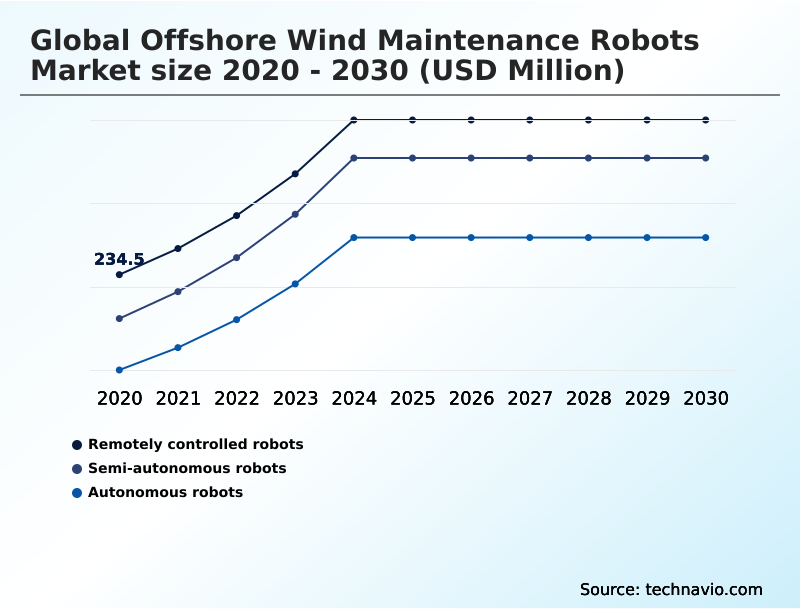
The Remotely controlled robots segment was valued at USD 350 million in 2024 and showed a gradual increase during the forecast period.
Request Free Sample

Regional Analysis

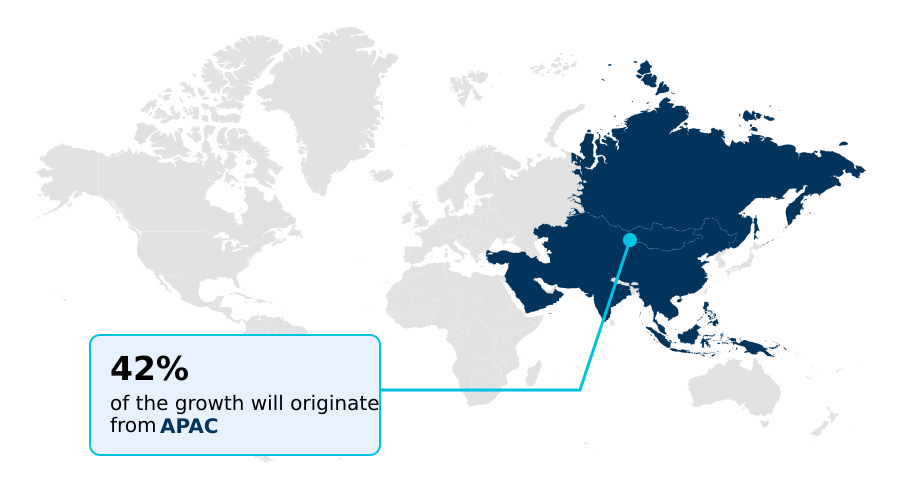
APAC is estimated to contribute 41.8% to the growth of the global market during the forecast period.Technavio’s analysts have elaborately explained the regional trends and drivers that shape the market during the forecast period.
See How Offshore Wind Maintenance Robots Market Demand is Rising in APAC Request Free Sample

The geographic landscape is characterized by varied adoption rates, with APAC leading regional growth at 18.8%, driven by massive new installations. In this region, drone-based monitoring systems with automated flight planning are critical for managing large turbine clusters.

Europe, the most mature market, focuses on advanced applications, deploying autonomous robots and robotic blade crawlers that leverage sophisticated defect detection algorithms for advanced robotic inspection.

These systems feed data into centralized predictive maintenance frameworks, with some operators reporting a 30% reduction in unscheduled downtime.

North America is rapidly adopting semi-autonomous robots that integrate human-in-the-loop supervision from a remote operations center, balancing automation with expert oversight for tasks like robotic pipeline inspection, supported by real-time data analytics and comprehensive cloud-based reporting.

Market Dynamics

Our researchers analyzed the data with 2025 as the base year, along with the key drivers, trends, and challenges. A holistic analysis of drivers will help companies refine their marketing strategies to gain a competitive advantage.

  • The evolution of the offshore wind maintenance robots market is marked by a deep AI integration in robotic maintenance, which is crucial for managing the complexities of next-generation assets. For instance, robotic systems for floating wind farms must perform constant automated monitoring of mooring lines to ensure stability, a task far beyond manual capabilities.
  • A primary application is the use of an autonomous drone for turbine blade inspection, which provides high-resolution data for structural analysis. Similarly, an ROV for subsea cable network inspection is essential for preventing power transmission failures.
  • The deployment of robotic crawlers for non-destructive testing of turbine towers identifies material fatigue early, while using USV carriers for robotic swarms optimizes large-scale inspection campaigns, covering more area in less time. This operational efficiency is notable; firms using integrated robotic platforms report inspection cycle times that are up to 40% faster than those relying on disparate, single-function systems.
  • Resident robotics for continuous monitoring further enhances this by eliminating mobilization delays. The impact of AI on maintenance robotics is most evident in the use of edge computing in structural health diagnostics.
  • However, the challenges of robots in extreme maritime environments, the high capital investment in robotic maintenance, and the lack of cohesive regulatory frameworks for autonomous robotics remain significant hurdles. Addressing the interoperability of robotic maintenance platforms and clarifying safety regulations for offshore robotics are key to deploying robotic solutions for deep-water wind farms.
  • The market continues to advance drone-based inspection of offshore turbines, subsea robots for foundation integrity, and specialized robotic systems for blade repair.
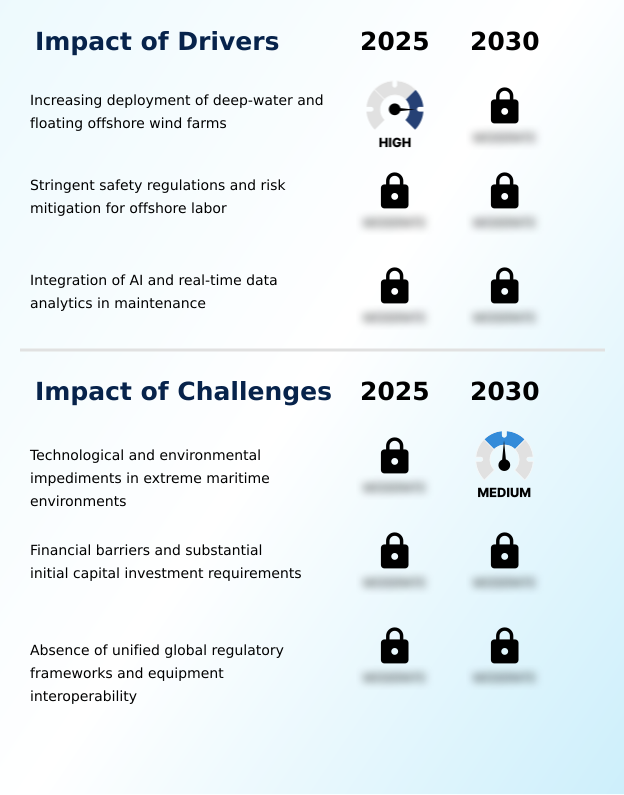
What are the key market drivers leading to the rise in the adoption of Offshore Wind Maintenance Robots Industry?

  • The market's growth is primarily driven by the increasing deployment of deep-water and floating offshore wind farms, which creates an imperative for advanced robotic maintenance solutions.

  • The imperative to lower the levelized cost of energy is a primary driver accelerating the adoption of automated systems for asset integrity management.
  • The expansion into deeper waters necessitates automated data collection using uncrewed surface vessels and autonomous inspection drones equipped with light detection and ranging (LiDAR) and high-resolution optical sensors.
  • These platforms enable detailed structural health monitoring and feed data into digital twin modeling, improving operational forecasts by over 30%. For hands-on tasks, remotely operated vehicles with haptic feedback systems and specialized robotic manipulators are performing complex subsea work.
  • Furthermore, magnetic-track climbing robots are conducting non-destructive testing on towers, with on-board edge computing reducing data processing times by more than 50% compared to traditional cloud-based analysis.

What are the market trends shaping the Offshore Wind Maintenance Robots Industry?

  • The emergence of resident robotic systems for continuous infrastructure monitoring is a defining market trend, reshaping asset management strategies toward persistent, on-site automated surveillance.

  • The emergence of resident robotic systems and multimodal robotic swarms is fundamentally transforming asset management. By stationing autonomous underwater vehicles at permanent robotic docking stations, operators can achieve continuous infrastructure monitoring for subsea foundation monitoring and mooring line inspection. This enables sophisticated predictive maintenance models, with some platforms achieving a 40% improvement in fault prediction accuracy.
  • The use of unmanned surface vessels as mobile hubs for these swarms, equipped with advanced thermal cameras and AI-driven diagnostics modules, facilitates real-time structural diagnostics and turbine blade integrity analysis. This shift toward robotics as a service lowers upfront capital expenditure and accelerates the adoption of automated structural integrity scans, reducing inspection-related downtime by up to 60%.

What challenges does the Offshore Wind Maintenance Robots Industry face during its growth?

  • Technological limitations and environmental impediments within extreme maritime environments present a key challenge affecting industry growth and the operational reliability of robotic systems.

  • Significant challenges persist, particularly the lack of a universal equipment interoperability standard, which fragments the market and complicates the integration of different subsea robotic systems. This forces operators to manage multiple platforms for tasks like splash zone cleaning and automated bolt tensioning.
  • Furthermore, harsh maritime conditions impede autonomous navigation accuracy for autonomous inspection robots and compact underwater drones, with some missions aborted due to environmental factors. The absence of a clear framework for robotic labor certification creates legal and insurance uncertainties for autonomous maritime operations.
  • Even advanced remotely controlled robots and work-class ROVs struggle with complex tasks like leading-edge erosion repair, while issues with inertial navigation sensors can affect robotic turbine blade inspection, with positioning errors of up to 5% reported in turbulent conditions.

Exclusive Technavio Analysis on Customer Landscape

The offshore wind maintenance robots market forecasting report includes the adoption lifecycle of the market, covering from the innovator’s stage to the laggard’s stage. It focuses on adoption rates in different regions based on penetration. Furthermore, the offshore wind maintenance robots market report also includes key purchase criteria and drivers of price sensitivity to help companies evaluate and develop their market growth analysis strategies.
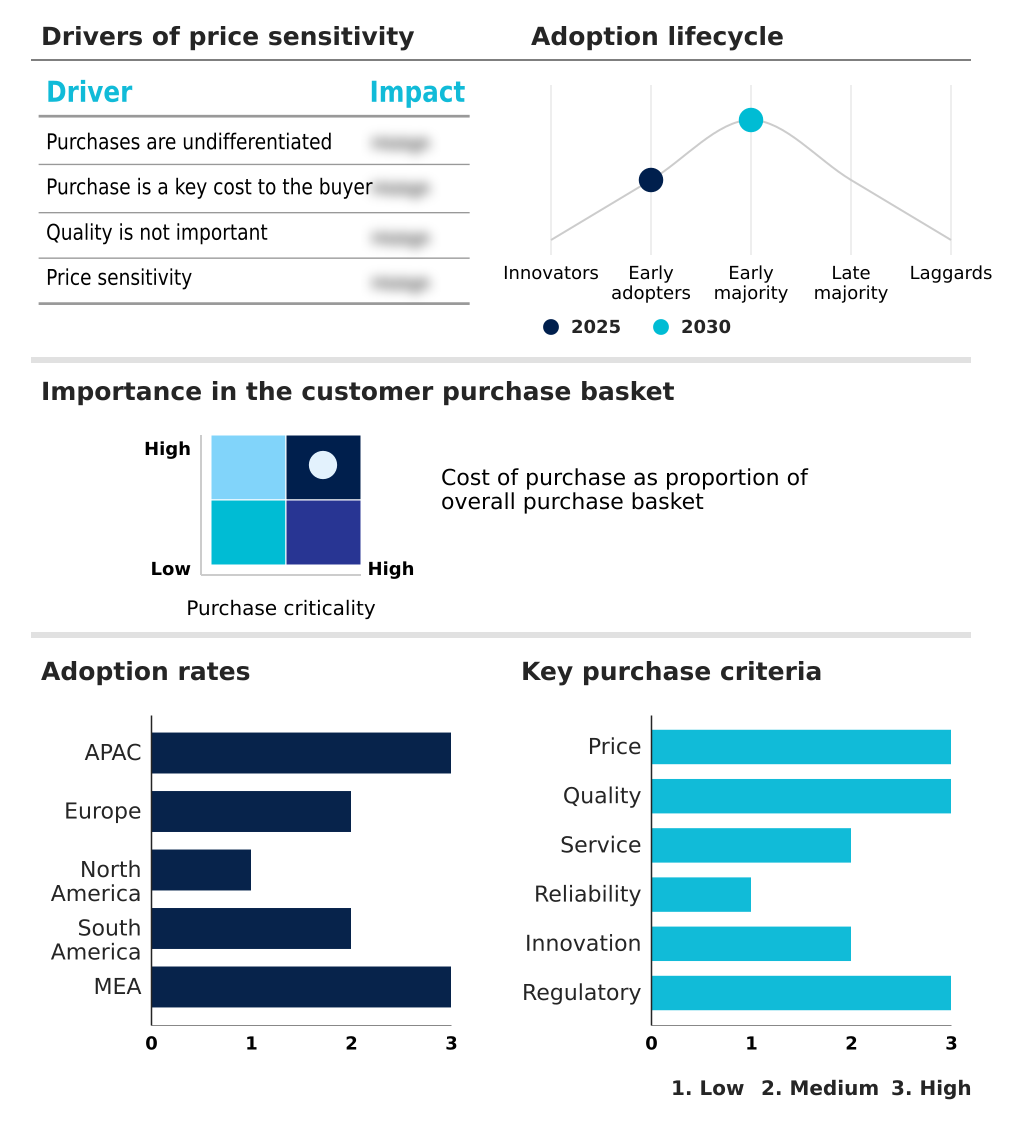
Customer Landscape of Offshore Wind Maintenance Robots Industry

Competitive Landscape

Companies are implementing various strategies, such as strategic alliances, offshore wind maintenance robots market forecast, partnerships, mergers and acquisitions, geographical expansion, and product/service launches, to enhance their presence in the industry.

Aerones Engineering - Delivering robotic turbine blade inspection and repair systems via remotely operated crawlers and winch-based platforms designed for enhanced operational safety in offshore environments.

The industry research and growth report includes detailed analyses of the competitive landscape of the market and information about key companies, including:

  • Aerones Engineering
  • Eddyfi Technologies
  • Exail Technologies
  • FORCE Technology
  • Fugro NV
  • Honeywell International Inc.
  • Interocean
  • Notilo Plus
  • Ocean Infinity
  • Oceaneering International Inc.
  • Reach Robotics
  • ROSEN Group
  • Saab AB
  • Siemens Gamesa Renewable Energy
  • SkySpecs Inc.
  • Sulzer and Schmid Laboratories
  • Technip Energies N.V.
  • Vestas Wind Systems AS
  • VideoRay LLC

Qualitative and quantitative analysis of companies has been conducted to help clients understand the wider business environment as well as the strengths and weaknesses of key industry players. Data is qualitatively analyzed to categorize companies as pure play, category-focused, industry-focused, and diversified; it is quantitatively analyzed to categorize companies as dominant, leading, strong, tentative, and weak.

Recent Development and News in Offshore wind maintenance robots market

  • In April 2025, Orsted successfully commissioned a permanent robotic residency program at the Hornsea Three offshore wind farm, utilizing a fleet of autonomous underwater vehicles that reside in subsea docking stations.
  • In July 2025, Siemens Gamesa launched a proprietary AI-driven diagnostic module for its robotic blade crawlers that can categorize the severity of structural damage with 99% accuracy while the robot is still on the turbine.
  • In August 2025, the Health and Safety Executive in the United Kingdom issued a formal recommendation for offshore operators to prioritize robotic inspection systems over manual climbing for turbines beyond 12 miles from the coast.
  • In November 2025, Ocean Infinity conducted a demonstration involving a large-scale Unmanned Surface Vessel that deployed a swarm of three autonomous underwater vehicles to inspect a subsea cable network, managed entirely from a remote operations center.

Dive into Technavio’s robust research methodology, blending expert interviews, extensive data synthesis, and validated models for unparalleled Offshore Wind Maintenance Robots Market insights. See full methodology.

Market Scope
Page number 308
Base year 2025
Historic period 2020-2024
Forecast period 2026-2030
Growth momentum & CAGR Accelerate at a CAGR of 17.8%
Market growth 2026-2030 USD 1374.2 million
Market structure Fragmented
YoY growth 2025-2026(%) 16.9%
Key countries China, Taiwan, South Korea, Japan, Vietnam, India, UK, Germany, The Netherlands, Denmark, France, Spain, US, Canada, Mexico, Brazil, Chile, Argentina, Saudi Arabia, UAE, South Africa, Egypt and Morocco
Competitive landscape Leading Companies, Market Positioning of Companies, Competitive Strategies, and Industry Risks

Request Free Sample

Research Analyst Overview

  • The market's evolution is defined by a push toward full autonomy, where integrated systems of autonomous underwater vehicles, remotely operated vehicles, and unmanned aerial vehicles perform comprehensive asset checks.
  • A key trend involves resident robotic systems, where robotic docking stations permanently house subsea robotic systems and specialized climbing units on-site, a boardroom-level decision that shifts maintenance from a variable operational expense to a predictable, capitalized asset. The use of multimodal robotic swarms, deployed from unmanned surface vessels or autonomous robotic vessels, is becoming standard for large-scale inspections.
  • Technology such as magnetic-track climbing robots, robotic blade crawlers, and compact underwater drones equipped with light detection and ranging, advanced thermal cameras, and ultrasonic testing probes enables unparalleled data fidelity. These platforms, including autonomous inspection drones and robotic inspection tools, feed data to AI-driven diagnostics modules often managed from a remote operations center.
  • The development of specialized robotic manipulators and agile robotic manipulators with haptic feedback systems, particularly on work-class ROVs, allows for complex repairs, with some operators achieving a 30% reduction in repair-related downtime. The market offers a mix of remotely controlled robots, semi-autonomous robots, and fully autonomous robots, with many solutions available through a robotics as a service model.
  • These systems, covering everything from robotic turbine blade inspection to robotic pipeline inspection, are crucial for automated integrity management.

What are the Key Data Covered in this Offshore Wind Maintenance Robots Market Research and Growth Report?

  • What is the expected growth of the Offshore Wind Maintenance Robots Market between 2026 and 2030?

    • USD 1.37 billion, at a CAGR of 17.8%

  • What segmentation does the market report cover?

    • The report is segmented by Type (Remotely controlled robots, Semi-autonomous robots, and Autonomous robots), End-user (Wind farm operators, O and M service providers, EPC contractors, and Energy utilities), Application (Inspection and monitoring, Repair and maintenance, Cleaning, and Installation support) and Geography (APAC, Europe, North America, South America, Middle East and Africa)

  • Which regions are analyzed in the report?

    • APAC, Europe, North America, South America and Middle East and Africa

  • What are the key growth drivers and market challenges?

    • Increasing deployment of deep-water and floating offshore wind farms, Technological and environmental impediments in extreme maritime environments

  • Who are the major players in the Offshore Wind Maintenance Robots Market?

    • Aerones Engineering, Eddyfi Technologies, Exail Technologies, FORCE Technology, Fugro NV, Honeywell International Inc., Interocean, Notilo Plus, Ocean Infinity, Oceaneering International Inc., Reach Robotics, ROSEN Group, Saab AB, Siemens Gamesa Renewable Energy, SkySpecs Inc., Sulzer and Schmid Laboratories, Technip Energies N.V., Vestas Wind Systems AS and VideoRay LLC

Market Research Insights

  • Market dynamics are shaped by a strategic shift toward predictive asset management, where continuous infrastructure monitoring is replacing reactive repairs. The adoption of predictive maintenance models has enabled operators to improve fault detection accuracy by over 30%. This data-driven approach relies on automated platforms performing structural integrity scans and turbine blade integrity analysis to ensure operational readiness.
  • In subsea applications, subsea foundation monitoring and mooring line inspection are now standard procedures, reducing the risk of catastrophic failure. Innovations in real-time structural diagnostics and non-destructive testing provide insights that were previously unattainable, leading to a 20% improvement in maintenance scheduling efficiency.
  • This focus on asset integrity management and structural health monitoring is essential for optimizing the levelized cost of energy and ensuring the long-term profitability of offshore wind assets.

We can help! Our analysts can customize this offshore wind maintenance robots market research report to meet your requirements.

Get in touch

1. Executive Summary

1.1 Market overview

Executive Summary - Chart on Market Overview
Executive Summary - Data Table on Market Overview
Executive Summary - Chart on Global Market Characteristics
Executive Summary - Chart on Market by Geography
Executive Summary - Chart on Market Segmentation by Type
Executive Summary - Chart on Market Segmentation by End-user
Executive Summary - Chart on Market Segmentation by Application
Executive Summary - Chart on Incremental Growth
Executive Summary - Data Table on Incremental Growth
Executive Summary - Chart on Company Market Positioning

2. Technavio Analysis

2.1 Analysis of price sensitivity, lifecycle, customer purchase basket, adoption rates, and purchase criteria

2.2 Criticality of inputs and Factors of differentiation

Chart on Overview on criticality of inputs and factors of differentiation

2.3 Factors of disruption

Chart on Overview on factors of disruption

2.4 Impact of drivers and challenges

Chart on Impact of drivers and challenges in 2025 and 2030

3. Market Landscape

3.1 Market ecosystem

Chart on Parent Market
Data Table on - Parent Market

3.2 Market characteristics

Chart on Market characteristics analysis

3.3 Value chain analysis

Chart on Value chain analysis

4. Market Sizing

4.1 Market definition

Data Table on Offerings of companies included in the market definition

4.2 Market segment analysis

Market segments

4.3 Market size 2025

4.4 Market outlook: Forecast for 2025-2030

Chart on Global - Market size and forecast 2025-2030 ($ million)
Data Table on Global - Market size and forecast 2025-2030 ($ million)
Chart on Global Market: Year-over-year growth 2025-2030 (%)
Data Table on Global Market: Year-over-year growth 2025-2030 (%)

5. Historic Market Size

5.1 Global Offshore Wind Maintenance Robots Market 2020 - 2024

Historic Market Size - Data Table on Global Offshore Wind Maintenance Robots Market 2020 - 2024 ($ million)

5.2 Type segment analysis 2020 - 2024

Historic Market Size - Type Segment 2020 - 2024 ($ million)

5.3 End-user segment analysis 2020 - 2024

Historic Market Size - End-user Segment 2020 - 2024 ($ million)

5.4 Application segment analysis 2020 - 2024

Historic Market Size - Application Segment 2020 - 2024 ($ million)

5.5 Geography segment analysis 2020 - 2024

Historic Market Size - Geography Segment 2020 - 2024 ($ million)

5.6 Country segment analysis 2020 - 2024

Historic Market Size - Country Segment 2020 - 2024 ($ million)

6. Qualitative Analysis

6.1 The AI impact on Global Offshore Wind Maintenance Robots Market

6.2 Impact of geopolitical conflicts on Global Offshore Wind Maintenance Robots Market

7. Five Forces Analysis

7.1 Five forces summary

Five forces analysis - Comparison between 2025 and 2030

7.2 Bargaining power of buyers

Bargaining power of buyers - Impact of key factors 2025 and 2030

7.3 Bargaining power of suppliers

Bargaining power of suppliers - Impact of key factors in 2025 and 2030

7.4 Threat of new entrants

Threat of new entrants - Impact of key factors in 2025 and 2030

7.5 Threat of substitutes

Threat of substitutes - Impact of key factors in 2025 and 2030

7.6 Threat of rivalry

Threat of rivalry - Impact of key factors in 2025 and 2030

7.7 Market condition

Chart on Market condition - Five forces 2025 and 2030

8. Market Segmentation by Type

8.1 Market segments

Chart on Type - Market share 2025-2030 (%)
Data Table on Type - Market share 2025-2030 (%)

8.2 Comparison by Type

Chart on Comparison by Type
Data Table on Comparison by Type

8.3 Remotely controlled robots - Market size and forecast 2025-2030

Chart on Remotely controlled robots - Market size and forecast 2025-2030 ($ million)
Data Table on Remotely controlled robots - Market size and forecast 2025-2030 ($ million)
Chart on Remotely controlled robots - Year-over-year growth 2025-2030 (%)
Data Table on Remotely controlled robots - Year-over-year growth 2025-2030 (%)

8.4 Semi-autonomous robots - Market size and forecast 2025-2030

Chart on Semi-autonomous robots - Market size and forecast 2025-2030 ($ million)
Data Table on Semi-autonomous robots - Market size and forecast 2025-2030 ($ million)
Chart on Semi-autonomous robots - Year-over-year growth 2025-2030 (%)
Data Table on Semi-autonomous robots - Year-over-year growth 2025-2030 (%)

8.5 Autonomous robots - Market size and forecast 2025-2030

Chart on Autonomous robots - Market size and forecast 2025-2030 ($ million)
Data Table on Autonomous robots - Market size and forecast 2025-2030 ($ million)
Chart on Autonomous robots - Year-over-year growth 2025-2030 (%)
Data Table on Autonomous robots - Year-over-year growth 2025-2030 (%)

8.6 Market opportunity by Type

Market opportunity by Type ($ million)
Data Table on Market opportunity by Type ($ million)

9. Market Segmentation by End-user

9.1 Market segments

Chart on End-user - Market share 2025-2030 (%)
Data Table on End-user - Market share 2025-2030 (%)

9.2 Comparison by End-user

Chart on Comparison by End-user
Data Table on Comparison by End-user

9.3 Wind farm operators - Market size and forecast 2025-2030

Chart on Wind farm operators - Market size and forecast 2025-2030 ($ million)
Data Table on Wind farm operators - Market size and forecast 2025-2030 ($ million)
Chart on Wind farm operators - Year-over-year growth 2025-2030 (%)
Data Table on Wind farm operators - Year-over-year growth 2025-2030 (%)

9.4 O and M service providers - Market size and forecast 2025-2030

Chart on O and M service providers - Market size and forecast 2025-2030 ($ million)
Data Table on O and M service providers - Market size and forecast 2025-2030 ($ million)
Chart on O and M service providers - Year-over-year growth 2025-2030 (%)
Data Table on O and M service providers - Year-over-year growth 2025-2030 (%)

9.5 EPC contractors - Market size and forecast 2025-2030

Chart on EPC contractors - Market size and forecast 2025-2030 ($ million)
Data Table on EPC contractors - Market size and forecast 2025-2030 ($ million)
Chart on EPC contractors - Year-over-year growth 2025-2030 (%)
Data Table on EPC contractors - Year-over-year growth 2025-2030 (%)

9.6 Energy utilities - Market size and forecast 2025-2030

Chart on Energy utilities - Market size and forecast 2025-2030 ($ million)
Data Table on Energy utilities - Market size and forecast 2025-2030 ($ million)
Chart on Energy utilities - Year-over-year growth 2025-2030 (%)
Data Table on Energy utilities - Year-over-year growth 2025-2030 (%)

9.7 Market opportunity by End-user

Market opportunity by End-user ($ million)
Data Table on Market opportunity by End-user ($ million)

10. Market Segmentation by Application

10.1 Market segments

Chart on Application - Market share 2025-2030 (%)
Data Table on Application - Market share 2025-2030 (%)

10.2 Comparison by Application

Chart on Comparison by Application
Data Table on Comparison by Application

10.3 Inspection and monitoring - Market size and forecast 2025-2030

Chart on Inspection and monitoring - Market size and forecast 2025-2030 ($ million)
Data Table on Inspection and monitoring - Market size and forecast 2025-2030 ($ million)
Chart on Inspection and monitoring - Year-over-year growth 2025-2030 (%)
Data Table on Inspection and monitoring - Year-over-year growth 2025-2030 (%)

10.4 Repair and maintenance - Market size and forecast 2025-2030

Chart on Repair and maintenance - Market size and forecast 2025-2030 ($ million)
Data Table on Repair and maintenance - Market size and forecast 2025-2030 ($ million)
Chart on Repair and maintenance - Year-over-year growth 2025-2030 (%)
Data Table on Repair and maintenance - Year-over-year growth 2025-2030 (%)

10.5 Cleaning - Market size and forecast 2025-2030

Chart on Cleaning - Market size and forecast 2025-2030 ($ million)
Data Table on Cleaning - Market size and forecast 2025-2030 ($ million)
Chart on Cleaning - Year-over-year growth 2025-2030 (%)
Data Table on Cleaning - Year-over-year growth 2025-2030 (%)

10.6 Installation support - Market size and forecast 2025-2030

Chart on Installation support - Market size and forecast 2025-2030 ($ million)
Data Table on Installation support - Market size and forecast 2025-2030 ($ million)
Chart on Installation support - Year-over-year growth 2025-2030 (%)
Data Table on Installation support - Year-over-year growth 2025-2030 (%)

10.7 Market opportunity by Application

Market opportunity by Application ($ million)
Data Table on Market opportunity by Application ($ million)

11. Customer Landscape

11.1 Customer landscape overview

Analysis of price sensitivity, lifecycle, customer purchase basket, adoption rates, and purchase criteria

12. Geographic Landscape

12.1 Geographic segmentation

Chart on Market share by geography 2025-2030 (%)
Data Table on Market share by geography 2025-2030 (%)

12.2 Geographic comparison

Chart on Geographic comparison
Data Table on Geographic comparison

12.3 APAC - Market size and forecast 2025-2030

Chart on APAC - Market size and forecast 2025-2030 ($ million)
Data Table on APAC - Market size and forecast 2025-2030 ($ million)
Chart on APAC - Year-over-year growth 2025-2030 (%)
Data Table on APAC - Year-over-year growth 2025-2030 (%)
Chart on Regional Comparison - APAC
Data Table on Regional Comparison - APAC

12.3.1 China - Market size and forecast 2025-2030

Chart on China - Market size and forecast 2025-2030 ($ million)
Data Table on China - Market size and forecast 2025-2030 ($ million)
Chart on China - Year-over-year growth 2025-2030 (%)
Data Table on China - Year-over-year growth 2025-2030 (%)

12.3.2 Taiwan - Market size and forecast 2025-2030

Chart on Taiwan - Market size and forecast 2025-2030 ($ million)
Data Table on Taiwan - Market size and forecast 2025-2030 ($ million)
Chart on Taiwan - Year-over-year growth 2025-2030 (%)
Data Table on Taiwan - Year-over-year growth 2025-2030 (%)

12.3.3 South Korea - Market size and forecast 2025-2030

Chart on South Korea - Market size and forecast 2025-2030 ($ million)
Data Table on South Korea - Market size and forecast 2025-2030 ($ million)
Chart on South Korea - Year-over-year growth 2025-2030 (%)
Data Table on South Korea - Year-over-year growth 2025-2030 (%)

12.3.4 Japan - Market size and forecast 2025-2030

Chart on Japan - Market size and forecast 2025-2030 ($ million)
Data Table on Japan - Market size and forecast 2025-2030 ($ million)
Chart on Japan - Year-over-year growth 2025-2030 (%)
Data Table on Japan - Year-over-year growth 2025-2030 (%)

12.3.5 Vietnam - Market size and forecast 2025-2030

Chart on Vietnam - Market size and forecast 2025-2030 ($ million)
Data Table on Vietnam - Market size and forecast 2025-2030 ($ million)
Chart on Vietnam - Year-over-year growth 2025-2030 (%)
Data Table on Vietnam - Year-over-year growth 2025-2030 (%)

12.3.6 India - Market size and forecast 2025-2030

Chart on India - Market size and forecast 2025-2030 ($ million)
Data Table on India - Market size and forecast 2025-2030 ($ million)
Chart on India - Year-over-year growth 2025-2030 (%)
Data Table on India - Year-over-year growth 2025-2030 (%)

12.4 Europe - Market size and forecast 2025-2030

Chart on Europe - Market size and forecast 2025-2030 ($ million)
Data Table on Europe - Market size and forecast 2025-2030 ($ million)
Chart on Europe - Year-over-year growth 2025-2030 (%)
Data Table on Europe - Year-over-year growth 2025-2030 (%)
Chart on Regional Comparison - Europe
Data Table on Regional Comparison - Europe

12.4.1 UK - Market size and forecast 2025-2030

Chart on UK - Market size and forecast 2025-2030 ($ million)
Data Table on UK - Market size and forecast 2025-2030 ($ million)
Chart on UK - Year-over-year growth 2025-2030 (%)
Data Table on UK - Year-over-year growth 2025-2030 (%)

12.4.2 Germany - Market size and forecast 2025-2030

Chart on Germany - Market size and forecast 2025-2030 ($ million)
Data Table on Germany - Market size and forecast 2025-2030 ($ million)
Chart on Germany - Year-over-year growth 2025-2030 (%)
Data Table on Germany - Year-over-year growth 2025-2030 (%)

12.4.3 The Netherlands - Market size and forecast 2025-2030

Chart on The Netherlands - Market size and forecast 2025-2030 ($ million)
Data Table on The Netherlands - Market size and forecast 2025-2030 ($ million)
Chart on The Netherlands - Year-over-year growth 2025-2030 (%)
Data Table on The Netherlands - Year-over-year growth 2025-2030 (%)

12.4.4 Denmark - Market size and forecast 2025-2030

Chart on Denmark - Market size and forecast 2025-2030 ($ million)
Data Table on Denmark - Market size and forecast 2025-2030 ($ million)
Chart on Denmark - Year-over-year growth 2025-2030 (%)
Data Table on Denmark - Year-over-year growth 2025-2030 (%)

12.4.5 France - Market size and forecast 2025-2030

Chart on France - Market size and forecast 2025-2030 ($ million)
Data Table on France - Market size and forecast 2025-2030 ($ million)
Chart on France - Year-over-year growth 2025-2030 (%)
Data Table on France - Year-over-year growth 2025-2030 (%)

12.4.6 Spain - Market size and forecast 2025-2030

Chart on Spain - Market size and forecast 2025-2030 ($ million)
Data Table on Spain - Market size and forecast 2025-2030 ($ million)
Chart on Spain - Year-over-year growth 2025-2030 (%)
Data Table on Spain - Year-over-year growth 2025-2030 (%)

12.5 North America - Market size and forecast 2025-2030

Chart on North America - Market size and forecast 2025-2030 ($ million)
Data Table on North America - Market size and forecast 2025-2030 ($ million)
Chart on North America - Year-over-year growth 2025-2030 (%)
Data Table on North America - Year-over-year growth 2025-2030 (%)
Chart on Regional Comparison - North America
Data Table on Regional Comparison - North America

12.5.1 US - Market size and forecast 2025-2030

Chart on US - Market size and forecast 2025-2030 ($ million)
Data Table on US - Market size and forecast 2025-2030 ($ million)
Chart on US - Year-over-year growth 2025-2030 (%)
Data Table on US - Year-over-year growth 2025-2030 (%)

12.5.2 Canada - Market size and forecast 2025-2030

Chart on Canada - Market size and forecast 2025-2030 ($ million)
Data Table on Canada - Market size and forecast 2025-2030 ($ million)
Chart on Canada - Year-over-year growth 2025-2030 (%)
Data Table on Canada - Year-over-year growth 2025-2030 (%)

12.5.3 Mexico - Market size and forecast 2025-2030

Chart on Mexico - Market size and forecast 2025-2030 ($ million)
Data Table on Mexico - Market size and forecast 2025-2030 ($ million)
Chart on Mexico - Year-over-year growth 2025-2030 (%)
Data Table on Mexico - Year-over-year growth 2025-2030 (%)

12.6 South America - Market size and forecast 2025-2030

Chart on South America - Market size and forecast 2025-2030 ($ million)
Data Table on South America - Market size and forecast 2025-2030 ($ million)
Chart on South America - Year-over-year growth 2025-2030 (%)
Data Table on South America - Year-over-year growth 2025-2030 (%)
Chart on Regional Comparison - South America
Data Table on Regional Comparison - South America

12.6.1 Brazil - Market size and forecast 2025-2030

Chart on Brazil - Market size and forecast 2025-2030 ($ million)
Data Table on Brazil - Market size and forecast 2025-2030 ($ million)
Chart on Brazil - Year-over-year growth 2025-2030 (%)
Data Table on Brazil - Year-over-year growth 2025-2030 (%)

12.6.2 Chile - Market size and forecast 2025-2030

Chart on Chile - Market size and forecast 2025-2030 ($ million)
Data Table on Chile - Market size and forecast 2025-2030 ($ million)
Chart on Chile - Year-over-year growth 2025-2030 (%)
Data Table on Chile - Year-over-year growth 2025-2030 (%)

12.6.3 Argentina - Market size and forecast 2025-2030

Chart on Argentina - Market size and forecast 2025-2030 ($ million)
Data Table on Argentina - Market size and forecast 2025-2030 ($ million)
Chart on Argentina - Year-over-year growth 2025-2030 (%)
Data Table on Argentina - Year-over-year growth 2025-2030 (%)

12.7 Middle East and Africa - Market size and forecast 2025-2030

Chart on Middle East and Africa - Market size and forecast 2025-2030 ($ million)
Data Table on Middle East and Africa - Market size and forecast 2025-2030 ($ million)
Chart on Middle East and Africa - Year-over-year growth 2025-2030 (%)
Data Table on Middle East and Africa - Year-over-year growth 2025-2030 (%)
Chart on Regional Comparison - Middle East and Africa
Data Table on Regional Comparison - Middle East and Africa

12.7.1 Saudi Arabia - Market size and forecast 2025-2030

Chart on Saudi Arabia - Market size and forecast 2025-2030 ($ million)
Data Table on Saudi Arabia - Market size and forecast 2025-2030 ($ million)
Chart on Saudi Arabia - Year-over-year growth 2025-2030 (%)
Data Table on Saudi Arabia - Year-over-year growth 2025-2030 (%)

12.7.2 UAE - Market size and forecast 2025-2030

Chart on UAE - Market size and forecast 2025-2030 ($ million)
Data Table on UAE - Market size and forecast 2025-2030 ($ million)
Chart on UAE - Year-over-year growth 2025-2030 (%)
Data Table on UAE - Year-over-year growth 2025-2030 (%)

12.7.3 South Africa - Market size and forecast 2025-2030

Chart on South Africa - Market size and forecast 2025-2030 ($ million)
Data Table on South Africa - Market size and forecast 2025-2030 ($ million)
Chart on South Africa - Year-over-year growth 2025-2030 (%)
Data Table on South Africa - Year-over-year growth 2025-2030 (%)

12.7.4 Egypt - Market size and forecast 2025-2030

Chart on Egypt - Market size and forecast 2025-2030 ($ million)
Data Table on Egypt - Market size and forecast 2025-2030 ($ million)
Chart on Egypt - Year-over-year growth 2025-2030 (%)
Data Table on Egypt - Year-over-year growth 2025-2030 (%)

12.7.5 Morocco - Market size and forecast 2025-2030

Chart on Morocco - Market size and forecast 2025-2030 ($ million)
Data Table on Morocco - Market size and forecast 2025-2030 ($ million)
Chart on Morocco - Year-over-year growth 2025-2030 (%)
Data Table on Morocco - Year-over-year growth 2025-2030 (%)

12.8 Market opportunity by geography

Market opportunity by geography ($ million)
Data Tables on Market opportunity by geography ($ million)

13. Drivers, Challenges, and Opportunity

13.1 Market drivers

Increasing deployment of deep-water and floating offshore wind farms
Stringent safety regulations and risk mitigation for offshore labor
Integration of AI and real-time data analytics in maintenance

13.2 Market challenges

Technological and environmental impediments in extreme maritime environments
Financial barriers and substantial initial capital investment requirements
Absence of unified global regulatory frameworks and equipment interoperability

13.3 Impact of drivers and challenges

Impact of drivers and challenges in 2025 and 2030

13.4 Market opportunities

Emergence of resident robotic systems for continuous infrastructure monitoring
Integration of edge computing and AI for real-time structural diagnostics
Deployment of multimodal robotic swarms and unmanned surface vessel carriers

14. Competitive Landscape

14.1 Overview

14.2

Overview on criticality of inputs and factors of differentiation

14.3 Landscape disruption

Overview on factors of disruption

14.4 Industry risks

Impact of key risks on business

15. Competitive Analysis

15.1 Companies profiled

Companies covered

15.2 Company ranking index

15.3 Market positioning of companies

Matrix on companies position and classification

15.4 Aerones Engineering

Aerones Engineering - Overview
Aerones Engineering - Product / Service
Aerones Engineering - Key offerings
SWOT

15.5 Eddyfi Technologies

Eddyfi Technologies - Overview
Eddyfi Technologies - Product / Service
Eddyfi Technologies - Key offerings
SWOT

15.6 Exail Technologies

Exail Technologies - Overview
Exail Technologies - Product / Service
Exail Technologies - Key offerings
SWOT

15.7 FORCE Technology

FORCE Technology - Overview
FORCE Technology - Product / Service
FORCE Technology - Key offerings
SWOT

15.8 Fugro NV

Fugro NV - Overview
Fugro NV - Business segments
Fugro NV - Key offerings
Fugro NV - Segment focus
SWOT

15.9 Honeywell International Inc.

Honeywell International Inc. - Overview
Honeywell International Inc. - Business segments
Honeywell International Inc. - Key news
Honeywell International Inc. - Key offerings
Honeywell International Inc. - Segment focus
SWOT

15.10 Interocean

Interocean - Overview
Interocean - Product / Service
Interocean - Key offerings
SWOT

15.11 Notilo Plus

Notilo Plus - Overview
Notilo Plus - Product / Service
Notilo Plus - Key offerings
SWOT

15.12 Ocean Infinity

Ocean Infinity - Overview
Ocean Infinity - Product / Service
Ocean Infinity - Key offerings
SWOT

15.13 Oceaneering International Inc.

Oceaneering International Inc. - Overview
Oceaneering International Inc. - Business segments
Oceaneering International Inc. - Key news
Oceaneering International Inc. - Key offerings
Oceaneering International Inc. - Segment focus
SWOT

15.14 Reach Robotics

Reach Robotics - Overview
Reach Robotics - Product / Service
Reach Robotics - Key offerings
SWOT

15.15 ROSEN Group

ROSEN Group - Overview
ROSEN Group - Product / Service
ROSEN Group - Key offerings
SWOT

15.16 Saab AB

Saab AB - Overview
Saab AB - Business segments
Saab AB - Key offerings
Saab AB - Segment focus
SWOT

15.17 Siemens Gamesa Renewable Energy

Siemens Gamesa Renewable Energy - Overview
Siemens Gamesa Renewable Energy - Product / Service
Siemens Gamesa Renewable Energy - Key offerings
SWOT

15.18 SkySpecs Inc.

SkySpecs Inc. - Overview
SkySpecs Inc. - Product / Service
SkySpecs Inc. - Key offerings
SWOT

16. Appendix

16.1 Scope of the report

Market definition
Objectives
Notes and caveats

16.2 Inclusions and exclusions checklist

Inclusions checklist
Exclusions checklist

16.3 Currency conversion rates for US$

16.4 Research methodology

16.5 Data procurement

Information sources

16.6 Data validation

16.7 Validation techniques employed for market sizing

16.8 Data synthesis

16.9 360 degree market analysis

16.10 List of abbreviations

Research Methodology

Technavio presents a detailed picture of the market by way of study, synthesis, and summation of data from multiple sources. The analysts have presented the various facets of the market with a particular focus on identifying the key industry influencers. The data thus presented is comprehensive, reliable, and the result of extensive research, both primary and secondary.

INFORMATION SOURCES

Primary sources

  • Manufacturers and suppliers
  • Channel partners
  • Industry experts
  • Strategic decision makers

Secondary sources

  • Industry journals and periodicals
  • Government data
  • Financial reports of key industry players
  • Historical data
  • Press releases

DATA ANALYSIS

Data Synthesis

  • Collation of data
  • Estimation of key figures
  • Analysis of derived insights

Data Validation

  • Triangulation with data models
  • Reference against proprietary databases
  • Corroboration with industry experts

REPORT WRITING

Qualitative

  • Market drivers
  • Market challenges
  • Market trends
  • Five forces analysis

Quantitative

  • Market size and forecast
  • Market segmentation
  • Geographical insights
  • Competitive landscape

Interested in this report?

Get your sample now to see our research methodology and insights!

Download Now

Frequently Asked Questions

Offshore Wind Maintenance Robots market growth will increase by USD 1374.2 million during 2026-2030.

The Offshore Wind Maintenance Robots market is expected to grow at a CAGR of 17.8% during 2026-2030.

Offshore Wind Maintenance Robots market is segmented by Type (Remotely controlled robots, Semi-autonomous robots, Autonomous robots) End-user (Wind farm operators, O and M service providers, EPC contractors, Energy utilities) Application (Inspection and monitoring, Repair and maintenance, Cleaning, Installation support)

Aerones Engineering, Eddyfi Technologies, Exail Technologies, FORCE Technology, Fugro NV, Honeywell International Inc., Interocean, Notilo Plus, Ocean Infinity, Oceaneering International Inc., Reach Robotics, ROSEN Group, Saab AB, Siemens Gamesa Renewable Energy, SkySpecs Inc., Sulzer and Schmid Laboratories, Technip Energies N.V., Vestas Wind Systems AS, VideoRay LLC are a few of the key vendors in the Offshore Wind Maintenance Robots market.

APAC will register the highest growth rate of 41.8% among the other regions. Therefore, the Offshore Wind Maintenance Robots market in APAC is expected to garner significant business opportunities for the vendors during the forecast period.

China, Taiwan, South Korea, Japan, Vietnam, India, UK, Germany, The Netherlands, Denmark, France, Spain, US, Canada, Mexico, Brazil, Chile, Argentina, Saudi Arabia, UAE, South Africa, Egypt, Morocco

  • Increasing deployment of deep-water and floating offshore wind farms is the driving factor this market.

The Offshore Wind Maintenance Robots market vendors should focus on grabbing business opportunities from the Type segment as it accounted for the largest market share in the base year.
RIA - Research AI Assistant
Ask RIA
