



Pine Honey Market Size 2026-2030
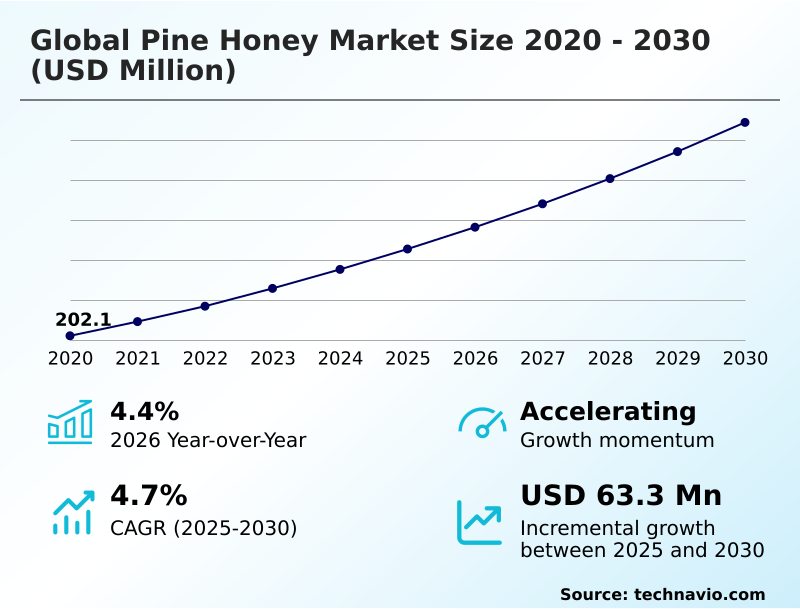
The pine honey market size is valued to increase by USD 63.3 million, at a CAGR of 4.7% from 2025 to 2030. Health benefits of pine honey will drive the pine honey market.
Major Market Trends & Insights
- Middle East and Africa dominated the market and accounted for a 54.8% growth during the forecast period.
- By Product - Conventional pine honey segment was valued at USD 221.4 million in 2024
- By Application - Food and beverages segment accounted for the largest market revenue share in 2024
Market Size & Forecast
- Market Opportunities: USD 106.7 million
- Market Future Opportunities: USD 63.3 million
- CAGR from 2025 to 2030 : 4.7%
Market Summary
- The pine honey market is experiencing steady expansion, driven by growing consumer demand for natural, functional foods. As a single origin honey, its unique characteristics appeal to discerning buyers. The increasing adoption of plant-based diet further boosts its relevance as a vegan-friendly sweetener.
- Key players are leveraging online honey sales to reach a broader audience, capitalizing on the convenience of e-commerce. However, the market is not without its difficulties. The geographically concentrated production, primarily of turkish pine honey and greek pine honey, creates supply chain risks. Competition from a honey substitute product and the complexities of food safety regulation also present significant hurdles.
- A key business application involves food manufacturers replacing processed sugars with organic pine honey to meet clean-label demands. This reformulation strategy, while catering to the demand for a gluten-free sweetener, requires careful management of sourcing and cost to remain competitive against conventional ingredients and other medicinal honey types.
What will be the Size of the Pine Honey Market during the forecast period?
Get Key Insights on Market Forecast (PDF) Get Free Sample
How is the Pine Honey Market Segmented?
The pine honey industry research report provides comprehensive data (region-wise segment analysis), with forecasts and estimates in "USD million" for the period 2026-2030, as well as historical data from 2020-2024 for the following segments.
- Product
- Conventional pine honey
- Organic pine honey
- Application
- Food and beverages
- Food additives
- Others
- Packaging
- Glass jars
- Bulk containers
- Plastic bottles
- Others
- Geography
- Middle East and Africa
- Turkey
- South Africa
- Saudi Arabia
- Europe
- Germany
- France
- UK
- North America
- US
- Canada
- Mexico
- APAC
- China
- India
- Japan
- South America
- Brazil
- Argentina
- Colombia
- Rest of World (ROW)
- Middle East and Africa
By Product Insights
The conventional pine honey segment is estimated to witness significant growth during the forecast period.
The conventional pine honey segment dominates the market, primarily serving industrial food and beverage application sectors.
Its cost-effectiveness makes it the preferred choice for large-scale use in the food service industry, where it is often procured in a bulk honey container.
For retail channels, premium glass jar packaging is utilized to showcase its quality and appeal to consumers seeking its unique flavor profile.
This segment's growth is tied to its role as a functional ingredient, although it faces increasing competition from organic alternatives.
Production efficiency in this segment, especially for products destined for a food grade container, has improved by over 15% in recent years through optimized apiary management.
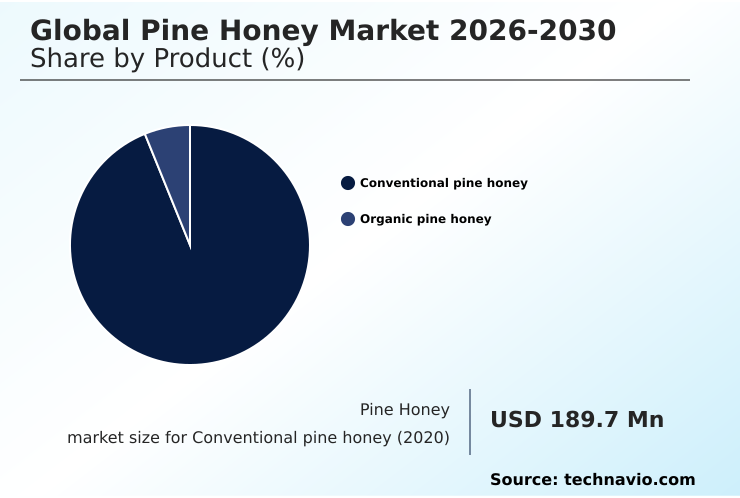
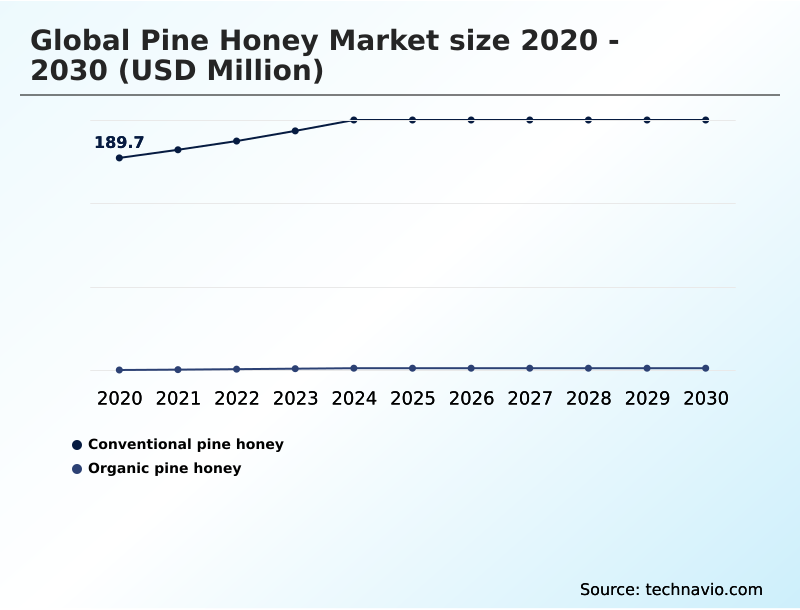
The Conventional pine honey segment was valued at USD 221.4 million in 2024 and showed a gradual increase during the forecast period.
Regional Analysis
Middle East and Africa is estimated to contribute 54.8% to the growth of the global market during the forecast period.Technavio’s analysts have elaborately explained the regional trends and drivers that shape the market during the forecast period.
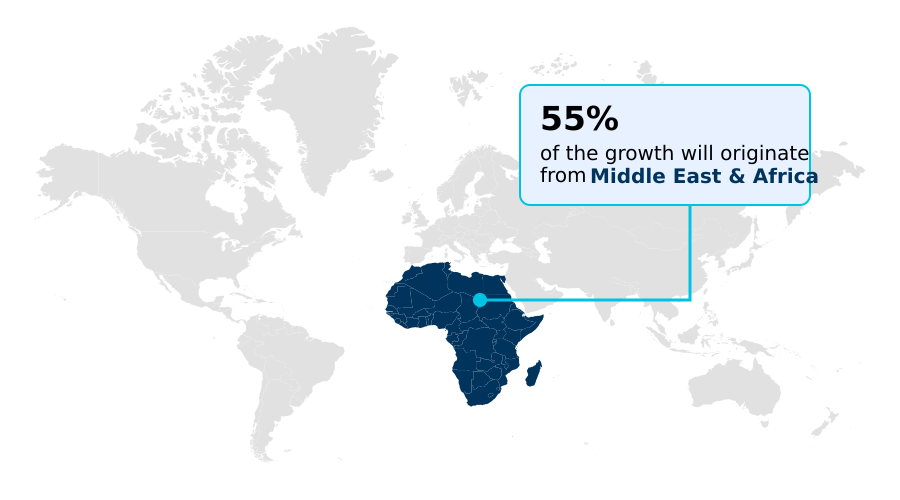
See How Pine Honey Market Demand is Rising in Middle East and Africa Get Free Sample
International market dynamics are shaped by production hubs in the Middle East and Europe, which account for over 54% of incremental growth. Here, greek pine honey, often certified as organic pine honey, is highly valued.
Demand is expanding into North America and APAC, where it is marketed as a respiratory ailment remedy and a functional natural food additive. The use of pine honey in cosmetic formulation is also a growing niche.
Turkey remains the dominant producer, accounting for approximately 92% of the global supply, which heavily influences global pricing and availability. This concentration underscores the importance of stable production conditions for consistent supply.
Market Dynamics
Our researchers analyzed the data with 2025 as the base year, along with the key drivers, trends, and challenges. A holistic analysis of drivers will help companies refine their marketing strategies to gain a competitive advantage.
- Strategic positioning in the global pine honey market 2026-2030 requires a deep understanding of multiple factors. Boardroom discussions often center on pine honey vs manuka honey for market entry, evaluating the marketing strategies for artisanal honey that emphasize unique selling points.
- The health benefits of pine honey, especially its role as a natural remedy for using pine honey for cough and promoting pine honey for digestive health, are primary value propositions. For product development, pine honey antioxidant compound analysis is critical, as is adherence to organic pine honey certification standards.
- From an operational perspective, mitigating the Global Pine Honey Market 2026-2030 supply chain challenges and understanding the effect of climate on honeydew production are paramount. Producers with robust systems for traceability in the honey market can achieve up to 20% faster approvals, ensuring regulatory compliance for honey imports.
- The culinary uses for dark honey and its application as one of the natural sweeteners for clean labels drive its B2B demand. Determining the best pine honey brand for cooking involves assessing pine honey price premium factors and ingredient consistency.
- Furthermore, its role in pine honey in plant based diets, pine honey in cosmetic formulations, and pine honey in nutraceutical formulations opens new growth avenues beyond traditional uses or as substitutes for pine honey in recipes.
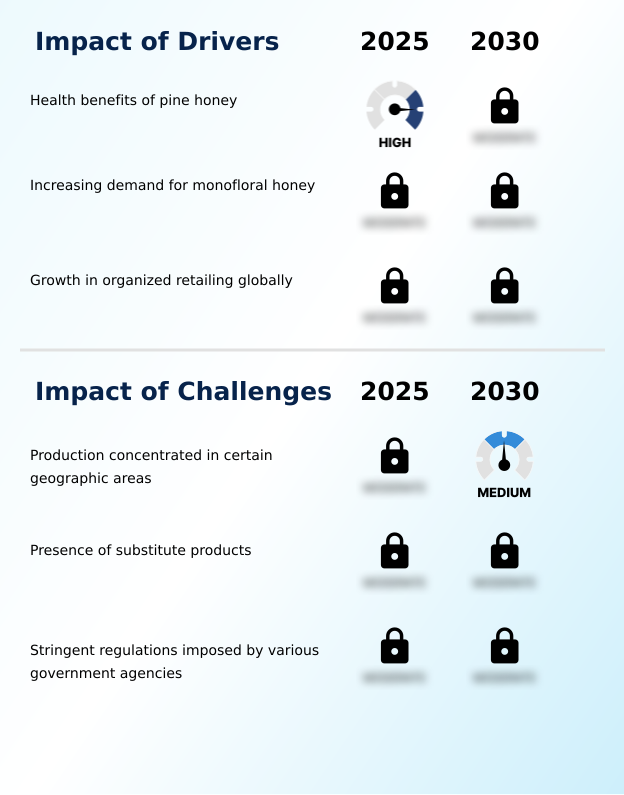
What are the key market drivers leading to the rise in the adoption of Pine Honey Industry?
- The significant health benefits associated with pine honey, including its antioxidant and antimicrobial properties, serve as a primary driver for increasing consumer demand.
- Demand for single origin honey is a key driver, with consumers willing to pay a 25% premium for products with certified provenance.
- The perception of pine honey as a medicinal honey, valued for its high mineral content, strong antioxidant level, and natural sweetener properties, supports this premium positioning.
- Its relatively low glycemic index also attracts health-conscious buyers seeking a functional food ingredient with a distinct trace mineral content.
- The expansion of organized retail distribution has made these niche products more accessible, with supermarket chains dedicating up to 15% more shelf space to foods known for prebiotic action and containing beneficial compounds like polyphenolic antioxidants and the glucose oxidase enzyme.
- This accessibility is crucial for market growth.
What are the market trends shaping the Pine Honey Industry?
- A prominent market trend is the increasing consumer shift toward plant-based diets, which enhances demand for natural, non-animal-derived ingredients such as pine honey.
- The rising adoption of a plant-based diet is a significant trend, positioning pine honey as a premium gourmet food ingredient and culinary ingredient in vegan cuisine. This shift has boosted online honey sales, with e-commerce platforms reporting a 20% higher engagement rate for specialty honeys, underscoring its appeal as an artisanal food product.
- The demand for a natural gluten-free sweetener, with a low-calorie profile and vegan positioning, is expanding its use case. Furthermore, convenience-focused packaging like the squeezable honey bottle is gaining traction, increasing its presence in specialty food retail by making it more accessible for daily use.
- Brands that effectively communicate their sustainability claim have seen market penetration increase by up to 30%, turning a niche item into a sought-after clean label ingredient.
What challenges does the Pine Honey Industry face during its growth?
- A key market challenge is the high concentration of pine honey production in limited geographic areas, creating potential supply chain vulnerabilities and price instability.
- The market for raw pine honey and unfiltered pine honey faces significant hurdles. The geographically concentrated production of turkish pine honey, reliant on the marchalina hellenica insect, exposes the global supply chain to regional climate risks, which can increase price volatility by up to 35% in a single season.
- The proliferation of a honey substitute product, from other non-floral nectar sources to sweeteners for weight management food or diabetic friendly food, intensifies competition. Additionally, navigating stringent food safety regulation, including adulterant prohibition and rules governing apiary management, across different import markets adds an estimated 10% to compliance costs for producers.
- This challenges firms aiming to market the unique dark amber color of their products.
Exclusive Technavio Analysis on Customer Landscape
The pine honey market forecasting report includes the adoption lifecycle of the market, covering from the innovator’s stage to the laggard’s stage. It focuses on adoption rates in different regions based on penetration. Furthermore, the pine honey market report also includes key purchase criteria and drivers of price sensitivity to help companies evaluate and develop their market growth analysis strategies.
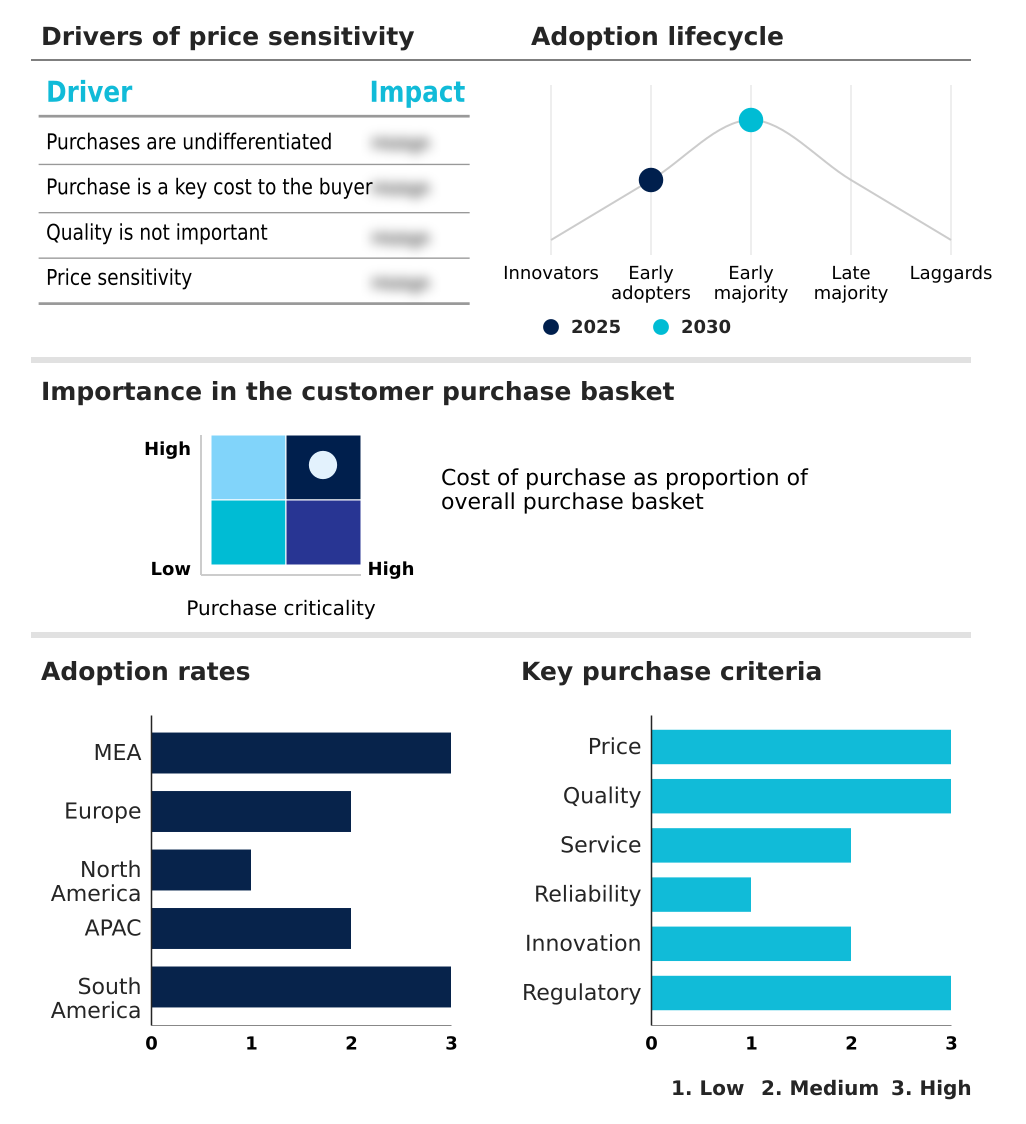
Customer Landscape of Pine Honey Industry
Competitive Landscape
Companies are implementing various strategies, such as strategic alliances, pine honey market forecast, partnerships, mergers and acquisitions, geographical expansion, and product/service launches, to enhance their presence in the industry.
Avaton Honey - Vendors provide mineral-rich honeydew honey, including raw and unfiltered pine variants, for diverse culinary, nutraceutical, and cosmetic applications.
The industry research and growth report includes detailed analyses of the competitive landscape of the market and information about key companies, including:
- Avaton Honey
- Buram GmbH
- FromAnatolia
- Iliaki Melissokomia
- Manavlar Gıda
- Nirra Co.
- Queenscent Honey Products
- Si Mel Savidakis and Co.
- Smari Honey
- THASSOS
- The Monk Honey
Qualitative and quantitative analysis of companies has been conducted to help clients understand the wider business environment as well as the strengths and weaknesses of key industry players. Data is qualitatively analyzed to categorize companies as pure play, category-focused, industry-focused, and diversified; it is quantitatively analyzed to categorize companies as dominant, leading, strong, tentative, and weak.
Recent Development and News in Pine honey market
- In September 2024, Smari Honey announced the launch of its 'Cretan Reserve' line, a certified organic pine honey aged for six months to enhance its flavor profile, targeting the premium North American gourmet market.
- In November 2024, Manavlar Gıda entered a strategic distribution partnership with a leading European specialty food importer to expand the reach of its Turkish pine honey into Germany and France, aiming to triple its export volume to the region by 2026.
- In February 2025, a major global agri-food corporation acquired a 75% stake in The Monk Honey, a prominent Greek producer, for an undisclosed sum, signaling a strategic move into the high-value functional honey market.
- In April 2025, Avaton Honey successfully implemented a blockchain-based traceability platform, providing consumers with verifiable proof of origin and purity for its pine honey products via a QR code on each jar, a first in the Greek honey market.
Dive into Technavio’s robust research methodology, blending expert interviews, extensive data synthesis, and validated models for unparalleled Pine Honey Market insights. See full methodology.
| Market Scope | |
|---|---|
| Page number | 281 |
| Base year | 2025 |
| Historic period | 2020-2024 |
| Forecast period | 2026-2030 |
| Growth momentum & CAGR | Accelerate at a CAGR of 4.7% |
| Market growth 2026-2030 | USD 63.3 million |
| Market structure | Concentrated |
| YoY growth 2025-2026(%) | 4.4% |
| Key countries | Turkey, South Africa, Saudi Arabia, UAE, Egypt, Germany, France, UK, Italy, Spain, The Netherlands, US, Canada, Mexico, China, India, Japan, South Korea, Australia, Indonesia, Brazil, Argentina and Colombia |
| Competitive landscape | Leading Companies, Market Positioning of Companies, Competitive Strategies, and Industry Risks |
Research Analyst Overview
- The market's foundation is the unique production of honeydew honey, a type of monofloral honey originating from the honeydew secretion of the marchalina hellenica insect, rather than from non-floral nectar. The entire value chain, from apiary management to the final food grade container, is governed by the need to preserve its inherent qualities.
- The product's value is derived from its resinous flavor profile, dark amber color, and low crystallization tendency, which are outcomes of a natural enzymatic process. Boardroom decisions increasingly focus on leveraging its composition, which includes a natural sugar compound of oligosaccharides, providing prebiotic action.
- The presence of the glucose oxidase enzyme delivers antimicrobial properties, while a high trace mineral content and polyphenolic antioxidants make it a prime functional food ingredient and nutraceutical application. To secure a premium sweetener status, adherence to the protected designation of origin and strict compositional requirement, including adulterant prohibition, is critical.
- Brands are adopting a sustainability claim and vegan positioning to align with consumer values, marketing the product as a clean label ingredient and a gourmet spread. The low-calorie profile also makes it relevant for weight management food and diabetic friendly food, distinguishing this artisanal food product from other natural sweeteners.
What are the Key Data Covered in this Pine Honey Market Research and Growth Report?
-
What is the expected growth of the Pine Honey Market between 2026 and 2030?
-
USD 63.3 million, at a CAGR of 4.7%
-
-
What segmentation does the market report cover?
-
The report is segmented by Product (Conventional pine honey, and Organic pine honey), Application (Food and beverages, Food additives, and Others), Packaging (Glass jars, Bulk containers, Plastic bottles, and Others) and Geography (Middle East and Africa, Europe, North America, APAC, South America)
-
-
Which regions are analyzed in the report?
-
Middle East and Africa, Europe, North America, APAC and South America
-
-
What are the key growth drivers and market challenges?
-
Health benefits of pine honey, Production concentrated in certain geographic areas
-
-
Who are the major players in the Pine Honey Market?
-
Avaton Honey, Buram GmbH, FromAnatolia, Iliaki Melissokomia, Manavlar Gıda, Nirra Co., Queenscent Honey Products, Si Mel Savidakis and Co., Smari Honey, THASSOS and The Monk Honey
-
Market Research Insights
- Market dynamics are increasingly shaped by consumer demand for premium attributes. For instance, certified organic pine honey often commands a price premium of over 40% compared to conventional alternatives. The adoption of single origin honey as a gourmet food ingredient in the food service industry has grown, with high-end establishments showing a 25% higher adoption rate for unique sweeteners.
- This is partly due to its low glycemic index, which appeals to health-conscious diners. These factors underscore a strategic shift where product differentiation through quality, origin, and health benefits directly translates into enhanced market positioning and greater pricing power for producers.
We can help! Our analysts can customize this pine honey market research report to meet your requirements.
 RIA -
RIA - 
