
Polypropylene Homopolymer (PPH) Market Analysis, Size, and Forecast 2026-2030: APAC (China, India, and Japan), Europe (Germany, Italy, and France), North America (US, Mexico, and Canada), Middle East and Africa (Turkey, Saudi Arabia, and South Africa), South America (Brazil, Argentina, and Colombia), and Rest of World (ROW)

Polypropylene Homopolymer (PPH) Market Analysis, Size, and Forecast 2026-2030:
APAC (China, India, and Japan), Europe (Germany, Italy, and France), North America (US, Mexico, and Canada), Middle East and Africa (Turkey, Saudi Arabia, and South Africa), South America (Brazil, Argentina, and Colombia), and Rest of World (ROW)

Published: Nov 2026 327 Pages SKU: IRTNTR81854

Market Overview at a Glance

$20.36 B
Market Opportunity
5.3%
CAGR 2025 - 2030
67.8%
APAC Growth
$21.31 B
Injection molding segment 2024

Polypropylene Homopolymer (Pph) Market Size 2026-2030

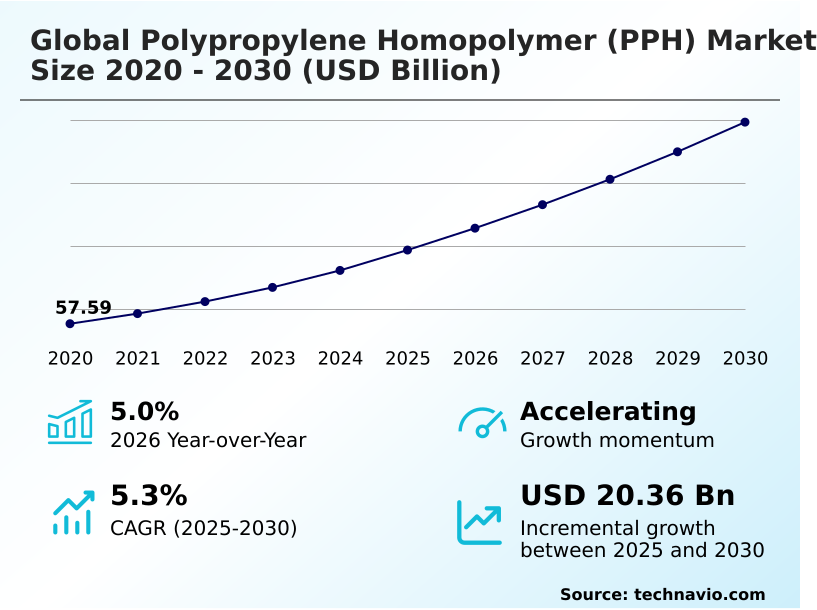
The polypropylene homopolymer (pph) market size is valued to increase by USD 20.36 billion, at a CAGR of 5.3% from 2025 to 2030. Surging demand for thin-wall injection molding and rigid packaging formats will drive the polypropylene homopolymer (pph) market.

Major Market Trends & Insights

  • APAC dominated the market and accounted for a 67.8% growth during the forecast period.
  • By Technology - Injection molding segment was valued at USD 21.31 billion in 2024
  • By End-user - Packaging segment accounted for the largest market revenue share in 2024

Market Size & Forecast

  • Market Opportunities: USD 32.08 billion
  • Market Future Opportunities: USD 20.36 billion
  • CAGR from 2025 to 2030 : 5.3%

Market Summary

  • Polypropylene Homopolymer (PPH) demand is fundamentally driven by an industrial pivot toward lightweight, highly rigid, and chemically inert materials across packaging and automotive sectors. Supply chain optimization strategies increasingly rely on localized polymer extrusion facilities to circumvent volatile international freight delays and ensure continuous availability of high-purity resins for critical conversion operations.
  • Consequently, leading packaging converters have achieved a 20% reduction in transport-related emissions by sourcing advanced reactor-grade materials closer to their injection molding centers. A primary driver of this market is the accelerated transition toward mono-material architectures, which drastically simplifies post-consumer mechanical recycling compared to legacy multi-layer laminates.
  • However, the industry grapples with the challenge of sub-zero temperature brittleness mitigation, as the inherently high crystallinity of the polymer limits its deployment in extreme cold-chain logistics without the addition of costly elastomeric modifiers. Manufacturers continue to adapt by employing advanced stereospecific polymerization methods that balance melt strength with structural resilience.
  • These strategic shifts secure long-term adoption across high-speed hygiene nonwoven fabrication and precision automotive engineering environments.

What will be the Size of the Polypropylene Homopolymer (Pph) Market during the forecast period?
Get Key Insights on Market Forecast (PDF) Get Free Sample

How is the Polypropylene Homopolymer (Pph) Market Segmented?

The polypropylene homopolymer (pph) industry research report provides comprehensive data (region-wise segment analysis), with forecasts and estimates in "USD million" for the period 2026-2030, as well as historical data from 2020-2024 for the following segments.

  • Technology
    • Injection molding
    • Fiber and raffia spinning
    • Extrusion
    • Thermoforming
    • Blow molding
  • End-user
    • Packaging
    • Textiles and non-wovens
    • Automotive and transportation
    • Electrical and electronics
    • Others
  • Type
    • Bulk process
    • Gas-phase process
    • Slurry process
    • Others
  • Geography
    • APAC
      • China
      • India
      • Japan
      • South Korea
      • Indonesia
      • Australia
    • Europe
      • Germany
      • Italy
      • France
      • Spain
      • UK
      • The Netherlands
    • North America
      • US
      • Mexico
      • Canada
    • Middle East and Africa
      • Turkey
      • Saudi Arabia
      • South Africa
      • UAE
      • Israel
    • South America
      • Brazil
      • Argentina
      • Colombia

By Technology Insights

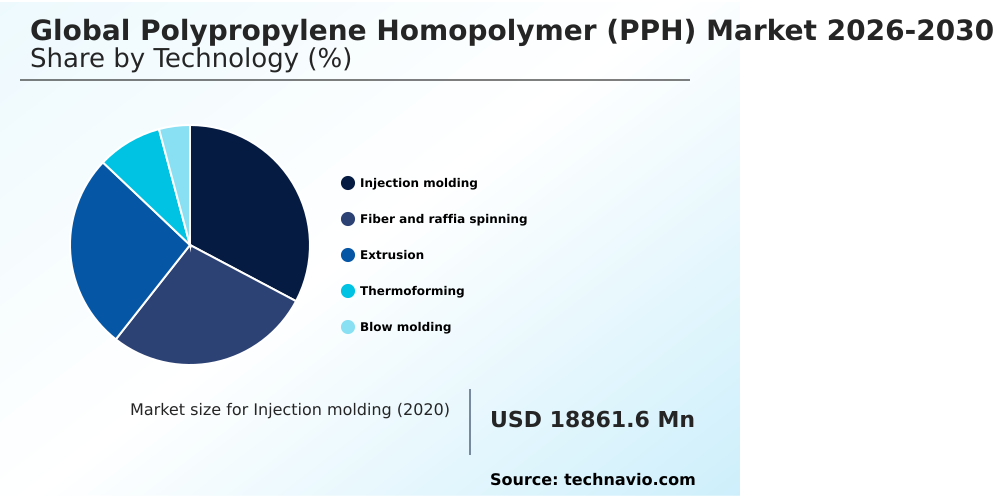
The injection molding segment is estimated to witness significant growth during the forecast period.

Injection molding functions as the primary processing technology for Polypropylene Homopolymer (PPH), driven by the demand for rigid packaging structures and rapid automated manufacturing cycles.

Converters utilize high melt flow formulations to achieve precise cavity filling, which reduces processing time by 15% across large-scale operations.

The inherent high isotactic arrangement of the polymer delivers essential stiffness, allowing manufacturers to decrease container wall thickness while maintaining stability. This downgauging capability translates directly into lower material consumption and optimized post-molding shrinkage compensation.

By integrating advanced nucleating agent addition, processors successfully elevate the thermal deflection threshold, enabling parts to withstand hot-fill packaging conditions.

This continuous shift toward thin-wall injection molding aligns with corporate material efficiency goals, directly improving overall dimensional stability maintenance by 12% across high-speed packaging lines.
Get Free Sample

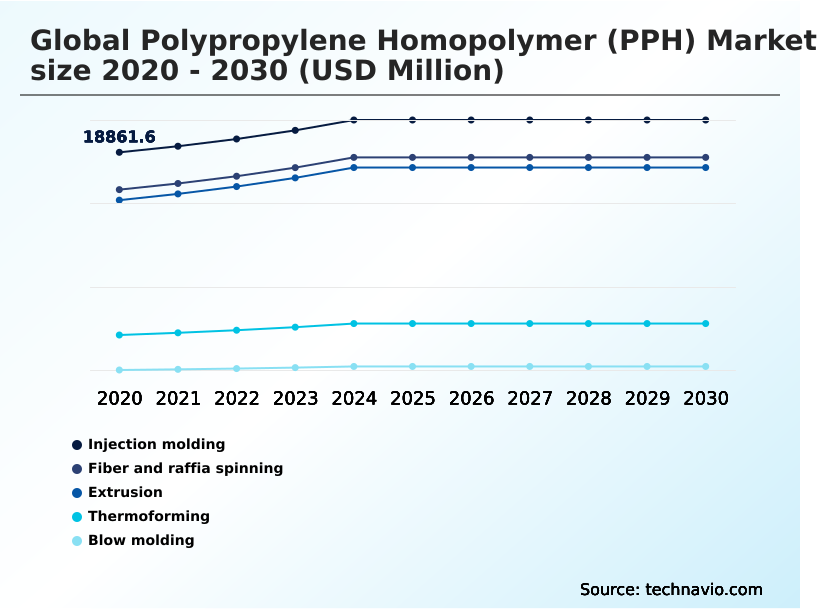
The Injection molding segment was valued at USD 21.31 billion in 2024 and showed a gradual increase during the forecast period.
Get Free Sample

Regional Analysis

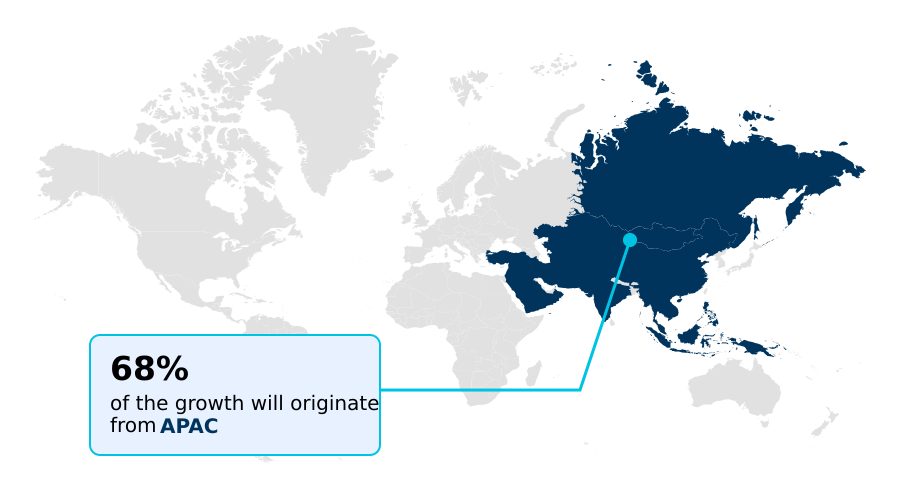
APAC is estimated to contribute 67.8% to the growth of the global market during the forecast period.Technavio’s analysts have elaborately explained the regional trends and drivers that shape the market during the forecast period.
See How Polypropylene Homopolymer (Pph) Market Demand is Rising in APAC Get Free Sample

The geographic adoption of Polypropylene Homopolymer (PPH) highlights distinct operational disparities between APAC and Europe.

APAC dominates industrial consumption, leveraging massive capacities in continuous tubular loop reactors and Ziegler-Natta catalyst platforms to achieve a 35% higher throughput efficiency in commodity packaging compared to Western counterparts.

Conversely, Europe prioritizes strict regulatory compliance, driving a 22% faster transition toward bio-attributed resins to satisfy rigorous carbon footprint reduction mandates.

This European shift emphasizes catalyst residue extraction for medical-grade applications, resulting in a 15% decrease in rejection rates for high-speed spunbond fiber extrusion processes.

While APAC focuses on maximizing scale for lightweighting implementation in consumer goods, European processors invest heavily in metallocene synthesized resins and peroxide-free degradation technologies to meet premium healthcare specifications.

These regional strategies reflect how businesses adapt their supply chains to protect operating margins.

Market Dynamics

Our researchers analyzed the data with 2025 as the base year, along with the key drivers, trends, and challenges. A holistic analysis of drivers will help companies refine their marketing strategies to gain a competitive advantage.

  • The continuous evolution of the Polypropylene Homopolymer (PPH) landscape is heavily influenced by the demand for specialized, high-performance applications across electronics, hygiene, and sustainable packaging. A critical area of advancement involves the production of ultra pure dielectric capacitor films, which are essential for modern electrification infrastructure and high-voltage energy transmission.
  • To optimize these materials, manufacturers are refining biaxial orientation stretching optimization techniques, which enhance electrical breakdown resistance far better than standard extrusion methods, effectively extending the operational lifespan of power grid components by up to 30%. Simultaneously, the personal care sector is driving the need for high speed hygiene nonwoven fabrication.
  • To meet strict regulatory standards for medical disposables, producers are developing peroxide free high melt flow resins that eliminate unwanted volatile residues. The industry is also witnessing a concerted push toward circular feedstock compliance pathways, prompting the integration of mass balanced bio attributed feedstocks that replicate the performance of virgin polymers without the associated carbon footprint.
  • In the packaging domain, the mono material flexible packaging shift is gaining momentum as brand owners prioritize end-of-life recyclability over legacy multi-material structures. Meanwhile, the automotive sector continues to push for high crystallinity automotive interior components to achieve vehicle weight reduction, though engineers must carefully navigate sub zero temperature brittleness mitigation and impact copolymer substitution strategies.
  • These coordinated efforts across different sectors highlight a strategic industrial focus on material purity, operational efficiency, and stringent environmental compliance.
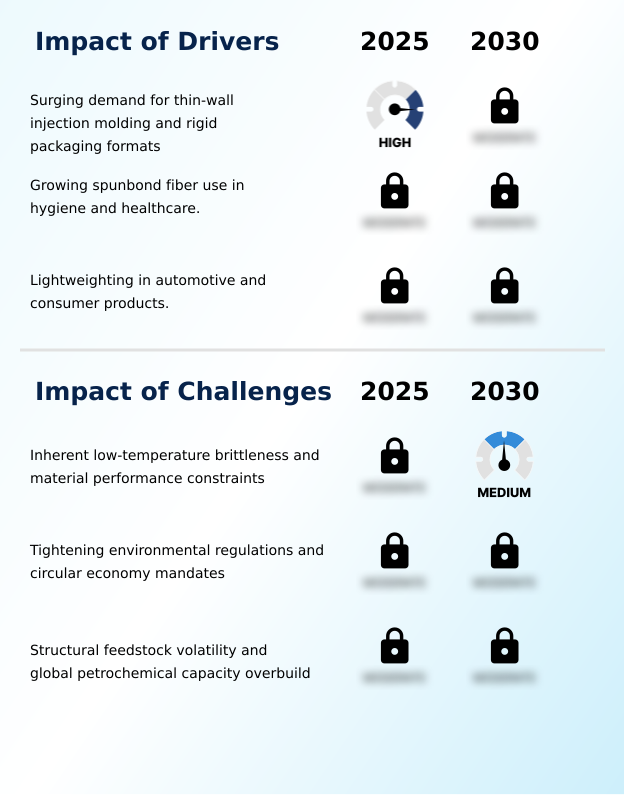
What are the key market drivers leading to the rise in the adoption of Polypropylene Homopolymer (Pph) Industry?

  • The surging demand for thin-wall injection molding and rigid packaging formats acts as a primary catalyst accelerating market expansion.

  • The aggressive pursuit of material efficiency across the automotive and consumer appliances sectors is a primary driver accelerating Polypropylene Homopolymer (PPH) adoption.
  • Manufacturers are increasingly utilizing flexural modulus enhancement to replace heavy metal frameworks, which has successfully reduced total component weight by 22% in next-generation interiors.
  • This transition is heavily supported by precise mineral filler integration into polymers with an inherently low specific gravity, improving structural rigidity while advancing mechanical recycling compatibility.
  • Consequently, suppliers leveraging supercritical loop prereactor technologies have achieved a 15% reduction in overall processing cycle times by utilizing high-flow grades that require less thermal energy.
  • These operational efficiencies, combined with strict visbreaking decomposition control and volatile organic emission reduction, ensure downstream processors can optimize their monomaterial architecture design footprint while maintaining tight dimensional tolerances.

What are the market trends shaping the Polypropylene Homopolymer (Pph) Industry?

  • The rising adoption of ultra-pure dielectric films for electrification and power grids represents a significant trend shaping the trajectory of the industry.

  • The rapid deployment of controlled rheology techniques is reshaping the Polypropylene Homopolymer (PPH) processing landscape, allowing manufacturers to achieve unprecedented precision in fiber spinning and molding. This shift is primarily driven by the demand for enhanced hydrophobic barrier performance in medical textiles, where advanced resin formulations have reduced moisture penetration by 24%.
  • Businesses benefit from these innovations through superior melt fracture mitigation, which directly lowers production scrap rates by 14% during microwaveable container fabrication. Furthermore, the integration of specialized stereo-regulating donor agents ensures tighter molecular distributions, resulting in a 20% improvement in dielectric breakdown strength across industrial films.
  • As companies prioritize structural consistency, the adoption of uniaxial drawing orientation alongside isobaric process optimization continues to accelerate, ensuring operational efficiency aligns with stringent performance requirements.

What challenges does the Polypropylene Homopolymer (Pph) Industry face during its growth?

  • Inherent low-temperature brittleness and material performance constraints pose considerable operational limitations that manufacturers must actively overcome.

  • Despite its broad industrial utility, the Polypropylene Homopolymer (PPH) sector faces significant operational limitations stemming from intricate stereospecific polymerization controls, which complicate its processing in sub-ambient environments. The polymer's high crystallinity directly causes severe low-temperature embrittlement, increasing structural failure rates by 30% in cold-chain logistics applications compared to impact-modified copolymers.
  • To address this, manufacturers resort to expensive secondary compounding that inadvertently compromises the microbial penetration resistance necessary for medical applications. Additionally, the challenge of maintaining parison sag prevention and thermal sag control during large-scale blow molding forces processors to operate within extremely narrow thermal windows, increasing machine downtime.
  • The stringent requirements for top-load resistance improvement in lightweight packaging further complicate tooling designs, while producers of medical textiles struggle to balance nonwoven web cohesion with the stability of fluidized bed reaction dynamics, requiring continuous investments in advanced cooling systems.

Exclusive Technavio Analysis on Customer Landscape

The polypropylene homopolymer (pph) market forecasting report includes the adoption lifecycle of the market, covering from the innovator’s stage to the laggard’s stage. It focuses on adoption rates in different regions based on penetration. Furthermore, the polypropylene homopolymer (pph) market report also includes key purchase criteria and drivers of price sensitivity to help companies evaluate and develop their market growth analysis strategies.
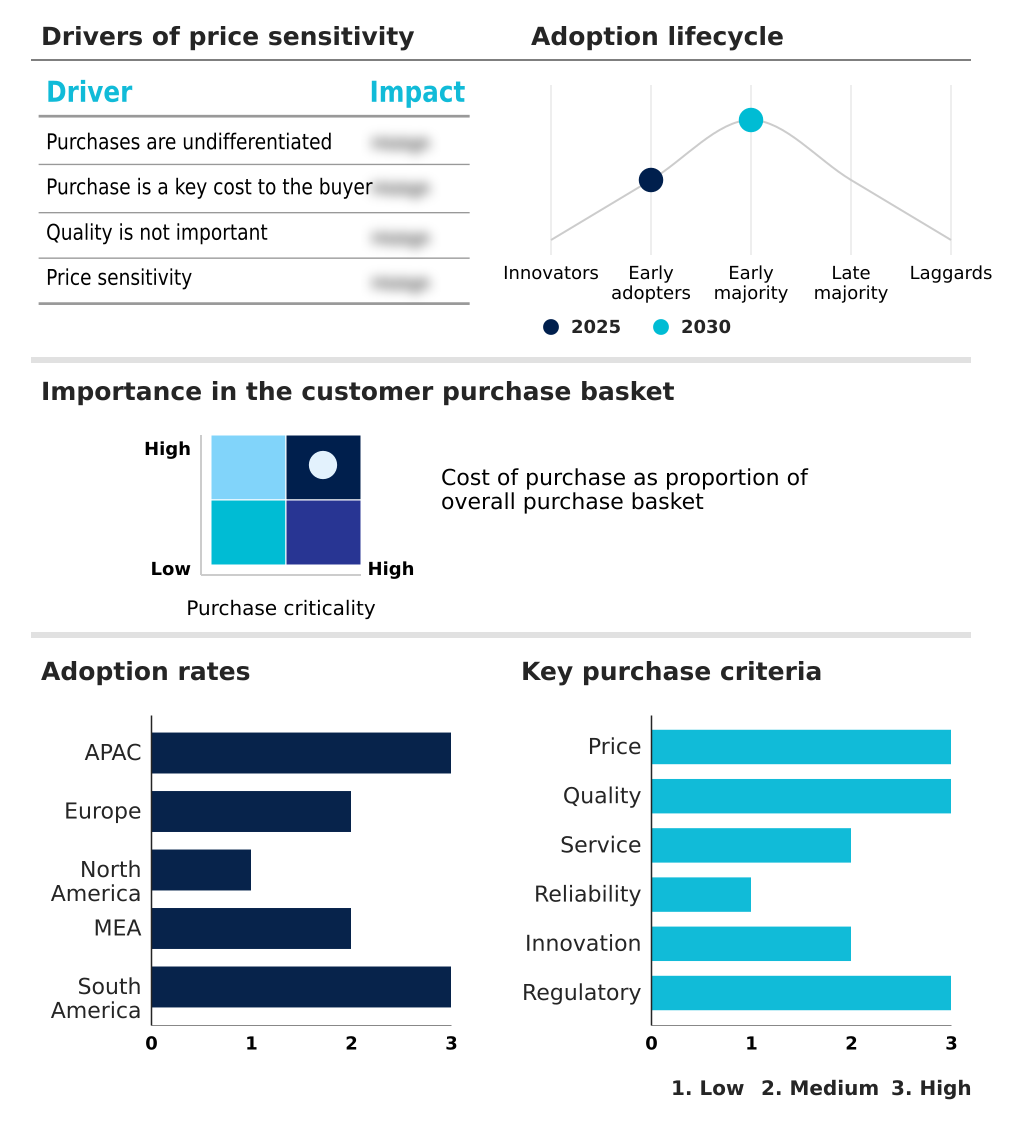
Customer Landscape of Polypropylene Homopolymer (Pph) Industry

Competitive Landscape

Companies are implementing various strategies, such as strategic alliances, polypropylene homopolymer (pph) market forecast, partnerships, mergers and acquisitions, geographical expansion, and product/service launches, to enhance their presence in the industry.

Apex Polymers - The enterprise delivers highly specialized injection molding homopolymers and advanced extrusion grade resins engineered to optimize structural rigidity and processing efficiency across demanding industrial applications.

The industry research and growth report includes detailed analyses of the competitive landscape of the market and information about key companies, including:

  • Apex Polymers
  • Ascent Petrochem Holdings Co.
  • Borealis AG
  • Borouge PLC
  • Braskem SA
  • ExxonMobil Chemical Co.
  • Formosa Plastics Corp.
  • Indian Oil Corp. Ltd.
  • INEOS Group Holdings S.A.
  • Lotte Chemical Titan Holding Bhd
  • Lyanchemicals Tech Co. Ltd.
  • LyondellBasell Industries N.V.
  • PetroChina Co. Ltd.
  • Sasol Ltd.
  • Saudi Basic Industries
  • Shree Meenakshi Polymers
  • SIBUR International GmbH
  • Sumitomo Chemical Europe S.A
  • TotalEnergies SE
  • Xiamen Keyuan Plastic Co. Ltd.

Qualitative and quantitative analysis of companies has been conducted to help clients understand the wider business environment as well as the strengths and weaknesses of key industry players. Data is qualitatively analyzed to categorize companies as pure play, category-focused, industry-focused, and diversified; it is quantitatively analyzed to categorize companies as dominant, leading, strong, tentative, and weak.

Recent Development and News in Polypropylene homopolymer (pph) market

  • In the Commodity Chemicals industry, the rapid deployment of mass-balance certification frameworks has established formalized tracking for circular feedstocks, directly impacting Polypropylene Homopolymer (PPH) demand by enabling packaging converters to meet strict regulatory recycling quotas.
  • The shift toward electrified grid infrastructure and high-voltage transmission networks has accelerated requirements for ultra-low dissipation materials, elevating consumption for specialized biaxially oriented dielectric films within capacitor manufacturing.
  • The implementation of stringent volatile organic emission reduction standards across healthcare sectors has phased out traditional peroxide-induced visbreaking decomposition control, pulling demand toward advanced reactor-grade nonwoven polymers.
  • Regional mandates aimed at decarbonizing automotive supply chains have pushed manufacturers toward extreme lightweighting implementation, expanding the use of mineral filler integration strategies to replace heavier metal components.

Dive into Technavio’s robust research methodology, blending expert interviews, extensive data synthesis, and validated models for unparalleled Polypropylene Homopolymer (Pph) Market insights. See full methodology.

Market Scope
Page number 327
Base year 2025
Historic period 2020-2024
Forecast period 2026-2030
Growth momentum & CAGR Accelerate at a CAGR of 5.3%
Market growth 2026-2030 USD 20356.2 million
Market structure Fragmented
YoY growth 2025-2026(%) 5.0%
Key countries China, India, Japan, South Korea, Indonesia, Australia, Germany, Italy, France, Spain, UK, The Netherlands, US, Mexico, Canada, Turkey, Saudi Arabia, South Africa, UAE, Israel, Brazil, Argentina and Colombia
Competitive landscape Leading Companies, Market Positioning of Companies, Competitive Strategies, and Industry Risks

Request Free Sample

Research Analyst Overview

  • The Polypropylene Homopolymer (PPH) sector is rapidly advancing through the integration of highly refined stereospecific polymerization and proprietary metallocene synthesized resins. This technological evolution allows polymer chemists to precisely engineer the molecular weight distribution, fundamentally enhancing nonwoven web cohesion for critical hygiene applications.
  • A defining trend is the strategic shift toward ultra-pure formulations for biaxially oriented dielectric films, which directly influences executive boardroom decisions regarding premium product pricing and energy sector compliance. By investing in these high-margin specialty resins, manufacturers have successfully improved overall energy efficiency in film extrusion by 18%.
  • Furthermore, the utilization of supercritical loop prereactor technology has drastically optimized plant throughput and operational flexibility. Advanced Ziegler-Natta catalyst platforms now enable the production of resins with an exceptionally low specific gravity, allowing automotive manufacturers to achieve critical lightweighting targets without compromising structural integrity.
  • The continuous optimization of fluidized bed reaction dynamics ensures minimal volatile emissions, aligning large-scale industrial output with aggressive global decarbonization mandates. These engineering breakthroughs are reshaping competitive dynamics across the global plastics supply chain.

What are the Key Data Covered in this Polypropylene Homopolymer (Pph) Market Research and Growth Report?

  • What is the expected growth of the Polypropylene Homopolymer (Pph) Market between 2026 and 2030?

    • USD 20.36 billion, at a CAGR of 5.3%

  • What segmentation does the market report cover?

    • The report is segmented by Technology (Injection molding, Fiber and raffia spinning, Extrusion, Thermoforming, and Blow molding), End-user (Packaging, Textiles and non-wovens, Automotive and transportation, Electrical and electronics, and Others), Type (Bulk process, Gas-phase process, Slurry process, and Others) and Geography (APAC, Europe, North America, Middle East and Africa, South America)

  • Which regions are analyzed in the report?

    • APAC, Europe, North America, Middle East and Africa and South America

  • What are the key growth drivers and market challenges?

    • Surging demand for thin-wall injection molding and rigid packaging formats, Inherent low-temperature brittleness and material performance constraints

  • Who are the major players in the Polypropylene Homopolymer (Pph) Market?

    • Apex Polymers, Ascent Petrochem Holdings Co., Borealis AG, Borouge PLC, Braskem SA, ExxonMobil Chemical Co., Formosa Plastics Corp., Indian Oil Corp. Ltd., INEOS Group Holdings S.A., Lotte Chemical Titan Holding Bhd, Lyanchemicals Tech Co. Ltd., LyondellBasell Industries N.V., PetroChina Co. Ltd., Sasol Ltd., Saudi Basic Industries, Shree Meenakshi Polymers, SIBUR International GmbH, Sumitomo Chemical Europe S.A, TotalEnergies SE and Xiamen Keyuan Plastic Co. Ltd.

Market Research Insights

  • The Polypropylene Homopolymer (PPH) landscape is undergoing a structural realignment focused on material efficiency and closed-loop recyclability. Processors are increasingly adopting monomaterial architecture design, which has improved mechanical recycling compatibility by 28% across municipal waste streams. To meet stringent safety standards, manufacturers are implementing volatile organic emission reduction protocols, achieving a 15% decrease in factory outgassing during high-speed melt processing.
  • Additionally, advances in thermal sag control have optimized thermoforming yield rates, reducing material scrap by 12% in rigid packaging structures. These measurable operational enhancements allow consumer goods brands to align with aggressive corporate sustainability mandates while maintaining the dimensional stability maintenance required for long-distance transit and retail display.

We can help! Our analysts can customize this polypropylene homopolymer (pph) market research report to meet your requirements.

Get in touch

1. Executive Summary

1.1 Market overview

Executive Summary - Chart on Market Overview
Executive Summary - Data Table on Market Overview
Executive Summary - Chart on Global Market Characteristics
Executive Summary - Chart on Market by Geography
Executive Summary - Chart on Market Segmentation by Technology
Executive Summary - Chart on Market Segmentation by End-user
Executive Summary - Chart on Market Segmentation by Type
Executive Summary - Chart on Incremental Growth
Executive Summary - Data Table on Incremental Growth
Executive Summary - Chart on Company Market Positioning

2. Technavio Analysis

2.1 Analysis of price sensitivity, lifecycle, customer purchase basket, adoption rates, and purchase criteria

2.2 Criticality of inputs and Factors of differentiation

Chart on Overview on criticality of inputs and factors of differentiation

2.3 Factors of disruption

Chart on Overview on factors of disruption

2.4 Impact of drivers and challenges

Chart on Impact of drivers and challenges in 2025 and 2030

3. Market Landscape

3.1 Market ecosystem

Chart on Parent Market
Data Table on - Parent Market

3.2 Market characteristics

Chart on Market characteristics analysis

3.3 Value chain analysis

Chart on Value chain analysis

4. Market Sizing

4.1 Market definition

Data Table on Offerings of companies included in the market definition

4.2 Market segment analysis

Market segments

4.3 Market size 2025

4.4 Market outlook: Forecast for 2025-2030

Chart on Global - Market size and forecast 2025-2030 ($ million)
Data Table on Global - Market size and forecast 2025-2030 ($ million)
Chart on Global Market: Year-over-year growth 2025-2030 (%)
Data Table on Global Market: Year-over-year growth 2025-2030 (%)

5. Historic Market Size

5.1 Global Polypropylene Homopolymer (PPH) Market 2020 - 2024

Historic Market Size - Data Table on Global Polypropylene Homopolymer (PPH) Market 2020 - 2024 ($ million)

5.2 Technology segment analysis 2020 - 2024

Historic Market Size - Technology Segment 2020 - 2024 ($ million)

5.3 End-user segment analysis 2020 - 2024

Historic Market Size - End-user Segment 2020 - 2024 ($ million)

5.4 Type segment analysis 2020 - 2024

Historic Market Size - Type Segment 2020 - 2024 ($ million)

5.5 Geography segment analysis 2020 - 2024

Historic Market Size - Geography Segment 2020 - 2024 ($ million)

5.6 Country segment analysis 2020 - 2024

Historic Market Size - Country Segment 2020 - 2024 ($ million)

6. Qualitative Analysis

6.1 Impact of AI on Global Polypropylene Homopolymer (PPH) Market

6.2 Impact of Geopolitical Conflicts on Global polypropylene homopolymer (PPH) market

7. Five Forces Analysis

7.1 Five forces summary

Five forces analysis - Comparison between 2025 and 2030

7.2 Bargaining power of buyers

Bargaining power of buyers - Impact of key factors 2025 and 2030

7.3 Bargaining power of suppliers

Bargaining power of suppliers - Impact of key factors in 2025 and 2030

7.4 Threat of new entrants

Threat of new entrants - Impact of key factors in 2025 and 2030

7.5 Threat of substitutes

Threat of substitutes - Impact of key factors in 2025 and 2030

7.6 Threat of rivalry

Threat of rivalry - Impact of key factors in 2025 and 2030

7.7 Market condition

Chart on Market condition - Five forces 2025 and 2030

8. Market Segmentation by Technology

8.1 Market segments

Chart on Technology - Market share 2025-2030 (%)
Data Table on Technology - Market share 2025-2030 (%)

8.2 Comparison by Technology

Chart on Comparison by Technology
Data Table on Comparison by Technology

8.3 Injection molding - Market size and forecast 2025-2030

Chart on Injection molding - Market size and forecast 2025-2030 ($ million)
Data Table on Injection molding - Market size and forecast 2025-2030 ($ million)
Chart on Injection molding - Year-over-year growth 2025-2030 (%)
Data Table on Injection molding - Year-over-year growth 2025-2030 (%)

8.4 Fiber and raffia spinning - Market size and forecast 2025-2030

Chart on Fiber and raffia spinning - Market size and forecast 2025-2030 ($ million)
Data Table on Fiber and raffia spinning - Market size and forecast 2025-2030 ($ million)
Chart on Fiber and raffia spinning - Year-over-year growth 2025-2030 (%)
Data Table on Fiber and raffia spinning - Year-over-year growth 2025-2030 (%)

8.5 Extrusion - Market size and forecast 2025-2030

Chart on Extrusion - Market size and forecast 2025-2030 ($ million)
Data Table on Extrusion - Market size and forecast 2025-2030 ($ million)
Chart on Extrusion - Year-over-year growth 2025-2030 (%)
Data Table on Extrusion - Year-over-year growth 2025-2030 (%)

8.6 Thermoforming - Market size and forecast 2025-2030

Chart on Thermoforming - Market size and forecast 2025-2030 ($ million)
Data Table on Thermoforming - Market size and forecast 2025-2030 ($ million)
Chart on Thermoforming - Year-over-year growth 2025-2030 (%)
Data Table on Thermoforming - Year-over-year growth 2025-2030 (%)

8.7 Blow molding - Market size and forecast 2025-2030

Chart on Blow molding - Market size and forecast 2025-2030 ($ million)
Data Table on Blow molding - Market size and forecast 2025-2030 ($ million)
Chart on Blow molding - Year-over-year growth 2025-2030 (%)
Data Table on Blow molding - Year-over-year growth 2025-2030 (%)

8.8 Market opportunity by Technology

Market opportunity by Technology ($ million)
Data Table on Market opportunity by Technology ($ million)

9. Market Segmentation by End-user

9.1 Market segments

Chart on End-user - Market share 2025-2030 (%)
Data Table on End-user - Market share 2025-2030 (%)

9.2 Comparison by End-user

Chart on Comparison by End-user
Data Table on Comparison by End-user

9.3 Packaging - Market size and forecast 2025-2030

Chart on Packaging - Market size and forecast 2025-2030 ($ million)
Data Table on Packaging - Market size and forecast 2025-2030 ($ million)
Chart on Packaging - Year-over-year growth 2025-2030 (%)
Data Table on Packaging - Year-over-year growth 2025-2030 (%)

9.4 Textiles and non-wovens - Market size and forecast 2025-2030

Chart on Textiles and non-wovens - Market size and forecast 2025-2030 ($ million)
Data Table on Textiles and non-wovens - Market size and forecast 2025-2030 ($ million)
Chart on Textiles and non-wovens - Year-over-year growth 2025-2030 (%)
Data Table on Textiles and non-wovens - Year-over-year growth 2025-2030 (%)

9.5 Automotive and transportation - Market size and forecast 2025-2030

Chart on Automotive and transportation - Market size and forecast 2025-2030 ($ million)
Data Table on Automotive and transportation - Market size and forecast 2025-2030 ($ million)
Chart on Automotive and transportation - Year-over-year growth 2025-2030 (%)
Data Table on Automotive and transportation - Year-over-year growth 2025-2030 (%)

9.6 Electrical and electronics - Market size and forecast 2025-2030

Chart on Electrical and electronics - Market size and forecast 2025-2030 ($ million)
Data Table on Electrical and electronics - Market size and forecast 2025-2030 ($ million)
Chart on Electrical and electronics - Year-over-year growth 2025-2030 (%)
Data Table on Electrical and electronics - Year-over-year growth 2025-2030 (%)

9.7 Others - Market size and forecast 2025-2030

Chart on Others - Market size and forecast 2025-2030 ($ million)
Data Table on Others - Market size and forecast 2025-2030 ($ million)
Chart on Others - Year-over-year growth 2025-2030 (%)
Data Table on Others - Year-over-year growth 2025-2030 (%)

9.8 Market opportunity by End-user

Market opportunity by End-user ($ million)
Data Table on Market opportunity by End-user ($ million)

10. Market Segmentation by Type

10.1 Market segments

Chart on Type - Market share 2025-2030 (%)
Data Table on Type - Market share 2025-2030 (%)

10.2 Comparison by Type

Chart on Comparison by Type
Data Table on Comparison by Type

10.3 Bulk process - Market size and forecast 2025-2030

Chart on Bulk process - Market size and forecast 2025-2030 ($ million)
Data Table on Bulk process - Market size and forecast 2025-2030 ($ million)
Chart on Bulk process - Year-over-year growth 2025-2030 (%)
Data Table on Bulk process - Year-over-year growth 2025-2030 (%)

10.4 Gas-phase process - Market size and forecast 2025-2030

Chart on Gas-phase process - Market size and forecast 2025-2030 ($ million)
Data Table on Gas-phase process - Market size and forecast 2025-2030 ($ million)
Chart on Gas-phase process - Year-over-year growth 2025-2030 (%)
Data Table on Gas-phase process - Year-over-year growth 2025-2030 (%)

10.5 Slurry process - Market size and forecast 2025-2030

Chart on Slurry process - Market size and forecast 2025-2030 ($ million)
Data Table on Slurry process - Market size and forecast 2025-2030 ($ million)
Chart on Slurry process - Year-over-year growth 2025-2030 (%)
Data Table on Slurry process - Year-over-year growth 2025-2030 (%)

10.6 Others - Market size and forecast 2025-2030

Chart on Others - Market size and forecast 2025-2030 ($ million)
Data Table on Others - Market size and forecast 2025-2030 ($ million)
Chart on Others - Year-over-year growth 2025-2030 (%)
Data Table on Others - Year-over-year growth 2025-2030 (%)

10.7 Market opportunity by Type

Market opportunity by Type ($ million)
Data Table on Market opportunity by Type ($ million)

11. Customer Landscape

11.1 Customer landscape overview

Analysis of price sensitivity, lifecycle, customer purchase basket, adoption rates, and purchase criteria

12. Geographic Landscape

12.1 Geographic segmentation

Chart on Market share by geography 2025-2030 (%)
Data Table on Market share by geography 2025-2030 (%)

12.2 Geographic comparison

Chart on Geographic comparison
Data Table on Geographic comparison

12.3 APAC - Market size and forecast 2025-2030

Chart on APAC - Market size and forecast 2025-2030 ($ million)
Data Table on APAC - Market size and forecast 2025-2030 ($ million)
Chart on APAC - Year-over-year growth 2025-2030 (%)
Data Table on APAC - Year-over-year growth 2025-2030 (%)
Chart on Regional Comparison - APAC
Data Table on Regional Comparison - APAC

12.3.1 China - Market size and forecast 2025-2030

Chart on China - Market size and forecast 2025-2030 ($ million)
Data Table on China - Market size and forecast 2025-2030 ($ million)
Chart on China - Year-over-year growth 2025-2030 (%)
Data Table on China - Year-over-year growth 2025-2030 (%)

12.3.2 India - Market size and forecast 2025-2030

Chart on India - Market size and forecast 2025-2030 ($ million)
Data Table on India - Market size and forecast 2025-2030 ($ million)
Chart on India - Year-over-year growth 2025-2030 (%)
Data Table on India - Year-over-year growth 2025-2030 (%)

12.3.3 Japan - Market size and forecast 2025-2030

Chart on Japan - Market size and forecast 2025-2030 ($ million)
Data Table on Japan - Market size and forecast 2025-2030 ($ million)
Chart on Japan - Year-over-year growth 2025-2030 (%)
Data Table on Japan - Year-over-year growth 2025-2030 (%)

12.3.4 South Korea - Market size and forecast 2025-2030

Chart on South Korea - Market size and forecast 2025-2030 ($ million)
Data Table on South Korea - Market size and forecast 2025-2030 ($ million)
Chart on South Korea - Year-over-year growth 2025-2030 (%)
Data Table on South Korea - Year-over-year growth 2025-2030 (%)

12.3.5 Indonesia - Market size and forecast 2025-2030

Chart on Indonesia - Market size and forecast 2025-2030 ($ million)
Data Table on Indonesia - Market size and forecast 2025-2030 ($ million)
Chart on Indonesia - Year-over-year growth 2025-2030 (%)
Data Table on Indonesia - Year-over-year growth 2025-2030 (%)

12.3.6 Australia - Market size and forecast 2025-2030

Chart on Australia - Market size and forecast 2025-2030 ($ million)
Data Table on Australia - Market size and forecast 2025-2030 ($ million)
Chart on Australia - Year-over-year growth 2025-2030 (%)
Data Table on Australia - Year-over-year growth 2025-2030 (%)

12.4 Europe - Market size and forecast 2025-2030

Chart on Europe - Market size and forecast 2025-2030 ($ million)
Data Table on Europe - Market size and forecast 2025-2030 ($ million)
Chart on Europe - Year-over-year growth 2025-2030 (%)
Data Table on Europe - Year-over-year growth 2025-2030 (%)
Chart on Regional Comparison - Europe
Data Table on Regional Comparison - Europe

12.4.1 Germany - Market size and forecast 2025-2030

Chart on Germany - Market size and forecast 2025-2030 ($ million)
Data Table on Germany - Market size and forecast 2025-2030 ($ million)
Chart on Germany - Year-over-year growth 2025-2030 (%)
Data Table on Germany - Year-over-year growth 2025-2030 (%)

12.4.2 Italy - Market size and forecast 2025-2030

Chart on Italy - Market size and forecast 2025-2030 ($ million)
Data Table on Italy - Market size and forecast 2025-2030 ($ million)
Chart on Italy - Year-over-year growth 2025-2030 (%)
Data Table on Italy - Year-over-year growth 2025-2030 (%)

12.4.3 France - Market size and forecast 2025-2030

Chart on France - Market size and forecast 2025-2030 ($ million)
Data Table on France - Market size and forecast 2025-2030 ($ million)
Chart on France - Year-over-year growth 2025-2030 (%)
Data Table on France - Year-over-year growth 2025-2030 (%)

12.4.4 Spain - Market size and forecast 2025-2030

Chart on Spain - Market size and forecast 2025-2030 ($ million)
Data Table on Spain - Market size and forecast 2025-2030 ($ million)
Chart on Spain - Year-over-year growth 2025-2030 (%)
Data Table on Spain - Year-over-year growth 2025-2030 (%)

12.4.5 UK - Market size and forecast 2025-2030

Chart on UK - Market size and forecast 2025-2030 ($ million)
Data Table on UK - Market size and forecast 2025-2030 ($ million)
Chart on UK - Year-over-year growth 2025-2030 (%)
Data Table on UK - Year-over-year growth 2025-2030 (%)

12.4.6 The Netherlands - Market size and forecast 2025-2030

Chart on The Netherlands - Market size and forecast 2025-2030 ($ million)
Data Table on The Netherlands - Market size and forecast 2025-2030 ($ million)
Chart on The Netherlands - Year-over-year growth 2025-2030 (%)
Data Table on The Netherlands - Year-over-year growth 2025-2030 (%)

12.5 North America - Market size and forecast 2025-2030

Chart on North America - Market size and forecast 2025-2030 ($ million)
Data Table on North America - Market size and forecast 2025-2030 ($ million)
Chart on North America - Year-over-year growth 2025-2030 (%)
Data Table on North America - Year-over-year growth 2025-2030 (%)
Chart on Regional Comparison - North America
Data Table on Regional Comparison - North America

12.5.1 US - Market size and forecast 2025-2030

Chart on US - Market size and forecast 2025-2030 ($ million)
Data Table on US - Market size and forecast 2025-2030 ($ million)
Chart on US - Year-over-year growth 2025-2030 (%)
Data Table on US - Year-over-year growth 2025-2030 (%)

12.5.2 Mexico - Market size and forecast 2025-2030

Chart on Mexico - Market size and forecast 2025-2030 ($ million)
Data Table on Mexico - Market size and forecast 2025-2030 ($ million)
Chart on Mexico - Year-over-year growth 2025-2030 (%)
Data Table on Mexico - Year-over-year growth 2025-2030 (%)

12.5.3 Canada - Market size and forecast 2025-2030

Chart on Canada - Market size and forecast 2025-2030 ($ million)
Data Table on Canada - Market size and forecast 2025-2030 ($ million)
Chart on Canada - Year-over-year growth 2025-2030 (%)
Data Table on Canada - Year-over-year growth 2025-2030 (%)

12.6 Middle East and Africa - Market size and forecast 2025-2030

Chart on Middle East and Africa - Market size and forecast 2025-2030 ($ million)
Data Table on Middle East and Africa - Market size and forecast 2025-2030 ($ million)
Chart on Middle East and Africa - Year-over-year growth 2025-2030 (%)
Data Table on Middle East and Africa - Year-over-year growth 2025-2030 (%)
Chart on Regional Comparison - Middle East and Africa
Data Table on Regional Comparison - Middle East and Africa

12.6.1 Turkey - Market size and forecast 2025-2030

Chart on Turkey - Market size and forecast 2025-2030 ($ million)
Data Table on Turkey - Market size and forecast 2025-2030 ($ million)
Chart on Turkey - Year-over-year growth 2025-2030 (%)
Data Table on Turkey - Year-over-year growth 2025-2030 (%)

12.6.2 Saudi Arabia - Market size and forecast 2025-2030

Chart on Saudi Arabia - Market size and forecast 2025-2030 ($ million)
Data Table on Saudi Arabia - Market size and forecast 2025-2030 ($ million)
Chart on Saudi Arabia - Year-over-year growth 2025-2030 (%)
Data Table on Saudi Arabia - Year-over-year growth 2025-2030 (%)

12.6.3 South Africa - Market size and forecast 2025-2030

Chart on South Africa - Market size and forecast 2025-2030 ($ million)
Data Table on South Africa - Market size and forecast 2025-2030 ($ million)
Chart on South Africa - Year-over-year growth 2025-2030 (%)
Data Table on South Africa - Year-over-year growth 2025-2030 (%)

12.6.4 UAE - Market size and forecast 2025-2030

Chart on UAE - Market size and forecast 2025-2030 ($ million)
Data Table on UAE - Market size and forecast 2025-2030 ($ million)
Chart on UAE - Year-over-year growth 2025-2030 (%)
Data Table on UAE - Year-over-year growth 2025-2030 (%)

12.6.5 Israel - Market size and forecast 2025-2030

Chart on Israel - Market size and forecast 2025-2030 ($ million)
Data Table on Israel - Market size and forecast 2025-2030 ($ million)
Chart on Israel - Year-over-year growth 2025-2030 (%)
Data Table on Israel - Year-over-year growth 2025-2030 (%)

12.7 South America - Market size and forecast 2025-2030

Chart on South America - Market size and forecast 2025-2030 ($ million)
Data Table on South America - Market size and forecast 2025-2030 ($ million)
Chart on South America - Year-over-year growth 2025-2030 (%)
Data Table on South America - Year-over-year growth 2025-2030 (%)
Chart on Regional Comparison - South America
Data Table on Regional Comparison - South America

12.7.1 Brazil - Market size and forecast 2025-2030

Chart on Brazil - Market size and forecast 2025-2030 ($ million)
Data Table on Brazil - Market size and forecast 2025-2030 ($ million)
Chart on Brazil - Year-over-year growth 2025-2030 (%)
Data Table on Brazil - Year-over-year growth 2025-2030 (%)

12.7.2 Argentina - Market size and forecast 2025-2030

Chart on Argentina - Market size and forecast 2025-2030 ($ million)
Data Table on Argentina - Market size and forecast 2025-2030 ($ million)
Chart on Argentina - Year-over-year growth 2025-2030 (%)
Data Table on Argentina - Year-over-year growth 2025-2030 (%)

12.7.3 Colombia - Market size and forecast 2025-2030

Chart on Colombia - Market size and forecast 2025-2030 ($ million)
Data Table on Colombia - Market size and forecast 2025-2030 ($ million)
Chart on Colombia - Year-over-year growth 2025-2030 (%)
Data Table on Colombia - Year-over-year growth 2025-2030 (%)

12.8 Market opportunity by geography

Market opportunity by geography ($ million)
Data Tables on Market opportunity by geography ($ million)

13. Drivers, Challenges, and Opportunity

13.1 Market drivers

Surging demand for thin-wall injection molding and rigid packaging formats
Growing spunbond fiber use in hygiene and healthcare.
Lightweighting in automotive and consumer products.

13.2 Market challenges

Inherent low-temperature brittleness and material performance constraints
Tightening environmental regulations and circular economy mandates
Structural feedstock volatility and global petrochemical capacity overbuild

13.3 Impact of drivers and challenges

Impact of drivers and challenges in 2025 and 2030

13.4 Market opportunities

Ultra-pure dielectric films for electrification and power grids
Non-peroxide resins for high-speed hygiene and medical nonwovens
Circular feedstocks in homopolymer polypropylene production.

14. Competitive Landscape

14.1 Overview

14.2

Overview on criticality of inputs and factors of differentiation

14.3 Landscape disruption

Overview on factors of disruption

14.4 Industry risks

Impact of key risks on business

15. Competitive Analysis

15.1 Companies profiled

Companies covered

15.2 Company ranking index

15.3 Market positioning of companies

Matrix on companies position and classification

15.4 Ascent Petrochem Holdings Co.

Ascent Petrochem Holdings Co. - Overview
Ascent Petrochem Holdings Co. - Product / Service
Ascent Petrochem Holdings Co. - Key offerings
SWOT

15.5 Borealis AG

Borealis AG - Overview
Borealis AG - Product / Service
Borealis AG - Key offerings
SWOT

15.6 Borouge PLC

Borouge PLC - Overview
Borouge PLC - Product / Service
Borouge PLC - Key offerings
SWOT

15.7 Braskem SA

Braskem SA - Overview
Braskem SA - Business segments
Braskem SA - Key news
Braskem SA - Key offerings
Braskem SA - Segment focus
SWOT

15.8 ExxonMobil Chemical Co.

ExxonMobil Chemical Co. - Overview
ExxonMobil Chemical Co. - Product / Service
ExxonMobil Chemical Co. - Key offerings
SWOT

15.9 Formosa Plastics Corp.

Formosa Plastics Corp. - Overview
Formosa Plastics Corp. - Product / Service
Formosa Plastics Corp. - Key offerings
SWOT

15.10 Indian Oil Corp. Ltd.

Indian Oil Corp. Ltd. - Overview
Indian Oil Corp. Ltd. - Business segments
Indian Oil Corp. Ltd. - Key offerings
Indian Oil Corp. Ltd. - Segment focus
SWOT

15.11 INEOS Group Holdings S.A.

INEOS Group Holdings S.A. - Overview
INEOS Group Holdings S.A. - Product / Service
INEOS Group Holdings S.A. - Key offerings
SWOT

15.12 Lotte Chemical Titan Holding Bhd

Lotte Chemical Titan Holding Bhd - Overview
Lotte Chemical Titan Holding Bhd - Business segments
Lotte Chemical Titan Holding Bhd - Key offerings
Lotte Chemical Titan Holding Bhd - Segment focus
SWOT

15.13 Lyanchemicals Tech Co. Ltd.

Lyanchemicals Tech Co. Ltd. - Overview
Lyanchemicals Tech Co. Ltd. - Product / Service
Lyanchemicals Tech Co. Ltd. - Key offerings
SWOT

15.14 LyondellBasell Industries N.V.

LyondellBasell Industries N.V. - Overview
LyondellBasell Industries N.V. - Business segments
LyondellBasell Industries N.V. - Key news
LyondellBasell Industries N.V. - Key offerings
LyondellBasell Industries N.V. - Segment focus
SWOT

15.15 PetroChina Co. Ltd.

PetroChina Co. Ltd. - Overview
PetroChina Co. Ltd. - Business segments
PetroChina Co. Ltd. - Key offerings
PetroChina Co. Ltd. - Segment focus
SWOT

15.16 Saudi Basic Industries

Saudi Basic Industries - Overview
Saudi Basic Industries - Business segments
Saudi Basic Industries - Key offerings
Saudi Basic Industries - Segment focus
SWOT

15.17 SIBUR International GmbH

SIBUR International GmbH - Overview
SIBUR International GmbH - Product / Service
SIBUR International GmbH - Key offerings
SWOT

15.18 TotalEnergies SE

TotalEnergies SE - Overview
TotalEnergies SE - Business segments
TotalEnergies SE - Key news
TotalEnergies SE - Key offerings
TotalEnergies SE - Segment focus
SWOT

16. Appendix

16.1 Scope of the report

Market definition
Objectives
Notes and caveats

16.2 Inclusions and exclusions checklist

Inclusions checklist
Exclusions checklist

16.3 Currency conversion rates for US$

16.4 Research methodology

16.5 Data procurement

Information sources

16.6 Data validation

16.7 Validation techniques employed for market sizing

16.8 Data synthesis

16.9 360 degree market analysis

16.10 List of abbreviations

Research Methodology

Technavio presents a detailed picture of the market by way of study, synthesis, and summation of data from multiple sources. The analysts have presented the various facets of the market with a particular focus on identifying the key industry influencers. The data thus presented is comprehensive, reliable, and the result of extensive research, both primary and secondary.

INFORMATION SOURCES

Primary sources

  • Manufacturers and suppliers
  • Channel partners
  • Industry experts
  • Strategic decision makers

Secondary sources

  • Industry journals and periodicals
  • Government data
  • Financial reports of key industry players
  • Historical data
  • Press releases

DATA ANALYSIS

Data Synthesis

  • Collation of data
  • Estimation of key figures
  • Analysis of derived insights

Data Validation

  • Triangulation with data models
  • Reference against proprietary databases
  • Corroboration with industry experts

REPORT WRITING

Qualitative

  • Market drivers
  • Market challenges
  • Market trends
  • Five forces analysis

Quantitative

  • Market size and forecast
  • Market segmentation
  • Geographical insights
  • Competitive landscape

Interested in this report?

Get your sample now to see our research methodology and insights!

Download Now

Frequently Asked Questions

Polypropylene Homopolymer (Pph) market growth will increase by USD 20356.2 million during 2026-2030.

The Polypropylene Homopolymer (Pph) market is expected to grow at a CAGR of 5.3% during 2026-2030.

Polypropylene Homopolymer (Pph) market is segmented by Technology (Injection molding, Fiber and raffia spinning, Extrusion, Thermoforming, Blow molding) End-user (Packaging, Textiles and non-wovens, Automotive and transportation, Electrical and electronics, Others) Type (Bulk process, Gas-phase process, Slurry process, Others)

Apex Polymers, Ascent Petrochem Holdings Co., Borealis AG, Borouge PLC, Braskem SA, ExxonMobil Chemical Co., Formosa Plastics Corp., Indian Oil Corp. Ltd., INEOS Group Holdings S.A., Lotte Chemical Titan Holding Bhd, Lyanchemicals Tech Co. Ltd., LyondellBasell Industries N.V., PetroChina Co. Ltd., Sasol Ltd., Saudi Basic Industries, Shree Meenakshi Polymers, SIBUR International GmbH, Sumitomo Chemical Europe S.A, TotalEnergies SE, Xiamen Keyuan Plastic Co. Ltd. are a few of the key vendors in the Polypropylene Homopolymer (Pph) market.

APAC will register the highest growth rate of 67.8% among the other regions. Therefore, the Polypropylene Homopolymer (Pph) market in APAC is expected to garner significant business opportunities for the vendors during the forecast period.

China, India, Japan, South Korea, Indonesia, Australia, Germany, Italy, France, Spain, UK, The Netherlands, US, Mexico, Canada, Turkey, Saudi Arabia, South Africa, UAE, Israel, Brazil, Argentina, Colombia

  • Surging demand for thin-wall injection molding and rigid packaging formats is the driving factor this market.

The Polypropylene Homopolymer (Pph) market vendors should focus on grabbing business opportunities from the Technology segment as it accounted for the largest market share in the base year.
RIA - Research AI Assistant
Ask RIA
