


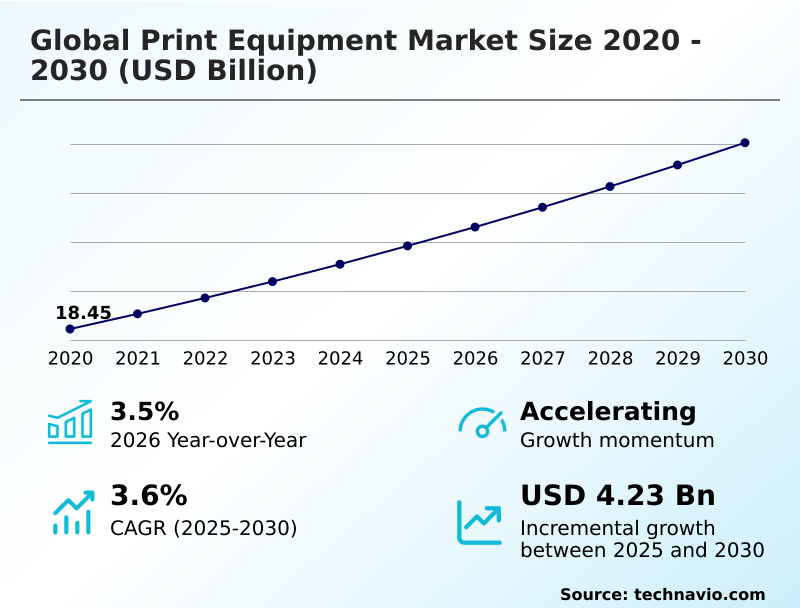
Print Equipment Market Size 2026-2030
The print equipment market size is valued to increase by USD 4.23 billion, at a CAGR of 3.6% from 2025 to 2030. Proliferation of digital inkjet technology and on-demand production will drive the print equipment market.
Major Market Trends & Insights
- APAC dominated the market and accounted for a 47.8% growth during the forecast period.
- By Technology - Digital segment was valued at USD 8.22 billion in 2024
- By Application - Packaging and labels segment accounted for the largest market revenue share in 2024
Market Size & Forecast
- Market Opportunities: USD 7.63 billion
- Market Future Opportunities: USD 4.23 billion
- CAGR from 2025 to 2030 : 3.6%
Market Summary
- The print equipment market is undergoing a significant transformation, defined by a shift from traditional analog processes to highly automated, digital-first workflows. This evolution is driven by the demand for shorter production runs, hyper-personalization in packaging, and the need for sustainable manufacturing practices.
- Key technologies such as high-speed inkjet presses and hybrid printing systems are becoming standard as they offer the flexibility to handle variable data printing without sacrificing industrial-scale throughput. Concurrently, the integration of the industrial internet of things (IIoT) enables predictive maintenance and autonomous quality control, addressing the industry's skilled labor shortages.
- For instance, a commercial printing firm can leverage a smart factory ecosystem where cloud-based management software automatically routes jobs to the most efficient press, using high-resolution sensors to monitor ink viscosity and make real-time adjustments.
- This level of production line automation minimizes waste and reduces downtime, a critical advantage in a market facing challenges from supply chain instability and the structural decline of traditional media.
What will be the Size of the Print Equipment Market during the forecast period?
Get Key Insights on Market Forecast (PDF) Get Free Sample
How is the Print Equipment Market Segmented?
The print equipment industry research report provides comprehensive data (region-wise segment analysis), with forecasts and estimates in "USD million" for the period 2026-2030, as well as historical data from 2020-2024 for the following segments.
- Technology
- Digital
- Offset lithography
- Flexographic
- Others
- Application
- Packaging and labels
- Commercial printing
- Publication
- Others
- Type
- Presses
- Post press and finishing
- Pre press systems
- Ancillary and inline converting
- Geography
- APAC
- China
- Japan
- India
- Europe
- Germany
- UK
- France
- North America
- US
- Canada
- Mexico
- South America
- Brazil
- Argentina
- Colombia
- Middle East and Africa
- Saudi Arabia
- UAE
- South Africa
- Rest of World (ROW)
- APAC
By Technology Insights
The digital segment is estimated to witness significant growth during the forecast period.
The digital segment is central to the global print equipment market, driven by the need for customization and efficiency. Technologies like electrophotography and digital inkjet solutions facilitate variable data printing, which is crucial for on-demand production and engaging consumers directly.
As brands shift their capital investment strategy towards shorter production runs, high-speed inkjet presses have become essential. These systems, featuring advanced thermal inkjet technology, integrate with customer relationship management platforms to enhance supply chain transparency.
Modern post-press finishing equipment further automates the workflow, with some automated systems improving job changeover efficiency by over 40%, enabling faster turnaround from digital label presses and supporting a more agile production model.
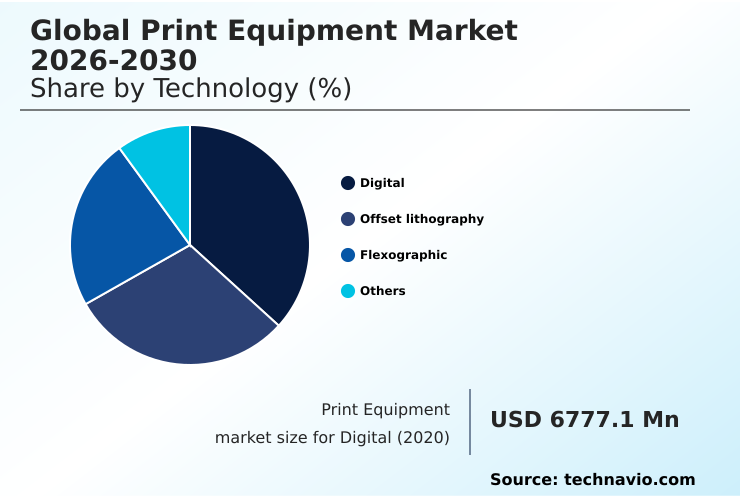
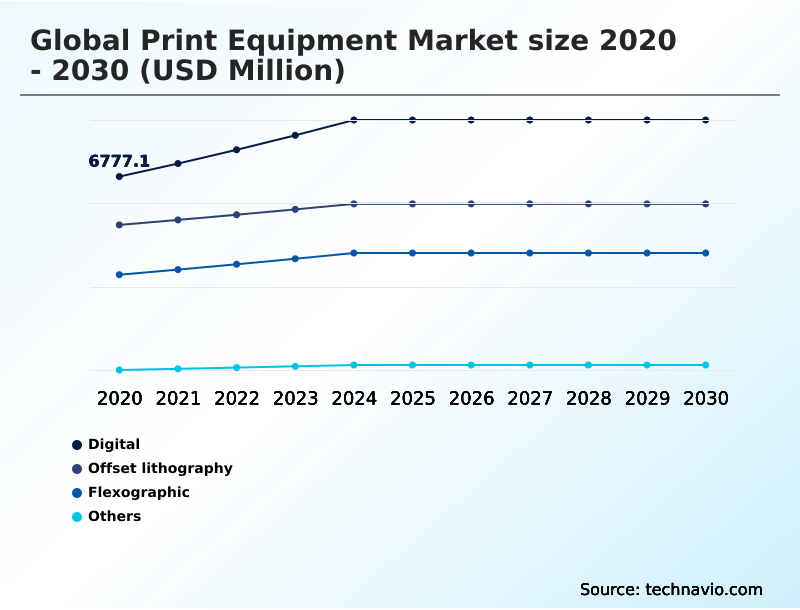
The Digital segment was valued at USD 8.22 billion in 2024 and showed a gradual increase during the forecast period.
Regional Analysis
APAC is estimated to contribute 47.8% to the growth of the global market during the forecast period.Technavio’s analysts have elaborately explained the regional trends and drivers that shape the market during the forecast period.
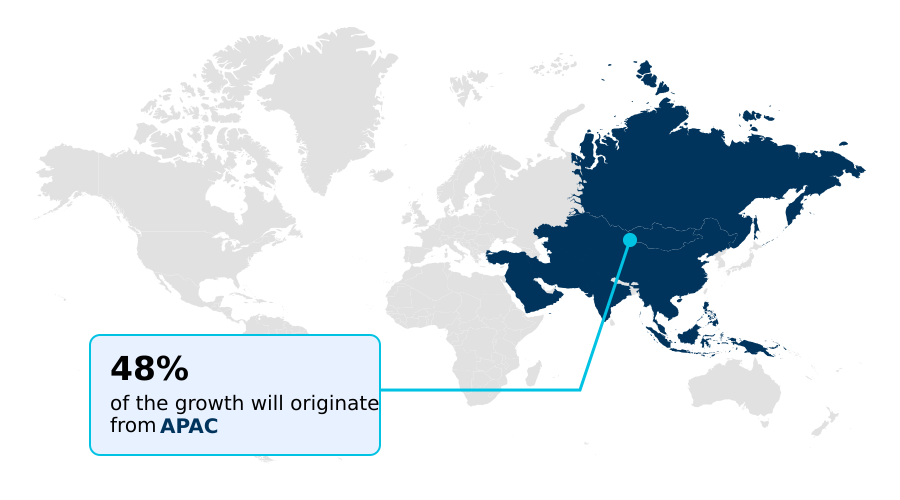
See How Print Equipment Market Demand is Rising in APAC Get Free Sample
The geographic landscape of the print equipment market is heavily influenced by regional manufacturing strengths and regulatory environments.
In APAC, rapid industrialization and a focus on localized production drive significant investment in smart manufacturing systems and narrow-web converters for the packaging industry.
These regions are seeing adoption rates for automated systems increase by over 20% annually to combat labor shortages. Meanwhile, in Europe, stringent environmental stewardship policies push the demand for machines with closed-loop color control and pre-press systems that minimize waste.
The focus on hyper-personalization in North America fuels demand for equipment capable of high data throughput for print-on-demand services.
The use of high-resolution sensors and machine vision inspection is becoming a global standard, improving defect detection by up to 30% and reinforcing brand protection across international supply chains.
Market Dynamics
Our researchers analyzed the data with 2025 as the base year, along with the key drivers, trends, and challenges. A holistic analysis of drivers will help companies refine their marketing strategies to gain a competitive advantage.
- Analyzing the global print equipment market 2026-2030 requires a deep dive into its core segments and dynamics. The global print equipment market 2026-2030 segmentation by technology reveals a decisive shift towards digital, though the future of offset lithography remains secure in high-volume applications.
- An examination of global print equipment market 2026-2030 key vendor offerings shows a focus on integrated solutions combining hardware with sophisticated software. The global print equipment market 2026-2030 impact of AI integration is a dominant theme, revolutionizing production efficiency. In terms of applications, the global print equipment market 2026-2030 trends in packaging labels highlight sustainability and customization.
- Key global print equipment market 2026-2030 drivers for digital adoption include flexibility and reduced waste. However, the market faces global print equipment market 2026-2030 challenges from supply chain volatility and managing escalating component costs. The global print equipment market 2026-2030 growth in APAC region is outpacing other areas, driven by manufacturing expansion.
- Commercial printing applications are evolving, as is security and transactional printing. The role of hybrid printing systems and flexographic printing for packaging is growing, alongside opportunities in textile printing. The global print equipment market 2026-2030 industrial internet of things (IIoT) is enabling automation in post-press finishing, while the shift to eco-friendly substrates and sustainable manufacturing solutions are key strategic considerations.
- The global print equipment market 2026-2030 North America market dynamics show a mature market focused on value-added services, where firms leveraging variable data printing capabilities have reported customer engagement metrics that are twice as high as those using static marketing materials.
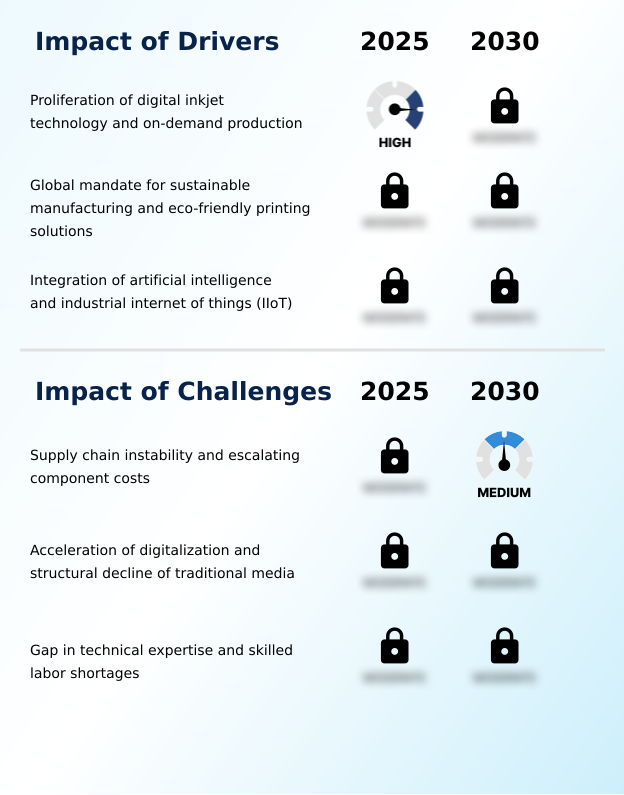
What are the key market drivers leading to the rise in the adoption of Print Equipment Industry?
- The proliferation of digital inkjet technology and growing demand for on-demand production are key drivers for market growth.
- The primary driver shaping the market is the integration of intelligence and connectivity into printing hardware, creating smart factory ecosystems.
- The industrial internet of things (IIoT) is central to this shift, enabling predictive maintenance that can reduce unplanned downtime by up to 30%.
- This is complemented by autonomous systems and production line automation, which utilize autonomous quality control to ensure consistency without manual oversight. The adoption of cloud-based management allows for the optimization of workflow software and digital front ends across multiple facilities.
- For instance, the latest hybrid printing systems for industrial inkjet printers leverage these technologies to improve operational efficiency by 20% compared to legacy equipment.
- This move towards intelligent, interconnected hardware, including advances in computer-to-plate technology, is essential for maintaining competitiveness in a rapidly evolving industrial landscape.
What are the market trends shaping the Print Equipment Industry?
- The proliferation of hyper-personalization, driven by the increasing capability of variable data integration, is a primary trend shaping the market.
- Key market trends are converging around sustainability and high-value customization, forcing a reconsideration of traditional production models. The adoption of eco-friendly printing methods is accelerating, with a notable shift towards water-based inks and ultraviolet-curable inks. This aligns with broader circular economy models, where the use of eco-friendly substrates is a primary concern.
- Consequently, equipment for flexographic printing and offset lithography is being re-engineered for sustainable manufacturing. In a recent industry benchmark, firms using new sheetfed offset press models with integrated energy-efficient machinery reported a 15% reduction in power consumption.
- This move toward environmental stewardship enhances brand reputation and addresses regulatory pressures, shaping a market where green credentials are as vital as print quality. The ability of modern systems to handle these new materials without compromising speed is a critical differentiator.
What challenges does the Print Equipment Industry face during its growth?
- Supply chain instability and escalating component costs present a key challenge affecting industry growth.
- The market faces significant operational and structural challenges, primarily stemming from supply chain instability and a growing technical expertise gap. Escalating component costs and logistical disruptions directly impact the production of ancillary inline converting modules and wide-format printers, with some manufacturers reporting lead time increases of over 25%.
- This financial pressure is compounded by the digitalization of media, which erodes demand for traditional print. Furthermore, the increasing complexity of modern equipment, from 3D printing equipment to machinery with high inkjet head durability, creates a shortage of skilled labor. The technical knowledge required for managed print services and maintaining automated plate-changing systems is not widely available.
- This skilled labor shortage means that even with advanced hardware like a new slitter cutter creaser, firms may not achieve the projected 40% efficiency gains without significant investment in training.
Exclusive Technavio Analysis on Customer Landscape
The print equipment market forecasting report includes the adoption lifecycle of the market, covering from the innovator’s stage to the laggard’s stage. It focuses on adoption rates in different regions based on penetration. Furthermore, the print equipment market report also includes key purchase criteria and drivers of price sensitivity to help companies evaluate and develop their market growth analysis strategies.
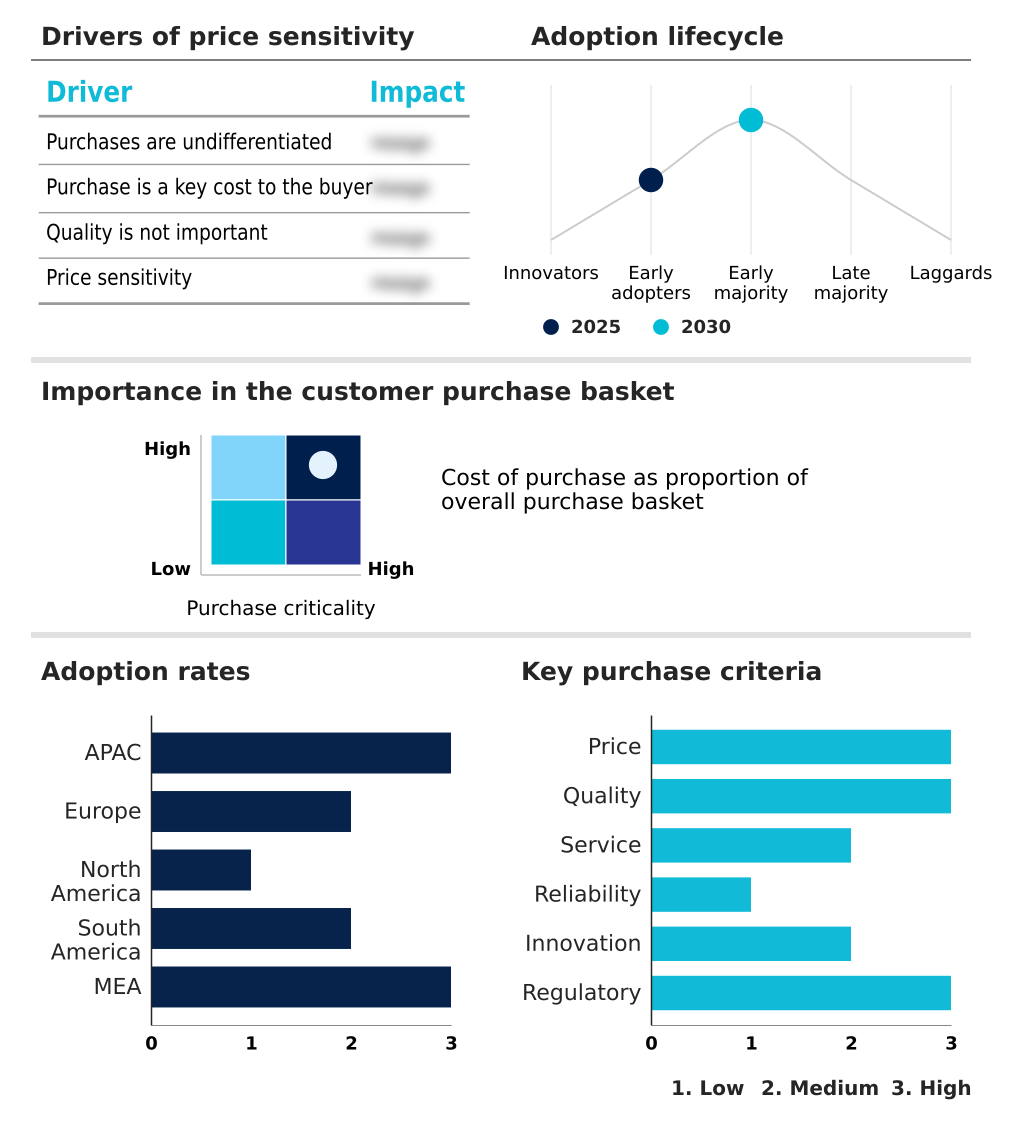
Customer Landscape of Print Equipment Industry
Competitive Landscape
Companies are implementing various strategies, such as strategic alliances, print equipment market forecast, partnerships, mergers and acquisitions, geographical expansion, and product/service launches, to enhance their presence in the industry.
Bobst Group SA - Key offerings include advanced digital presses, wide-format printers, and industrial printing systems designed for diverse applications, emphasizing efficiency and high-quality output on various substrates.
The industry research and growth report includes detailed analyses of the competitive landscape of the market and information about key companies, including:
- Bobst Group SA
- Brother Industries Ltd.
- Canon Inc.
- Electronics For Imaging Inc.
- FUJIFILM Holdings Corp.
- Heidelberger Druckmaschinen AG
- HP Inc.
- Komori Corp
- Konica Minolta Inc.
- Lexmark International Inc.
- Mimaki Engineering Co. Ltd.
- Oki Electric Industry Co. Ltd.
- Ricoh Co. Ltd.
- Roland DG Corp.
- Seiko Epson Corp.
- Sharp Corp.
- Toshiba Corp.
- Videojet Technologies Inc.
- Xerox Holdings Corp.
- Zebra Technologies Corp.
Qualitative and quantitative analysis of companies has been conducted to help clients understand the wider business environment as well as the strengths and weaknesses of key industry players. Data is qualitatively analyzed to categorize companies as pure play, category-focused, industry-focused, and diversified; it is quantitatively analyzed to categorize companies as dominant, leading, strong, tentative, and weak.
Recent Development and News in Print equipment market
- In June 2025, HP Inc. introduced an enhanced version of its Advantage 2200 series high-speed inkjet web press, incorporating new drying technologies to increase production speeds on a wider variety of coated media for the commercial market.
- In March 2025, Ricoh Global announced the integration of advanced machine learning algorithms into its TotalFlow Cloud suite, enabling automated job scheduling and intelligent resource allocation for its latest digital production presses.
- In October 2025, Epson announced it had successfully transitioned to one hundred percent renewable electricity across all its global manufacturing and distribution sites, highlighting a major sustainability milestone for an equipment provider.
- In February 2025, the European Union implemented new trade regulations that affected the import of critical minerals from certain Asian markets, leading to a sudden price increase for specialized alloys used in high-speed industrial printing cylinders.
Dive into Technavio’s robust research methodology, blending expert interviews, extensive data synthesis, and validated models for unparalleled Print Equipment Market insights. See full methodology.
| Market Scope | |
|---|---|
| Page number | 315 |
| Base year | 2025 |
| Historic period | 2020-2024 |
| Forecast period | 2026-2030 |
| Growth momentum & CAGR | Accelerate at a CAGR of 3.6% |
| Market growth 2026-2030 | USD 4225.9 million |
| Market structure | Fragmented |
| YoY growth 2025-2026(%) | 3.5% |
| Key countries | China, Japan, India, South Korea, Australia, Indonesia, Germany, UK, France, Italy, Spain, The Netherlands, US, Canada, Mexico, Brazil, Argentina, Colombia, Saudi Arabia, UAE, South Africa, Turkey and Israel |
| Competitive landscape | Leading Companies, Market Positioning of Companies, Competitive Strategies, and Industry Risks |
Research Analyst Overview
- The print equipment market is defined by a critical transition toward digital-first, automated production environments. Investment in digital inkjet solutions and high-speed inkjet presses is no longer optional but a core component of a competitive strategy, allowing for sophisticated variable data printing.
- Boardroom decisions are increasingly influenced by the need to integrate these systems into smart manufacturing systems, as the adoption of thermal inkjet technology and digital label presses directly impacts supply chain agility. The evolution of post-press finishing, including advanced slitter cutter creaser machinery, and pre-press systems is driven by the requirement for end-to-end automation.
- Technologies such as electrophotography and managed print services are pivotal for operational efficiency. The integration of 3d printing equipment and industrial inkjet printers into production lines is expanding application possibilities. For instance, the deployment of automated plate-changing systems has been shown to reduce job setup times by over 35%, a compelling metric for capital expenditure decisions.
- This focus on automation, from flexographic printing to wide-format printers, is the industry’s response to demands for both mass production and hyper-personalization.
What are the Key Data Covered in this Print Equipment Market Research and Growth Report?
-
What is the expected growth of the Print Equipment Market between 2026 and 2030?
-
USD 4.23 billion, at a CAGR of 3.6%
-
-
What segmentation does the market report cover?
-
The report is segmented by Technology (Digital, Offset lithography, Flexographic, and Others), Application (Packaging and labels, Commercial printing, Publication, and Others), Type (Presses, Post press and finishing, Pre press systems, and Ancillary and inline converting) and Geography (APAC, Europe, North America, South America, Middle East and Africa)
-
-
Which regions are analyzed in the report?
-
APAC, Europe, North America, South America and Middle East and Africa
-
-
What are the key growth drivers and market challenges?
-
Proliferation of digital inkjet technology and on-demand production, Supply chain instability and escalating component costs
-
-
Who are the major players in the Print Equipment Market?
-
Bobst Group SA, Brother Industries Ltd., Canon Inc., Electronics For Imaging Inc., FUJIFILM Holdings Corp., Heidelberger Druckmaschinen AG, HP Inc., Komori Corp, Konica Minolta Inc., Lexmark International Inc., Mimaki Engineering Co. Ltd., Oki Electric Industry Co. Ltd., Ricoh Co. Ltd., Roland DG Corp., Seiko Epson Corp., Sharp Corp., Toshiba Corp., Videojet Technologies Inc., Xerox Holdings Corp. and Zebra Technologies Corp.
-
Market Research Insights
- The market's momentum is heavily influenced by a strategic shift towards on-demand production and smart factory ecosystems, where operational efficiency is paramount. The adoption of cloud-based management systems has been shown to improve resource allocation across multiple sites by up to 25%, a crucial factor given the persistent technical expertise gap.
- While supply chain instability creates pressure on component costs, the drive for sustainable manufacturing provides a counterbalancing force, compelling firms to invest in energy-efficient machinery. This capital investment strategy is paying off, with some companies reporting a 15% reduction in their carbon footprint after upgrading.
- The integration of customer relationship management with production workflows enables a level of hyper-personalization that boosts consumer engagement, justifying the investment. This dynamic interplay of drivers and challenges shapes a landscape where agility and technological adoption are key to navigating the industry's evolution.
We can help! Our analysts can customize this print equipment market research report to meet your requirements.
 RIA -
RIA - 
