
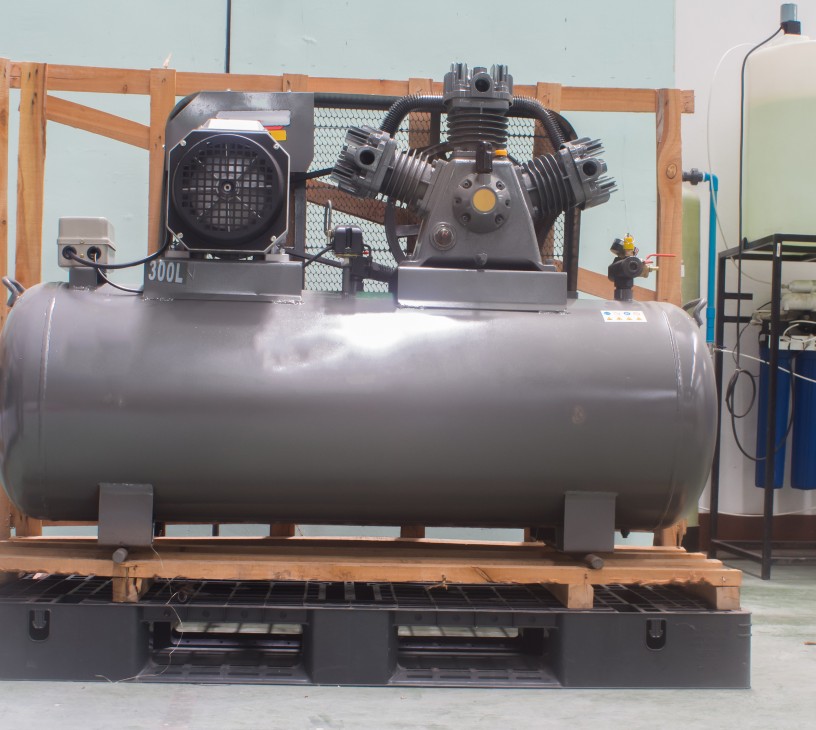

Reciprocating Compressor Market Analysis, Size, and Forecast 2026-2030: APAC (China, India, and Japan), North America (US, Canada, and Mexico), Europe (Germany, UK, and France), Middle East and Africa (Saudi Arabia, UAE, and South Africa), South America (Brazil, Argentina, and Colombia), and Rest of World (ROW)

Reciprocating Compressor Market Analysis, Size, and Forecast 2026-2030:
APAC (China, India, and Japan), North America (US, Canada, and Mexico), Europe (Germany, UK, and France), Middle East and Africa (Saudi Arabia, UAE, and South Africa), South America (Brazil, Argentina, and Colombia), and Rest of World (ROW)

Published: May 2026 302 Pages SKU: IRTNTR81481

Market Overview at a Glance

$2.79 B
Market Opportunity
5.1%
CAGR 2025 - 2030
45.1%
APAC Growth
$6.17 B
Lubricated segment 2024

Reciprocating Compressor Market Size 2026-2030

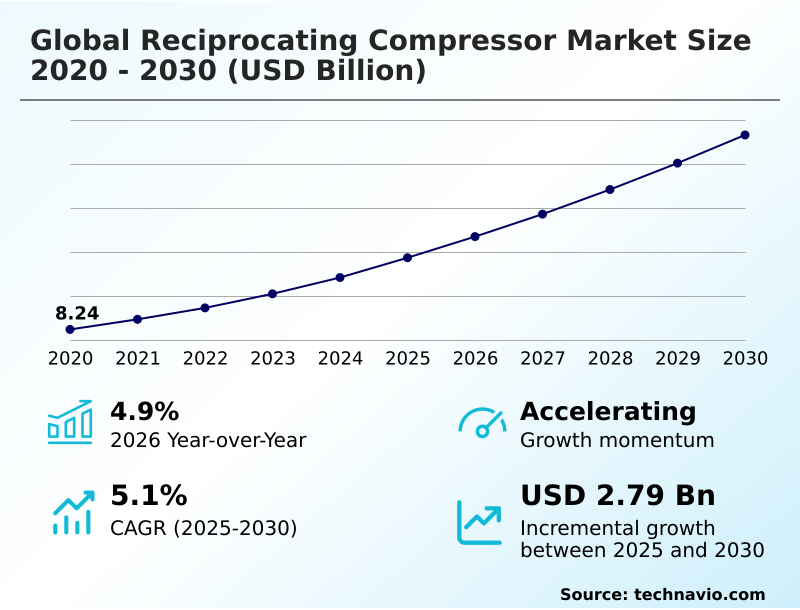
The reciprocating compressor market size is valued to increase by USD 2.79 billion, at a CAGR of 5.1% from 2025 to 2030. Accelerated expansion of global hydrogen infrastructure and processing facilities will drive the reciprocating compressor market.

Major Market Trends & Insights

  • APAC dominated the market and accounted for a 45.1% growth during the forecast period.
  • By Product - Lubricated segment was valued at USD 6.17 billion in 2024
  • By End-user - Oil and gas segment accounted for the largest market revenue share in 2024

Market Size & Forecast

  • Market Opportunities: USD 4.42 billion
  • Market Future Opportunities: USD 2.79 billion
  • CAGR from 2025 to 2030 : 5.1%

Market Summary

  • The reciprocating compressor market is integral to heavy industry, defined by the essential role of these positive displacement devices in achieving high-pressure gas compression. These machines, which use a crankshaft-driven piston mechanism, are fundamental to operations in petroleum refining, natural gas transportation, and chemical processing. Market dynamics are increasingly shaped by a dual focus on operational efficiency and environmental compliance.
  • A key driver is the expansion of energy infrastructure, especially in emerging economies, which requires robust equipment for applications like gas gathering and pipeline transmission. Concurrently, a significant trend is the industry's adaptation to the energy transition, with strong demand for compressors capable of handling hydrogen and captured carbon dioxide.
  • For instance, a midstream gas company can leverage predictive maintenance algorithms integrated into its compressor fleet. This allows them to monitor thermodynamic efficiency and component wear in real time, reducing unplanned downtime and optimizing maintenance schedules.
  • This proactive approach prevents costly disruptions to their gas transmission network, minimizes fugitive emissions, and ensures compliance with increasingly stringent environmental regulations, showcasing a direct link between technological adoption and operational resilience.

What will be the Size of the Reciprocating Compressor Market during the forecast period?
Get Key Insights on Market Forecast (PDF) Get Free Sample

How is the Reciprocating Compressor Market Segmented?

The reciprocating compressor industry research report provides comprehensive data (region-wise segment analysis), with forecasts and estimates in "USD million" for the period 2026-2030, as well as historical data from 2020-2024 for the following segments.

  • Product
    • Lubricated
    • Oil-free
  • End-user
    • Oil and gas
    • Petrochemicals and chemicals
    • Manufacturing
    • Power generation
    • Others
  • Type
    • Multi-stage
    • Single-stage
  • Geography
    • APAC
      • China
      • India
      • Japan
    • North America
      • US
      • Canada
      • Mexico
    • Europe
      • Germany
      • UK
      • France
    • Middle East and Africa
      • Saudi Arabia
      • UAE
      • South Africa
    • South America
      • Brazil
      • Argentina
      • Colombia
    • Rest of World (ROW)

By Product Insights

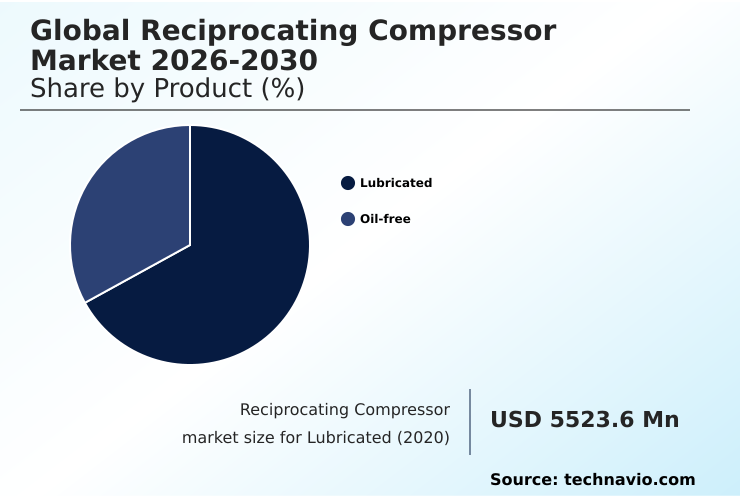
The lubricated segment is estimated to witness significant growth during the forecast period.

The lubricated segment forms a foundational component of the reciprocating compressor market, where oil is essential for minimizing friction, sealing piston rings and rider bands, and managing thermal loads.

These machines, including both single-stage reciprocating compressor and multi-stage reciprocating units, are indispensable in heavy-duty applications across various process industries.

Their design offers exceptional thermodynamic efficiency and durability, making them a preferred choice for general industrial air compressors and heavy-duty reciprocating compressors. While they require diligent maintenance, their lower initial cost and robust performance ensure continued relevance.

Deployments in sectors like natural gas processing show that proper lubrication management can reduce unscheduled downtime by over 15%, reinforcing their economic viability and strong market position for reciprocating air compressors.
Get Free Sample

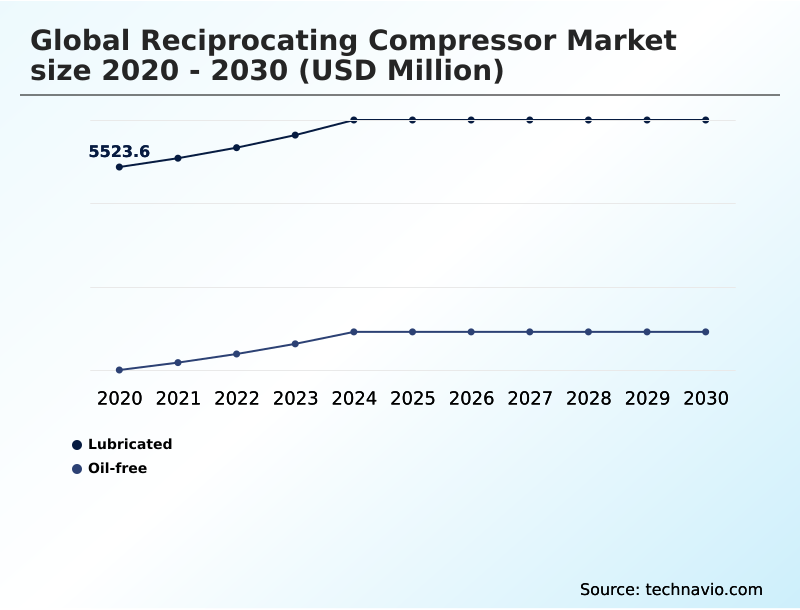
The Lubricated segment was valued at USD 6.17 billion in 2024 and showed a gradual increase during the forecast period.
Get Free Sample

Regional Analysis

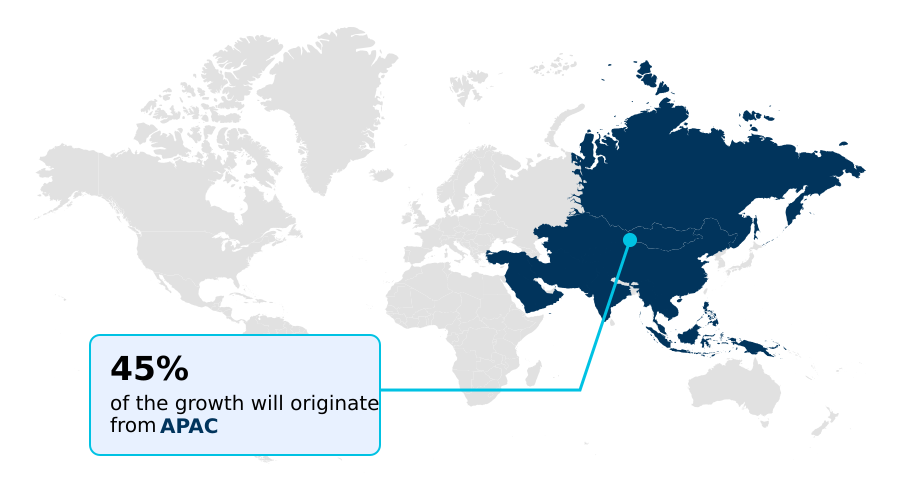
APAC is estimated to contribute 45.1% to the growth of the global market during the forecast period.Technavio’s analysts have elaborately explained the regional trends and drivers that shape the market during the forecast period.
See How Reciprocating Compressor Market Demand is Rising in APAC Get Free Sample

The geographic landscape is dominated by the APAC region, which accounts for over 45% of the market's incremental growth. This is driven by rapid industrialization and massive investments in energy infrastructure, from gas gathering to pipeline transmission.

The demand for positive displacement devices, specifically the crankshaft-driven piston type, is immense. Both industrial air compressors and heavy-duty reciprocating compressors are seeing high adoption.

Advanced features like stepless capacity control are becoming critical to managing energy costs in new facilities, where thermodynamic efficiency is paramount.

For instance, new natural gas compressors in the region have demonstrated up to a 10% improvement in energy efficiency over older models.

The region's focus on expanding LNG capabilities also boosts demand for specialized boil-off gas compressors and robust reciprocating compressor systems.

Market Dynamics

Our researchers analyzed the data with 2025 as the base year, along with the key drivers, trends, and challenges. A holistic analysis of drivers will help companies refine their marketing strategies to gain a competitive advantage.

  • Strategic decision-making in the industry hinges on a detailed understanding of diverse applications, from reciprocating compressors for hydrogen applications to reciprocating compressors for carbon capture. The selection process requires a thorough reciprocating vs centrifugal compressor analysis, weighing the benefits of each for specific tasks like biogas upgrading with reciprocating units.
  • For sectors demanding high purity, oil-free reciprocating compressor maintenance protocols are non-negotiable. Key considerations include the total lifecycle cost of lubricated compressors and the specifics of compressor design for sour gas service, where material resilience is paramount. Optimizing compressor performance with VFDs is a common strategy to enhance energy efficiency in multi-stage compressors.
  • Furthermore, achieving API 618 compliance in petrochemicals is a critical requirement. Innovations in digital monitoring of reciprocating compressors and predictive analytics for compressor failure are transforming maintenance protocols for reciprocating units. This digital shift has enabled some operators to reduce diagnostic time by over 50% compared to traditional manual inspections, directly improving operational planning.
  • Other critical areas include advanced materials for compressor durability, noise reduction in reciprocating compressors, and effective thermal management in reciprocating compressors. The move toward compact modular skid-mounted compressors addresses the need for rapid deployment, especially in natural gas processing, while managing fugitive emissions from compressors remains a core challenge.
What are the key market drivers leading to the rise in the adoption of Reciprocating Compressor Industry?

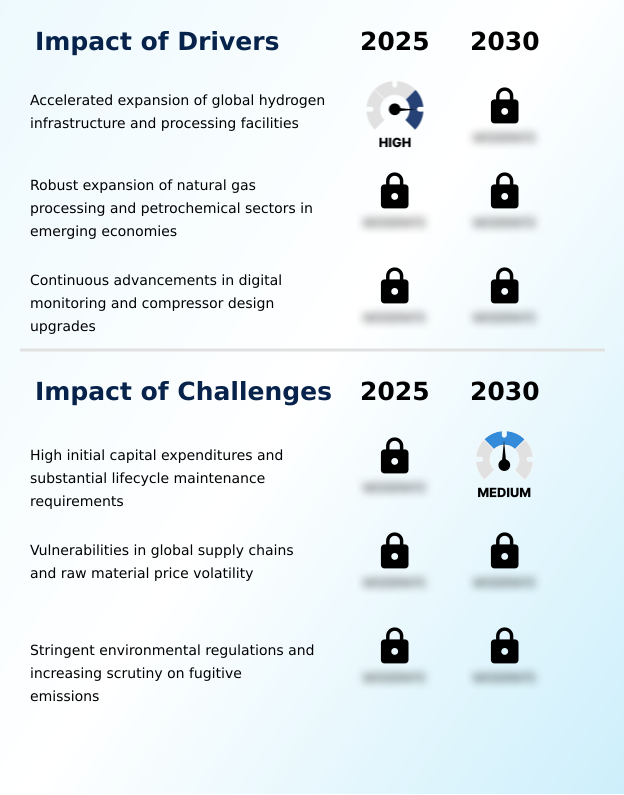
  • The accelerated expansion of global hydrogen infrastructure and processing facilities is a key driver propelling market growth for specialized compression technologies.

  • The accelerated expansion of hydrogen infrastructure is a primary market driver, demanding specialized gas and process compressors. Reciprocating units are crucial for this transition, requiring solutions that mitigate hydrogen embrittlement through advanced materials and non-lubricated cylinder designs for purity.
  • These systems are deployed at hydrogen refueling stations and integrated into the downstream petrochemical industry for desulfurization processes. The need for operational flexibility is met with stepless volume control mechanisms, enhancing industrial gas compression efficiency.
  • In related applications like gas gathering, the use of modern boil-off gas compressors has reduced product loss by up to 10%, while advanced hermetic reciprocating compressors in controlled environments achieve a 99.8% containment rate, showcasing significant operational gains.

What are the market trends shaping the Reciprocating Compressor Industry?

  • The prominent adoption of carbon capture utilization and storage mechanisms is emerging as a significant trend, influencing equipment design and creating new market opportunities.

  • A defining trend is the prominent adoption of carbon capture utilization, creating demand for reciprocating compressor systems designed for unique gas properties. These machines must handle CO2 in supercritical states for injection into carbon sequestration hubs, driving innovation in advanced sealing technologies. This supports the build-out of extensive carbon dioxide transportation networks.
  • Simultaneously, the push for zero-emission transportation and robust hydrogen infrastructure is boosting demand for high-pressure hydrogen compressors and API 618 reciprocating compressors at green hydrogen hubs. This trend has led to a 20% improvement in gas transmission efficiency in pilot projects, with some facilities seeing a 25% faster deployment time for new capture units.

What challenges does the Reciprocating Compressor Industry face during its growth?

  • High initial capital expenditures and substantial lifecycle maintenance requirements present a key challenge affecting industry growth and broader market adoption.

  • Significant challenges in the reciprocating compressor market stem from high initial capital costs and stringent environmental regulations concerning fugitive emissions. Operators must invest in advanced systems to comply, often adopting predictive maintenance algorithms and predictive analytics software to extend equipment life and reduce lifecycle costs. Innovations in polymer compounds for seals are helping reduce leaks, but the financial burden remains.
  • In industrial refrigeration, facilities have seen maintenance overheads constitute up to 40% of the total cost of ownership, compared to just 25% for other machinery.
  • However, the adoption of modular gas compressor packages and skid-mounted reciprocating compressors for industrial reciprocating compressors is helping reduce installation costs by 15%, offering a partial solution to the high initial investment barrier for these reciprocating variants.

Exclusive Technavio Analysis on Customer Landscape

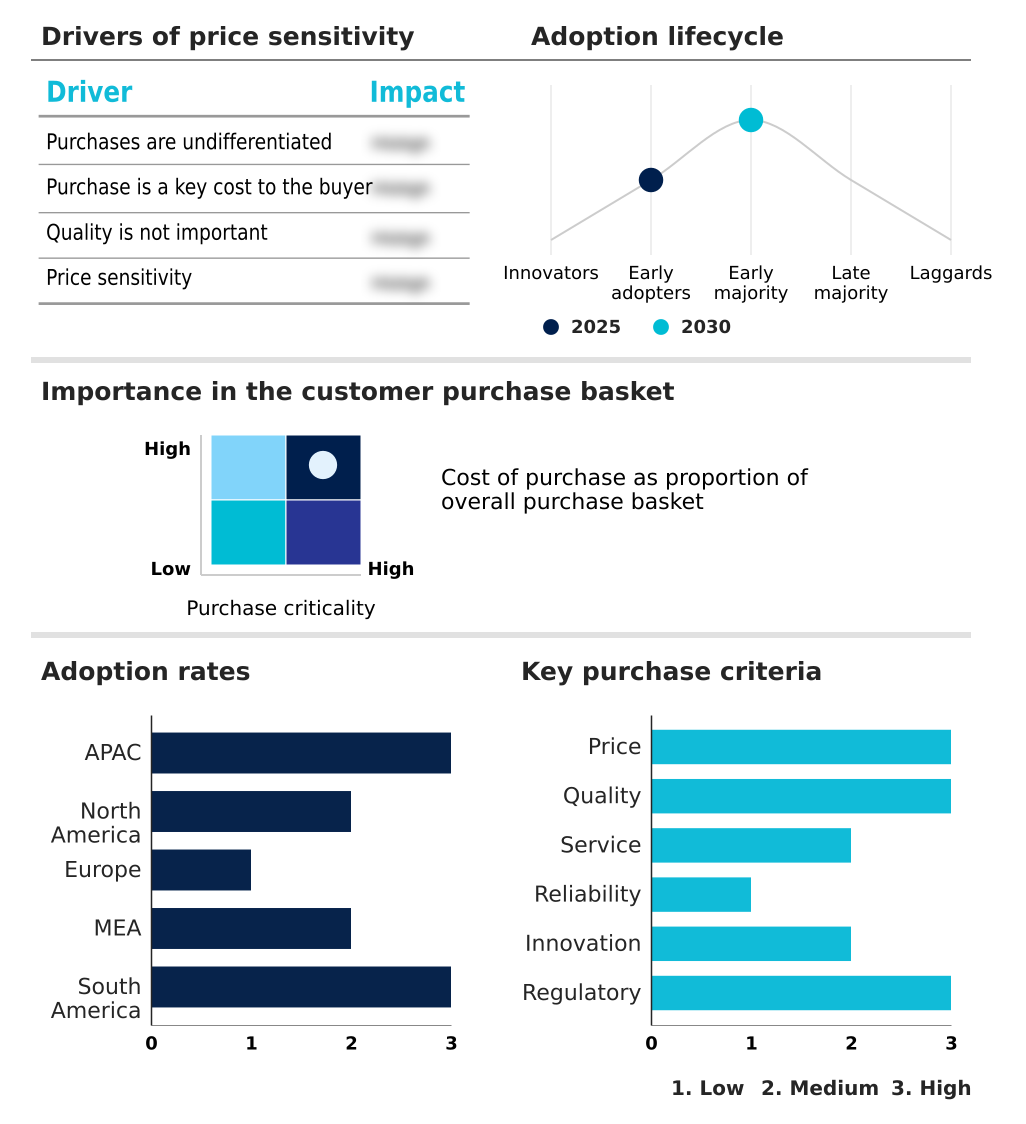
The reciprocating compressor market forecasting report includes the adoption lifecycle of the market, covering from the innovator’s stage to the laggard’s stage. It focuses on adoption rates in different regions based on penetration. Furthermore, the reciprocating compressor market report also includes key purchase criteria and drivers of price sensitivity to help companies evaluate and develop their market growth analysis strategies.
Customer Landscape of Reciprocating Compressor Industry

Competitive Landscape

Companies are implementing various strategies, such as strategic alliances, reciprocating compressor market forecast, partnerships, mergers and acquisitions, geographical expansion, and product/service launches, to enhance their presence in the industry.

Ariel Corp - Analysts highlight specialization in separable reciprocating gas compressors, crucial for demanding applications in the global energy infrastructure and natural gas processing industries.

The industry research and growth report includes detailed analyses of the competitive landscape of the market and information about key companies, including:

  • Ariel Corp
  • Atlas Copco AB
  • Baker Hughes Co.
  • BITZER
  • Burckhardt Compression AG
  • Chart Industries Inc.
  • Copeland LP
  • Danfoss AS
  • Embraco LLC
  • GEA Group AG
  • IDEX Corp.
  • Ingersoll Rand Inc.
  • Kobe Steel Ltd.
  • KwangShin Machine Ind.
  • MAYEKAWA MFG. Co Ltd
  • NEUMAN and ESSER
  • Secop GmbH
  • SIAD S.p.A.
  • Siemens Energy AG
  • Tecumseh Products Co. LLC

Qualitative and quantitative analysis of companies has been conducted to help clients understand the wider business environment as well as the strengths and weaknesses of key industry players. Data is qualitatively analyzed to categorize companies as pure play, category-focused, industry-focused, and diversified; it is quantitatively analyzed to categorize companies as dominant, leading, strong, tentative, and weak.

Recent Development and News in Reciprocating compressor market

  • In January 2025, Cooper Machinery Services announced the acquisition of ACI Services Inc., a move aimed at strengthening its engineering, maintenance, and reliability solutions for reciprocating compressors in the oil and gas and process industries.
  • In September 2025, OJUS Power and Technologies formed a strategic partnership with Hitachi Industrial Equipment Systems to introduce a new range of industrial compressors in India, targeting sectors such as pharmaceuticals, automotive, and food processing.
  • In July 2025, Ingersoll Rand announced the acquisition of TMIC and Adicomp for approximately USD 170 million to bolster its industrial gas compression portfolio, with a focus on energy transition applications like hydrogen and biomethane.
  • In September 2025, Burckhardt Compression acquired Advanced Compressor Technology (ACT) in the United States to expand its local aftermarket services, spare parts manufacturing, and maintenance support for reciprocating compressors in the refinery and petrochemical sectors.

Dive into Technavio’s robust research methodology, blending expert interviews, extensive data synthesis, and validated models for unparalleled Reciprocating Compressor Market insights. See full methodology.

Market Scope
Page number 302
Base year 2025
Historic period 2020-2024
Forecast period 2026-2030
Growth momentum & CAGR Accelerate at a CAGR of 5.1%
Market growth 2026-2030 USD 2793.0 million
Market structure Fragmented
YoY growth 2025-2026(%) 4.9%
Key countries China, India, Japan, South Korea, Australia, Indonesia, US, Canada, Mexico, Germany, UK, France, Italy, Spain, The Netherlands, Saudi Arabia, UAE, South Africa, Turkey, Israel, Brazil, Argentina and Colombia
Competitive landscape Leading Companies, Market Positioning of Companies, Competitive Strategies, and Industry Risks

Request Free Sample

Research Analyst Overview

  • The market is defined by the critical function of the positive displacement device, specifically the crankshaft-driven piston model, across industrial applications. A significant focus is on enhancing thermodynamic efficiency and developing advanced sealing technologies to mitigate risks like hydrogen embrittlement.
  • The adoption of non-lubricated cylinder designs is pivotal for industries requiring gas purity, while innovations in polymer compounds for piston rings and rider bands extend equipment life. We observe a clear trend towards digitalization, with predictive maintenance algorithms becoming standard. Stepless capacity control and stepless volume control mechanisms are key for managing variable loads efficiently.
  • The industry is also responding to new demands from the energy transition, engineering API 618 reciprocating compressors for carbon dioxide transportation networks and high-pressure hydrogen compressors for green energy projects. For example, deploying advanced process gas compressors with integrated digital twins has been shown to reduce commissioning time by up to 30%.
  • This shift impacts everything from single-stage and multi-stage reciprocating units to specialized boil-off gas compressors, hermetic, and semi-hermetic reciprocating compressors for industrial air compressors.

What are the Key Data Covered in this Reciprocating Compressor Market Research and Growth Report?

  • What is the expected growth of the Reciprocating Compressor Market between 2026 and 2030?

    • USD 2.79 billion, at a CAGR of 5.1%

  • What segmentation does the market report cover?

    • The report is segmented by Product (Lubricated, and Oil-free), End-user (Oil and gas, Petrochemicals and chemicals, Manufacturing, Power generation, and Others), Type (Multi-stage, and Single-stage) and Geography (APAC, North America, Europe, Middle East and Africa, South America)

  • Which regions are analyzed in the report?

    • APAC, North America, Europe, Middle East and Africa and South America

  • What are the key growth drivers and market challenges?

    • Accelerated expansion of global hydrogen infrastructure and processing facilities, High initial capital expenditures and substantial lifecycle maintenance requirements

  • Who are the major players in the Reciprocating Compressor Market?

    • Ariel Corp, Atlas Copco AB, Baker Hughes Co., BITZER, Burckhardt Compression AG, Chart Industries Inc., Copeland LP, Danfoss AS, Embraco LLC, GEA Group AG, IDEX Corp., Ingersoll Rand Inc., Kobe Steel Ltd., KwangShin Machine Ind., MAYEKAWA MFG. Co Ltd, NEUMAN and ESSER, Secop GmbH, SIAD S.p.A., Siemens Energy AG and Tecumseh Products Co. LLC

Market Research Insights

  • Market dynamics are heavily influenced by the expansion of hydrogen infrastructure and the need for advanced gas compressor packages. In the downstream petrochemical industry, new reciprocating compressor systems have enabled process intensification, leading to a 15% increase in production yields.
  • The adoption of predictive analytics software for gas compression systems has proven to reduce unscheduled maintenance by up to 30%, a significant improvement in operational uptime. Furthermore, in industrial refrigeration, modern compressors are delivering a 12% improvement in energy efficiency over five-year-old models, directly impacting bottom-line costs and supporting sustainability goals across various process industries.

We can help! Our analysts can customize this reciprocating compressor market research report to meet your requirements.

Get in touch

1. Executive Summary

1.1 Market overview

Executive Summary - Chart on Market Overview
Executive Summary - Data Table on Market Overview
Executive Summary - Chart on Global Market Characteristics
Executive Summary - Chart on Market by Geography
Executive Summary - Chart on Market Segmentation by Product
Executive Summary - Chart on Market Segmentation by End-user
Executive Summary - Chart on Market Segmentation by Type
Executive Summary - Chart on Incremental Growth
Executive Summary - Data Table on Incremental Growth
Executive Summary - Chart on Company Market Positioning

2. Technavio Analysis

2.1 Analysis of price sensitivity, lifecycle, customer purchase basket, adoption rates, and purchase criteria

2.2 Criticality of inputs and Factors of differentiation

Chart on Overview on criticality of inputs and factors of differentiation

2.3 Factors of disruption

Chart on Overview on factors of disruption

2.4 Impact of drivers and challenges

Chart on Impact of drivers and challenges in 2025 and 2030

3. Market Landscape

3.1 Market ecosystem

Chart on Parent Market
Data Table on - Parent Market

3.2 Market characteristics

Chart on Market characteristics analysis

3.3 Value chain analysis

Chart on Value chain analysis

4. Market Sizing

4.1 Market definition

Data Table on Offerings of companies included in the market definition

4.2 Market segment analysis

Market segments

4.3 Market size 2025

4.4 Market outlook: Forecast for 2025-2030

Chart on Global - Market size and forecast 2025-2030 ($ million)
Data Table on Global - Market size and forecast 2025-2030 ($ million)
Chart on Global Market: Year-over-year growth 2025-2030 (%)
Data Table on Global Market: Year-over-year growth 2025-2030 (%)

5. Historic Market Size

5.1 Global Reciprocating Compressor Market 2020 - 2024

Historic Market Size - Data Table on Global Reciprocating Compressor Market 2020 - 2024 ($ million)

5.2 Product segment analysis 2020 - 2024

Historic Market Size - Product Segment 2020 - 2024 ($ million)

5.3 End-user segment analysis 2020 - 2024

Historic Market Size - End-user Segment 2020 - 2024 ($ million)

5.4 Type segment analysis 2020 - 2024

Historic Market Size - Type Segment 2020 - 2024 ($ million)

5.5 Geography segment analysis 2020 - 2024

Historic Market Size - Geography Segment 2020 - 2024 ($ million)

5.6 Country segment analysis 2020 - 2024

Historic Market Size - Country Segment 2020 - 2024 ($ million)

6. Qualitative Analysis

6.1 Impact of AI on Global Reciprocating Compressor Market

6.2 Impact of Geopolitical conflicts on Global Reciprocating Compressor Market

7. Five Forces Analysis

7.1 Five forces summary

Five forces analysis - Comparison between 2025 and 2030

7.2 Bargaining power of buyers

Bargaining power of buyers - Impact of key factors 2025 and 2030

7.3 Bargaining power of suppliers

Bargaining power of suppliers - Impact of key factors in 2025 and 2030

7.4 Threat of new entrants

Threat of new entrants - Impact of key factors in 2025 and 2030

7.5 Threat of substitutes

Threat of substitutes - Impact of key factors in 2025 and 2030

7.6 Threat of rivalry

Threat of rivalry - Impact of key factors in 2025 and 2030

7.7 Market condition

Chart on Market condition - Five forces 2025 and 2030

8. Market Segmentation by Product

8.1 Market segments

Chart on Product - Market share 2025-2030 (%)
Data Table on Product - Market share 2025-2030 (%)

8.2 Comparison by Product

Chart on Comparison by Product
Data Table on Comparison by Product

8.3 Lubricated - Market size and forecast 2025-2030

Chart on Lubricated - Market size and forecast 2025-2030 ($ million)
Data Table on Lubricated - Market size and forecast 2025-2030 ($ million)
Chart on Lubricated - Year-over-year growth 2025-2030 (%)
Data Table on Lubricated - Year-over-year growth 2025-2030 (%)

8.4 Oil-free - Market size and forecast 2025-2030

Chart on Oil-free - Market size and forecast 2025-2030 ($ million)
Data Table on Oil-free - Market size and forecast 2025-2030 ($ million)
Chart on Oil-free - Year-over-year growth 2025-2030 (%)
Data Table on Oil-free - Year-over-year growth 2025-2030 (%)

8.5 Market opportunity by Product

Market opportunity by Product ($ million)
Data Table on Market opportunity by Product ($ million)

9. Market Segmentation by End-user

9.1 Market segments

Chart on End-user - Market share 2025-2030 (%)
Data Table on End-user - Market share 2025-2030 (%)

9.2 Comparison by End-user

Chart on Comparison by End-user
Data Table on Comparison by End-user

9.3 Oil and gas - Market size and forecast 2025-2030

Chart on Oil and gas - Market size and forecast 2025-2030 ($ million)
Data Table on Oil and gas - Market size and forecast 2025-2030 ($ million)
Chart on Oil and gas - Year-over-year growth 2025-2030 (%)
Data Table on Oil and gas - Year-over-year growth 2025-2030 (%)

9.4 Petrochemicals and chemicals - Market size and forecast 2025-2030

Chart on Petrochemicals and chemicals - Market size and forecast 2025-2030 ($ million)
Data Table on Petrochemicals and chemicals - Market size and forecast 2025-2030 ($ million)
Chart on Petrochemicals and chemicals - Year-over-year growth 2025-2030 (%)
Data Table on Petrochemicals and chemicals - Year-over-year growth 2025-2030 (%)

9.5 Manufacturing - Market size and forecast 2025-2030

Chart on Manufacturing - Market size and forecast 2025-2030 ($ million)
Data Table on Manufacturing - Market size and forecast 2025-2030 ($ million)
Chart on Manufacturing - Year-over-year growth 2025-2030 (%)
Data Table on Manufacturing - Year-over-year growth 2025-2030 (%)

9.6 Power generation - Market size and forecast 2025-2030

Chart on Power generation - Market size and forecast 2025-2030 ($ million)
Data Table on Power generation - Market size and forecast 2025-2030 ($ million)
Chart on Power generation - Year-over-year growth 2025-2030 (%)
Data Table on Power generation - Year-over-year growth 2025-2030 (%)

9.7 Others - Market size and forecast 2025-2030

Chart on Others - Market size and forecast 2025-2030 ($ million)
Data Table on Others - Market size and forecast 2025-2030 ($ million)
Chart on Others - Year-over-year growth 2025-2030 (%)
Data Table on Others - Year-over-year growth 2025-2030 (%)

9.8 Market opportunity by End-user

Market opportunity by End-user ($ million)
Data Table on Market opportunity by End-user ($ million)

10. Market Segmentation by Type

10.1 Market segments

Chart on Type - Market share 2025-2030 (%)
Data Table on Type - Market share 2025-2030 (%)

10.2 Comparison by Type

Chart on Comparison by Type
Data Table on Comparison by Type

10.3 Multi-stage - Market size and forecast 2025-2030

Chart on Multi-stage - Market size and forecast 2025-2030 ($ million)
Data Table on Multi-stage - Market size and forecast 2025-2030 ($ million)
Chart on Multi-stage - Year-over-year growth 2025-2030 (%)
Data Table on Multi-stage - Year-over-year growth 2025-2030 (%)

10.4 Single-stage - Market size and forecast 2025-2030

Chart on Single-stage - Market size and forecast 2025-2030 ($ million)
Data Table on Single-stage - Market size and forecast 2025-2030 ($ million)
Chart on Single-stage - Year-over-year growth 2025-2030 (%)
Data Table on Single-stage - Year-over-year growth 2025-2030 (%)

10.5 Market opportunity by Type

Market opportunity by Type ($ million)
Data Table on Market opportunity by Type ($ million)

11. Customer Landscape

11.1 Customer landscape overview

Analysis of price sensitivity, lifecycle, customer purchase basket, adoption rates, and purchase criteria

12. Geographic Landscape

12.1 Geographic segmentation

Chart on Market share by geography 2025-2030 (%)
Data Table on Market share by geography 2025-2030 (%)

12.2 Geographic comparison

Chart on Geographic comparison
Data Table on Geographic comparison

12.3 APAC - Market size and forecast 2025-2030

Chart on APAC - Market size and forecast 2025-2030 ($ million)
Data Table on APAC - Market size and forecast 2025-2030 ($ million)
Chart on APAC - Year-over-year growth 2025-2030 (%)
Data Table on APAC - Year-over-year growth 2025-2030 (%)
Chart on Regional Comparison - APAC
Data Table on Regional Comparison - APAC

12.3.1 China - Market size and forecast 2025-2030

Chart on China - Market size and forecast 2025-2030 ($ million)
Data Table on China - Market size and forecast 2025-2030 ($ million)
Chart on China - Year-over-year growth 2025-2030 (%)
Data Table on China - Year-over-year growth 2025-2030 (%)

12.3.2 India - Market size and forecast 2025-2030

Chart on India - Market size and forecast 2025-2030 ($ million)
Data Table on India - Market size and forecast 2025-2030 ($ million)
Chart on India - Year-over-year growth 2025-2030 (%)
Data Table on India - Year-over-year growth 2025-2030 (%)

12.3.3 Japan - Market size and forecast 2025-2030

Chart on Japan - Market size and forecast 2025-2030 ($ million)
Data Table on Japan - Market size and forecast 2025-2030 ($ million)
Chart on Japan - Year-over-year growth 2025-2030 (%)
Data Table on Japan - Year-over-year growth 2025-2030 (%)

12.3.4 South Korea - Market size and forecast 2025-2030

Chart on South Korea - Market size and forecast 2025-2030 ($ million)
Data Table on South Korea - Market size and forecast 2025-2030 ($ million)
Chart on South Korea - Year-over-year growth 2025-2030 (%)
Data Table on South Korea - Year-over-year growth 2025-2030 (%)

12.3.5 Australia - Market size and forecast 2025-2030

Chart on Australia - Market size and forecast 2025-2030 ($ million)
Data Table on Australia - Market size and forecast 2025-2030 ($ million)
Chart on Australia - Year-over-year growth 2025-2030 (%)
Data Table on Australia - Year-over-year growth 2025-2030 (%)

12.3.6 Indonesia - Market size and forecast 2025-2030

Chart on Indonesia - Market size and forecast 2025-2030 ($ million)
Data Table on Indonesia - Market size and forecast 2025-2030 ($ million)
Chart on Indonesia - Year-over-year growth 2025-2030 (%)
Data Table on Indonesia - Year-over-year growth 2025-2030 (%)

12.4 North America - Market size and forecast 2025-2030

Chart on North America - Market size and forecast 2025-2030 ($ million)
Data Table on North America - Market size and forecast 2025-2030 ($ million)
Chart on North America - Year-over-year growth 2025-2030 (%)
Data Table on North America - Year-over-year growth 2025-2030 (%)
Chart on Regional Comparison - North America
Data Table on Regional Comparison - North America

12.4.1 US - Market size and forecast 2025-2030

Chart on US - Market size and forecast 2025-2030 ($ million)
Data Table on US - Market size and forecast 2025-2030 ($ million)
Chart on US - Year-over-year growth 2025-2030 (%)
Data Table on US - Year-over-year growth 2025-2030 (%)

12.4.2 Canada - Market size and forecast 2025-2030

Chart on Canada - Market size and forecast 2025-2030 ($ million)
Data Table on Canada - Market size and forecast 2025-2030 ($ million)
Chart on Canada - Year-over-year growth 2025-2030 (%)
Data Table on Canada - Year-over-year growth 2025-2030 (%)

12.4.3 Mexico - Market size and forecast 2025-2030

Chart on Mexico - Market size and forecast 2025-2030 ($ million)
Data Table on Mexico - Market size and forecast 2025-2030 ($ million)
Chart on Mexico - Year-over-year growth 2025-2030 (%)
Data Table on Mexico - Year-over-year growth 2025-2030 (%)

12.5 Europe - Market size and forecast 2025-2030

Chart on Europe - Market size and forecast 2025-2030 ($ million)
Data Table on Europe - Market size and forecast 2025-2030 ($ million)
Chart on Europe - Year-over-year growth 2025-2030 (%)
Data Table on Europe - Year-over-year growth 2025-2030 (%)
Chart on Regional Comparison - Europe
Data Table on Regional Comparison - Europe

12.5.1 Germany - Market size and forecast 2025-2030

Chart on Germany - Market size and forecast 2025-2030 ($ million)
Data Table on Germany - Market size and forecast 2025-2030 ($ million)
Chart on Germany - Year-over-year growth 2025-2030 (%)
Data Table on Germany - Year-over-year growth 2025-2030 (%)

12.5.2 UK - Market size and forecast 2025-2030

Chart on UK - Market size and forecast 2025-2030 ($ million)
Data Table on UK - Market size and forecast 2025-2030 ($ million)
Chart on UK - Year-over-year growth 2025-2030 (%)
Data Table on UK - Year-over-year growth 2025-2030 (%)

12.5.3 France - Market size and forecast 2025-2030

Chart on France - Market size and forecast 2025-2030 ($ million)
Data Table on France - Market size and forecast 2025-2030 ($ million)
Chart on France - Year-over-year growth 2025-2030 (%)
Data Table on France - Year-over-year growth 2025-2030 (%)

12.5.4 Italy - Market size and forecast 2025-2030

Chart on Italy - Market size and forecast 2025-2030 ($ million)
Data Table on Italy - Market size and forecast 2025-2030 ($ million)
Chart on Italy - Year-over-year growth 2025-2030 (%)
Data Table on Italy - Year-over-year growth 2025-2030 (%)

12.5.5 Spain - Market size and forecast 2025-2030

Chart on Spain - Market size and forecast 2025-2030 ($ million)
Data Table on Spain - Market size and forecast 2025-2030 ($ million)
Chart on Spain - Year-over-year growth 2025-2030 (%)
Data Table on Spain - Year-over-year growth 2025-2030 (%)

12.5.6 The Netherlands - Market size and forecast 2025-2030

Chart on The Netherlands - Market size and forecast 2025-2030 ($ million)
Data Table on The Netherlands - Market size and forecast 2025-2030 ($ million)
Chart on The Netherlands - Year-over-year growth 2025-2030 (%)
Data Table on The Netherlands - Year-over-year growth 2025-2030 (%)

12.6 Middle East and Africa - Market size and forecast 2025-2030

Chart on Middle East and Africa - Market size and forecast 2025-2030 ($ million)
Data Table on Middle East and Africa - Market size and forecast 2025-2030 ($ million)
Chart on Middle East and Africa - Year-over-year growth 2025-2030 (%)
Data Table on Middle East and Africa - Year-over-year growth 2025-2030 (%)
Chart on Regional Comparison - Middle East and Africa
Data Table on Regional Comparison - Middle East and Africa

12.6.1 Saudi Arabia - Market size and forecast 2025-2030

Chart on Saudi Arabia - Market size and forecast 2025-2030 ($ million)
Data Table on Saudi Arabia - Market size and forecast 2025-2030 ($ million)
Chart on Saudi Arabia - Year-over-year growth 2025-2030 (%)
Data Table on Saudi Arabia - Year-over-year growth 2025-2030 (%)

12.6.2 UAE - Market size and forecast 2025-2030

Chart on UAE - Market size and forecast 2025-2030 ($ million)
Data Table on UAE - Market size and forecast 2025-2030 ($ million)
Chart on UAE - Year-over-year growth 2025-2030 (%)
Data Table on UAE - Year-over-year growth 2025-2030 (%)

12.6.3 South Africa - Market size and forecast 2025-2030

Chart on South Africa - Market size and forecast 2025-2030 ($ million)
Data Table on South Africa - Market size and forecast 2025-2030 ($ million)
Chart on South Africa - Year-over-year growth 2025-2030 (%)
Data Table on South Africa - Year-over-year growth 2025-2030 (%)

12.6.4 Turkey - Market size and forecast 2025-2030

Chart on Turkey - Market size and forecast 2025-2030 ($ million)
Data Table on Turkey - Market size and forecast 2025-2030 ($ million)
Chart on Turkey - Year-over-year growth 2025-2030 (%)
Data Table on Turkey - Year-over-year growth 2025-2030 (%)

12.6.5 Israel - Market size and forecast 2025-2030

Chart on Israel - Market size and forecast 2025-2030 ($ million)
Data Table on Israel - Market size and forecast 2025-2030 ($ million)
Chart on Israel - Year-over-year growth 2025-2030 (%)
Data Table on Israel - Year-over-year growth 2025-2030 (%)

12.7 South America - Market size and forecast 2025-2030

Chart on South America - Market size and forecast 2025-2030 ($ million)
Data Table on South America - Market size and forecast 2025-2030 ($ million)
Chart on South America - Year-over-year growth 2025-2030 (%)
Data Table on South America - Year-over-year growth 2025-2030 (%)
Chart on Regional Comparison - South America
Data Table on Regional Comparison - South America

12.7.1 Brazil - Market size and forecast 2025-2030

Chart on Brazil - Market size and forecast 2025-2030 ($ million)
Data Table on Brazil - Market size and forecast 2025-2030 ($ million)
Chart on Brazil - Year-over-year growth 2025-2030 (%)
Data Table on Brazil - Year-over-year growth 2025-2030 (%)

12.7.2 Argentina - Market size and forecast 2025-2030

Chart on Argentina - Market size and forecast 2025-2030 ($ million)
Data Table on Argentina - Market size and forecast 2025-2030 ($ million)
Chart on Argentina - Year-over-year growth 2025-2030 (%)
Data Table on Argentina - Year-over-year growth 2025-2030 (%)

12.7.3 Colombia - Market size and forecast 2025-2030

Chart on Colombia - Market size and forecast 2025-2030 ($ million)
Data Table on Colombia - Market size and forecast 2025-2030 ($ million)
Chart on Colombia - Year-over-year growth 2025-2030 (%)
Data Table on Colombia - Year-over-year growth 2025-2030 (%)

12.8 Market opportunity by geography

Market opportunity by geography ($ million)
Data Tables on Market opportunity by geography ($ million)

13. Drivers, Challenges, and Opportunity

13.1 Market drivers

Accelerated expansion of global hydrogen infrastructure and processing facilities
Robust expansion of natural gas processing and petrochemical sectors in emerging economies
Continuous advancements in digital monitoring and compressor design upgrades

13.2 Market challenges

High initial capital expenditures and substantial lifecycle maintenance requirements
Vulnerabilities in global supply chains and raw material price volatility
Stringent environmental regulations and increasing scrutiny on fugitive emissions

13.3 Impact of drivers and challenges

Impact of drivers and challenges in 2025 and 2030

13.4 Market opportunities

Prominent adoption of carbon capture utilization and storage mechanisms
Transition toward total electrification in industrial prime movers
Expansion of decentralized biogas upgrading and renewable energy operations

14. Competitive Landscape

14.1 Overview

14.2

Overview on criticality of inputs and factors of differentiation

14.3 Landscape disruption

Overview on factors of disruption

14.4 Industry risks

Impact of key risks on business

15. Competitive Analysis

15.1 Companies profiled

Companies covered

15.2 Company ranking index

15.3 Market positioning of companies

Matrix on companies position and classification

15.4 Ariel Corp

Ariel Corp - Overview
Ariel Corp - Product / Service
Ariel Corp - Key offerings
SWOT

15.5 Atlas Copco AB

Atlas Copco AB - Overview
Atlas Copco AB - Business segments
Atlas Copco AB - Key offerings
Atlas Copco AB - Segment focus
SWOT

15.6 Baker Hughes Co.

Baker Hughes Co. - Overview
Baker Hughes Co. - Business segments
Baker Hughes Co. - Key offerings
Baker Hughes Co. - Segment focus
SWOT

15.7 BITZER

BITZER - Overview
BITZER - Product / Service
BITZER - Key offerings
SWOT

15.8 Burckhardt Compression AG

Burckhardt Compression AG - Overview
Burckhardt Compression AG - Product / Service
Burckhardt Compression AG - Key offerings
SWOT

15.9 Copeland LP

Copeland LP - Overview
Copeland LP - Product / Service
Copeland LP - Key offerings
SWOT

15.10 Danfoss AS

Danfoss AS - Overview
Danfoss AS - Product / Service
Danfoss AS - Key offerings
SWOT

15.11 GEA Group AG

GEA Group AG - Overview
GEA Group AG - Business segments
GEA Group AG - Key offerings
GEA Group AG - Segment focus
SWOT

15.12 Ingersoll Rand Inc.

Ingersoll Rand Inc. - Overview
Ingersoll Rand Inc. - Business segments
Ingersoll Rand Inc. - Key offerings
Ingersoll Rand Inc. - Segment focus
SWOT

15.13 Kobe Steel Ltd.

Kobe Steel Ltd. - Overview
Kobe Steel Ltd. - Business segments
Kobe Steel Ltd. - Key offerings
Kobe Steel Ltd. - Segment focus
SWOT

15.14 MAYEKAWA MFG. Co Ltd

MAYEKAWA MFG. Co Ltd - Overview
MAYEKAWA MFG. Co Ltd - Product / Service
MAYEKAWA MFG. Co Ltd - Key offerings
SWOT

15.15 NEUMAN and ESSER

NEUMAN and ESSER - Overview
NEUMAN and ESSER - Product / Service
NEUMAN and ESSER - Key offerings
SWOT

15.16 Secop GmbH

Secop GmbH - Overview
Secop GmbH - Product / Service
Secop GmbH - Key offerings
SWOT

15.17 Siemens Energy AG

Siemens Energy AG - Overview
Siemens Energy AG - Business segments
Siemens Energy AG - Key news
Siemens Energy AG - Key offerings
Siemens Energy AG - Segment focus
SWOT

15.18 Tecumseh Products Co. LLC

Tecumseh Products Co. LLC - Overview
Tecumseh Products Co. LLC - Product / Service
Tecumseh Products Co. LLC - Key offerings
SWOT

16. Appendix

16.1 Scope of the report

Market definition
Objectives
Notes and caveats

16.2 Inclusions and exclusions checklist

Inclusions checklist
Exclusions checklist

16.3 Currency conversion rates for US$

16.4 Research methodology

16.5 Data procurement

Information sources

16.6 Data validation

16.7 Validation techniques employed for market sizing

16.8 Data synthesis

16.9 360 degree market analysis

16.10 List of abbreviations

Research Methodology

Technavio presents a detailed picture of the market by way of study, synthesis, and summation of data from multiple sources. The analysts have presented the various facets of the market with a particular focus on identifying the key industry influencers. The data thus presented is comprehensive, reliable, and the result of extensive research, both primary and secondary.

INFORMATION SOURCES

Primary sources

  • Manufacturers and suppliers
  • Channel partners
  • Industry experts
  • Strategic decision makers

Secondary sources

  • Industry journals and periodicals
  • Government data
  • Financial reports of key industry players
  • Historical data
  • Press releases

DATA ANALYSIS

Data Synthesis

  • Collation of data
  • Estimation of key figures
  • Analysis of derived insights

Data Validation

  • Triangulation with data models
  • Reference against proprietary databases
  • Corroboration with industry experts

REPORT WRITING

Qualitative

  • Market drivers
  • Market challenges
  • Market trends
  • Five forces analysis

Quantitative

  • Market size and forecast
  • Market segmentation
  • Geographical insights
  • Competitive landscape

Interested in this report?

Get your sample now to see our research methodology and insights!

Download Now

Frequently Asked Questions

Reciprocating Compressor market growth will increase by USD 2793.0 million during 2026-2030.

The Reciprocating Compressor market is expected to grow at a CAGR of 5.1% during 2026-2030.

Reciprocating Compressor market is segmented by Product (Lubricated, Oil-free) End-user (Oil and gas, Petrochemicals and chemicals, Manufacturing, Power generation, Others) Type (Multi-stage, Single-stage)

Ariel Corp, Atlas Copco AB, Baker Hughes Co., BITZER, Burckhardt Compression AG, Chart Industries Inc., Copeland LP, Danfoss AS, Embraco LLC, GEA Group AG, IDEX Corp., Ingersoll Rand Inc., Kobe Steel Ltd., KwangShin Machine Ind., MAYEKAWA MFG. Co Ltd, NEUMAN and ESSER, Secop GmbH, SIAD S.p.A., Siemens Energy AG, Tecumseh Products Co. LLC are a few of the key vendors in the Reciprocating Compressor market.

APAC will register the highest growth rate of 45.1% among the other regions. Therefore, the Reciprocating Compressor market in APAC is expected to garner significant business opportunities for the vendors during the forecast period.

China, India, Japan, South Korea, Australia, Indonesia, US, Canada, Mexico, Germany, UK, France, Italy, Spain, The Netherlands, Saudi Arabia, UAE, South Africa, Turkey, Israel, Brazil, Argentina, Colombia

  • Accelerated expansion of global hydrogen infrastructure and processing facilities is the driving factor this market.

The Reciprocating Compressor market vendors should focus on grabbing business opportunities from the Product segment as it accounted for the largest market share in the base year.
RIA - Research AI Assistant
Ask RIA
