



US Same-day Delivery Market Size 2026-2030
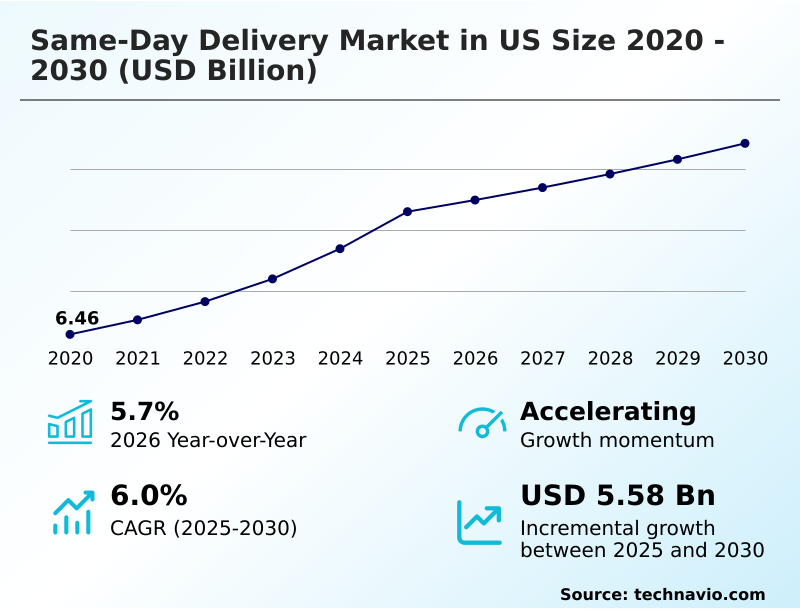
The us same-day delivery market size is valued to increase by USD 5.58 billion, at a CAGR of 6% from 2025 to 2030. Intensification of consumer demand for immediacy and convenience will drive the us same-day delivery market.
Major Market Trends & Insights
- By End-user - B2C segment was valued at USD 8.47 billion in 2024
- By Service - Regular service segment accounted for the largest market revenue share in 2024
Market Size & Forecast
- Market Opportunities: USD 15.63 billion
- Market Future Opportunities: USD 5.58 billion
- CAGR from 2025 to 2030 : 6%
Market Summary
- The same-day delivery market in us is rapidly evolving from a premium service to a standard consumer expectation, driven by the relentless pace of e-commerce and a cultural shift toward instant gratification. This transformation compels businesses to fundamentally rethink their fulfillment strategies, focusing intensely on the complexities of last-mile fulfillment.
- The market is characterized by a dual push: the need for operational efficiency to manage high costs and the imperative to innovate for competitive differentiation. A key trend is the architectural shift toward a decentralized logistics network, where businesses leverage urban micro-fulfillment centers and retail store inventories to position products closer to customers.
- For instance, a national retailer might use its urban stores as dispatch hubs, enabling delivery within hours and transforming physical assets into critical components of its digital supply chain. However, this model introduces challenges related to intricate inventory management and the high cost of last-mile labor.
- Success in this dynamic environment depends on harnessing technology, from AI-powered route optimization to predictive demand analytics, to solve the core economic and logistical puzzles of delivering goods at unprecedented speeds.
What will be the Size of the US Same-day Delivery Market during the forecast period?
Get Key Insights on Market Forecast (PDF) Get Free Sample
How is the US Same-day Delivery Market Segmented?
The us same-day delivery industry research report provides comprehensive data (region-wise segment analysis), with forecasts and estimates in "USD million" for the period 2026-2030, as well as historical data from 2020-2024 for the following segments.
- End-user
- B2C
- B2B
- C2C
- Service
- Regular service
- Priority service
- Rush service
- Mode of transportation
- Roadways
- Airways
- Intermodal
- Railways
- Geography
- North America
- US
- North America
By End-user Insights
The b2c segment is estimated to witness significant growth during the forecast period.
The business-to-consumer segment is defined by intense competitive market dynamics, where retail logistics strategy increasingly revolves around speed for customer experience enhancement. Handling high-volume e-commerce parcel delivery presents a significant last-mile delivery challenge.
While B2C dominates volume, specialized segments like B2B just-in-time delivery and temperature-controlled cold chain logistics offer higher margins, demanding strict service level agreement adherence.
The rise of dark stores helps meet B2C demand, while emerging platforms focusing on C2C transaction facilitation represent a growing niche.
The success of these varied services is underpinned by just-in-time inventory strategies, which have been shown to reduce carrying costs by over 15% for retailers who effectively integrate them.
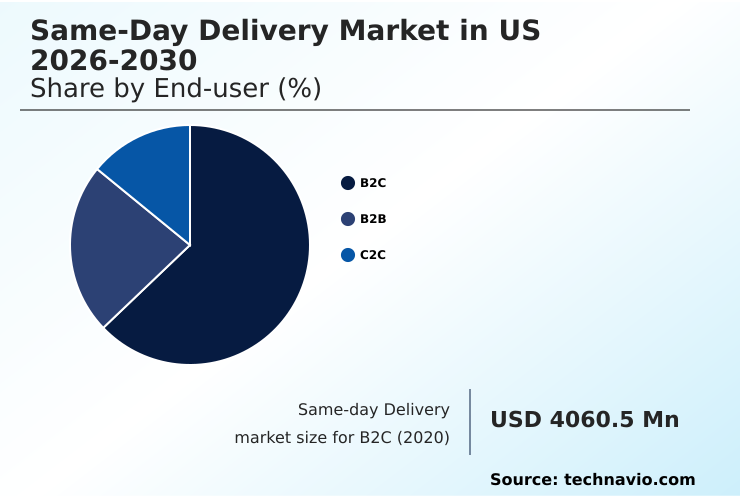
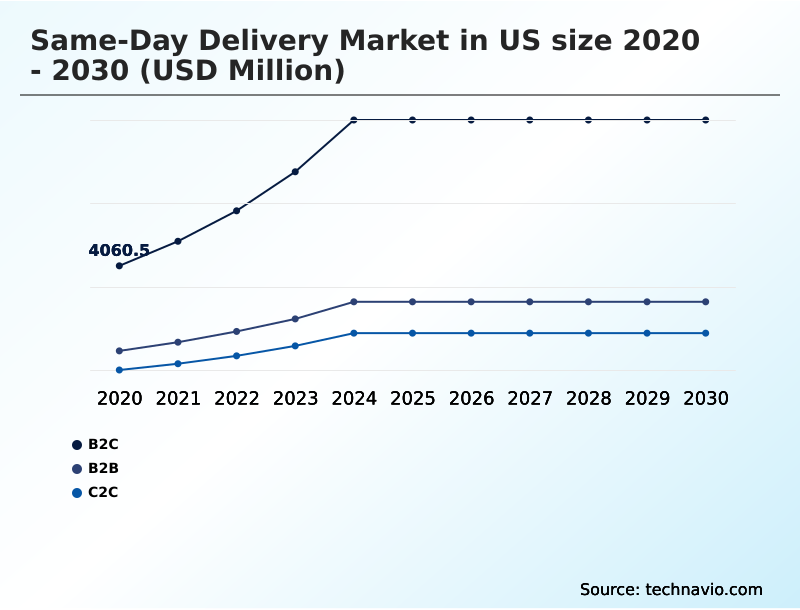
The B2C segment was valued at USD 8.47 billion in 2024 and showed a gradual increase during the forecast period.
Market Dynamics
Our researchers analyzed the data with 2025 as the base year, along with the key drivers, trends, and challenges. A holistic analysis of drivers will help companies refine their marketing strategies to gain a competitive advantage.
- Strategic planning in the same-day delivery market in us requires a multifaceted approach focused on optimizing last mile unit economics. The use of technology in same day delivery is central, with a significant push toward automating warehouse for rapid dispatch and leveraging predictive analytics for delivery demand.
- These technologies are critical for improving last mile delivery speed and achieving meaningful cost reduction in final mile. In the commercial space, the complexity of B2B same day delivery logistics and specialized needs like same day pharmaceutical delivery requirements necessitate robust, reliable systems.
- For consumer-facing operations, understanding B2C same day delivery trends informs the deployment of various hyperlocal delivery service models. The adoption of a micro-fulfillment center strategy and understanding the impact of dark stores on retail are key to realizing decentralized fulfillment network benefits.
- However, operators must confront significant urban logistics infrastructure issues and the persistent challenges of gig economy delivery while managing on-demand delivery workforce. The implementation of AI in last mile logistics and advanced software for route optimization for same day are becoming standard.
- Looking ahead, the pursuit of sustainable urban delivery solutions is intensifying, though initiatives face regulatory hurdles for drone delivery. Companies that effectively integrate these strategies see performance gains, with those using advanced dispatch algorithms reporting more than double the on-time performance rate of competitors relying on manual planning.
What are the key market drivers leading to the rise in the adoption of US Same-day Delivery Industry?
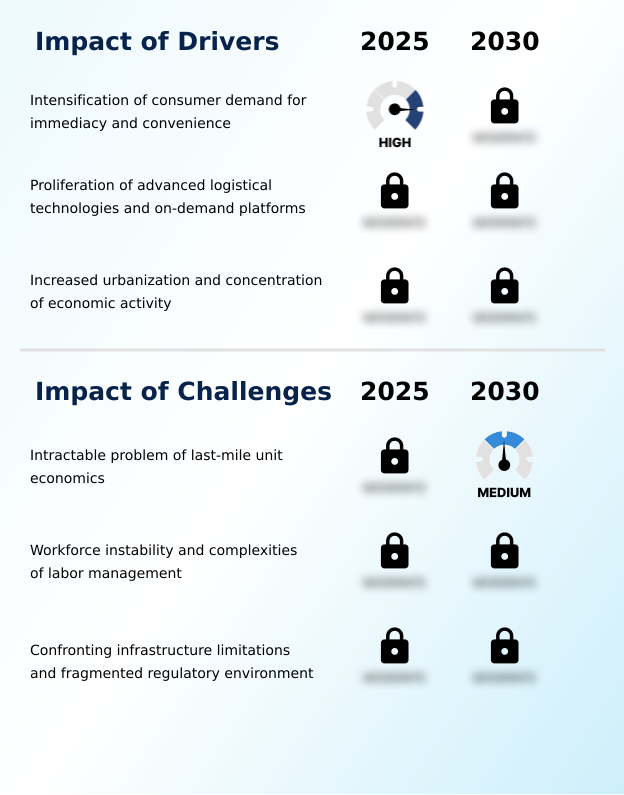
- The market's growth is fundamentally driven by the intensifying consumer demand for immediacy and convenience in product fulfillment.
- Growth is fundamentally fueled by the intense consumer demand for immediacy, which has elevated e-commerce fulfillment speed to a competitive necessity. The logistical technology proliferation, especially concerning last-mile technology integration, underpins the sector's viability.
- This includes warehouse automation robotics that can cut order processing times by more than 60%, creating a significant customer-facing strategic advantage. The challenging urban logistics landscape is navigated using flexible labor from on-demand workforce platforms and crowd-sourced delivery platforms.
- These technologies enable dynamic scaling and logistics value chain optimization. Moreover, ubiquitous real-time tracking capabilities provide essential transparency, while a focus on increasing urban delivery density is critical for making services economically sustainable across metropolitan areas.
What are the market trends shaping the US Same-day Delivery Industry?
- The ascendancy of hyper-automation and artificial intelligence is a defining market trend. This movement reshapes last-mile logistics by optimizing operational efficiency and altering competitive dynamics.
- The market is being reshaped by hyper-automation in logistics, where AI-powered dynamic routing can reduce fuel costs by over 15%. This trend facilitates new on-demand business models and drives last-mile delivery innovation. A key infrastructural shift is the adoption of micro-fulfillment centers, which enable the forward-deployment of stock and significantly shorten the final-mile travel distance.
- This strategy improves delivery speed by up to 50% in dense urban areas. Concurrently, sectoral diversification into high-value verticals is occurring alongside a push for sustainable delivery ecosystems. This includes the electrification of delivery fleets and a focus on corporate Environmental, Social, and Governance (ESG) metrics, with the long-term vision including autonomous delivery vehicles to further enhance efficiency and sustainability.
What challenges does the US Same-day Delivery Industry face during its growth?
- A key challenge affecting industry growth is the intractable problem of achieving sustainable last-mile unit economics amidst high operational costs.
- The primary challenge is achieving last-mile profitability due to punishing last-mile unit economics and high last-mile delivery costs. The industry's logistical cost structures are strained by urban traffic congestion, which can increase fuel consumption by up to 20%. These infrastructure limitations compound the difficulty of designing viable final-mile delivery solutions.
- Operators grapple with a complex cost-to-serve model and the constant need for route density optimization to stay afloat. Furthermore, the sector faces significant issues with last-mile labor management, including high turnover and workforce instability, which contribute to the severe last-mile operational complexity. Navigating a fragmented regulatory environment adds another layer of difficulty, with compliance costs varying dramatically between municipalities.
Exclusive Technavio Analysis on Customer Landscape
The us same-day delivery market forecasting report includes the adoption lifecycle of the market, covering from the innovator’s stage to the laggard’s stage. It focuses on adoption rates in different regions based on penetration. Furthermore, the us same-day delivery market report also includes key purchase criteria and drivers of price sensitivity to help companies evaluate and develop their market growth analysis strategies.
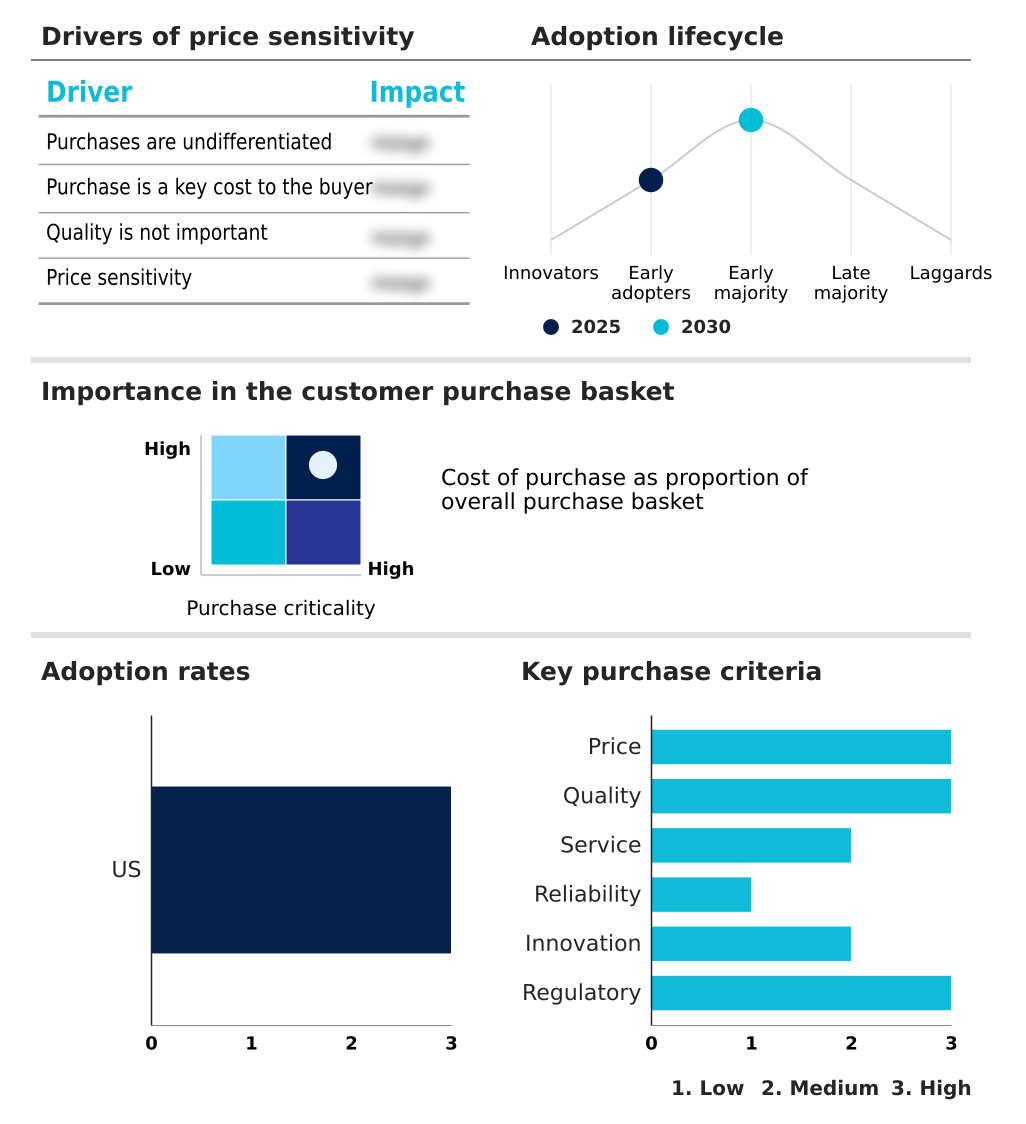
Customer Landscape of US Same-day Delivery Industry
Competitive Landscape
Companies are implementing various strategies, such as strategic alliances, us same-day delivery market forecast, partnerships, mergers and acquisitions, geographical expansion, and product/service launches, to enhance their presence in the industry.
Amazon.com Inc. - Offerings leverage vast e-commerce infrastructure to integrate rapid grocery and essentials delivery, setting new consumer expectations for fulfillment speed and convenience.
The industry research and growth report includes detailed analyses of the competitive landscape of the market and information about key companies, including:
- Amazon.com Inc.
- Courier Express
- DHL International GmbH
- DOORDASH INC.
- Dropoff Inc.
- FedEx Corp.
- Greenwich Logistics LLC
- Jitsu
- Maplebear Inc.
- OnTrac
- Postmates Inc
- Power Link Expedite Corp.
- Senpex Inc
- Shipt Inc.
- Target Corp.
- The Home Depot Inc.
- United Parcel Service Inc.
- USA Couriers
- USPack Logistics
- Walmart Inc.
Qualitative and quantitative analysis of companies has been conducted to help clients understand the wider business environment as well as the strengths and weaknesses of key industry players. Data is qualitatively analyzed to categorize companies as pure play, category-focused, industry-focused, and diversified; it is quantitatively analyzed to categorize companies as dominant, leading, strong, tentative, and weak.
Recent Development and News in Us same-day delivery market
- In October 2024, Walmart Inc. expanded its same-day delivery services by introducing an on-demand, early morning option, offering delivery in as little as thirty minutes to its loyalty program members.
- In November 2024, Target Corp. responded to competitive pressures by announcing the launch of its new paid membership program, Target Circle 360, which includes unlimited same-day delivery for eligible orders.
- In January 2025, United Parcel Service Inc. shifted its strategy by terminating its SurePost partnership with the USPS, bringing all economy deliveries in-house under its new Ground Saver brand to enhance control over the last-mile.
- In February 2025, FedEx Corp. significantly enhanced its weekend service capabilities by expanding its Sunday residential delivery coverage to reach approximately two-thirds of the US population, addressing growing e-commerce demand.
Dive into Technavio’s robust research methodology, blending expert interviews, extensive data synthesis, and validated models for unparalleled US Same-day Delivery Market insights. See full methodology.
| Market Scope | |
|---|---|
| Page number | 197 |
| Base year | 2025 |
| Historic period | 2020-2024 |
| Forecast period | 2026-2030 |
| Growth momentum & CAGR | Accelerate at a CAGR of 6% |
| Market growth 2026-2030 | USD 5582.1 million |
| Market structure | Fragmented |
| YoY growth 2025-2026(%) | 5.7% |
| Key countries | US |
| Competitive landscape | Leading Companies, Market Positioning of Companies, Competitive Strategies, and Industry Risks |
Research Analyst Overview
- The same-day delivery market in us is defined by the critical need to solve the core last-mile delivery challenge and its inherent last-mile operational complexity. Success hinges on mastering last-mile unit economics, a task addressed through the logistical technology proliferation.
- Key strategies include leveraging a decentralized logistics network composed of micro-fulfillment centers, dark stores, and urban fulfillment hubs to shorten the final-mile travel distance. This infrastructure supports various on-demand fulfillment models and facilitates the forward-deployment of stock. Operationally, the adoption of hyper-automation in logistics is paramount, with warehouse automation robotics and automated sorting systems accelerating last-mile fulfillment.
- For transport, AI-powered dynamic routing and advanced dynamic route optimization platforms, which incorporate sophisticated order batching algorithms, are critical for improving urban delivery density and enabling effective route density optimization. These systems, combined with real-time tracking capabilities, ensure strict service level agreement adherence.
- The labor component is managed through flexible on-demand workforce platforms and gig economy courier networks, although this introduces complexities in last-mile labor management. Specialized segments require unique capabilities, such as cold chain logistics for perishables and precise B2B just-in-time delivery for commercial clients.
- The future points toward autonomous delivery vehicles and the development of sustainable delivery ecosystems to navigate a fragmented regulatory environment. For operators, the ultimate goal is achieving a customer-facing strategic advantage by offering superior final-mile delivery solutions.
- Firms utilizing predictive demand forecasting and supply chain synchronization across their hyperlocal logistics networks have achieved up to a 20% improvement in inventory placement accuracy, directly impacting profitability. This landscape pressures even large crowd-sourced delivery platforms to continually innovate.
What are the Key Data Covered in this US Same-day Delivery Market Research and Growth Report?
-
What is the expected growth of the US Same-day Delivery Market between 2026 and 2030?
-
USD 5.58 billion, at a CAGR of 6%
-
-
What segmentation does the market report cover?
-
The report is segmented by End-user (B2C, B2B, and C2C), Service (Regular service, Priority service, and Rush service), Mode of Transportation (Roadways, Airways, Intermodal, and Railways) and Geography (North America)
-
-
Which regions are analyzed in the report?
-
North America
-
-
What are the key growth drivers and market challenges?
-
Intensification of consumer demand for immediacy and convenience, Intractable problem of last-mile unit economics
-
-
Who are the major players in the US Same-day Delivery Market?
-
Amazon.com Inc., Courier Express, DHL International GmbH, DOORDASH INC., Dropoff Inc., FedEx Corp., Greenwich Logistics LLC, Jitsu, Maplebear Inc., OnTrac, Postmates Inc, Power Link Expedite Corp., Senpex Inc, Shipt Inc., Target Corp., The Home Depot Inc., United Parcel Service Inc., USA Couriers, USPack Logistics and Walmart Inc.
-
Market Research Insights
- The intense competitive market dynamics of same-day delivery are forcing operators to refine their strategies for customer experience enhancement and operational resilience. A primary focus is optimizing the final leg of delivery to manage escalating last-mile delivery costs. Firms leveraging advanced analytics are achieving superior operational efficiency gains, with some platforms reporting a 25% improvement in route density.
- The difficult urban logistics landscape and persistent workforce instability associated with gig-based labor models are significant hurdles. However, the adoption of sophisticated on-demand delivery platforms and an emphasis on last-mile technology integration help mitigate these issues.
- Effective management of the cost-to-serve model remains critical, as companies that align pricing with their actual logistical cost structures demonstrate a 10% higher rate of profitability compared to those heavily subsidizing services.
We can help! Our analysts can customize this us same-day delivery market research report to meet your requirements.
 RIA -
RIA - 
