
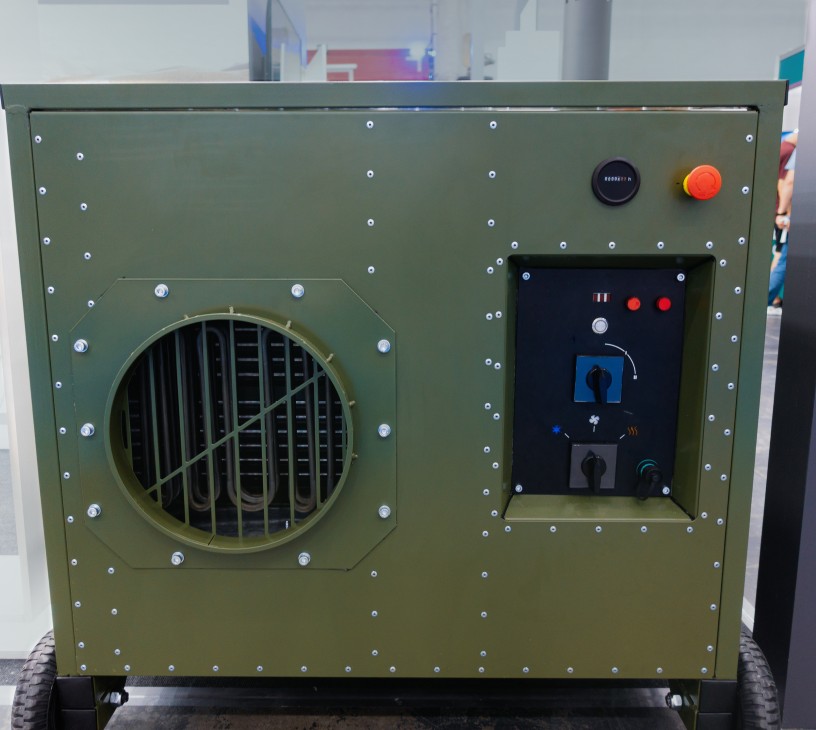


Temperature Control Rental Market Size and Growth Forecast 2026-2030
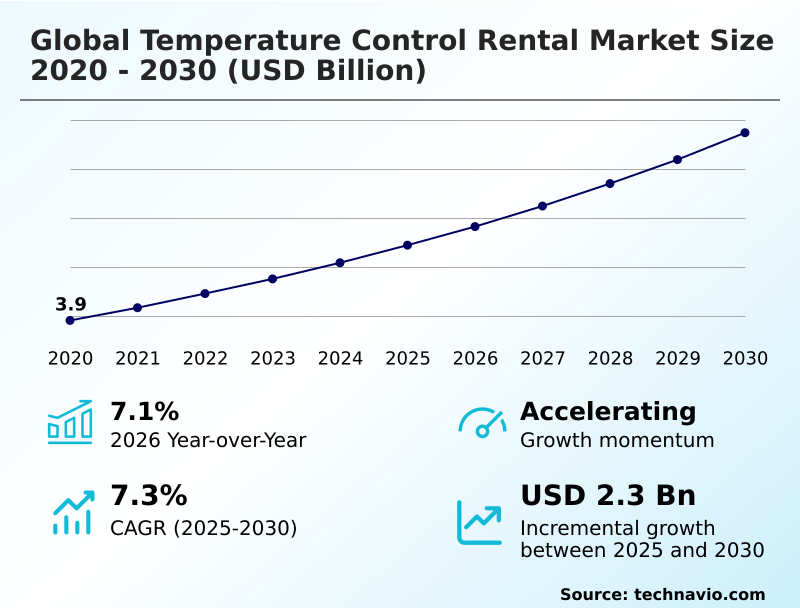
The Temperature Control Rental Market size was valued at USD 5.44 billion in 2025 growing at a CAGR of 7.3% during the forecast period 2026-2030.
APAC accounts for 42.1% of incremental growth during the forecast period. The Chillers segment by Type was valued at USD 1.77 billion in 2024, while the Industrial segment holds the largest revenue share by End-user.
The market is projected to grow by USD 3.83 billion from 2020 to 2030, with USD 2.30 billion of the growth expected during the forecast period of 2025 to 2030.
Get Key Insights on Market Forecast (PDF) Request Free Sample
Temperature Control Rental Market Overview
The temperature control rental market, growing at a 7.1% year-over-year rate, provides mission-critical temporary climate control for industries prioritizing operational agility and resilience. Companies are adopting an asset-light business model, leveraging HVAC rental solutions to manage seasonal peaks, planned maintenance, and emergency cooling needs without significant capital investment. A key application is in the pharmaceutical sector, where a manufacturer might deploy a modular pharmaceutical cleanroom rental solution to rapidly scale up vaccine production, ensuring strict adherence to environmental standards while meeting urgent public health demands. This flexibility is vital for industries from data center cooling rental to heavy manufacturing, where achieving decarbonization goals and compliance with energy management standards like ISO 50001 requires access to the latest, most efficient equipment on an as-needed basis.
Drivers, Trends, and Challenges in the Temperature Control Rental Market
The market's value is demonstrated in its highly specific applications, which address both planned and emergency needs across critical infrastructure. For example, rental cooling towers for refinery turnarounds are essential for maintaining operational safety and minimizing downtime during planned maintenance, a scenario where a single day of lost production can be far more costly than the rental fee.
Similarly, emergency chiller rental for data centers provides immediate, redundant capacity to prevent catastrophic hardware failure during a primary system outage, safeguarding data integrity. While the industrial segment, which includes demand for industrial boiler rental for manufacturing plants and supplemental cooling for power generation facilities, is significantly larger than the commercial segment, specialized commercial applications are growing.
These include temporary hvac for hospital construction projects, which must meet stringent air quality standards, and large-scale portable air conditioner rental for large events. Even niche needs, like dehumidifier rental for water damage restoration, underscore the market's role as an essential service provider, helping businesses meet both operational and energy management goals under frameworks like ISO 50001.
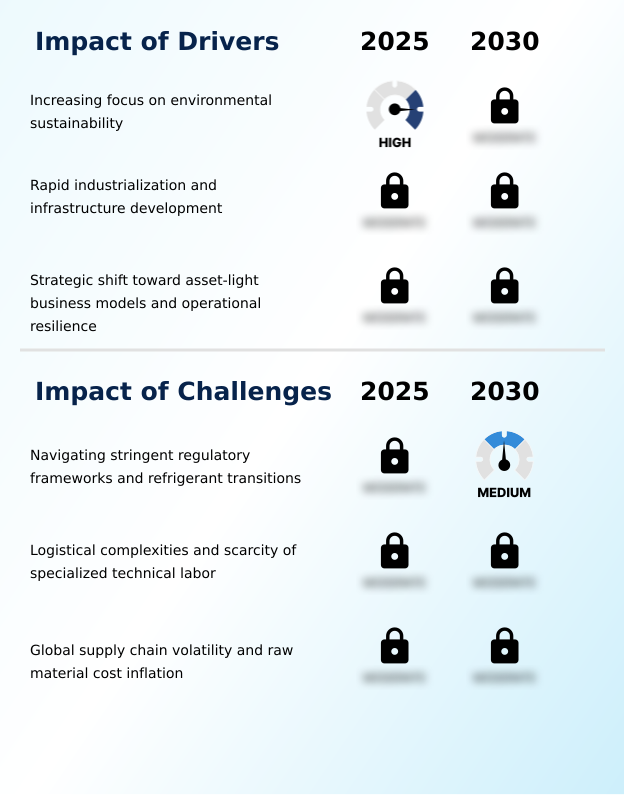
Primary Growth Driver: An increasing focus on environmental sustainability, driven by stringent regulatory frameworks and corporate ESG mandates, is a primary driver for the market.
The strategic shift toward an asset-light business model is a major market driver, allowing organizations to convert large capital expenditure (CAPEX) into predictable operational expenditure (OPEX).
This financial flexibility is crucial for operational resilience and effective contingency planning during equipment failures or extreme weather.
Rapid industrialization, particularly in APAC which is poised for 8.1% growth, fuels demand for temporary and supplemental cooling in new manufacturing and data center constructions.
Furthermore, intensifying environmental pressures compel industries to pursue net-zero emissions targets, making rental access to the latest energy-efficient equipment a vital tool for compliance and achieving corporate sustainability objectives without the risk of technology obsolescence.
Emerging Market Trend: The integration of advanced telematics and real-time remote monitoring is a defining market trend, shifting asset management toward predictive maintenance and enhanced operational transparency for clients.
A key trend is the integration of remote monitoring telematics, enabling predictive maintenance and optimizing fleet management. This shift to data-driven operations helps clients achieve decarbonization goals by fine-tuning energy usage. Concurrently, the push for sustainability, driven by EU F-Gas regulations, is accelerating the adoption of hybrid cooling systems and equipment using low-GWP refrigerants.
Rental providers are expanding their offerings to include industry-specific modular solutions, such as pre-configured modular cooling towers for data centers and pharmaceutical cleanrooms. This approach allows for rapid deployment and scalability, directly supporting clients' need for agile and compliant temporary climate control infrastructure without significant upfront capital expenditure.
Key Industry Challenge: Navigating complex regulatory frameworks and the capital-intensive transition to alternative refrigerants presents a significant challenge for industry operators.
The industry faces significant challenges, led by the complex and costly refrigerant transition mandated by regulations like the EPA Section 608 compliance rules in the US, forcing fleet modernization to low-GWP alternatives. Logistical complexities and a shortage of skilled technicians increase operational costs and can delay deployment for critical applications like refinery turnaround maintenance.
Furthermore, global supply chain volatility affects the availability and cost of raw materials and electronic components for new equipment, from industrial chillers to rental boilers. These pressures create a difficult operating environment, where providers must balance the high cost of compliance and fleet upgrades with maintaining competitive pricing for end-users.
Explore Full Market Dynamics Analysis Request Free Sample
Temperature Control Rental Market Segmentation
The temperature control rental industry research report provides comprehensive data including region-wise segment analysis, with forecasts and analysis for the period 2026-2030, as well as historical data from 2020-2024 for the following segments.
Type Segment Analysis
The chillers segment is estimated to witness significant growth during the forecast period.
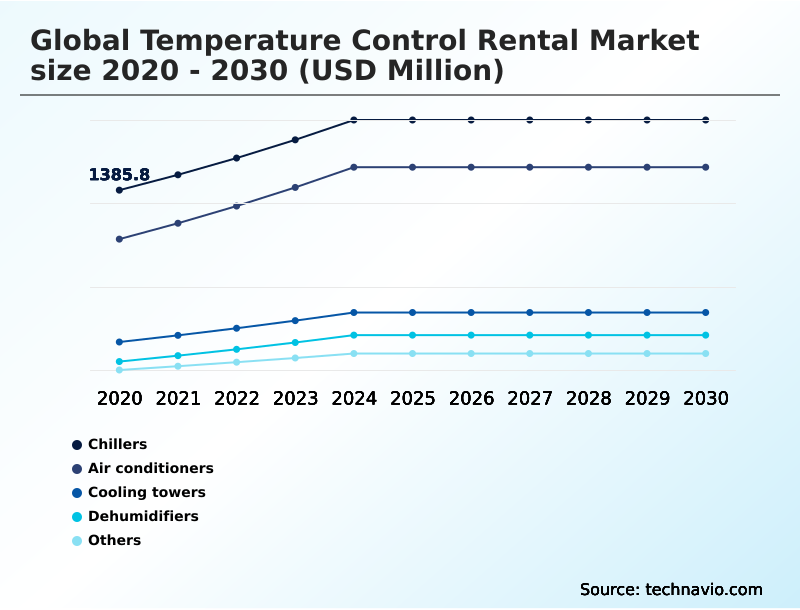
The chillers segment, accounting for a substantial market share with a value of 1,889.0 million in 2025, is critical for industrial operations.
This segment is segmented into air-cooled chillers and water-cooled chillers, deployed for precise process cooling in sectors like pharmaceuticals and data centers.
Procurement decisions are increasingly influenced by the total cost of ownership, where factors like the energy efficiency ratio (EER), compliant with ASHRAE 90.1 standards, play a key role.
The adoption of advanced industrial chillers with variable-speed drives is becoming standard practice for managing fluctuating thermal loads, optimizing power consumption, and meeting sustainability targets for end-users.
This technology is crucial for applications requiring stable, high-capacity cooling without compromising operational efficiency.
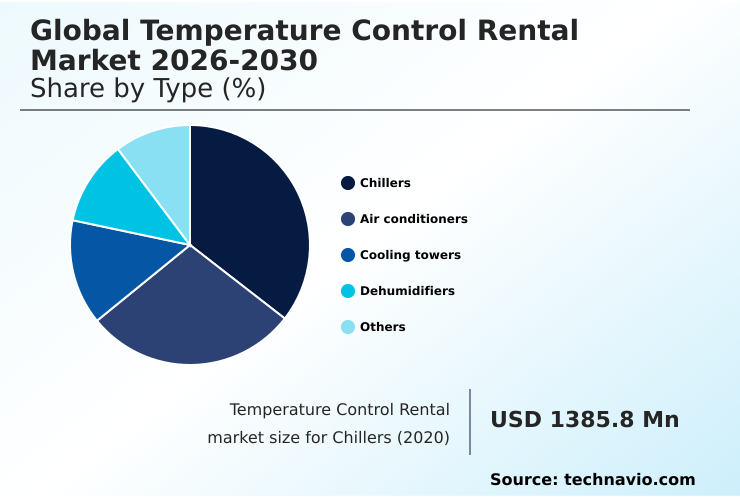
The Chillers segment was valued at USD 1.77 billion in 2024 and showed a gradual increase during the forecast period.
Temperature Control Rental Market by Region: APAC Leads with 42.1% Growth Share
APAC is estimated to contribute 42.1% to the growth of the global market during the forecast period.
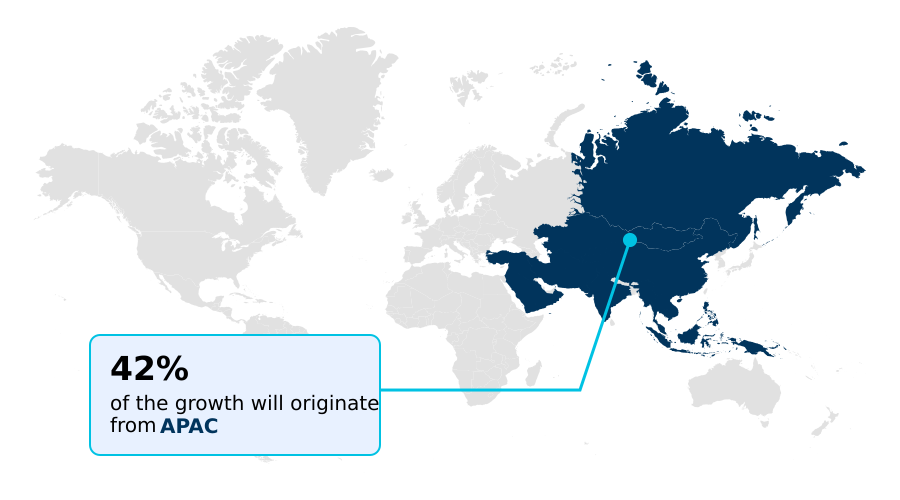
The geographic landscape is dominated by North America and APAC, with APAC projected to contribute 42.1% of the market's incremental growth.
In North America, demand is driven by disaster recovery HVAC needs and supplemental cooling for power generation cooling during peak summer loads. In APAC, rapid industrialization fuels demand for temporary climate control in new constructions and manufacturing facilities.
The Middle East requires specialized solutions for oil and gas rig cooling in extreme heat. In Europe, stringent local emission zones are accelerating the shift toward electric-powered equipment for applications like construction site heating.
Across all regions, rental solutions are critical for seasonal peak shaving and ensuring operational continuity.
Customer Landscape Analysis for the Temperature Control Rental Market
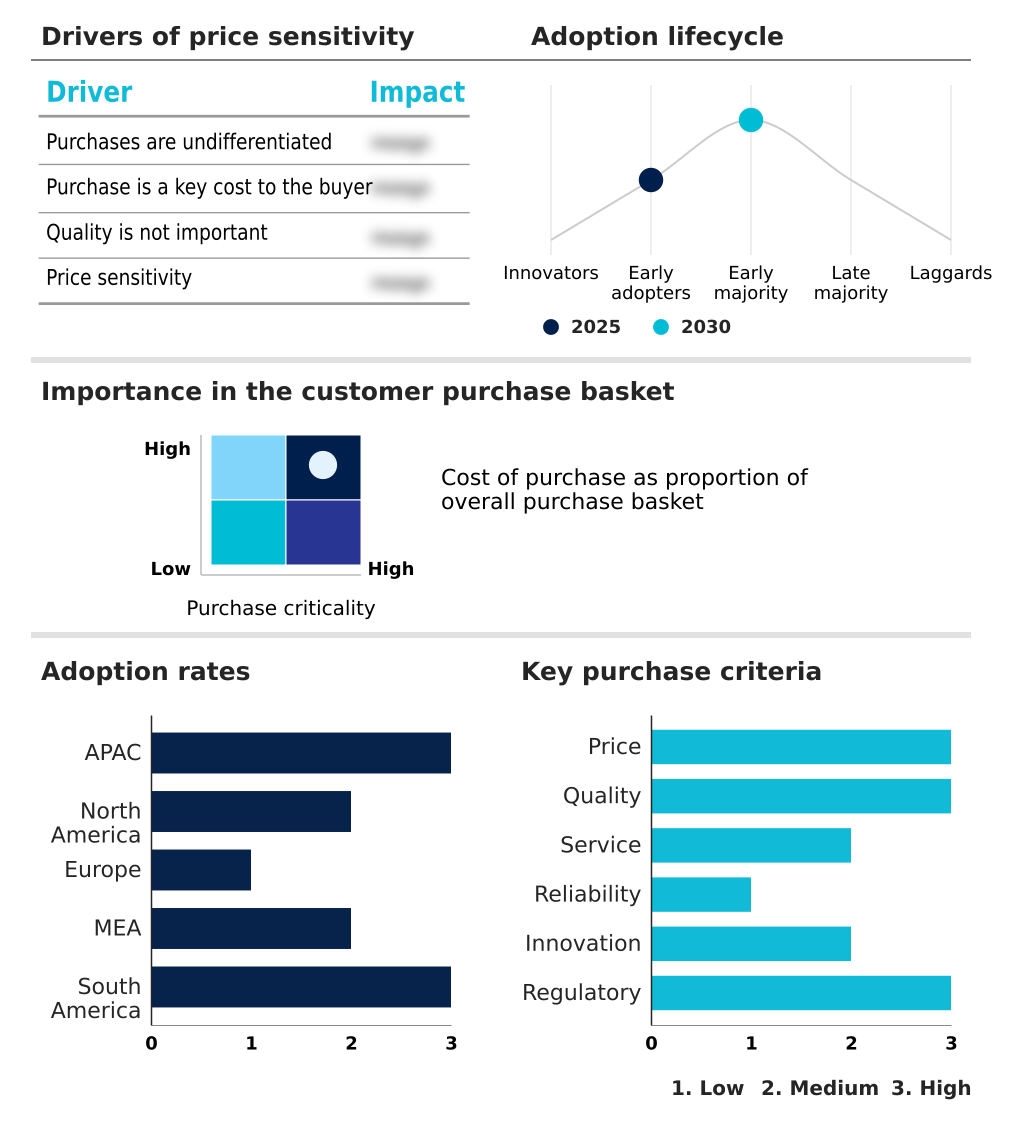
The temperature control rental market forecasting report includes the adoption lifecycle of the market, covering from the innovator’s stage to the laggard’s stage. It focuses on adoption rates in different regions based on penetration. Furthermore, the temperature control rental market report also includes key purchase criteria and drivers of price sensitivity to help companies evaluate and develop their market growth analysis strategies.
Competitive Landscape of the Temperature Control Rental Market
Companies are implementing various strategies, such as strategic alliances, partnerships, mergers and acquisitions, geographical expansion, and product/service launches, to enhance their presence in the temperature control rental market industry.
Aggreko Plc - Specialized providers offer temporary heating, ventilation, and air conditioning (HVAC) systems, enabling operational continuity and supporting project-based or emergency needs across diverse industrial and commercial sectors.
The industry research and growth report includes detailed analyses of the competitive landscape of the market and information about key companies, including:
- Aggreko Plc
- Andrews Sykes Group PLC.
- Boels Rental.
- Byrne Equipment Rental
- Carrier Global Corp.
- Cat Rentals
- Cool Air Rentals Ltd.
- Emerson Electric Co.
- HERC HOLDINGS INC.
- Honeywell International Inc.
- Johnson Controls International
- Kiloutou
- LOXAM GROUP.
- Modulaire Group
- Polygon International AB
- Rankin Climate LLC.
- Sunbelt Rentals Inc.
- Trane Technologies plc
- United Rentals Inc.
- WillScot Holdings Corp.
Qualitative and quantitative analysis of companies has been conducted to help clients understand the wider business environment as well as the strengths and weaknesses of key industry players. Data is qualitatively analyzed to categorize companies as pure play, category-focused, industry-focused, and diversified; it is quantitatively analyzed to categorize companies as dominant, leading, strong, tentative, and weak.
Recent Developments in the Temperature Control Rental Market
- In August 2025, Aggreko successfully deployed a large-scale hybrid cooling system in South America that combined solar photovoltaic arrays with battery energy storage to power its industrial temperature control units at a remote mining site, demonstrating the feasibility of using renewable energy in extreme environments.
- In February 2025, Sunbelt Rentals launched a specialized emergency preparedness program in North America designed to help industrial facilities pre-allocate temporary climate control assets for immediate mobilization during peak seasonal stress periods, reflecting a trend toward proactive risk management.
- In October 2025, Trane introduced a new series of modular rental chillers in Europe specifically optimized for cooling Artificial Intelligence server racks, featuring advanced variable-speed drives and redundant control systems to handle high thermal loads.
- In May 2025, United Rentals announced a major strategic investment in North America to incorporate advanced electric industrial heat pumps into its rental portfolio, targeting industrial clients needing to comply with stringent local carbon emission caps.
Research Analyst Overview: Temperature Control Rental Market
The market is fundamentally shifting from a commodity rental service to a strategic partnership model, driven by regulatory pressures and technological advancements. In boardrooms, the decision to rent versus buy temporary HVAC equipment is increasingly framed as a risk mitigation strategy.
For instance, facing an aggressive EPA F-Gas phase-down schedule, a facility manager can use rental air handling units with compliant low-GWP refrigerants to bridge the gap during a multi-year permanent system upgrade, avoiding capital lock-in. This trend is most prominent in APAC, the largest regional market.
Vendors are differentiating by offering integrated solutions combining hardware like spot coolers with remote monitoring telematics and variable-speed drives, ensuring optimized process cooling for applications from power generation cooling to scheduled turnaround maintenance. This evolution makes rental a key enabler of both operational continuity and sustainability compliance.
Dive into Technavio’s robust research methodology, blending expert interviews, extensive data synthesis, and validated models for unparalleled Temperature Control Rental Market insights. See full methodology.
| Market Scope | |
|---|---|
| Page number | 315 |
| Base year | 2025 |
| Historic period | 2020-2024 |
| Forecast period | 2026-2030 |
| Growth momentum & CAGR | Accelerate at a CAGR of 7.3% |
| Market growth 2026-2030 | USD 2300.1 million |
| Market structure | Fragmented |
| YoY growth 2025-2026(%) | 7.1% |
| Key countries | China, India, Japan, South Korea, Australia, Indonesia, US, Canada, Mexico, Germany, UK, France, Italy, The Netherlands, Spain, Saudi Arabia, UAE, South Africa, Israel, Turkey, Brazil, Argentina and Colombia |
| Competitive landscape | Leading Companies, Market Positioning of Companies, Competitive Strategies, and Industry Risks |
Temperature Control Rental Market: Key Questions Answered in This Report
-
What is the expected growth of the Temperature Control Rental Market between 2026 and 2030?
-
The Temperature Control Rental Market is expected to grow by USD 2.30 billion during 2026-2030, registering a CAGR of 7.3%. Year-over-year growth in 2026 is estimated at 7.1%%. This acceleration is shaped by increasing focus on environmental sustainability, which is intensifying demand across multiple end-use verticals covered in the report.
-
-
What segmentation does the market report cover?
-
The report is segmented by Type (Chillers, Air conditioners, Cooling towers, Dehumidifiers, and Others), End-user (Industrial, Commercial, and Residential), Application (Oil and gas, Manufacturing, Construction, Petrochemical and refining, and Others) and Geography (APAC, North America, Europe, Middle East and Africa, South America). Among these, the Chillers segment is estimated to witness significant growth during the forecast period, driven by rising adoption across key application areas. Each segment includes detailed qualitative and quantitative analysis, along with historical data from 2020-2024 and forecasts through 2030 with year-over-year growth rates.
-
-
Which regions are analyzed in the report?
-
The report covers APAC, North America, Europe, Middle East and Africa and South America. APAC is estimated to contribute 42.1% to market growth during the forecast period. Country-level analysis includes China, India, Japan, South Korea, Australia, Indonesia, US, Canada, Mexico, Germany, UK, France, Italy, The Netherlands, Spain, Saudi Arabia, UAE, South Africa, Israel, Turkey, Brazil, Argentina and Colombia, with dedicated market size tables and year-over-year growth for each.
-
-
What are the key growth drivers and market challenges?
-
The primary driver is increasing focus on environmental sustainability, which is accelerating investment and industry demand. The main challenge is navigating stringent regulatory frameworks and refrigerant transitions, creating operational barriers for key market participants. The report quantifies the impact of each driver and challenge across 2026 and 2030 with comparative analysis.
-
-
Who are the major players in the Temperature Control Rental Market?
-
Key vendors include Aggreko Plc, Andrews Sykes Group PLC., Boels Rental., Byrne Equipment Rental, Carrier Global Corp., Cat Rentals, Cool Air Rentals Ltd., Emerson Electric Co., HERC HOLDINGS INC., Honeywell International Inc., Johnson Controls International, Kiloutou, LOXAM GROUP., Modulaire Group, Polygon International AB, Rankin Climate LLC., Sunbelt Rentals Inc., Trane Technologies plc, United Rentals Inc. and WillScot Holdings Corp.. The report provides qualitative and quantitative analysis categorizing companies as dominant, leading, strong, tentative, and weak based on their market positioning. Company profiles include business segment analysis, SWOT assessment, key offerings, and recent strategic developments.
-
Temperature Control Rental Market Research Insights
Market dynamics are shaped by the need for financial flexibility and operational resilience, driving a preference for converting capital costs into manageable operational expenditure (OPEX). While the industrial segment remains dominant, the commercial sector is expanding due to applications like event climate control for large international expos, requiring sophisticated temporary HVAC systems.
The integration of rental equipment with existing building management system (BMS) infrastructure is becoming a key vendor selection criterion, enabling unified control and predictive maintenance. Stricter environmental rules, such as Europe's F-Gas regulations, are accelerating the adoption of rental fleets with compliant, low-GWP refrigerants, positioning rental providers as key partners in navigating the complex regulatory landscape.
We can help! Our analysts can customize this temperature control rental market research report to meet your requirements.
 RIA -
RIA - 
