
Time-of-flight (TOF) Sensor Market Size 2025-2029
The time-of-flight (TOF) sensor market size is forecast to increase by USD 3.6 billion, at a CAGR of 37.7% between 2024 and 2029.
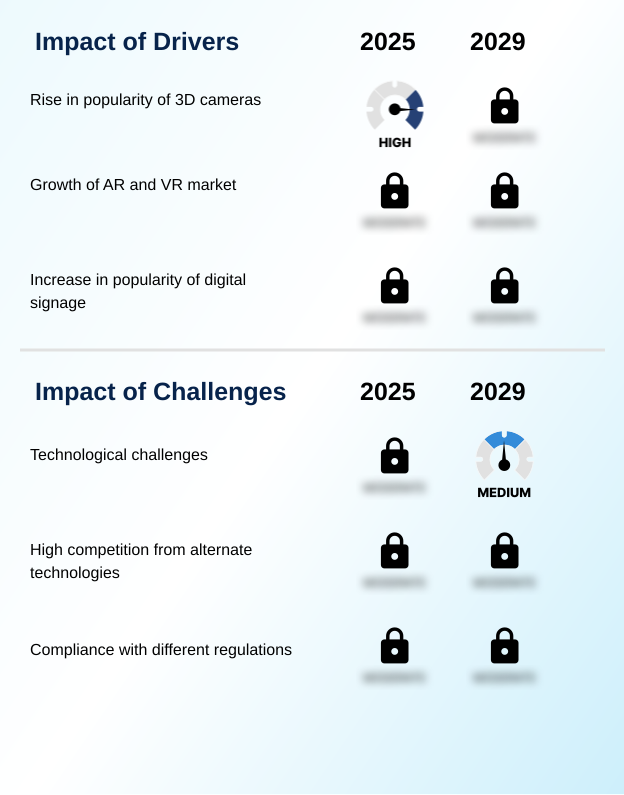
The global time-of-flight (TOF) sensor market is shaped by the increasing popularity of 3D cameras, which rely on modulated light source technology and depth map generation for advanced imaging. This driver is pivotal for applications in robotics, security, and consumer electronics, where real-time 3d mapping is essential. The integration of tof cameras into drones to create virtual reality experiences is a significant trend, leveraging 3d point cloud data to deliver immersive user interactions. The expansion of the smart sensor ecosystem, including innovations in low light level imaging sensors, is supporting this development. These advancements enable new use cases in entertainment and industrial inspection, where both high-resolution depth sensing and autonomous navigation are critical for operational success.Technological challenges, including limited sensor resolution and aliasing problems from a restricted unambiguous distance range, currently affect performance. Issues such as the accumulation of dust on sensor lenses can cause malfunctions, impacting the reliability of systems that utilize gesture recognition algorithm and proximity detection. These operational hurdles require ongoing innovation in sensor design and materials. Despite these issues, the market continues to evolve, with developments in the 3d sensors market and wearable sensors indicating a trajectory toward more sophisticated and resilient solutions. Addressing these technical limitations is crucial for unlocking the full potential of applications in augmented reality, automotive systems, and industrial automation, where precision and reliability are paramount.
What will be the Size of the Time-of-flight (TOF) Sensor Market during the forecast period?

Explore in-depth regional segment analysis with market size data - historical 2019 - 2023 and forecasts 2025-2029 - in the full report.
Request Free Sample
The global time-of-flight (TOF) sensor market is characterized by ongoing advancements in depth sensing camera technology and sensor miniaturization. Innovations in direct tof sensing and indirect tof measurement are expanding applications across various sectors. The development of high-resolution depth sensing capabilities is crucial for systems requiring precise 3d perception, such as autonomous mobile robots and drones. This progress is closely tied to the broader semiconductor sensors field, where improvements in power consumption optimization and motion artifact reduction are key areas of focus. These evolving technical attributes continue to shape the landscape for interactive and automated systems.Market dynamics are also influenced by the increasing integration of these sensors into complex systems like advanced driver assistance systems and mixed reality hardware. The use of a time-of-flight sensor for automotive lidar is a critical aspect of this trend, enabling safer and more reliable autonomous navigation. Concurrently, the proliferation of contactless user interfaces in consumer electronics and public-facing kiosks is driving demand for robust gesture recognition and proximity detection solutions. The continuous refinement of technologies such as background removal processing and real-time 3d mapping is essential for meeting the performance demands of these emerging use cases within the ai sensor landscape.
How is this Time-of-flight (TOF) Sensor Industry segmented?
The time-of-flight (TOF) sensor industry research report provides comprehensive data (region-wise segment analysis), with forecasts and estimates in "USD million" for the period 2025-2029, as well as historical data from 2019 - 2023 for the following segments.
- End-user
- Application
- LiDAR
- Gesture recognition
- AR and VR
- 3D imaging and scanning
- Type
- Direct TOF
- Indirect TOF
- Range-gated imagers
- Geography
- APAC
- China
- India
- Japan
- South Korea
- Australia
- Indonesia
- North America
- Europe
- Germany
- UK
- France
- Italy
- Spain
- The Netherlands
- South America
- Middle East and Africa
- Rest of World (ROW)
By End-user Insights
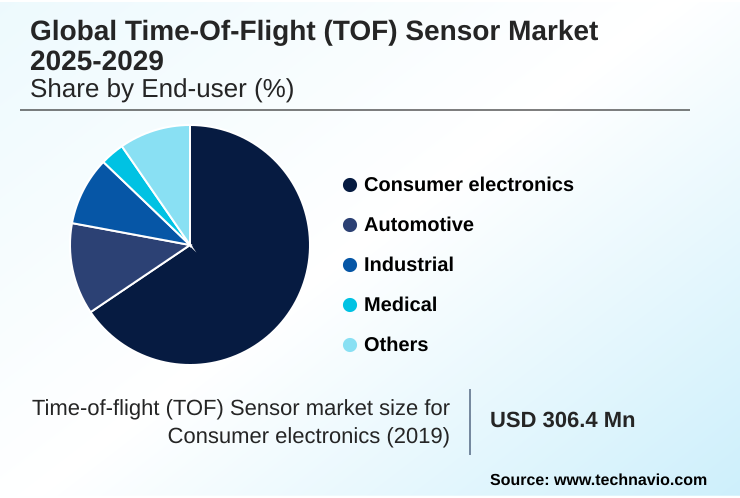
The consumer electronics segment is estimated to witness significant growth during the forecast period.
The consumer electronics segment is a primary area of activity, driven by the widespread integration of sensors for camera autofocus assist and facial recognition in devices like smartphones and tablets. The increasing adoption of wearables such as smartwatches, which incorporate proximity detection and presence detection sensor technology, further contributes to this segment's momentum. The ongoing trend of sensor miniaturization is enabling the inclusion of sophisticated depth-sensing capabilities in a broader range of consumer products, enhancing user interaction and functionality.
Demand is also sustained by the move to replace older sensor technologies with more cost-effective and power-efficient alternatives. This transition supports the development of advanced computational photography features and improves low-light performance in cameras. As the industry continues to innovate, the focus on enhancing the human-machine interface through touchless controls and gesture recognition algorithms is set to maintain a strong innovation cycle. This segment's expansion is global, though certain emerging geographies represent a smaller opportunity share, around 1.71%, indicating room for future penetration.

Request Free Sample
The Consumer electronics segment was valued at USD 306.40 million in 2019 and showed a gradual increase during the forecast period.

Regional Analysis
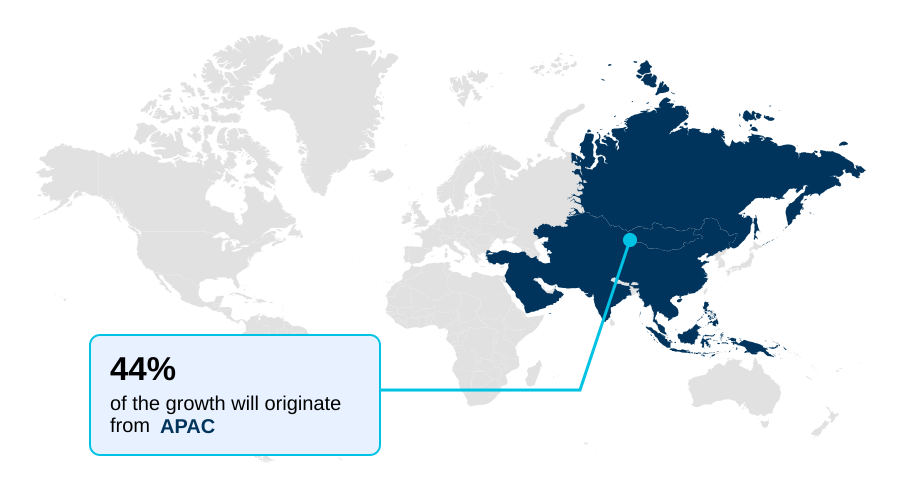
APAC is estimated to contribute 44.4% to the growth of the global market during the forecast period.Technavio’s analysts have elaborately explained the regional trends and drivers that shape the market during the forecast period.
Request Free Sample
The APAC region is a dominant force in the global time-of-flight (TOF) sensor market, driven by its extensive consumer electronics manufacturing ecosystem and a rapidly expanding consumer base. The high demand for camera-enabled mobile devices and digital cameras in developing nations provides a substantial volume market for components enabling camera autofocus assist and advanced imaging. The presence of major electronics manufacturing hubs ensures a steady supply chain and fosters innovation in sensor miniaturization and power consumption optimization for the APAC market.
Furthermore, the rapid pace of digitalization across the APAC region is creating new opportunities for applications in machine vision and industrial automation. The region represents the largest geographic opportunity, accounting for 44.36% of the global potential. The continuous launch of innovative products by regional industry leaders to meet the demand from both electronics and automotive sectors is a key factor sustaining this leadership position. This dynamic environment supports ongoing advancements in depth map generation and real-time 3D mapping technologies in the APAC market.
Market Dynamics
Our researchers analyzed the data with 2024 as the base year, along with the key drivers, trends, and challenges. A holistic analysis of drivers will help companies refine their marketing strategies to gain a competitive advantage.
The Global Time-of-Flight (TOF) Sensor Market is experiencing significant expansion, driven by advancements and its broadening application scope. A key driver is the automotive industry, where the time-of-flight sensor for automotive LIDAR is integral to advanced driver-assistance systems with LIDAR and the development of real-time 3D mapping for autonomous vehicles. Beyond external sensing, in-cabin sensing for driver monitoring enhances vehicle safety, while gesture-based control for infotainment systems improves user experience. In parallel, the industrial sector leverages time-of-flight sensors in industrial automation for applications like robotic guidance with 3D perception sensors and enhancing machine vision systems using 3D sensors. These technologies are crucial for tasks such as automated inventory tracking in logistics and enabling drone navigation and obstacle avoidance sensors, showcasing the versatility of TOF technology in complex operational environments.The proliferation of TOF technology extends deeply into the consumer market, where indirect time-of-flight for consumer electronics is becoming standard. For instance, the TOF sensor for mobile device facial recognition provides robust security, and the technology facilitates immersive experiences like augmented reality with TOF environmental mapping. Innovations in direct time-of-flight with SPAD detectors are enabling high-resolution 3D depth sensing cameras that are critical for gesture recognition using depth sensor data. This capability is also finding its way into smart home presence detection sensors. Furthermore, the market is seeing specialized applications emerge, including TOF based object scanning and dimensioning for commercial use, low power TOF sensors for wearables, and promising developments in TOF sensors for medical imaging applications, indicating a future of continued growth for TOF solutions.

What are the key market drivers leading to the rise in the adoption of Time-of-flight (TOF) Sensor Industry?
- The primary market driver is the expanding adoption and increasing popularity of 3D cameras across various industries.
The increasing integration of 3D cameras is a primary factor driving market dynamics. These cameras, which utilize a modulated light source and observe reflected light, are essential for depth map generation and real-time 3d mapping. Key applications include object scanning, security systems, robotics, and gesture recognition, all of which rely on accurate 3d point cloud data. The growing use of 3d cameras in sectors such as medical, architecture, and gaming is expanding the technology's footprint. As advancements in electronic components continue, the capabilities of these cameras are improving, supporting their adoption in more complex systems. This trend is central to the ongoing development of more interactive and autonomous technologies across multiple industries.The growth of the augmented reality (AR) and virtual reality (VR) markets is another key driver. The proliferation of VR headsets and mobile-integrated devices creates strong demand for sensors that enable environmental mapping and touchless controls. Technologies like SLAM and proximity detection are fundamental to creating immersive experiences in games and movies. The enterprise sector is also adopting AR for applications in logistics, warehousing, and service maintenance, where hands-free interaction via a human-machine interface improves efficiency. While consumer revenue generation is still developing, growing interest and application downloads indicate future potential, with some regions accounting for 24.11% of the geographic opportunity.
What are the market trends shaping the Time-of-flight (TOF) Sensor Industry?
- The integration of virtual reality experiences with drones is an emerging trend shaping the market's future.
The growing adoption of time-of-flight cameras in drones to create virtual reality (VR) experiences is a notable market trend. This development leverages real-time 3d mapping and depth map generation to produce immersive environments for entertainment and educational purposes. Drone companies are capitalizing on the demand for VR products, integrating their aerial platforms with headsets to offer unique perspectives and interactive content. This trend is gaining significant traction, particularly with the rise of drone racing, where precise autonomous navigation and obstacle avoidance systems are critical. The fusion of drone technology with VR, supported by innovations in the ai sensor and wireless sensors market, is creating new opportunities for user engagement and expanding the application scope of both technologies into new recreational and professional domains.The increasing popularity of motion-sensing remotes is another significant trend influencing the market. While infrared remotes have historically dominated consumer electronics, new technologies like radio frequency (RF), bluetooth, and wi-fi are enabling more advanced functionalities. These remotes incorporate motion control technology, allowing users to interact with gaming consoles and smart TVs through intuitive gestures. This shift creates opportunities for developing sophisticated motion-controlled remotes that utilize gesture recognition algorithms and 3d perception. As technology advances, these innovative human-machine interfaces are expected to gain wide consumer acceptance. Specific geographic landscapes present notable opportunities for this trend, with some accounting for 25.73% of the market potential, indicating strong regional interest in advanced consumer electronics.
What challenges does the Time-of-flight (TOF) Sensor Industry face during its growth?
- Key technological challenges related to sensor performance and environmental factors currently constrain market growth.
Technological challenges associated with sensor performance present a significant hurdle. These devices are crucial for identifying objects within a predefined perimeter to ensure user safety, but their detection ability is dependent on the size of the interfering object. In some instances, sensors may fail to detect small movements, which can compromise the integrity of industrial processes that rely on precise robotic navigation and collision avoidance sensor technology. Key issues include limited resolution, which can fail to suppress noise in depth images, and aliasing problems due to a limited unambiguous distance range. Additionally, the accumulation of dust or microbiological organisms can contaminate lenses, leading to malfunctions and false alarms, thereby impacting system reliability.High competition from alternate technologies poses another considerable challenge to market growth. Stereovision cameras, which use multiple lenses to create 3d images with depth perception, are often preferred for applications like 3d movie production due to their ease of implementation. Similarly, structured light projection technology, where a pattern is projected onto a scene to calculate depth and surface information, is favored in fields such as forensic fingerprint scanning and certain 3d scanning applications. These alternative methods for 3d perception and 3d point cloud data acquisition offer viable solutions for specific use cases. While some regions represent a smaller portion of the geographic opportunity at 4.1%, the presence of these alternate technologies requires continuous innovation to maintain a competitive edge.
Exclusive Customer Landscape
The time-of-flight (TOF) sensor market forecasting report includes the adoption lifecycle of the market, covering from the innovator’s stage to the laggard’s stage. It focuses on adoption rates in different regions based on penetration. Furthermore, the time-of-flight (TOF) sensor market report also includes key purchase criteria and drivers of price sensitivity to help companies evaluate and develop their market growth analysis strategies.

Customer Landscape
Key Companies & Market Insights
Companies are implementing various strategies, such as strategic alliances, time-of-flight (TOF) sensor market forecast, partnerships, mergers and acquisitions, geographical expansion, and product/service launches, to enhance their presence in the industry.
Adafruit Industries LLC - The company provides a range of time-of-flight (TOF) sensors, including advanced solutions for high-performance 3D distance measurement with superior ambient light suppression. Offerings extend to specialized sensors featuring stacked architecture with SPAD technology for high-resolution 3D sensing at low power consumption. The portfolio also includes compact, die-cast body sensors designed for long-range detection and high repeatability, as well as integrated light detectors and proximity sensors. These components are developed for various applications, from consumer electronics to automotive systems, focusing on enhancing features like facial recognition, augmented reality, and advanced driver assistance functionalities.
The industry research and growth report includes detailed analyses of the competitive landscape of the market and information about key companies, including:
- Adafruit Industries LLC
- ams OSRAM AG
- Balluff GmbH
- BECOM Electronics GmbH
- Broadcom Inc.
- ESPROS Photonics Corp.
- Infineon Technologies AG
- iris GmbH infrared and intelligent sensors
- Keyence India Pvt. Ltd.
- Melexis NV
- Panasonic Holdings Corp.
- pmdtechnologies AG
- Pololu Corp.
- Renesas Electronics Corp.
- Seeed Technology Co. Ltd.
- Sharp Corp.
- Sony Group Corp.
- STMicroelectronics NV
- TDK Corp.
- Texas Instruments Inc.
Qualitative and quantitative analysis of companies has been conducted to help clients understand the wider business environment as well as the strengths and weaknesses of key industry players. Data is qualitatively analyzed to categorize companies as pure play, category-focused, industry-focused, and diversified; it is quantitatively analyzed to categorize companies as dominant, leading, strong, tentative, and weak.
Recent Development and News in Time-Of-Flight (TOF) Sensor Market
In March 2024, Sony Semiconductor Solutions announced the development of its new stacked SPAD depth sensor, the IMX459, which is designed to enhance automotive LiDAR applications by delivering high-speed, high-precision distance measurement.In February 2024, ams OSRAM expanded its portfolio with the launch of the TMF8822, a direct time-of-flight (DTOF) sensor that offers an extended detection range in a single compact module for applications like presence detection and camera autofocus.In January 2024, Melexis introduced its new automotive-grade QVGA resolution time-of-flight sensor, the MLX75026, which is optimized for in-cabin monitoring applications such as driver state monitoring and gesture control.In January 2024, Infineon Technologies AG revealed that its REAL3 time-of-flight imager sensor is being integrated into a new augmented reality (AR) headset, enabling advanced environmental mapping and interaction capabilities for immersive experiences.
Research Analyst Overview
The global time-of-flight (TOF) sensor market is characterized by the continuous refinement of sensing methodologies, including direct tof sensing and indirect tof measurement. The integration of VCSEL technology as a modulated light source is fundamental to operations involving phase shift calculation, while advanced ambient light suppression techniques improve accuracy. These systems utilize a CMOS image sensor and photodiode array for depth map generation and detailed 3d point cloud data. Distinct from stereoscopic imaging or structured light projection, this 3d scanning technology, often using infrared illumination, sees advancements through components like the single-photon avalanche diode. The evolution of range-gated imagers further diversifies the technological landscape, shaping how data is captured and processed across various sectors.The application sphere is expanding, with a gesture recognition algorithm enabling sophisticated touchless controls and a dynamic human-machine interface. In consumer devices, functionalities like a facial recognition sensor, camera autofocus assist, and background removal processing are becoming standard. Automotive applications are advancing with LIDAR system integration for the obstacle avoidance system and collision avoidance sensor, alongside developments in in-cabin monitoring for driver drowsiness detection. Industrial processes increasingly rely on an industrial automation sensor for machine vision systems, robotic navigation in automated guided vehicles, and quality control inspection. An object tracking sensor aids SLAM technology, while a presence detection sensor enhances automation. Functions such as volumetric measurement and the inventory management sensor demonstrate adaptation, with industry growth expectations at 18%.
Dive into Technavio’s robust research methodology, blending expert interviews, extensive data synthesis, and validated models for unparalleled Time-of-flight (TOF) Sensor Market insights. See full methodology.
|
Market Scope
|
|
Report Coverage
|
Details
|
|
Page number
|
311
|
|
Base year
|
2024
|
|
Historic period
|
2019 - 2023 |
|
Forecast period
|
2025-2029
|
|
Growth momentum & CAGR
|
Accelerating at a CAGR of 37.7%
|
|
Market growth 2024-2029
|
USD 3.6 billion
|
|
Market structure
|
Fragmented
|
|
YoY growth 2024-2029(%)
|
29.9%
|
|
Key countries
|
China, India, Japan, South Korea, Australia, Indonesia, US, Canada, Mexico, Germany, UK, France, Italy, Spain, The Netherlands, Brazil, Argentina, Chile, Saudi Arabia, UAE, South Africa, Egypt, Nigeria
|
|
Competitive landscape
|
Leading Companies, Market Positioning of Companies, Competitive Strategies, and Industry Risks
|
Request Free Sample
What are the Key Data Covered in this Time-of-flight (TOF) Sensor Market Research and Growth Report?
- CAGR of the Time-of-flight (TOF) Sensor industry during the forecast period
- Detailed information on factors that will drive the growth and forecasting between 2024 and 2029
- Precise estimation of the size of the market and its contribution of the industry in focus to the parent market
- Accurate predictions about upcoming growth and trends and changes in consumer behaviour
- Growth of the market across APAC, North America, Europe, South America, Middle East and Africa
- Thorough analysis of the market’s competitive landscape and detailed information about companies
- Comprehensive analysis of factors that will challenge the time-of-flight (TOF) sensor market growth of industry companies
We can help! Our analysts can customize this time-of-flight (TOF) sensor market research report to meet your requirements.
Get in touch
1 Executive Summary
- 1 Executive Summary
- 1.1 Market overview
- Executive Summary - Chart on Market Overview
- Executive Summary - Data Table on Market Overview
- Executive Summary - Chart on Global Market Characteristics
- Executive Summary - Chart on Market by Geography
- Executive Summary - Chart on Market Segmentation by End-user
- Executive Summary - Chart on Market Segmentation by Application
- Executive Summary - Chart on Market Segmentation by Type
- Executive Summary - Chart on Incremental Growth
- Executive Summary - Data Table on Incremental Growth
- Executive Summary - Chart on Company Market Positioning
2 Technavio Analysis
- 2 Technavio Analysis
- 2.1 Analysis of price sensitivity, lifecycle, customer purchase basket, adoption rates, and purchase criteria
- Analysis of price sensitivity, lifecycle, customer purchase basket, adoption rates, and purchase criteria
- 2.2 Criticality of inputs and Factors of differentiation
- Chart on Overview on criticality of inputs and factors of differentiation
- 2.3 Factors of disruption
- Chart on Overview on factors of disruption
- 2.4 Impact of drivers and challenges
- Chart on Impact of drivers and challenges in 2024 and 2029
3 Market Landscape
- 3 Market Landscape
- 3.1 Market ecosystem
- Chart on Parent Market
- Data Table on - Parent Market
- 3.2 Market characteristics
- Chart on Market characteristics analysis
- 3.3 Value chain analysis
- Chart on Value chain analysis
4 Market Sizing
- 4 Market Sizing
- 4.1 Market definition
- Data Table on Offerings of companies included in the market definition
- 4.2 Market segment analysis
- 4.3 Market size 2024
- 4.4 Market outlook: Forecast for 2024-2029
- Chart on Global - Market size and forecast 2024-2029 ($ billion)
- Data Table on Global - Market size and forecast 2024-2029 ($ billion)
- Chart on Global Market: Year-over-year growth 2024-2029 (%)
- Data Table on Global Market: Year-over-year growth 2024-2029 (%)
5 Historic Market Size
- 5 Historic Market Size
- 5.1 Global Time-Of-Flight (TOF) Sensor Market 2019 - 2023
- Historic Market Size - Data Table on Global Time-Of-Flight (TOF) Sensor Market 2019 - 2023 ($ billion)
- 5.2 End-user segment analysis 2019 - 2023
- Historic Market Size - End-user Segment 2019 - 2023 ($ billion)
- 5.3 Application segment analysis 2019 - 2023
- Historic Market Size - Application Segment 2019 - 2023 ($ billion)
- 5.4 Type segment analysis 2019 - 2023
- Historic Market Size - Type Segment 2019 - 2023 ($ billion)
- 5.5 Geography segment analysis 2019 - 2023
- Historic Market Size - Geography Segment 2019 - 2023 ($ billion)
- 5.6 Country segment analysis 2019 - 2023
- Historic Market Size - Country Segment 2019 - 2023 ($ billion)
6 Qualitative Analysis
- 6 Qualitative Analysis
- 6.1 The AI impact on Global Time-of-flight (TOF) Sensor Market
7 Five Forces Analysis
- 7 Five Forces Analysis
- 7.1 Five forces summary
- Five forces analysis - Comparison between 2024 and 2029
- 7.2 Bargaining power of buyers
- Bargaining power of buyers - Impact of key factors 2024 and 2029
- 7.3 Bargaining power of suppliers
- Bargaining power of suppliers - Impact of key factors in 2024 and 2029
- 7.4 Threat of new entrants
- Threat of new entrants - Impact of key factors in 2024 and 2029
- 7.5 Threat of substitutes
- Threat of substitutes - Impact of key factors in 2024 and 2029
- 7.6 Threat of rivalry
- Threat of rivalry - Impact of key factors in 2024 and 2029
- 7.7 Market condition
- Chart on Market condition - Five forces 2024 and 2029
8 Market Segmentation by End-user
- 8 Market Segmentation by End-user
- 8.1 Market segments
- Chart on End-user - Market share 2024-2029 (%)
- Data Table on End-user - Market share 2024-2029 (%)
- 8.2 Comparison by End-user
- Chart on Comparison by End-user
- Data Table on Comparison by End-user
- 8.3 Consumer electronics - Market size and forecast 2024-2029
- Chart on Consumer electronics - Market size and forecast 2024-2029 ($ billion)
- Data Table on Consumer electronics - Market size and forecast 2024-2029 ($ billion)
- Chart on Consumer electronics - Year-over-year growth 2024-2029 (%)
- Data Table on Consumer electronics - Year-over-year growth 2024-2029 (%)
- 8.4 Automotive - Market size and forecast 2024-2029
- Chart on Automotive - Market size and forecast 2024-2029 ($ billion)
- Data Table on Automotive - Market size and forecast 2024-2029 ($ billion)
- Chart on Automotive - Year-over-year growth 2024-2029 (%)
- Data Table on Automotive - Year-over-year growth 2024-2029 (%)
- 8.5 Industrial - Market size and forecast 2024-2029
- Chart on Industrial - Market size and forecast 2024-2029 ($ billion)
- Data Table on Industrial - Market size and forecast 2024-2029 ($ billion)
- Chart on Industrial - Year-over-year growth 2024-2029 (%)
- Data Table on Industrial - Year-over-year growth 2024-2029 (%)
- 8.6 Medical - Market size and forecast 2024-2029
- Chart on Medical - Market size and forecast 2024-2029 ($ billion)
- Data Table on Medical - Market size and forecast 2024-2029 ($ billion)
- Chart on Medical - Year-over-year growth 2024-2029 (%)
- Data Table on Medical - Year-over-year growth 2024-2029 (%)
- 8.7 Others - Market size and forecast 2024-2029
- Chart on Others - Market size and forecast 2024-2029 ($ billion)
- Data Table on Others - Market size and forecast 2024-2029 ($ billion)
- Chart on Others - Year-over-year growth 2024-2029 (%)
- Data Table on Others - Year-over-year growth 2024-2029 (%)
- 8.8 Market opportunity by End-user
- Market opportunity by End-user ($ billion)
- Data Table on Market opportunity by End-user ($ billion)
9 Market Segmentation by Application
- 9 Market Segmentation by Application
- 9.1 Market segments
- Chart on Application - Market share 2024-2029 (%)
- Data Table on Application - Market share 2024-2029 (%)
- 9.2 Comparison by Application
- Chart on Comparison by Application
- Data Table on Comparison by Application
- 9.3 LiDAR - Market size and forecast 2024-2029
- Chart on LiDAR - Market size and forecast 2024-2029 ($ billion)
- Data Table on LiDAR - Market size and forecast 2024-2029 ($ billion)
- Chart on LiDAR - Year-over-year growth 2024-2029 (%)
- Data Table on LiDAR - Year-over-year growth 2024-2029 (%)
- 9.4 Gesture recognition - Market size and forecast 2024-2029
- Chart on Gesture recognition - Market size and forecast 2024-2029 ($ billion)
- Data Table on Gesture recognition - Market size and forecast 2024-2029 ($ billion)
- Chart on Gesture recognition - Year-over-year growth 2024-2029 (%)
- Data Table on Gesture recognition - Year-over-year growth 2024-2029 (%)
- 9.5 AR and VR - Market size and forecast 2024-2029
- Chart on AR and VR - Market size and forecast 2024-2029 ($ billion)
- Data Table on AR and VR - Market size and forecast 2024-2029 ($ billion)
- Chart on AR and VR - Year-over-year growth 2024-2029 (%)
- Data Table on AR and VR - Year-over-year growth 2024-2029 (%)
- 9.6 3D imaging and scanning - Market size and forecast 2024-2029
- Chart on 3D imaging and scanning - Market size and forecast 2024-2029 ($ billion)
- Data Table on 3D imaging and scanning - Market size and forecast 2024-2029 ($ billion)
- Chart on 3D imaging and scanning - Year-over-year growth 2024-2029 (%)
- Data Table on 3D imaging and scanning - Year-over-year growth 2024-2029 (%)
- 9.7 Market opportunity by Application
- Market opportunity by Application ($ billion)
- Data Table on Market opportunity by Application ($ billion)
10 Market Segmentation by Type
- 10 Market Segmentation by Type
- 10.1 Market segments
- Chart on Type - Market share 2024-2029 (%)
- Data Table on Type - Market share 2024-2029 (%)
- 10.2 Comparison by Type
- Chart on Comparison by Type
- Data Table on Comparison by Type
- 10.3 Direct TOF - Market size and forecast 2024-2029
- Chart on Direct TOF - Market size and forecast 2024-2029 ($ billion)
- Data Table on Direct TOF - Market size and forecast 2024-2029 ($ billion)
- Chart on Direct TOF - Year-over-year growth 2024-2029 (%)
- Data Table on Direct TOF - Year-over-year growth 2024-2029 (%)
- 10.4 Indirect TOF - Market size and forecast 2024-2029
- Chart on Indirect TOF - Market size and forecast 2024-2029 ($ billion)
- Data Table on Indirect TOF - Market size and forecast 2024-2029 ($ billion)
- Chart on Indirect TOF - Year-over-year growth 2024-2029 (%)
- Data Table on Indirect TOF - Year-over-year growth 2024-2029 (%)
- 10.5 Range-gated imagers - Market size and forecast 2024-2029
- Chart on Range-gated imagers - Market size and forecast 2024-2029 ($ billion)
- Data Table on Range-gated imagers - Market size and forecast 2024-2029 ($ billion)
- Chart on Range-gated imagers - Year-over-year growth 2024-2029 (%)
- Data Table on Range-gated imagers - Year-over-year growth 2024-2029 (%)
- 10.6 Market opportunity by Type
- Market opportunity by Type ($ billion)
- Data Table on Market opportunity by Type ($ billion)
11 Customer Landscape
- 11 Customer Landscape
- 11.1 Customer landscape overview
- Analysis of price sensitivity, lifecycle, customer purchase basket, adoption rates, and purchase criteria
12 Geographic Landscape
- 12 Geographic Landscape
- 12.1 Geographic segmentation
- Chart on Market share by geography 2024-2029 (%)
- Data Table on Market share by geography 2024-2029 (%)
- 12.2 Geographic comparison
- Chart on Geographic comparison
- Data Table on Geographic comparison
- 12.3 APAC - Market size and forecast 2024-2029
- Chart on APAC - Market size and forecast 2024-2029 ($ billion)
- Data Table on APAC - Market size and forecast 2024-2029 ($ billion)
- Chart on APAC - Year-over-year growth 2024-2029 (%)
- Data Table on APAC - Year-over-year growth 2024-2029 (%)
- Chart on Regional Comparison - APAC
- Data Table on Regional Comparison - APAC
- 12.3.1 China - Market size and forecast 2024-2029
- Chart on China - Market size and forecast 2024-2029 ($ billion)
- Data Table on China - Market size and forecast 2024-2029 ($ billion)
- Chart on China - Year-over-year growth 2024-2029 (%)
- Data Table on China - Year-over-year growth 2024-2029 (%)
- 12.3.2 India - Market size and forecast 2024-2029
- Chart on India - Market size and forecast 2024-2029 ($ billion)
- Data Table on India - Market size and forecast 2024-2029 ($ billion)
- Chart on India - Year-over-year growth 2024-2029 (%)
- Data Table on India - Year-over-year growth 2024-2029 (%)
- 12.3.3 Japan - Market size and forecast 2024-2029
- Chart on Japan - Market size and forecast 2024-2029 ($ billion)
- Data Table on Japan - Market size and forecast 2024-2029 ($ billion)
- Chart on Japan - Year-over-year growth 2024-2029 (%)
- Data Table on Japan - Year-over-year growth 2024-2029 (%)
- 12.3.4 South Korea - Market size and forecast 2024-2029
- Chart on South Korea - Market size and forecast 2024-2029 ($ billion)
- Data Table on South Korea - Market size and forecast 2024-2029 ($ billion)
- Chart on South Korea - Year-over-year growth 2024-2029 (%)
- Data Table on South Korea - Year-over-year growth 2024-2029 (%)
- 12.3.5 Australia - Market size and forecast 2024-2029
- Chart on Australia - Market size and forecast 2024-2029 ($ billion)
- Data Table on Australia - Market size and forecast 2024-2029 ($ billion)
- Chart on Australia - Year-over-year growth 2024-2029 (%)
- Data Table on Australia - Year-over-year growth 2024-2029 (%)
- 12.3.6 Indonesia - Market size and forecast 2024-2029
- Chart on Indonesia - Market size and forecast 2024-2029 ($ billion)
- Data Table on Indonesia - Market size and forecast 2024-2029 ($ billion)
- Chart on Indonesia - Year-over-year growth 2024-2029 (%)
- Data Table on Indonesia - Year-over-year growth 2024-2029 (%)
- 12.4 North America - Market size and forecast 2024-2029
- Chart on North America - Market size and forecast 2024-2029 ($ billion)
- Data Table on North America - Market size and forecast 2024-2029 ($ billion)
- Chart on North America - Year-over-year growth 2024-2029 (%)
- Data Table on North America - Year-over-year growth 2024-2029 (%)
- Chart on Regional Comparison - North America
- Data Table on Regional Comparison - North America
- 12.4.1 US - Market size and forecast 2024-2029
- Chart on US - Market size and forecast 2024-2029 ($ billion)
- Data Table on US - Market size and forecast 2024-2029 ($ billion)
- Chart on US - Year-over-year growth 2024-2029 (%)
- Data Table on US - Year-over-year growth 2024-2029 (%)
- 12.4.2 Canada - Market size and forecast 2024-2029
- Chart on Canada - Market size and forecast 2024-2029 ($ billion)
- Data Table on Canada - Market size and forecast 2024-2029 ($ billion)
- Chart on Canada - Year-over-year growth 2024-2029 (%)
- Data Table on Canada - Year-over-year growth 2024-2029 (%)
- 12.4.3 Mexico - Market size and forecast 2024-2029
- Chart on Mexico - Market size and forecast 2024-2029 ($ billion)
- Data Table on Mexico - Market size and forecast 2024-2029 ($ billion)
- Chart on Mexico - Year-over-year growth 2024-2029 (%)
- Data Table on Mexico - Year-over-year growth 2024-2029 (%)
- 12.5 Europe - Market size and forecast 2024-2029
- Chart on Europe - Market size and forecast 2024-2029 ($ billion)
- Data Table on Europe - Market size and forecast 2024-2029 ($ billion)
- Chart on Europe - Year-over-year growth 2024-2029 (%)
- Data Table on Europe - Year-over-year growth 2024-2029 (%)
- Chart on Regional Comparison - Europe
- Data Table on Regional Comparison - Europe
- 12.5.1 Germany - Market size and forecast 2024-2029
- Chart on Germany - Market size and forecast 2024-2029 ($ billion)
- Data Table on Germany - Market size and forecast 2024-2029 ($ billion)
- Chart on Germany - Year-over-year growth 2024-2029 (%)
- Data Table on Germany - Year-over-year growth 2024-2029 (%)
- 12.5.2 UK - Market size and forecast 2024-2029
- Chart on UK - Market size and forecast 2024-2029 ($ billion)
- Data Table on UK - Market size and forecast 2024-2029 ($ billion)
- Chart on UK - Year-over-year growth 2024-2029 (%)
- Data Table on UK - Year-over-year growth 2024-2029 (%)
- 12.5.3 France - Market size and forecast 2024-2029
- Chart on France - Market size and forecast 2024-2029 ($ billion)
- Data Table on France - Market size and forecast 2024-2029 ($ billion)
- Chart on France - Year-over-year growth 2024-2029 (%)
- Data Table on France - Year-over-year growth 2024-2029 (%)
- 12.5.4 Italy - Market size and forecast 2024-2029
- Chart on Italy - Market size and forecast 2024-2029 ($ billion)
- Data Table on Italy - Market size and forecast 2024-2029 ($ billion)
- Chart on Italy - Year-over-year growth 2024-2029 (%)
- Data Table on Italy - Year-over-year growth 2024-2029 (%)
- 12.5.5 Spain - Market size and forecast 2024-2029
- Chart on Spain - Market size and forecast 2024-2029 ($ billion)
- Data Table on Spain - Market size and forecast 2024-2029 ($ billion)
- Chart on Spain - Year-over-year growth 2024-2029 (%)
- Data Table on Spain - Year-over-year growth 2024-2029 (%)
- 12.5.6 The Netherlands - Market size and forecast 2024-2029
- Chart on The Netherlands - Market size and forecast 2024-2029 ($ billion)
- Data Table on The Netherlands - Market size and forecast 2024-2029 ($ billion)
- Chart on The Netherlands - Year-over-year growth 2024-2029 (%)
- Data Table on The Netherlands - Year-over-year growth 2024-2029 (%)
- 12.6 South America - Market size and forecast 2024-2029
- Chart on South America - Market size and forecast 2024-2029 ($ billion)
- Data Table on South America - Market size and forecast 2024-2029 ($ billion)
- Chart on South America - Year-over-year growth 2024-2029 (%)
- Data Table on South America - Year-over-year growth 2024-2029 (%)
- Chart on Regional Comparison - South America
- Data Table on Regional Comparison - South America
- 12.6.1 Brazil - Market size and forecast 2024-2029
- Chart on Brazil - Market size and forecast 2024-2029 ($ billion)
- Data Table on Brazil - Market size and forecast 2024-2029 ($ billion)
- Chart on Brazil - Year-over-year growth 2024-2029 (%)
- Data Table on Brazil - Year-over-year growth 2024-2029 (%)
- 12.6.2 Argentina - Market size and forecast 2024-2029
- Chart on Argentina - Market size and forecast 2024-2029 ($ billion)
- Data Table on Argentina - Market size and forecast 2024-2029 ($ billion)
- Chart on Argentina - Year-over-year growth 2024-2029 (%)
- Data Table on Argentina - Year-over-year growth 2024-2029 (%)
- 12.6.3 Chile - Market size and forecast 2024-2029
- Chart on Chile - Market size and forecast 2024-2029 ($ billion)
- Data Table on Chile - Market size and forecast 2024-2029 ($ billion)
- Chart on Chile - Year-over-year growth 2024-2029 (%)
- Data Table on Chile - Year-over-year growth 2024-2029 (%)
- 12.7 Middle East and Africa - Market size and forecast 2024-2029
- Chart on Middle East and Africa - Market size and forecast 2024-2029 ($ billion)
- Data Table on Middle East and Africa - Market size and forecast 2024-2029 ($ billion)
- Chart on Middle East and Africa - Year-over-year growth 2024-2029 (%)
- Data Table on Middle East and Africa - Year-over-year growth 2024-2029 (%)
- Chart on Regional Comparison - Middle East and Africa
- Data Table on Regional Comparison - Middle East and Africa
- 12.7.1 Saudi Arabia - Market size and forecast 2024-2029
- Chart on Saudi Arabia - Market size and forecast 2024-2029 ($ billion)
- Data Table on Saudi Arabia - Market size and forecast 2024-2029 ($ billion)
- Chart on Saudi Arabia - Year-over-year growth 2024-2029 (%)
- Data Table on Saudi Arabia - Year-over-year growth 2024-2029 (%)
- 12.7.2 UAE - Market size and forecast 2024-2029
- Chart on UAE - Market size and forecast 2024-2029 ($ billion)
- Data Table on UAE - Market size and forecast 2024-2029 ($ billion)
- Chart on UAE - Year-over-year growth 2024-2029 (%)
- Data Table on UAE - Year-over-year growth 2024-2029 (%)
- 12.7.3 South Africa - Market size and forecast 2024-2029
- Chart on South Africa - Market size and forecast 2024-2029 ($ billion)
- Data Table on South Africa - Market size and forecast 2024-2029 ($ billion)
- Chart on South Africa - Year-over-year growth 2024-2029 (%)
- Data Table on South Africa - Year-over-year growth 2024-2029 (%)
- 12.7.4 Egypt - Market size and forecast 2024-2029
- Chart on Egypt - Market size and forecast 2024-2029 ($ billion)
- Data Table on Egypt - Market size and forecast 2024-2029 ($ billion)
- Chart on Egypt - Year-over-year growth 2024-2029 (%)
- Data Table on Egypt - Year-over-year growth 2024-2029 (%)
- 12.7.5 Nigeria - Market size and forecast 2024-2029
- Chart on Nigeria - Market size and forecast 2024-2029 ($ billion)
- Data Table on Nigeria - Market size and forecast 2024-2029 ($ billion)
- Chart on Nigeria - Year-over-year growth 2024-2029 (%)
- Data Table on Nigeria - Year-over-year growth 2024-2029 (%)
- 12.8 Market opportunity by geography
- Market opportunity by geography ($ billion)
- Data Tables on Market opportunity by geography ($ billion)
13 Drivers, Challenges, and Opportunity
- 13 Drivers, Challenges, and Opportunity
- 13.1 Market drivers
- Rise in popularity of 3D cameras
- Growth of AR and VR market
- Increase in popularity of digital signage
- 13.2 Market challenges
- Technological challenges
- High competition from alternate technologies
- Compliance with different regulations
- 13.3 Impact of drivers and challenges
- Impact of drivers and challenges in 2024 and 2029
- 13.4 Market opportunities
- Virtual reality experience through drones
- Growing popularity of motion-sensing remotes
- Growing popularity of 3D scanners
14 Competitive Landscape
- 14 Competitive Landscape
- 14.1 Overview
- 14.2 Competitive Landscape
- Overview on criticality of inputs and factors of differentiation
- 14.3 Landscape disruption
- Overview on factors of disruption
- 14.4 Industry risks
- Impact of key risks on business
15 Competitive Analysis
- 15 Competitive Analysis
- 15.1 Companies profiled
- 15.2 Company ranking index
- 15.3 Market positioning of companies
- Matrix on companies position and classification
- 15.4 Adafruit Industries LLC
- Adafruit Industries LLC - Overview
- Adafruit Industries LLC - Product / Service
- Adafruit Industries LLC - Key offerings
- SWOT
- 15.5 ams OSRAM AG
- ams OSRAM AG - Overview
- ams OSRAM AG - Business segments
- ams OSRAM AG - Key news
- ams OSRAM AG - Key offerings
- ams OSRAM AG - Segment focus
- SWOT
- 15.6 Balluff GmbH
- Balluff GmbH - Overview
- Balluff GmbH - Product / Service
- Balluff GmbH - Key offerings
- SWOT
- 15.7 Broadcom Inc.
- Broadcom Inc. - Overview
- Broadcom Inc. - Business segments
- Broadcom Inc. - Key news
- Broadcom Inc. - Key offerings
- Broadcom Inc. - Segment focus
- SWOT
- 15.8 ESPROS Photonics Corp.
- ESPROS Photonics Corp. - Overview
- ESPROS Photonics Corp. - Product / Service
- ESPROS Photonics Corp. - Key offerings
- SWOT
- 15.9 Infineon Technologies AG
- Infineon Technologies AG - Overview
- Infineon Technologies AG - Business segments
- Infineon Technologies AG - Key news
- Infineon Technologies AG - Key offerings
- Infineon Technologies AG - Segment focus
- SWOT
- 15.10 Melexis NV
- Melexis NV - Overview
- Melexis NV - Product / Service
- Melexis NV - Key offerings
- SWOT
- 15.11 Panasonic Holdings Corp.
- Panasonic Holdings Corp. - Overview
- Panasonic Holdings Corp. - Business segments
- Panasonic Holdings Corp. - Key news
- Panasonic Holdings Corp. - Key offerings
- Panasonic Holdings Corp. - Segment focus
- SWOT
- 15.12 pmdtechnologies AG
- pmdtechnologies AG - Overview
- pmdtechnologies AG - Product / Service
- pmdtechnologies AG - Key offerings
- SWOT
- 15.13 Renesas Electronics Corp.
- Renesas Electronics Corp. - Overview
- Renesas Electronics Corp. - Business segments
- Renesas Electronics Corp. - Key news
- Renesas Electronics Corp. - Key offerings
- Renesas Electronics Corp. - Segment focus
- SWOT
- 15.14 Sharp Corp.
- Sharp Corp. - Overview
- Sharp Corp. - Business segments
- Sharp Corp. - Key news
- Sharp Corp. - Key offerings
- Sharp Corp. - Segment focus
- SWOT
- 15.15 Sony Group Corp.
- Sony Group Corp. - Overview
- Sony Group Corp. - Business segments
- Sony Group Corp. - Key offerings
- Sony Group Corp. - Segment focus
- SWOT
- 15.16 STMicroelectronics NV
- STMicroelectronics NV - Overview
- STMicroelectronics NV - Business segments
- STMicroelectronics NV - Key news
- STMicroelectronics NV - Key offerings
- STMicroelectronics NV - Segment focus
- SWOT
- 15.17 TDK Corp.
- TDK Corp. - Overview
- TDK Corp. - Business segments
- TDK Corp. - Key news
- TDK Corp. - Key offerings
- TDK Corp. - Segment focus
- SWOT
- 15.18 Texas Instruments Inc.
- Texas Instruments Inc. - Overview
- Texas Instruments Inc. - Business segments
- Texas Instruments Inc. - Key offerings
- Texas Instruments Inc. - Segment focus
- SWOT
16 Appendix
- 16 Appendix
- 16.1 Scope of the report
- Market definition
- Objectives
- Notes and caveats
- 16.2 Inclusions and exclusions checklist
- Inclusions checklist
- Exclusions checklist
- 16.3 Currency conversion rates for US$
- Currency conversion rates for US$
- 16.4 Research methodology
- 16.5 Data procurement
- 16.6 Data validation
- 16.7 Validation techniques employed for market sizing
- Validation techniques employed for market sizing
- 16.8 Data synthesis
- 16.9 360 degree market analysis
- 360 degree market analysis
- 16.10 List of abbreviations
Research Framework
Technavio presents a detailed picture of the market by way of study, synthesis, and summation of data from multiple sources. The analysts have presented the various facets of the market with a particular focus on identifying the key industry influencers. The data thus presented is comprehensive, reliable, and the result of extensive research, both primary and secondary.
INFORMATION SOURCES
Primary sources
- Manufacturers and suppliers
- Channel partners
- Industry experts
- Strategic decision makers
Secondary sources
- Industry journals and periodicals
- Government data
- Financial reports of key industry players
- Historical data
- Press releases

DATA ANALYSIS
Data Synthesis
- Collation of data
- Estimation of key figures
- Analysis of derived insights
Data Validation
- Triangulation with data models
- Reference against proprietary databases
- Corroboration with industry experts

REPORT WRITING
Qualitative
- Market drivers
- Market challenges
- Market trends
- Five forces analysis
Quantitative
- Market size and forecast
- Market segmentation
- Geographical insights
- Competitive landscape