



Traffic Control Services Market Size 2026-2030
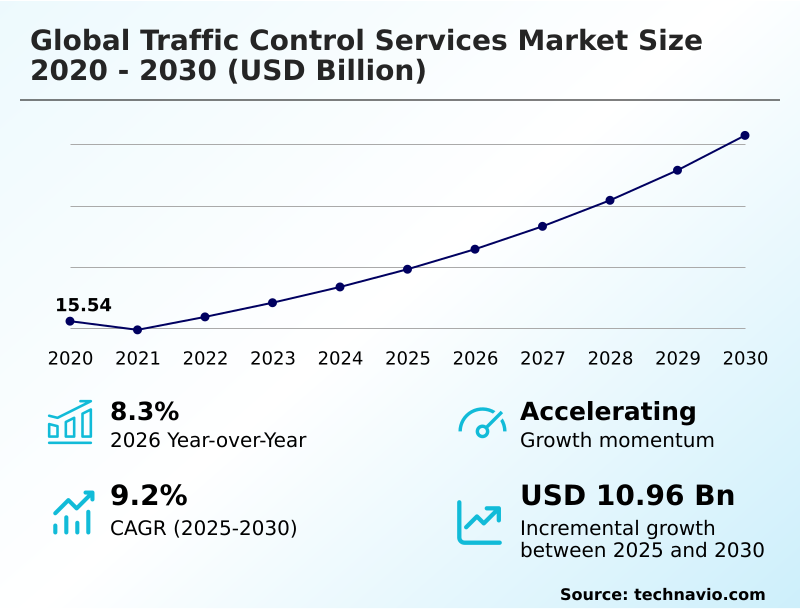
The traffic control services market size is valued to increase by USD 10.96 billion, at a CAGR of 9.2% from 2025 to 2030. Operational modernization and TSMO adoption will drive the traffic control services market.
Major Market Trends & Insights
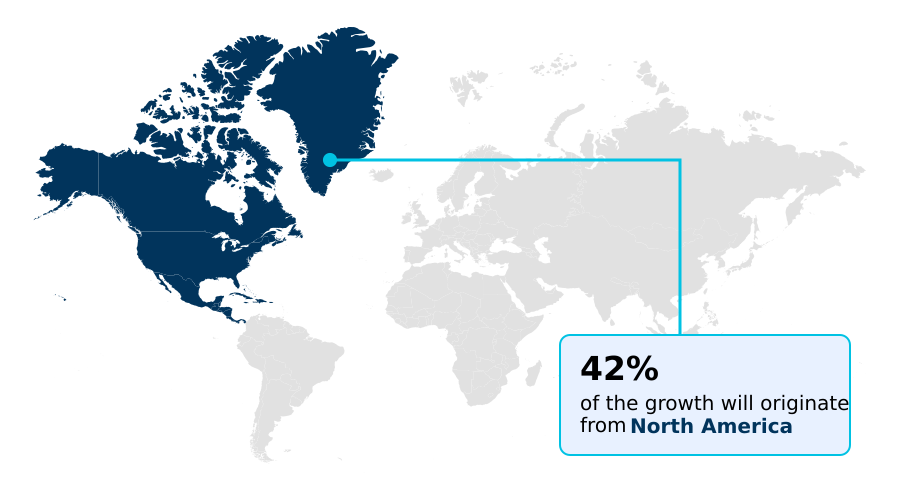
- North America dominated the market and accounted for a 41.9% growth during the forecast period.
- By Type - Event safety segment was valued at USD 5.55 billion in 2024
- By Application - Highway segment accounted for the largest market revenue share in 2024
Market Size & Forecast
- Market Opportunities: USD 15.20 billion
- Market Future Opportunities: USD 10.96 billion
- CAGR from 2025 to 2030 : 9.2%
Market Summary
- The traffic control services market is undergoing a significant transformation, driven by the dual needs of modernizing aging infrastructure and enhancing public safety. A key industry driver is the increasing outsourcing of complex operations to specialized firms that provide advanced roadway safety services. These companies leverage technology to manage traffic flow, ensure work zone safety, and optimize transportation networks.
- Market trends indicate a decisive shift from basic equipment rental to comprehensive, service-based models that integrate real-time data analytics and intelligent transportation systems.
- For instance, a municipal authority might contract a service provider to manage its entire network of adaptive traffic signals, using predictive algorithms to adjust signal timing dynamically based on traffic volume, thereby reducing congestion and improving emergency response times. This approach allows public agencies to improve operational efficiency without significant upfront capital investment.
- However, the industry faces challenges related to skilled labor shortages and the need for continuous investment in training and technology to keep pace with evolving regulatory standards and cybersecurity threats, which tempers the growth trajectory.
What will be the Size of the Traffic Control Services Market during the forecast period?
Get Key Insights on Market Forecast (PDF) Get Free Sample
How is the Traffic Control Services Market Segmented?
The traffic control services industry research report provides comprehensive data (region-wise segment analysis), with forecasts and estimates in "USD million" for the period 2026-2030, as well as historical data from 2020-2024 for the following segments.
- Type
- Event safety
- Traffic pacing
- Advanced warning sign installation
- Traffic control drawings
- Others
- Application
- Highway
- Street
- Others
- Deployment
- Permanent traffic control
- Temporary traffic control
- Geography
- North America
- US
- Canada
- Mexico
- Europe
- Germany
- UK
- France
- APAC
- China
- India
- Japan
- South America
- Brazil
- Argentina
- Middle East and Africa
- UAE
- Saudi Arabia
- South Africa
- Rest of World (ROW)
- North America
By Type Insights
The event safety segment is estimated to witness significant growth during the forecast period.
Event safety has evolved into a sophisticated operational domain, requiring comprehensive integration of advanced security and traffic management protocols.
Modern public gatherings necessitate detailed traffic control plans and traffic management planning that incorporate hostile vehicle mitigation strategies and dynamic pedestrian flow analysis to manage large crowds securely.
Service providers use traffic control drawings and advanced traffic management system software to simulate ingress and egress, ensuring a robust incident response capability. Execution involves close, real-time inter-agency communication and the management of temporary flight restrictions for airspace security.
This approach, which can improve coordination efficiency by over 25%, integrates work zone protection techniques like rolling roadblocks and strategic temporary signage solutions to create secure perimeters, transforming event traffic control into a critical component of public safety infrastructure.
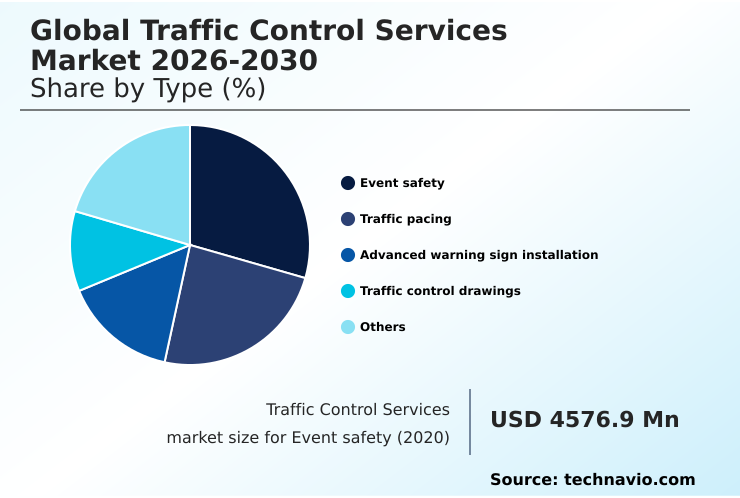
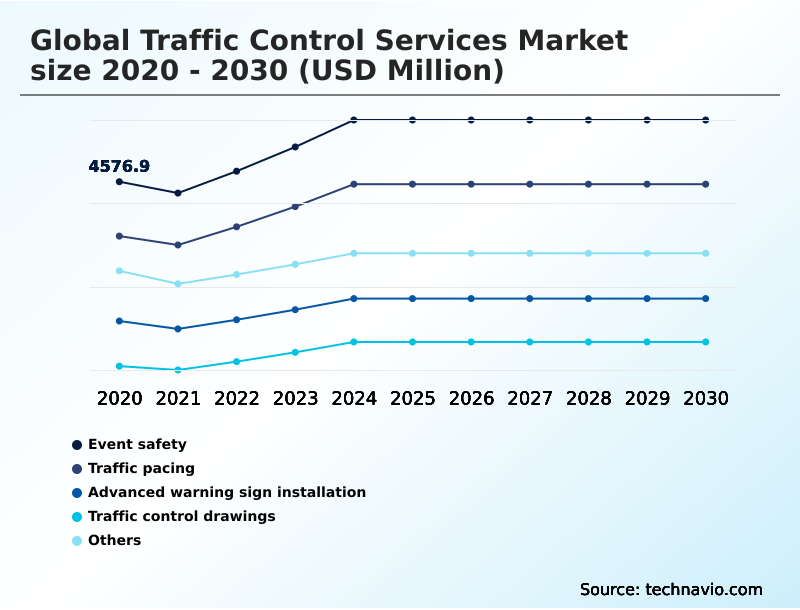
The Event safety segment was valued at USD 5.55 billion in 2024 and showed a gradual increase during the forecast period.
Regional Analysis
North America is estimated to contribute 41.9% to the growth of the global market during the forecast period.Technavio’s analysts have elaborately explained the regional trends and drivers that shape the market during the forecast period.
See How Traffic Control Services Market Demand is Rising in North America Get Free Sample
The global market landscape reveals distinct regional priorities shaping service demand.
In North America, the focus is on outsourcing operations of traffic management centers and entire traffic operations centers to private firms to manage complex urban corridors and intelligent transportation systems, improving network reliability by 15%.
European markets prioritize environmental goals, using permanent traffic control and public transit priority systems to enforce low-emission zones. This has led to a 10% decrease in targeted pollutants in some cities.
Meanwhile, APAC is leapfrogging legacy systems, investing in smart work zone technologies and connected infrastructure. The deployment of tunnel management system solutions is also critical in regions with challenging geographies like South America.
This regional diversification requires service providers to tailor their highway traffic management and temporary road closures strategies to local regulatory and operational demands, especially for event traffic management.
Market Dynamics
Our researchers analyzed the data with 2025 as the base year, along with the key drivers, trends, and challenges. A holistic analysis of drivers will help companies refine their marketing strategies to gain a competitive advantage.
- The evaluation criteria for traffic control services are shifting from basic execution to strategic capability. Clients now prioritize providers that demonstrate proficiency in managing traffic for large-scale public events and offer outsourced traffic operations center management services. The focus on liability management for temporary work zone safety is driving demand for advanced planning and real-time monitoring.
- In the urban context, expertise in urban traffic management for multimodal mobility is a key differentiator. The industry is also seeing a rise in performance-based contracting for traffic enforcement, where providers are compensated based on system uptime and accuracy. A major challenge and opportunity lies in integrating C-ITS with legacy traffic infrastructure.
- Firms that excel in strategic ITS deployment for critical infrastructure safety are gaining a competitive edge. The digital overhaul of road user charging systems requires deep technical expertise, as does the implementation of AI-driven predictive analytics for incident response. Leading providers are deploying cloud-based advanced traffic management systems, which offer greater flexibility and scalability.
- However, ensuring cybersecurity for connected traffic control networks has become a paramount concern. The ability to leverage real-time traffic data for adaptive signal control is now a standard expectation. Specialized services for rolling roadblock operations and the maintenance of multi-lane free-flow tolling gantries represent high-value niches.
- Furthermore, automated enforcement for low emission zone compliance is a growing service line, alongside traditional services for highway construction projects and temporary traffic control for utility infrastructure projects. Expertise in traffic management planning for urban events is crucial, and companies are analyzing the trade-offs when comparing permanent vs temporary traffic control costs.
- Overall, adherence to best practices for work zone safety management is non-negotiable, with providers that use simulation-based planning reporting 25% fewer in-field adjustments.
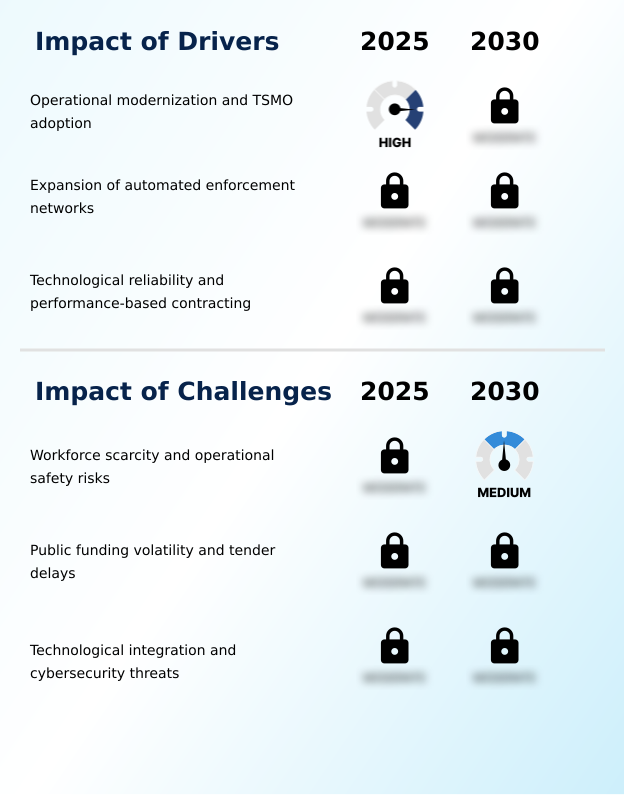
What are the key market drivers leading to the rise in the adoption of Traffic Control Services Industry?
- The accelerated adoption of operational modernization strategies, including Transportation Systems Management and Operations (TSMO), is a primary driver of market growth.
- Market growth is significantly driven by the expansion of automated enforcement networks and the adoption of performance-based contracts. Governments are increasingly deploying multi-lane free-flow and electronic toll collection systems, which require sophisticated backend traffic violation processing and infrastructure asset management.
- These long-term contracts, which often include section speed control, can improve revenue collection accuracy by over 12%. The shift to Transportation Systems Management and Operations (TSMO) pushes agencies to outsource oversight to specialized firms.
- These firms provide comprehensive traffic engineering support and manage road user charging schemes, ensuring high road safety compliance.
- The demand for proven, high-availability architectures validates the sector's critical role in public safety and drives investment in reliable, automated incident detection technologies.
What are the market trends shaping the Traffic Control Services Industry?
- The integration of AI-driven ecosystems represents a dominant market trend. This shift is reshaping traffic management from isolated hardware to holistic, cloud-native mobility platforms.
- A dominant trend is the convergence of physical infrastructure with AI-driven software, creating holistic smart mobility ecosystems. Companies are moving beyond selling standalone hardware to offering integrated solutions combining a digital mobility platform with AI-powered detection sensors.
- This shift toward adaptive traffic control and connected vehicle technologies enables real-time adjustments that optimize traffic flows, with some cities reporting a 15% reduction in intersection delays. The use of real-time traffic data for traffic signal coordination and traffic flow optimization allows for dynamic management of urban networks.
- These software-centric models, often including emergency vehicle preemption, are fundamentally altering the competitive landscape. Success is now measured by the ability to deliver interoperable, data-driven traffic management services that improve safety and efficiency, making digital traffic management a core competency.
What challenges does the Traffic Control Services Industry face during its growth?
- A key challenge affecting industry growth is the acute scarcity of a skilled workforce, compounded by significant operational safety risks in active work zones.
- The market faces significant operational hurdles, primarily from a skilled labor shortage and escalating cybersecurity threats. The scarcity of trained technicians for work zone safety and temporary traffic control creates project bottlenecks, elevating risks for work zone crew safety. In response, adoption of the automated flagger assistance device has risen by over 20% in some regions.
- Concurrently, the integration of vehicle-to-everything (V2X) and cooperative intelligent transport systems (C-ITS) introduces new vulnerabilities. Securing these connected networks against digital disruptions is a major concern, as a single breach could compromise an entire urban traffic grid.
- Service providers must balance the push for smart city innovation with the need for robust traffic safety protocols and remote traffic monitoring to mitigate these evolving challenges.
Exclusive Technavio Analysis on Customer Landscape
The traffic control services market forecasting report includes the adoption lifecycle of the market, covering from the innovator’s stage to the laggard’s stage. It focuses on adoption rates in different regions based on penetration. Furthermore, the traffic control services market report also includes key purchase criteria and drivers of price sensitivity to help companies evaluate and develop their market growth analysis strategies.
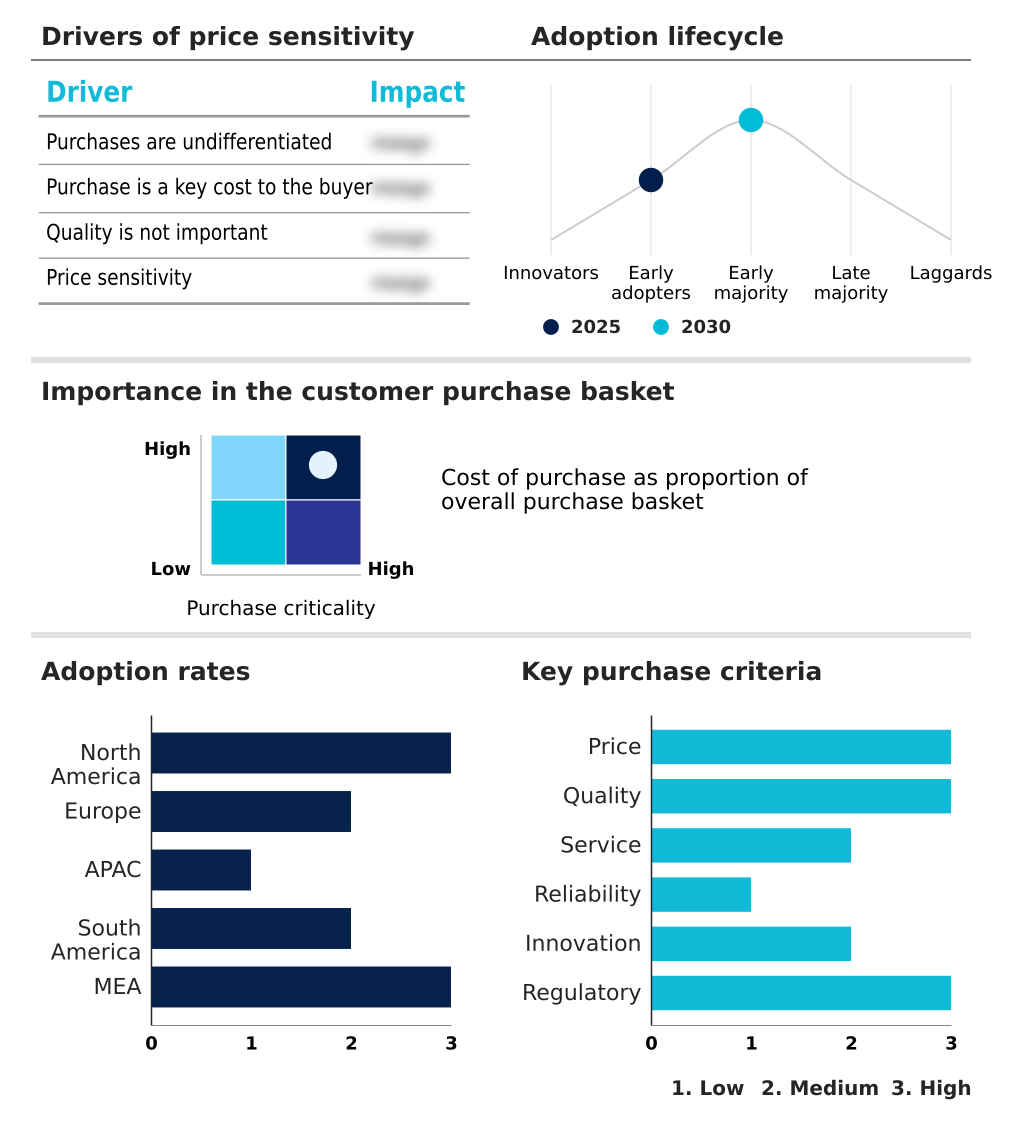
Customer Landscape of Traffic Control Services Industry
Competitive Landscape
Companies are implementing various strategies, such as strategic alliances, traffic control services market forecast, partnerships, mergers and acquisitions, geographical expansion, and product/service launches, to enhance their presence in the industry.
Acme Barricades - Provides rental and installation of temporary traffic control devices, specializing in barricades and message boards for highway construction projects.
The industry research and growth report includes detailed analyses of the competitive landscape of the market and information about key companies, including:
- Acme Barricades
- Altus Traffic
- AWP Safety
- BUKO Traffic and Safety
- Chevron Traffic Management
- Colorado Barricade Co.
- Core Highways
- D and D Traffic Management
- Flagger Force LLC
- Go Traffic Management
- Hatton Traffic Management Ltd.
- Highway Traffic Management
- Premier Traffic Management
- RoadSafe Traffic Systems Inc.
- Roadway Construction Service
- Traffic Group Australia
- Traffic Management Inc.
- Traffic Management NZ
- Verifact Traffic
Qualitative and quantitative analysis of companies has been conducted to help clients understand the wider business environment as well as the strengths and weaknesses of key industry players. Data is qualitatively analyzed to categorize companies as pure play, category-focused, industry-focused, and diversified; it is quantitatively analyzed to categorize companies as dominant, leading, strong, tentative, and weak.
Recent Development and News in Traffic control services market
- In December, 2024, Q-Free secured a contract for a comprehensive roadside tolling system project, which includes a twelve-year service and maintenance agreement.
- In January, 2025, AWP Safety expanded its US footprint by acquiring three regional traffic control companies: Site Barricades, Integrity Traffic, and WS Barricade.
- In March, 2025, Parsons Corp. was selected by the Virginia Department of Transportation to provide traffic engineering and operational support services for the congested Northern Virginia district.
- In May, 2025, Kapsch TrafficCom completed the deployment of a state-of-the-art Tunnel Management System for the Greater Florianopolis Ring Road in Brazil.
Dive into Technavio’s robust research methodology, blending expert interviews, extensive data synthesis, and validated models for unparalleled Traffic Control Services Market insights. See full methodology.
| Market Scope | |
|---|---|
| Page number | 294 |
| Base year | 2025 |
| Historic period | 2020-2024 |
| Forecast period | 2026-2030 |
| Growth momentum & CAGR | Accelerate at a CAGR of 9.2% |
| Market growth 2026-2030 | USD 10955.7 million |
| Market structure | Fragmented |
| YoY growth 2025-2026(%) | 8.3% |
| Key countries | US, Canada, Mexico, Germany, UK, France, Italy, Spain, The Netherlands, China, India, Japan, South Korea, Australia, Indonesia, Brazil, Argentina, Chile, UAE, Saudi Arabia, South Africa, Egypt and Israel |
| Competitive landscape | Leading Companies, Market Positioning of Companies, Competitive Strategies, and Industry Risks |
Research Analyst Overview
- The traffic control services market is undergoing a structural shift driven by technology convergence. The integration of AI-powered detection, automated enforcement networks, and cooperative intelligent transport systems is redefining service delivery. Boardroom decisions are increasingly centered on shifting from capital-intensive asset ownership to flexible, performance-based service contracts, a model that can reduce initial capital outlay by over 40%.
- This transition demands expertise in managing complex digital ecosystems, including advanced traffic management system platforms and multi-lane free-flow tolling. Service providers must now demonstrate proficiency in everything from traffic signal coordination and pedestrian flow analysis to the deployment of automated flagger assistance devices.
- The market values holistic solutions that combine permanent traffic control maintenance with dynamic temporary traffic control for work zones. Expertise in areas like tunnel management system operations, vehicle-to-everything connectivity, and section speed control is becoming a key differentiator.
- Success depends on the ability to leverage real-time traffic data through a cohesive digital mobility platform, ensuring robust incident response and optimized public transit priority. This data-centric approach is critical for everything from creating accurate traffic control drawings to executing complex road user charging schemes.
What are the Key Data Covered in this Traffic Control Services Market Research and Growth Report?
-
What is the expected growth of the Traffic Control Services Market between 2026 and 2030?
-
USD 10.96 billion, at a CAGR of 9.2%
-
-
What segmentation does the market report cover?
-
The report is segmented by Type (Event safety, Traffic pacing, Advanced warning sign installation, Traffic control drawings, and Others), Application (Highway, Street, and Others), Deployment (Permanent traffic control, and Temporary traffic control) and Geography (North America, Europe, APAC, South America, Middle East and Africa)
-
-
Which regions are analyzed in the report?
-
North America, Europe, APAC, South America and Middle East and Africa
-
-
What are the key growth drivers and market challenges?
-
Operational modernization and TSMO adoption, Workforce scarcity and operational safety risks
-
-
Who are the major players in the Traffic Control Services Market?
-
Acme Barricades, Altus Traffic, AWP Safety, BUKO Traffic and Safety, Chevron Traffic Management, Colorado Barricade Co., Core Highways, D and D Traffic Management, Flagger Force LLC, Go Traffic Management, Hatton Traffic Management Ltd., Highway Traffic Management, Premier Traffic Management, RoadSafe Traffic Systems Inc., Roadway Construction Service, Traffic Group Australia, Traffic Management Inc., Traffic Management NZ and Verifact Traffic
-
Market Research Insights
- The traffic control services market is defined by a shift toward outsourced and technologically advanced solutions. Municipalities leveraging third-party traffic management services for traffic data analytics report up to a 20% reduction in urban gridlock.
- The adoption of formal traffic control plans and proactive road safety audits has become critical for infrastructure asset management, with firms demonstrating certified traffic safety protocols seeing lower insurance premiums. Comprehensive work zone traffic management, which includes temporary barricades installation and active remote traffic monitoring, improves work zone crew safety compliance by over 30%.
- This evolution underscores the move from basic equipment rental to strategic partnerships focused on measurable traffic flow optimization and public safety outcomes through robust digital traffic management.
We can help! Our analysts can customize this traffic control services market research report to meet your requirements.
 RIA -
RIA - 
