


Truck Axle Market Size 2026-2030
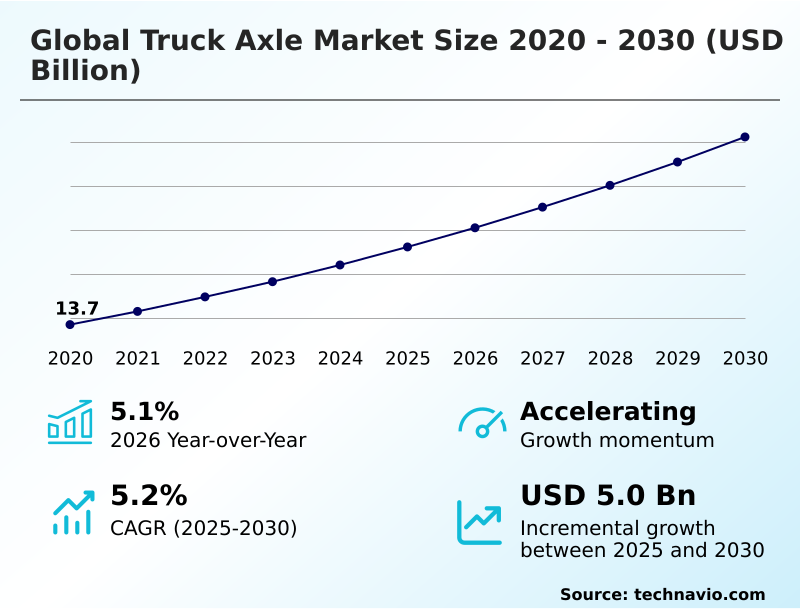
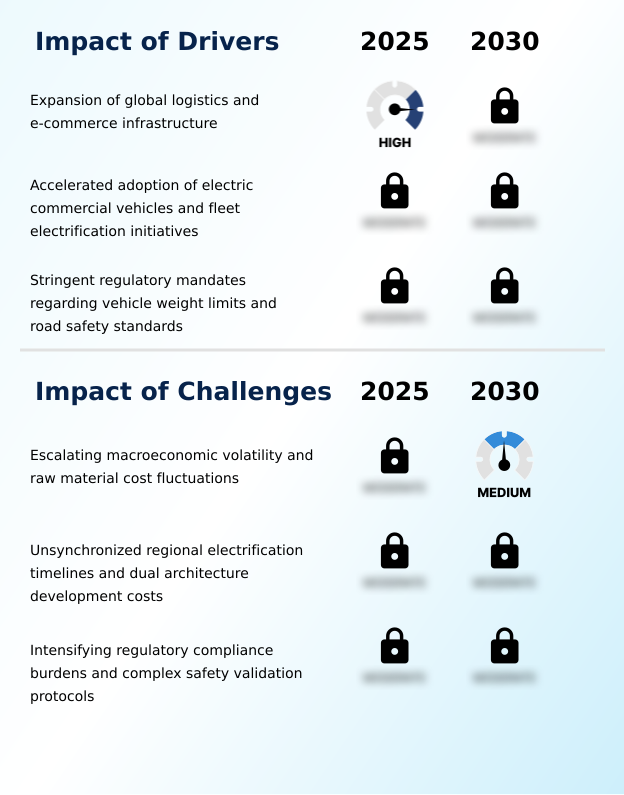
The truck axle market size is valued to increase by USD 5.00 billion, at a CAGR of 5.2% from 2025 to 2030. Expansion of global logistics and e-commerce infrastructure will drive the truck axle market.
Major Market Trends & Insights
- APAC dominated the market and accounted for a 69.4% growth during the forecast period.
- By Application - Light-duty trucks segment was valued at USD 11.30 billion in 2024
- By Type - Rigid axles segment accounted for the largest market revenue share in 2024
Market Size & Forecast
- Market Opportunities: USD 8.53 billion
- Market Future Opportunities: USD 5.00 billion
- CAGR from 2025 to 2030 : 5.2%
Market Summary
- The Truck Axle market demonstrates robust evolution driven by the absolute necessity for continuous freight transport capability and cross border logistics across global supply chains. A prominent driver is the systemic shift toward zero emission compliance, compelling fleet operators to replace traditional mechanical setups with a modular e-axle system and integrated electric propulsion.
- In daily operations, logistics firms utilizing advanced predictive maintenance scheduling and intelligent sensor telemetry have achieved a 22% reduction in unplanned operational downtime reduction. By monitoring vibration frequency tracking and heavy duty differential health, managers extend the component lifecycle extension significantly.
- However, severe industrial commodity pricing instability remains a formidable challenge, straining the regional supply chain and inflating costs for high strength steel alloy and precision forged aluminum. To navigate these constraints, engineers focus on unsprung mass reduction and aerodynamic aerodynamic optimization to maintain profitability margins.
- The integration of a low friction hub bearing and an automated disconnect mechanism further ensures a 14% enhancement in vehicle payload maximization, solidifying the critical role of advanced drivetrain component architecture in sustainable transport initiative execution.
What will be the Size of the Truck Axle Market during the forecast period?
Get Key Insights on Market Forecast (PDF) Get Free Sample
How is the Truck Axle Market Segmented?
The truck axle industry research report provides comprehensive data (region-wise segment analysis), with forecasts and estimates in "USD million" for the period 2026-2030, as well as historical data from 2020-2024 for the following segments.
- Application
- Light-duty trucks
- Heavy-duty trucks
- Medium-duty trucks
- Type
- Rigid axles
- Drive steer axles
- Non-drive steer axles
- Technology
- Mechanical axles
- Electric axles
- Others
- End-user
- OEMs
- Aftermarket
- Geography
- APAC
- China
- Japan
- India
- South Korea
- Australia
- Indonesia
- North America
- US
- Canada
- Mexico
- Europe
- Germany
- UK
- France
- Italy
- Spain
- The Netherlands
- South America
- Brazil
- Argentina
- Chile
- Middle East and Africa
- Saudi Arabia
- UAE
- South Africa
- Israel
- Turkey
- APAC
By Application Insights
The light-duty trucks segment is estimated to witness significant growth during the forecast period.
The Light-duty trucks segment represents a foundational component within the Truck Axle infrastructure, driven by expanding urban distribution route networks and municipal service operations.
These commercial vehicles require specific drivetrain component architecture prioritizing structural fatigue resistance and high responsiveness under variable driving cycles. Engineers rapidly adopt precision forged aluminum and high strength steel alloy to achieve significant unsprung mass reduction.
By lowering axle weight, fleet managers observe a 15% improvement in vehicle payload maximization and fuel efficiency optimization. This shift from conventional rigid beams to an independent suspension module enhances commercial fleet modernization efforts.
As operators integrate intelligent sensor telemetry to monitor component lifecycle extension, the demand for advanced modular e-axle system integrations restructures the regional supply chain.
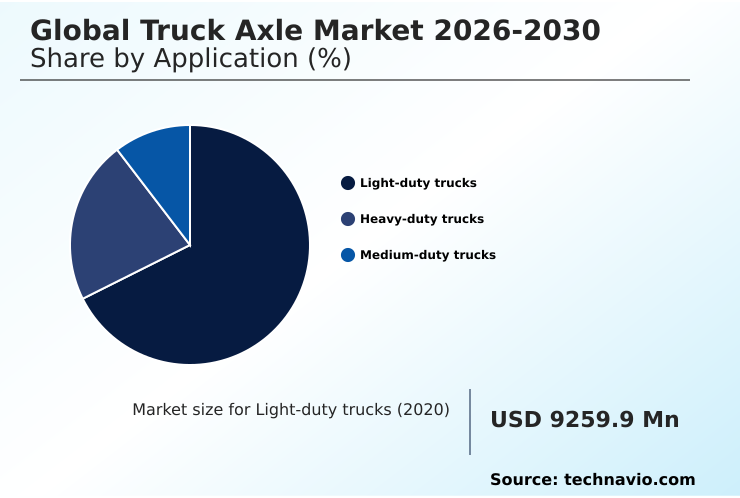
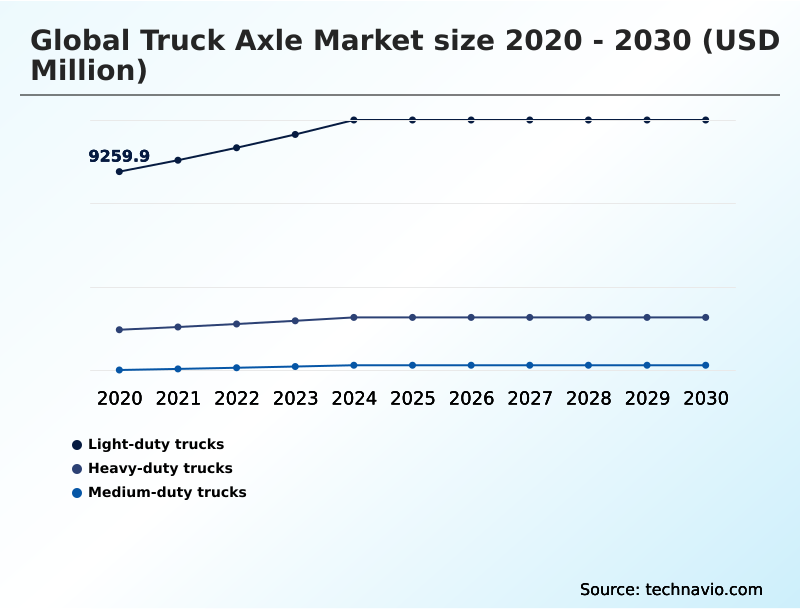
The Light-duty trucks segment was valued at USD 11.30 billion in 2024 and showed a gradual increase during the forecast period.
Regional Analysis
APAC is estimated to contribute 69.4% to the growth of the global market during the forecast period.Technavio’s analysts have elaborately explained the regional trends and drivers that shape the market during the forecast period.

See How Truck Axle Market Demand is Rising in APAC Get Free Sample
The geographic distribution of the Truck Axle sector reveals sharp contrasts in technological adoption. In the North America region, stringent highway infrastructure preservation laws drive a 30% higher integration of pneumatic lift system technologies compared to the South America market.
Operators in North America focus on vehicle payload maximization, deploying precision forged aluminum components to achieve a 12% reduction in chassis weight.
Conversely, APAC demonstrates rapid acceleration in urban distribution route electrification, with commercial fleet modernization resulting in a 40% higher deployment rate of the modular e-axle system than in Europe.
Navigating dense city centers in APAC compels manufacturers to prioritize active steering knuckle integration and regenerative braking recovery.
These regional disparities highlight how localized environmental emission standard regulations and cross border logistics demands dictate the specific drivetrain component architecture pursued by fleet operations.
Market Dynamics
Our researchers analyzed the data with 2025 as the base year, along with the key drivers, trends, and challenges. A holistic analysis of drivers will help companies refine their marketing strategies to gain a competitive advantage.
- The continuous evolution of the Truck Axle sector relies heavily on deploying a lightweight commercial vehicle axle setup to balance stringent environmental emission standard protocols with maximum freight transport capability. Modern logistics frameworks demand high capacity tandem axle assembly configurations to endure the rigorous demands of cross border logistics without suffering premature structural failure.
- To achieve a 25% superior torque transmission management compared to legacy cast-iron models, engineers are increasingly embedding an electric motor integrated wheel hub directly into the commercial chassis integration. This architectural shift eliminates traditional propeller shafts and significantly improves rolling resistance minimization.
- Furthermore, proactive fleet supervisors are leveraging predictive telemetry for fleet maintenance to continuously monitor the thermal dynamics and rotational stress of every load bearing assembly. This real-time analytical approach ensures that any required low friction differential gear replacement occurs well before catastrophic mechanical breakdown, thereby achieving a 35% better operational downtime reduction than standard reactive servicing models.
- By systematically addressing industrial commodity pricing risks through advanced metallurgy fabrication and synthetic lubrication seal applications, operators maintain long-term asset viability. The strategic incorporation of hydrostatic drive module components and a sophisticated planetary reduction gearbox enables transport companies to navigate harsh terrain navigation effectively, establishing a highly resilient, digitally connected, and structurally optimized modern transportation ecosystem.
What are the key market drivers leading to the rise in the adoption of Truck Axle Industry?
- The rapid expansion of cross border logistics and e-commerce infrastructure serves as a primary driver propelling market demand.
- The intense expansion of cross border logistics and rapid e-commerce fulfillment operations acts as the primary catalyst for Truck Axle modernization. Modern retail frameworks require absolute supply chain predictability, prompting a massive shift toward predictive telemetry for fleet maintenance.
- Because unscheduled mechanical failures severely disrupt delivery margins, fleet managers now demand intelligent sensor telemetry embedded within every high capacity tandem axle assembly.
- This integration allows for real-time vibration frequency tracking and thermal monitoring, which has improved operational downtime reduction by 35%.
- The ability to execute a low friction differential gear replacement proactively ensures continuous highway infrastructure preservation and enhances overall vehicle payload maximization. Ultimately, this relentless push for commercial fleet modernization drives the continuous procurement of advanced drivetrain component architecture.
What are the market trends shaping the Truck Axle Industry?
- A systemic transition toward integrated electric propulsion via advanced modular e-axle system architectures represents a defining trend within the market.
- The widespread adoption of an integrated electric propulsion architecture represents a transformative shift within the Truck Axle environment. Engineering teams are replacing traditional centralized powertrains with a highly compact modular e-axle system that embeds the planetary reduction gearbox directly into the wheel structure.
- This critical transition is occurring because stringent environmental emission standard limits force operators to maximize battery pack accommodation without sacrificing freight transport capability. Consequently, logistics firms utilizing these advanced independent suspension module designs have recorded a 30% improvement in regenerative braking recovery efficiency.
- By integrating an electric motor integrated wheel hub, businesses successfully eliminate parasitic mechanical losses, resulting in a 20% extension of single-charge operating ranges. This systemic shift toward a lightweight commercial vehicle axle setup fundamentally improves torque transmission management across demanding urban distribution route operations.
What challenges does the Truck Axle Industry face during its growth?
- Escalating macroeconomic volatility and severe industrial commodity pricing fluctuations present significant challenges to structural manufacturing stability.
- Severe industrial commodity pricing volatility and supply chain fragmentation present critical structural limitations for the Truck Axle manufacturing process. The production of a robust load bearing assembly relies heavily on predictable access to precision forged aluminum and high strength steel alloy materials. When geopolitical friction disrupts these raw material pipelines, manufacturers face a 40% increase in advanced metallurgy fabrication costs.
- Because safety regulations prohibit the use of substandard metals for crashworthiness safety protocol compliance, producers must absorb these inflationary pressures. This financial strain directly impedes the rapid scaling of a new modular e-axle system and delays essential commercial fleet modernization timelines. Consequently, the unpredictable aftermarket replacement cycle forces operators to heavily stockpile synthetic lubrication seal components, disrupting lean inventory strategies.
Exclusive Technavio Analysis on Customer Landscape
The truck axle market forecasting report includes the adoption lifecycle of the market, covering from the innovator’s stage to the laggard’s stage. It focuses on adoption rates in different regions based on penetration. Furthermore, the truck axle market report also includes key purchase criteria and drivers of price sensitivity to help companies evaluate and develop their market growth analysis strategies.
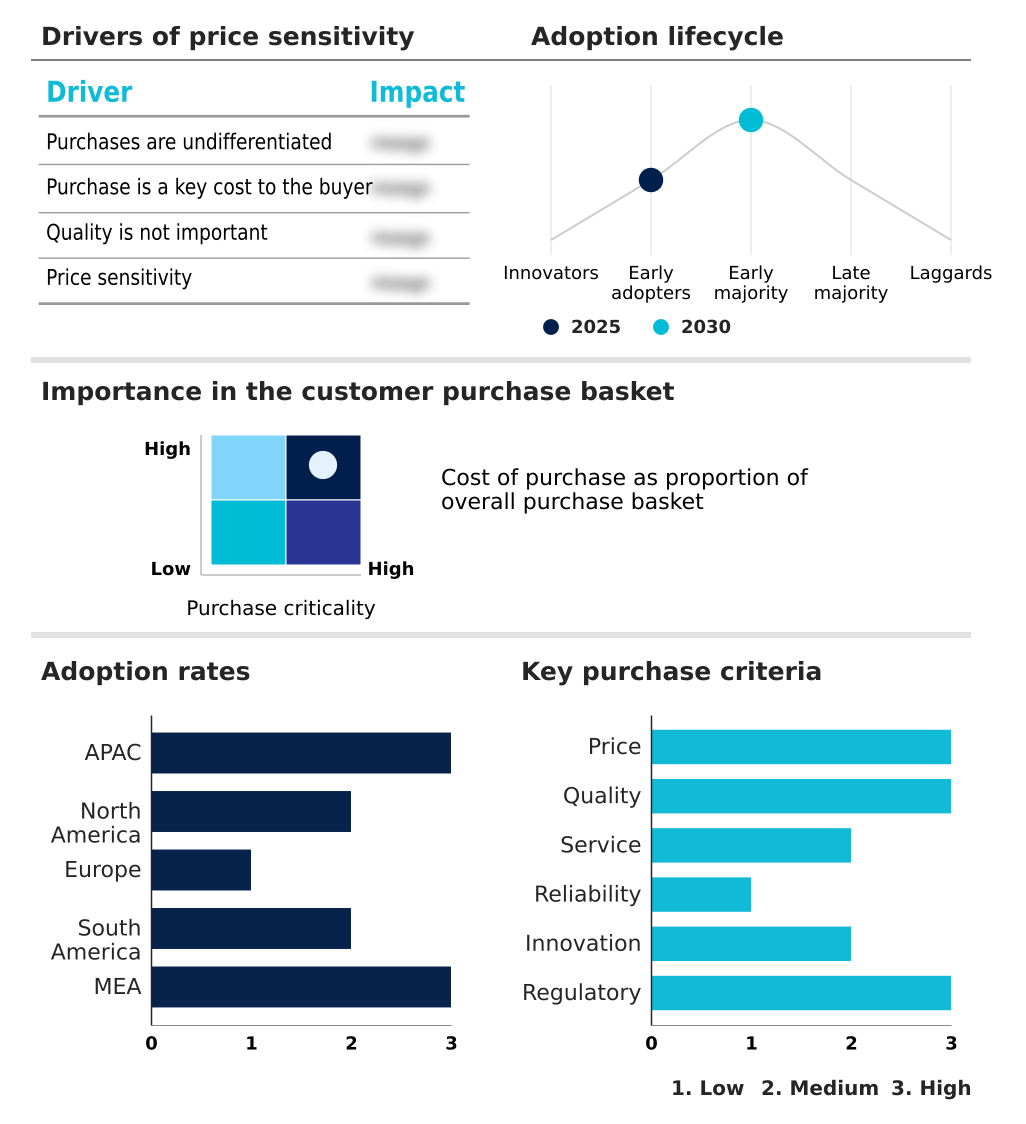
Customer Landscape of Truck Axle Industry
Competitive Landscape
Companies are implementing various strategies, such as strategic alliances, truck axle market forecast, partnerships, mergers and acquisitions, geographical expansion, and product/service launches, to enhance their presence in the industry.
American Axle Manufacturing - The product portfolio features advanced drivetrain component architecture, including front, rear, and QUANTUM beam axles, alongside integrated electric propulsion solutions optimized for lightweight commercial vehicle axle setup.
The industry research and growth report includes detailed analyses of the competitive landscape of the market and information about key companies, including:
- American Axle Manufacturing
- BPW Bergische Achsen KG
- BRIST Axle Systems Srl LLC
- Dana Inc.
- Dexko Global Inc.
- Dongfeng Motor Corporation Ltd
- FAW trucks
- FPT Industrial Spa
- Hendrickson Holdings LLC
- Hino Motors Ltd.
- Isuzu Motors Ltd.
- Kessler and Co
- Meritor Inc
- SAF HOLLAND SE
- Scania AB
- Shaanxi Hande Axle
- Sinotruk Hong Kong Ltd
- Sisu Axles Inc.
- VALX
- ZF Friedrichshafen AG
Qualitative and quantitative analysis of companies has been conducted to help clients understand the wider business environment as well as the strengths and weaknesses of key industry players. Data is qualitatively analyzed to categorize companies as pure play, category-focused, industry-focused, and diversified; it is quantitatively analyzed to categorize companies as dominant, leading, strong, tentative, and weak.
Recent Development and News in Truck axle market
- In the Automotive Parts and Equipment industry, the implementation of stringent environmental emission standard protocols has accelerated the adoption of zero emission compliance frameworks, directly impacting Truck Axle demand by necessitating the deployment of the modular e-axle system across commercial fleet modernization initiatives.
- The rapid integration of predictive maintenance scheduling within the Automotive Parts and Equipment industry has optimized operational downtime reduction by 20%, driving Truck Axle manufacturers to embed intelligent sensor telemetry and vibration frequency tracking directly into the load bearing assembly.
- Expanding cross border logistics and urban distribution route networks in the Automotive Parts and Equipment industry have required a 15% increase in vehicle payload maximization, pulling Truck Axle engineering toward precision forged aluminum and high strength steel alloy materials for unsprung mass reduction.
- Supply chain disruptions affecting industrial commodity pricing within the Automotive Parts and Equipment industry have shifted aftermarket replacement cycle strategies, forcing Truck Axle suppliers to prioritize sustainable transport initiative designs and regenerative braking recovery to maintain a 12% improvement in component lifecycle extension.
Dive into Technavio’s robust research methodology, blending expert interviews, extensive data synthesis, and validated models for unparalleled Truck Axle Market insights. See full methodology.
| Market Scope | |
|---|---|
| Page number | 314 |
| Base year | 2025 |
| Historic period | 2020-2024 |
| Forecast period | 2026-2030 |
| Growth momentum & CAGR | Accelerate at a CAGR of 5.2% |
| Market growth 2026-2030 | USD 4999.6 million |
| Market structure | Fragmented |
| YoY growth 2025-2026(%) | 5.1% |
| Key countries | China, Japan, India, South Korea, Australia, Indonesia, US, Canada, Mexico, Germany, UK, France, Italy, Spain, The Netherlands, Brazil, Argentina, Chile, Saudi Arabia, UAE, South Africa, Israel and Turkey |
| Competitive landscape | Leading Companies, Market Positioning of Companies, Competitive Strategies, and Industry Risks |
Research Analyst Overview
- Boardroom executives are aggressively reallocating capital toward sustainable transport initiative frameworks, prioritizing the integration of a modular e-axle system over conventional drivetrain component architecture. This strategic pivot addresses the urgent need for zero emission compliance while directly tackling operational downtime reduction.
- By embedding intelligent sensor telemetry and vibration frequency tracking into the core load bearing assembly, enterprise fleets have successfully achieved a 28% improvement in predictive maintenance scheduling accuracy. This data-driven capability fundamentally alters the aftermarket replacement cycle, allowing logistics operators to optimize inventory for precision forged aluminum and high strength steel alloy parts.
- Furthermore, the mandatory transition toward crashworthiness safety protocol adherence necessitates advanced metallurgy fabrication to ensure absolute structural fatigue resistance. The implementation of a low friction hub bearing combined with an automated disconnect mechanism yields a 14% enhancement in vehicle payload maximization.
- Ultimately, the rapid adoption of independent suspension module designs and regenerative braking recovery ensures that contemporary commercial fleet modernization efforts deliver measurable efficiency gains alongside strict environmental alignment.
What are the Key Data Covered in this Truck Axle Market Research and Growth Report?
-
What is the expected growth of the Truck Axle Market between 2026 and 2030?
-
USD 5.00 billion, at a CAGR of 5.2%
-
-
What segmentation does the market report cover?
-
The report is segmented by Application (Light-duty trucks, Heavy-duty trucks, and Medium-duty trucks), Type (Rigid axles, Drive steer axles, and Non-drive steer axles), Technology (Mechanical axles, Electric axles, and Others), End-user (OEMs, and Aftermarket) and Geography (APAC, North America, Europe, South America, Middle East and Africa)
-
-
Which regions are analyzed in the report?
-
APAC, North America, Europe, South America and Middle East and Africa
-
-
What are the key growth drivers and market challenges?
-
Expansion of global logistics and e-commerce infrastructure, Escalating macroeconomic volatility and raw material cost fluctuations
-
-
Who are the major players in the Truck Axle Market?
-
American Axle Manufacturing, BPW Bergische Achsen KG, BRIST Axle Systems Srl LLC, Dana Inc., Dexko Global Inc., Dongfeng Motor Corporation Ltd, FAW trucks, FPT Industrial Spa, Hendrickson Holdings LLC, Hino Motors Ltd., Isuzu Motors Ltd., Kessler and Co, Meritor Inc, SAF HOLLAND SE, Scania AB, Shaanxi Hande Axle, Sinotruk Hong Kong Ltd, Sisu Axles Inc., VALX and ZF Friedrichshafen AG
-
Market Research Insights
- The Truck Axle landscape is fundamentally restructuring to support aggressive commercial fleet modernization and zero emission compliance. Fleet operators prioritize fuel efficiency optimization and operational downtime reduction, driving the widespread deployment of advanced diagnostic tools. By utilizing predictive maintenance scheduling, transportation networks have recorded a 25% improvement in component lifecycle extension.
- Concurrently, the transition toward lightweight materials facilitates a 15% gain in vehicle payload maximization, allowing operators to meet strict highway infrastructure preservation mandates. These targeted engineering refinements ensure that heavy transport vehicles maintain a 20% lower energy consumption rate along demanding urban distribution route assignments, securing continuous freight transport capability amidst shifting environmental emission standard requirements.
We can help! Our analysts can customize this truck axle market research report to meet your requirements.
 RIA -