



Agricultural Machinery Market Size 2026-2030
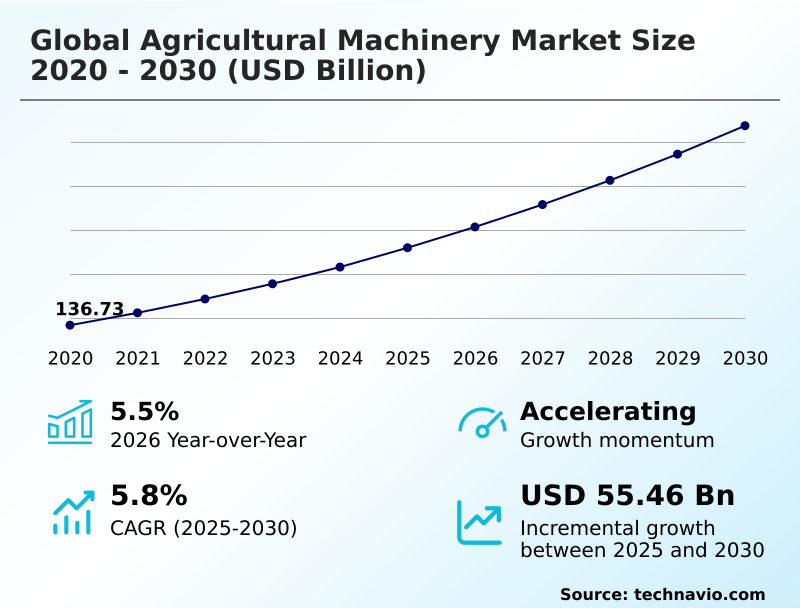
The agricultural machinery market size is valued to increase by USD 55.46 billion, at a CAGR of 5.8% from 2025 to 2030. Increasing global population and imperative for food security will drive the agricultural machinery market.
Major Market Trends & Insights
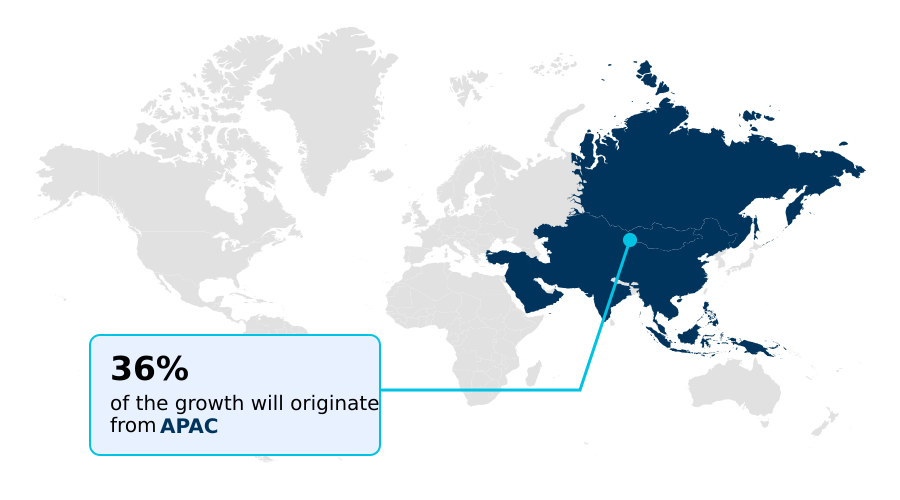
- APAC dominated the market and accounted for a 36.4% growth during the forecast period.
- By Type - Tractors segment was valued at USD 120.13 billion in 2024
- By Application - Land development and seedbed preparation segment accounted for the largest market revenue share in 2024
Market Size & Forecast
- Market Opportunities: USD 90.66 billion
- Market Future Opportunities: USD 55.46 billion
- CAGR from 2025 to 2030 : 5.8%
Market Summary
- The agricultural machinery market is undergoing a profound transformation, shifting from a focus on mechanical power to the development of intelligent, connected platforms. This evolution is driven by the need for enhanced productivity and sustainability in global food production. The integration of precision agriculture technologies, such as variable rate application and advanced sensor suites, is central to this change.
- For instance, a large-scale agribusiness can now leverage real-time telematics from its entire fleet of combine harvesters and tractors to optimize logistics, schedule proactive maintenance, and analyze performance data, thereby maximizing uptime during critical operational windows. This data-driven approach allows for more efficient use of resources and informed decision-making.
- However, the high capital investment required for this advanced equipment and the need for new operator skills present significant adoption hurdles. The market's future trajectory is defined by the ongoing development of autonomous systems and data-centric business models, which promise to further redefine agricultural efficiency.
- This includes a move towards next-generation farm implements that are not only powerful but also integral components of a wider digital ecosystem focused on farm data management.
What will be the Size of the Agricultural Machinery Market during the forecast period?
Get Key Insights on Market Forecast (PDF) Get Free Sample
How is the Agricultural Machinery Market Segmented?
The agricultural machinery industry research report provides comprehensive data (region-wise segment analysis), with forecasts and estimates in "USD million" for the period 2026-2030, as well as historical data from 2020-2024 for the following segments.
- Type
- Tractors
- Harvesting machinery
- Haying machinery
- Planting and fertilizing machinery
- Plowing and cultivating machinery
- Application
- Land development and seedbed preparation
- Sowing and planting
- Harvesting and threshing
- Others
- Product type
- Manual
- Semi-automatic
- Fully automatic
- Geography
- APAC
- China
- India
- Japan
- Europe
- Germany
- France
- Italy
- North America
- US
- Canada
- Mexico
- South America
- Brazil
- Argentina
- Colombia
- Middle East and Africa
- Saudi Arabia
- Turkey
- UAE
- Rest of World (ROW)
- APAC
By Type Insights
The tractors segment is estimated to witness significant growth during the forecast period.
Tractors serve as the fundamental power source in agriculture, but their role is evolving from mere motive force to central hubs of data-driven farming. This segment is increasingly defined by horsepower and the integration of smart agricultural machinery features.
Advanced GPS guidance systems and automated headland turning are now standard, enhancing operational precision. The industry is moving towards fully autonomous tractors to address labor shortages, with developments in fleet management solutions enabling remote oversight.
This technological shift, supported by emerging farm equipment interoperability standards and robust OEM data platforms, has improved efficiency, with precision techniques reducing input waste by up to 15%.
The growth of connected farm equipment ecosystems, alongside custom hiring centers, is also expanding access to these advanced capabilities.
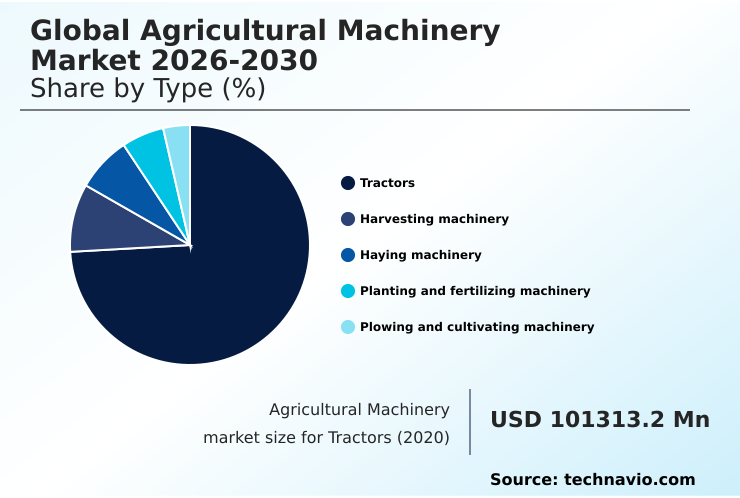
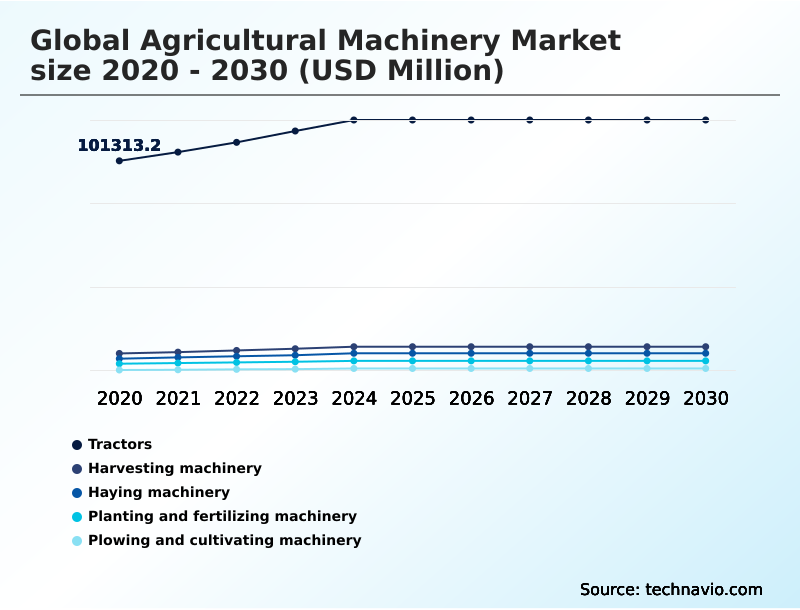
The Tractors segment was valued at USD 120.13 billion in 2024 and showed a gradual increase during the forecast period.
Regional Analysis
APAC is estimated to contribute 36.4% to the growth of the global market during the forecast period.Technavio’s analysts have elaborately explained the regional trends and drivers that shape the market during the forecast period.
See How Agricultural Machinery Market Demand is Rising in APAC Get Free Sample
The global agricultural machinery market exhibits distinct regional dynamics. In APAC, which accounts for over 36% of incremental growth, the focus is on smallholder mechanization solutions and developing appropriate business models like pay-per-use service platforms.
North America leads in the adoption of large-scale automation and precision nutrient management to manage vast acreages efficiently.
Meanwhile, Europe's market is heavily influenced by sustainability regulations that are driving innovation in advanced forage harvesting techniques and equipment that supports a circular nutrient system.
These regulations are pushing for a 20% reduction in chemical inputs, which accelerates demand for precision sprayers and implements that improve soil health.
This diverse landscape requires manufacturers to tailor their product development and connected farm equipment ecosystems to specific regional needs, from robust no-till planters in the Americas to compact, versatile machines in Asia.
Market Dynamics
Our researchers analyzed the data with 2025 as the base year, along with the key drivers, trends, and challenges. A holistic analysis of drivers will help companies refine their marketing strategies to gain a competitive advantage.
- Strategic decision-making in the global agricultural machinery market 2026-2030 is becoming increasingly complex, as enterprises evaluate the long-term value of technological investments. A critical topic is the global agricultural machinery market 2026-2030 electric vs diesel tractor efficiency debate, where total cost of ownership is weighed against sustainability mandates.
- Concurrently, a global agricultural machinery market 2026-2030 autonomous tractor ROI analysis is essential for justifying high capital outlays, particularly as the global agricultural machinery market 2026-2030 role of AI in crop harvesting becomes more pronounced.
- For many, the global agricultural machinery market 2026-2030 precision agriculture adoption barriers remain high, prompting a need for a thorough global agricultural machinery market 2026-2030 digital farm management software comparison to find user-friendly solutions.
- The question of global agricultural machinery market 2026-2030 data ownership in smart farming is a boardroom-level concern, directly linked to the global agricultural machinery market 2026-2030 impact of telematics on farm profitability. As the global agricultural machinery market 2026-2030 future of regenerative agriculture equipment takes shape, understanding global agricultural machinery market 2026-2030 soil health and conservation tillage becomes non-negotiable.
- This is amplified by the global agricultural machinery market 2026-2030 challenges of mechanizing small farms, where different solutions are needed. Integrating new tools requires looking at the global agricultural machinery market 2026-2030 benefits of controlled traffic farming and the global agricultural machinery market 2026-2030 ISOBUS standards and compatibility issues.
- The global agricultural machinery market 2026-2030 telematics for predictive maintenance offers clear value, with some integrated operations reporting efficiency gains more than twice those of non-connected fleets.
- The industry is also exploring the global agricultural machinery market 2026-2030 variable rate technology for fertilization, the global agricultural machinery market 2026-2030 sustainable energy for farm equipment, and the global agricultural machinery market 2026-2030 reducing soil compaction with machinery.
- Looking ahead, the rise of global agricultural machinery market 2026-2030 swarm robotics in agriculture and the details of global agricultural machinery market 2026-2030 OEM data platforms for agriculture, global agricultural machinery market 2026-2030 integrating drones with farm machinery and global agricultural machinery market 2026-2030 carbon-neutral farming equipment analysis, will define the next wave of innovation.
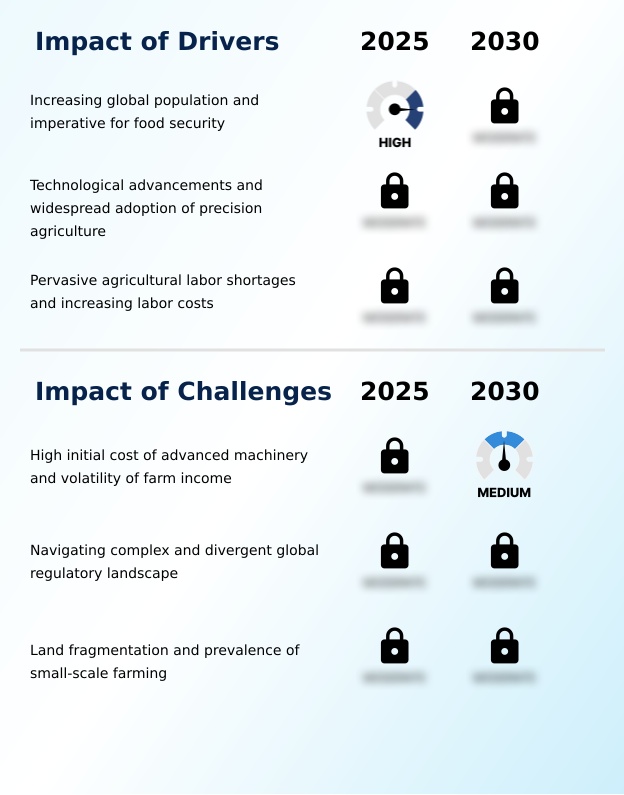
What are the key market drivers leading to the rise in the adoption of Agricultural Machinery Industry?
- The relentless growth of the global population and the corresponding imperative for food security serves as a fundamental driver for the agricultural machinery market.
- The market is propelled by fundamental drivers, including the need to enhance food security and address structural labor shortages.
- The adoption of precision agriculture is central, with advanced systems enabling farmers to increase yields by up to 15% on existing land.
- Technological advancements like high-speed planting systems and smart agricultural machinery allow for timely and efficient operations within narrow agronomic windows.
- The scarcity of skilled labor makes agricultural robotics and autonomous tractors essential, reducing dependency on manual work for certain harvesting tasks by over 70%.
- Furthermore, governments are encouraging sustainable farm mechanization through incentives, supporting the adoption of technologies that promote soil health and efficient resource use.
- The development of see-and-spray technology and other precision application technologies directly supports these goals by minimizing chemical inputs and environmental impact.
What are the market trends shaping the Agricultural Machinery Industry?
- The rise of electrification and alternative propulsion systems represents a significant market trend. This movement is steered by heightened sustainability objectives and evolving regulatory frameworks.
- Key trends are reshaping the agricultural machinery market, led by the push toward full autonomy and alternative power. The development of hybrid diesel-electric architecture in high-horsepower equipment is improving fuel efficiency by up to 20%, while fully electrified farm equipment is becoming viable for smaller-scale operations.
- The move toward unmanned agricultural vehicles promises to enhance asset utilization by over 40% by enabling 24/7 field operations. Another transformative trend is the growth of data-centric service models, where manufacturers offer subscription-based services built on OEM data platforms. This shift, along with the rise of agricultural robotics-as-a-service (RaaS) and equipment-as-a-service models, is changing how farmers access technology.
- The increasing focus on precision seeding equipment and advanced tillage implements further underscores the industry's direction toward resource optimization and higher productivity.
What challenges does the Agricultural Machinery Industry face during its growth?
- The high initial capital cost of advanced machinery, coupled with the inherent volatility of farm income, presents a key structural challenge to industry growth.
- Despite strong growth drivers, the agricultural machinery market faces significant challenges that temper adoption rates. The high capital cost of advanced machinery, such as self-propelled sprayers and combine harvesters, remains a primary barrier, particularly when farm incomes are volatile.
- Navigating divergent global regulations for emissions and safety can increase R&D costs for a single product line by over 25%, complicating market entry and scaling. Furthermore, the physical reality of land fragmentation in many regions is incompatible with the design of large-scale equipment, limiting the market for high-horsepower tractors.
- Addressing this requires a focus on smallholder mechanization business models and a departure from conventional R&D trajectories. Issues surrounding farm machinery data security protocols and the push for the right to repair farm equipment also introduce complexity for manufacturers.
Exclusive Technavio Analysis on Customer Landscape
The agricultural machinery market forecasting report includes the adoption lifecycle of the market, covering from the innovator’s stage to the laggard’s stage. It focuses on adoption rates in different regions based on penetration. Furthermore, the agricultural machinery market report also includes key purchase criteria and drivers of price sensitivity to help companies evaluate and develop their market growth analysis strategies.
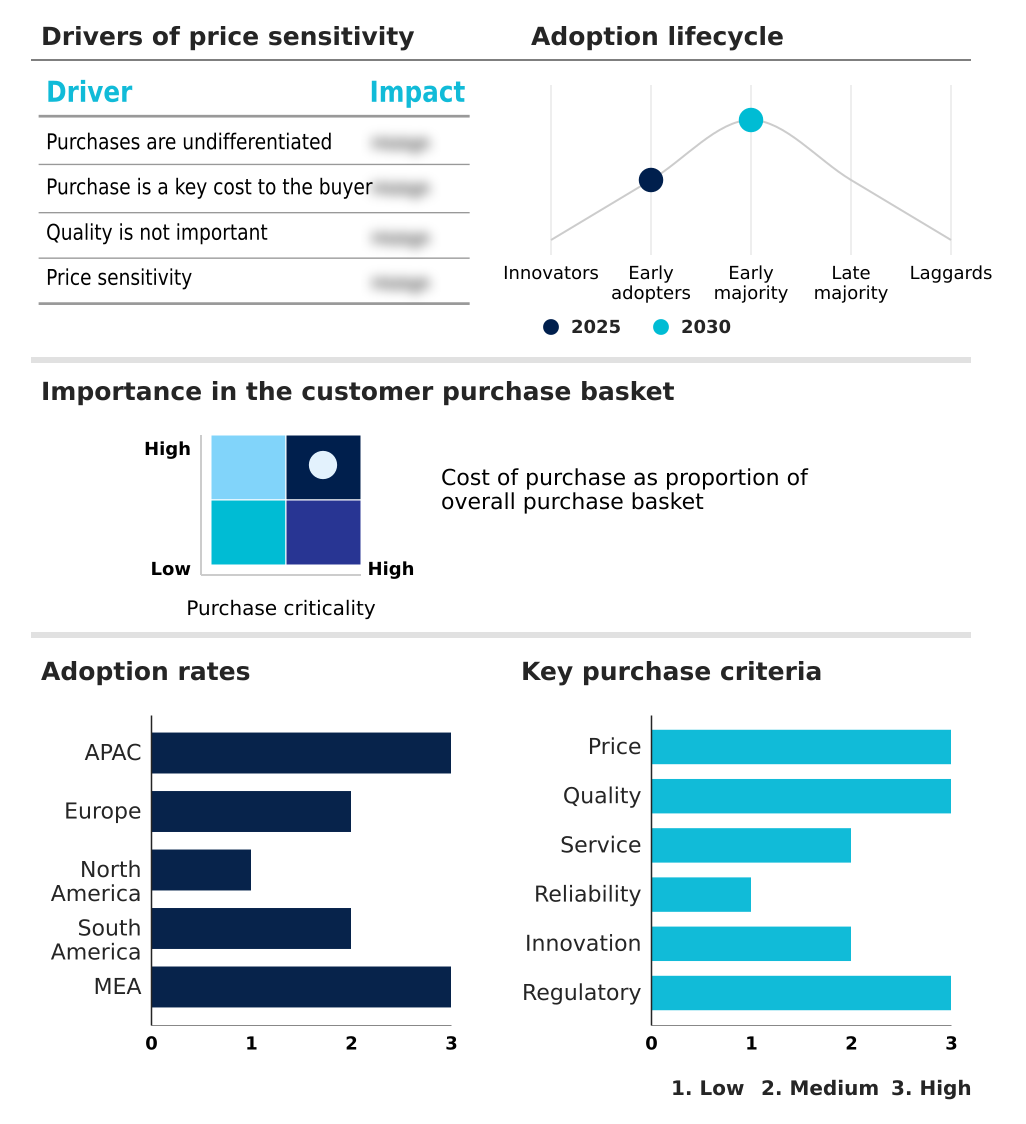
Customer Landscape of Agricultural Machinery Industry
Competitive Landscape
Companies are implementing various strategies, such as strategic alliances, agricultural machinery market forecast, partnerships, mergers and acquisitions, geographical expansion, and product/service launches, to enhance their presence in the industry.
AGCO Corp. - A diverse portfolio of agricultural machinery addresses core farming operations, from tillage and planting to harvesting and forage production, meeting varied operational scales.
The industry research and growth report includes detailed analyses of the competitive landscape of the market and information about key companies, including:
- AGCO Corp.
- Agrale SA
- Bucher Industries AG
- China National Machinery Ltd.
- CLAAS KGaA
- CNH Industrial NV
- Daedong Corp.
- Deere and Co.
- HORSCH Maschinen GmbH
- ISEKI and Co. Ltd.
- J C Bamford Excavators Ltd.
- Jiangsu Changfa Group Co. Ltd
- Kubota Corp.
- KUHN SAS
- LEMKEN GmbH and Co. KG
- Mahindra and Mahindra Ltd.
- SDF SpA
- Sonalika International Tractors
- Weichei Lovol Heavy Industry
- Yanmar Holdings Co. Ltd.
Qualitative and quantitative analysis of companies has been conducted to help clients understand the wider business environment as well as the strengths and weaknesses of key industry players. Data is qualitatively analyzed to categorize companies as pure play, category-focused, industry-focused, and diversified; it is quantitatively analyzed to categorize companies as dominant, leading, strong, tentative, and weak.
Recent Development and News in Agricultural machinery market
- In January 2025, Deere and Co. unveiled its second-generation autonomy kit at the Consumer Electronics Show, featuring advanced computer vision and AI to enable autonomous tillage operations and address agricultural labor shortages.
- In March 2025, the Brazilian government, in partnership with Embrapa, launched the SustainAgro Machinery Program to provide preferential financing for machinery that meets stringent criteria for sustainable intensification and compatibility with regenerative agriculture.
- In April 2025, a consortium of US universities, with funding from the USDA, initiated the Digital Farmhand Project, a research program focused on developing modular, cost-effective robotic solutions for labor-intensive tasks in specialty crop production.
- In May 2025, the International Rice Research Institute launched the Mekong Rice Mechanization Initiative, a program to develop and distribute a new generation of small-scale, smart agricultural machinery, including a multi-purpose robotic platform, for rice cultivation.
Dive into Technavio’s robust research methodology, blending expert interviews, extensive data synthesis, and validated models for unparalleled Agricultural Machinery Market insights. See full methodology.
| Market Scope | |
|---|---|
| Page number | 313 |
| Base year | 2025 |
| Historic period | 2020-2024 |
| Forecast period | 2026-2030 |
| Growth momentum & CAGR | Accelerate at a CAGR of 5.8% |
| Market growth 2026-2030 | USD 55457.8 million |
| Market structure | Fragmented |
| YoY growth 2025-2026(%) | 5.5% |
| Key countries | China, India, Japan, South Korea, Australia, Indonesia, Germany, France, Italy, Spain, UK, The Netherlands, US, Canada, Mexico, Brazil, Argentina, Colombia, Saudi Arabia, Turkey, UAE, Egypt and Qatar |
| Competitive landscape | Leading Companies, Market Positioning of Companies, Competitive Strategies, and Industry Risks |
Research Analyst Overview
- The agricultural machinery market is pivoting from a hardware-centric model to one dominated by integrated digital farming platforms. This strategic shift is compelling boardroom decisions to reallocate R&D investment toward software development and data science capabilities. The core of modern equipment, from combine harvesters and self-propelled sprayers to forage harvesters, now lies in its advanced sensor suite and connectivity.
- Technologies like precision agriculture, including GPS guidance systems and autosteer systems, are standard, enabling data-driven farming and precise crop residue management. The frontier is now full autonomy, with unmanned agricultural vehicles and autonomous tractors moving from concept to commercial reality.
- This evolution is driven by the need to optimize every facet of the crop cycle, utilizing everything from high-speed planting systems and no-till planters to strip tillage systems and robotic weeders. Leveraging predictive maintenance analytics through telematics can reduce unscheduled equipment downtime by over 40%, demonstrating clear ROI.
- The integration of ISOBUS technology, automated headland turning, and machine-to-machine communication is creating a cohesive ecosystem, with fleet management solutions providing a holistic operational view. The push for sustainability is also spurring innovation in hybrid diesel-electric architecture, electrified farm equipment, and implements that support controlled traffic farming and regenerative agriculture practices, all while focusing on soil compaction reduction.
What are the Key Data Covered in this Agricultural Machinery Market Research and Growth Report?
-
What is the expected growth of the Agricultural Machinery Market between 2026 and 2030?
-
USD 55.46 billion, at a CAGR of 5.8%
-
-
What segmentation does the market report cover?
-
The report is segmented by Type (Tractors, Harvesting machinery, Haying machinery, Planting and fertilizing machinery, and Plowing and cultivating machinery), Application (Land development and seedbed preparation, Sowing and planting, Harvesting and threshing, and Others), Product Type (Manual, Semi-automatic, and Fully automatic) and Geography (APAC, Europe, North America, South America, Middle East and Africa)
-
-
Which regions are analyzed in the report?
-
APAC, Europe, North America, South America and Middle East and Africa
-
-
What are the key growth drivers and market challenges?
-
Increasing global population and imperative for food security, High initial cost of advanced machinery and volatility of farm income
-
-
Who are the major players in the Agricultural Machinery Market?
-
AGCO Corp., Agrale SA, Bucher Industries AG, China National Machinery Ltd., CLAAS KGaA, CNH Industrial NV, Daedong Corp., Deere and Co., HORSCH Maschinen GmbH, ISEKI and Co. Ltd., J C Bamford Excavators Ltd., Jiangsu Changfa Group Co. Ltd, Kubota Corp., KUHN SAS, LEMKEN GmbH and Co. KG, Mahindra and Mahindra Ltd., SDF SpA, Sonalika International Tractors, Weichei Lovol Heavy Industry and Yanmar Holdings Co. Ltd.
-
Market Research Insights
- The agricultural machinery market is increasingly shaped by the adoption of data-centric service models that prioritize operational intelligence and efficiency. Widespread implementation of precision application technologies has been shown to improve input efficiency by over 20%, directly enhancing farm profitability.
- The integration of connected farm equipment ecosystems enables advanced telematics and predictive maintenance, with some operators reporting a 30% reduction in unscheduled downtime. These digital farm management software platforms are becoming critical as agricultural data governance policies evolve.
- Furthermore, the availability of diverse farm equipment financing options is helping to overcome the barrier of high initial investment, making advanced technology more accessible and improving the financial viability of modern farming operations.
We can help! Our analysts can customize this agricultural machinery market research report to meet your requirements.
 RIA -
RIA - 
