


Truck Transportation Market Size 2026-2030
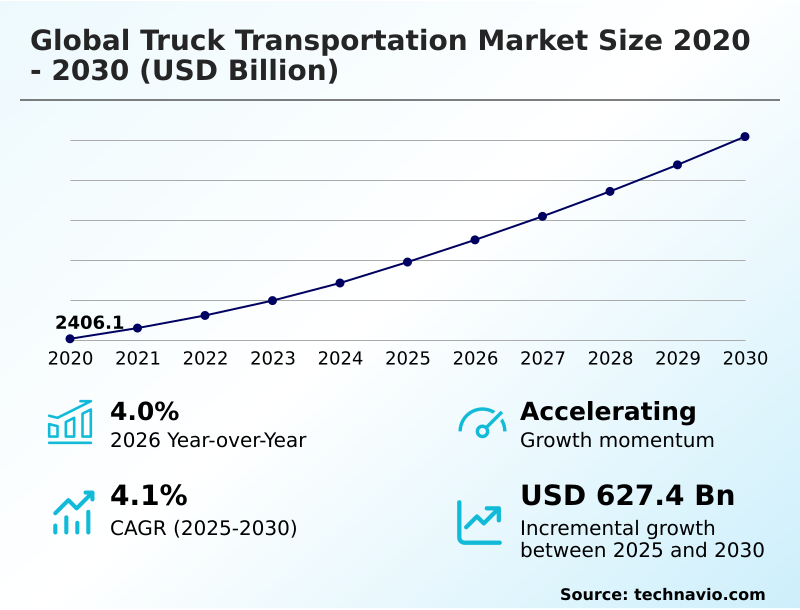
The truck transportation market size is valued to increase by USD 627.4 billion, at a CAGR of 4.1% from 2025 to 2030. Expansion of global electronic commerce will drive the truck transportation market.
Major Market Trends & Insights
- APAC dominated the market and accounted for a 42.1% growth during the forecast period.
- By Type - Heavy duty trucks segment was valued at USD 1135.7 billion in 2024
- By End-user - Manufacturing segment accounted for the largest market revenue share in 2024
Market Size & Forecast
- Market Opportunities: USD 1011 billion
- Market Future Opportunities: USD 627.4 billion
- CAGR from 2025 to 2030 : 4.1%
Market Summary
- The truck transportation market is undergoing a significant transformation, shaped by technological innovation and evolving supply chain dynamics. Key drivers include the surge in e-commerce, which necessitates robust last-mile delivery and reverse logistics networks. To meet these demands, operators are increasingly adopting fleet management software and telematics systems to enhance route optimization and supply chain visibility.
- For instance, a large retail distributor can leverage real-time tracking data to adjust delivery schedules dynamically, ensuring fulfillment of stringent service-level agreements while reducing fuel consumption. However, the industry grapples with challenges such as a persistent driver shortage and the high capital cost of transitioning to zero-emission vehicles.
- The move toward sustainable operations is a defining trend, with significant investment in battery-electric trucks and hydrogen fuel cells. Navigating this landscape requires balancing operational efficiency, regulatory compliance, and strategic technological investment. The integration of digital freight matching platforms further streamlines freight brokerage, enhancing overall market liquidity and asset utilization.
What will be the Size of the Truck Transportation Market during the forecast period?
Get Key Insights on Market Forecast (PDF) Get Free Sample
How is the Truck Transportation Market Segmented?
The truck transportation industry research report provides comprehensive data (region-wise segment analysis), with forecasts and estimates in "USD billion" for the period 2026-2030, as well as historical data from 2020-2024 for the following segments.
- Type
- Heavy duty trucks
- Medium duty trucks
- Light duty trucks
- End-user
- Manufacturing
- Retail and e-commerce
- Food and beverages
- Construction
- Oil and gas
- Application
- Long haul
- Short haul
- Geography
- APAC
- China
- India
- Japan
- North America
- US
- Canada
- Mexico
- Europe
- Germany
- UK
- France
- South America
- Brazil
- Argentina
- Colombia
- Middle East and Africa
- Saudi Arabia
- UAE
- South Africa
- Rest of World (ROW)
- APAC
By Type Insights
The heavy duty trucks segment is estimated to witness significant growth during the forecast period.
The heavy-duty truck segment is foundational to the global economy, engineered for long-haul freight and heavy industrial applications. These vehicles are central to dedicated contract carriage and bulk cargo handling, connecting manufacturing centers with distribution networks.
Fleet operators prioritize vehicle-to-everything (V2X) communication and backhaul optimization to maximize asset utilization. Strategic investments in advanced driver-assistance systems (ADAS) are critical for improving safety and driver retention.
As part of a broader network optimization strategy, the integration of advanced logistics process automation has shown to improve on-time delivery rates by over 12%.
Advanced transport management systems (TMS) are essential for coordinating complex just-in-time delivery schedules, ensuring supply chain resilience across vast distances.
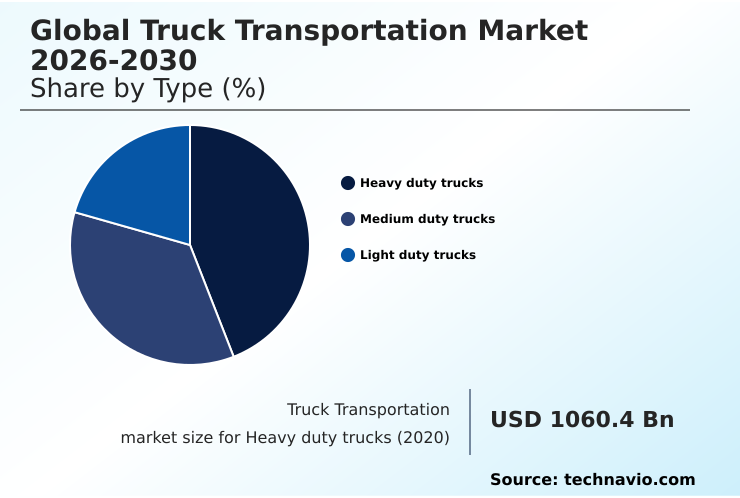
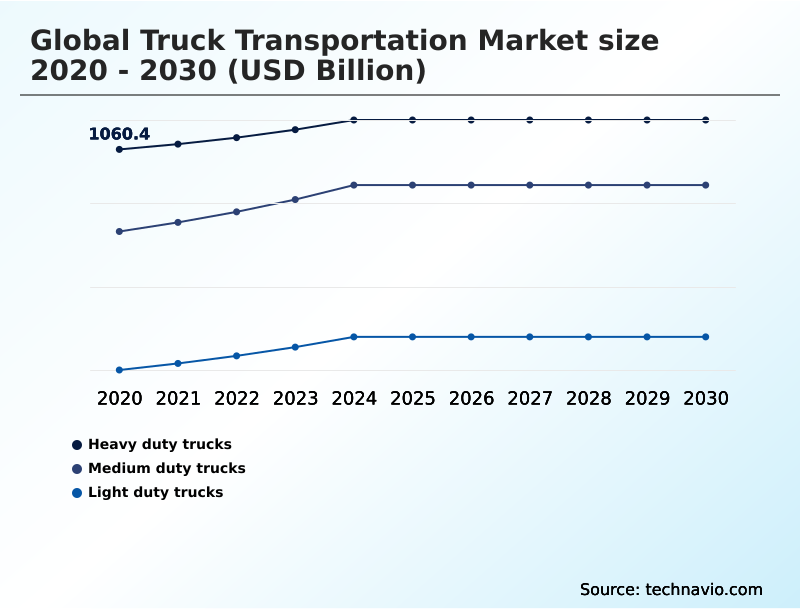
The Heavy duty trucks segment was valued at USD 1135.7 billion in 2024 and showed a gradual increase during the forecast period.
Regional Analysis
APAC is estimated to contribute 42.1% to the growth of the global market during the forecast period.Technavio’s analysts have elaborately explained the regional trends and drivers that shape the market during the forecast period.
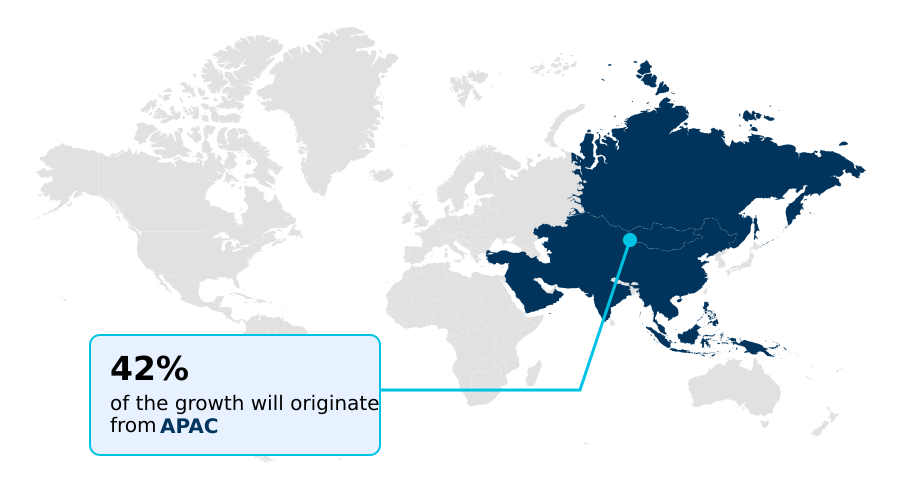
See How Truck Transportation Market Demand is Rising in APAC Get Free Sample
The market's geographic landscape is characterized by diverse regional dynamics and infrastructure levels. APAC is the fastest-growing region, with explosive industrialization in China and India driving massive demand for freight consolidation and drayage services.
This growth is supported by substantial government investment in highway networks to facilitate smoother freight transit. In North America, the market is mature, with a strong focus on technology adoption for driver fatigue management and regulatory compliance.
European markets prioritize carbon emissions reduction, leading to accelerated adoption of sustainable logistics practices.
The deployment of digital freight matching platforms is a global trend, with adoption rates in emerging markets increasing by 35% annually, significantly improving asset utilization and connecting independent operators to a wider freight network.
Market Dynamics
Our researchers analyzed the data with 2025 as the base year, along with the key drivers, trends, and challenges. A holistic analysis of drivers will help companies refine their marketing strategies to gain a competitive advantage.
- Strategic planning in the modern freight industry requires a deep understanding of several interconnected factors. Executing the best practices for cold chain transportation is crucial for the pharmaceutical and food sectors, while simultaneously optimizing reverse logistics for e-commerce returns defines retail success.
- Many operators are now implementing predictive maintenance in commercial fleets to mitigate the financial impact of driver shortage on freight costs. A key boardroom debate involves comparing electric vs hydrogen fuel cell trucks for future fleet composition.
- Operationally, the focus is on strategies for reducing empty miles in trucking, leveraging the clear benefits of telematics for fleet management to achieve this. Concurrently, solving the challenges of last-mile delivery in urban areas is a primary objective.
- The role of AI in truck transportation logistics is expanding, particularly in improving fuel efficiency in heavy-duty trucks and integrating TMS with warehouse management systems. For specialized operations, securing cargo in high-risk transit corridors and navigating cross-border trucking regulations are paramount.
- Managing fuel price volatility for carriers remains a constant struggle, though many are finding the advantages of dedicated contract carriage services to be a stabilizing factor. As sustainability becomes a core business principle, implementing circular supply chain in logistics is gaining traction, supported by technology for real-time freight visibility.
- Finally, enhancing driver safety with ADAS technology is a key initiative, and a thorough cost-benefit analysis of truck platooning and automation technologies in freight handling will shape future investments.
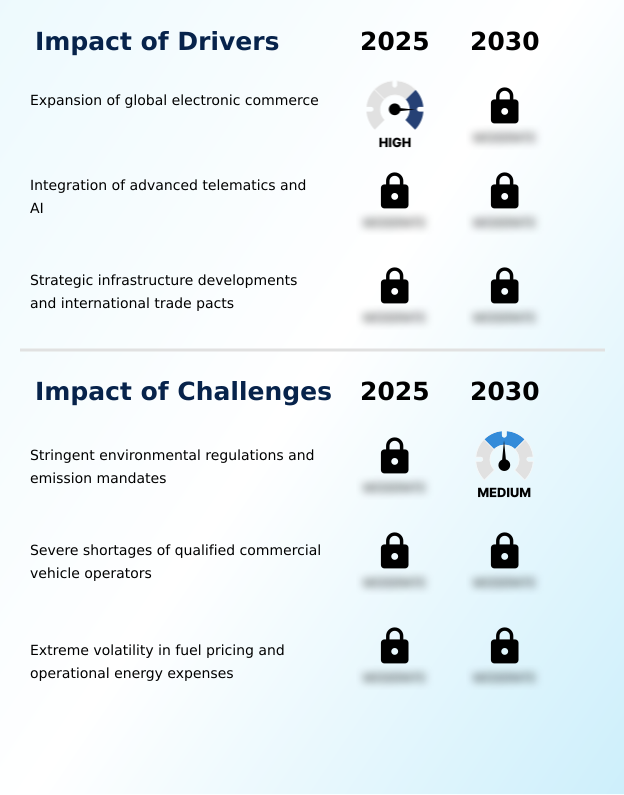
What are the key market drivers leading to the rise in the adoption of Truck Transportation Industry?
- The expansion of global electronic commerce is a key driver for the market, increasing the demand for efficient and reliable freight movement.
- Technological integration and infrastructure development are primary drivers of growth and efficiency in the market. The widespread deployment of telematics systems allows for meticulous fuel efficiency monitoring and real-time tracking, which can reduce operational costs by over 10%.
- This data-driven approach, central to modern supply chain optimization, is enhanced by government investments in smart highway corridors equipped with weigh-in-motion sensors, which cut transit delays by up to 20% in some regions.
- Furthermore, the relentless expansion of e-commerce fuels the need for sophisticated final mile optimization and just-in-time delivery networks, compelling logistics providers to enhance their capacity planning and dynamic routing capabilities to manage unprecedented freight volumes.
What are the market trends shaping the Truck Transportation Industry?
- The transition toward alternative fuel and zero-emission commercial vehicles represents an upcoming market trend. This shift is driven by environmental regulations and the pursuit of long-term operational cost reductions.
- The truck transportation market is pivoting toward sustainability and specialization. The most significant trend is the adoption of zero-emission vehicles, with fleet operators investing in both battery-electric trucks and hydrogen fuel cells to meet stringent carbon emissions reduction targets. This transition to sustainable logistics is reshaping capital expenditure strategies.
- Concurrently, the demand for specialized services like cold chain logistics is surging, driven by the pharmaceutical and fresh food industries, where maintaining temperature-controlled freight integrity can reduce spoilage by over 95%. Another key trend is the optimization of reverse logistics within a circular supply chain model.
- Efficiently managing returned goods through advanced freight-matching platforms not only cuts waste but also recovers value, improving profitability by up to 15% for e-commerce retailers.
What challenges does the Truck Transportation Industry face during its growth?
- Stringent environmental regulations and emission mandates present a key challenge affecting industry growth, requiring significant capital investment in fleet modernization.
- The market confronts significant operational and financial challenges that temper its growth trajectory. The severe, industry-wide shortage of qualified drivers increases labor costs and constrains capacity, with high turnover rates boosting recruitment expenses by up to 30% annually for some carriers.
- This human capital crisis is compounded by stringent environmental regulations mandating a costly transition toward electrified fleets, a move that can increase the initial capital outlay per vehicle by over 200%. Moreover, the extreme volatility in fuel pricing directly impacts profitability, forcing operators to constantly re-evaluate transportation procurement and freight claims management strategies.
- Navigating this environment requires robust financial planning and a strategic approach to both asset tracking solutions and hazmat transportation compliance.
Exclusive Technavio Analysis on Customer Landscape
The truck transportation market forecasting report includes the adoption lifecycle of the market, covering from the innovator’s stage to the laggard’s stage. It focuses on adoption rates in different regions based on penetration. Furthermore, the truck transportation market report also includes key purchase criteria and drivers of price sensitivity to help companies evaluate and develop their market growth analysis strategies.
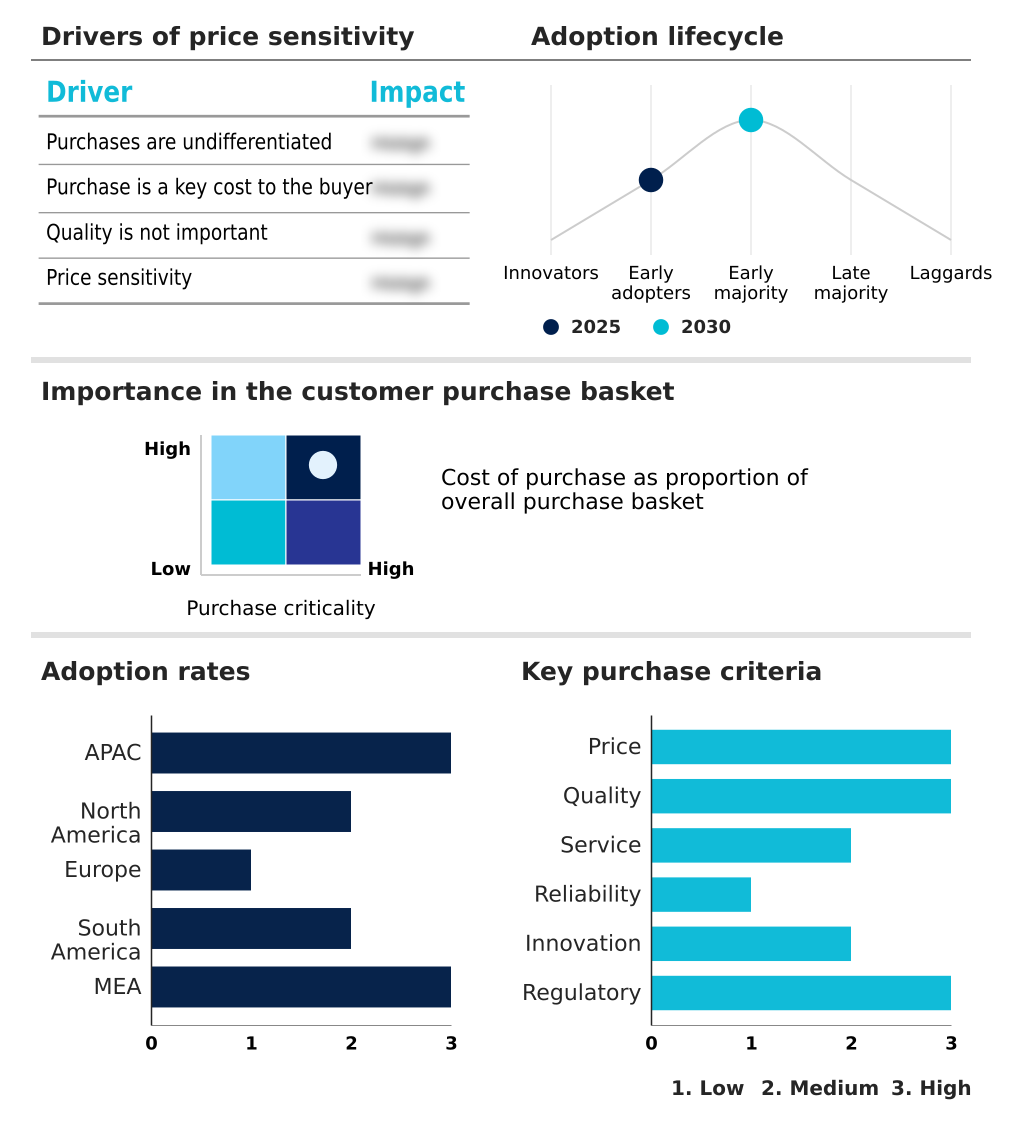
Customer Landscape of Truck Transportation Industry
Competitive Landscape
Companies are implementing various strategies, such as strategic alliances, truck transportation market forecast, partnerships, mergers and acquisitions, geographical expansion, and product/service launches, to enhance their presence in the industry.
C H Robinson Worldwide Inc. - Asset-light freight brokerage models connect shippers to a diverse network of motor carriers, optimizing full truckload and LTL logistics.
The industry research and growth report includes detailed analyses of the competitive landscape of the market and information about key companies, including:
- C H Robinson Worldwide Inc.
- CEVA Logistics SA
- Dachser SE
- DB Schenker
- DHL International GmbH
- DSV AS
- Estes Express Lines
- FedEx Corp.
- GEODIS
- JB Hunt Transport Services
- Knight Swift Transportation
- Kuehne Nagel Management AG
- Landstar System Inc.
- Old Dominion Freight Line
- Ryder System Inc.
- Schneider National Inc.
- SF Express Co. Ltd.
- TFI International Inc.
- United Parcel Service Inc.
- XPO Inc.
Qualitative and quantitative analysis of companies has been conducted to help clients understand the wider business environment as well as the strengths and weaknesses of key industry players. Data is qualitatively analyzed to categorize companies as pure play, category-focused, industry-focused, and diversified; it is quantitatively analyzed to categorize companies as dominant, leading, strong, tentative, and weak.
Recent Development and News in Truck transportation market
- In January, 2025, Ram introduced its heavy-duty truck lineup, highlighting the addition of a new 6.7-litre Cummins High-Output Turbo Diesel engine.
- In April, 2025, Mack Trucks introduced the Mack Pioneer in international markets. This heavy-duty vehicle was designed for long-haul logistics, supporting large retail supply chains and warehouse distribution networks.
- In May, 2025, Aurora Innovation, Inc. officially kicked off commercial driverless trucking operations in Texas marking a major turning point for the freight industry.
- In June, 2025, MAN Truck and Bus officially began mass production of its new electric trucks, representing a major milestone and a historic transition for the company.
Dive into Technavio’s robust research methodology, blending expert interviews, extensive data synthesis, and validated models for unparalleled Truck Transportation Market insights. See full methodology.
| Market Scope | |
|---|---|
| Page number | 304 |
| Base year | 2025 |
| Historic period | 2020-2024 |
| Forecast period | 2026-2030 |
| Growth momentum & CAGR | Accelerate at a CAGR of 4.1% |
| Market growth 2026-2030 | USD 627.4 billion |
| Market structure | Fragmented |
| YoY growth 2025-2026(%) | 4.0% |
| Key countries | China, India, Japan, South Korea, Australia, Indonesia, US, Canada, Mexico, Germany, UK, France, Italy, Spain, The Netherlands, Brazil, Argentina, Colombia, Saudi Arabia, UAE, South Africa, Turkey and Israel |
| Competitive landscape | Leading Companies, Market Positioning of Companies, Competitive Strategies, and Industry Risks |
Research Analyst Overview
- The truck transportation market is defined by a complex interplay of operational technologies and logistical strategies. At its core, efficiency is pursued through advanced fleet management software, which enables precise route optimization and supports predictive maintenance to minimize downtime.
- The industry's evolution is evident in the shift toward zero-emission vehicles, including both hydrogen fuel cells and battery-electric trucks, driven by stringent environmental mandates. This transition is a major boardroom focus, weighing the high capital cost against long-term regulatory compliance. Key operational segments include less-than-truckload (LTL) and full truckload (FTL) services, often managed through sophisticated freight brokerage.
- Digital transformation is pivotal, with electronic logging devices (ELDs) ensuring compliance, while transport management systems (TMS) and load board integration enhance supply chain visibility. Advanced systems for driver fatigue management and cargo security systems are becoming standard. Firms are exploring backhaul optimization, platooning technology, and autonomous driving systems to counter labor shortages.
- In warehouses, cross-docking operations and yard management systems, often featuring automated guided vehicles (AGVs), improve throughput. The entire ecosystem is connected through digital freight matching, dedicated contract carriage, advanced driver-assistance systems (ADAS), and vehicle-to-everything (V2X) communication, with a sharp focus on cold chain logistics, reverse logistics, and perfecting last-mile delivery.
What are the Key Data Covered in this Truck Transportation Market Research and Growth Report?
-
What is the expected growth of the Truck Transportation Market between 2026 and 2030?
-
USD 627.4 billion, at a CAGR of 4.1%
-
-
What segmentation does the market report cover?
-
The report is segmented by Type (Heavy duty trucks, Medium duty trucks, and Light duty trucks), End-user (Manufacturing, Retail and e-commerce, Food and beverages, Construction, and Oil and gas), Application (Long haul, and Short haul) and Geography (APAC, North America, Europe, South America, Middle East and Africa)
-
-
Which regions are analyzed in the report?
-
APAC, North America, Europe, South America and Middle East and Africa
-
-
What are the key growth drivers and market challenges?
-
Expansion of global electronic commerce, Stringent environmental regulations and emission mandates
-
-
Who are the major players in the Truck Transportation Market?
-
C H Robinson Worldwide Inc., CEVA Logistics SA, Dachser SE, DB Schenker, DHL International GmbH, DSV AS, Estes Express Lines, FedEx Corp., GEODIS, JB Hunt Transport Services, Knight Swift Transportation, Kuehne Nagel Management AG, Landstar System Inc., Old Dominion Freight Line, Ryder System Inc., Schneider National Inc., SF Express Co. Ltd., TFI International Inc., United Parcel Service Inc. and XPO Inc.
-
Market Research Insights
- The market's momentum is defined by a strategic focus on supply chain optimization and enhanced asset visibility. Effective capacity planning and transportation procurement are critical, with leading firms leveraging transportation analytics to improve efficiency by over 15%.
- The adoption of sophisticated third-party logistics (3PL) and fourth-party logistics (4PL) models is growing, driven by the demand for managed transportation services and comprehensive supply chain resilience. Integrating electronic proof of delivery (ePOD) systems reduces disputes and improves freight audit and payment cycles by more than 20%.
- As regulatory compliance management becomes more complex, investment in logistics process automation and sustainable logistics practices is no longer optional but essential for maintaining a competitive edge.
We can help! Our analysts can customize this truck transportation market research report to meet your requirements.
 RIA -
RIA - 
