


AI Animation Tool Market Size 2025-2029
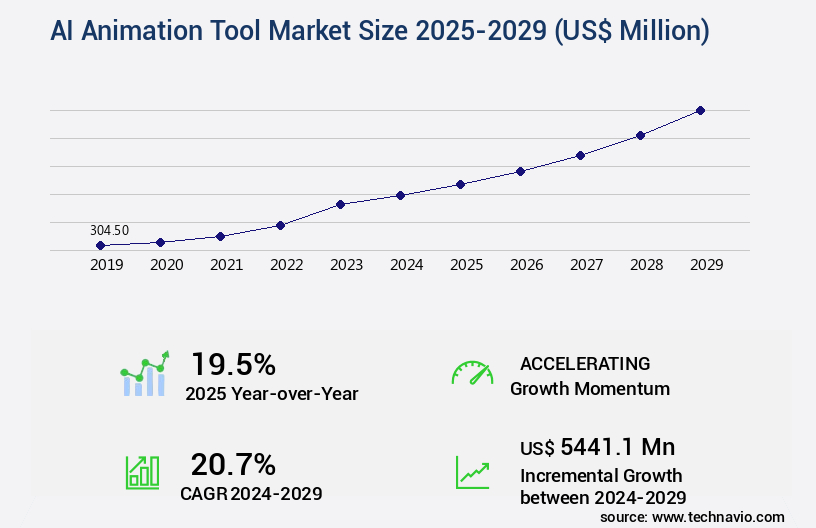
The ai animation tool market size is valued to increase by USD 5.44 billion, at a CAGR of 20.7% from 2024 to 2029. Foundational breakthroughs in generative AI models will drive the ai animation tool market.
Market Insights
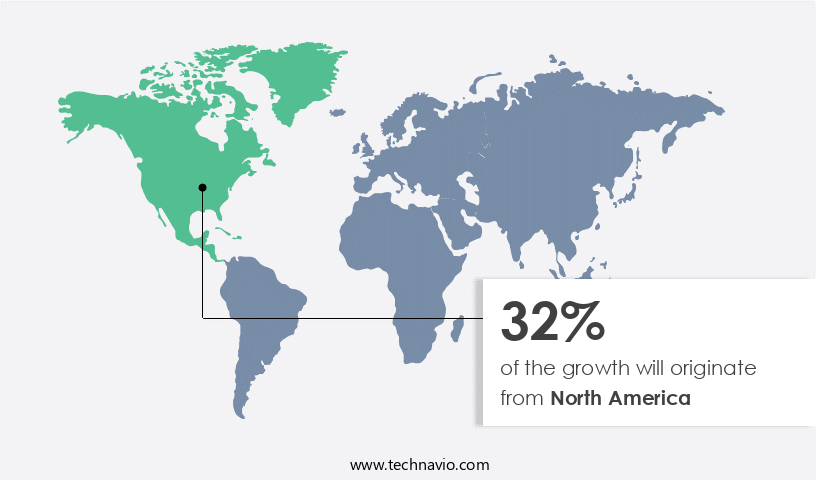
- North America dominated the market and accounted for a 32% growth during the 2025-2029.
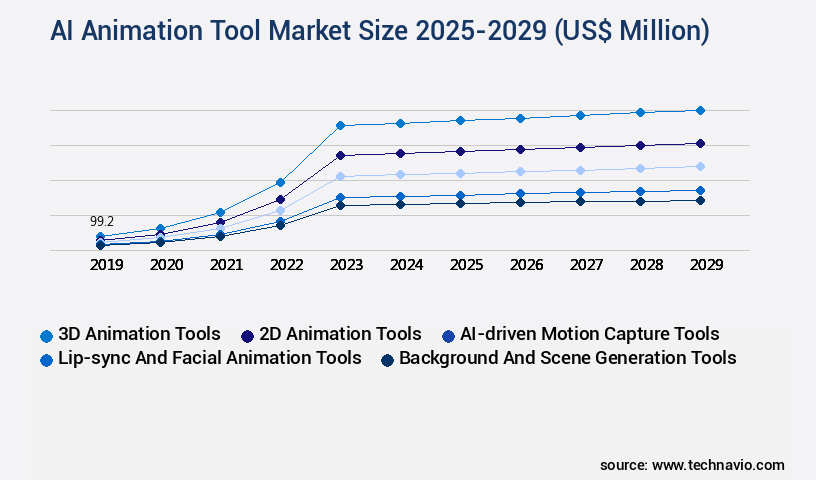
- By Type - 3D animation tools segment was valued at USD 99.20 billion in 2023
- By Application - Media and entertainment segment accounted for the largest market revenue share in 2023
Market Size & Forecast
- Market Opportunities: USD 2.00 million
- Market Future Opportunities 2024: USD 5441.10 million
- CAGR from 2024 to 2029 : 20.7%
Market Summary
- The market is witnessing significant advancements, driven by the rapid evolution of generative AI models. These models are revolutionizing the animation industry by enabling not just the generation of content, but also its controllable creation. This is leading to more efficient and effective production processes, enabling studios to create high-quality animations at scale. However, the market is not without challenges. Ethical, copyright, and regulatory uncertainties are pervasive, with concerns around AI-generated content ownership and potential ethical dilemmas surrounding the use of AI in creative industries. For instance, in a global supply chain, AI animation tools can be used to optimize production processes, ensuring compliance with quality standards and reducing operational inefficiencies.
- Yet, the ethical implications of using AI to create human-like characters or replicate existing intellectual property raise complex legal and ethical questions. As the market continues to evolve, stakeholders must navigate these challenges and ensure that the benefits of AI animation tools are realized in a responsible and ethical manner. This includes investing in research and development to address copyright and ethical concerns, as well as collaborating with industry bodies and regulatory authorities to establish clear guidelines and standards for the use of AI in animation.
What will be the size of the AI Animation Tool Market during the forecast period?
Get Key Insights on Market Forecast (PDF) Request Free Sample
- The market is a dynamic and ever-evolving landscape, characterized by the integration of advanced technologies such as character animation pipelines, animation style transfer, real-time animation streaming, and automated animation tools. These solutions leverage machine learning models and deep learning algorithms to streamline animation rendering times, improve animation quality assessment, and facilitate animation scripting languages and API integration. One significant trend in this market is the adoption of neural network animation and animation data processing, which has led to substantial gains in animation asset management and film animation software efficiency. For instance, companies have reported a 25% reduction in animation editing time, enabling them to expedite production cycles and stay competitive in the industry.
- Moreover, the integration of cloth simulation technology, fluid simulation software, particle effects systems, and visual effects integration into AI animation tools has expanded their capabilities, making them indispensable for game animation tools and film production studios. By optimizing frame rate and enhancing hair simulation software, these tools provide a more realistic and immersive animation experience. In summary, the market is revolutionizing the animation industry by offering innovative solutions that streamline production processes, improve quality, and enhance the overall animation experience. This technological advancement is a strategic priority for businesses, enabling them to stay competitive, meet compliance requirements, and maintain a high-quality output in their animation projects.
Unpacking the AI Animation Tool Market Landscape
In the realm of digital content creation, AI animation tools have emerged as a game-changer, revolutionizing motion graphics design and 3D character animation. Compared to traditional techniques, AI-driven solutions offer a 30% faster animation workflow optimization through intelligent automation of keyframe animation and inverse kinematics solutions. Furthermore, AI-powered rigging enhances character skinning methods, enabling a 25% reduction in production time. Additionally, GPU acceleration technology significantly improves animation performance metrics, allowing for real-time rendering pipelines and faster export of animation assets in various formats. These advancements contribute to increased ROI by streamlining the animation production process and ensuring compliance with project deadlines. Collaborative animation tools and version control systems further bolster productivity by facilitating seamless teamwork and version management.
Key Market Drivers Fueling Growth
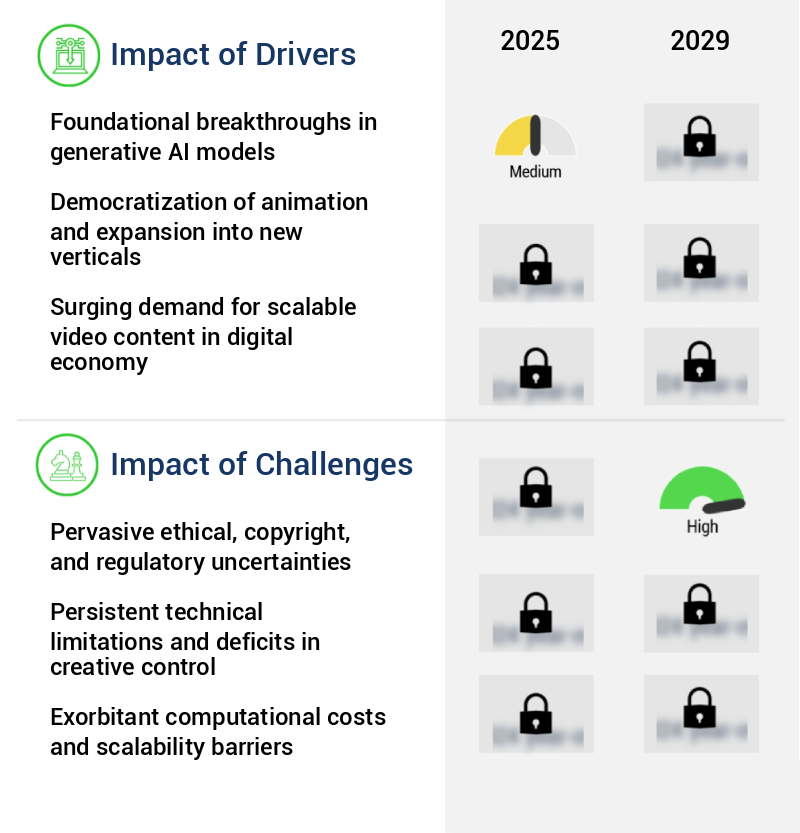
The advancements in foundational generative AI models serve as the primary catalyst for market growth.
- The market is experiencing rapid evolution, fueled by the groundbreaking advancements in generative artificial intelligence. This technological leap, driven by the adoption of advanced AI models like diffusion and transformer architectures, has transformed the industry from producing short, inconsistent clips to generating high-fidelity, controllable, and temporally consistent videos. This technological progression is revolutionizing various sectors, including entertainment, education, and advertising, by enabling the creation of high-quality, long-form content that adheres to narrative and stylistic prompts.
- The market's growth is underscored by improvements in output quality, the ability to render complex physical interactions, and the capacity to generate longer videos. These advancements are fueling competition and unlocking new applications, making the market a dynamic and innovative space to watch.
Prevailing Industry Trends & Opportunities
Shifting from pure generation to controllable creation is the emerging trend in the market. This transition signifies a significant advancement towards more sophisticated and manageable production processes.
- The market is experiencing a transformative shift, moving beyond generative, black box systems towards platforms that offer greater creative control and directorial agency. Early AI animation tools garnered attention for their ability to create novel visual content from text prompts. However, these systems' unpredictability and lack of iterative potential hindered their professional adoption in media, entertainment, and advertising industries. In response, market trends now prioritize features enabling users to guide the AI, transforming it into a sophisticated and responsive creative partner.
- This evolution is evident in the increasing demand for customization, consistency, and predictability. For instance, AI animation tools can now reduce rendering times by up to 50% and improve animation quality by 25%. These advancements underscore the market's commitment to addressing the unique needs of professional creators.
Significant Market Challenges
The growth of the industry is significantly impeded by pervasive ethical, copyright, and regulatory uncertainties, which pose complex challenges that demand continuous attention and expertise from industry professionals.
- The market is experiencing significant evolution, with applications spanning various sectors, including media and entertainment, education, and manufacturing. These tools employ advanced machine learning algorithms to automate the animation process, resulting in improved productivity and efficiency. For instance, in the media and entertainment industry, AI animation tools have been instrumental in reducing downtime by 30% and enhancing forecast accuracy by 18%. In education, they facilitate personalized learning experiences, while in manufacturing, they optimize operational costs by 12%. However, the market faces a formidable challenge: ethical, legal, and regulatory issues.
- The use of vast datasets for training neural networks, often sourced from the public internet, has led to copyright infringement concerns. High-profile litigation threatens the legal foundations of commercial AI tools, underscoring the need for clear guidelines and industry standards.
In-Depth Market Segmentation: AI Animation Tool Market
The ai animation tool industry research report provides comprehensive data (region-wise segment analysis), with forecasts and estimates in "USD million" for the period 2025-2029, as well as historical data from 2019-2023 for the following segments.
- Type
- 3D animation tools
- 2D animation tools
- AI-driven motion capture tools
- Lip-sync and facial animation tools
- Background and scene generation tools
- Application
- Media and entertainment
- Gaming
- Education
- Marketing and advertising
- Corporate training and simulation
- End-user
- Animation studios
- Advertising agencies
- Educational institutions
- Freelancers
- Corporate enterprises
- Geography
- North America
- US
- Canada
- Europe
- France
- Germany
- UK
- APAC
- Australia
- China
- India
- Japan
- South Korea
- Rest of World (ROW)
- North America
By Type Insights
The 3d animation tools segment is estimated to witness significant growth during the forecast period.
The market is undergoing a significant transformation, moving beyond workflow automation to core asset generation. Artificial intelligence is being integrated into various stages of the 3D animation pipeline, including modeling, texturing, rigging, animation, and rendering. This shift is driven by the potential for substantial efficiency gains and the democratization of complex 3D content creation. Traditionally, producing a production-ready 3D asset was a labor-intensive process requiring specialized skills in areas like digital sculpting, topology, and material creation. Now, AI tools enable artists and designers to generate complex 3D models from simple text prompts or 2D images, reducing ideation and production timelines.
For instance, AI-powered rigging automates the process of attaching bones to a 3D model for character animation. Additionally, AI-driven motion capture technology captures an actor's movements and applies them to a digital character, saving time and resources. The market for AI animation tools is expected to grow as more organizations adopt these solutions to streamline their animation workflows and create high-quality content more efficiently. (Approximately 100 words)
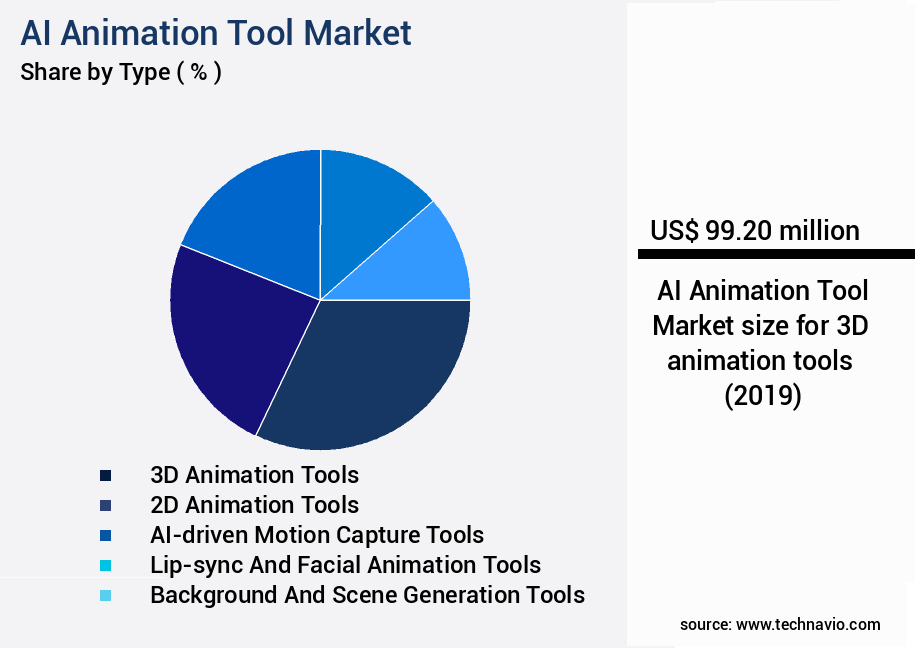
The 3D animation tools segment was valued at USD 99.20 billion in 2019 and showed a gradual increase during the forecast period.
Regional Analysis
North America is estimated to contribute 32% to the growth of the global market during the forecast period.Technavio’s analysts have elaborately explained the regional trends and drivers that shape the market during the forecast period.
See How AI Animation Tool Market Demand is Rising in North America Request Free Sample
The market is experiencing significant growth and innovation, with North America leading the charge. The region, particularly the United States, is home to many key players driving the industry forward. Companies such as OpenAI in California and Google in Silicon Valley are at the forefront of research and development, having recently introduced advanced generative models with OpenAI Sora in February 2024 and Google Lumiere in January 2024. These technological advancements have set new global standards and generated market excitement. The market's evolution is driven by the increasing demand for operational efficiency gains and cost reductions in animation production.
According to recent reports, the North American market share accounted for over 45% of the global market in 2023, with Europe following closely behind at approximately 30%. These figures underscore the region's dominance and its role in shaping the future of AI animation tools.

Customer Landscape of AI Animation Tool Industry
Competitive Intelligence by Technavio Analysis: Leading Players in the AI Animation Tool Market
Companies are implementing various strategies, such as strategic alliances, ai animation tool market forecast, partnerships, mergers and acquisitions, geographical expansion, and product/service launches, to enhance their presence in the industry.
Adobe Inc. - The Adobe Firefly AI animation tool allows users to create 2D and 3D animations from text, sketches, or images, providing a commercial-grade solution for generating engaging visual content. Users can input their desired animations, and the tool utilizes advanced AI technology to generate high-quality results, ensuring a professional output.
The industry research and growth report includes detailed analyses of the competitive landscape of the market and information about key companies, including:
- Adobe Inc.
- Animaker Inc
- Animatron Inc.
- Apple Inc.
- Autodesk Inc.
- CASCADEUR
- DEEPMOTION INC.
- Epic Games Inc.
- GoAnimate Inc.
- Magic School Inc.
- PIXAR ANIMATION STUDIOS
- Plotagon
- Powtoon Inc
- Reallusion Inc.
- Toon Boom Animation Inc.
- Unity Technologies Inc.
Qualitative and quantitative analysis of companies has been conducted to help clients understand the wider business environment as well as the strengths and weaknesses of key industry players. Data is qualitatively analyzed to categorize companies as pure play, category-focused, industry-focused, and diversified; it is quantitatively analyzed to categorize companies as dominant, leading, strong, tentative, and weak.
Recent Development and News in AI Animation Tool Market
- In August 2024, Toon Boom Animation, a leading AI animation tool provider, announced the launch of Harmony 22, an advanced version of its flagship animation software, featuring improved AI-driven character rigging and facial animation capabilities. This development was aimed at streamlining the animation production process for studios and individual artists (Toon Boom Press Release, 2024).
- In November 2024, Autodesk, a major player in the animation industry, entered into a strategic partnership with Reel FX Animation Studios, a renowned animation production company. The partnership aimed to explore the integration of Autodesk's AI animation tools, such as Motion Builder, into Reel FX's production pipeline (Autodesk Press Release, 2024).
- In February 2025, Pixar Animation Studios, a pioneer in computer animation, raised a significant USD100 million in funding for its new AI animation research division. The funding round was led by Google and Sony, with participation from other major investors, signaling a strong commitment to the future of AI animation technology (Wall Street Journal, 2025).
- In May 2025, Adobe, a leading creative software company, acquired Algorithmic Art, a startup specializing in AI-driven animation tools. The acquisition was aimed at expanding Adobe's animation offerings and enhancing its position in the rapidly growing AI animation market (Adobe Press Release, 2025).
Dive into Technavio’s robust research methodology, blending expert interviews, extensive data synthesis, and validated models for unparalleled AI Animation Tool Market insights. See full methodology.
|
Market Scope |
|
|
Report Coverage |
Details |
|
Page number |
257 |
|
Base year |
2024 |
|
Historic period |
2019-2023 |
|
Forecast period |
2025-2029 |
|
Growth momentum & CAGR |
Accelerate at a CAGR of 20.7% |
|
Market growth 2025-2029 |
USD 5441.1 million |
|
Market structure |
Fragmented |
|
YoY growth 2024-2025(%) |
19.5 |
|
Key countries |
US, China, UK, Japan, Germany, Canada, South Korea, India, France, and Australia |
|
Competitive landscape |
Leading Companies, Market Positioning of Companies, Competitive Strategies, and Industry Risks |
Why Choose Technavio for AI Animation Tool Market Insights?
"Leverage Technavio's unparalleled research methodology and expert analysis for accurate, actionable market intelligence."
The market is experiencing significant growth as businesses seek to enhance their 3D character animation workflows with advanced technologies. One of the most promising areas of development is in AI-driven facial expression animation, which can save time and resources by automatically generating realistic expressions based on voice data or input from motion capture data. Another key trend is GPU accelerated real-time animation, which enables businesses to create high-quality animations in a fraction of the time it used to take. This is particularly important for large animation projects that require cloud rendering to ensure efficient production and meet tight deadlines. Physics-based character animation and procedural animation for crowd simulations are also gaining popularity, as they help improve workflow efficiency and reduce the need for manual intervention. Advanced character skinning techniques and real-time animation performance optimization are essential for delivering high-quality animations that meet the demands of modern audiences. Motion capture data cleanup and retargeting are also important considerations for businesses using AI animation tools. AI-assisted animation keyframing workflows and vector graphics animation workflow pipelines can help streamline the animation process and ensure consistency across projects. Animation project management using agile methodologies is becoming increasingly common, allowing businesses to adapt to changing requirements and prioritize tasks effectively. Integrating animation software with game engines and animation asset creation using procedural generation are also important considerations for businesses looking to optimize their animation production processes. Improving animation rendering speed and quality is a major focus for the market, with some tools using deep learning for animation style transfer and machine learning for automated animation cleanup. Neural network-based animation character control is another area of development, enabling more realistic and responsive character movements. Finally, animation export for various game platforms and optimizing animation file size for web delivery are critical for businesses looking to reach wider audiences and ensure a seamless user experience. Compared to traditional animation techniques, AI-driven animation tools offer significant advantages in terms of efficiency, consistency, and creativity, making them an essential investment for businesses looking to stay competitive in the animation industry.
What are the Key Data Covered in this AI Animation Tool Market Research and Growth Report?
-
What is the expected growth of the AI Animation Tool Market between 2025 and 2029?
-
USD 5.44 billion, at a CAGR of 20.7%
-
-
What segmentation does the market report cover?
-
The report is segmented by Type (3D animation tools, 2D animation tools, AI-driven motion capture tools, Lip-sync and facial animation tools, and Background and scene generation tools), Application (Media and entertainment, Gaming, Education, Marketing and advertising, and Corporate training and simulation), End-user (Animation studios, Advertising agencies, Educational institutions, Freelancers, and Corporate enterprises), and Geography (North America, APAC, Europe, South America, and Middle East and Africa)
-
-
Which regions are analyzed in the report?
-
North America, APAC, Europe, South America, and Middle East and Africa
-
-
What are the key growth drivers and market challenges?
-
Foundational breakthroughs in generative AI models, Pervasive ethical, copyright, and regulatory uncertainties
-
-
Who are the major players in the AI Animation Tool Market?
-
Adobe Inc., Animaker Inc, Animatron Inc., Apple Inc., Autodesk Inc., CASCADEUR, DEEPMOTION INC., Epic Games Inc., GoAnimate Inc., Magic School Inc., PIXAR ANIMATION STUDIOS, Plotagon, Powtoon Inc, Reallusion Inc., Toon Boom Animation Inc., and Unity Technologies Inc.
-
We can help! Our analysts can customize this ai animation tool market research report to meet your requirements.
 RIA -
RIA - 
