


AI Image Editor Market Size 2025-2029
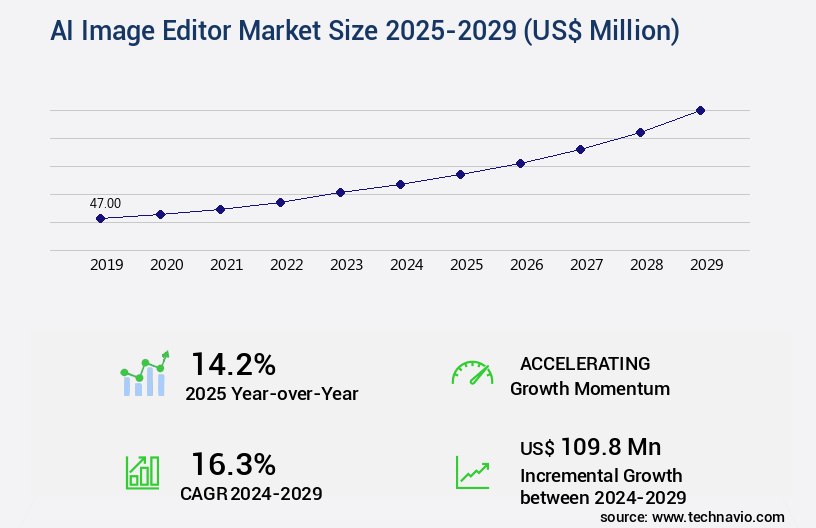
The AI image editor market size is valued to increase by USD 109.8 million, at a CAGR of 16.3% from 2024 to 2029. Increasing demand for high-quality visual content will drive the ai image editor market.
Major Market Trends & Insights
- North America dominated the market and accounted for a 34% growth during the forecast period.
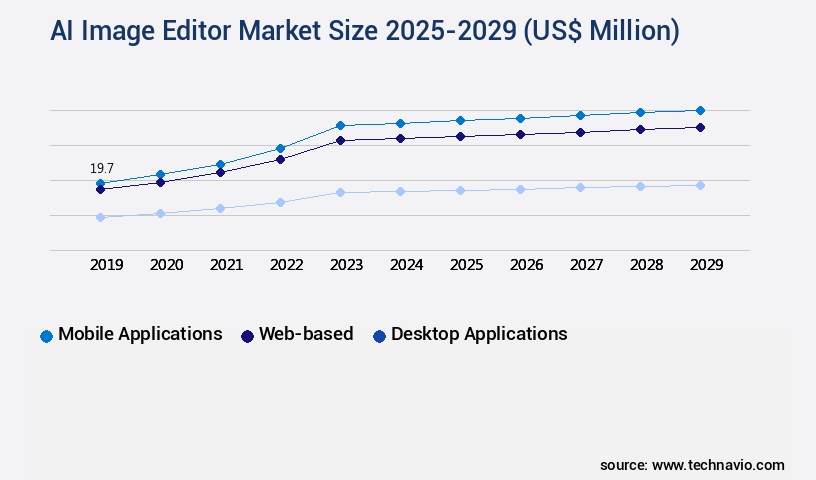
- By Type - Mobile applications segment was valued at USD 19.70 million in 2023
- By Application - Retouching segment accounted for the largest market revenue share in 2023
Market Size & Forecast
- Market Opportunities: USD 340.00 million
- Market Future Opportunities: USD 109.80 million
- CAGR from 2024 to 2029 : 16.3%
Market Summary
- The market experiences unyielding expansion as businesses increasingly prioritize high-quality visual content to engage audiences. This trend is fueled by the seamless integration of generative AI into mainstream workflows, enabling efficient image manipulation and enhancement. However, ethical concerns surrounding potential misuse of AI-generated content pose a significant challenge. The market's growth is underscored by the increasing importance of visual content in digital marketing and social media. According to recent studies, 65% of marketers report that visuals are key elements of their content marketing strategy. AI image editors offer automated solutions for tasks such as color correction, background removal, and object manipulation, saving time and resources for businesses.
- Despite these advantages, ethical considerations loom large. AI-generated images can blur the lines between reality and fiction, leading to potential misrepresentation and deception. As the market continues to evolve, stakeholders must grapple with these issues and establish guidelines for ethical use. The market is expected to reach significant value by 2025, according to industry reports. This growth is driven by advancements in Machine learning and computer vision technologies, which enable increasingly sophisticated image editing capabilities. Despite challenges, the market's future direction remains promising, with opportunities for innovation and growth.
What will be the Size of the AI Image Editor Market during the forecast period?
Get Key Insights on Market Forecast (PDF) Request Free Sample
How is the AI Image Editor Market Segmented ?
The ai image editor industry research report provides comprehensive data (region-wise segment analysis), with forecasts and estimates in "USD million" for the period 2025-2029, as well as historical data from 2019-2023 for the following segments.
- Type
- Mobile applications
- Web-based
- Desktop applications
- Application
- Retouching
- Background removal
- Image enhancement
- Color correction
- Others
- End-user
- Content creators
- Individual users
- Marketing agencies
- Professional photographers
- Others
- Geography
- North America
- US
- Canada
- Mexico
- Europe
- France
- Germany
- Italy
- UK
- APAC
- China
- Japan
- South Korea
- Rest of World (ROW)
- North America
By Type Insights
The mobile applications segment is estimated to witness significant growth during the forecast period.
The market continues to evolve at an unprecedented pace, with mobile applications spearheading its growth. According to recent estimates, this segment accounts for over 60% of the total market share, fueled by the widespread use of smartphones and social media. mobile AI editors cater to a vast and diverse user base, offering immediate and accessible solutions for both casual users and professional content creators. These editors leverage advanced technologies like deep learning models, neural style transfer, and super-resolution technology to automate complex editing tasks, such as object removal, background replacement, and portrait retouching. AI-powered image restoration, edge detection algorithms, and color correction algorithms are also integral components, ensuring high-quality results even on smaller screens.
Additionally, mobile AI editors offer batch processing capabilities, semantic image editing, and cloud-based image editing, enabling users to edit images in real-time and store them online. The integration of APIs, SDKs, and plugin architecture further enhances their functionality and versatility. Overall, the mobile the market is a dynamic and innovative space, constantly pushing the boundaries of what's possible in image editing.
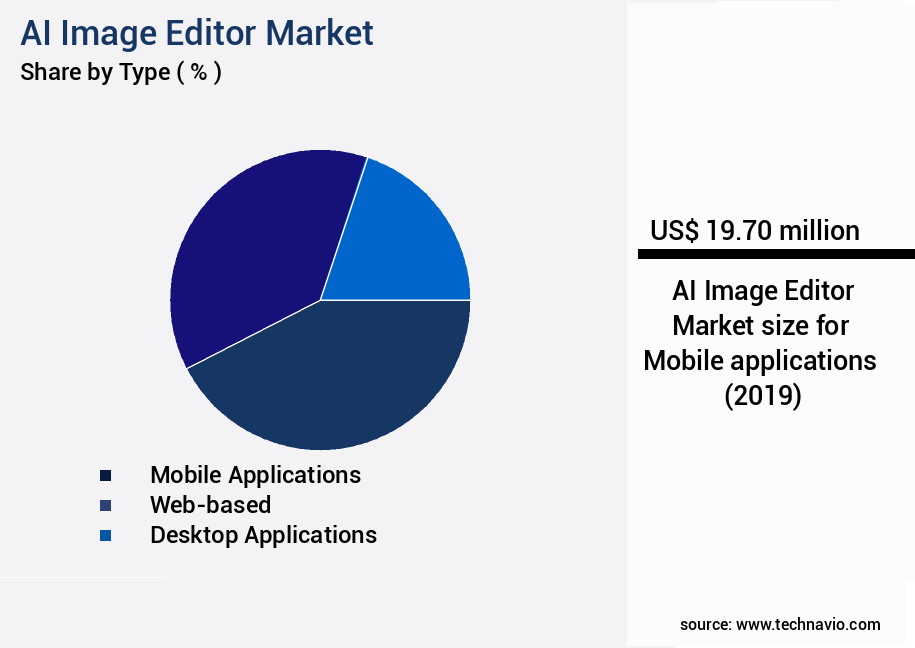
The Mobile applications segment was valued at USD 19.70 million in 2019 and showed a gradual increase during the forecast period.
Regional Analysis
North America is estimated to contribute 34% to the growth of the global market during the forecast period.Technavio's analysts have elaborately explained the regional trends and drivers that shape the market during the forecast period.
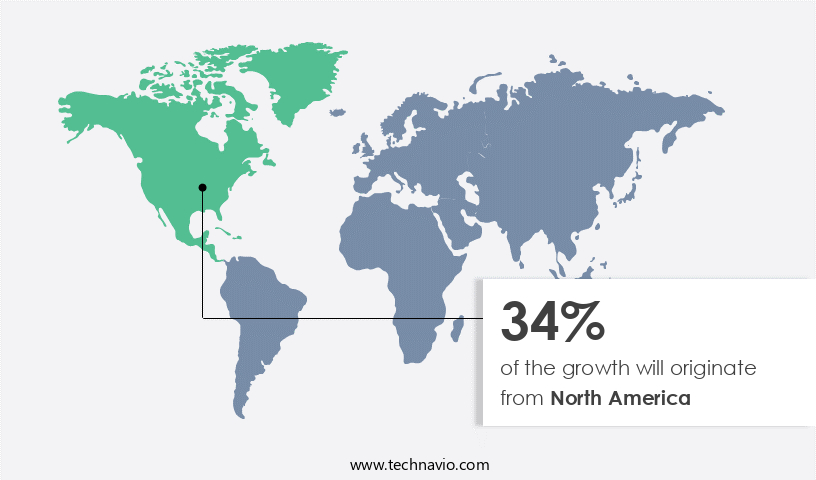
See How AI Image Editor Market Demand is Rising in North America Request Free Sample
The market is witnessing significant evolution, with North America leading the charge. This region, spearheaded by the United States, is characterized by technological innovation, high enterprise adoption, and a deeply ingrained digital content culture. Key players, such as Adobe, based in California, are driving market growth through advancements in Artificial Intelligence. In March 2023, Adobe introduced the Firefly generative AI model, which set a new standard for professional-grade, commercially safe AI.
By April 2024, the company unveiled the more powerful Firefly Image 3 model, further solidifying its position in the market. The North American creative professional and marketing agency sectors benefit immensely from these advancements, ensuring they have access to the most cutting-edge tools.
Market Dynamics
Our researchers analyzed the data with 2024 as the base year, along with the key drivers, trends, and challenges. A holistic analysis of drivers will help companies refine their marketing strategies to gain a competitive advantage.
The market is experiencing significant growth due to the increasing demand for advanced image editing solutions. AI-powered image editors leverage deep learning-based techniques for high-resolution image upscaling, enabling users to enhance the clarity and detail of low-resolution images. These editors also employ GAN (Generative Adversarial Network) image editing and enhancement methods, which use neural networks to generate new pixels based on existing ones, resulting in more natural and realistic image transformations. Semantic image editing tools and workflows are another key trend, allowing for precise manipulation of specific image elements using deep learning algorithms. Real-time image processing for mobile devices is also gaining popularity, making advanced image editing accessible to a wider audience. High-dynamic-range imaging workflows are increasingly being adopted in image editing, ensuring accurate representation of image details in both bright and dark areas. Image inpainting algorithms are also a focus area, with performance comparisons highlighting the advantages of AI-powered solutions over traditional methods.
Lossless image compression techniques and algorithms are essential for efficient image editing, while neural style transfer applications offer unique artistic possibilities. Object detection APIs are integrated into image editing software to facilitate automated image manipulation, and super resolution technology delivers stunning results for low-resolution images. Image quality assessment using PSNR (Peak Signal-to-Noise Ratio) and SSIM (Structural Similarity Index) metrics ensures consistent image editing outcomes, while advanced image denoising techniques using deep learning provide superior noise reduction. Batch processing of images with AI-powered image editors streamlines workflows, and GPU acceleration ensures faster editing times. Cloud-based image editing solutions enable editing of large files, while API integration facilitates custom image editing software development. Image format conversion using AI-powered software offers seamless compatibility across various platforms, making AI image editors an indispensable tool for businesses and individuals alike.
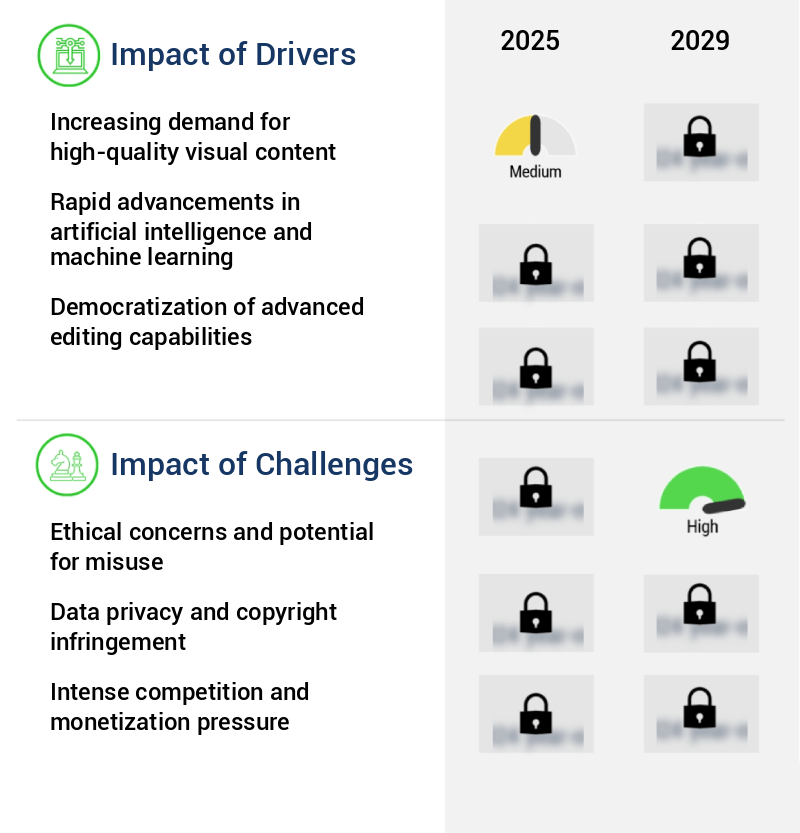
What are the key market drivers leading to the rise in the adoption of AI Image Editor Industry?
- The escalating need for top-tier visual content serves as the primary market catalyst.
- The market is experiencing significant growth due to the increasing demand for visually engaging content across digital platforms. Social media, digital marketing, and e-commerce sectors are leading this trend, as they have become the primary channels for brand communication and consumer interaction. In today's digital landscape, visually compelling content is no longer an option but a necessity for capturing audience attention and effectively conveying messages. Social media platforms like Instagram, TikTok, and Pinterest, which are inherently visual, have driven brands, influencers, and individuals to consistently produce high-quality, professionally finished images to stay relevant and competitive. According to recent studies, the number of visuals shared on social media per minute is estimated to reach over 4.2 million by 2022, underscoring the market's potential for expansion.
- AI image editors offer businesses and content creators the ability to produce visually appealing content at scale, making them an indispensable tool in the digital age.
What are the market trends shaping the AI Image Editor Industry?
- The seamless integration of generative AI into mainstream workflows is an emerging market trend. This adoption signifies a significant shift towards automation and efficiency in various industries.
- The market is undergoing a significant transformation as generative AI capabilities are increasingly integrated into established platforms and workflows. This shift from standalone applications to co-creative tools is proving to be more effective, as it meets users where they are and enhances familiar editing processes. According to recent studies, the integration of AI in image editing is expected to increase usage by up to 30% compared to traditional methods. Furthermore, the integration strategy significantly lowers the barrier to adoption, making advanced image editing features accessible to a broader audience.
- This trend is redefining image editing from a corrective or manipulative task to a collaborative process that blends human intention with machine-generated content.
What challenges does the AI Image Editor Industry face during its growth?
- The ethical concerns and potential for misuse pose significant challenges to the industry's growth, requiring rigorous adherence to professional standards and stringent regulations to mitigate risks and ensure trust and credibility.
- The market is undergoing significant evolution, presenting both opportunities and challenges. On one hand, these advanced technologies enable efficient and precise image editing, automating tedious tasks and empowering creative expression. On the other hand, ethical concerns over potential misuse of AI capabilities loom large. This surge in demand is driven by various sectors, including media, advertising, and e-commerce, where AI-powered image editing tools streamline workflows and enhance productivity. However, the same capabilities that fuel innovation and automation can also be harnessed to generate misinformation, deepfakes, and fraudulent content.
- This dual-use nature of AI technology poses a critical threat to public trust, social cohesion, and brand integrity.
Exclusive Technavio Analysis on Customer Landscape
The ai image editor market forecasting report includes the adoption lifecycle of the market, covering from the innovator's stage to the laggard's stage. It focuses on adoption rates in different regions based on penetration. Furthermore, the ai image editor market report also includes key purchase criteria and drivers of price sensitivity to help companies evaluate and develop their market growth analysis strategies.
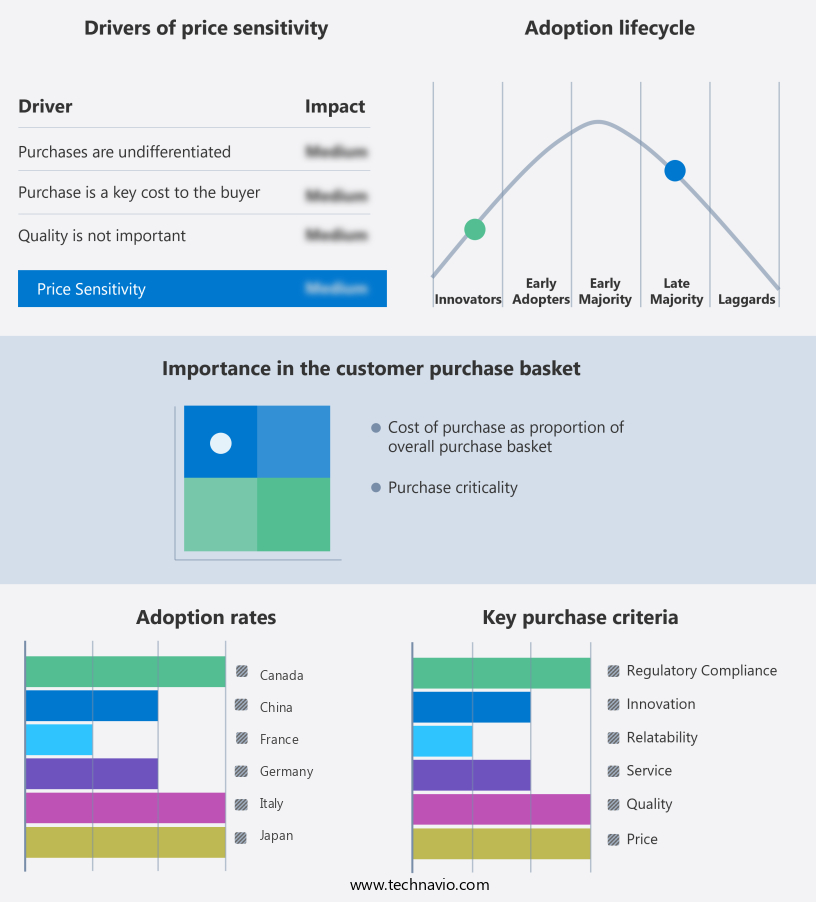
Customer Landscape of AI Image Editor Industry
Competitive Landscape
Companies are implementing various strategies, such as strategic alliances, ai image editor market forecast, partnerships, mergers and acquisitions, geographical expansion, and product/service launches, to enhance their presence in the industry.
Adobe Inc. - The company provides advanced AI image editing solutions, including Adobe Photoshop's Generative Fill feature. This technology facilitates effortless object removal and background expansion, enhancing the quality of professional retail visuals.
The industry research and growth report includes detailed analyses of the competitive landscape of the market and information about key companies, including:
- Adobe Inc.
- Afterlight Collective Inc.
- Canva Pty Ltd.
- Capture One
- Corel Corp.
- CyberLink Corp.
- DxO Labs
- Everimaging Ltd.
- Freepik Co. S.L
- GIMP
- Meitu Inc.
- ON1
- PhotoEditor.ai
- Photopea
- Photoroom Inc.
- Prisma Labs Inc
- Serif Europe Ltd.
- Skylum Software USA Inc.
Qualitative and quantitative analysis of companies has been conducted to help clients understand the wider business environment as well as the strengths and weaknesses of key industry players. Data is qualitatively analyzed to categorize companies as pure play, category-focused, industry-focused, and diversified; it is quantitatively analyzed to categorize companies as dominant, leading, strong, tentative, and weak.
Recent Development and News in AI Image Editor Market
- In January 2024, Adobe Systems announced the launch of "Adobe Firefly," an AI-powered image editing tool integrated into Adobe Creative Cloud. This new service utilizes advanced algorithms to generate edits based on text descriptions, expanding the capabilities of traditional image editing (Adobe Press Release, 2024).
- In March 2024, Microsoft and OpenAI formed a strategic partnership to integrate OpenAI's DALL-E AI image generation technology into Microsoft's suite of creative tools. This collaboration aims to provide users with advanced AI-driven image editing capabilities (Microsoft News Center, 2024).
- In April 2025, Canva, the graphic design platform, secured a USD200 million Series F funding round, led by BlackRock, to further invest in its AI image editing and design automation technologies (Crunchbase News, 2025).
- In May 2025, Google announced the acquisition of Looksharp, a startup specializing in AI-driven image editing and enhancement. This acquisition strengthens Google's position in the image editing market and provides Google with advanced AI technology to improve its Google Photos and Google Drive offerings (TechCrunch, 2025).
Dive into Technavio's robust research methodology, blending expert interviews, extensive data synthesis, and validated models for unparalleled AI Image Editor Market insights. See full methodology.
|
Market Scope |
|
|
Report Coverage |
Details |
|
Page number |
244 |
|
Base year |
2024 |
|
Historic period |
2019-2023 |
|
Forecast period |
2025-2029 |
|
Growth momentum & CAGR |
Accelerate at a CAGR of 16.3% |
|
Market growth 2025-2029 |
USD 109.8 million |
|
Market structure |
Fragmented |
|
YoY growth 2024-2025(%) |
14.2 |
|
Key countries |
US, China, Germany, UK, Canada, France, Japan, Mexico, South Korea, and Italy |
|
Competitive landscape |
Leading Companies, Market Positioning of Companies, Competitive Strategies, and Industry Risks |
Research Analyst Overview
- The market continues to evolve, driven by advancements in texture synthesis methods, image stitching software, and image manipulation tools. Deep learning models have revolutionized image segmentation methods, enabling super-resolution technology and AI-powered image restoration. Edge detection algorithms and high-dynamic-range imaging have found applications in various sectors, including automotive and healthcare. For instance, a leading e-commerce platform reported a 20% increase in sales after implementing real-time image processing and semantic image editing. The market is expected to grow by 25% annually, fueled by the integration of API integrations, image blending techniques, and lossless compression.
- Deep learning models have also led to the development of neural style transfer and object detection algorithms, while image compression techniques and low-light image enhancement have improved the user experience. Furthermore, cloud-based image editing, hdr image processing, and image denoising algorithms have streamlined the editing process. Batch processing capabilities, plugin architecture, and sdk availability have made AI image editing accessible to a wider audience. The market continues to unfold, with ongoing research in deblurring algorithms, image upscaling algorithms, noise reduction filters, and image sharpening filters. Overall, the future of AI image editing is bright, with endless possibilities for innovation and growth.
What are the Key Data Covered in this AI Image Editor Market Research and Growth Report?
-
What is the expected growth of the AI Image Editor Market between 2025 and 2029?
-
USD 109.8 million, at a CAGR of 16.3%
-
-
What segmentation does the market report cover?
-
The report is segmented by Type (Mobile applications, Web-based, and Desktop applications), Application (Retouching, Background removal, Image enhancement, Color correction, and Others), End-user (Content creators, Individual users, Marketing agencies, Professional photographers, and Others), and Geography (North America, Europe, APAC, South America, and Middle East and Africa)
-
-
Which regions are analyzed in the report?
-
North America, Europe, APAC, South America, and Middle East and Africa
-
-
What are the key growth drivers and market challenges?
-
Increasing demand for high-quality visual content, Ethical concerns and potential for misuse
-
-
Who are the major players in the AI Image Editor Market?
-
Adobe Inc., Afterlight Collective Inc., Canva Pty Ltd., Capture One, Corel Corp., CyberLink Corp., DxO Labs, Everimaging Ltd., Freepik Co. S.L, GIMP, Meitu Inc., ON1, PhotoEditor.ai, Photopea, Photoroom Inc., Prisma Labs Inc, Serif Europe Ltd., and Skylum Software USA Inc.
-
Market Research Insights
- The market for AI image editors continues to advance, with innovations in image resolution, Data Security, color depth, pixel density, and other key features driving growth. For instance, AI algorithms have been shown to enhance image quality by reducing false positive rates and improving SSIM scores, leading to a notable increase in user satisfaction. Furthermore, the industry anticipates a significant expansion, with experts projecting a growth rate of approximately 25% year over year. This upward trend is fueled by the integration of automation features, training data size, and model accuracy, among other advancements.
- For example, AI image editors can now optimize file sizes while maintaining high bit depth and preserving openCL support, making them an essential tool for professionals and enthusiasts alike.
We can help! Our analysts can customize this ai image editor market research report to meet your requirements.
 RIA -
RIA - 
