


AI In Media Market Size 2025-2029
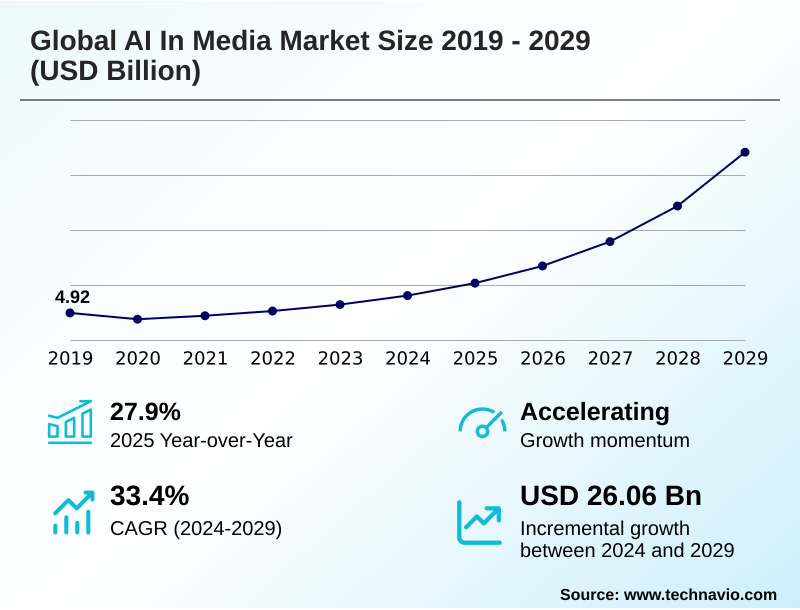
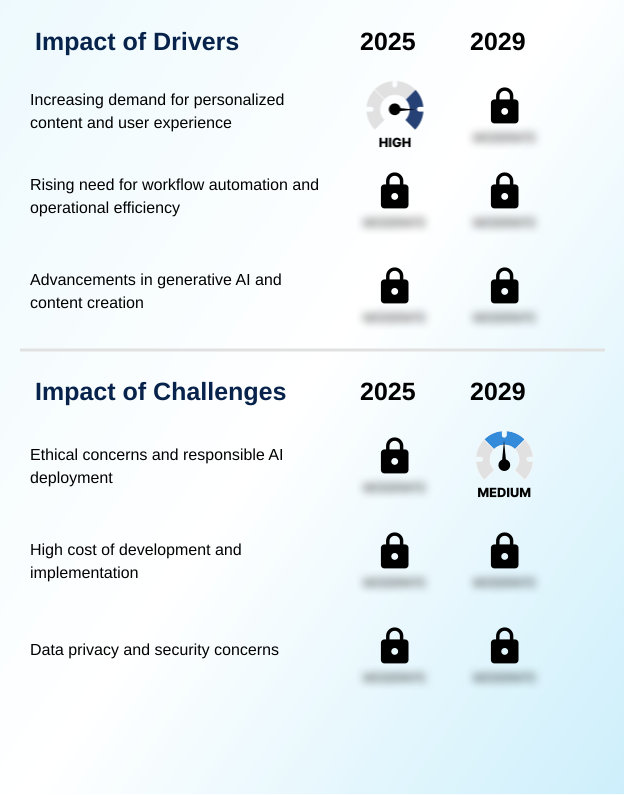
The ai in media market size is valued to increase by USD 26.06 billion, at a CAGR of 33.4% from 2024 to 2029. Increasing demand for personalized content and user experience will drive the ai in media market.
Major Market Trends & Insights
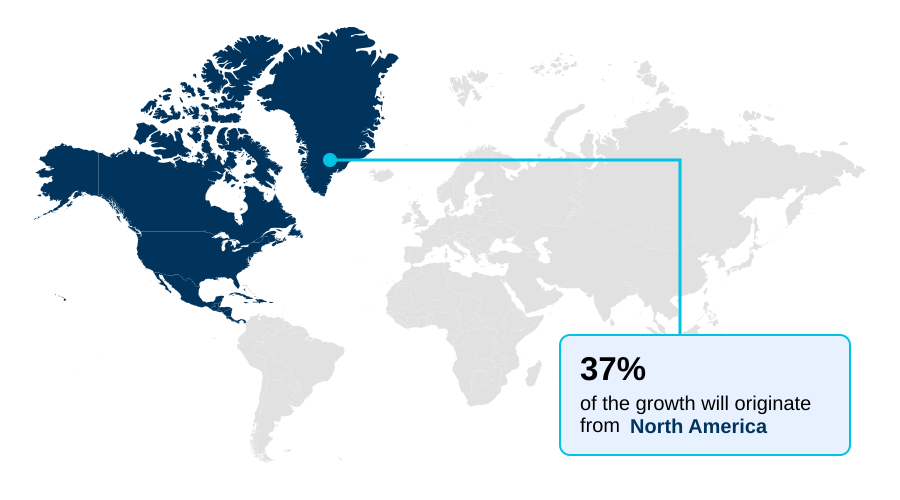
- North America dominated the market and accounted for a 36.6% growth during the forecast period.
- By Application - Video production segment was valued at USD 3.68 billion in 2023
- By Type - Content distribution segment accounted for the largest market revenue share in 2023
Market Size & Forecast
- Market Opportunities: USD 29.21 billion
- Market Future Opportunities: USD 26.06 billion
- CAGR from 2024 to 2029 : 33.4%
Market Summary
- The AI in media market is defined by the integration of intelligent technologies to revolutionize content creation, distribution, and monetization. Key drivers include the demand for workflow automation and advancements in generative AI, which are reshaping production pipelines.
- This has led to the rise of trends like hyper-personalization, where AI-driven recommendation engines analyze user data to deliver tailored content, significantly enhancing engagement. For instance, a broadcast network can implement AI for automated metadata tagging and content ingest, which not only accelerates asset management but also powers more sophisticated audience analysis.
- However, the industry grapples with challenges such as data privacy regulations and the high costs associated with developing and implementing advanced AI systems. The need to navigate ethical concerns, including algorithmic bias and the potential for deepfakes, remains a critical consideration for sustainable growth.
- As technology matures, the focus is shifting toward creating a responsible framework that balances innovation with user trust and safety.
What will be the Size of the AI In Media Market during the forecast period?
Get Key Insights on Market Forecast (PDF) Get Free Sample
How is the AI In Media Market Segmented?
The ai in media industry research report provides comprehensive data (region-wise segment analysis), with forecasts and estimates in "USD million" for the period 2025-2029, as well as historical data from 2019-2023 for the following segments.
- Application
- Video production
- Content moderation
- Fake news detection
- Type
- Content distribution
- Workflow automation
- Audience analysis
- Technology
- Machine learning
- Natural language processing
- Computer vision
- Generative AI
- Geography
- North America
- US
- Canada
- Mexico
- APAC
- China
- India
- Japan
- Europe
- UK
- Germany
- France
- Middle East and Africa
- UAE
- Saudi Arabia
- South Africa
- South America
- Brazil
- Argentina
- Colombia
- Rest of World (ROW)
- North America
By Application Insights
The video production segment is estimated to witness significant growth during the forecast period.
The video production segment is undergoing a significant transformation, driven by the integration of advanced technologies across the content pipeline. AI-powered dubbing and real-time motion capture are streamlining workflows, from pre-production to post-production finishing.
The use of generative adversarial networks and AI-driven filmmaking platforms enables more dynamic and complex shot creation without the logistical challenges of traditional physical sets.
These systems, utilizing computer vision algorithms, assist with script analysis, automated video editing, and even generate preliminary storyboards.
This intelligent automation accelerates production timelines, with some studios reporting a 40% reduction in the time required for initial concept visualization, allowing creative professionals to focus on narrative and artistic vision.
This shift makes AI an indispensable asset in modern video production, enhancing both efficiency and creative output.
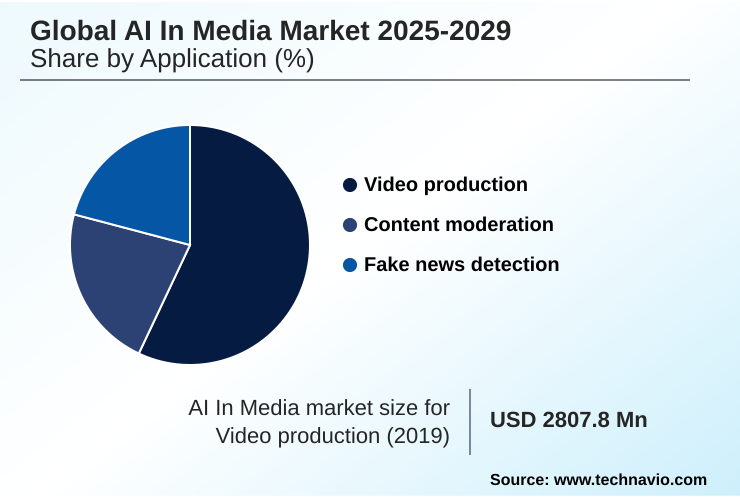
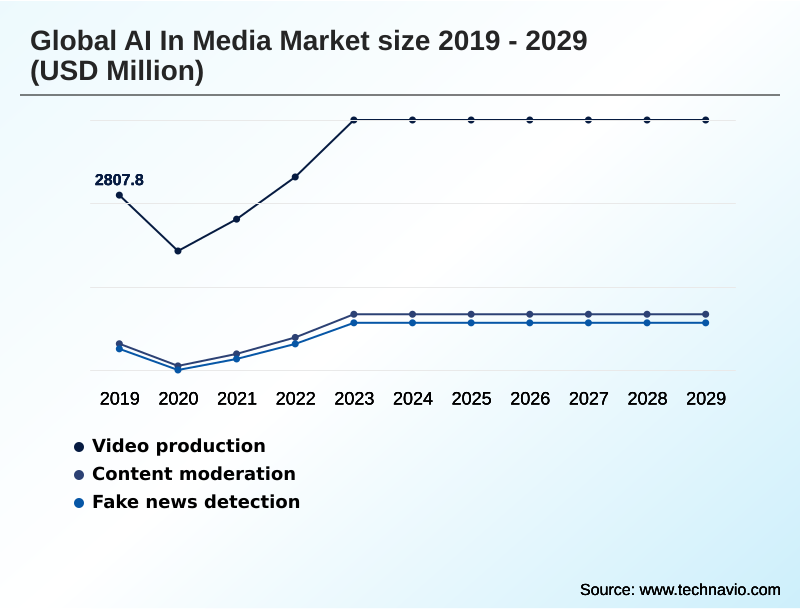
The Video production segment was valued at USD 3.68 billion in 2023 and showed a gradual increase during the forecast period.
Regional Analysis
North America is estimated to contribute 36.6% to the growth of the global market during the forecast period.Technavio’s analysts have elaborately explained the regional trends and drivers that shape the market during the forecast period.
See How AI In Media Market Demand is Rising in North America Get Free Sample
The geographic landscape of the market is characterized by distinct regional dynamics, with North America currently leading in adoption and innovation.
The region benefits from a mature technology ecosystem and high consumer demand, with firms reporting a 30% reduction in post-production time due to AI integration. AI-powered voice cloning and AI-powered audio synthesis are key investment areas.
Meanwhile, APAC is emerging as the fastest-growing region, driven by its massive digital consumer base and government-led AI initiatives, contributing to over 34% of the market's incremental growth.
In Europe, the focus is on responsible AI deployment, with an emphasis on data privacy and ethical frameworks governing automated closed captioning and other AI applications.
These regional distinctions highlight a global market that is both expanding and diversifying, with innovation in automated content ingest shaping worldwide media workflows.
Market Dynamics
Our researchers analyzed the data with 2024 as the base year, along with the key drivers, trends, and challenges. A holistic analysis of drivers will help companies refine their marketing strategies to gain a competitive advantage.
- Strategic deployment of artificial intelligence is fundamentally reshaping media operations, with a focus on specific, high-impact applications. The use of AI for automating video post-production is no longer a novelty but a core component for achieving efficiency, allowing creative teams to focus on storytelling rather than tedious manual tasks.
- In parallel, the application of generative AI for character design is accelerating pre-production cycles, enabling studios to explore a wider range of creative options in a fraction of the time. For content distributors, leveraging AI algorithms for audience analysis provides deep, actionable insights that drive personalization and increase engagement.
- This is complemented by the rise of machine learning for content personalization, which dynamically tailors user experiences, leading to higher retention rates. The development of NLP for automated script generation is also gaining traction, offering a powerful tool for ideation and initial drafting.
- On the operational side, using computer vision for content moderation has become critical for maintaining platform safety at scale. Addressing the ethical challenges of deepfake technology remains a significant hurdle, demanding robust detection and verification solutions. Organizations that successfully measure the ROI of AI in media workflows consistently report higher efficiency.
- The overall impact of AI on content monetization is positive, creating new revenue streams through dynamic advertising and personalized offerings. A key consideration for global platforms is ensuring AI in media data privacy compliance, which is now a boardroom-level priority.
What are the key market drivers leading to the rise in the adoption of AI In Media Industry?
- The increasing demand for personalized content and tailored user experiences is a key driver of market growth.
- Market growth is fueled by the imperative to enhance operational efficiency and meet rising consumer expectations for personalized content.
- The demand for workflow automation is a primary driver, with AI-driven news curation systems reducing manual editorial effort by up to 50%.
- Advancements in generative AI, particularly multimodal AI models, are accelerating content creation, allowing for the automatic generation of marketing copy and visual assets.
- The need for intelligent content localization is also propelling adoption, as visual dubbing solutions and automated translation tools enable media companies to reach global audiences more effectively.
- For instance, platforms using these tools have seen a 30% increase in engagement from non-native language markets. This focus on efficiency and personalization is creating significant opportunities for innovation and competitive differentiation across the industry.
What are the market trends shaping the AI In Media Industry?
- A predominant market trend is the move toward hyper-personalization of content and experiences. This involves delivering deeply customized interactions that go beyond basic recommendations.
- Key trends are reshaping the media landscape, driven by the pursuit of deeper audience engagement and production efficiency. The shift towards hyper-personalization is paramount, with platforms utilizing advanced AI to deliver unique user experiences. This is exemplified by the use of AI-generated interactive narratives, which have been shown to increase user interaction by over 40%.
- The proliferation of generative AI for content creation is another transformative trend, enabling the rapid production of text, images, and video. Studios leveraging AI-enhanced visual effects report a 20% reduction in rendering times for complex scenes. This trend is supported by technologies like AI-powered audio synthesis, which provides scalable solutions for custom soundscapes and voiceovers.
- An AI-driven filmmaking platform now allows independent creators to produce high-quality content, democratizing the creative process and fostering innovation.
What challenges does the AI In Media Industry face during its growth?
- Ethical concerns and the need for responsible AI deployment present a key challenge affecting industry growth.
- The market faces significant challenges centered on ethical implementation, cost, and data security. Navigating ethical concerns, particularly around the use of deepfake detection mechanisms and AI-driven content moderation, is a primary restraint. The potential for algorithmic bias in an AI-driven recommendation engine can lead to content filtering issues, impacting user trust.
- The high cost of development is another barrier, as building and maintaining systems for automated video editing or synthetic media creation requires substantial investment. A media startup reported that infrastructure costs for their generative AI platform constituted over 60% of their initial operating budget.
- Furthermore, data privacy regulations necessitate robust security for any platform engaging in hyper-personalized media interactions, adding complexity and cost to system architecture and creating compliance hurdles for global operations.
Exclusive Technavio Analysis on Customer Landscape
The ai in media market forecasting report includes the adoption lifecycle of the market, covering from the innovator’s stage to the laggard’s stage. It focuses on adoption rates in different regions based on penetration. Furthermore, the ai in media market report also includes key purchase criteria and drivers of price sensitivity to help companies evaluate and develop their market growth analysis strategies.
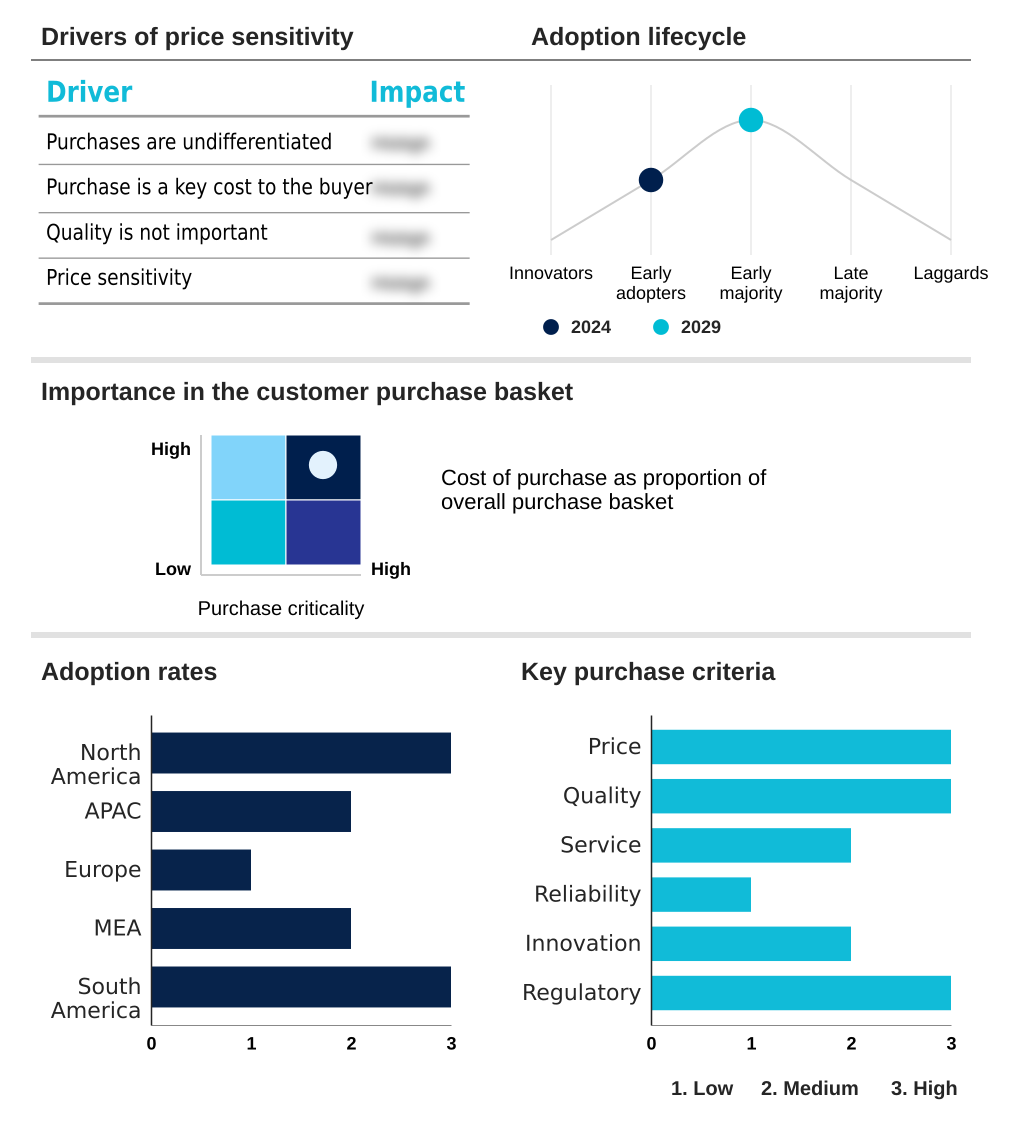
Customer Landscape of AI In Media Industry
Competitive Landscape
Companies are implementing various strategies, such as strategic alliances, ai in media market forecast, partnerships, mergers and acquisitions, geographical expansion, and product/service launches, to enhance their presence in the industry.
Adobe Inc. - Offers generative AI solutions for video and image editing, designed to enhance marketing assets and automate content creation workflows across integrated product suites.
The industry research and growth report includes detailed analyses of the competitive landscape of the market and information about key companies, including:
- Adobe Inc.
- Alibaba Group Holding Ltd.
- Amazon.com Inc.
- Autodesk Inc.
- Baidu Inc.
- Deepdub Inc.
- Electric Sheep
- EVS Broadcast Equipment S.A.
- Flawless
- Google LLC
- IBM Corp.
- Meta Platforms Inc.
- Metaphysic
- Microsoft Corp.
- NVIDIA Corp.
- OpenAI
- Oracle Corp.
- Respeecher Inc.
- Runway AI Inc.
Qualitative and quantitative analysis of companies has been conducted to help clients understand the wider business environment as well as the strengths and weaknesses of key industry players. Data is qualitatively analyzed to categorize companies as pure play, category-focused, industry-focused, and diversified; it is quantitatively analyzed to categorize companies as dominant, leading, strong, tentative, and weak.
Recent Development and News in Ai in media market
- In September 2024, OpenAI announced a strategic partnership with a major news consortium to develop AI tools for journalistic fact-checking and misinformation detection, leveraging advanced language models.
- In November 2024, Runway AI Inc. launched its Gen-3 platform, introducing real-time collaborative video editing and advanced text-to-video capabilities with enhanced photorealism.
- In January 2025, Adobe Inc. acquired a leading AI-powered audio synthesis startup to integrate hyper-realistic voice cloning and soundscape generation into its Creative Cloud suite.
- In April 2025, Deepdub Inc. announced the opening of a new localization hub in Japan to scale its AI-driven dubbing services for the APAC entertainment market.
Dive into Technavio’s robust research methodology, blending expert interviews, extensive data synthesis, and validated models for unparalleled AI In Media Market insights. See full methodology.
| Market Scope | |
|---|---|
| Page number | 306 |
| Base year | 2024 |
| Historic period | 2019-2023 |
| Forecast period | 2025-2029 |
| Growth momentum & CAGR | Accelerate at a CAGR of 33.4% |
| Market growth 2025-2029 | USD 26056.3 million |
| Market structure | Fragmented |
| YoY growth 2024-2025(%) | 27.9% |
| Key countries | US, Canada, Mexico, China, India, Japan, South Korea, Australia, Singapore, UK, Germany, France, Italy, Spain, The Netherlands, UAE, Saudi Arabia, South Africa, Egypt, Nigeria, Brazil, Argentina and Colombia |
| Competitive landscape | Leading Companies, Market Positioning of Companies, Competitive Strategies, and Industry Risks |
Research Analyst Overview
- The market is undergoing a period of intense innovation, driven by the practical application of sophisticated AI technologies across the content lifecycle. At the core of this transformation are generative adversarial networks and large language models, which are moving beyond theoretical applications to become central to content creation and workflow automation.
- The deployment of AI-driven content moderation and automated metadata tagging is now standard practice for managing content at scale, with some platforms achieving a 95% accuracy rate in identifying policy-violating content automatically. The adoption of an AI-driven recommendation engine is a critical competitive differentiator, directly impacting user retention.
- Boardroom decisions are increasingly focused on the strategic implementation of deepfake detection mechanisms to mitigate brand risk and maintain public trust. Technologies like synthetic media creation and intelligent video search are enabling new business models, while AI-powered dubbing is democratizing global content distribution.
- The integration of hyper-personalized media interactions and dynamic content generation is no longer optional but essential for engaging modern audiences. As advancements in natural language processing models and computer vision algorithms continue, the industry is poised for even greater disruption, pushing the boundaries of automated video editing and real-time content moderation.
What are the Key Data Covered in this AI In Media Market Research and Growth Report?
-
What is the expected growth of the AI In Media Market between 2025 and 2029?
-
USD 26.06 billion, at a CAGR of 33.4%
-
-
What segmentation does the market report cover?
-
The report is segmented by Application (Video production, Content moderation, Fake news detection), Type (Content distribution, Workflow automation, Audience analysis), Technology (Machine learning, Natural language processing, Computer vision, Generative AI) and Geography (North America, APAC, Europe, Middle East and Africa, South America)
-
-
Which regions are analyzed in the report?
-
North America, APAC, Europe, Middle East and Africa and South America
-
-
What are the key growth drivers and market challenges?
-
Increasing demand for personalized content and user experience, Ethical concerns and responsible AI deployment
-
-
Who are the major players in the AI In Media Market?
-
Adobe Inc., Alibaba Group Holding Ltd., Amazon.com Inc., Autodesk Inc., Baidu Inc., Deepdub Inc., Electric Sheep, EVS Broadcast Equipment S.A., Flawless, Google LLC, IBM Corp., Meta Platforms Inc., Metaphysic, Microsoft Corp., NVIDIA Corp., OpenAI, Oracle Corp., Respeecher Inc. and Runway AI Inc.
-
Market Research Insights
- The market's momentum is sustained by the continuous drive for operational efficiency and enhanced user engagement. The implementation of AI-driven news curation and intelligent content localization is becoming standard practice, with organizations reporting a 25% improvement in content discovery for multilingual audiences.
- Innovations in AI-enhanced visual effects and virtual production tools are reducing production costs and timelines, while visual dubbing solutions are breaking down language barriers for global content distribution. The adoption of AI-generated interactive narratives has been shown to increase user session times by up to 40%.
- As the technology evolves, the focus remains on leveraging multimodal AI models to create more immersive and personalized media experiences, directly impacting viewer retention and platform loyalty.
We can help! Our analysts can customize this ai in media market research report to meet your requirements.
 RIA -
RIA - 
