



AI In Reverse Logistics Market Size 2026-2030
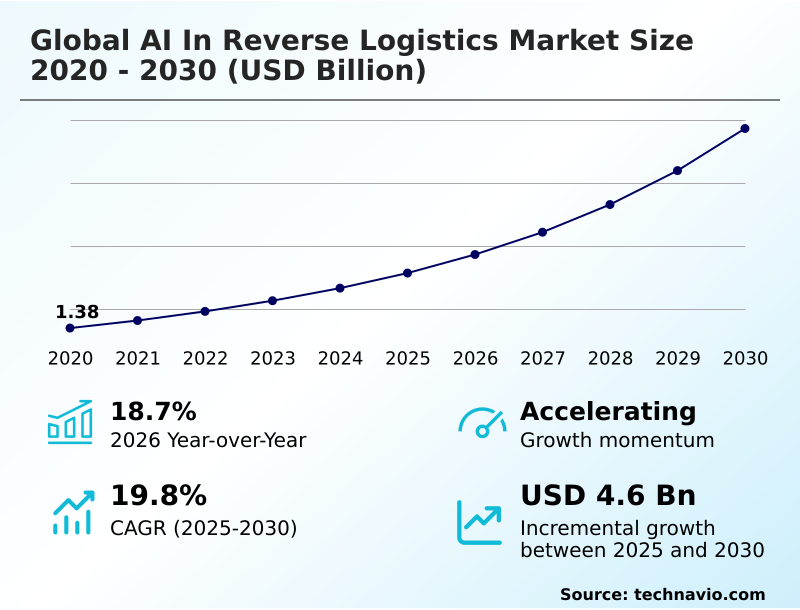
The ai in reverse logistics market size is valued to increase by USD 4.60 billion, at a CAGR of 19.8% from 2025 to 2030. Escalating complexity of global e-commerce returns will drive the ai in reverse logistics market.
Major Market Trends & Insights
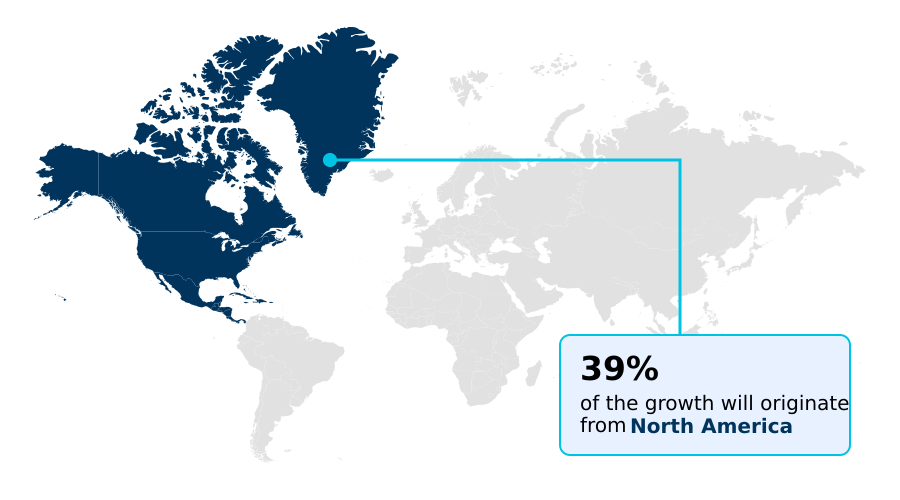
- North America dominated the market and accounted for a 38.6% growth during the forecast period.
- By Component - Software segment was valued at USD 1.56 billion in 2024
- By Deployment - Cloud segment accounted for the largest market revenue share in 2024
Market Size & Forecast
- Market Opportunities: USD 6.35 billion
- Market Future Opportunities: USD 4.60 billion
- CAGR from 2025 to 2030 : 19.8%
Market Summary
- The AI in reverse logistics market represents a critical evolution in supply chain operations, driven by the need to manage the immense volume and complexity of product returns efficiently. Integrating advanced technologies such as machine learning and computer vision allows businesses to automate and optimize the entire returns lifecycle, from initial customer authorization to final product disposition.
- Key drivers include the exponential growth of e-commerce, which has led to return rates far exceeding those of brick-and-mortar retail, and a growing regulatory and consumer push toward circular economy models. These intelligent systems use predictive returns analytics to forecast return volumes and return pattern analysis for AI for returns reduction.
- For instance, a large electronics retailer can use an AI-powered returns platform for automated product grading, identifying whether a returned smartphone is suitable for immediate resale, refurbishment, or parts harvesting, thereby maximizing return value recovery.
- While high initial investment and data integration issues present challenges, the move toward returns processing automation and AI-driven returns is essential for maintaining profitability and sustainability.
What will be the Size of the AI In Reverse Logistics Market during the forecast period?
Get Key Insights on Market Forecast (PDF) Get Free Sample
How is the AI In Reverse Logistics Market Segmented?
The ai in reverse logistics industry research report provides comprehensive data (region-wise segment analysis), with forecasts and estimates in "USD million" for the period 2026-2030, as well as historical data from 2020-2024 for the following segments.
- Component
- Software
- Services
- Hardware
- Deployment
- Cloud
- On-premises
- Application
- Returns management and authorization
- Transportation and route optimization
- Inventory and warehouse management
- Product inspection and sorting
- Others
- Geography
- North America
- US
- Canada
- Mexico
- Europe
- Germany
- UK
- France
- APAC
- China
- India
- Japan
- South America
- Brazil
- Argentina
- Colombia
- Middle East and Africa
- Saudi Arabia
- UAE
- Turkey
- Rest of World (ROW)
- North America
By Component Insights
The software segment is estimated to witness significant growth during the forecast period.
The software segment is the core intelligence layer, powering warehouse automation and enabling sophisticated automated returns processing. An effective AI-powered returns platform uses return pattern analysis to forecast return volumes and reasons, allowing for proactive inventory adjustments.
These returns data analysis platforms are crucial for smart returns management, helping businesses transition toward AI for supply chain circularity by providing the data needed for intelligent disposition decisions.
The deployment of advanced AI in logistics automation has demonstrated the capacity to reduce manual assessment errors by over 15%, directly enhancing value recovery. This technology transforms returns from a cost center into a strategic, data-driven operation.
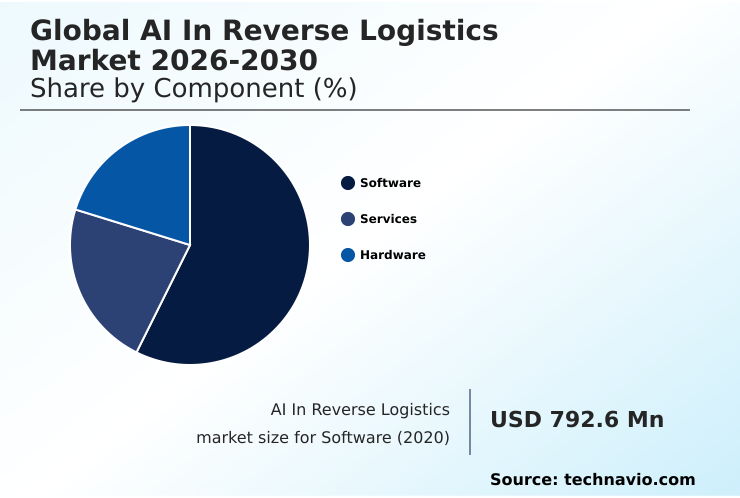
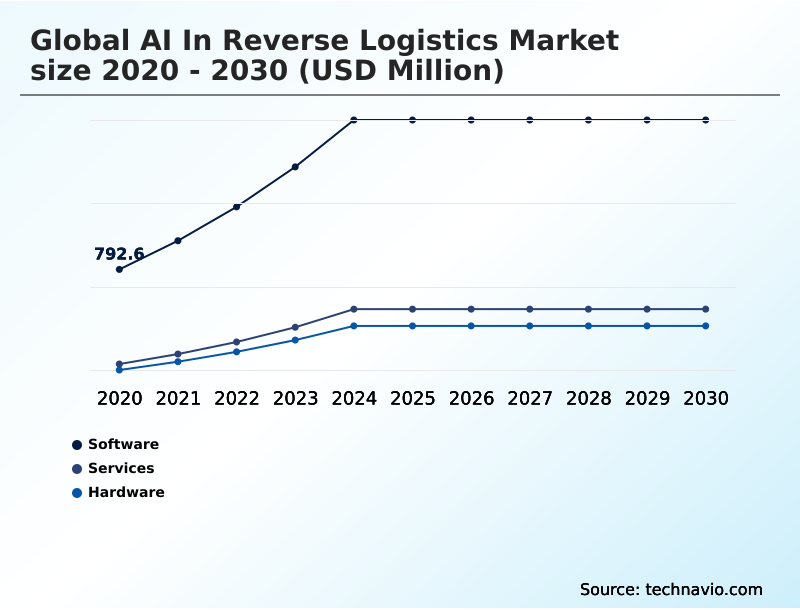
The Software segment was valued at USD 1.56 billion in 2024 and showed a gradual increase during the forecast period.
Regional Analysis
North America is estimated to contribute 38.6% to the growth of the global market during the forecast period.Technavio’s analysts have elaborately explained the regional trends and drivers that shape the market during the forecast period.
See How AI In Reverse Logistics Market Demand is Rising in North America Get Free Sample
The geographic landscape shows varied adoption maturity. North America leads in reverse supply chain management, driven by its massive e-commerce scale, with investments in autonomous mobile robots and automated product grading to manage high labor costs.
This focus on AI in warehouse returns has led to a 30% increase in processing throughput in some facilities.
In contrast, Europe's adoption of reverse logistics technology is heavily influenced by regulations promoting circular economy AI applications, leading to a greater emphasis on supply chain visibility and lifecycle tracking.
APAC is rapidly adopting returns processing automation to manage its fast-growing digital markets. The global AI in reverse logistics market is thus shaped by regional economic drivers and regulatory priorities.
Market Dynamics
Our researchers analyzed the data with 2025 as the base year, along with the key drivers, trends, and challenges. A holistic analysis of drivers will help companies refine their marketing strategies to gain a competitive advantage.
- Evaluating an AI returns management platform features reveals that the core benefits stem from a combination of cost reduction and efficiency gains. For businesses exploring AI in reverse logistics market cost reduction, the implementation of AI for circular economy supply chain models is paramount.
- This approach uses an AI platform for e-commerce returns to streamline workflows, directly impacting the bottom line. A key technology is AI computer vision for product grading, which automates a previously manual and error-prone task.
- The overall automated returns management system benefits are clear, particularly when comparing returns optimization software comparison metrics, which often show a significant reduction in processing time. For example, using AI for reducing return processing time has been shown to be over 40% faster than traditional methods.
- The implementing AI in reverse logistics journey also involves leveraging predictive analytics for return forecasting and generative AI for customer returns to enhance customer experience. This leads to higher AI in reverse logistics market efficiency and a stronger reverse logistics automation ROI.
- Firms now prioritize AI for sustainable reverse logistics, with intelligent returns platform case studies demonstrating a clear path to both profitability and environmental responsibility.
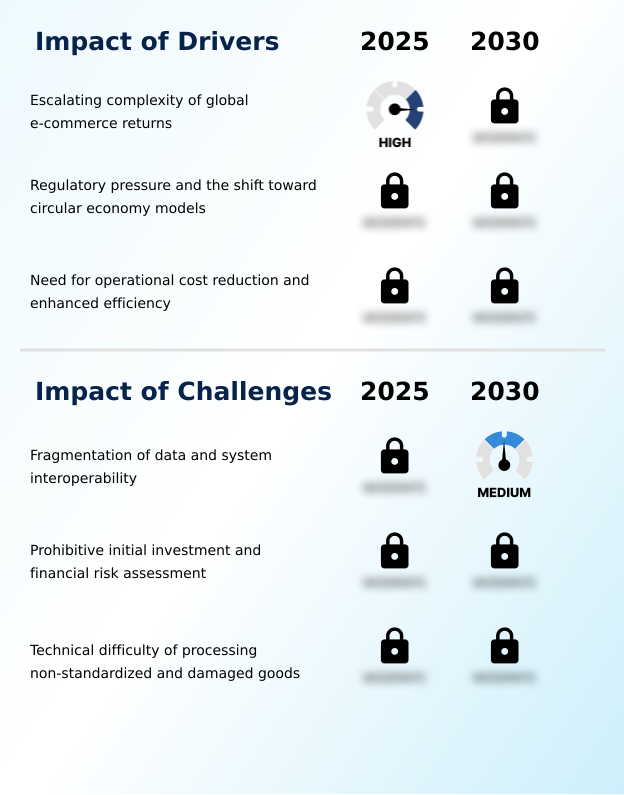
What are the key market drivers leading to the rise in the adoption of AI In Reverse Logistics Industry?
- The escalating complexity and volume of global e-commerce returns are primary drivers for adopting intelligent automation in reverse logistics.
- The escalating volume of e-commerce returns is a primary catalyst for adopting reverse logistics AI solutions.
- Businesses are leveraging predictive returns analytics for optimizing returns with AI, which can reduce return rates at the point of sale by up to 10% through better sizing recommendations.
- The strategic push toward circular economy logistics and sustainability mandates the use of AI-driven returns to identify refurbishment and recycling opportunities.
- Modern returns management software is central to this shift, providing the tools for reverse logistics optimization and enabling effective e-commerce returns management AI.
- These platforms not only improve operational efficiency but are also critical for AI for returns reduction, transforming the returns process into a value-generating activity.
What are the market trends shaping the AI In Reverse Logistics Industry?
- The integration of generative AI is creating hyper-personalized return experiences. This trend shifts returns management from a standardized process to a dynamic, customer-centric interaction.
- Key trends are redefining operational capabilities. The use of multi-spectral imaging inspection enables automated, granular assessment of returned items, improving grading accuracy by over 25% compared to manual methods. This precision, a core component of intelligent returns management, directly boosts return value recovery. Concurrently, the convergence of AI with the digital product passport creates a transparent lifecycle record.
- Generative AI for customer returns is personalizing the user experience, while AI-driven disposition logic and integrated returns fraud prevention AI optimize financial outcomes. These advancements, including intelligent returns routing, provide the AI-powered returns intelligence necessary for firms to turn a logistical challenge into a competitive advantage.
What challenges does the AI In Reverse Logistics Industry face during its growth?
- The fragmentation of data across incompatible legacy systems and a lack of interoperability present a key challenge to effective AI implementation.
- A significant challenge is data fragmentation, which hampers the effectiveness of predictive analytics for returns and machine learning for reverse logistics. Without standardized data, even advanced robotic sorting systems and AI-powered product inspection tools cannot perform optimally, with accuracy sometimes dropping by 20% when handling non-standardized goods.
- Implementing a cohesive disposition decision engine requires integrating siloed data from return merchandise authorization and other systems. The high capital cost of automated returns handling technology and the complexity of achieving logistics network optimization create financial barriers. Successfully deploying comprehensive returns data analytics requires modernizing legacy infrastructures, a costly but necessary step for full automation.
Exclusive Technavio Analysis on Customer Landscape
The ai in reverse logistics market forecasting report includes the adoption lifecycle of the market, covering from the innovator’s stage to the laggard’s stage. It focuses on adoption rates in different regions based on penetration. Furthermore, the ai in reverse logistics market report also includes key purchase criteria and drivers of price sensitivity to help companies evaluate and develop their market growth analysis strategies.
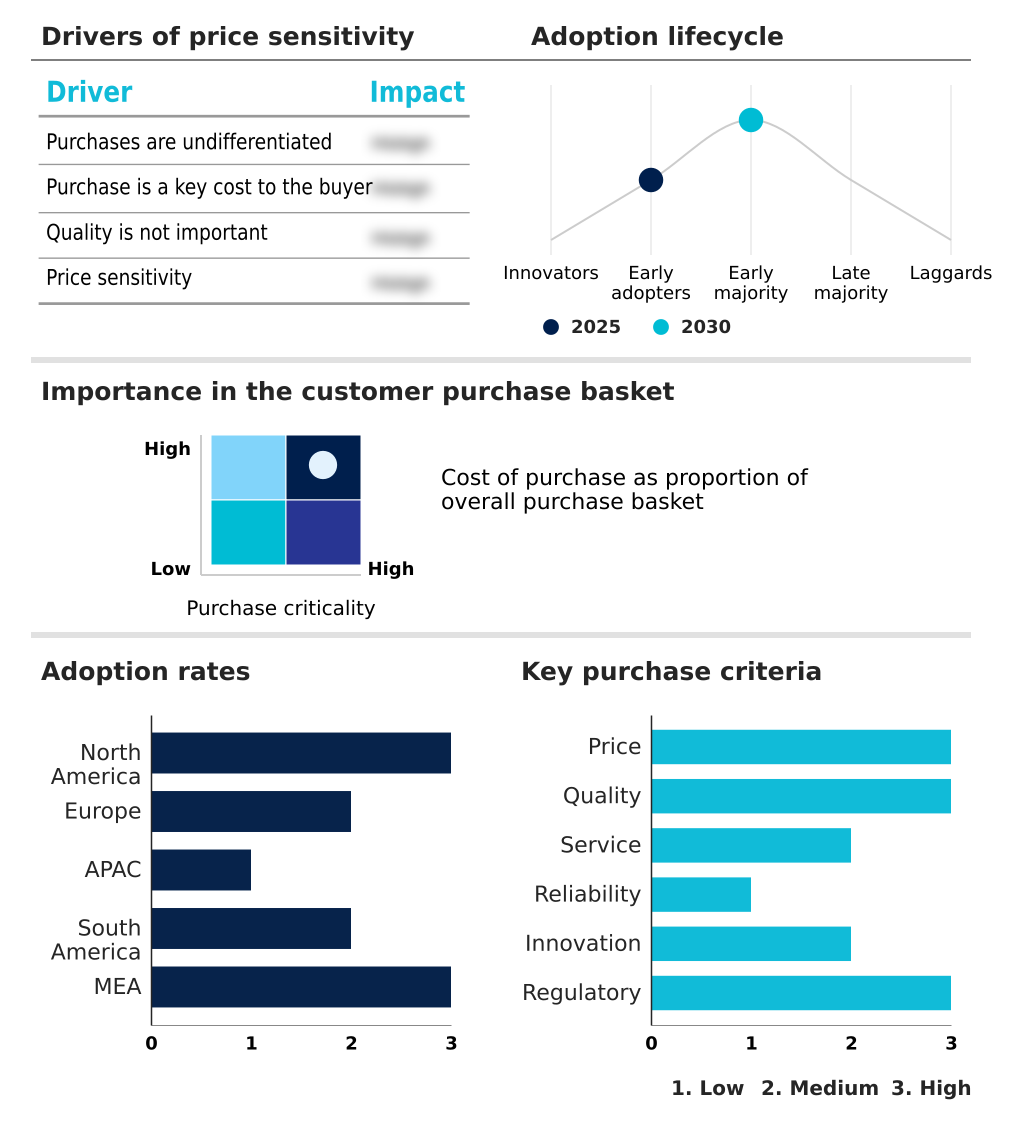
Customer Landscape of AI In Reverse Logistics Industry
Competitive Landscape
Companies are implementing various strategies, such as strategic alliances, ai in reverse logistics market forecast, partnerships, mergers and acquisitions, geographical expansion, and product/service launches, to enhance their presence in the industry.
Amazon Web Services Inc. - The company offers AI in reverse logistics through cloud-based machine learning, predictive analytics, and automation tools that enable intelligent returns processing, routing optimization, and inventory reintegration workflows.
The industry research and growth report includes detailed analyses of the competitive landscape of the market and information about key companies, including:
- Amazon Web Services Inc.
- Blue Yonder Group Inc.
- DHL International GmbH
- FarEye Technologies Pvt. Ltd.
- FedEx Corp.
- GXO Logistics Inc.
- IBM Corp.
- Kinaxis Inc.
- Locus Robotics Corp.
- Loop Returns
- Manhattan Associates Inc.
- Microsoft Corp.
- Narvar Inc.
- Oracle Corp.
- Parcel Perform Pte Ltd.
- ReBound Returns
- ReturnLogic.
- ReverseLogix
- SAP SE
- United Parcel Service Inc.
Qualitative and quantitative analysis of companies has been conducted to help clients understand the wider business environment as well as the strengths and weaknesses of key industry players. Data is qualitatively analyzed to categorize companies as pure play, category-focused, industry-focused, and diversified; it is quantitatively analyzed to categorize companies as dominant, leading, strong, tentative, and weak.
Recent Development and News in Ai in reverse logistics market
- In May 2025, OmniChannel Dynamics, a global leader in digital marketplace technology, introduced an advanced machine learning framework designed to analyze the return habits of users across different geographical regions.
- In June 2025, RetailFlow Solutions, a leading global provider of enterprise software for the retail sector, introduced a generative intelligence module that allows businesses to automate complex return negotiations through natural language interfaces.
- In August 2025, AutoCycle Innovations, a major European automotive manufacturer, announced the implementation of an AI-driven material recovery system designed to identify and sort high-value alloys from returned vehicle components.
- In September 2025, Vision Systems Lab, a prominent research laboratory in East Asia, in collaboration with a major industrial sensor manufacturer, unveiled a prototype for an automated inspection station that uses short-wave infrared imaging to verify the authenticity and internal integrity of high-end consumer electronics.
Dive into Technavio’s robust research methodology, blending expert interviews, extensive data synthesis, and validated models for unparalleled AI In Reverse Logistics Market insights. See full methodology.
| Market Scope | |
|---|---|
| Page number | 306 |
| Base year | 2025 |
| Historic period | 2020-2024 |
| Forecast period | 2026-2030 |
| Growth momentum & CAGR | Accelerate at a CAGR of 19.8% |
| Market growth 2026-2030 | USD 4602.5 million |
| Market structure | Fragmented |
| YoY growth 2025-2026(%) | 18.7% |
| Key countries | US, Canada, Mexico, Germany, UK, France, The Netherlands, Italy, Spain, China, India, Japan, South Korea, Australia, Indonesia, Brazil, Argentina, Colombia, Saudi Arabia, UAE, Turkey, South Africa and Egypt |
| Competitive landscape | Leading Companies, Market Positioning of Companies, Competitive Strategies, and Industry Risks |
Research Analyst Overview
- The market is rapidly evolving from a cost-center management function to a strategic, value-generating operation powered by AI-driven returns. The integration of sophisticated technologies such as autonomous mobile robots and multi-spectral imaging inspection for automated product grading is becoming a key differentiator.
- A core component is the disposition decision engine, which uses predictive returns analytics and return pattern analysis for reverse logistics optimization. Boardroom decisions are increasingly influenced by the capabilities of intelligent returns management systems to support circular economy logistics and enhance supply chain visibility.
- The implementation of a comprehensive AI-powered returns platform can lead to a 25% improvement in return value recovery. Successful strategies now depend on robust returns data analytics and warehouse automation to manage everything from return merchandise authorization to the final intelligent disposition, underpinned by effective returns management software and automated returns processing.
What are the Key Data Covered in this AI In Reverse Logistics Market Research and Growth Report?
-
What is the expected growth of the AI In Reverse Logistics Market between 2026 and 2030?
-
USD 4.60 billion, at a CAGR of 19.8%
-
-
What segmentation does the market report cover?
-
The report is segmented by Component (Software, Services, and Hardware), Deployment (Cloud, and On-premises), Application (Returns management and authorization, Transportation and route optimization, Inventory and warehouse management, Product inspection and sorting, and Others) and Geography (North America, Europe, APAC, South America, Middle East and Africa)
-
-
Which regions are analyzed in the report?
-
North America, Europe, APAC, South America and Middle East and Africa
-
-
What are the key growth drivers and market challenges?
-
Escalating complexity of global e-commerce returns, Fragmentation of data and system interoperability
-
-
Who are the major players in the AI In Reverse Logistics Market?
-
Amazon Web Services Inc., Blue Yonder Group Inc., DHL International GmbH, FarEye Technologies Pvt. Ltd., FedEx Corp., GXO Logistics Inc., IBM Corp., Kinaxis Inc., Locus Robotics Corp., Loop Returns, Manhattan Associates Inc., Microsoft Corp., Narvar Inc., Oracle Corp., Parcel Perform Pte Ltd., ReBound Returns, ReturnLogic., ReverseLogix, SAP SE and United Parcel Service Inc.
-
Market Research Insights
- Market dynamics are shaped by the dual pressures of operational cost reduction and the strategic need for sustainability. The adoption of automated returns handling has shown a direct correlation with improved profitability, with some firms reporting a 15% reduction in processing costs per unit.
- Predictive analytics for returns is becoming standard, enabling AI-powered returns intelligence that helps businesses anticipate and manage return volumes more effectively. The shift toward AI in warehouse returns has led to efficiency gains where throughput has increased by over 30% without physical expansion.
- Furthermore, the focus on circular economy AI applications is not just a compliance measure; it is a value driver, turning a potential loss into a new revenue stream through effective machine learning for reverse logistics.
We can help! Our analysts can customize this ai in reverse logistics market research report to meet your requirements.
 RIA -
RIA - 
