


AI Investment Trends Market Analysis, Size, and Forecast 2025-2029: North America (US, Canada, and Mexico), Europe (UK, Germany, and France), APAC (China, India, and South Korea), South America (Brazil, Argentina, and Colombia), Middle East and Africa (Israel, UAE, and South Africa), and Rest of World (ROW)

AI Investment Trends Market Analysis, Size, and Forecast 2025-2029:
North America (US, Canada, and Mexico), Europe (UK, Germany, and France), APAC (China, India, and South Korea), South America (Brazil, Argentina, and Colombia), Middle East and Africa (Israel, UAE, and South Africa), and Rest of World (ROW)

Published: Dec 2025 291 Pages SKU: IRTNTR81035

Market Overview at a Glance

$101.34 B
Market Opportunity
20.9%
CAGR 2024 - 2029
37.4%
North America Growth
$28.53 B
Venture capital segment 2023

AI Investment Trends Market Size 2025-2029

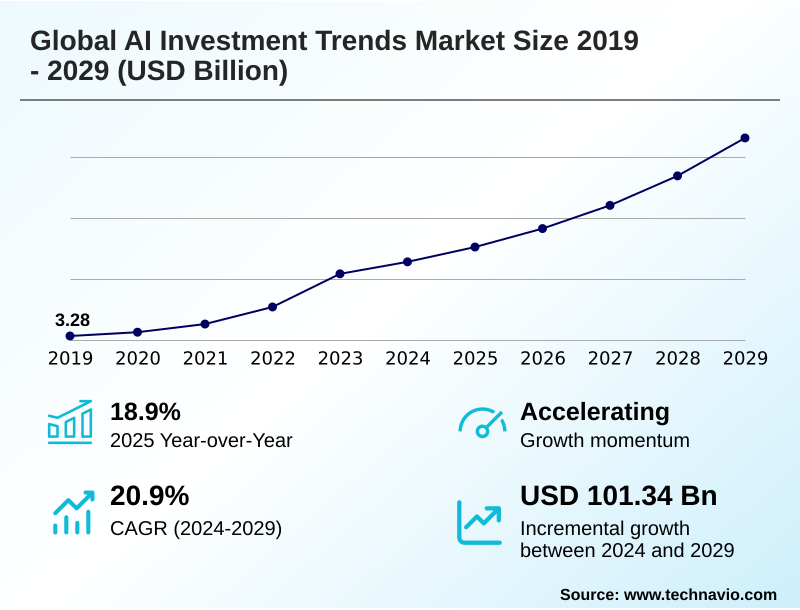
The ai investment trends market size is valued to increase by USD 101.34 billion, at a CAGR of 20.9% from 2024 to 2029. Proliferation of generative ai and large language models will drive the ai investment trends market.

Major Market Trends & Insights

  • North America dominated the market and accounted for a 37.4% growth during the forecast period.
  • By Type - Venture capital segment was valued at USD 28.53 billion in 2023
  • By Application - Algorithmic trading segment accounted for the largest market revenue share in 2023

Market Size & Forecast

  • Market Opportunities: USD 162.02 billion
  • Market Future Opportunities: USD 101.34 billion
  • CAGR from 2024 to 2029 : 20.9%

Market Summary

  • The AI investment trends market is defined by a strategic imperative compelling corporations and governments to secure a stake in next-generation technological infrastructure. The rapid utility of generative AI has shifted focus from theoretical potential to tangible economic value, igniting a global race for dominance.
  • This has led to massive capital deployment into developing proprietary foundational models and the underlying hardware, creating a highly competitive landscape. Within this environment, a key business application involves using advanced AI for fraud detection in financial services.
  • By analyzing millions of transactions in real-time, these systems can identify anomalous patterns indicative of sophisticated fraud with an accuracy that surpasses human capability, significantly reducing financial losses and enhancing security. However, this progress is tempered by challenges such as navigating divergent international regulations, the high cost of computational resources, and a persistent shortage of specialized talent.
  • Success hinges on balancing aggressive investment in innovation with strategic management of these operational and regulatory risks.

What will be the Size of the AI Investment Trends Market during the forecast period?
Get Key Insights on Market Forecast (PDF) Request Free Sample

How is the AI Investment Trends Market Segmented?

The ai investment trends industry research report provides comprehensive data (region-wise segment analysis), with forecasts and estimates in "USD million" for the period 2025-2029, as well as historical data from 2019-2023 for the following segments.

  • Type
    • Venture capital
    • Corporate investment
    • Private equity
  • Application
    • Algorithmic trading
    • Fraud detection
    • Portfolio optimization
  • Technology
    • Generative AI
    • Natural language processing
    • Predictive analytics
  • Geography
    • North America
      • US
      • Canada
      • Mexico
    • Europe
      • UK
      • Germany
      • France
    • APAC
      • China
      • India
      • South Korea
    • South America
      • Brazil
      • Argentina
      • Colombia
    • Middle East and Africa
      • Israel
      • UAE
      • South Africa
    • Rest of World (ROW)

By Type Insights

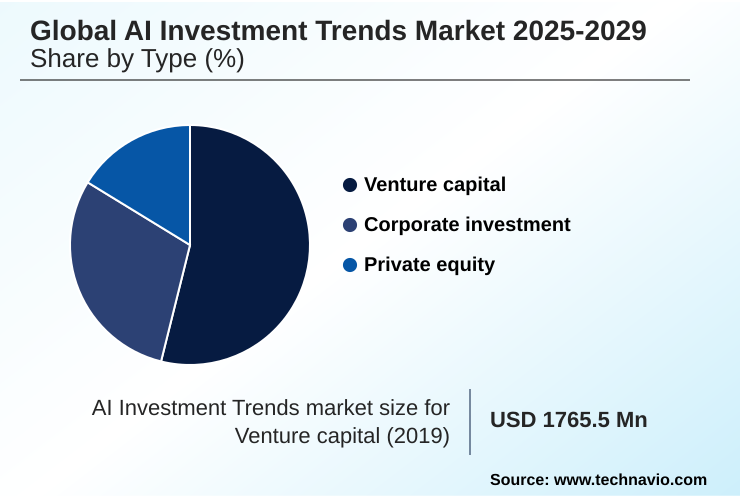
The venture capital segment is estimated to witness significant growth during the forecast period.

Venture capital remains a formative force in the AI investment trends market, characterized by a high-risk tolerance for funding early-stage companies with disruptive potential.

This segment's focus has sharply pivoted toward generative AI, with capital allocation in AI targeting foundational models and the specialized AI agents built upon them. The investment thesis centers on platform shifts, where AI-enabled workflows can redefine entire industries.

This aggressive strategy is driven by the pursuit of an AI-driven competitive advantage, compelling firms to make concentrated bets.

For instance, companies specializing in AI security firms have seen funding rounds increase by over 40% as investors back solutions for emerging threats like synthetic identity fraud, reflecting a clear trend in venture capital for foundational models.

This approach fuels enterprise AI adoption strategy by providing innovative tools for deep technology investment focus.
Request Free Sample

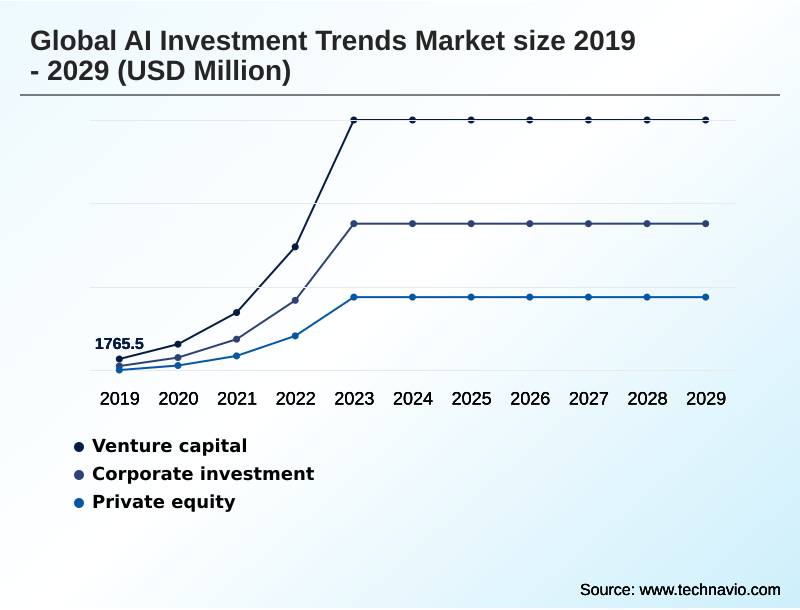
The Venture capital segment was valued at USD 28.53 billion in 2023 and showed a gradual increase during the forecast period.
Request Free Sample

Regional Analysis

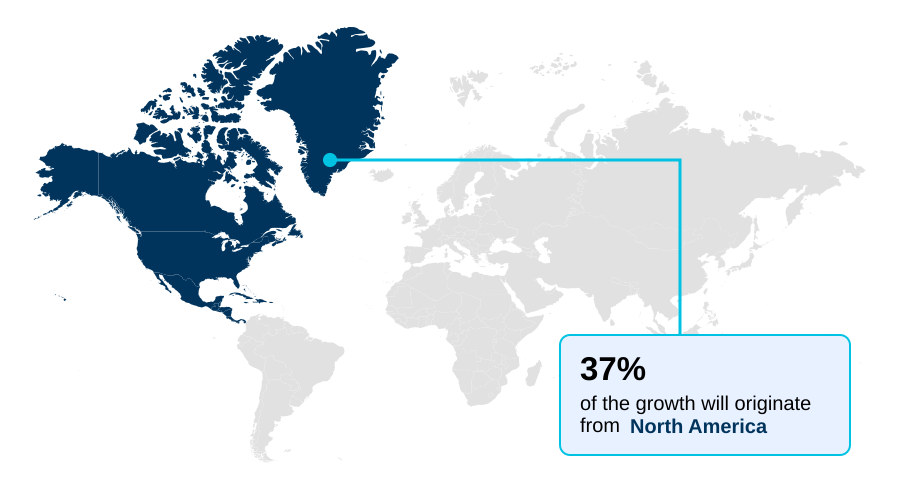
North America is estimated to contribute 37.4% to the growth of the global market during the forecast period.Technavio’s analysts have elaborately explained the regional trends and drivers that shape the market during the forecast period.
See How AI Investment Trends Market Demand is Rising in North America Request Free Sample

The geographic landscape is defined by distinct regional strategies. North America leads in private equity AI consolidation and corporate investment, driven by a mature venture capital ecosystem focused on technologies like retrieval-augmented generation (RAG).

Its dominance is reflected in it accounting for over 37% of global AI startup ecosystem funding. In contrast, Europe prioritizes regulatory leadership and ethical AI development frameworks, focusing investment in industrial automation and explainable AI.

This has led to a 20% increase in funding for compliant-by-design AI platforms. APAC is characterized by the rapid rise of sovereign AI initiatives, particularly in China, aimed at achieving self-sufficiency in AI chip design and embodied AI.

Investment in AI compute in the region has grown substantially, with countries aiming to reduce technological dependence on foreign machine learning operations (MLOps) platforms.

Market Dynamics

Our researchers analyzed the data with 2024 as the base year, along with the key drivers, trends, and challenges. A holistic analysis of drivers will help companies refine their marketing strategies to gain a competitive advantage.

  • Global investment strategies are increasingly nuanced, focusing on specific high-value applications and technologies. The impact of AI on portfolio optimization is a key area, as asset managers leverage advanced models to outperform benchmarks. Concurrently, the use of machine learning for fraud detection has become standard practice in financial technology, driving significant capital into security-focused AI.
  • The integration of generative AI in enterprise workflows is another major theme, with corporate funding for AI research aimed at automating complex tasks. Natural language processing for document intelligence allows organizations to extract insights from vast unstructured data, improving operational efficiency.
  • Similarly, the application of predictive analytics in supply chain management enhances forecasting accuracy by a margin that is double that of traditional statistical methods. Venture capital investment in AI startups continues to target disruptive technologies, while private equity acquisition of AI companies focuses on consolidating mature markets.
  • The role of AI in industrial automation and using AI for algorithmic trading remain critical investment areas, alongside efforts to use AI to enhance customer experience.
  • This is all set against a backdrop of a geopolitical race for AI supremacy, which fuels investment in developing sovereign AI capabilities and the strategic investment in AI infrastructure, though this is complicated by challenges of AI talent acquisition, regulatory compliance for AI systems, and evolving monetization strategies for AI models.
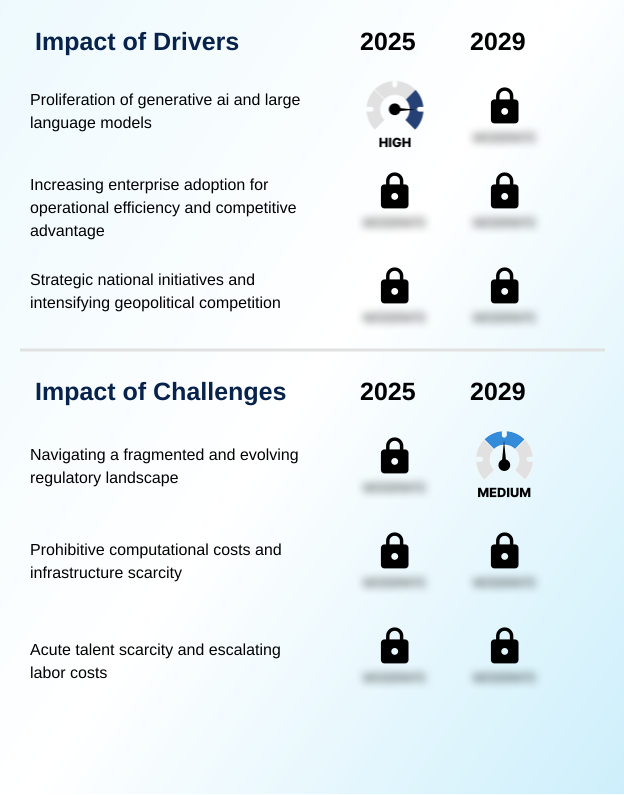
What are the key market drivers leading to the rise in the adoption of AI Investment Trends Industry?

  • The proliferation of generative AI and large language models is a primary driver fueling investment and innovation across the market.

  • A primary driver is the demonstrable ROI from AI-powered software platforms, which facilitate superior data-driven decision making and unlock significant productivity gains. For example, deploying AI for non-diagnostic healthcare tasks has shown to reduce administrative workloads by over 35%.
  • This push for operational efficiency is compelling broad enterprise adoption. The unprecedented proliferation of large language models (LLMs) and multimodal systems has also ignited a global investment race, fueling AI research and development funding.
  • This is further amplified by strategic national imperatives, where governments view leadership in areas like high bandwidth memory (HBM) production and human-centric AI systems as crucial for economic security.
  • Investment in the enterprise AI stack is surging, as companies that integrate AI achieve 15% higher risk-adjusted returns from AI compared to their peers.

What are the market trends shaping the AI Investment Trends Industry?

  • The market is characterized by the accelerating proliferation and commercialization of advanced generative AI models. This trend is transitioning the technology from a research focus to a core driver of business value.

  • The market is shaped by the proliferation of advanced generative AI models, which are now being commercialized for widespread use. This is driving an accelerated enterprise AI adoption strategy, with businesses integrating AI for operational transformation rather than just incremental improvements.
  • The pursuit of tangible returns is evident, as the use of AI in supply chain optimization has reduced logistics errors by up to 22%. A parallel trend is the intensifying geopolitical AI competition, leading to strategic national initiatives for AI.
  • This has given rise to sovereign AI infrastructure development, with some nations increasing public-private AI partnerships by 30% to build domestic AI compute capacity and reduce AI hardware dependency. These dynamics highlight a strategic shift toward securing technological leadership through vertical AI solutions and robust data governance solutions.

What challenges does the AI Investment Trends Industry face during its growth?

  • Navigating a fragmented and evolving regulatory landscape presents a key challenge to sustained growth and global capital deployment in the industry.

  • A significant challenge is navigating the fragmented and evolving regulatory AI fragmentation, which introduces compliance uncertainty and can increase time-to-market by up to 25%. This forces a regional, rather than global, investment strategy. Another major hurdle is the prohibitive cost and scarcity of computational infrastructure.
  • The dependency on a few providers creates AI infrastructure bottlenecks, with the cost of training a state-of-the-art foundational model surpassing that of previous generations by a factor of ten. Compounding this is the acute AI talent scarcity, which ignites an intense and costly global war for prompt engineers and AI ethicists.
  • This escalates labor costs and represents a significant operational risk, with AI talent acquisition and retention becoming a paramount factor in due diligence. Effective AI model monetization becomes difficult under these constraints.

Exclusive Technavio Analysis on Customer Landscape

The ai investment trends market forecasting report includes the adoption lifecycle of the market, covering from the innovator’s stage to the laggard’s stage. It focuses on adoption rates in different regions based on penetration. Furthermore, the ai investment trends market report also includes key purchase criteria and drivers of price sensitivity to help companies evaluate and develop their market growth analysis strategies.
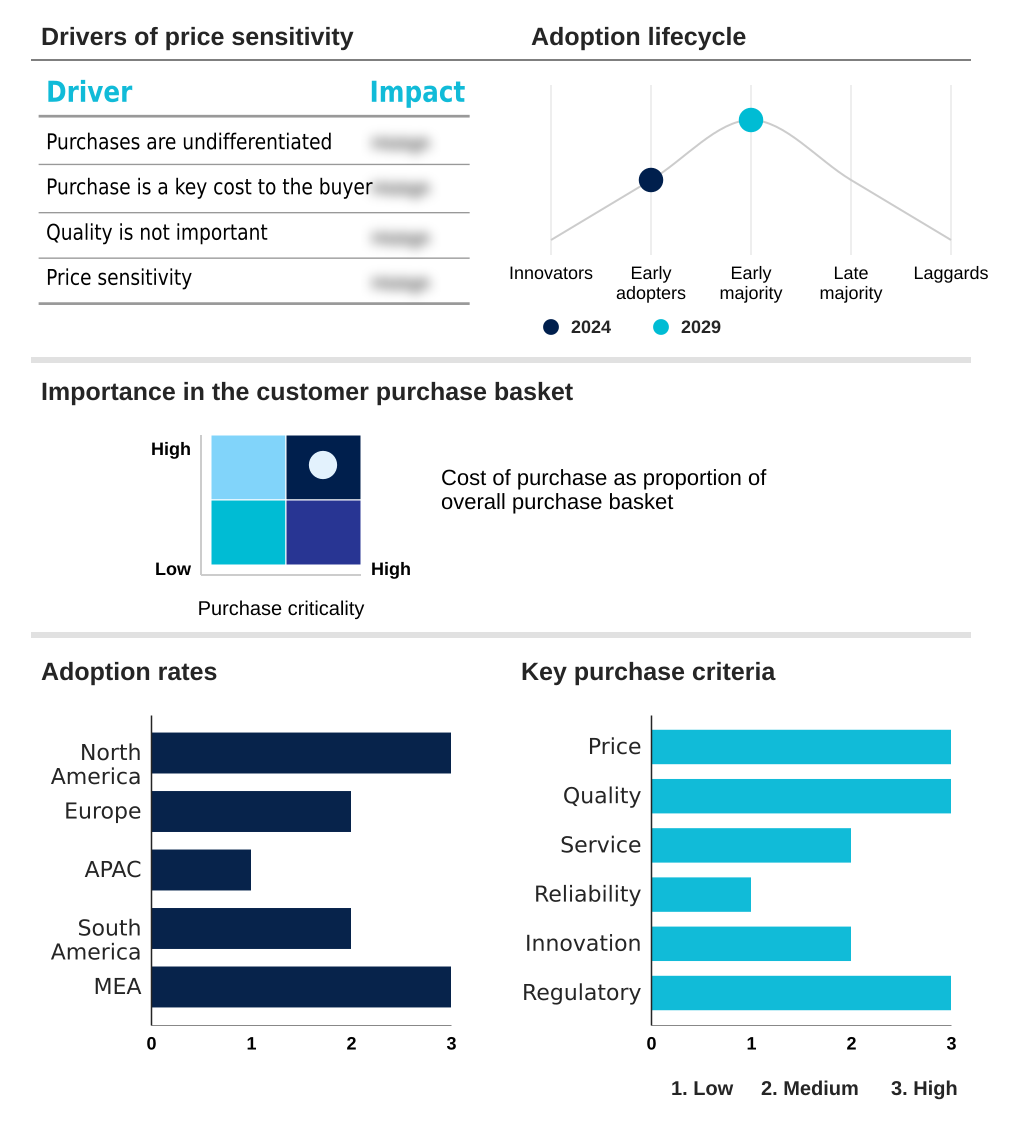
Customer Landscape of AI Investment Trends Industry

Competitive Landscape

Companies are implementing various strategies, such as strategic alliances, ai investment trends market forecast, partnerships, mergers and acquisitions, geographical expansion, and product/service launches, to enhance their presence in the industry.

Accel - Strategic capital allocation drives innovation in foundational AI and enterprise applications, enabling significant competitive advantages for adopters.

The industry research and growth report includes detailed analyses of the competitive landscape of the market and information about key companies, including:

  • Accel
  • AH Capital Management LLC
  • Antler
  • Baidu Inc.
  • Databricks Inc.
  • General Catalyst
  • Intel Corp.
  • Khosla Ventures
  • Lakestar Advisors GmbH
  • Lightspeed Management Co. LLC
  • NVIDIA Corp.
  • OpenAI
  • Salesforce Inc.
  • Samsung Electronics Co. Ltd.
  • Sequoia Capital Operations LLC
  • SoftBank Group Corp.

Qualitative and quantitative analysis of companies has been conducted to help clients understand the wider business environment as well as the strengths and weaknesses of key industry players. Data is qualitatively analyzed to categorize companies as pure play, category-focused, industry-focused, and diversified; it is quantitatively analyzed to categorize companies as dominant, leading, strong, tentative, and weak.

Recent Development and News in Ai investment trends market

  • In May 2024, Hippocratic AI secured $53 million in a seed funding round to advance the development of a safety-oriented large language model specifically for non-diagnostic tasks within the healthcare sector.
  • In April 2024, Microsoft announced a strategic partnership involving a $1.5 billion investment in G42, an Abu Dhabi-based AI company, to accelerate AI development and expand cloud infrastructure in the region.
  • In March 2024, Nvidia unveiled its Blackwell platform, a new generation of powerful and costly GPU architecture designed to accelerate the training and deployment of large-scale AI models.
  • In February 2024, Figure AI, a company developing humanoid robots, announced a significant funding round of $675 million from a consortium of venture capitalists and major corporate investors to advance its work in embodied AI.

Dive into Technavio’s robust research methodology, blending expert interviews, extensive data synthesis, and validated models for unparalleled AI Investment Trends Market insights. See full methodology.

Market Scope
Page number 291
Base year 2024
Historic period 2019-2023
Forecast period 2025-2029
Growth momentum & CAGR Accelerate at a CAGR of 20.9%
Market growth 2025-2029 USD 101341.4 million
Market structure Fragmented
YoY growth 2024-2025(%) 18.9%
Key countries US, Canada, Mexico, UK, Germany, France, The Netherlands, Spain, Italy, China, India, South Korea, Japan, Australia, Indonesia, Brazil, Argentina, Colombia, Israel, UAE, South Africa, Saudi Arabia and Turkey
Competitive landscape Leading Companies, Market Positioning of Companies, Competitive Strategies, and Industry Risks

Request Free Sample

Research Analyst Overview

  • Strategic capital allocation now defines the AI investment trends market, shifting from speculative bets to a focus on securing foundational technologies and infrastructure. A significant portion of private equity and corporate investment is directed toward the enterprise AI stack, including data governance solutions and cloud-based AI platforms essential for deploying large language models (LLMs).
  • Investment in vertical AI solutions for sectors like finance and healthcare is surging, with a particular emphasis on algorithmic trading, portfolio optimization, and predictive analytics. The development of generative AI and multimodal systems remains a primary focus, requiring immense computational infrastructure and driving AI hardware dependency.
  • The pursuit of sovereign AI capabilities and the high demand for machine learning operations (MLOps) platforms further underscore this trend.
  • In boardroom discussions, the decision to invest in advanced AI is often justified by tangible outcomes; for example, the use of natural language processing has been shown to achieve a 30% reduction in error rates for document analysis, directly impacting compliance and operational budgets.

What are the Key Data Covered in this AI Investment Trends Market Research and Growth Report?

  • What is the expected growth of the AI Investment Trends Market between 2025 and 2029?

    • USD 101.34 billion, at a CAGR of 20.9%

  • What segmentation does the market report cover?

    • The report is segmented by Type (Venture capital, Corporate investment, Private equity), Application (Algorithmic trading, Fraud detection, Portfolio optimization), Technology (Generative AI, Natural language processing, Predictive analytics) and Geography (North America, Europe, APAC, South America, Middle East and Africa)

  • Which regions are analyzed in the report?

    • North America, Europe, APAC, South America and Middle East and Africa

  • What are the key growth drivers and market challenges?

    • Proliferation of generative ai and large language models , Navigating a fragmented and evolving regulatory landscape

  • Who are the major players in the AI Investment Trends Market?

    • Accel, AH Capital Management LLC, Antler, Baidu Inc., Databricks Inc., General Catalyst, Intel Corp., Khosla Ventures, Lakestar Advisors GmbH, Lightspeed Management Co. LLC, NVIDIA Corp., OpenAI, Salesforce Inc., Samsung Electronics Co. Ltd., Sequoia Capital Operations LLC and SoftBank Group Corp.

Market Research Insights

  • The market's dynamics are influenced by a strategic shift toward practical, high-value AI deployment. The focus on AI-driven productivity gains is compelling organizations to rethink their operational frameworks, with the integration of AI into legacy systems showing a 20% improvement in processing efficiency.
  • This enterprise AI adoption strategy prioritizes technologies that offer clear ROI, driving investment in AI for operational transformation. Consequently, solutions delivering hyper-personalized customer experiences are attracting significant capital, as they have been linked to a 15% increase in customer retention rates.
  • The overarching goal is to achieve a sustainable AI-driven competitive advantage, pushing firms to explore everything from AI-powered digital forensics to optimizing complex supply chains. This pragmatic approach is shaping the flow of capital toward mature applications that promise immediate and measurable business impact.

We can help! Our analysts can customize this ai investment trends market research report to meet your requirements.

Get in touch

1. Executive Summary

1.1 Market overview

Executive Summary - Chart on Market Overview
Executive Summary - Data Table on Market Overview
Executive Summary - Chart on Global Market Characteristics
Executive Summary - Chart on Market by Geography
Executive Summary - Chart on Market Segmentation by Type
Executive Summary - Chart on Market Segmentation by Application
Executive Summary - Chart on Market Segmentation by Technology
Executive Summary - Chart on Incremental Growth
Executive Summary - Data Table on Incremental Growth
Executive Summary - Chart on Company Market Positioning

2. Technavio Analysis

2.1 Analysis of price sensitivity, lifecycle, customer purchase basket, adoption rates, and purchase criteria

2.2 Criticality of inputs and Factors of differentiation

Chart on Overview on criticality of inputs and factors of differentiation

2.3 Factors of disruption

Chart on Overview on factors of disruption

2.4 Impact of drivers and challenges

Chart on Impact of drivers and challenges in 2024 and 2029

3. Market Landscape

3.1 Market ecosystem

Chart on Parent Market
Data Table on - Parent Market

3.2 Market characteristics

Chart on Market characteristics analysis

3.3 Value chain analysis

Chart on Value chain analysis

4. Market Sizing

4.1 Market definition

Data Table on Offerings of companies included in the market definition

4.2 Market segment analysis

Market segments

4.3 Market size 2024

4.4 Market outlook: Forecast for 2024-2029

Chart on Global - Market size and forecast 2024-2029 ($ million)
Data Table on Global - Market size and forecast 2024-2029 ($ million)
Chart on Global Market: Year-over-year growth 2024-2029 (%)
Data Table on Global Market: Year-over-year growth 2024-2029 (%)

5. Historic Market Size

5.1 Global AI Investment Trends Market 2019 - 2023

Historic Market Size - Data Table on Global AI Investment Trends Market 2019 - 2023 ($ million)

5.2 Type segment analysis 2019 - 2023

Historic Market Size - Type Segment 2019 - 2023 ($ million)

5.3 Application segment analysis 2019 - 2023

Historic Market Size - Application Segment 2019 - 2023 ($ million)

5.4 Technology segment analysis 2019 - 2023

Historic Market Size - Technology Segment 2019 - 2023 ($ million)

5.5 Geography segment analysis 2019 - 2023

Historic Market Size - Geography Segment 2019 - 2023 ($ million)

5.6 Country segment analysis 2019 - 2023

Historic Market Size - Country Segment 2019 - 2023 ($ million)

6. Five Forces Analysis

6.1 Five forces summary

Five forces analysis - Comparison between 2024 and 2029

6.2 Bargaining power of buyers

Bargaining power of buyers - Impact of key factors 2024 and 2029

6.3 Bargaining power of suppliers

Bargaining power of suppliers - Impact of key factors in 2024 and 2029

6.4 Threat of new entrants

Threat of new entrants - Impact of key factors in 2024 and 2029

6.5 Threat of substitutes

Threat of substitutes - Impact of key factors in 2024 and 2029

6.6 Threat of rivalry

Threat of rivalry - Impact of key factors in 2024 and 2029

6.7 Market condition

Chart on Market condition - Five forces 2024 and 2029

7. Market Segmentation by Type

7.1 Market segments

Chart on Type - Market share 2024-2029 (%)
Data Table on Type - Market share 2024-2029 (%)

7.2 Comparison by Type

Chart on Comparison by Type
Data Table on Comparison by Type

7.3 Venture capital - Market size and forecast 2024-2029

Chart on Venture capital - Market size and forecast 2024-2029 ($ million)
Data Table on Venture capital - Market size and forecast 2024-2029 ($ million)
Chart on Venture capital - Year-over-year growth 2024-2029 (%)
Data Table on Venture capital - Year-over-year growth 2024-2029 (%)

7.4 Corporate investment - Market size and forecast 2024-2029

Chart on Corporate investment - Market size and forecast 2024-2029 ($ million)
Data Table on Corporate investment - Market size and forecast 2024-2029 ($ million)
Chart on Corporate investment - Year-over-year growth 2024-2029 (%)
Data Table on Corporate investment - Year-over-year growth 2024-2029 (%)

7.5 Private equity - Market size and forecast 2024-2029

Chart on Private equity - Market size and forecast 2024-2029 ($ million)
Data Table on Private equity - Market size and forecast 2024-2029 ($ million)
Chart on Private equity - Year-over-year growth 2024-2029 (%)
Data Table on Private equity - Year-over-year growth 2024-2029 (%)

7.6 Market opportunity by Type

Market opportunity by Type ($ million)
Data Table on Market opportunity by Type ($ million)

8. Market Segmentation by Application

8.1 Market segments

Chart on Application - Market share 2024-2029 (%)
Data Table on Application - Market share 2024-2029 (%)

8.2 Comparison by Application

Chart on Comparison by Application
Data Table on Comparison by Application

8.3 Algorithmic trading - Market size and forecast 2024-2029

Chart on Algorithmic trading - Market size and forecast 2024-2029 ($ million)
Data Table on Algorithmic trading - Market size and forecast 2024-2029 ($ million)
Chart on Algorithmic trading - Year-over-year growth 2024-2029 (%)
Data Table on Algorithmic trading - Year-over-year growth 2024-2029 (%)

8.4 Fraud detection - Market size and forecast 2024-2029

Chart on Fraud detection - Market size and forecast 2024-2029 ($ million)
Data Table on Fraud detection - Market size and forecast 2024-2029 ($ million)
Chart on Fraud detection - Year-over-year growth 2024-2029 (%)
Data Table on Fraud detection - Year-over-year growth 2024-2029 (%)

8.5 Portfolio optimization - Market size and forecast 2024-2029

Chart on Portfolio optimization - Market size and forecast 2024-2029 ($ million)
Data Table on Portfolio optimization - Market size and forecast 2024-2029 ($ million)
Chart on Portfolio optimization - Year-over-year growth 2024-2029 (%)
Data Table on Portfolio optimization - Year-over-year growth 2024-2029 (%)

8.6 Market opportunity by Application

Market opportunity by Application ($ million)
Data Table on Market opportunity by Application ($ million)

9. Market Segmentation by Technology

9.1 Market segments

Chart on Technology - Market share 2024-2029 (%)
Data Table on Technology - Market share 2024-2029 (%)

9.2 Comparison by Technology

Chart on Comparison by Technology
Data Table on Comparison by Technology

9.3 Generative AI - Market size and forecast 2024-2029

Chart on Generative AI - Market size and forecast 2024-2029 ($ million)
Data Table on Generative AI - Market size and forecast 2024-2029 ($ million)
Chart on Generative AI - Year-over-year growth 2024-2029 (%)
Data Table on Generative AI - Year-over-year growth 2024-2029 (%)

9.4 Natural language processing - Market size and forecast 2024-2029

Chart on Natural language processing - Market size and forecast 2024-2029 ($ million)
Data Table on Natural language processing - Market size and forecast 2024-2029 ($ million)
Chart on Natural language processing - Year-over-year growth 2024-2029 (%)
Data Table on Natural language processing - Year-over-year growth 2024-2029 (%)

9.5 Predictive analytics - Market size and forecast 2024-2029

Chart on Predictive analytics - Market size and forecast 2024-2029 ($ million)
Data Table on Predictive analytics - Market size and forecast 2024-2029 ($ million)
Chart on Predictive analytics - Year-over-year growth 2024-2029 (%)
Data Table on Predictive analytics - Year-over-year growth 2024-2029 (%)

9.6 Market opportunity by Technology

Market opportunity by Technology ($ million)
Data Table on Market opportunity by Technology ($ million)

10. Customer Landscape

10.1 Customer landscape overview

Analysis of price sensitivity, lifecycle, customer purchase basket, adoption rates, and purchase criteria

11. Geographic Landscape

11.1 Geographic segmentation

Chart on Market share by geography 2024-2029 (%)
Data Table on Market share by geography 2024-2029 (%)

11.2 Geographic comparison

Chart on Geographic comparison
Data Table on Geographic comparison

11.3 North America - Market size and forecast 2024-2029

Chart on North America - Market size and forecast 2024-2029 ($ million)
Data Table on North America - Market size and forecast 2024-2029 ($ million)
Chart on North America - Year-over-year growth 2024-2029 (%)
Data Table on North America - Year-over-year growth 2024-2029 (%)
Chart on Regional Comparison - North America
Data Table on Regional Comparison - North America

11.3.1 US - Market size and forecast 2024-2029

Chart on US - Market size and forecast 2024-2029 ($ million)
Data Table on US - Market size and forecast 2024-2029 ($ million)
Chart on US - Year-over-year growth 2024-2029 (%)
Data Table on US - Year-over-year growth 2024-2029 (%)

11.3.2 Canada - Market size and forecast 2024-2029

Chart on Canada - Market size and forecast 2024-2029 ($ million)
Data Table on Canada - Market size and forecast 2024-2029 ($ million)
Chart on Canada - Year-over-year growth 2024-2029 (%)
Data Table on Canada - Year-over-year growth 2024-2029 (%)

11.3.3 Mexico - Market size and forecast 2024-2029

Chart on Mexico - Market size and forecast 2024-2029 ($ million)
Data Table on Mexico - Market size and forecast 2024-2029 ($ million)
Chart on Mexico - Year-over-year growth 2024-2029 (%)
Data Table on Mexico - Year-over-year growth 2024-2029 (%)

11.4 Europe - Market size and forecast 2024-2029

Chart on Europe - Market size and forecast 2024-2029 ($ million)
Data Table on Europe - Market size and forecast 2024-2029 ($ million)
Chart on Europe - Year-over-year growth 2024-2029 (%)
Data Table on Europe - Year-over-year growth 2024-2029 (%)
Chart on Regional Comparison - Europe
Data Table on Regional Comparison - Europe

11.4.1 UK - Market size and forecast 2024-2029

Chart on UK - Market size and forecast 2024-2029 ($ million)
Data Table on UK - Market size and forecast 2024-2029 ($ million)
Chart on UK - Year-over-year growth 2024-2029 (%)
Data Table on UK - Year-over-year growth 2024-2029 (%)

11.4.2 Germany - Market size and forecast 2024-2029

Chart on Germany - Market size and forecast 2024-2029 ($ million)
Data Table on Germany - Market size and forecast 2024-2029 ($ million)
Chart on Germany - Year-over-year growth 2024-2029 (%)
Data Table on Germany - Year-over-year growth 2024-2029 (%)

11.4.3 France - Market size and forecast 2024-2029

Chart on France - Market size and forecast 2024-2029 ($ million)
Data Table on France - Market size and forecast 2024-2029 ($ million)
Chart on France - Year-over-year growth 2024-2029 (%)
Data Table on France - Year-over-year growth 2024-2029 (%)

11.4.4 The Netherlands - Market size and forecast 2024-2029

Chart on The Netherlands - Market size and forecast 2024-2029 ($ million)
Data Table on The Netherlands - Market size and forecast 2024-2029 ($ million)
Chart on The Netherlands - Year-over-year growth 2024-2029 (%)
Data Table on The Netherlands - Year-over-year growth 2024-2029 (%)

11.4.5 Spain - Market size and forecast 2024-2029

Chart on Spain - Market size and forecast 2024-2029 ($ million)
Data Table on Spain - Market size and forecast 2024-2029 ($ million)
Chart on Spain - Year-over-year growth 2024-2029 (%)
Data Table on Spain - Year-over-year growth 2024-2029 (%)

11.4.6 Italy - Market size and forecast 2024-2029

Chart on Italy - Market size and forecast 2024-2029 ($ million)
Data Table on Italy - Market size and forecast 2024-2029 ($ million)
Chart on Italy - Year-over-year growth 2024-2029 (%)
Data Table on Italy - Year-over-year growth 2024-2029 (%)

11.5 APAC - Market size and forecast 2024-2029

Chart on APAC - Market size and forecast 2024-2029 ($ million)
Data Table on APAC - Market size and forecast 2024-2029 ($ million)
Chart on APAC - Year-over-year growth 2024-2029 (%)
Data Table on APAC - Year-over-year growth 2024-2029 (%)
Chart on Regional Comparison - APAC
Data Table on Regional Comparison - APAC

11.5.1 China - Market size and forecast 2024-2029

Chart on China - Market size and forecast 2024-2029 ($ million)
Data Table on China - Market size and forecast 2024-2029 ($ million)
Chart on China - Year-over-year growth 2024-2029 (%)
Data Table on China - Year-over-year growth 2024-2029 (%)

11.5.2 India - Market size and forecast 2024-2029

Chart on India - Market size and forecast 2024-2029 ($ million)
Data Table on India - Market size and forecast 2024-2029 ($ million)
Chart on India - Year-over-year growth 2024-2029 (%)
Data Table on India - Year-over-year growth 2024-2029 (%)

11.5.3 South Korea - Market size and forecast 2024-2029

Chart on South Korea - Market size and forecast 2024-2029 ($ million)
Data Table on South Korea - Market size and forecast 2024-2029 ($ million)
Chart on South Korea - Year-over-year growth 2024-2029 (%)
Data Table on South Korea - Year-over-year growth 2024-2029 (%)

11.5.4 Japan - Market size and forecast 2024-2029

Chart on Japan - Market size and forecast 2024-2029 ($ million)
Data Table on Japan - Market size and forecast 2024-2029 ($ million)
Chart on Japan - Year-over-year growth 2024-2029 (%)
Data Table on Japan - Year-over-year growth 2024-2029 (%)

11.5.5 Australia - Market size and forecast 2024-2029

Chart on Australia - Market size and forecast 2024-2029 ($ million)
Data Table on Australia - Market size and forecast 2024-2029 ($ million)
Chart on Australia - Year-over-year growth 2024-2029 (%)
Data Table on Australia - Year-over-year growth 2024-2029 (%)

11.5.6 Indonesia - Market size and forecast 2024-2029

Chart on Indonesia - Market size and forecast 2024-2029 ($ million)
Data Table on Indonesia - Market size and forecast 2024-2029 ($ million)
Chart on Indonesia - Year-over-year growth 2024-2029 (%)
Data Table on Indonesia - Year-over-year growth 2024-2029 (%)

11.6 South America - Market size and forecast 2024-2029

Chart on South America - Market size and forecast 2024-2029 ($ million)
Data Table on South America - Market size and forecast 2024-2029 ($ million)
Chart on South America - Year-over-year growth 2024-2029 (%)
Data Table on South America - Year-over-year growth 2024-2029 (%)
Chart on Regional Comparison - South America
Data Table on Regional Comparison - South America

11.6.1 Brazil - Market size and forecast 2024-2029

Chart on Brazil - Market size and forecast 2024-2029 ($ million)
Data Table on Brazil - Market size and forecast 2024-2029 ($ million)
Chart on Brazil - Year-over-year growth 2024-2029 (%)
Data Table on Brazil - Year-over-year growth 2024-2029 (%)

11.6.2 Argentina - Market size and forecast 2024-2029

Chart on Argentina - Market size and forecast 2024-2029 ($ million)
Data Table on Argentina - Market size and forecast 2024-2029 ($ million)
Chart on Argentina - Year-over-year growth 2024-2029 (%)
Data Table on Argentina - Year-over-year growth 2024-2029 (%)

11.6.3 Colombia - Market size and forecast 2024-2029

Chart on Colombia - Market size and forecast 2024-2029 ($ million)
Data Table on Colombia - Market size and forecast 2024-2029 ($ million)
Chart on Colombia - Year-over-year growth 2024-2029 (%)
Data Table on Colombia - Year-over-year growth 2024-2029 (%)

11.7 Middle East and Africa - Market size and forecast 2024-2029

Chart on Middle East and Africa - Market size and forecast 2024-2029 ($ million)
Data Table on Middle East and Africa - Market size and forecast 2024-2029 ($ million)
Chart on Middle East and Africa - Year-over-year growth 2024-2029 (%)
Data Table on Middle East and Africa - Year-over-year growth 2024-2029 (%)
Chart on Regional Comparison - Middle East and Africa
Data Table on Regional Comparison - Middle East and Africa

11.7.1 Israel - Market size and forecast 2024-2029

Chart on Israel - Market size and forecast 2024-2029 ($ million)
Data Table on Israel - Market size and forecast 2024-2029 ($ million)
Chart on Israel - Year-over-year growth 2024-2029 (%)
Data Table on Israel - Year-over-year growth 2024-2029 (%)

11.7.2 UAE - Market size and forecast 2024-2029

Chart on UAE - Market size and forecast 2024-2029 ($ million)
Data Table on UAE - Market size and forecast 2024-2029 ($ million)
Chart on UAE - Year-over-year growth 2024-2029 (%)
Data Table on UAE - Year-over-year growth 2024-2029 (%)

11.7.3 South Africa - Market size and forecast 2024-2029

Chart on South Africa - Market size and forecast 2024-2029 ($ million)
Data Table on South Africa - Market size and forecast 2024-2029 ($ million)
Chart on South Africa - Year-over-year growth 2024-2029 (%)
Data Table on South Africa - Year-over-year growth 2024-2029 (%)

11.7.4 Saudi Arabia - Market size and forecast 2024-2029

Chart on Saudi Arabia - Market size and forecast 2024-2029 ($ million)
Data Table on Saudi Arabia - Market size and forecast 2024-2029 ($ million)
Chart on Saudi Arabia - Year-over-year growth 2024-2029 (%)
Data Table on Saudi Arabia - Year-over-year growth 2024-2029 (%)

11.7.5 Turkey - Market size and forecast 2024-2029

Chart on Turkey - Market size and forecast 2024-2029 ($ million)
Data Table on Turkey - Market size and forecast 2024-2029 ($ million)
Chart on Turkey - Year-over-year growth 2024-2029 (%)
Data Table on Turkey - Year-over-year growth 2024-2029 (%)

11.8 Market opportunity by geography

Market opportunity by geography ($ million)
Data Tables on Market opportunity by geography ($ million)

12. Drivers, Challenges, and Opportunity

12.1 Market drivers

Proliferation of generative ai and large language models
Increasing enterprise adoption for operational efficiency and competitive advantage
Strategic national initiatives and intensifying geopolitical competition

12.2 Market challenges

Navigating a fragmented and evolving regulatory landscape
Prohibitive computational costs and infrastructure scarcity
Acute talent scarcity and escalating labor costs

12.3 Impact of drivers and challenges

Impact of drivers and challenges in 2024 and 2029

12.4 Market opportunities

Proliferation and commercialization of advanced generative ai models
Accelerated enterprise adoption for operational transformation and competitive advantage
Intensifying geopolitical competition and national strategic imperatives

13. Competitive Landscape

13.1 Overview

13.2

Overview on criticality of inputs and factors of differentiation

13.3 Landscape disruption

Overview on factors of disruption

13.4 Industry risks

Impact of key risks on business

14. Competitive Analysis

14.1 Companies profiled

Companies covered

14.2 Company ranking index

14.3 Market positioning of companies

Matrix on companies position and classification

14.4 Accel

Accel - Overview
Accel - Product / Service
Accel - Key offerings
SWOT

14.5 AH Capital Management LLC

AH Capital Management LLC - Overview
AH Capital Management LLC - Product / Service
AH Capital Management LLC - Key offerings
SWOT

14.6 Baidu Inc.

Baidu Inc. - Overview
Baidu Inc. - Business segments
Baidu Inc. - Key offerings
Baidu Inc. - Segment focus
SWOT

14.7 Databricks Inc.

Databricks Inc. - Overview
Databricks Inc. - Product / Service
Databricks Inc. - Key offerings
SWOT

14.8 General Catalyst

General Catalyst - Overview
General Catalyst - Product / Service
General Catalyst - Key offerings
SWOT

14.9 Intel Corp.

Intel Corp. - Overview
Intel Corp. - Business segments
Intel Corp. - Key news
Intel Corp. - Key offerings
Intel Corp. - Segment focus
SWOT

14.10 Khosla Ventures

Khosla Ventures - Overview
Khosla Ventures - Product / Service
Khosla Ventures - Key offerings
SWOT

14.11 Lakestar Advisors GmbH

Lakestar Advisors GmbH - Overview
Lakestar Advisors GmbH - Product / Service
Lakestar Advisors GmbH - Key offerings
SWOT

14.12 Lightspeed Management Co. LLC

Lightspeed Management Co. LLC - Overview
Lightspeed Management Co. LLC - Product / Service
Lightspeed Management Co. LLC - Key offerings
SWOT

14.13 NVIDIA Corp.

NVIDIA Corp. - Overview
NVIDIA Corp. - Business segments
NVIDIA Corp. - Key news
NVIDIA Corp. - Key offerings
NVIDIA Corp. - Segment focus
SWOT

14.14 OpenAI

OpenAI - Overview
OpenAI - Product / Service
OpenAI - Key offerings
SWOT

14.15 Salesforce Inc.

Salesforce Inc. - Overview
Salesforce Inc. - Product / Service
Salesforce Inc. - Key news
Salesforce Inc. - Key offerings
SWOT

14.16 Samsung Electronics Co. Ltd.

Samsung Electronics Co. Ltd. - Overview
Samsung Electronics Co. Ltd. - Business segments
Samsung Electronics Co. Ltd. - Key news
Samsung Electronics Co. Ltd. - Key offerings
Samsung Electronics Co. Ltd. - Segment focus
SWOT

14.17 Sequoia Capital Operations LLC

Sequoia Capital Operations LLC - Overview
Sequoia Capital Operations LLC - Product / Service
Sequoia Capital Operations LLC - Key offerings
SWOT

14.18 SoftBank Group Corp.

SoftBank Group Corp. - Overview
SoftBank Group Corp. - Business segments
SoftBank Group Corp. - Key news
SoftBank Group Corp. - Key offerings
SoftBank Group Corp. - Segment focus
SWOT

15. Appendix

15.1 Scope of the report

Market definition
Objectives
Notes and caveats

15.2 Inclusions and exclusions checklist

Inclusions checklist
Exclusions checklist

15.3 Currency conversion rates for US$

15.4 Research methodology

15.5 Data procurement

Information sources

15.6 Data validation

15.7 Validation techniques employed for market sizing

15.8 Data synthesis

15.9 360 degree market analysis

15.10 List of abbreviations

Research Methodology

Technavio presents a detailed picture of the market by way of study, synthesis, and summation of data from multiple sources. The analysts have presented the various facets of the market with a particular focus on identifying the key industry influencers. The data thus presented is comprehensive, reliable, and the result of extensive research, both primary and secondary.

INFORMATION SOURCES

Primary sources

  • Manufacturers and suppliers
  • Channel partners
  • Industry experts
  • Strategic decision makers

Secondary sources

  • Industry journals and periodicals
  • Government data
  • Financial reports of key industry players
  • Historical data
  • Press releases

DATA ANALYSIS

Data Synthesis

  • Collation of data
  • Estimation of key figures
  • Analysis of derived insights

Data Validation

  • Triangulation with data models
  • Reference against proprietary databases
  • Corroboration with industry experts

REPORT WRITING

Qualitative

  • Market drivers
  • Market challenges
  • Market trends
  • Five forces analysis

Quantitative

  • Market size and forecast
  • Market segmentation
  • Geographical insights
  • Competitive landscape

Interested in this report?

Get your sample now to see our research methodology and insights!

Download Now

Frequently Asked Questions

AI Investment Trends market growth will increase by USD 101341.4 million during 2025-2029.

The AI Investment Trends market is expected to grow at a CAGR of 20.9% during 2025-2029.

AI Investment Trends market is segmented by Type (Venture capital, Corporate investment, Private equity) Application (Algorithmic trading, Fraud detection, Portfolio optimization) Technology (Generative AI, Natural language processing, Predictive analytics)

Accel, AH Capital Management LLC, Antler, Baidu Inc., Databricks Inc., General Catalyst, Intel Corp., Khosla Ventures, Lakestar Advisors GmbH, Lightspeed Management Co. LLC, NVIDIA Corp., OpenAI, Salesforce Inc., Samsung Electronics Co. Ltd., Sequoia Capital Operations LLC, SoftBank Group Corp. are a few of the key vendors in the AI Investment Trends market.

North America will register the highest growth rate of 37.4% among the other regions. Therefore, the AI Investment Trends market in North America is expected to garner significant business opportunities for the vendors during the forecast period.

US, Canada, Mexico, UK, Germany, France, The Netherlands, Spain, Italy, China, India, South Korea, Japan, Australia, Indonesia, Brazil, Argentina, Colombia, Israel, UAE, South Africa, Saudi Arabia, Turkey

  • Proliferation of generative ai and large language models is the driving factor this market.

The AI Investment Trends market vendors should focus on grabbing business opportunities from the Type segment as it accounted for the largest market share in the base year.
