



APAC Intelligent Transportation Systems Market Size and Growth Forecast 2026-2030
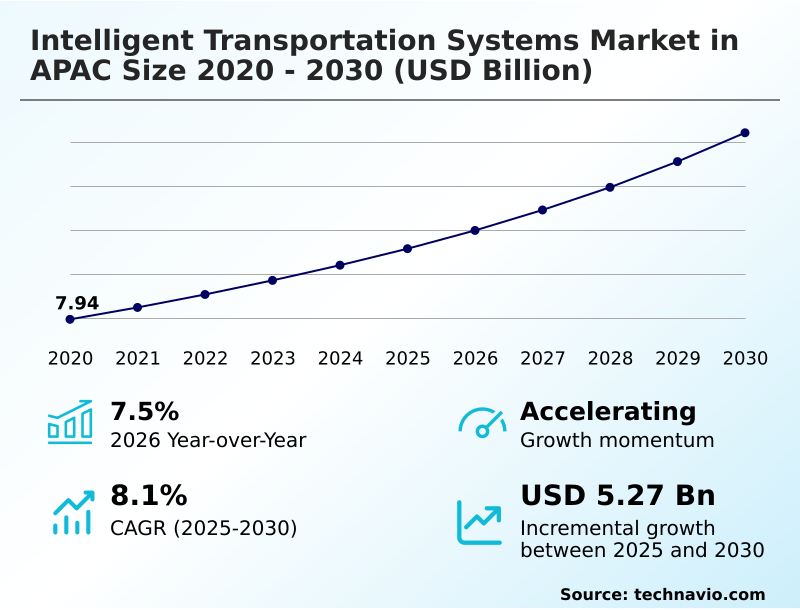
The APAC Intelligent Transportation Systems Market size was valued at USD 11.15 billion in 2025 growing at a CAGR of 8.1% during the forecast period 2026-2030.
The Hardware segment by Component was valued at USD 4.72 billion in 2024, while the Traffic management segment holds the largest revenue share by Application.
The market is projected to grow by USD 8.48 billion from 2020 to 2030, with USD 5.27 billion of the growth expected during the forecast period of 2025 to 2030.
Get Key Insights on Market Forecast (PDF) Request Free Sample
APAC Intelligent Transportation Systems Market Overview
The intelligent transportation systems market in APAC is defined by the convergence of information technology and physical infrastructure to enhance mobility and safety. Growth, which registered a 7.5% year-over-year increase, is propelled by government-led smart city initiatives and the widespread rollout of 5G networks. A key trend is the adoption of cooperative intelligent transport systems that facilitate V2X communication, allowing vehicles and infrastructure to share data in real time. This enables advanced driver assistance systems to function more effectively, improving road safety. For instance, a regional logistics firm deploying a new fleet management telematics platform can leverage predictive traffic modeling to dynamically reroute its vehicles, avoiding congestion and reducing fuel consumption, thereby improving delivery times and operational efficiency. However, the market grapples with challenges related to the high cost of implementation and the need for data interoperability across disparate systems and borders.
Drivers, Trends, and Challenges in the APAC Intelligent Transportation Systems Market
The evolution of the intelligent transportation systems market in APAC is increasingly tied to sophisticated data processing and network capabilities. The integration of AI for predictive traffic flow is becoming a key differentiator for vendors, enabling proactive congestion management rather than reactive responses.
This requires robust cybersecurity protocols for connected vehicle networks to protect against potential threats that could disrupt urban mobility. A significant operational hurdle remains the interoperability challenges of cross-border tolling, an issue highlighted by the ASEAN Transport Facilitation Working Group, which affects regional logistics and supply chain efficiency.
To address planning complexities, municipalities are now utilizing digital twin simulation for traffic planning, allowing them to model the impact of new infrastructure before construction begins. An urban planning department, for instance, can use a digital twin to assess how a new highway will affect local traffic, optimizing for dynamic routing for emergency vehicle preemption.
This data-driven approach also extends to data analytics for public transport optimization, helping authorities improve service delivery. The impact of 5G on autonomous vehicle data transmission is profound, enabling the high-bandwidth, low-latency communication necessary for safe operation and for V2X for vulnerable road user protection.
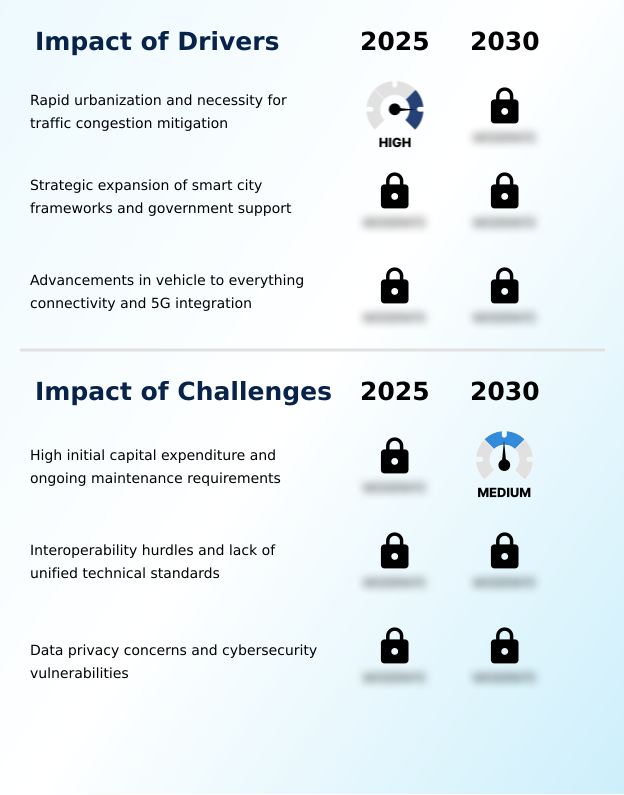
Primary Growth Driver: Rapid urbanization across the Asia-Pacific region and the critical need to mitigate traffic congestion are primary drivers for the market's expansion.
The primary impetus for the market comes from strategic government initiatives and technological advancements. The widespread rollout of 5G-enabled connectivity provides the low-latency, high-bandwidth foundation necessary for real-time traffic optimization and advanced applications.
Governments are leveraging this by investing in smart city projects that often feature a digital twin for urban mobility, allowing for sophisticated planning and simulation.
These digital models help authorities design effective congestion management solutions before physical deployment, optimizing resource allocation.
The market's 7.5% year-over-year growth is a direct result of these efforts to create more efficient, responsive, and sustainable urban environments through the strategic application of technology to manage traffic flow and public services.
Emerging Market Trend: The integration of AI and edge computing is an emerging trend for real-time traffic optimization. This involves processing data closer to the source to enable faster decision-making in dynamic urban environments.
Key trends are reshaping the intelligent transportation systems market, driven by shifts in consumer behavior and technology. The evolution toward mobility-as-a-service platforms is compelling transport authorities to integrate disparate services, from public transit to ride-hailing, into a single user experience. This integration relies heavily on the establishment of unified payment ecosystems, allowing for seamless multi-modal journey planning.
Concurrently, the rising adoption of electric vehicles is creating demand for intelligent electric vehicle charging management systems that can balance grid load while ensuring driver convenience. These trends are supported by advancements in edge computing in transportation, which enables localized data processing for applications like cooperative perception for autonomous driving, making transit safer and more efficient.
Key Industry Challenge: High initial capital expenditure for infrastructure deployment, coupled with significant ongoing maintenance costs, presents a key challenge to market growth.
Despite strong drivers, the market faces significant structural challenges that constrain widespread adoption. The high initial capital expenditure for deploying cooperative intelligent transport systems remains a primary barrier, particularly for developing economies. Furthermore, a lack of standardized protocols creates interoperability challenges of cross-border tolling, a problem highlighted in reports by the ASEAN Transport Facilitation Working Group.
This fragmentation forces logistics operators to use multiple systems, increasing complexity and cost. While technologies like multi-lane free-flow and satellite-based tolling systems promise greater efficiency, their effectiveness is undermined without common technical frameworks, impeding the creation of a truly seamless regional transportation network.
Explore Full Market Dynamics Analysis Request Free Sample
APAC Intelligent Transportation Systems Market Segmentation
The apac intelligent transportation systems industry research report provides comprehensive data including region-wise segment analysis, with forecasts and analysis for the period 2026-2030, as well as historical data from 2020-2024 for the following segments.
Component Segment Analysis
The hardware segment is estimated to witness significant growth during the forecast period.
The hardware segment represents the foundational physical layer, with procurement decisions for devices such as light detection and ranging sensors, roadside units, and advanced telematics control unit hardware being critical.
These components form the backbone of vehicle-to-infrastructure networks, enabling the data collection necessary for traffic management. This segment's offerings are essential for capturing real-time environmental data, facilitating communication between vehicles and the wider transport network.
In 2024, this segment accounted for approximately 45% of the total market, underscoring the significant upfront capital expenditure required to establish the physical infrastructure for intelligent transportation rollouts before software and service layers can deliver value.
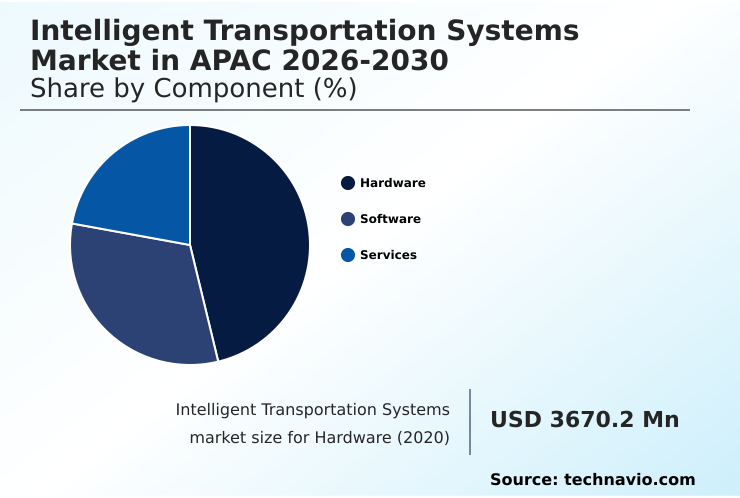
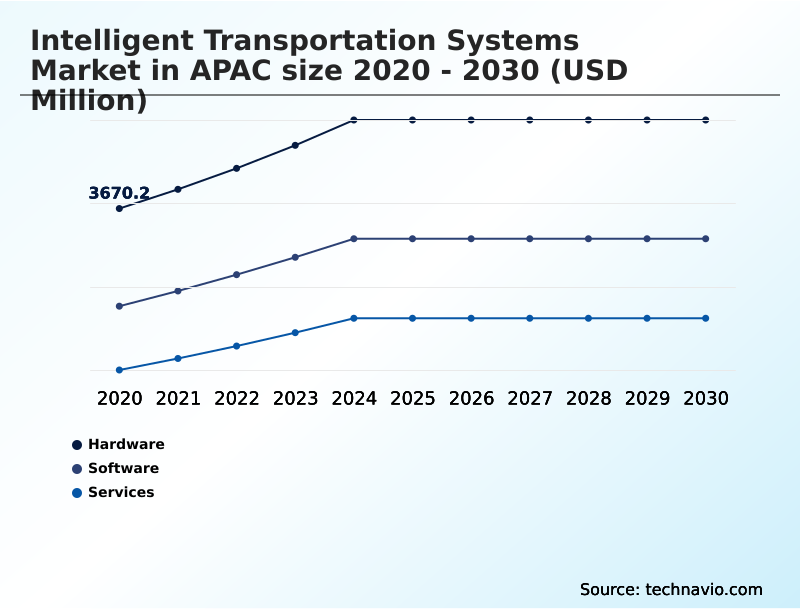
The Hardware segment was valued at USD 4.72 billion in 2024 and showed a gradual increase during the forecast period.
Customer Landscape Analysis for the APAC Intelligent Transportation Systems Market
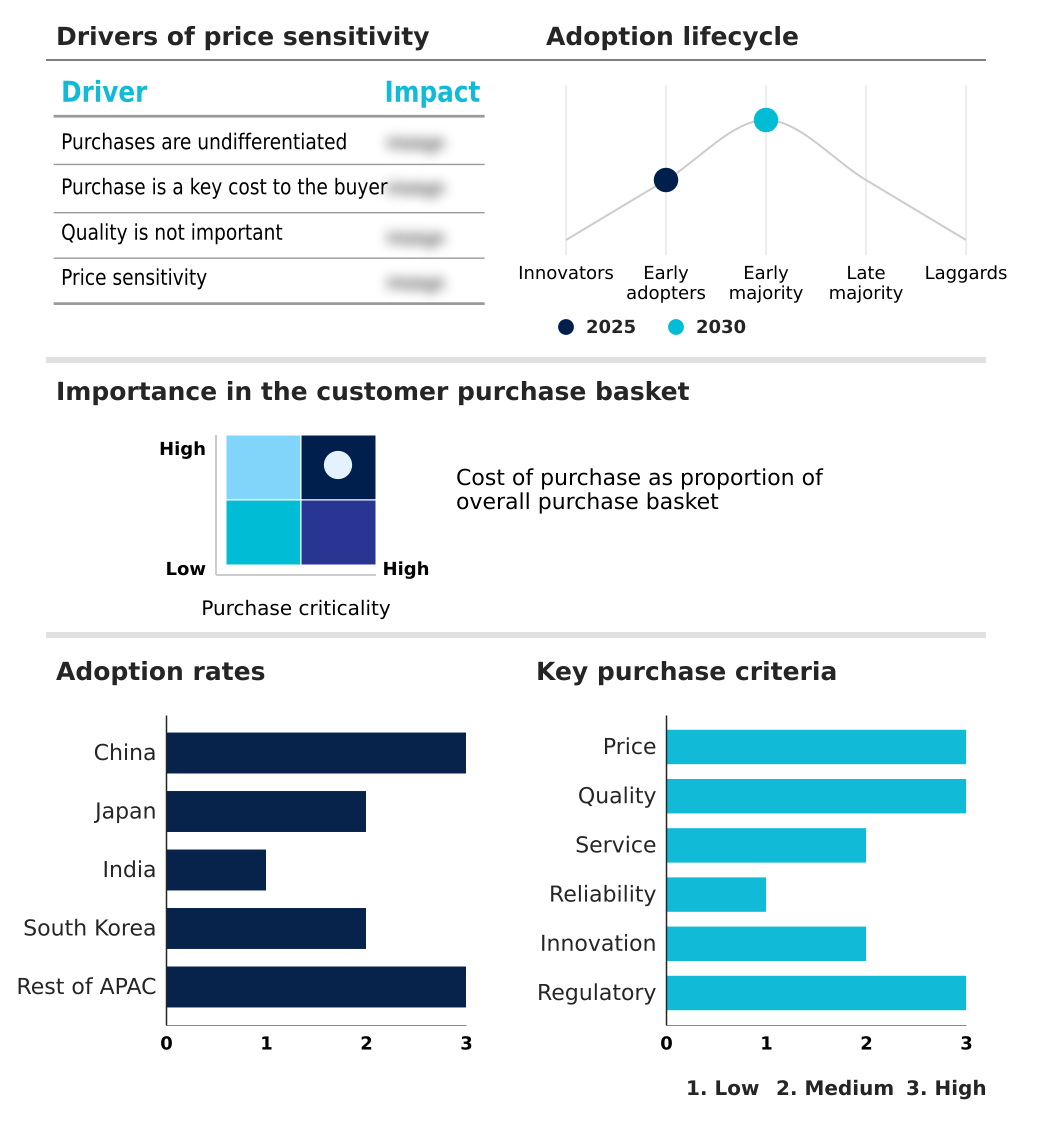
The apac intelligent transportation systems market forecasting report includes the adoption lifecycle of the market, covering from the innovator’s stage to the laggard’s stage. It focuses on adoption rates in different regions based on penetration. Furthermore, the apac intelligent transportation systems market report also includes key purchase criteria and drivers of price sensitivity to help companies evaluate and develop their market growth analysis strategies.
Competitive Landscape of the APAC Intelligent Transportation Systems Market
Companies are implementing various strategies, such as strategic alliances, partnerships, mergers and acquisitions, geographical expansion, and product/service launches, to enhance their presence in the apac intelligent transportation systems market industry.
AECOM - Offers end-to-end solutions for public transportation agencies, including electronic toll collection, public transit systems, and traffic enforcement support.
The industry research and growth report includes detailed analyses of the competitive landscape of the market and information about key companies, including:
- AECOM
- Conduent Inc.
- Cubic Corp.
- DENSO Corp.
- Fujitsu Ltd.
- Hangzhou Hikvision Digital
- HERE Global BV
- Hitachi Ltd.
- Huawei Technologies Co. Ltd.
- INRIX Inc.
- LG Electronics Inc.
- Mitsubishi Electric Corp.
- NEC Corp.
- Panasonic Holdings Corp.
- Siemens AG
- SK Telecom Co. Ltd.
- SWARCO AG
- Thales Group
- Toshiba Corp.
- WSP Global Inc.
Qualitative and quantitative analysis of companies has been conducted to help clients understand the wider business environment as well as the strengths and weaknesses of key industry players. Data is qualitatively analyzed to categorize companies as pure play, category-focused, industry-focused, and diversified; it is quantitatively analyzed to categorize companies as dominant, leading, strong, tentative, and weak.
Recent Developments in the APAC Intelligent Transportation Systems Market
- In August 2025, the Ministry of Housing and Urban Affairs in India announced a new phase of its Smart Cities Mission, focusing on deploying standardized digital twin models for urban transit monitoring in thirty additional cities to improve long-term planning.
- In June 2025, the Land Transport Authority in Singapore expanded its SimplyGo framework with a cross-border feature, allowing passengers to use a single digital wallet for local transit and ferry services to the neighboring Riau Islands.
- In May 2025, the Bangkok Metropolitan Administration in Thailand initiated the full-scale implementation of an automated area traffic control system using machine learning algorithms to adjust signal timings across fifty major intersections.
- In March 2025, the Beijing Municipal Commission of Transport deployed over five hundred edge-computing-enabled signal controllers in the Haidian District, using decentralized processing to synchronize traffic lights based on real-time vehicle density.
Research Analyst Overview: APAC Intelligent Transportation Systems Market
Boardroom decisions at automotive OEMs and public sector agencies are increasingly influenced by the technical roadmap of the intelligent transportation systems market in APAC. With the market expanding at a compound annual rate of 8.1%, the strategic focus is on future-proofing infrastructure investments.
Key considerations include the adoption of V2X communication protocols and the integration of advanced driver assistance systems with roadside infrastructure. This requires a shift from standalone hardware procurement to architecting cooperative intelligent transport systems that rely on high-definition mapping and predictive traffic modeling.
A critical factor for decision-makers is the standardization of communication, as highlighted by initiatives from the ASEAN Transport Facilitation Working Group, which directly impacts the total cost of ownership and avoids vendor lock-in.
For an automaker, this means aligning R&D on the telematics control unit and other vehicle-to-infrastructure components with emerging regional standards to ensure market access and interoperability for features like automated vehicle location and 5G-enabled connectivity.
Dive into Technavio’s robust research methodology, blending expert interviews, extensive data synthesis, and validated models for unparalleled APAC Intelligent Transportation Systems Market insights. See full methodology.
| Market Scope | |
|---|---|
| Page number | 234 |
| Base year | 2025 |
| Historic period | 2020-2024 |
| Forecast period | 2026-2030 |
| Growth momentum & CAGR | Accelerate at a CAGR of 8.1% |
| Market growth 2026-2030 | USD 5273.3 million |
| Market structure | Fragmented |
| YoY growth 2025-2026(%) | 7.5% |
| Key countries | China, Japan, India, South Korea and Rest of APAC |
| Competitive landscape | Leading Companies, Market Positioning of Companies, Competitive Strategies, and Industry Risks |
APAC Intelligent Transportation Systems Market: Key Questions Answered in This Report
-
What is the expected growth of the APAC Intelligent Transportation Systems Market between 2026 and 2030?
-
The APAC Intelligent Transportation Systems Market is expected to grow by USD 5.27 billion during 2026-2030, registering a CAGR of 8.1%. Year-over-year growth in 2026 is estimated at 7.5%%. This acceleration is shaped by rapid urbanization and necessity for traffic congestion mitigation, which is intensifying demand across multiple end-use verticals covered in the report.
-
-
What segmentation does the market report cover?
-
The report is segmented by Component (Hardware, Software, and Services), Application (Traffic management, Toll management, Automotive and infotainment telematics, Public transport, and Others), Type (ATM system, APT system, ATP system, ATI system, and Others) and Geography (APAC). Among these, the Hardware segment is estimated to witness significant growth during the forecast period, driven by rising adoption across key application areas. Each segment includes detailed qualitative and quantitative analysis, along with historical data from 2020-2024 and forecasts through 2030 with year-over-year growth rates.
-
-
Which regions are analyzed in the report?
-
The report covers APAC. Country-level analysis includes China, Japan, India, South Korea and Rest of APAC, with dedicated market size tables and year-over-year growth for each.
-
-
What are the key growth drivers and market challenges?
-
The primary driver is rapid urbanization and necessity for traffic congestion mitigation, which is accelerating investment and industry demand. The main challenge is high initial capital expenditure and ongoing maintenance requirements, creating operational barriers for key market participants. The report quantifies the impact of each driver and challenge across 2026 and 2030 with comparative analysis.
-
-
Who are the major players in the APAC Intelligent Transportation Systems Market?
-
Key vendors include AECOM, Conduent Inc., Cubic Corp., DENSO Corp., Fujitsu Ltd., Hangzhou Hikvision Digital, HERE Global BV, Hitachi Ltd., Huawei Technologies Co. Ltd., INRIX Inc., LG Electronics Inc., Mitsubishi Electric Corp., NEC Corp., Panasonic Holdings Corp., Siemens AG, SK Telecom Co. Ltd., SWARCO AG, Thales Group, Toshiba Corp. and WSP Global Inc.. The report provides qualitative and quantitative analysis categorizing companies as dominant, leading, strong, tentative, and weak based on their market positioning. Company profiles include business segment analysis, SWOT assessment, key offerings, and recent strategic developments.
-
APAC Intelligent Transportation Systems Market Research Insights
Market dynamics are shaped by a push for seamless mobility, driving the adoption of mobility-as-a-service platforms and unified payment ecosystems. This is exemplified by policies such as the one in South Korea, where the Ministry of Science and ICT dedicated a 6-gigahertz spectrum for vehicle-to-vehicle communication, ensuring low-latency data exchange for safety applications.
Incident detection algorithms are becoming standard in new deployments, enhancing the responsiveness of traffic management centers. Historically, the traffic management and toll management applications have commanded comparable market shares, with traffic management holding a slight lead.
The focus is shifting toward integrated solutions that incorporate real-time traffic optimization and advanced traveler information systems to manage urban flow more effectively, with increasing investment in traffic data fusion techniques.
We can help! Our analysts can customize this apac intelligent transportation systems market research report to meet your requirements.
 RIA -
RIA - 
