



APAC Wireless Healthcare Market Size 2024-2028
The APAC wireless healthcare market size is forecast to increase by USD 77.05 billion at a CAGR of 30.33% between 2023 and 2028.
- The market is experiencing significant growth due to several key trends. The adoption of wearable devices for health monitoring is increasing, driven by the convenience and accessibility they offer. Additionally, the integration of IoT technology in healthcare is gaining momentum, enabling remote patient monitoring and real-time data analysis. This includes servers, storage devices, network equipment, and client devices such as laptops, tablets, mobiles, and wearables. However, data privacy and security concerns remain a challenge, as sensitive health information is transmitted wirelessly. Addressing these concerns through strong security protocols and regulations will be crucial for market growth. Overall, the market presents a promising opportunity for innovation and growth In the coming years.
What will be the size of the APAC Wireless Healthcare Market during the forecast period?

- The wireless healthcare market In the Asia Pacific region is experiencing significant growth due to the increasing adoption of wireless communication technologies and connected devices. This trend is particularly prominent in managing chronic diseases, where patient-centric approaches are prioritized. Healthcare providers are leveraging wireless technology to improve quality healthcare through real-time monitoring of health parameters such as glucose levels and heartbeat. Cloud computing enables the storage and sharing of vast amounts of data within medical communities, enhancing documentation accuracy and facilitating collaborative care.
- Furthermore, the rise of home care and medical tourism also contributes to the market's expansion. Wi-Fi and WLAN technologies are essential infrastructure for hospitals, clinics, nursing homes, and pharmaceutical companies to effectively implement these advanced solutions. The Internet and wireless communication technology are revolutionizing healthcare delivery, offering patients and healthcare professionals access to valuable information and resources.
How is this market segmented and which is the largest segment?
The market research report provides comprehensive data (region-wise segment analysis), with forecasts and estimates in "USD million" for the period 2024-2028, as well as historical data from 2018-2022 for the following segments.
- Component
- Hardware
- Software and Services
- Application
- Healthcare amenities
- Home care
- Pharmaceuticals
- Others
- Geography
- APAC
- China
- India
- Japan
- South Korea
- APAC
By Component Insights
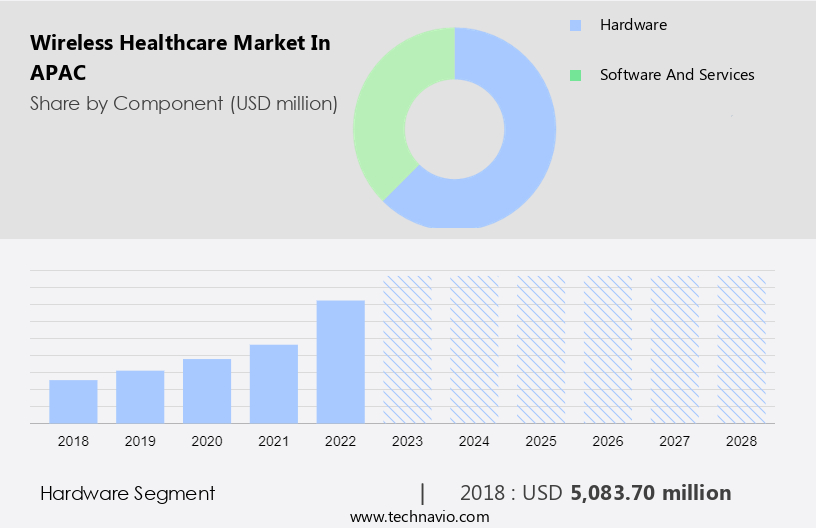
- The hardware segment is estimated to witness significant growth during the forecast period.
In the APAC wireless healthcare market, the hardware segment dominated with the largest market share in 2022. Hospitals and healthcare facilities require a strong IT infrastructure to manage and process patient and business data efficiently. The portability and interoperability features of these devices enable medical practitioners to record, store, and share patient information electronically. Hospitals also invest in servers to deploy Electronic Health Records (EHR) systems and storage and backup devices to securely store patient and hospital data. The use of WiMAX, WWAN, Bluetooth, and RFID technologies in hardware enhances the functionality of these devices in wireless healthcare applications. Patients, providers, and payers benefit from this technology through improved patient care, streamlined workflows, and cost savings.
Get a glance at the market share of various segments Request Free Sample
The hardware segment was valued at USD 5.08 billion in 2018 and showed a gradual increase during the forecast period.
Market Dynamics
Our researchers analyzed the data with 2023 as the base year, along with the key drivers, trends, and challenges. A holistic analysis of drivers will help companies refine their marketing strategies to gain a competitive advantage.
What are the key market drivers leading to the rise in adoption of APAC Wireless Healthcare Market?
Increasing adoption of wearables is the key driver of the market.
- Wireless communication technologies have revolutionized the healthcare industry, enabling connected devices to transmit real-time medical information between patients, healthcare providers, and payers. In the APAC region, chronic diseases such as heart disease and diabetes are prevalent, making patient-centric approaches essential. Wireless technologies like WPAN (Wireless Personal Area Network), WLAN (Wireless Local Area Network), WiFi, WiMAX, WWAN (Wide Area Network), Bluetooth, RFID, Zigbee, and Z-wave are transforming healthcare delivery. Cloud computing facilitates the storage and sharing of patient-specific data, enhancing documentation accuracy and quality healthcare. Medical tourism is on the rise, and wireless technology is making it more accessible, efficient, and convenient.
- Furthermore, the Internet of Things (IoT) is driving innovation, with mHealth solutions, telemonitoring systems, and mobile applications enabling remote monitoring and social distancing. Wearable devices, such as body-worn sensors, smartphones, and smartwatches, are increasingly popular for physiological monitoring. The aging population and chronic disease conditions necessitate advanced monitoring systems, including ECG monitoring, patient monitoring systems, and clinical sensors. Caregivers and healthcare practitioners benefit from real-time information, improving patient health conditions and outcomes. The pharmaceuticals industry is also embracing wireless technology, with software and hardware solutions enhancing patient care and medical equipment functionality. Cybersecurity is a critical concern, ensuring data privacy and security. The integration of wireless communication technologies in hospitals, clinics, nursing homes, and medical information systems is transforming healthcare delivery, making it more efficient, accessible, and patient-centric.
What are the market trends shaping the APAC Wireless Healthcare Market?
The growing use of IoT in healthcare is the upcoming trend In the market.
- The market is experiencing significant growth due to the increasing adoption of wireless communication technologies and connected devices In the healthcare industry. This trend is particularly prominent in managing chronic diseases, where patient-centric approaches are prioritized. IoT infrastructure, including WPAN, WLAN, WiFi, WiMAX, WWAN, and various sensors such as Bluetooth, RFID, Zigbee, Z-wave, Ultra-wide Band, GPRS, GPS, and Wi-Fi, is transforming healthcare delivery. Connected hospitals, caregivers, and medical equipment are becoming the norm, enabling real-time medical information and patient monitoring. The aging population and the prevalence of chronic disease conditions necessitate innovative solutions to ensure quality healthcare. Cloud computing facilitates data storage, access, and sharing among healthcare providers, payers, and patients.
- Moreover, home care solutions and pharmaceuticals industry collaborations are expanding the reach of wireless technology in healthcare. The integration of software and hardware in patient-specific physiological monitoring systems, such as ECG monitoring for heart disease, is revolutionizing clinical practice. The use of wearable devices, smartphones, and body-worn sensors is enabling remote monitoring and telemonitoring systems. Cybersecurity and social distancing are crucial considerations in this digital healthcare transformation. The Internet of Things (IoT) and healthcare IT are paving the way for improved patient health conditions and documentation accuracy. Hospitals, clinics, nursing homes, and medical information systems are all benefiting from these advancements. Wearable medical devices, diagnostic sensors, and mHealth solutions are increasingly popular, offering real-time information and convenience. Healthcare practitioners are embracing these technologies to optimize patient care and enhance patient outcomes.
What challenges does APAC Wireless Healthcare Market face during the growth?
Data privacy and security issues are key challenges affecting the market growth.
- The market is experiencing significant growth due to the integration of wireless communication technologies with healthcare systems. Connected devices, such as wearable medical devices, body-worn sensors, and smartphones, are increasingly being used for real-time patient monitoring, especially for chronic disease conditions. A patient-centric approach is being adopted by healthcare providers to improve quality healthcare and enhance the patient experience. Cloud computing plays a crucial role in wireless healthcare by enabling the storage, processing, and sharing of medical information in real time. Medical tourism is also driving the market, as patients seek advanced healthcare services from other countries. The use of wireless technologies, such as WPAN, WLAN, WiFi, WiMAX, WWAN, Bluetooth, RFID, Zigbee, Z-wave, Ultra-wide Band, GPRS, GPS, and Wi-Fi, is transforming home care and enabling remote monitoring and telemonitoring systems. The Pharmaceuticals industry is also leveraging wireless technology for patient-specific physiological monitoring and real-time medical information. The aging population and chronic disease conditions are fueling the demand for wireless healthcare solutions. Hospital administrators are investing in cybersecurity to protect sensitive patient data from cyberattacks.
- Furthermore, the Internet of Things (IoT) and healthcare IT are revolutionizing the way healthcare is delivered, with ECG monitoring, heart disease patient monitoring systems, and clinical communication becoming increasingly common. Healthcare practitioners are using sensors to monitor health parameters such as body temperature, glucose levels, and heartbeat. Data communities are being formed to improve documentation accuracy and provide real-time information to hospitals, clinics, nursing homes, and medical equipment manufacturers. The use of wireless technology in healthcare is improving patient outcomes, reducing hospital-acquired infections, and providing mHealth solutions and mobile applications to patients. Thus, the market is a dynamic and evolving industry that is transforming the way healthcare is delivered. With the increasing use of wireless communication technologies, connected devices, and cloud computing, healthcare providers are able to offer more efficient, effective, and patient-centric services. The challenges of cybersecurity and social distancing are being addressed through innovative solutions, ensuring that patients receive quality healthcare while maintaining their privacy and safety.
Exclusive APAC Wireless Healthcare Market Customer Landscape
The market forecasting report includes the adoption lifecycle of the market, covering from the innovator's stage to the laggard's stage. It focuses on adoption rates in different regions based on penetration. Furthermore, the report also includes key purchase criteria and drivers of price sensitivity to help companies evaluate and develop their market growth analysis strategies.

Customer Landscape
Key Companies & Market Insights
Companies are implementing various strategies, such as strategic alliances, market forecast partnerships, mergers and acquisitions, geographical expansion, and product/service launches, to enhance their presence In the market. The market research and growth report includes detailed analyses of the competitive landscape of the market and information about key companies, including:
- Agfa Gevaert NV
- Baxter International Inc.
- Bio Rad Laboratories Inc.
- Canon Inc.
- Carestream Health Inc.
- F. Hoffmann La Roche Ltd.
- FUJIFILM Corp.
- General Electric Co.
- Koninklijke Philips N.V.
- Masimo Corp.
- Medtronic Plc
- Nihon Kohden Corp.
- Oracle Corp.
- Samsung Electronics Co. Ltd.
- Shenzhen Mindray BioMedical Electronics Co. Ltd
- Shimadzu Corp.
- Siemens AG
- Stryker Corp.
- Terumo Corp.
- Zebra Technologies Corp.
Qualitative and quantitative analysis of companies has been conducted to help clients understand the wider business environment as well as the strengths and weaknesses of key market players. Data is qualitatively analyzed to categorize companies as pure play, category-focused, industry-focused, and diversified; it is quantitatively analyzed to categorize companies as dominant, leading, strong, tentative, and weak.
Research Analyst Overview
Wireless communication technologies have revolutionized various industries, and the healthcare sector is no exception. The integration of connected devices and patient-centric approaches in APAC countries has significantly transformed the delivery of quality healthcare services. This dynamic market is driven by the growing prevalence of chronic diseases, an aging population, and the increasing demand for remote monitoring and telemedicine solutions. Connected devices, such as wearable medical devices and body-worn sensors, enable real-time physiological monitoring, allowing healthcare providers to make informed decisions regarding patient health conditions. These devices can transmit data to cloud computing platforms, providing healthcare practitioners with access to valuable patient information, improving documentation accuracy, and facilitating better patient care. The healthcare industry in APAC is embracing wireless communication technologies to enhance patient-specific monitoring systems. Software and hardware solutions enable the collection and analysis of health parameters, including body temperature, glucose levels, heartbeat, and other vital signs. These systems can be integrated with telemonitoring systems, enabling remote monitoring and enabling caregivers to intervene promptly in case of any abnormalities. The pharmaceuticals industry is also leveraging wireless technology to improve patient care.
For instance, wireless communication technologies can be used to monitor hospital-acquired infections, ensuring that patients receive the best possible care. Furthermore, mHealth solutions, such as mobile applications, can help patients manage chronic disease conditions more effectively, allowing them to take a more active role In their healthcare. The increasing adoption of wireless communication technologies in healthcare is also facilitating medical tourism. Patients can now access quality healthcare services from anywhere In the world, making healthcare more accessible and affordable. Moreover, the use of wireless communication technologies in home care settings is enabling elderly patients to age in place, improving their quality of life and reducing the burden on healthcare systems. However, the integration of wireless communication technologies in healthcare also presents challenges, particularly in terms of cybersecurity. With the increasing amount of sensitive patient data being transmitted wirelessly, it is essential to ensure that these systems are secure and protected from cyber threats.
Furthermore, social distancing measures implemented due to the COVID-19 pandemic have accelerated the adoption of remote monitoring and telemedicine solutions, highlighting the need for strong cybersecurity measures. Thus, wireless communication technologies are transforming the healthcare landscape in APAC, enabling patient-centric approaches, improving the quality of healthcare services, and making healthcare more accessible and affordable. However, challenges such as cybersecurity and data privacy must be addressed to ensure the safe and effective implementation of these technologies. The future of healthcare in APAC is undoubtedly wireless, and it is essential that stakeholders, including healthcare providers, payers, and patients, work together to harness the full potential of these technologies.
|
Market Scope |
|
|
Report Coverage |
Details |
|
Page number |
165 |
|
Base year |
2023 |
|
Historic period |
2018-2022 |
|
Forecast period |
2024-2028 |
|
Growth momentum & CAGR |
Accelerate at a CAGR of 30.33% |
|
Market growth 2024-2028 |
USD 77.05 billion |
|
Market structure |
Fragmented |
|
YoY growth 2023-2024(%) |
24.47 |
|
Competitive landscape |
Leading Companies, Market Positioning of Companies, Competitive Strategies, and Industry Risks |
What are the Key Data Covered in this Market Research Report?
- CAGR of the market during the forecast period
- Detailed information on factors that will drive the market growth and forecasting between 2024 and 2028
- Precise estimation of the size of the market and its contribution of the market in focus to the parent market
- Accurate predictions about upcoming market growth and trends and changes in consumer behaviour
- Growth of the market across APAC
- Thorough analysis of the market's competitive landscape and detailed information about companies
- Comprehensive analysis of factors that will challenge the growth of market companies
We can help! Our analysts can customize this market research report to meet your requirements Get in touch
 RIA -
RIA - 
