
Artificial Intelligence Platforms Market Analysis North America, APAC, Europe, South America, Middle East and Africa - US, China, Germany, UK, France - Size and Forecast 2024-2028

Artificial Intelligence Platforms Market Analysis North America, APAC, Europe, South America, Middle East and Africa - US, China, Germany, UK, France - Size and Forecast 2024-2028

Published: Sep 2024 195 Pages SKU: IRTNTR44235

Market Overview at a Glance

$64.90 B
Market Opportunity
45.1%
CAGR
35.6
YoY growth 2023-2024(%)

Artificial Intelligence Platforms Market Size 2024-2028

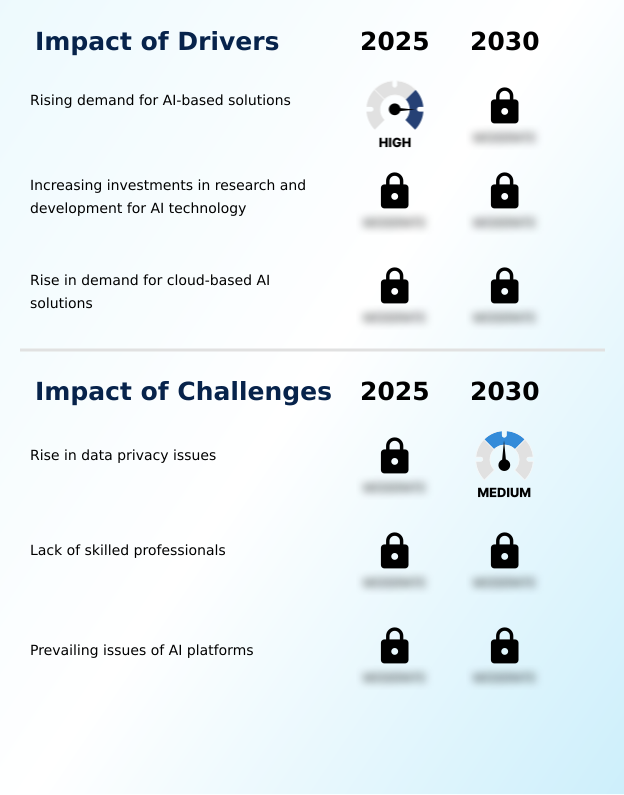
The artificial intelligence platforms market size is valued to increase USD 64.9 billion, at a CAGR of 45.1% from 2023 to 2028. Rising demand for AI-based solutions will drive the artificial intelligence platforms market.

Major Market Trends & Insights

  • North America dominated the market and accounted for a 66% growth during the forecast period.
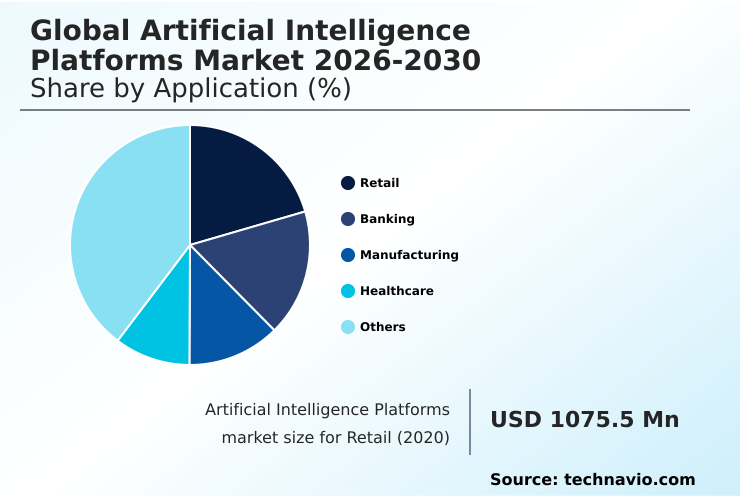
  • By Application - Retail segment was valued at USD 662.60 billion in 2022
  • By Deployment - On-premises segment accounted for the largest market revenue share in 2022

Market Size & Forecast

  • Market Opportunities: USD 2.00 million
  • Market Future Opportunities: USD 64896.80 million
  • CAGR : 45.1%
  • North America: Largest market in 2022

Market Summary

  • The market represents a dynamic and ever-evolving landscape, characterized by continuous innovation and advancements in core technologies and applications. With the increasing adoption of AI-driven solutions, there is a rising demand for advanced platforms that can facilitate seamless integration and interoperability among neural networks. According to recent studies, the global AI platforms market is expected to witness significant growth, with a notable market share held by major players such as IBM, Microsoft, and Google. However, the market is not without challenges.
  • The rise in data privacy issues poses a significant threat, necessitating stringent regulations and compliance measures. Despite these challenges, the market presents ample opportunities for growth, particularly in sectors such as healthcare, finance, and manufacturing, where AI-driven solutions can bring about transformative change. The ongoing unfolding of market activities and evolving patterns underscores the importance of staying informed and agile in this rapidly evolving landscape.

What will be the Size of the Artificial Intelligence Platforms Market during the forecast period?
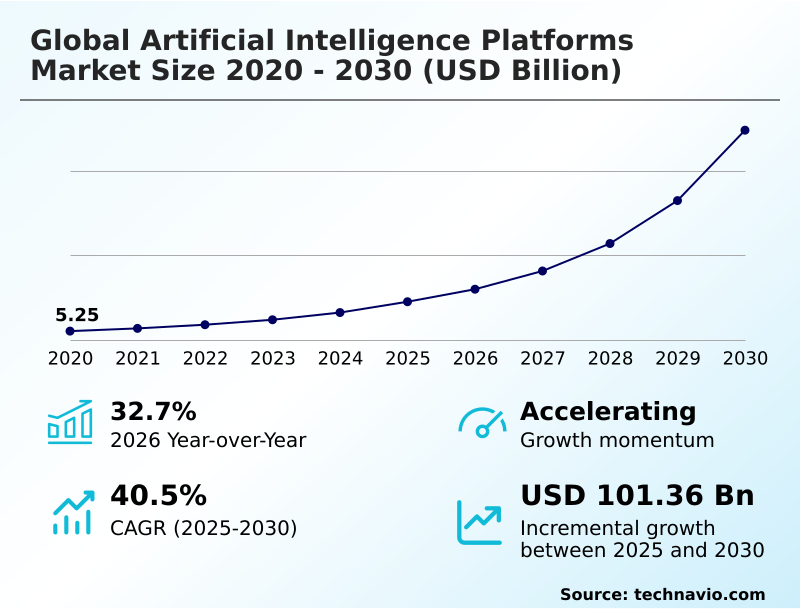
Artificial Intelligence Platforms Market Size

Get Key Insights on Market Forecast (PDF) Request Free Sample

How is the Artificial Intelligence Platforms Market Segmented and what are the key trends of market segmentation?

The artificial intelligence platforms industry research report provides comprehensive data (region-wise segment analysis), with forecasts and estimates in "USD million" for the period 2024-2028, as well as historical data from 2018-2022 for the following segments.

  • Application
    • Retail
    • Banking
    • Manufacturing
    • Healthcare
    • Others
  • Deployment
    • On-premises
    • Cloud-based
  • Geography
    • North America
      • US
    • Europe
      • France
      • Germany
      • UK
    • APAC
      • China
    • Rest of World (ROW)

By Application Insights

The retail segment is estimated to witness significant growth during the forecast period.

Artificial Intelligence (AI) platforms are revolutionizing business operations across various sectors, with the retail industry experiencing significant growth. According to recent reports, the retail segment accounts for approximately 25% of the global AI market, a trend fueled by the digitalization of commerce and the increasing demand for personalized customer experiences. In the realm of AI, Natural Language Processing (NLP) and Cognitive Computing Services are key technologies driving innovation. NLP enables machines to understand human language, while cognitive computing services mimic human thought processes, leading to more accurate and efficient business solutions. Moreover, AI platforms are transforming industries by addressing challenges related to Hyperparameter Optimization, Model Versioning, and Responsible AI Development.

Hyperparameter optimization fine-tunes machine learning models for optimal performance, while model versioning ensures that updated models are seamlessly integrated into existing systems. Responsible AI development focuses on creating ethical AI frameworks and minimizing bias in AI systems. Key performance metrics, such as F1-score calculation, precision, and recall, are essential for evaluating AI model performance. Reinforcement learning methods, inference latency, and throughput optimization are also critical aspects of AI platforms, ensuring real-time data streaming and scalability. The integration of APIs, semantic web technologies, and predictive analytics tools further enhances AI capabilities. Deep learning algorithms, neural network architecture, and model training pipelines are essential components of advanced AI systems.

Data security protocols and knowledge graph technology are crucial for ensuring data privacy and security. Model performance evaluation, real-time data streaming, and bias detection algorithms are essential for maintaining trust and transparency in AI applications. AI-powered automation and big data processing are transforming industries by streamlining processes and generating valuable insights. Edge AI deployment and cloud-based AI platforms are enabling businesses to leverage AI capabilities at scale while addressing scalability challenges. In the near future, the AI market is expected to expand by over 20% in various sectors, with predictive analytics and computer vision systems leading the charge. The integration of machine learning models and neural network architecture into existing systems is expected to further accelerate market growth.

In conclusion, AI platforms are transforming industries by enabling more efficient and accurate business operations. The retail industry is at the forefront of this transformation, with technologies such as NLP, cognitive computing services, and Big Data driving innovation. The future of AI is bright, with continued growth and advancements expected in various sectors.

Artificial Intelligence Platforms Market Size

Request Free Sample

The Retail segment was valued at USD 662.60 billion in 2018 and showed a gradual increase during the forecast period.
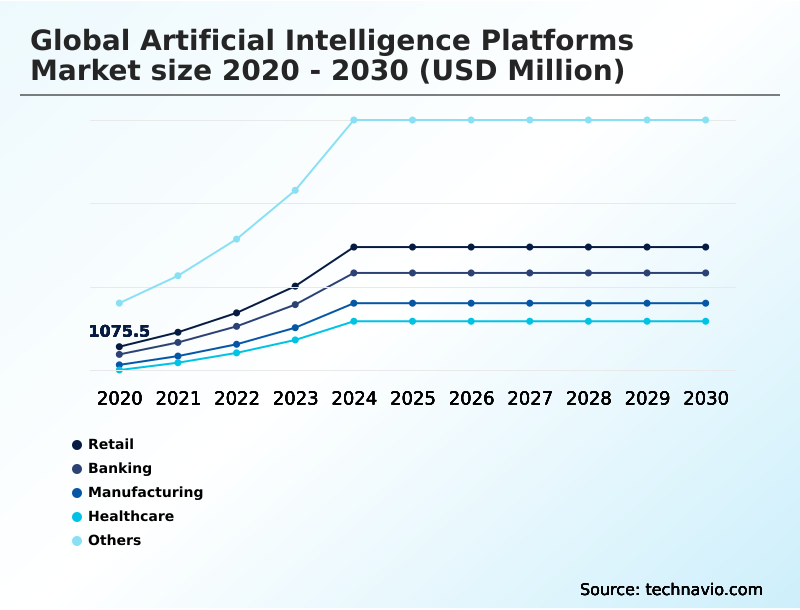
Artificial Intelligence Platforms Market Size

Request Free Sample

Regional Analysis

North America is estimated to contribute 66% to the growth of the global market during the forecast period.Technavio's analysts have elaborately explained the regional trends and drivers that shape the market during the forecast period.
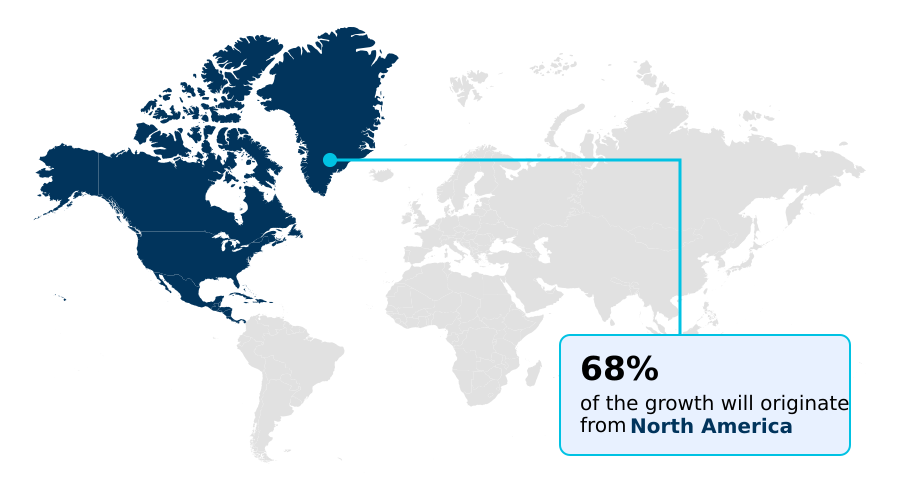
Artificial Intelligence Platforms Market Share by Geography

See How Artificial Intelligence Platforms Market Demand is Rising in North America Request Free Sample

In the dynamic business landscape, North America stands out as a significant contributor to the adoption of Artificial Intelligence (AI) platforms. Industries such as banking and retail are capitalizing on AI's potential for automated decision-making. The region's early technology adoption and substantial investments from major players like Microsoft Corp., Alphabet Inc., and International Business Machines Corp., are fueling the demand for AI.

The US and Canada collectively account for approximately 26% of all global AI-related patent applications. IBM holds the largest share of these patents, with Microsoft and Google following closely. As a professional, it's essential to acknowledge the transformative impact of AI on various industries and the strategic role these key players are taking in shaping its future.

Market Dynamics

Our researchers analyzed the data with 2023 as the base year, along with the key drivers, trends, and challenges. A holistic analysis of drivers will help companies refine their marketing strategies to gain a competitive advantage.

The global artificial intelligence (AI) platforms market is experiencing significant growth as businesses increasingly adopt AI to enhance operational efficiency, improve decision-making, and create innovative products. However, the scalability limitations of AI platforms pose a challenge as organizations grapple with managing and processing vast amounts of data. Deep learning model deployment, a critical component of AI, faces challenges due to the complexity and resource-intensive nature of these models. To address these challenges, there is a growing focus on optimizing natural language processing pipelines and computer vision system accuracy. Machine learning model bias mitigation techniques are also gaining traction to ensure fairness and unbiased decision-making.

Real-time data streaming for AI applications is essential to keep up with the increasing data volume and enable real-time insights. Edge AI deployment optimization strategies are becoming increasingly popular to reduce latency and improve performance. Security considerations are a crucial aspect of cloud-based AI platforms, with API integration for AI-powered automation playing a significant role in ensuring secure access and data privacy. AI model explainability methods and their limitations are under scrutiny as businesses demand transparency and accountability. Responsible AI development guidelines and best practices are being adopted to ensure ethical use of AI. Model training pipeline efficiency improvements, hyperparameter optimization techniques for deep learning, and model performance evaluation metrics for AI applications are key areas of focus to enhance AI system effectiveness.

AI platform resource allocation strategies, system monitoring and alerting mechanisms, data governance policies, and privacy-preserving AI techniques for sensitive data are essential to manage the complexities of AI implementation. Federated learning for decentralized AI model training and differential privacy mechanisms for data protection are emerging trends to address data security and privacy concerns. Despite the challenges, the industrial application segment accounts for a significantly larger share of AI platform adoption compared to the academic segment, with more than 70% of new product developments focusing on industrial applications. This underscores the growing importance of AI in driving business innovation and competitiveness.

Artificial Intelligence Platforms Market Size

What are the key market drivers leading to the rise in the adoption of Artificial Intelligence Platforms Industry?

  • The surge in demand for AI-driven solutions serves as the primary catalyst for market growth. 
  • In the rapidly evolving landscape of industrial automation, businesses are continually seeking to mitigate the limitations of robotic technologies. Challenges such as cost, computational capacity, storage, size, power supply, motion mode, and working environment have prompted organizations to explore cloud solutions. Small and medium enterprises (SMEs) are increasingly adopting cloud-based services to access the scalability of hardware and resources offered by providers. By scaling their workload as needed, companies can eliminate the need for costly on-premises data centers. The growth of AI infrastructure is significantly influenced by the emergence of cloud-based services and machine learning platforms.
  • These solutions enable businesses to process vast amounts of data and make informed decisions in real-time, thereby enhancing operational efficiency and productivity. The adaptability and flexibility of cloud-based AI infrastructure make it a preferred choice for industries ranging from manufacturing to healthcare and finance.

What are the market trends shaping the Artificial Intelligence Platforms Industry?

  • Neural networks are increasingly interoperable in the current market trend. This enhances the ability of these systems to communicate and collaborate effectively.
  • In today's interconnected business landscape, interoperability between computerized systems has become a critical requirement for enterprises. Interoperability refers to the ability of distinct systems, developed by various manufacturers and operating in diverse industries, to exchange and interpret data. This data exchange is essential for seamless communication and collaboration between applications and databases. The dynamic domain of Deep Learning (DL) frameworks and platforms is expanding rapidly, compelling data scientists to select the optimal DL framework for specific tasks. However, the absence of interoperability among DL frameworks utilizing neural network tools is an emerging challenge.
  • This limitation hampers the widespread adoption of Artificial Intelligence (AI) by restricting the ease of transferring models and data between frameworks. By addressing interoperability issues, organizations can streamline their AI implementation processes and enhance their overall technological agility.

What challenges does the Artificial Intelligence Platforms Industry face during its growth?

  • The escalating concerns over data privacy represent a significant challenge to the expansion of various industries. 
  • AI applications bring significant value to businesses by providing insights from vast amounts of data for future planning and operational optimization. However, their implementation comes with various safety and security concerns. Data leakage is a notable risk, which can lead to misuse or manipulation of information, resulting in legal and security repercussions. These risks stem from the need for AI systems to process and analyze large datasets. To mitigate these issues, organizations must prioritize data security and privacy. This includes implementing robust access control measures, identity management systems, and risk management strategies. Additionally, regulatory and legislative compliance, auditing, and logging are essential components of ensuring the secure use of AI applications.
  • The ongoing evolution of AI technology necessitates continuous adaptation and improvement of these measures to address emerging threats and concerns. AI systems' potential to revolutionize industries and sectors is vast, from healthcare to finance, education, and manufacturing. By addressing the associated risks and ensuring transparency, businesses can harness the power of AI to drive innovation and growth.

Exclusive Technavio Analysis on Customer Landscape

The artificial intelligence platforms market forecasting report includes the adoption lifecycle of the market, covering from the innovator's stage to the laggard's stage. It focuses on adoption rates in different regions based on penetration. Furthermore, the artificial intelligence platforms market report also includes key purchase criteria and drivers of price sensitivity to help companies evaluate and develop their market growth analysis strategies.
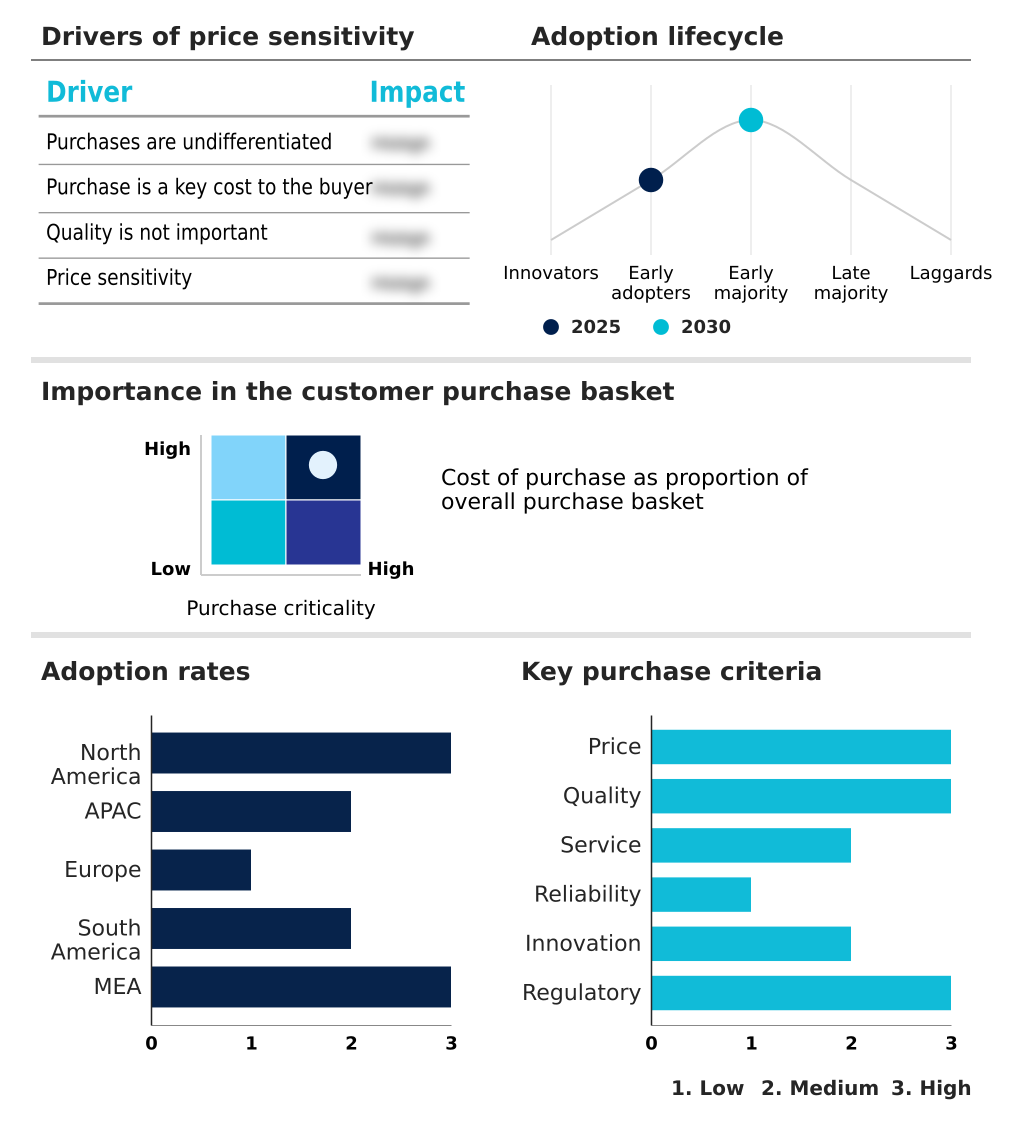
Artificial Intelligence Platforms Market Share by Geography

 Customer Landscape of Artificial Intelligence Platforms Industry

Competitive Landscape

Companies are implementing various strategies, such as strategic alliances, artificial intelligence platforms market forecast, partnerships, mergers and acquisitions, geographical expansion, and product/service launches, to enhance their presence in the industry.

Alphabet Inc. - The company specializes in artificial intelligence technology, with offerings including Google AI platforms. These solutions leverage advanced machine learning algorithms to streamline business processes and enhance operational efficiency. By automating complex tasks, the company empowers organizations to make data-driven decisions and improve overall productivity.

The industry research and growth report includes detailed analyses of the competitive landscape of the market and information about key companies, including:

  • Alphabet Inc.
  • Amazon.com Inc.
  • Amelia US LLC
  • Baidu Inc.
  • Dell Technologies Inc.
  • Hewlett Packard Enterprise Co.
  • Infosys Ltd.
  • Intel Corp.
  • International Business Machines Corp.
  • Microsoft Corp.
  • Nuance Communications Inc.
  • NVIDIA Corp.
  • Palantir Technologies Inc.
  • Qualcomm Inc.
  • Salesforce Inc.
  • SAP SE
  • SAS Institute Inc.
  • ServiceNow Inc.
  • Tata Consultancy Services Ltd.
  • Wipro Ltd.

Qualitative and quantitative analysis of companies has been conducted to help clients understand the wider business environment as well as the strengths and weaknesses of key industry players. Data is qualitatively analyzed to categorize companies as pure play, category-focused, industry-focused, and diversified; it is quantitatively analyzed to categorize companies as dominant, leading, strong, tentative, and weak.

Recent Development and News in Artificial Intelligence Platforms Market

  • In January 2024, IBM announced the launch of its new AI-powered financial crime detection platform, Watson Financial Crime Insights, designed to help financial institutions mitigate money laundering and fraud risks (IBM Press Release).
  • In March 2024, Microsoft and OpenAI collaborated to release ChatGPT, an advanced AI language model, marking a significant advancement in conversational AI technology (Microsoft Blog).
  • In April 2024, Google Cloud completed the acquisition of Anthos, a startup specializing in hybrid and multi-cloud management, aiming to strengthen its AI platform offerings (Google Cloud Blog).
  • In May 2025, Amazon Web Services (AWS) secured a major contract with the US Department of Defense to provide cloud services, including AI and machine learning capabilities, for the Pentagon's Joint Artificial Intelligence Center (AWS Press Release). These developments underscore the rapid advancements and growing importance of AI platforms in various industries, from financial services to defense, and the strategic partnerships and acquisitions driving market growth.

Dive into Technavio's robust research methodology, blending expert interviews, extensive data synthesis, and validated models for unparalleled Artificial Intelligence Platforms Market insights. See full methodology.

Market Scope

Report Coverage

Details

Page number

195

Base year

2023

Historic period

2018-2022

Forecast period

2024-2028

Growth momentum & CAGR

Accelerate at a CAGR of 45.1%

Market growth 2024-2028

USD 64896.8 million

Market structure

Fragmented

YoY growth 2023-2024(%)

35.6

Key countries

US, China, Germany, UK, and France

Competitive landscape

Leading Companies, Market Positioning of Companies, Competitive Strategies, and Industry Risks

Request Free Sample

Research Analyst Overview

  • In the dynamic and ever-evolving landscape of artificial intelligence (AI) platforms, various advancements and trends are shaping the industry's future. Natural language processing (NLP) continues to refine communication between humans and machines, enabling more intuitive interactions. Hyperparameter optimization and model versioning are crucial components of responsible AI development, ensuring optimal performance and accountability. F1-score calculation and accuracy metrics are essential for evaluating model performance, while data mining techniques uncover valuable insights from vast datasets. Cognitive computing services and knowledge graph technology are revolutionizing decision-making processes, providing contextually relevant information. Reinforcement learning methods and inference latency are critical aspects of AI development, with the former enabling machines to learn from their environment and the latter ensuring real-time responses.
  • Deep learning algorithms and predictive analytics tools are transforming industries, from healthcare to finance, by uncovering hidden patterns and trends. API integration strategies, semantic web technologies, and real-time data streaming are essential for seamless AI implementation, while scalability challenges and edge AI deployment are key considerations for businesses. Cloud-based AI platforms and ROC curve analysis provide flexibility and adaptability, allowing organizations to leverage AI at scale. Model explainability techniques, machine learning models, and neural network architecture are essential for understanding AI behavior and ensuring transparency. Throughput optimization, big data processing, and AI-powered automation are driving efficiency and productivity gains.
  • Precision and recall, as well as AUC score computation, are essential for measuring model effectiveness and improving performance. Bias detection algorithms and data security protocols are crucial for maintaining ethical AI frameworks and protecting sensitive information. Inference latency, accuracy metrics, and model performance evaluation are ongoing concerns for businesses looking to maximize the value of their AI investments. Computer vision systems and predictive analytics tools are revolutionizing industries, from manufacturing to retail, by enabling more accurate and efficient processes. Overall, the AI platforms market continues to evolve, with new advancements and trends shaping its future.

What are the Key Data Covered in this Artificial Intelligence Platforms Market Research and Growth Report?

  • What is the expected growth of the Artificial Intelligence Platforms Market between 2024 and 2028?

    • USD 64.9 billion, at a CAGR of 45.1%

  • What segmentation does the market report cover?

    • The report is segmented by Application (Retail, Banking, Manufacturing, Healthcare, and Others), Deployment (On-premises and Cloud-based), and Geography (North America, APAC, Europe, South America, and Middle East and Africa)

  • Which regions are analyzed in the report?

    • North America, APAC, Europe, South America, and Middle East and Africa

  • What are the key growth drivers and market challenges?

    • Rising demand for AI-based solutions, Rise in data privacy issues

  • Who are the major players in the Artificial Intelligence Platforms Market?

    • Alphabet Inc., Amazon.com Inc., Amelia US LLC, Baidu Inc., Dell Technologies Inc., Hewlett Packard Enterprise Co., Infosys Ltd., Intel Corp., International Business Machines Corp., Microsoft Corp., Nuance Communications Inc., NVIDIA Corp., Palantir Technologies Inc., Qualcomm Inc., Salesforce Inc., SAP SE, SAS Institute Inc., ServiceNow Inc., Tata Consultancy Services Ltd., and Wipro Ltd.

Market Research Insights

  • The market continues to expand, driven by advancements in technology and increasing business demand. According to recent estimates, the global market size for AI platforms is projected to reach USD215.3 billion by 2027, growing at a compound annual growth rate of 33.7% from 2020. This growth is fueled by the integration of AI into various industries, including healthcare, finance, and manufacturing. One significant trend in the market is the development of privacy-preserving AI solutions, which address concerns around data security and compliance. In contrast, traditional AI platforms rely on cloud infrastructure, which can pose privacy risks. For instance, containerization technologies, such as Docker and Kubernetes, are increasingly being used to enhance security and improve error handling mechanisms in AI platform architecture.
  • Another trend is the adoption of serverless computing and API documentation, which streamline the software development lifecycle and enable faster model deployment strategies. Additionally, database management systems, unit testing frameworks, and system monitoring tools are essential components of AI platforms, ensuring data governance policies and efficient performance tuning. Moreover, the market is witnessing the emergence of advanced techniques, such as differential privacy, homomorphic encryption, and debugging techniques, to address challenges around data preprocessing, feature engineering, and model selection criteria. These innovations contribute to the continuous evolution of AI platforms and their integration into various industries.

We can help! Our analysts can customize this artificial intelligence platforms market research report to meet your requirements.

Get in touch

1 Executive Summary

  • 1.1 Market overview
    • Executive Summary - Chart on Market Overview
    • Executive Summary - Data Table on Market Overview
    • Executive Summary - Chart on Global Market Characteristics
    • Executive Summary - Chart on Market by Geography
    • Executive Summary - Chart on Market Segmentation by Application
    • Executive Summary - Chart on Market Segmentation by Deployment
    • Executive Summary - Chart on Incremental Growth
    • Executive Summary - Data Table on Incremental Growth
    • Executive Summary - Chart on Company Market Positioning

2 Market Landscape

  • 2.1 Market ecosystem
    • Parent Market
    • Data Table on - Parent Market
  • 2.2 Market characteristics
    • Market characteristics analysis
  • 2.3 Value chain analysis
    • Value Chain Analysis

3 Market Sizing

  • 3.1 Market definition
    • Offerings of companies included in the market definition
  • 3.2 Market segment analysis
    • Market segments
  • 3.3 Market size 2023
    • 3.4 Market outlook: Forecast for 2023-2028
      • Chart on Global - Market size and forecast 2023-2028 ($ million)
      • Data Table on Global - Market size and forecast 2023-2028 ($ million)
      • Chart on Global Market: Year-over-year growth 2023-2028 (%)
      • Data Table on Global Market: Year-over-year growth 2023-2028 (%)

    4 Historic Market Size

    • 4.1 Global Artificial Intelligence Platforms Market 2018 - 2022
      • Historic Market Size - Data Table on Global Artificial Intelligence Platforms Market 2018 - 2022 ($ million)
    • 4.2 Application segment analysis 2018 - 2022
      • Historic Market Size - Application Segment 2018 - 2022 ($ million)
    • 4.3 Deployment segment analysis 2018 - 2022
      • Historic Market Size - Deployment Segment 2018 - 2022 ($ million)
    • 4.4 Geography segment analysis 2018 - 2022
      • Historic Market Size - Geography Segment 2018 - 2022 ($ million)
    • 4.5 Country segment analysis 2018 - 2022
      • Historic Market Size - Country Segment 2018 - 2022 ($ million)

    5 Five Forces Analysis

    • 5.1 Five forces summary
      • Five forces analysis - Comparison between 2023 and 2028
    • 5.2 Bargaining power of buyers
      • Bargaining power of buyers - Impact of key factors 2023 and 2028
    • 5.3 Bargaining power of suppliers
      • Bargaining power of suppliers - Impact of key factors in 2023 and 2028
    • 5.4 Threat of new entrants
      • Threat of new entrants - Impact of key factors in 2023 and 2028
    • 5.5 Threat of substitutes
      • Threat of substitutes - Impact of key factors in 2023 and 2028
    • 5.6 Threat of rivalry
      • Threat of rivalry - Impact of key factors in 2023 and 2028
    • 5.7 Market condition
      • Chart on Market condition - Five forces 2023 and 2028

    6 Market Segmentation by Application

    • 6.1 Market segments
      • Chart on Application - Market share 2023-2028 (%)
      • Data Table on Application - Market share 2023-2028 (%)
    • 6.2 Comparison by Application
      • Chart on Comparison by Application
      • Data Table on Comparison by Application
    • 6.3 Retail - Market size and forecast 2023-2028
      • Chart on Retail - Market size and forecast 2023-2028 ($ million)
      • Data Table on Retail - Market size and forecast 2023-2028 ($ million)
      • Chart on Retail - Year-over-year growth 2023-2028 (%)
      • Data Table on Retail - Year-over-year growth 2023-2028 (%)
    • 6.4 Banking - Market size and forecast 2023-2028
      • Chart on Banking - Market size and forecast 2023-2028 ($ million)
      • Data Table on Banking - Market size and forecast 2023-2028 ($ million)
      • Chart on Banking - Year-over-year growth 2023-2028 (%)
      • Data Table on Banking - Year-over-year growth 2023-2028 (%)
    • 6.5 Manufacturing - Market size and forecast 2023-2028
      • Chart on Manufacturing - Market size and forecast 2023-2028 ($ million)
      • Data Table on Manufacturing - Market size and forecast 2023-2028 ($ million)
      • Chart on Manufacturing - Year-over-year growth 2023-2028 (%)
      • Data Table on Manufacturing - Year-over-year growth 2023-2028 (%)
    • 6.6 Healthcare - Market size and forecast 2023-2028
      • Chart on Healthcare - Market size and forecast 2023-2028 ($ million)
      • Data Table on Healthcare - Market size and forecast 2023-2028 ($ million)
      • Chart on Healthcare - Year-over-year growth 2023-2028 (%)
      • Data Table on Healthcare - Year-over-year growth 2023-2028 (%)
    • 6.7 Others - Market size and forecast 2023-2028
      • Chart on Others - Market size and forecast 2023-2028 ($ million)
      • Data Table on Others - Market size and forecast 2023-2028 ($ million)
      • Chart on Others - Year-over-year growth 2023-2028 (%)
      • Data Table on Others - Year-over-year growth 2023-2028 (%)
    • 6.8 Market opportunity by Application
      • Market opportunity by Application ($ million)
      • Data Table on Market opportunity by Application ($ million)

    7 Market Segmentation by Deployment

    • 7.1 Market segments
      • Chart on Deployment - Market share 2023-2028 (%)
      • Data Table on Deployment - Market share 2023-2028 (%)
    • 7.2 Comparison by Deployment
      • Chart on Comparison by Deployment
      • Data Table on Comparison by Deployment
    • 7.3 On-premises - Market size and forecast 2023-2028
      • Chart on On-premises - Market size and forecast 2023-2028 ($ million)
      • Data Table on On-premises - Market size and forecast 2023-2028 ($ million)
      • Chart on On-premises - Year-over-year growth 2023-2028 (%)
      • Data Table on On-premises - Year-over-year growth 2023-2028 (%)
    • 7.4 Cloud-based - Market size and forecast 2023-2028
      • Chart on Cloud-based - Market size and forecast 2023-2028 ($ million)
      • Data Table on Cloud-based - Market size and forecast 2023-2028 ($ million)
      • Chart on Cloud-based - Year-over-year growth 2023-2028 (%)
      • Data Table on Cloud-based - Year-over-year growth 2023-2028 (%)
    • 7.5 Market opportunity by Deployment
      • Market opportunity by Deployment ($ million)
      • Data Table on Market opportunity by Deployment ($ million)

    8 Customer Landscape

    • 8.1 Customer landscape overview
      • Analysis of price sensitivity, lifecycle, customer purchase basket, adoption rates, and purchase criteria

    9 Geographic Landscape

    • 9.1 Geographic segmentation
      • Chart on Market share by geography 2023-2028 (%)
      • Data Table on Market share by geography 2023-2028 (%)
    • 9.2 Geographic comparison
      • Chart on Geographic comparison
      • Data Table on Geographic comparison
    • 9.3 North America - Market size and forecast 2023-2028
      • Chart on North America - Market size and forecast 2023-2028 ($ million)
      • Data Table on North America - Market size and forecast 2023-2028 ($ million)
      • Chart on North America - Year-over-year growth 2023-2028 (%)
      • Data Table on North America - Year-over-year growth 2023-2028 (%)
    • 9.4 APAC - Market size and forecast 2023-2028
      • Chart on APAC - Market size and forecast 2023-2028 ($ million)
      • Data Table on APAC - Market size and forecast 2023-2028 ($ million)
      • Chart on APAC - Year-over-year growth 2023-2028 (%)
      • Data Table on APAC - Year-over-year growth 2023-2028 (%)
    • 9.5 Europe - Market size and forecast 2023-2028
      • Chart on Europe - Market size and forecast 2023-2028 ($ million)
      • Data Table on Europe - Market size and forecast 2023-2028 ($ million)
      • Chart on Europe - Year-over-year growth 2023-2028 (%)
      • Data Table on Europe - Year-over-year growth 2023-2028 (%)
    • 9.6 South America - Market size and forecast 2023-2028
      • Chart on South America - Market size and forecast 2023-2028 ($ million)
      • Data Table on South America - Market size and forecast 2023-2028 ($ million)
      • Chart on South America - Year-over-year growth 2023-2028 (%)
      • Data Table on South America - Year-over-year growth 2023-2028 (%)
    • 9.7 Middle East and Africa - Market size and forecast 2023-2028
      • Chart on Middle East and Africa - Market size and forecast 2023-2028 ($ million)
      • Data Table on Middle East and Africa - Market size and forecast 2023-2028 ($ million)
      • Chart on Middle East and Africa - Year-over-year growth 2023-2028 (%)
      • Data Table on Middle East and Africa - Year-over-year growth 2023-2028 (%)
    • 9.8 US - Market size and forecast 2023-2028
      • Chart on US - Market size and forecast 2023-2028 ($ million)
      • Data Table on US - Market size and forecast 2023-2028 ($ million)
      • Chart on US - Year-over-year growth 2023-2028 (%)
      • Data Table on US - Year-over-year growth 2023-2028 (%)
    • 9.9 China - Market size and forecast 2023-2028
      • Chart on China - Market size and forecast 2023-2028 ($ million)
      • Data Table on China - Market size and forecast 2023-2028 ($ million)
      • Chart on China - Year-over-year growth 2023-2028 (%)
      • Data Table on China - Year-over-year growth 2023-2028 (%)
    • 9.10 Germany - Market size and forecast 2023-2028
      • Chart on Germany - Market size and forecast 2023-2028 ($ million)
      • Data Table on Germany - Market size and forecast 2023-2028 ($ million)
      • Chart on Germany - Year-over-year growth 2023-2028 (%)
      • Data Table on Germany - Year-over-year growth 2023-2028 (%)
    • 9.11 UK - Market size and forecast 2023-2028
      • Chart on UK - Market size and forecast 2023-2028 ($ million)
      • Data Table on UK - Market size and forecast 2023-2028 ($ million)
      • Chart on UK - Year-over-year growth 2023-2028 (%)
      • Data Table on UK - Year-over-year growth 2023-2028 (%)
    • 9.12 France - Market size and forecast 2023-2028
      • Chart on France - Market size and forecast 2023-2028 ($ million)
      • Data Table on France - Market size and forecast 2023-2028 ($ million)
      • Chart on France - Year-over-year growth 2023-2028 (%)
      • Data Table on France - Year-over-year growth 2023-2028 (%)
    • 9.13 Market opportunity by geography
      • Market opportunity by geography ($ million)
      • Data Tables on Market opportunity by geography ($ million)

    10 Drivers, Challenges, and Opportunity/Restraints

    • 10.1 Market drivers
      • 10.2 Market challenges
        • 10.3 Impact of drivers and challenges
          • Impact of drivers and challenges in 2023 and 2028
        • 10.4 Market opportunities/restraints

          11 Competitive Landscape

          • 11.1 Overview
            • 11.2 Competitive Landscape
              • Overview on criticality of inputs and factors of differentiation
            • 11.3 Landscape disruption
              • Overview on factors of disruption
            • 11.4 Industry risks
              • Impact of key risks on business

            12 Competitive Analysis

            • 12.1 Companies profiled
              • Companies covered
            • 12.2 Market positioning of companies
              • Matrix on companies position and classification
            • 12.3 Alphabet Inc.
              • Alphabet Inc. - Overview
              • Alphabet Inc. - Business segments
              • Alphabet Inc. - Key offerings
              • Alphabet Inc. - Segment focus
            • 12.4 Amazon.com Inc.
              • Amazon.com Inc. - Overview
              • Amazon.com Inc. - Business segments
              • Amazon.com Inc. - Key news
              • Amazon.com Inc. - Key offerings
              • Amazon.com Inc. - Segment focus
            • 12.5 Amelia US LLC
              • Amelia US LLC - Overview
              • Amelia US LLC - Product / Service
              • Amelia US LLC - Key offerings
            • 12.6 Baidu Inc.
              • Baidu Inc. - Overview
              • Baidu Inc. - Business segments
              • Baidu Inc. - Key offerings
              • Baidu Inc. - Segment focus
            • 12.7 Dell Technologies Inc.
              • Dell Technologies Inc. - Overview
              • Dell Technologies Inc. - Business segments
              • Dell Technologies Inc. - Key offerings
              • Dell Technologies Inc. - Segment focus
            • 12.8 International Business Machines Corp.
              • International Business Machines Corp. - Overview
              • International Business Machines Corp. - Business segments
              • International Business Machines Corp. - Key news
              • International Business Machines Corp. - Key offerings
              • International Business Machines Corp. - Segment focus
            • 12.9 Microsoft Corp.
              • Microsoft Corp. - Overview
              • Microsoft Corp. - Business segments
              • Microsoft Corp. - Key news
              • Microsoft Corp. - Key offerings
              • Microsoft Corp. - Segment focus
            • 12.10 Palantir Technologies Inc.
              • Palantir Technologies Inc. - Overview
              • Palantir Technologies Inc. - Product / Service
              • Palantir Technologies Inc. - Key offerings
            • 12.11 Qualcomm Inc.
              • Qualcomm Inc. - Overview
              • Qualcomm Inc. - Business segments
              • Qualcomm Inc. - Key news
              • Qualcomm Inc. - Key offerings
              • Qualcomm Inc. - Segment focus
            • 12.12 Salesforce Inc.
              • Salesforce Inc. - Overview
              • Salesforce Inc. - Product / Service
              • Salesforce Inc. - Key news
              • Salesforce Inc. - Key offerings
            • 12.13 SAP SE
              • SAP SE - Overview
              • SAP SE - Business segments
              • SAP SE - Key news
              • SAP SE - Key offerings
              • SAP SE - Segment focus
            • 12.14 SAS Institute Inc.
              • SAS Institute Inc. - Overview
              • SAS Institute Inc. - Product / Service
              • SAS Institute Inc. - Key news
              • SAS Institute Inc. - Key offerings
            • 12.15 ServiceNow Inc.
              • ServiceNow Inc. - Overview
              • ServiceNow Inc. - Product / Service
              • ServiceNow Inc. - Key news
              • ServiceNow Inc. - Key offerings
            • 12.16 Tata Consultancy Services Ltd.
              • Tata Consultancy Services Ltd. - Overview
              • Tata Consultancy Services Ltd. - Business segments
              • Tata Consultancy Services Ltd. - Key news
              • Tata Consultancy Services Ltd. - Key offerings
              • Tata Consultancy Services Ltd. - Segment focus
            • 12.17 Wipro Ltd.
              • Wipro Ltd. - Overview
              • Wipro Ltd. - Business segments
              • Wipro Ltd. - Key news
              • Wipro Ltd. - Key offerings
              • Wipro Ltd. - Segment focus

            13 Appendix

            • 13.1 Scope of the report
              • 13.2 Inclusions and exclusions checklist
                • Inclusions checklist
                • Exclusions checklist
              • 13.3 Currency conversion rates for US$
                • Currency conversion rates for US$
              • 13.4 Research methodology
                • Research methodology
              • 13.5 Data procurement
                • Information sources
              • 13.6 Data validation
                • Data validation
              • 13.7 Validation techniques employed for market sizing
                • Validation techniques employed for market sizing
              • 13.8 Data synthesis
                • Data synthesis
              • 13.9 360 degree market analysis
                • 360 degree market analysis
              • 13.10 List of abbreviations
                • List of abbreviations

              Research Methodology

              Technavio presents a detailed picture of the market by way of study, synthesis, and summation of data from multiple sources. The analysts have presented the various facets of the market with a particular focus on identifying the key industry influencers. The data thus presented is comprehensive, reliable, and the result of extensive research, both primary and secondary.

              INFORMATION SOURCES

              Primary sources

              • Manufacturers and suppliers
              • Channel partners
              • Industry experts
              • Strategic decision makers

              Secondary sources

              • Industry journals and periodicals
              • Government data
              • Financial reports of key industry players
              • Historical data
              • Press releases

              DATA ANALYSIS

              Data Synthesis

              • Collation of data
              • Estimation of key figures
              • Analysis of derived insights

              Data Validation

              • Triangulation with data models
              • Reference against proprietary databases
              • Corroboration with industry experts

              REPORT WRITING

              Qualitative

              • Market drivers
              • Market challenges
              • Market trends
              • Five forces analysis

              Quantitative

              • Market size and forecast
              • Market segmentation
              • Geographical insights
              • Competitive landscape

              Interested in this report?

              Get your sample now to see our research methodology and insights!

              Download Now

              Frequently Asked Questions

              Artificial Intelligence Platforms market growth will increase by $ 64896.8 mn during 2024-2028 .

              The Artificial Intelligence Platforms market is expected to grow at a CAGR of 45.1% during 2024-2028 .

              Artificial Intelligence Platforms market is segmented by Application( Retail, Banking, Manufacturing, Healthcare, Others) Deployment( On-premises, Cloud-based, Europe, South America, MEA)

              Alphabet Inc., Amazon.com Inc., Amelia US LLC, Baidu Inc., Dell Technologies Inc., Hewlett Packard Enterprise Co., Infosys Ltd., Intel Corp., International Business Machines Corp., Microsoft Corp., Nuance Communications Inc., NVIDIA Corp., Palantir Technologies Inc., Qualcomm Inc., Salesforce Inc., SAP SE, SAS Institute Inc., ServiceNow Inc., Tata Consultancy Services Ltd., Wipro Ltd. are a few of the key vendors in the Artificial Intelligence Platforms market.

              North America will register the highest growth rate of 66% among the other regions. Therefore, the Artificial Intelligence Platforms market in North America is expected to garner significant business opportunities for the vendors during the forecast period.

              US, China, Germany, UK, France

              • Rising demand for AI-based solutionsWith the increasing application of robotics in repetitive and risky tasks is the driving factor this market.
              • end-users are increasingly seeking avenues to eliminate the drawbacks of industrial automation and robotic technologies. These limitations arise due to factors such as cost is the driving factor this market.
              • computational capacity is the driving factor this market.
              • storage is the driving factor this market.
              • size is the driving factor this market.
              • power supply is the driving factor this market.
              • motion mode is the driving factor this market.
              • and working environment. SMEs are adopting cloud solutions to leverage the scalability of hardware and resources offered by cloud providers. Organizations can scale their workload only if required and thereby eliminate the need to set up their own data centers that involve high CAPEX and operational expenditure (OPEX). One of the major factors driving the growth of AI infrastructure is the emergence of cloud-based services and ML platforms. Increasing demand for AI hardware in high-performance computing data centers and the growing volumes of data in industries such as healthcare and automotive are the reasons behind the growth of cloud-based solutions. The benefits of cloud-based AI solutions deployments is the driving factor this market.
              • such as reduced operational costs is the driving factor this market.
              • hassle-free deployment is the driving factor this market.
              • high scalability is the driving factor this market.
              • easy data accessibility is the driving factor this market.
              • faster access to critical data is the driving factor this market.
              • and low capital requirements is the driving factor this market.
              • are increasing the adoption of cloud-based AI platforms. The demand for cloud-based AI solutions has led to an increase in the development of cloud-based AI platforms. For instance is the driving factor this market.
              • In February 2024 is the driving factor this market.
              • Infosys Ltd. launched its responsible AI suite is the driving factor this market.
              • a part of Infosys Topaz is the driving factor this market.
              • an AI first set of services is the driving factor this market.
              • solutions is the driving factor this market.
              • and platforms using generative AI. Therefore is the driving factor this market.
              • the market has witnessed several launches is the driving factor this market.
              • which is driving the market growth during the forecast period. In the current crisis of COVID-19 is the driving factor this market.
              • cloud-based AI is playing a critical role in the transformation of industries such as warehousing and logistics is the driving factor this market.
              • conversational AI is the driving factor this market.
              • and healthcare and pharmaceuticals. Warehousing and logistics companies are trying to evaluate the options and changes across modes of transportation is the driving factor this market.
              • including delays and disruptions is the driving factor this market.
              • using AI platforms. Similarly is the driving factor this market.
              • the demand for AI tools has increased in the healthcare sector as well. Several major AI companies have developed AI tools that aid in detecting virus and tracking its evolution to project the trajectory of COVID-19 in the future. The advent of advanced technologies is the driving factor this market.
              • such as IoT and blockchain is the driving factor this market.
              • has made IT infrastructure management increasingly complex is the driving factor this market.
              • which is the driving factor this market.
              • in turn is the driving factor this market.
              • is driving organizations to migrate their solutions from traditional on-premises to cloud-based deployments. This is encouraging solution providers to develop more robust cloud-based solutions to meet customer demands. The deployment of cloud platforms improves the capability to predict risks due to the easy accessibility of resources in critical situations. Moreover is the driving factor this market.
              • cloud-based deployment increases the flexibility of business operations for companies and facilitates their access to real-time data. Furthermore is the driving factor this market.
              • it helps them maintain a competitive edge by eliminating the administrative hurdles posed by the supporting infrastructure and is the driving factor this market.
              • thus is the driving factor this market.
              • enables organizations to focus on improving their core competencies. Leading software enterprises are integrating AI capabilities into cloud-based enterprise software and bringing them to the market. For instance is the driving factor this market.
              • SAP integrated AI capabilities into its cloud-based ERP system is the driving factor this market.
              • called S4/HANA is the driving factor this market.
              • with the aim of supporting business processes is the driving factor this market.
              • such as sales is the driving factor this market.
              • finance is the driving factor this market.
              • procurement is the driving factor this market.
              • and the supply chain. Similarly is the driving factor this market.
              • Salesforce has integrated Einstein is the driving factor this market.
              • an AI-enabled business intelligence tool is the driving factor this market.
              • into its CRM software to enhance the recommendations given to its customers. Some cloud-based AI platforms offered by vendors include IBM Watson is the driving factor this market.
              • Microsoft Azure is the driving factor this market.
              • Amazon.com AWS is the driving factor this market.
              • Alibaba Cloud is the driving factor this market.
              • and Google Cloud. Public cloud providers are also increasing their investments in AI to attract more customers to their platforms. AI in the public cloud is still in the developing stage but is expected to drive the growth of the global AI platforms market during the forecast period. With the rise in the adoption of cloud-based services is the driving factor this market.
              • vendors in the market have also started offering cloud-based analytics for the easy management of data. Thus is the driving factor this market.
              • companies are migrating their infrastructure from on-premises to the cloud to accelerate the efficiency and flexibility of their business processes while reducing capital expenditure. Such factors are expected to drive the growth of the global AI platforms market during the forecast period. is the driving factor this market.

              The Artificial Intelligence Platforms market vendors should focus on grabbing business opportunities from the Retail segment as it accounted for the largest market share in the base year.