



Calcium Carbonate (caco3) Market Size 2026-2030
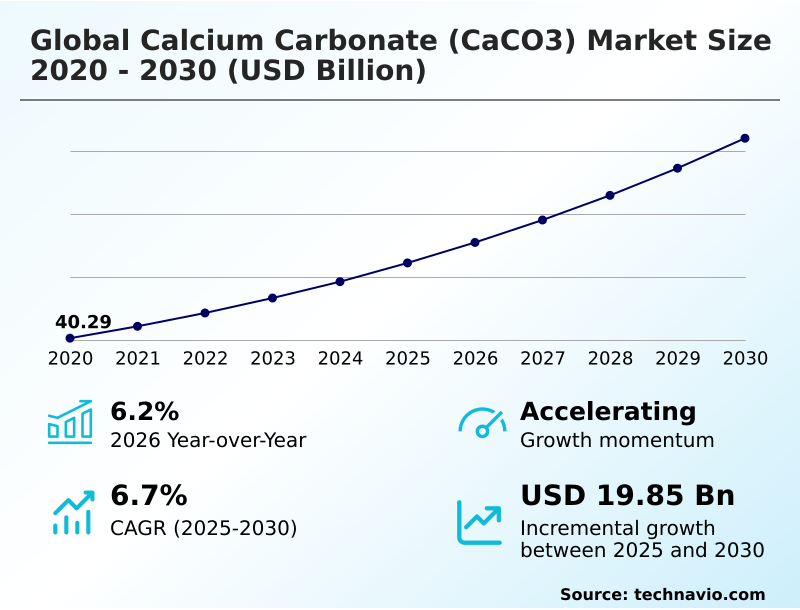
The calcium carbonate (caco3) market size is valued to increase by USD 19.85 billion, at a CAGR of 6.7% from 2025 to 2030. Increasing importance of PCC in paper industry will drive the calcium carbonate (caco3) market.
Major Market Trends & Insights
- APAC dominated the market and accounted for a 50.5% growth during the forecast period.
- By Type - GCC segment was valued at USD 38.86 billion in 2024
- By End-user - Paper segment accounted for the largest market revenue share in 2024
Market Size & Forecast
- Market Opportunities: USD 31.81 billion
- Market Future Opportunities: USD 19.85 billion
- CAGR from 2025 to 2030 : 6.7%
Market Summary
- The Calcium Carbonate (CaCO3) market is defined by the mineral's extensive role as a versatile and cost-effective material across numerous industrial sectors. As a functional filler and extender pigment, it is integral to the manufacturing of products in the paper, plastics, paints, and construction industries.
- Its prominence is driven by the ability to enhance physical properties such as brightness, stiffness, and durability while simultaneously reducing formulation costs. Key market dynamics include a growing emphasis on high-purity and surface-treated grades that offer specialized performance benefits.
- For instance, a plastics compounder may leverage an engineered surface-treated calcium carbonate to increase the filler loading in its PVC pipe formulation. This strategic material selection allows for a significant reduction in reliance on more expensive polymer resins, leading to improved operational efficiency and a more competitive cost structure, even after accounting for the necessary adjustments to processing parameters.
What will be the Size of the Calcium Carbonate (caco3) Market during the forecast period?
Get Key Insights on Market Forecast (PDF) Get Free Sample
How is the Calcium Carbonate (caco3) Market Segmented?
The calcium carbonate (caco3) industry research report provides comprehensive data (region-wise segment analysis), with forecasts and estimates in "USD million" for the period 2026-2030, as well as historical data from 2020-2024 for the following segments.
- Type
- GCC
- PCC
- End-user
- Paper
- Plastic
- Paint
- Adhesive and sealant
- Others
- Application
- Automotive
- Building and construction
- Agriculture
- Geography
- APAC
- China
- India
- Japan
- North America
- US
- Canada
- Mexico
- Europe
- Germany
- France
- UK
- Middle East and Africa
- South Africa
- Saudi Arabia
- Turkey
- South America
- Brazil
- Argentina
- Rest of World (ROW)
- APAC
By Type Insights
The gcc segment is estimated to witness significant growth during the forecast period.
The Calcium Carbonate (CaCO3) market is primarily segmented by its two principal forms: ground calcium carbonate (GCC) and precipitated calcium carbonate (PCC), each serving distinct industrial purposes.
GCC, produced through mechanical limestone grinding, is valued for its cost-effectiveness as a bulk mineral additive, making it a staple in high-volume industries.
In contrast, PCC is a synthetic mineral manufactured via a controlled chemical precipitation process, which allows for precise engineering of particle size distribution and crystal structure.
This makes PCC a preferred high-purity calcium carbonate for pharmaceuticals and premium paper coatings, where it can improve opacity by up to 5%.
The strategic choice between GCC and PCC depends on the required performance characteristics and the economic constraints of the final application.
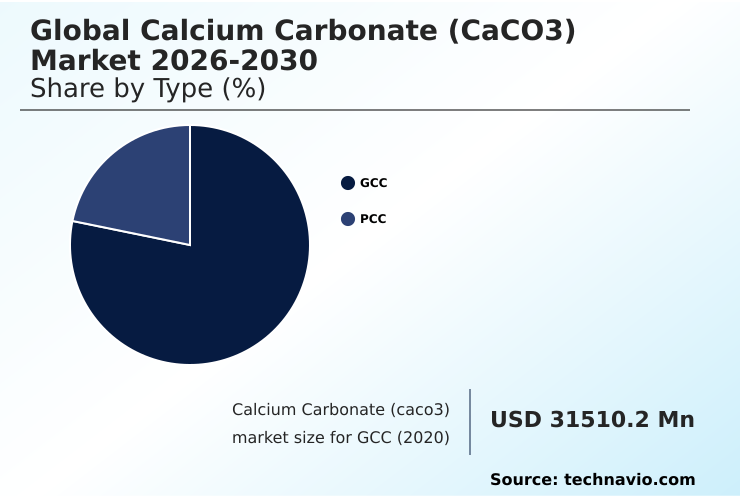
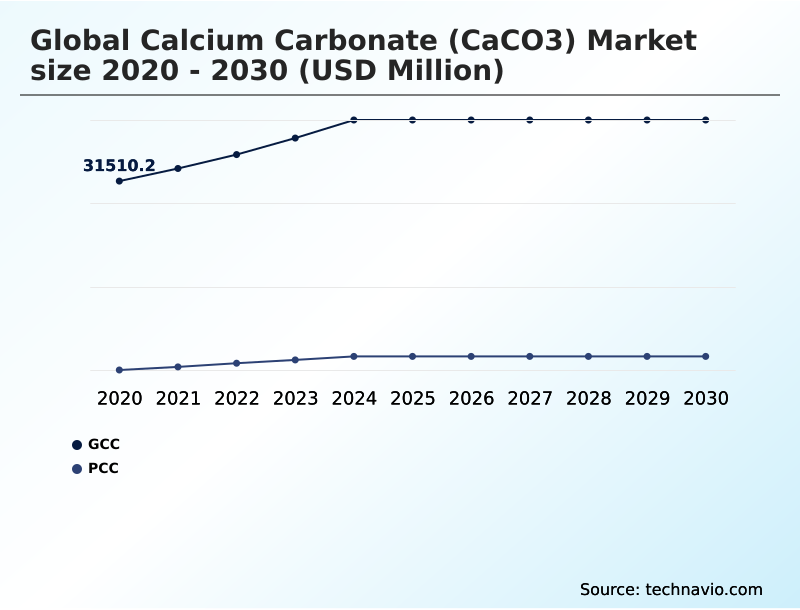
The GCC segment was valued at USD 38.86 billion in 2024 and showed a gradual increase during the forecast period.
Regional Analysis
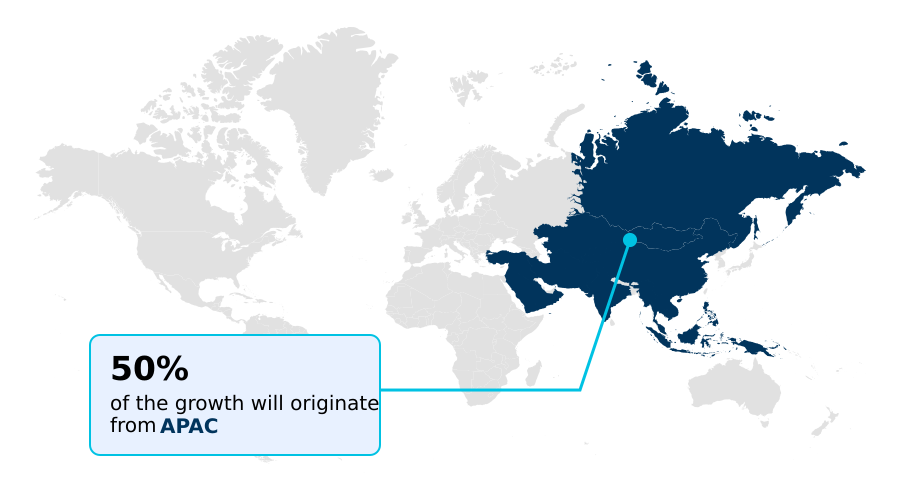
APAC is estimated to contribute 50.5% to the growth of the global market during the forecast period.Technavio’s analysts have elaborately explained the regional trends and drivers that shape the market during the forecast period.
See How Calcium Carbonate (caco3) Market Demand is Rising in APAC Get Free Sample
The geographic landscape of the market is led by APAC, which accounts for 50.5% of the incremental growth, driven by rapid industrialization and large-scale manufacturing in countries like China and India.
This region's demand is heavily centered on high-volume applications such as paper and construction, where ground calcium carbonate (GCC) is a primary input.
In contrast, North America and Europe represent mature markets focused on high-value applications requiring specialty mineral products and precipitated calcium carbonate (PCC).
The deployment of on-site satellite PCC plant models in APAC has proven to reduce logistics costs by over 20% compared to traditional supply chains.
This efficiency underscores the differing regional dynamics, with APAC focused on scale and cost, while western markets prioritize technological advancement and specialized, high-purity calcium carbonate for pharmaceuticals.
Market Dynamics
Our researchers analyzed the data with 2025 as the base year, along with the key drivers, trends, and challenges. A holistic analysis of drivers will help companies refine their marketing strategies to gain a competitive advantage.
- Strategic decision-making in industries utilizing calcium carbonate involves a complex evaluation of material science and economic trade-offs. A product development team, for example, must weigh the impact of PCC on paper brightness against the cost-benefit of GCC in paints. This analysis extends to manufacturing, where the benefits of surface-treated CaCO3 in polymers for improving dispersion and mechanical properties are assessed.
- The role of calcium carbonate in plastic lightweighting is critical for the automotive sector, where every gram of weight reduction contributes to fuel efficiency. Simultaneously, the use of CaCO3 as a soil amendment agent in agriculture highlights its environmental applications.
- When considering the adoption of new materials, a key comparison is ground vs precipitated calcium carbonate, with PCC offering superior purity and brightness for high-end applications. For instance, companies that utilize high-purity calcium carbonate for pharmaceuticals face regulatory and processing costs that are nearly double those for firms producing industrial-grade CaCO3 for construction.
- This significant cost differential underscores the importance of application-specific material selection and the diverse value chains within the broader market. The health effects of CaCO3 dust exposure also factor into operational planning, necessitating investment in safety protocols. Ultimately, understanding CaCO3s role in adhesives and sealants and its interactions within various formulations is crucial for innovation and market positioning.
What are the key market drivers leading to the rise in the adoption of Calcium Carbonate (caco3) Industry?
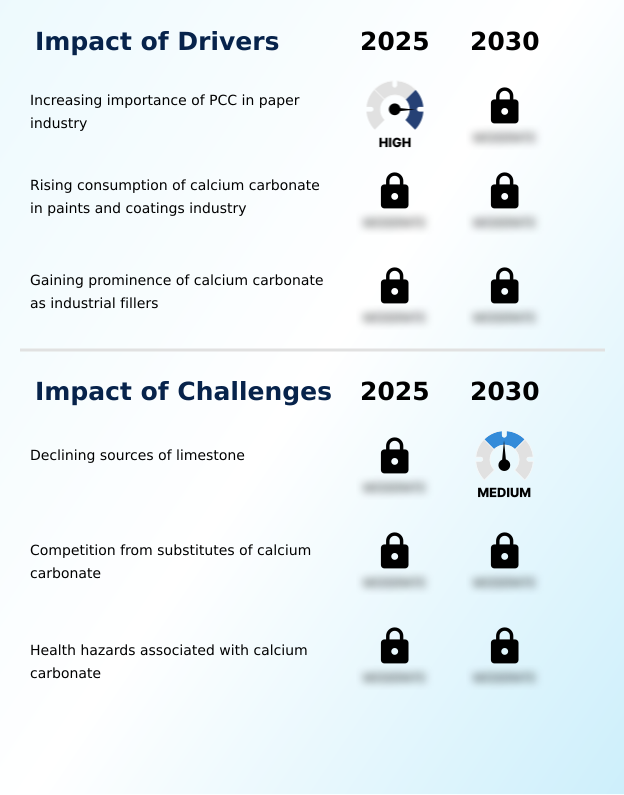
- The increasing importance of precipitated calcium carbonate (PCC) in the paper industry stands as a key driver for market growth.
- Market growth is significantly propelled by the increasing importance of PCC in the paper industry and its rising consumption in paints and coatings.
- In papermaking, the adoption of on-site satellite PCC plant technology allows mills to enhance sheet brightness by 3 points while reducing associated logistics costs. This underscores the material's dual benefit of performance improvement and economic efficiency.
- In the coatings sector, high-brightness calcium carbonate serves as a cost-effective extender pigment. By replacing a portion of expensive titanium dioxide, paint formulators can lower raw material costs by 10% to 15% without compromising opacity.
- The gaining prominence of calcium carbonate as industrial fillers, particularly as a functional filler in plastics and a mineral additive in adhesives, further solidifies its role as an essential component in modern manufacturing, driving steady demand across multiple high-volume industries.
What are the market trends shaping the Calcium Carbonate (caco3) Industry?
- A significant upcoming market trend is the growing demand from the construction industry, driven by the extensive use of calcium carbonate in a wide array of building and infrastructure materials.
- Key trends are reshaping the market, driven by sustainability and advanced material science. A primary trend is the expanding use of plastics and polymers, where calcium carbonate is a critical functional additive. The integration of calcium carbonate fillers into recycled polymer streams has demonstrated a 20% improvement in tensile strength, enhancing the viability of circular economy initiatives.
- Another major trend is the growing demand from the construction industry for more sustainable materials. The use of ground calcium carbonate (GCC) as a limestone filler in cement has enabled some producers to lower clinker content, resulting in a 5% reduction in associated carbon emissions.
- This move toward environmentally friendly CaCO3 products is also evident in the development of specialized mineral-polymer hybrids that reduce reliance on virgin plastics while improving the mechanical properties of finished goods.
What challenges does the Calcium Carbonate (caco3) Industry face during its growth?
- The declining availability of high-quality limestone sources presents a key challenge affecting the industry's growth trajectory.
- The market faces significant challenges related to raw material sourcing and competitive pressures that affect operational stability. The declining sources of high-quality limestone are a primary concern, forcing producers to explore more remote quarries. This shift has inflated logistics expenses, leading to a 12% increase in raw material procurement costs for some processors and creating supply chain volatility.
- Simultaneously, competition from substitutes of calcium carbonate, such as talc and kaolin, presents a persistent threat. While calcium carbonate remains a cost-effective mineral additive, these substitutes offer specialized properties that appeal to niche, high-value applications.
- This competition for market share in the industrial fillers segment can impact profit margins by as much as 8% in certain applications, compelling producers to innovate and reinforce their value proposition.
Exclusive Technavio Analysis on Customer Landscape
The calcium carbonate (caco3) market forecasting report includes the adoption lifecycle of the market, covering from the innovator’s stage to the laggard’s stage. It focuses on adoption rates in different regions based on penetration. Furthermore, the calcium carbonate (caco3) market report also includes key purchase criteria and drivers of price sensitivity to help companies evaluate and develop their market growth analysis strategies.
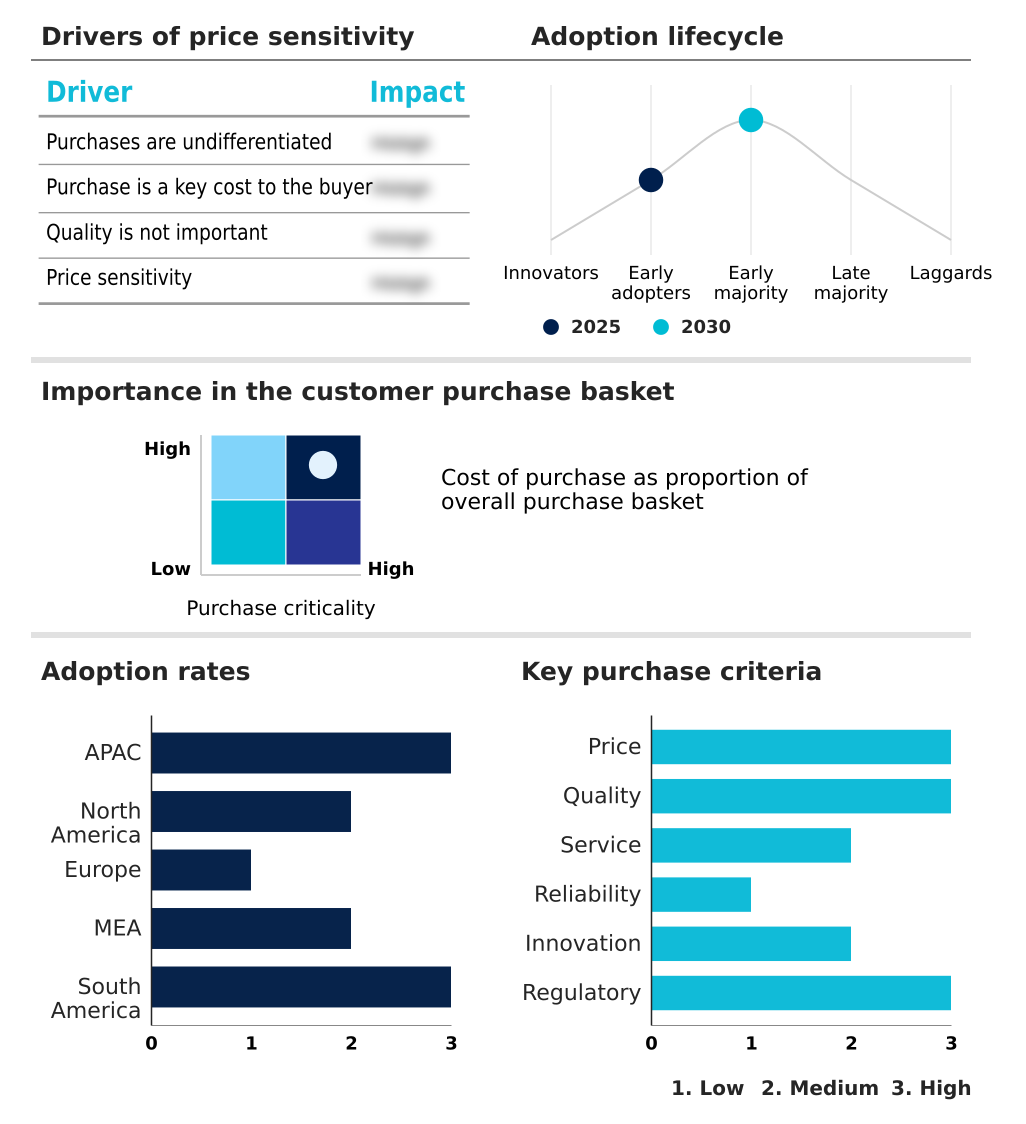
Customer Landscape of Calcium Carbonate (caco3) Industry
Competitive Landscape
Companies are implementing various strategies, such as strategic alliances, calcium carbonate (caco3) market forecast, partnerships, mergers and acquisitions, geographical expansion, and product/service launches, to enhance their presence in the industry.
ACCM - Offerings include high-purity ground and coated calcium carbonate, providing essential mineral additives for performance enhancement in the paint and plastics industries.
The industry research and growth report includes detailed analyses of the competitive landscape of the market and information about key companies, including:
- ACCM
- Carmeuse SA
- Gulshan Polyols Ltd.
- Imerys S.A.
- Israel Chemicals Ltd.
- J M Huber Corp.
- Jordan Carbonate Co.
- Lhoist SA
- Manaseer Group
- Maruo Calcium Co. Ltd.
- Minerals Technologies Inc.
- Mississippi Lime Co.
- Nordkalk Corp.
- Omya International AG
- Schaefer Kalk GmbH and Co. KG
- SCR Sibelco NV
- Shiraishi Kogyo Kaisha Ltd.
Qualitative and quantitative analysis of companies has been conducted to help clients understand the wider business environment as well as the strengths and weaknesses of key industry players. Data is qualitatively analyzed to categorize companies as pure play, category-focused, industry-focused, and diversified; it is quantitatively analyzed to categorize companies as dominant, leading, strong, tentative, and weak.
Recent Development and News in Calcium carbonate (caco3) market
- In May 2025, Minerals Technologies Inc finalized a major contract to deploy its latest generation of satellite precipitated calcium carbonate plants at a large scale paper mill.
- In April 2025, AkzoNobel established a strategic partnership with a leading mineral producer to secure a long term supply of ultra pure calcium carbonate for its new line of carbon neutral architectural coatings.
- In March 2025, Huber Engineered Materials introduced a new range of surface modified calcium carbonate particles intended to optimize the performance of recycled polyolefins.
- In February 2025, Omya successfully completed the expansion of its ultra fine grinding facility in the Americas to meet the surging demand for high quality mineral fillers.
Dive into Technavio’s robust research methodology, blending expert interviews, extensive data synthesis, and validated models for unparalleled Calcium Carbonate (caco3) Market insights. See full methodology.
| Market Scope | |
|---|---|
| Page number | 297 |
| Base year | 2025 |
| Historic period | 2020-2024 |
| Forecast period | 2026-2030 |
| Growth momentum & CAGR | Accelerate at a CAGR of 6.7% |
| Market growth 2026-2030 | USD 19846.1 million |
| Market structure | Fragmented |
| YoY growth 2025-2026(%) | 6.2% |
| Key countries | China, India, Japan, South Korea, Indonesia, Australia, US, Canada, Mexico, Germany, France, UK, Italy, Spain, The Netherlands, South Africa, Saudi Arabia, Turkey, UAE, Israel, Brazil, Argentina and Chile |
| Competitive landscape | Leading Companies, Market Positioning of Companies, Competitive Strategies, and Industry Risks |
Research Analyst Overview
- The Calcium Carbonate (CaCO3) market's significance extends far beyond its role as a simple limestone filler; it is a critical functional filler and extender pigment that enables innovation across diverse industries.
- The market's dynamism is rooted in the distinction between ground calcium carbonate (GCC) and precipitated calcium carbonate (PCC), with PCC offering engineered properties like controlled particle size distribution and high purity. This allows for its use in demanding applications such as high-quality paper coatings and pharmaceutical-grade CaCO3.
- The adoption of mineral-polymer hybrids and specialized mineral additives is transforming product formulations in plastics and paints. A key boardroom-level decision involves navigating the supply chain and compliance complexities when sourcing food-grade calcium carbonate versus industrial grades for construction.
- For example, employing precipitated calcium carbonate (PCC) as a coating pigment in paper manufacturing can enhance sheet opacity, reducing the need for expensive wood pulp by up to 15%. This demonstrates how strategic material selection directly impacts both product performance and operational profitability.
What are the Key Data Covered in this Calcium Carbonate (caco3) Market Research and Growth Report?
-
What is the expected growth of the Calcium Carbonate (caco3) Market between 2026 and 2030?
-
USD 19.85 billion, at a CAGR of 6.7%
-
-
What segmentation does the market report cover?
-
The report is segmented by Type (GCC, and PCC), End-user (Paper, Plastic, Paint, Adhesive and sealant, and Others), Application (Automotive, Building and construction, and Agriculture) and Geography (APAC, North America, Europe, Middle East and Africa, South America)
-
-
Which regions are analyzed in the report?
-
APAC, North America, Europe, Middle East and Africa and South America
-
-
What are the key growth drivers and market challenges?
-
Increasing importance of PCC in paper industry, Declining sources of limestone
-
-
Who are the major players in the Calcium Carbonate (caco3) Market?
-
ACCM, Carmeuse SA, Gulshan Polyols Ltd., Imerys S.A., Israel Chemicals Ltd., J M Huber Corp., Jordan Carbonate Co., Lhoist SA, Manaseer Group, Maruo Calcium Co. Ltd., Minerals Technologies Inc., Mississippi Lime Co., Nordkalk Corp., Omya International AG, Schaefer Kalk GmbH and Co. KG, SCR Sibelco NV and Shiraishi Kogyo Kaisha Ltd.
-
Market Research Insights
- The market is shaped by a dual focus on performance enhancement and cost optimization, with the adoption of precipitated calcium carbonate (PCC) in lightweight composites leading to a 10% reduction in vehicle component weight. Concurrently, the use of ground calcium carbonate (GCC) as a functional filler allows manufacturers to decrease their reliance on expensive polymer resins by up to 25%.
- This economic advantage is particularly evident in the paints and coatings industry, where high-brightness calcium carbonate serves as an effective extender pigment, reducing the need for costly titanium dioxide. The development of specialized precipitated calcium carbonate and mineral-polymer hybrids further supports this trend, enabling higher filler loading without compromising product integrity.
- This strategic use of industrial fillers is central to improving manufacturing processability and achieving significant material cost savings across multiple sectors.
We can help! Our analysts can customize this calcium carbonate (caco3) market research report to meet your requirements.
 RIA -
RIA - 
