


Canada Arc Welding Robots Market Size and Growth Forecast 2026-2030
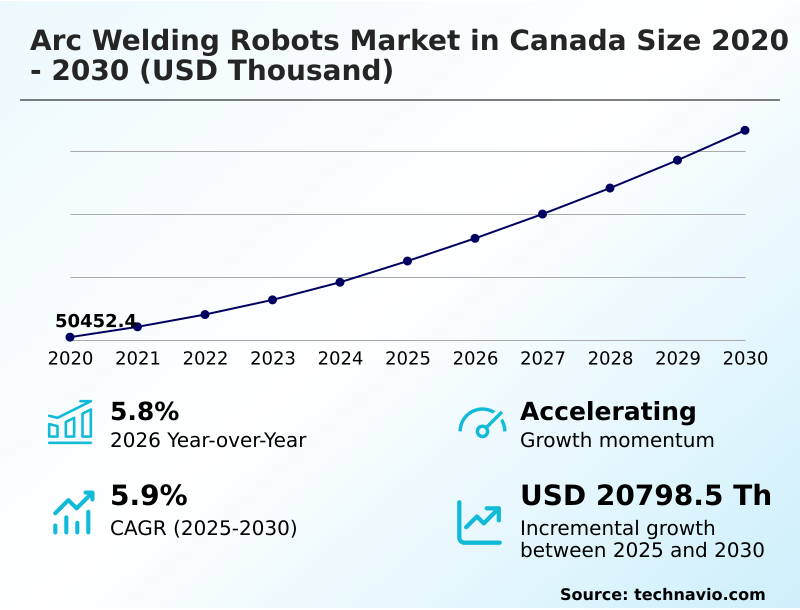
The Canada Arc Welding Robots Market size was valued at USD 62.56 million in 2025 growing at a CAGR of 5.9% during the forecast period 2026-2030.
The Automotive segment by Application was valued at USD 25.19 million in 2024, while the Consumable method segment holds the largest revenue share by Product.
The market is projected to grow by from 2020 to 2030, with USD 20.80 million of the growth expected during the forecast period of 2025 to 2030.
Get Key Insights on Market Forecast (PDF) Request Free Sample
Canada Arc Welding Robots Market Overview
The arc welding robots market in Canada is defined by a push for greater manufacturing resilience and efficiency. A persistent shortage of skilled labor, coupled with increasingly stringent occupational health and safety standards under bodies like the Canadian Centre for Occupational Health and Safety (CCOHS), compels fabricators to invest in automation. This transition is supported by advancements in AI-driven machine vision and adaptive algorithms, which enable robots to handle variations in part fit-up without manual intervention. For instance, a medium-sized structural steel fabrication shop deploying a robotic welding cell with integrated seam tracking for high-mix low-volume production typically achieves a significant reduction in rework by ensuring consistent weld quality across complex joints. This adoption of intelligent systems, including automated inspection and predictive maintenance, allows facilities to maintain production schedules, which are often interrupted by workforce turnover. With a year-over-year growth of 5.8%, the market reflects a clear trend toward leveraging robotic welding for superior structural integrity and operational flexibility, moving beyond simple automation to intelligent, data-driven manufacturing.
Drivers, Trends, and Challenges in the Canada Arc Welding Robots Market
The trajectory of the arc welding robots market in Canada is heavily influenced by the drive for greater productivity in high-mix, low-volume production environments. Integrating robotic welding systems for short production runs requires sophisticated offline programming capabilities to minimize downtime between part changeovers.
Advancements in AI-powered welding robot programming are critical, enabling systems to autonomously generate weld paths from CAD models, which addresses the complexity of custom metal fabrication. In practice, a custom fabrication shop using AI-driven path planning can reduce programming time by over 70% compared to manual teach pendant methods.
Furthermore, the selection of an optimal welding robot payload capacity is a key decision; while medium-payload robots are versatile, heavy-duty robots are essential for large structural steel fabrication, where end-of-arm tooling is substantial.
The choice between gas metal arc welding (GMAW) vs gas tungsten arc welding (GTAW) robots depends entirely on application-specific requirements for speed versus precision, a trade-off that manufacturers must balance.
Adherence to standards like ISO 3834 for quality requirements in fusion welding of metallic materials is becoming a key vendor qualification criterion, pushing companies toward automated systems that offer superior process control and traceability.
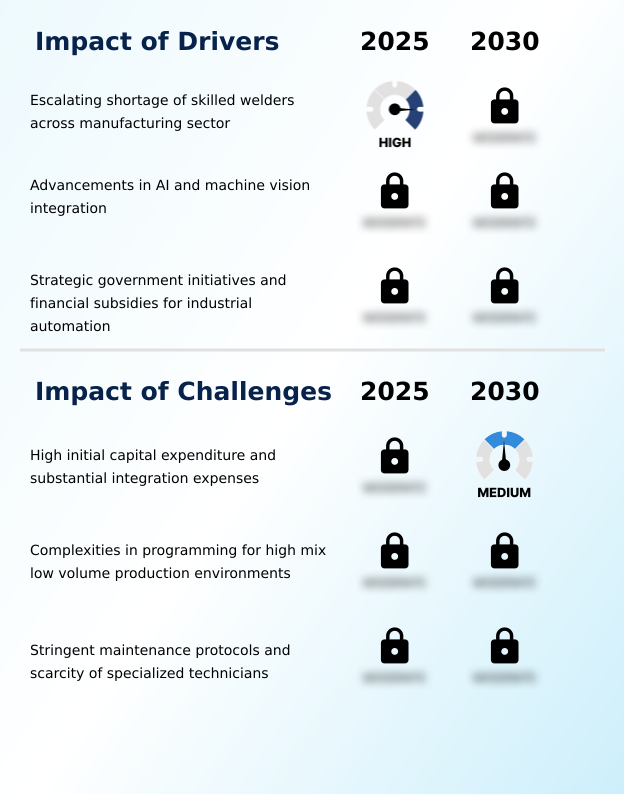
Primary Growth Driver: The escalating shortage of skilled welders across the manufacturing sector is a primary driver compelling enterprises to adopt automated solutions to ensure operational continuity and quality.
Market growth is fundamentally driven by an escalating shortage of skilled welders, compelling manufacturers to adopt automation to maintain production continuity and quality standards.
This labor gap makes investments in robotic systems a necessity for survival in a competitive global market. Technological advancements, particularly the integration of artificial intelligence and machine vision, are another powerful driver.
Modern robots equipped with optical sensors and adaptive algorithms can dynamically adjust weld parameters and paths in real-time, compensating for variations and ensuring high weld quality without human intervention. This capability is enhanced by sophisticated offline programming software.
Furthermore, strategic government initiatives, including financial subsidies and tax incentives, are critical in mitigating the high upfront costs of automation, making arc welding robots more accessible to smaller enterprises and accelerating industrial modernization.
Emerging Market Trend: The emergence of collaborative welding robots is reshaping the market, providing small and medium-sized enterprises with unprecedented flexibility and accessibility to automation.
Key trends are democratizing access to advanced automation. The emergence of collaborative welding robots, or cobots, is particularly impactful for small and medium enterprises, which can now integrate automated systems without extensive safety caging or facility redesigns. These systems feature intuitive robotic programming that allows operators with minimal experience to teach new weld paths quickly, crucial for high-mix production.
Concurrently, the shift toward robotics-as-a-service (RaaS) business models is alleviating the high capital expenditure traditionally associated with industrial robots. This allows fabricators to align operational costs with revenue, scaling their automation capabilities based on project demand.
Another significant trend is the focus on energy efficient welding and sustainable manufacturing, with modern robots incorporating power-saving modes and regenerative braking to reduce electricity consumption and comply with environmental mandates.
Key Industry Challenge: The high initial capital expenditure and substantial integration expenses for automated systems represent a significant challenge affecting the industry's growth, particularly for smaller enterprises.
Despite strong drivers, significant challenges constrain market growth. The high initial capital expenditure for a complete automated welding cell, including peripheral equipment like robotic positioners and safety enclosures, remains a primary barrier, especially for smaller businesses. Beyond the hardware, substantial integration expenses and the need for specialized engineering resources add to the total cost of ownership.
Another major challenge is the complexity of robotic programming for high-mix, low-volume production. Frequent reprogramming for different parts can create significant downtime, negating the efficiency gains of automation.
Finally, there is a pronounced scarcity of specialized technicians who can perform the stringent maintenance required for these complex systems, leading to fears of prolonged downtime and creating a persistent operational risk for manufacturers.
Explore Full Market Dynamics Analysis Request Free Sample
Canada Arc Welding Robots Market Segmentation
The canada arc welding robots industry research report provides comprehensive data including region-wise segment analysis, with forecasts and analysis for the period 2026-2030, as well as historical data from 2020-2024 for the following segments.
Application Segment Analysis
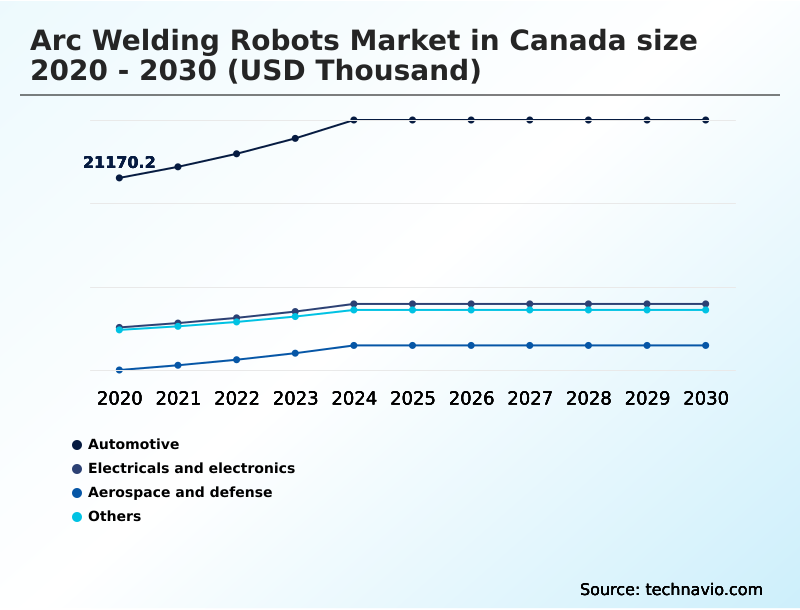
The automotive segment is estimated to witness significant growth during the forecast period.
The automotive sector commands the largest share of the arc welding robots market in Canada, a dominance driven by the industry's stringent requirements for precision and throughput.
The transition to electric vehicle manufacturing, with its focus on lightweighting through aluminum alloys and advanced high-strength steels, necessitates the consistent weld quality that only automated systems can provide.
In practice, fabricators of battery enclosures and vehicle chassis deploy robotic welding cells to achieve flawless structural integrity, a critical safety and performance factor.
This segment's demand is reflected in its significant market size, which stood at over USD 25,000 thousand in 2024.
The use of through-arm cable routing on modern robots minimizes interference and wear, essential for complex weld paths on vehicle frames, while advanced collision detection ensures uptime in high-volume assembly lines.
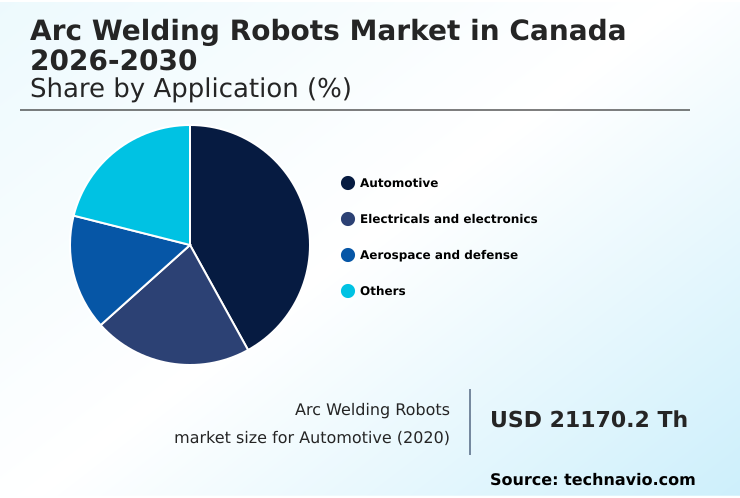
The Automotive segment was valued at USD 25.19 million in 2024 and showed a gradual increase during the forecast period.
Customer Landscape Analysis for the Canada Arc Welding Robots Market
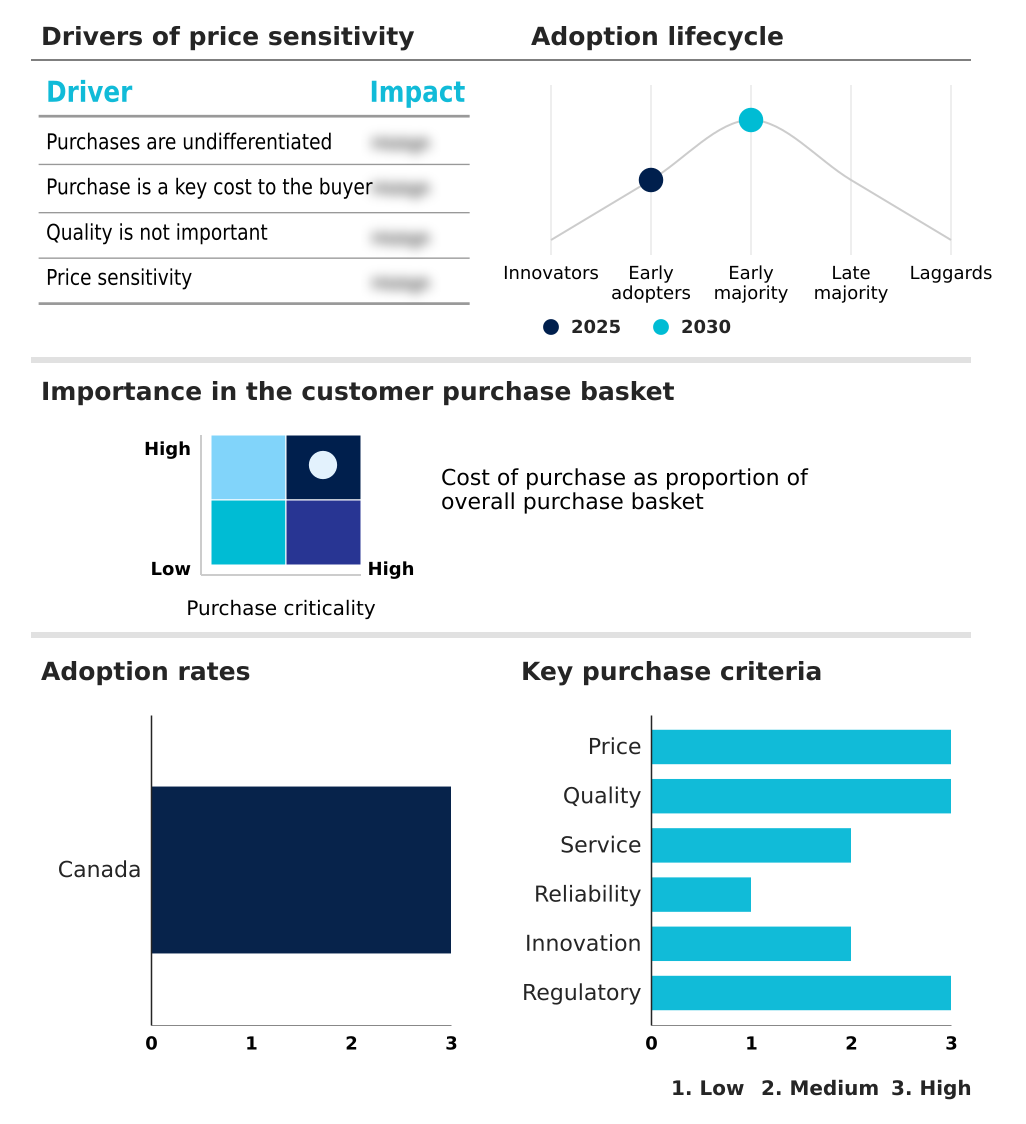
The canada arc welding robots market forecasting report includes the adoption lifecycle of the market, covering from the innovator’s stage to the laggard’s stage. It focuses on adoption rates in different regions based on penetration. Furthermore, the canada arc welding robots market report also includes key purchase criteria and drivers of price sensitivity to help companies evaluate and develop their market growth analysis strategies.
Competitive Landscape of the Canada Arc Welding Robots Market
Companies are implementing various strategies, such as strategic alliances, partnerships, mergers and acquisitions, geographical expansion, and product/service launches, to enhance their presence in the canada arc welding robots market industry.
ABB Ltd. - Key offerings include advanced arc welding robots featuring integrated dress packs, which are designed to minimize cable wear and enhance accessibility for complex manufacturing and fabrication tasks.
The industry research and growth report includes detailed analyses of the competitive landscape of the market and information about key companies, including:
- ABB Ltd.
- AGT Robotics
- Carl Cloos Schweißtechnik GmbH
- Comau SpA
- FANUC Corp.
- Fronius International GmbH
- HD Hyundai Robotics
- Hirebotics
- IGM Robotersysteme AG
- IPG Photonics Corp.
- Kawasaki Robotics USA, Inc.
- KUKA AG
- Miller Electric Mfg. LLC
- Nachi Robotic Systems Inc
- Novarc Technologies
- OTC Daihen.
- Path Robotics
- Promation
- The Lincoln Electric Co.
- Yaskawa Electric Corp.
Qualitative and quantitative analysis of companies has been conducted to help clients understand the wider business environment as well as the strengths and weaknesses of key industry players. Data is qualitatively analyzed to categorize companies as pure play, category-focused, industry-focused, and diversified; it is quantitatively analyzed to categorize companies as dominant, leading, strong, tentative, and weak.
Recent Developments in the Canada Arc Welding Robots Market
- In March 2025, Seaspan Shipyards announced a USD 5 million investment in Novarc Technologies Inc. to support the development and commercialization of AI-driven robotic welding solutions aimed at improving productivity and quality in industrial manufacturing.
- In January 2025, ABB Ltd. expanded its large industrial robot portfolio by introducing the IRB 6730S, IRB 6750S, and IRB 6760 models, which are powered by the OmniCore controller to deliver enhanced performance and sustainability for heavy fabrication tasks.
- In October 2024, Novarc Technologies Inc. launched its SWR TIPTIG Autonomy system, described as the world's first fully autonomous TIG welding system, at its new headquarters in Burnaby, enhancing capabilities for high-precision welding.
- In September 2024, FANUC Corp. showcased its latest advancements in robotic welding, industrial painting, and collaborative automation at FABTECH 2025, with solutions designed to help manufacturers address labor shortages and improve operational flexibility.
Research Analyst Overview: Canada Arc Welding Robots Market
Operational realities in Canadian manufacturing, primarily the persistent shortage of certified welders, anchor the business case for arc welding robots. This is not merely about replacing labor but about achieving a level of weld quality and consistency that is difficult to sustain manually, a critical factor for compliance with standards like ISO 9001.
The automotive sector, which remains the dominant application, leverages these systems for joining advanced materials in EV chassis, where structural integrity is non-negotiable. A key boardroom consideration is the total cost of ownership, extending beyond the robotic arm to include robotic positioners, safety systems, and the complex integration of end-of-arm tooling.
Decisions are increasingly influenced by the availability of user-friendly robotic programming interfaces that reduce the reliance on specialized technicians. With the automotive segment representing a significant portion of the market, manufacturers are prioritizing automated welding cells that incorporate advanced seam tracking and through-arm cable designs to maximize uptime and reduce maintenance on the factory floor.
Dive into Technavio’s robust research methodology, blending expert interviews, extensive data synthesis, and validated models for unparalleled Canada Arc Welding Robots Market insights. See full methodology.
| Market Scope | |
|---|---|
| Page number | 184 |
| Base year | 2025 |
| Historic period | 2020-2024 |
| Forecast period | 2026-2030 |
| Growth momentum & CAGR | Accelerate at a CAGR of 5.9% |
| Market growth 2026-2030 | USD 20798.5 thousand |
| Market structure | Fragmented |
| YoY growth 2025-2026(%) | 5.8% |
| Key countries | Canada |
| Competitive landscape | Leading Companies, Market Positioning of Companies, Competitive Strategies, and Industry Risks |
Canada Arc Welding Robots Market: Key Questions Answered in This Report
-
What is the expected growth of the Canada Arc Welding Robots Market between 2026 and 2030?
-
The Canada Arc Welding Robots Market is expected to grow by USD 20.80 million during 2026-2030, registering a CAGR of 5.9%. Year-over-year growth in 2026 is estimated at 5.8%%. This acceleration is shaped by escalating shortage of skilled welders across manufacturing sector, which is intensifying demand across multiple end-use verticals covered in the report.
-
-
What segmentation does the market report cover?
-
The report is segmented by Application (Automotive, Electricals and electronics, Aerospace and defense, and Others), Product (Consumable method, and Non consumable method), Type (50-150 kilograms, and Greater than 150 kilograms) and Geography (North America). Among these, the Automotive segment is estimated to witness significant growth during the forecast period, driven by rising adoption across key application areas. Each segment includes detailed qualitative and quantitative analysis, along with historical data from 2020-2024 and forecasts through 2030 with year-over-year growth rates.
-
-
Which regions are analyzed in the report?
-
The report covers North America. Country-level analysis includes Canada, with dedicated market size tables and year-over-year growth for each.
-
-
What are the key growth drivers and market challenges?
-
The primary driver is escalating shortage of skilled welders across manufacturing sector, which is accelerating investment and industry demand. The main challenge is high initial capital expenditure and substantial integration expenses, creating operational barriers for key market participants. The report quantifies the impact of each driver and challenge across 2026 and 2030 with comparative analysis.
-
-
Who are the major players in the Canada Arc Welding Robots Market?
-
Key vendors include ABB Ltd., AGT Robotics, Carl Cloos Schweißtechnik GmbH, Comau SpA, FANUC Corp., Fronius International GmbH, HD Hyundai Robotics, Hirebotics, IGM Robotersysteme AG, IPG Photonics Corp., Kawasaki Robotics USA, Inc., KUKA AG, Miller Electric Mfg. LLC, Nachi Robotic Systems Inc, Novarc Technologies, OTC Daihen., Path Robotics, Promation, The Lincoln Electric Co. and Yaskawa Electric Corp.. The report provides qualitative and quantitative analysis categorizing companies as dominant, leading, strong, tentative, and weak based on their market positioning. Company profiles include business segment analysis, SWOT assessment, key offerings, and recent strategic developments.
-
Canada Arc Welding Robots Market Research Insights
Market dynamics are increasingly shaped by the need for operational flexibility and cost management. While consumable methods like gas metal arc welding (GMAW) dominate due to speed and cost-effectiveness, accounting for over 65% of the market in 2024, non-consumable methods such as gas tungsten arc welding (GTAW) are gaining ground in high-value applications.
This shift is tied to demands for superior weld quality in sectors adhering to strict standards like ISO 9001. A key operational reality is the management of the total cost of ownership, where businesses evaluate not just the robotic arm but also the peripheral equipment and integration costs.
The rise of robotics-as-a-service (RaaS) models directly addresses this, allowing smaller fabricators to adopt advanced automation without prohibitive upfront capital, aligning expenditures with project-based revenue and mitigating technology obsolescence risks.
We can help! Our analysts can customize this canada arc welding robots market research report to meet your requirements.
 RIA -
RIA - 
