
Containerboard Market Analysis, Size, and Forecast 2026-2030: APAC (China, Japan, and India), Europe (Germany, UK, and France), North America (US, Canada, and Mexico), South America (Brazil, Argentina, and Chile), Middle East and Africa (Turkey, Saudi Arabia, and South Africa), and Rest of World (ROW)

Containerboard Market Analysis, Size, and Forecast 2026-2030:
APAC (China, Japan, and India), Europe (Germany, UK, and France), North America (US, Canada, and Mexico), South America (Brazil, Argentina, and Chile), Middle East and Africa (Turkey, Saudi Arabia, and South Africa), and Rest of World (ROW)

Published: Oct 2026 300 Pages SKU: IRTNTR40895

Market Overview at a Glance

$26.64 B
Market Opportunity
2.9%
CAGR 2025 - 2030
52%
APAC Growth
$62.45 B
Food and beverages segment 2024

Containerboard Market Size 2026-2030

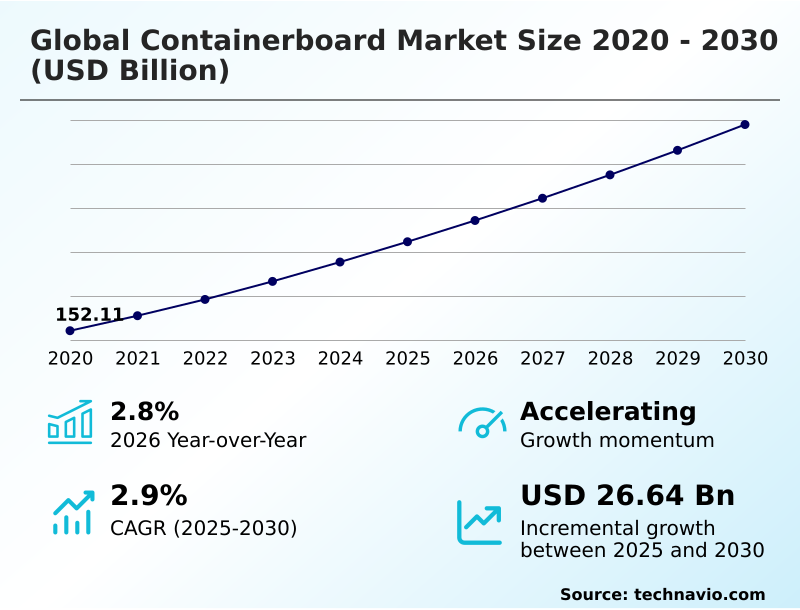
The containerboard market size is valued to increase by USD 26.64 billion, at a CAGR of 2.9% from 2025 to 2030. E-commerce sector expansion accelerates corrugated box demand will drive the containerboard market.

Major Market Trends & Insights

  • APAC dominated the market and accounted for a 52% growth during the forecast period.
  • By End-user - Food and beverages segment was valued at USD 62.45 billion in 2024
  • By Product - Recycled segment accounted for the largest market revenue share in 2024

Market Size & Forecast

  • Market Opportunities: USD 46.86 billion
  • Market Future Opportunities: USD 26.64 billion
  • CAGR from 2025 to 2030 : 2.9%

Market Summary

  • The Containerboard Market operates as the foundational infrastructure for modern supply chains, providing essential structural packaging materials required for industrial and commercial transit. Facilities worldwide continuously refine raw fiber inputs to manufacture resilient linerboard and fluting mediums capable of withstanding extreme logistical stress.
  • In a practical supply chain scenario, automated e-commerce fulfillment centers utilize standardized, high-strength corrugated boxes to ensure seamless operation of robotic handling systems, preventing transit damage across high-velocity sorting lines. This operational integration has allowed high-volume distributors to achieve a 20% reduction in product loss rates compared to legacy shipping methods.
  • The rapid expansion of direct-to-consumer retail serves as a primary demand driver, as customized parcel shipping inherently requires higher square footage of protective boarding per shipped unit. Conversely, intense price fluctuations in recovered paper and old corrugated container streams present a formidable operational challenge, severely compressing manufacturing margins and complicating long-term capital expenditure planning for integrated mills.
  • By maintaining rigorous production standards and adapting to circular economy policies, paper producers ensure uninterrupted material flow across intricate global distribution networks.

What will be the Size of the Containerboard Market during the forecast period?
Get Key Insights on Market Forecast (PDF) Get Free Sample

How is the Containerboard Market Segmented?

The containerboard industry research report provides comprehensive data (region-wise segment analysis), with forecasts and estimates in "USD million" for the period 2026-2030, as well as historical data from 2020-2024 for the following segments.

  • End-user
    • Food and beverages
    • Consumer goods
    • Industrial
    • Others
  • Product
    • Recycled
    • Virgin
  • Product type
    • Linerboard
    • Corrugating medium
  • Geography
    • APAC
      • China
      • Japan
      • India
      • South Korea
      • Indonesia
      • Australia
    • Europe
      • Germany
      • UK
      • France
      • Italy
      • Spain
      • The Netherlands
    • North America
      • US
      • Canada
      • Mexico
    • South America
      • Brazil
      • Argentina
      • Chile
    • Middle East and Africa
      • Turkey
      • Saudi Arabia
      • South Africa
      • UAE
      • Israel

By End-user Insights

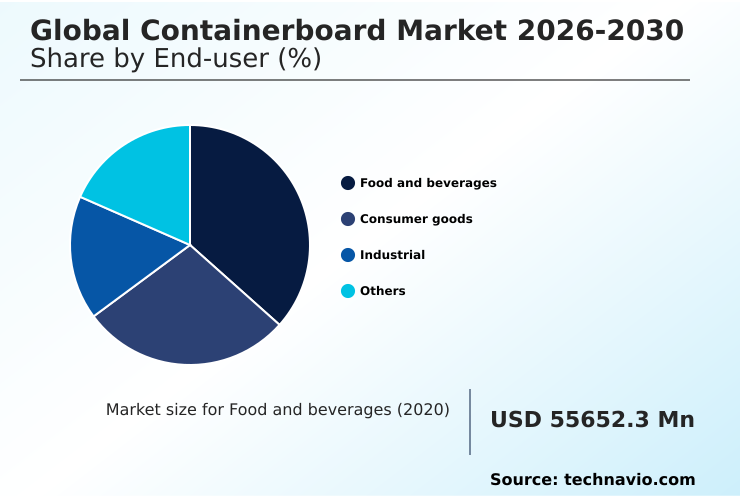
The food and beverages segment is estimated to witness significant growth during the forecast period.

The food and beverages segment necessitates highly specialized protective layers to ensure continuous cold-chain logistics protection and structural integrity across complex distribution networks.

Food processors are aggressively transitioning toward circular economy packaging, replacing rigid plastics with high-compression fluting profiles and recycled corrugated medium to achieve single-use plastic displacement targets.

This structural evolution relies heavily on semi-chemical wood pulp and unbleached softwood kraftliner, which together deliver a 25% improvement in burst resistance under high-humidity transit conditions compared to legacy packaging formats.

By integrating advanced microfibrillated cellulose additives, packaging converters can significantly enhance structural moisture barriers without compromising weight.

These material optimizations enable businesses to reduce total transit damage by 18%, streamlining operations across the demanding omnichannel retail supply and ensuring fresh produce arrives intact at destination facilities.
Get Free Sample

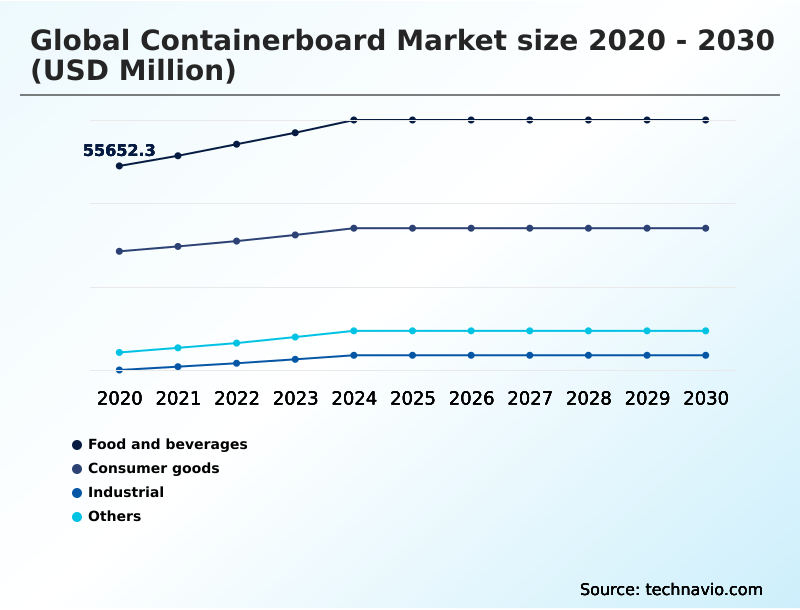
The Food and beverages segment was valued at USD 62.45 billion in 2024 and showed a gradual increase during the forecast period.
Get Free Sample

Regional Analysis

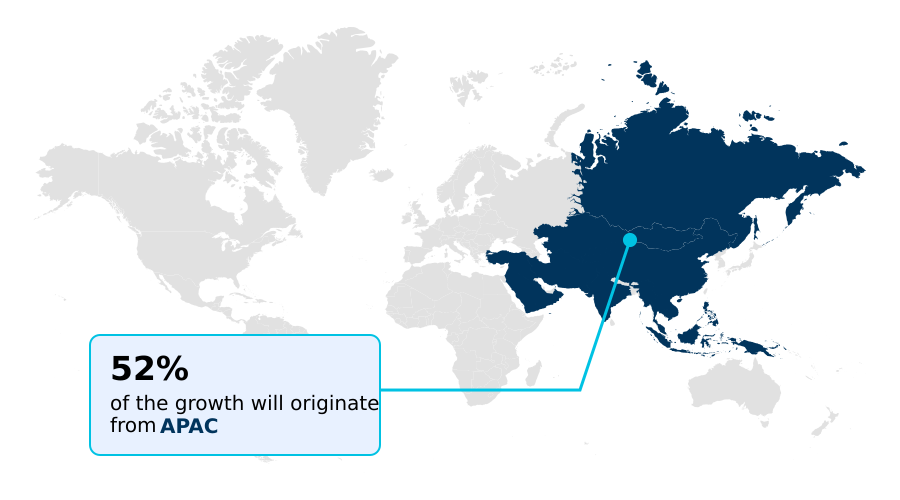
APAC is estimated to contribute 52% to the growth of the global market during the forecast period.Technavio’s analysts have elaborately explained the regional trends and drivers that shape the market during the forecast period.
See How Containerboard Market Demand is Rising in APAC Get Free Sample

The geographic distribution of the Containerboard Market highlights a sharp divergence between established industrial hubs and rapidly modernizing manufacturing centers.

The North America region demonstrates a highly consolidated infrastructure where mills have achieved a 25% superior recovery rate of post-consumer waste streams compared to emerging APAC territories, driving rapid closed-loop manufacturing transition.

Facilities in Europe leverage advanced biomass energy boilers and sustainable forestry certifications to align with strict environmental directives, lowering energy-related operational costs by 14%.

Conversely, the APAC sector aggressively scales production to support expansive electronics and industrial component wrapping demands, utilizing anti-corrosive heavy-duty wrapping to safeguard export shipments.

Across these high-volume facilities, the deployment of automated quality control scanners has reduced cross-machine defect rates by 18%, significantly enhancing overall supply chain resiliency.

Meanwhile, western economies focus on premium shelf-ready retail packaging formats that reduce in-store labor requirements, reflecting a sophisticated adaptation to diverse regional retail environments and automated distribution parameters.

Market Dynamics

Our researchers analyzed the data with 2025 as the base year, along with the key drivers, trends, and challenges. A holistic analysis of drivers will help companies refine their marketing strategies to gain a competitive advantage.

  • Navigating the complex logistics of modern industrial supply chains requires highly resilient and adaptable packaging infrastructures to protect valuable merchandise from origin to destination. Manufacturers are progressively shifting their operational focus toward lightweight high-compression corrugated packaging layers, which allow distribution centers to maximize payload capacity without sacrificing vertical stacking strength.
  • This structural evolution significantly impacts freight logistics, where businesses implementing these advanced materials realize up to a 15% improvement in transit efficiency compared to those relying on heavier, traditional wooden crating systems. Furthermore, ongoing investments in recycled fiber based testliner optimization empower converters to produce high-quality boxes that meet rigorous sustainability mandates while minimizing dependence on expensive virgin timber inputs.
  • To ensure absolute structural consistency across vast production runs, modern facilities actively deploy automated quality control papermaking systems that detect microscopic web variations in real-time, drastically reducing raw material waste and machinery downtime. The accelerating demand for eco-friendly structural shipping box materials is particularly evident in the food and beverage sector, where maintaining freshness during extended transit is paramount.
  • Consequently, agricultural exporters rely heavily on moisture resistant agricultural transport boards to safeguard perishable goods through fluctuating cold-chain environments, preventing costly spoilage and preserving brand integrity. By continuously refining these specialized fiber architectures and adopting intelligent manufacturing controls, packaging enterprises deliver reliable, high-performance solutions that sustain the seamless flow of global commerce while strictly adhering to evolving environmental compliance frameworks.
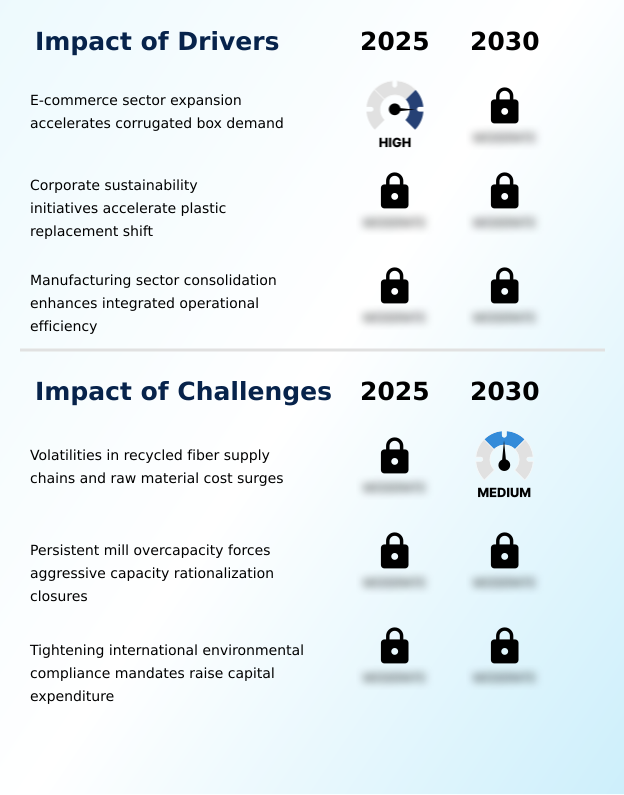
What are the key market drivers leading to the rise in the adoption of Containerboard Industry?

  • The exponential expansion of the global e-commerce sector significantly accelerates the demand for robust corrugated shipping boxes, acting as the primary driver for sustained market growth.

  • The exponential expansion of e-commerce parcel fulfillment acts as a primary catalyst propelling demand within the Containerboard Market. As online retail platforms scale, distribution centers require robust materials to support digital order scheduling and automated sorting operations.
  • To optimize these logistics, manufacturers prioritize aggressive basis weight reduction alongside dynamic void-fill reduction software, effectively lowering total parcel shipping costs by 18%.
  • Production facilities ensure optimal board consistency during high-speed corrugating runs by utilizing automated contaminant removal and correcting cross-machine basis variations in real-time.
  • The deployment of sensor-driven predictive maintenance and robotic palletizer systems has increased machine uptime by 22%, significantly improving throughput. These technological and operational advancements guarantee reliable supplies of secondary packaging and heavy-duty transit displays, driving sustained industrial procurement.

What are the market trends shaping the Containerboard Industry?

  • The accelerated adoption of lightweight, high-strength packaging grades represents a defining trend currently transforming the market. Enterprises are increasingly integrating these advanced materials to optimize freight efficiency and achieve critical sustainability objectives.

  • A fundamental trend reshaping the Containerboard Market is the rapid industrial integration of advanced lightweight transit engineering to support complex digital retail networks. Packaging converters are actively prioritizing freight payload optimization, utilizing multi-wall corrugated architecture that reduces overall shipping volume by up to 15% while maintaining absolute compression strength.
  • To comply with rigorous extended producer responsibility mandates, manufacturers are accelerating closed-loop fiber recovery initiatives, achieving a 20% improvement in resource utilization and driving measurable carbon footprint minimization. Concurrently, advancements in starch-adhesion mechanics and moisture-resistant barrier coatings allow recycled boards to withstand extreme environmental stress during transit.
  • Brands increasingly specify high-graphics white top linerboard for superior shelf presentation, while seamless integration with automated material handling equipment ensures rapid order processing. This structural shift effectively lowers logistical overheads and limits product damage across heavily mechanized distribution environments.

What challenges does the Containerboard Industry face during its growth?

  • Persistent volatilities within recycled fiber supply chains and unprecedented surges in raw material costs pose significant operational challenges that restrict overall industry profitability.

  • Unpredictable raw material pricing and stringent environmental compliance regulations present formidable challenges for operators in the Containerboard Market. Processing facilities face escalating costs associated with virgin timber procurement and the complex management of industrial effluent discharge, which compress overall manufacturing margins by up to 12%.
  • Transitioning completely to high-yield recycled pulp often degrades critical fiber properties, complicating burst strength optimization and ring crush resistance required for demanding agricultural chemical distribution. Furthermore, specialized applications like pharmaceutical cold-chain transport necessitate advanced thermal insulation linings and water-resistant surface lamination, which require costly machinery retrofits.
  • Meeting strict mandates for reducing greenhouse gas emission scopes forces integrated mills to divert capital away from capacity expansion, increasing operational overheads by 15% compared to baseline traditional manufacturing setups and restricting agile market scaling.

Exclusive Technavio Analysis on Customer Landscape

The containerboard market forecasting report includes the adoption lifecycle of the market, covering from the innovator’s stage to the laggard’s stage. It focuses on adoption rates in different regions based on penetration. Furthermore, the containerboard market report also includes key purchase criteria and drivers of price sensitivity to help companies evaluate and develop their market growth analysis strategies.
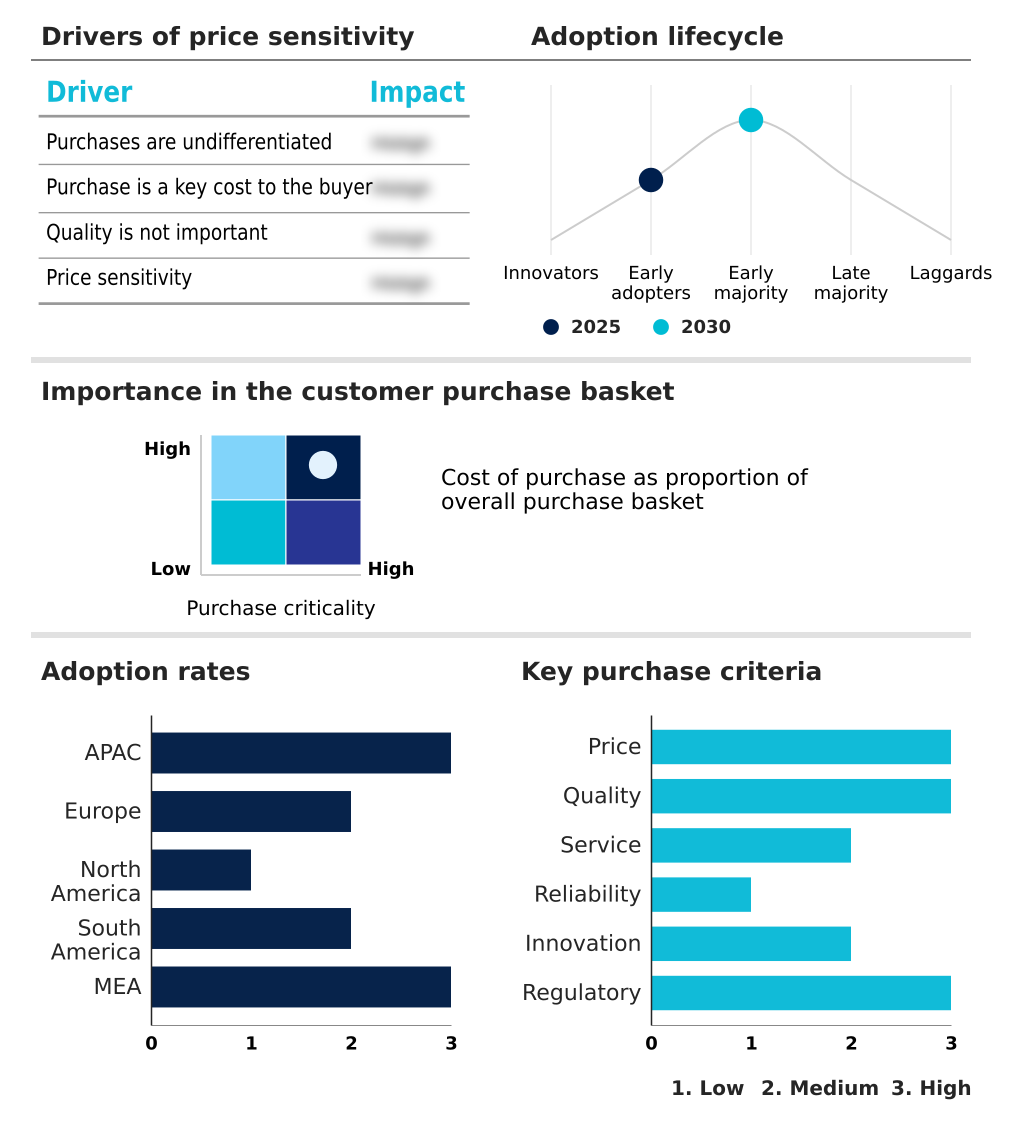
Customer Landscape of Containerboard Industry

Competitive Landscape

Companies are implementing various strategies, such as strategic alliances, containerboard market forecast, partnerships, mergers and acquisitions, geographical expansion, and product/service launches, to enhance their presence in the industry.

Billerud AB - This enterprise manufactures specialized packaging materials, featuring premium brown sack and white top kraftliner variations designed to deliver robust structural integrity and superior graphic printability for demanding shipping applications.

The industry research and growth report includes detailed analyses of the competitive landscape of the market and information about key companies, including:

  • Billerud AB
  • DS Smith Plc
  • Georgia Pacific LLC
  • Greif Inc.
  • International Paper Co.
  • Klabin S.A.
  • Lee and Man Paper Manufacturing
  • MODEL HOLDING AG
  • Mondi Plc
  • Nine Dragons Paper Holdings Ltd.
  • Nippon Paper Industries Co Ltd
  • Oji Holdings Corp.
  • Packaging Corp. of America
  • Rengo Co. Ltd.
  • Sappi Ltd.
  • Shanying International Holding
  • Smurfit Westrock plc
  • Stora Enso Oyj
  • The SCA Group LLC
  • West Fraser Timber Co. Ltd.

Qualitative and quantitative analysis of companies has been conducted to help clients understand the wider business environment as well as the strengths and weaknesses of key industry players. Data is qualitatively analyzed to categorize companies as pure play, category-focused, industry-focused, and diversified; it is quantitatively analyzed to categorize companies as dominant, leading, strong, tentative, and weak.

Recent Development and News in Containerboard market

  • In the Paper and Plastic Packaging Products and Materials industry, the implementation of stringent extended producer responsibility regulations mandated a minimum of 30% post-consumer recycled content in commercial shipments, directly impacting Containerboard demand by accelerating the shift toward high-yield recycled pulp and closed-loop fiber recovery systems.
  • The rapid integration of enterprise automation and AI infrastructure within modern converting plants reduced raw material waste by 14%, directly impacting Containerboard operations by enabling more precise basis weight reduction and high-speed corrugating runs without structural failure.
  • Aggressive single-use plastic displacement mandates across international retail sectors catalyzed a 22% increase in fiber-based packaging adoption, directly impacting Containerboard demand as major brands required higher volumes of moisture-resistant barrier coatings for shelf-ready retail packaging.
  • The widespread transition toward circular economy packaging models necessitated a 40% improvement in secondary packaging recyclability, directly impacting Containerboard supply dynamics by prioritizing sustainable forestry certifications and optimized freight payload optimization strategies across global distribution networks.

Dive into Technavio’s robust research methodology, blending expert interviews, extensive data synthesis, and validated models for unparalleled Containerboard Market insights. See full methodology.

Market Scope
Page number 300
Base year 2025
Historic period 2020-2024
Forecast period 2026-2030
Growth momentum & CAGR Accelerate at a CAGR of 2.9%
Market growth 2026-2030 USD 26640.9 million
Market structure Fragmented
YoY growth 2025-2026(%) 2.8%
Key countries China, Japan, India, South Korea, Indonesia, Australia, Germany, UK, France, Italy, Spain, The Netherlands, US, Canada, Mexico, Brazil, Argentina, Chile, Turkey, Saudi Arabia, South Africa, UAE and Israel
Competitive landscape Leading Companies, Market Positioning of Companies, Competitive Strategies, and Industry Risks

Request Free Sample

Research Analyst Overview

  • The Containerboard Market is experiencing a massive structural transformation as regulatory pressures and supply chain optimization strategies dictate new boardroom-level procurement decisions. Corporate executives now strictly mandate packaging solutions that align with net-zero carbon targets without compromising mechanical durability.
  • In response to these stringent compliance and budgeting directives, paper mills are heavily investing in automated contaminant removal and closed-loop fiber recovery systems to drastically minimize raw material waste. This technological modernization has enabled advanced manufacturing facilities to achieve a 25% reduction in total freshwater consumption compared to older, non-integrated plants.
  • Furthermore, the integration of microfibrillated cellulose additives allows producers to effectively manage cross-machine basis variations, ensuring uniform structural integrity at significantly lower basis weights. Downstream converting operations are similarly optimizing their fulfillment lines by deploying robotic palletizer systems that handle specialized thermal insulation linings for pharmaceutical and agricultural transport.
  • By systematically upgrading legacy equipment and refining fiber recovery chemistry, integrated packaging enterprises are successfully mitigating raw material cost volatility while delivering highly resilient, eco-compliant shipping architectures to the global logistics network.

What are the Key Data Covered in this Containerboard Market Research and Growth Report?

  • What is the expected growth of the Containerboard Market between 2026 and 2030?

    • USD 26.64 billion, at a CAGR of 2.9%

  • What segmentation does the market report cover?

    • The report is segmented by End-user (Food and beverages, Consumer goods, Industrial, and Others), Product (Recycled, and Virgin), Product Type (Linerboard, and Corrugating medium) and Geography (APAC, Europe, North America, South America, Middle East and Africa)

  • Which regions are analyzed in the report?

    • APAC, Europe, North America, South America and Middle East and Africa

  • What are the key growth drivers and market challenges?

    • E-commerce sector expansion accelerates corrugated box demand, Volatilities in recycled fiber supply chains and raw material cost surges

  • Who are the major players in the Containerboard Market?

    • Billerud AB, DS Smith Plc, Georgia Pacific LLC, Greif Inc., International Paper Co., Klabin S.A., Lee and Man Paper Manufacturing, MODEL HOLDING AG, Mondi Plc, Nine Dragons Paper Holdings Ltd., Nippon Paper Industries Co Ltd, Oji Holdings Corp., Packaging Corp. of America, Rengo Co. Ltd., Sappi Ltd., Shanying International Holding, Smurfit Westrock plc, Stora Enso Oyj, The SCA Group LLC and West Fraser Timber Co. Ltd.

Market Research Insights

  • The Containerboard Market undergoes continuous technological refinement to meet the rigorous demands of e-commerce parcel fulfillment and modern industrial transit. Enterprises actively prioritize supply chain resiliency by integrating intelligent packaging structures that facilitate dynamic void-fill reduction across high-volume sorting hubs.
  • By upgrading legacy paper machines with digital process controls, leading facilities have achieved a 22% improvement in energy efficiency, substantially lowering operational overheads. Concurrently, strict adherence to sustainable forestry certifications has enabled manufacturers to align with compliance mandates, resulting in a 15% decrease in regulatory penalty risks.
  • These structural material advancements ensure that businesses can optimize freight density and maintain uninterrupted logistics operations while successfully navigating volatile raw material pricing environments.

We can help! Our analysts can customize this containerboard market research report to meet your requirements.

Get in touch

1. Executive Summary

1.1 Market overview

Executive Summary - Chart on Market Overview
Executive Summary - Data Table on Market Overview
Executive Summary - Chart on Global Market Characteristics
Executive Summary - Chart on Market by Geography
Executive Summary - Chart on Market Segmentation by End-user
Executive Summary - Chart on Market Segmentation by Product
Executive Summary - Chart on Market Segmentation by Product Type
Executive Summary - Chart on Incremental Growth
Executive Summary - Data Table on Incremental Growth
Executive Summary - Chart on Company Market Positioning

2. Technavio Analysis

2.1 Analysis of price sensitivity, lifecycle, customer purchase basket, adoption rates, and purchase criteria

2.2 Criticality of inputs and Factors of differentiation

Chart on Overview on criticality of inputs and factors of differentiation

2.3 Factors of disruption

Chart on Overview on factors of disruption

2.4 Impact of drivers and challenges

Chart on Impact of drivers and challenges in 2025 and 2030

3. Market Landscape

3.1 Market ecosystem

Chart on Parent Market
Data Table on - Parent Market

3.2 Market characteristics

Chart on Market characteristics analysis

3.3 Value chain analysis

Chart on Value chain analysis

4. Market Sizing

4.1 Market definition

Data Table on Offerings of companies included in the market definition

4.2 Market segment analysis

Market segments

4.3 Market size 2025

4.4 Market outlook: Forecast for 2025-2030

Chart on Global - Market size and forecast 2025-2030 ($ million)
Data Table on Global - Market size and forecast 2025-2030 ($ million)
Chart on Global Market: Year-over-year growth 2025-2030 (%)
Data Table on Global Market: Year-over-year growth 2025-2030 (%)

5. Historic Market Size

5.1 Global Containerboard Market 2020 - 2024

Historic Market Size - Data Table on Global Containerboard Market 2020 - 2024 ($ million)

5.2 End-user segment analysis 2020 - 2024

Historic Market Size - End-user Segment 2020 - 2024 ($ million)

5.3 Product segment analysis 2020 - 2024

Historic Market Size - Product Segment 2020 - 2024 ($ million)

5.4 Product Type segment analysis 2020 - 2024

Historic Market Size - Product Type Segment 2020 - 2024 ($ million)

5.5 Geography segment analysis 2020 - 2024

Historic Market Size - Geography Segment 2020 - 2024 ($ million)

5.6 Country segment analysis 2020 - 2024

Historic Market Size - Country Segment 2020 - 2024 ($ million)

6. Qualitative Analysis

6.1 Impact of AI on global containerboard market

6.2 Impact of geopolitical conflicts on global containerboard market

7. Five Forces Analysis

7.1 Five forces summary

Five forces analysis - Comparison between 2025 and 2030

7.2 Bargaining power of buyers

Bargaining power of buyers - Impact of key factors 2025 and 2030

7.3 Bargaining power of suppliers

Bargaining power of suppliers - Impact of key factors in 2025 and 2030

7.4 Threat of new entrants

Threat of new entrants - Impact of key factors in 2025 and 2030

7.5 Threat of substitutes

Threat of substitutes - Impact of key factors in 2025 and 2030

7.6 Threat of rivalry

Threat of rivalry - Impact of key factors in 2025 and 2030

7.7 Market condition

Chart on Market condition - Five forces 2025 and 2030

8. Market Segmentation by End-user

8.1 Market segments

Chart on End-user - Market share 2025-2030 (%)
Data Table on End-user - Market share 2025-2030 (%)

8.2 Comparison by End-user

Chart on Comparison by End-user
Data Table on Comparison by End-user

8.3 Food and beverages - Market size and forecast 2025-2030

Chart on Food and beverages - Market size and forecast 2025-2030 ($ million)
Data Table on Food and beverages - Market size and forecast 2025-2030 ($ million)
Chart on Food and beverages - Year-over-year growth 2025-2030 (%)
Data Table on Food and beverages - Year-over-year growth 2025-2030 (%)

8.4 Consumer goods - Market size and forecast 2025-2030

Chart on Consumer goods - Market size and forecast 2025-2030 ($ million)
Data Table on Consumer goods - Market size and forecast 2025-2030 ($ million)
Chart on Consumer goods - Year-over-year growth 2025-2030 (%)
Data Table on Consumer goods - Year-over-year growth 2025-2030 (%)

8.5 Industrial - Market size and forecast 2025-2030

Chart on Industrial - Market size and forecast 2025-2030 ($ million)
Data Table on Industrial - Market size and forecast 2025-2030 ($ million)
Chart on Industrial - Year-over-year growth 2025-2030 (%)
Data Table on Industrial - Year-over-year growth 2025-2030 (%)

8.6 Others - Market size and forecast 2025-2030

Chart on Others - Market size and forecast 2025-2030 ($ million)
Data Table on Others - Market size and forecast 2025-2030 ($ million)
Chart on Others - Year-over-year growth 2025-2030 (%)
Data Table on Others - Year-over-year growth 2025-2030 (%)

8.7 Market opportunity by End-user

Market opportunity by End-user ($ million)
Data Table on Market opportunity by End-user ($ million)

9. Market Segmentation by Product

9.1 Market segments

Chart on Product - Market share 2025-2030 (%)
Data Table on Product - Market share 2025-2030 (%)

9.2 Comparison by Product

Chart on Comparison by Product
Data Table on Comparison by Product

9.3 Recycled - Market size and forecast 2025-2030

Chart on Recycled - Market size and forecast 2025-2030 ($ million)
Data Table on Recycled - Market size and forecast 2025-2030 ($ million)
Chart on Recycled - Year-over-year growth 2025-2030 (%)
Data Table on Recycled - Year-over-year growth 2025-2030 (%)

9.4 Virgin - Market size and forecast 2025-2030

Chart on Virgin - Market size and forecast 2025-2030 ($ million)
Data Table on Virgin - Market size and forecast 2025-2030 ($ million)
Chart on Virgin - Year-over-year growth 2025-2030 (%)
Data Table on Virgin - Year-over-year growth 2025-2030 (%)

9.5 Market opportunity by Product

Market opportunity by Product ($ million)
Data Table on Market opportunity by Product ($ million)

10. Market Segmentation by Product Type

10.1 Market segments

Chart on Product Type - Market share 2025-2030 (%)
Data Table on Product Type - Market share 2025-2030 (%)

10.2 Comparison by Product Type

Chart on Comparison by Product Type
Data Table on Comparison by Product Type

10.3 Linerboard - Market size and forecast 2025-2030

Chart on Linerboard - Market size and forecast 2025-2030 ($ million)
Data Table on Linerboard - Market size and forecast 2025-2030 ($ million)
Chart on Linerboard - Year-over-year growth 2025-2030 (%)
Data Table on Linerboard - Year-over-year growth 2025-2030 (%)

10.4 Corrugating medium - Market size and forecast 2025-2030

Chart on Corrugating medium - Market size and forecast 2025-2030 ($ million)
Data Table on Corrugating medium - Market size and forecast 2025-2030 ($ million)
Chart on Corrugating medium - Year-over-year growth 2025-2030 (%)
Data Table on Corrugating medium - Year-over-year growth 2025-2030 (%)

10.5 Market opportunity by Product Type

Market opportunity by Product Type ($ million)
Data Table on Market opportunity by Product Type ($ million)

11. Customer Landscape

11.1 Customer landscape overview

Analysis of price sensitivity, lifecycle, customer purchase basket, adoption rates, and purchase criteria

12. Geographic Landscape

12.1 Geographic segmentation

Chart on Market share by geography 2025-2030 (%)
Data Table on Market share by geography 2025-2030 (%)

12.2 Geographic comparison

Chart on Geographic comparison
Data Table on Geographic comparison

12.3 APAC - Market size and forecast 2025-2030

Chart on APAC - Market size and forecast 2025-2030 ($ million)
Data Table on APAC - Market size and forecast 2025-2030 ($ million)
Chart on APAC - Year-over-year growth 2025-2030 (%)
Data Table on APAC - Year-over-year growth 2025-2030 (%)
Chart on Regional Comparison - APAC
Data Table on Regional Comparison - APAC

12.3.1 China - Market size and forecast 2025-2030

Chart on China - Market size and forecast 2025-2030 ($ million)
Data Table on China - Market size and forecast 2025-2030 ($ million)
Chart on China - Year-over-year growth 2025-2030 (%)
Data Table on China - Year-over-year growth 2025-2030 (%)

12.3.2 Japan - Market size and forecast 2025-2030

Chart on Japan - Market size and forecast 2025-2030 ($ million)
Data Table on Japan - Market size and forecast 2025-2030 ($ million)
Chart on Japan - Year-over-year growth 2025-2030 (%)
Data Table on Japan - Year-over-year growth 2025-2030 (%)

12.3.3 India - Market size and forecast 2025-2030

Chart on India - Market size and forecast 2025-2030 ($ million)
Data Table on India - Market size and forecast 2025-2030 ($ million)
Chart on India - Year-over-year growth 2025-2030 (%)
Data Table on India - Year-over-year growth 2025-2030 (%)

12.3.4 South Korea - Market size and forecast 2025-2030

Chart on South Korea - Market size and forecast 2025-2030 ($ million)
Data Table on South Korea - Market size and forecast 2025-2030 ($ million)
Chart on South Korea - Year-over-year growth 2025-2030 (%)
Data Table on South Korea - Year-over-year growth 2025-2030 (%)

12.3.5 Indonesia - Market size and forecast 2025-2030

Chart on Indonesia - Market size and forecast 2025-2030 ($ million)
Data Table on Indonesia - Market size and forecast 2025-2030 ($ million)
Chart on Indonesia - Year-over-year growth 2025-2030 (%)
Data Table on Indonesia - Year-over-year growth 2025-2030 (%)

12.3.6 Australia - Market size and forecast 2025-2030

Chart on Australia - Market size and forecast 2025-2030 ($ million)
Data Table on Australia - Market size and forecast 2025-2030 ($ million)
Chart on Australia - Year-over-year growth 2025-2030 (%)
Data Table on Australia - Year-over-year growth 2025-2030 (%)

12.4 Europe - Market size and forecast 2025-2030

Chart on Europe - Market size and forecast 2025-2030 ($ million)
Data Table on Europe - Market size and forecast 2025-2030 ($ million)
Chart on Europe - Year-over-year growth 2025-2030 (%)
Data Table on Europe - Year-over-year growth 2025-2030 (%)
Chart on Regional Comparison - Europe
Data Table on Regional Comparison - Europe

12.4.1 Germany - Market size and forecast 2025-2030

Chart on Germany - Market size and forecast 2025-2030 ($ million)
Data Table on Germany - Market size and forecast 2025-2030 ($ million)
Chart on Germany - Year-over-year growth 2025-2030 (%)
Data Table on Germany - Year-over-year growth 2025-2030 (%)

12.4.2 UK - Market size and forecast 2025-2030

Chart on UK - Market size and forecast 2025-2030 ($ million)
Data Table on UK - Market size and forecast 2025-2030 ($ million)
Chart on UK - Year-over-year growth 2025-2030 (%)
Data Table on UK - Year-over-year growth 2025-2030 (%)

12.4.3 France - Market size and forecast 2025-2030

Chart on France - Market size and forecast 2025-2030 ($ million)
Data Table on France - Market size and forecast 2025-2030 ($ million)
Chart on France - Year-over-year growth 2025-2030 (%)
Data Table on France - Year-over-year growth 2025-2030 (%)

12.4.4 Italy - Market size and forecast 2025-2030

Chart on Italy - Market size and forecast 2025-2030 ($ million)
Data Table on Italy - Market size and forecast 2025-2030 ($ million)
Chart on Italy - Year-over-year growth 2025-2030 (%)
Data Table on Italy - Year-over-year growth 2025-2030 (%)

12.4.5 Spain - Market size and forecast 2025-2030

Chart on Spain - Market size and forecast 2025-2030 ($ million)
Data Table on Spain - Market size and forecast 2025-2030 ($ million)
Chart on Spain - Year-over-year growth 2025-2030 (%)
Data Table on Spain - Year-over-year growth 2025-2030 (%)

12.4.6 The Netherlands - Market size and forecast 2025-2030

Chart on The Netherlands - Market size and forecast 2025-2030 ($ million)
Data Table on The Netherlands - Market size and forecast 2025-2030 ($ million)
Chart on The Netherlands - Year-over-year growth 2025-2030 (%)
Data Table on The Netherlands - Year-over-year growth 2025-2030 (%)

12.5 North America - Market size and forecast 2025-2030

Chart on North America - Market size and forecast 2025-2030 ($ million)
Data Table on North America - Market size and forecast 2025-2030 ($ million)
Chart on North America - Year-over-year growth 2025-2030 (%)
Data Table on North America - Year-over-year growth 2025-2030 (%)
Chart on Regional Comparison - North America
Data Table on Regional Comparison - North America

12.5.1 US - Market size and forecast 2025-2030

Chart on US - Market size and forecast 2025-2030 ($ million)
Data Table on US - Market size and forecast 2025-2030 ($ million)
Chart on US - Year-over-year growth 2025-2030 (%)
Data Table on US - Year-over-year growth 2025-2030 (%)

12.5.2 Canada - Market size and forecast 2025-2030

Chart on Canada - Market size and forecast 2025-2030 ($ million)
Data Table on Canada - Market size and forecast 2025-2030 ($ million)
Chart on Canada - Year-over-year growth 2025-2030 (%)
Data Table on Canada - Year-over-year growth 2025-2030 (%)

12.5.3 Mexico - Market size and forecast 2025-2030

Chart on Mexico - Market size and forecast 2025-2030 ($ million)
Data Table on Mexico - Market size and forecast 2025-2030 ($ million)
Chart on Mexico - Year-over-year growth 2025-2030 (%)
Data Table on Mexico - Year-over-year growth 2025-2030 (%)

12.6 South America - Market size and forecast 2025-2030

Chart on South America - Market size and forecast 2025-2030 ($ million)
Data Table on South America - Market size and forecast 2025-2030 ($ million)
Chart on South America - Year-over-year growth 2025-2030 (%)
Data Table on South America - Year-over-year growth 2025-2030 (%)
Chart on Regional Comparison - South America
Data Table on Regional Comparison - South America

12.6.1 Brazil - Market size and forecast 2025-2030

Chart on Brazil - Market size and forecast 2025-2030 ($ million)
Data Table on Brazil - Market size and forecast 2025-2030 ($ million)
Chart on Brazil - Year-over-year growth 2025-2030 (%)
Data Table on Brazil - Year-over-year growth 2025-2030 (%)

12.6.2 Argentina - Market size and forecast 2025-2030

Chart on Argentina - Market size and forecast 2025-2030 ($ million)
Data Table on Argentina - Market size and forecast 2025-2030 ($ million)
Chart on Argentina - Year-over-year growth 2025-2030 (%)
Data Table on Argentina - Year-over-year growth 2025-2030 (%)

12.6.3 Chile - Market size and forecast 2025-2030

Chart on Chile - Market size and forecast 2025-2030 ($ million)
Data Table on Chile - Market size and forecast 2025-2030 ($ million)
Chart on Chile - Year-over-year growth 2025-2030 (%)
Data Table on Chile - Year-over-year growth 2025-2030 (%)

12.7 Middle East and Africa - Market size and forecast 2025-2030

Chart on Middle East and Africa - Market size and forecast 2025-2030 ($ million)
Data Table on Middle East and Africa - Market size and forecast 2025-2030 ($ million)
Chart on Middle East and Africa - Year-over-year growth 2025-2030 (%)
Data Table on Middle East and Africa - Year-over-year growth 2025-2030 (%)
Chart on Regional Comparison - Middle East and Africa
Data Table on Regional Comparison - Middle East and Africa

12.7.1 Turkey - Market size and forecast 2025-2030

Chart on Turkey - Market size and forecast 2025-2030 ($ million)
Data Table on Turkey - Market size and forecast 2025-2030 ($ million)
Chart on Turkey - Year-over-year growth 2025-2030 (%)
Data Table on Turkey - Year-over-year growth 2025-2030 (%)

12.7.2 Saudi Arabia - Market size and forecast 2025-2030

Chart on Saudi Arabia - Market size and forecast 2025-2030 ($ million)
Data Table on Saudi Arabia - Market size and forecast 2025-2030 ($ million)
Chart on Saudi Arabia - Year-over-year growth 2025-2030 (%)
Data Table on Saudi Arabia - Year-over-year growth 2025-2030 (%)

12.7.3 South Africa - Market size and forecast 2025-2030

Chart on South Africa - Market size and forecast 2025-2030 ($ million)
Data Table on South Africa - Market size and forecast 2025-2030 ($ million)
Chart on South Africa - Year-over-year growth 2025-2030 (%)
Data Table on South Africa - Year-over-year growth 2025-2030 (%)

12.7.4 UAE - Market size and forecast 2025-2030

Chart on UAE - Market size and forecast 2025-2030 ($ million)
Data Table on UAE - Market size and forecast 2025-2030 ($ million)
Chart on UAE - Year-over-year growth 2025-2030 (%)
Data Table on UAE - Year-over-year growth 2025-2030 (%)

12.7.5 Israel - Market size and forecast 2025-2030

Chart on Israel - Market size and forecast 2025-2030 ($ million)
Data Table on Israel - Market size and forecast 2025-2030 ($ million)
Chart on Israel - Year-over-year growth 2025-2030 (%)
Data Table on Israel - Year-over-year growth 2025-2030 (%)

12.8 Market opportunity by geography

Market opportunity by geography ($ million)
Data Tables on Market opportunity by geography ($ million)

13. Drivers, Challenges, and Opportunity

13.1 Market drivers

E-commerce sector expansion accelerates corrugated box demand
Corporate sustainability initiatives accelerate plastic replacement shift
Manufacturing sector consolidation enhances integrated operational efficiency

13.2 Market challenges

Volatilities in recycled fiber supply chains and raw material cost surges
Persistent mill overcapacity forces aggressive capacity rationalization closures
Tightening international environmental compliance mandates raise capital expenditure

13.3 Impact of drivers and challenges

Impact of drivers and challenges in 2025 and 2030

13.4 Market opportunities

Accelerated adoption lightweight high-strength containerboard packaging grades
Strategic production expansion focuses recycled fiber infrastructure investments
Advanced smart plant automation systems transform packaging production

14. Competitive Landscape

14.1 Overview

14.2

Overview on criticality of inputs and factors of differentiation

14.3 Landscape disruption

Overview on factors of disruption

14.4 Industry risks

Impact of key risks on business

15. Competitive Analysis

15.1 Companies profiled

Companies covered

15.2 Company ranking index

15.3 Market positioning of companies

Matrix on companies position and classification

15.4 Billerud AB

Billerud AB - Overview
Billerud AB - Business segments
Billerud AB - Key offerings
Billerud AB - Segment focus
SWOT

15.5 Greif Inc.

Greif Inc. - Overview
Greif Inc. - Business segments
Greif Inc. - Key offerings
Greif Inc. - Segment focus
SWOT

15.6 International Paper Co.

International Paper Co. - Overview
International Paper Co. - Business segments
International Paper Co. - Key news
International Paper Co. - Key offerings
International Paper Co. - Segment focus
SWOT

15.7 Klabin S.A.

Klabin S.A. - Overview
Klabin S.A. - Business segments
Klabin S.A. - Key offerings
Klabin S.A. - Segment focus
SWOT

15.8 Lee and Man Paper Manufacturing

Lee and Man Paper Manufacturing - Overview
Lee and Man Paper Manufacturing - Business segments
Lee and Man Paper Manufacturing - Key offerings
Lee and Man Paper Manufacturing - Segment focus
SWOT

15.9 Mondi Plc

Mondi Plc - Overview
Mondi Plc - Business segments
Mondi Plc - Key news
Mondi Plc - Key offerings
Mondi Plc - Segment focus
SWOT

15.10 Nine Dragons Paper Holdings Ltd.

Nine Dragons Paper Holdings Ltd. - Overview
Nine Dragons Paper Holdings Ltd. - Business segments
Nine Dragons Paper Holdings Ltd. - Key offerings
Nine Dragons Paper Holdings Ltd. - Segment focus
SWOT

15.11 Nippon Paper Industries Co Ltd

Nippon Paper Industries Co Ltd - Overview
Nippon Paper Industries Co Ltd - Business segments
Nippon Paper Industries Co Ltd - Key offerings
Nippon Paper Industries Co Ltd - Segment focus
SWOT

15.12 Oji Holdings Corp.

Oji Holdings Corp. - Overview
Oji Holdings Corp. - Business segments
Oji Holdings Corp. - Key offerings
Oji Holdings Corp. - Segment focus
SWOT

15.13 Rengo Co. Ltd.

Rengo Co. Ltd. - Overview
Rengo Co. Ltd. - Business segments
Rengo Co. Ltd. - Key offerings
Rengo Co. Ltd. - Segment focus
SWOT

15.14 Sappi Ltd.

Sappi Ltd. - Overview
Sappi Ltd. - Business segments
Sappi Ltd. - Key offerings
Sappi Ltd. - Segment focus
SWOT

15.15 Shanying International Holding

Shanying International Holding - Overview
Shanying International Holding - Business segments
Shanying International Holding - Key offerings
Shanying International Holding - Segment focus
SWOT

15.16 Smurfit Westrock plc

Smurfit Westrock plc - Overview
Smurfit Westrock plc - Business segments
Smurfit Westrock plc - Key news
Smurfit Westrock plc - Key offerings
Smurfit Westrock plc - Segment focus
SWOT

15.17 Stora Enso Oyj

Stora Enso Oyj - Overview
Stora Enso Oyj - Business segments
Stora Enso Oyj - Key news
Stora Enso Oyj - Key offerings
Stora Enso Oyj - Segment focus
SWOT

15.18 The SCA Group LLC

The SCA Group LLC - Overview
The SCA Group LLC - Business segments
The SCA Group LLC - Key offerings
The SCA Group LLC - Segment focus
SWOT

16. Appendix

16.1 Scope of the report

Market definition
Objectives
Notes and caveats

16.2 Inclusions and exclusions checklist

Inclusions checklist
Exclusions checklist

16.3 Currency conversion rates for US$

16.4 Research methodology

16.5 Data procurement

Information sources

16.6 Data validation

16.7 Validation techniques employed for market sizing

16.8 Data synthesis

16.9 360 degree market analysis

16.10 List of abbreviations

Research Methodology

Technavio presents a detailed picture of the market by way of study, synthesis, and summation of data from multiple sources. The analysts have presented the various facets of the market with a particular focus on identifying the key industry influencers. The data thus presented is comprehensive, reliable, and the result of extensive research, both primary and secondary.

INFORMATION SOURCES

Primary sources

  • Manufacturers and suppliers
  • Channel partners
  • Industry experts
  • Strategic decision makers

Secondary sources

  • Industry journals and periodicals
  • Government data
  • Financial reports of key industry players
  • Historical data
  • Press releases

DATA ANALYSIS

Data Synthesis

  • Collation of data
  • Estimation of key figures
  • Analysis of derived insights

Data Validation

  • Triangulation with data models
  • Reference against proprietary databases
  • Corroboration with industry experts

REPORT WRITING

Qualitative

  • Market drivers
  • Market challenges
  • Market trends
  • Five forces analysis

Quantitative

  • Market size and forecast
  • Market segmentation
  • Geographical insights
  • Competitive landscape

Interested in this report?

Get your sample now to see our research methodology and insights!

Download Now

Frequently Asked Questions

Containerboard market growth will increase by USD 26640.9 million during 2026-2030.

The Containerboard market is expected to grow at a CAGR of 2.9% during 2026-2030.

Containerboard market is segmented by End-user (Food and beverages, Consumer goods, Industrial, Others) Product (Recycled, Virgin) Product type (Linerboard, Corrugating medium)

Billerud AB, DS Smith Plc, Georgia Pacific LLC, Greif Inc., International Paper Co., Klabin S.A., Lee and Man Paper Manufacturing, MODEL HOLDING AG, Mondi Plc, Nine Dragons Paper Holdings Ltd., Nippon Paper Industries Co Ltd, Oji Holdings Corp., Packaging Corp. of America, Rengo Co. Ltd., Sappi Ltd., Shanying International Holding, Smurfit Westrock plc, Stora Enso Oyj, The SCA Group LLC, West Fraser Timber Co. Ltd. are a few of the key vendors in the Containerboard market.

APAC will register the highest growth rate of 52% among the other regions. Therefore, the Containerboard market in APAC is expected to garner significant business opportunities for the vendors during the forecast period.

China, Japan, India, South Korea, Indonesia, Australia, Germany, UK, France, Italy, Spain, The Netherlands, US, Canada, Mexico, Brazil, Argentina, Chile, Turkey, Saudi Arabia, South Africa, UAE, Israel

  • E-commerce sector expansion accelerates corrugated box demand is the driving factor this market.

The Containerboard market vendors should focus on grabbing business opportunities from the End-user segment as it accounted for the largest market share in the base year.
RIA - Research AI Assistant
Ask RIA
