


Flexible Packaging Market Analysis APAC, Europe, North America, South America, Middle East and Africa - US, China, UK, Germany, Canada - Size and Forecast 2024-2028

Flexible Packaging Market Analysis APAC, Europe, North America, South America, Middle East and Africa - US, China, UK, Germany, Canada - Size and Forecast 2024-2028

Published: May 2024 179 Pages SKU: IRTNTR43633

Market Overview at a Glance

$45.1 B
Market Opportunity
3.93%
CAGR
3.63
YoY growth 2023-2024(%)

Flexible Packaging Market Size 2024-2028

The flexible packaging market size is valued to increase by USD 45.1 billion, at a CAGR of 3.93% from 2023 to 2028. Rising focus on improving shelf life of products will drive the flexible packaging market.

Major Market Trends & Insights

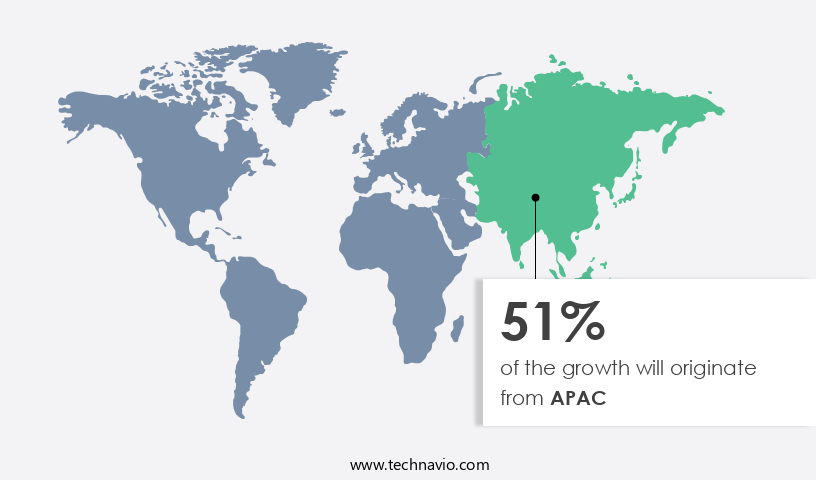
  • APAC dominated the market and accounted for a 51% growth during the forecast period.
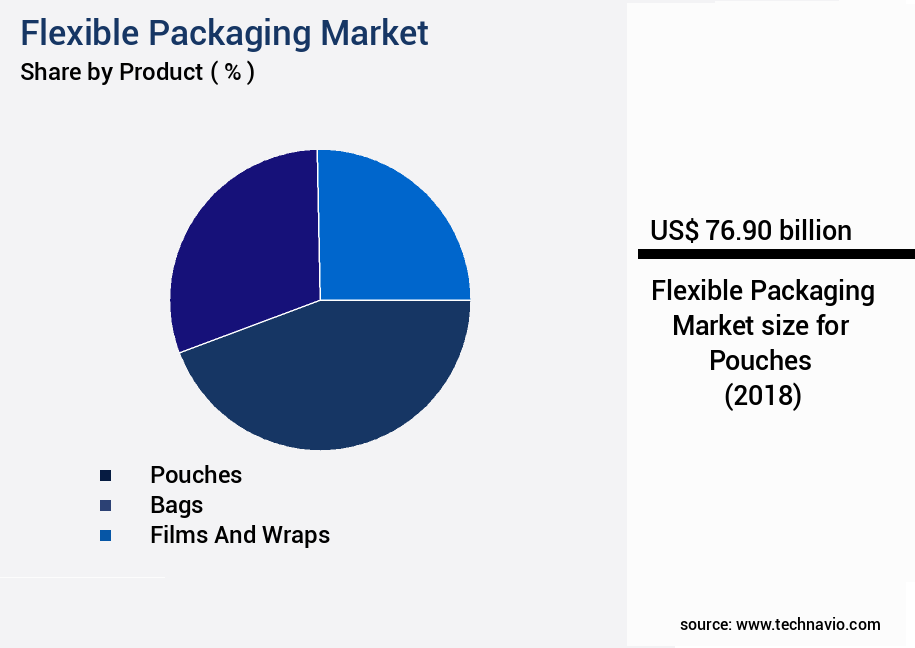
  • By Product - Pouches segment was valued at USD 76.90 billion in 2022
  • By Type - Food and beverage segment accounted for the largest market revenue share in 2022

Market Size & Forecast

  • Market Opportunities: USD 35.64 billion
  • Market Future Opportunities: USD 45.10 billion
  • CAGR from 2023 to 2028 : 3.93%

Market Summary

  • The market is witnessing significant growth due to the rising focus on extending product shelf life and enhancing product protection. This trend is particularly prevalent in industries such as food and beverage, pharmaceuticals, and consumer goods, where preserving product quality and freshness is crucial. However, the high cost involved in manufacturing flexible packaging remains a challenge for market participants. Despite this, advancements in technology are driving innovation in the industry. For instance, the adoption of nanotechnology and biodegradable materials is enabling the production of eco-friendly and sustainable packaging solutions. Moreover, the integration of smart technology into flexible packaging is enabling real-time monitoring of product conditions and improving supply chain efficiency.
  • For example, a leading food and beverage company implemented a Smart Packaging solution that monitors temperature and humidity levels in real-time. By using this technology, the company was able to reduce spoilage and improve operational efficiency, resulting in a significant cost savings. According to recent studies, the implementation of smart packaging solutions has led to a reduction in food waste by up to 20%. In conclusion, the market is experiencing robust growth, driven by the need for extended shelf life and product protection. Despite the high manufacturing costs, advancements in technology are enabling the production of eco-friendly and sustainable packaging solutions, while also improving operational efficiency and reducing costs.

What will be the Size of the Flexible Packaging Market during the forecast period?
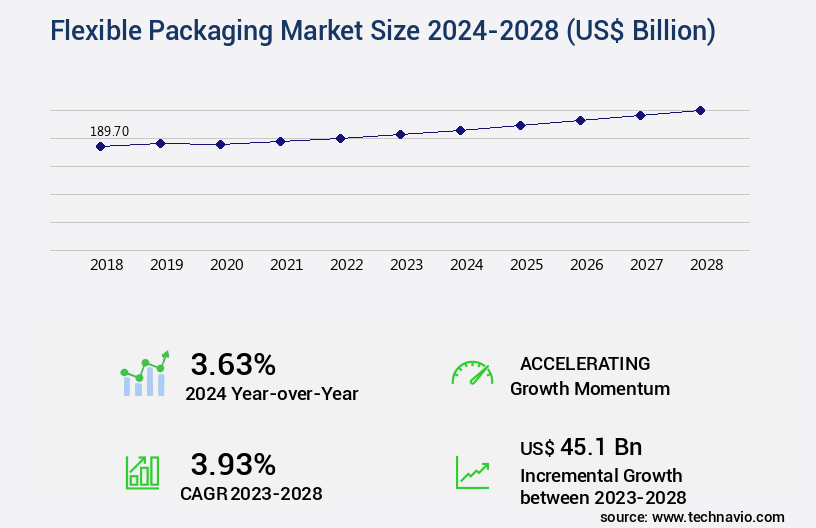
Flexible Packaging Market Size

Get Key Insights on Market Forecast (PDF) Request Free Sample

How is the Flexible Packaging Market Segmented ?

The flexible packaging industry research report provides comprehensive data (region-wise segment analysis), with forecasts and estimates in "USD billion" for the period 2024-2028, as well as historical data from 2018-2022 for the following segments.

  • Product
    • Pouches
    • Bags
    • Films and wraps
    • Others
  • Type
    • Food and beverage
    • Healthcare
    • Others
  • Geography
    • North America
      • US
      • Canada
    • Europe
      • Germany
      • UK
    • APAC
      • China
    • Rest of World (ROW)

By Product Insights

The pouches segment is estimated to witness significant growth during the forecast period.

Flexible packaging continues to evolve, with innovations in material science leading to advancements in pouches and films. Stand-up pouches, a popular choice for food and liquid packaging, boast airtight closures and impressive shelf life extension. These pouches feature multiple barrier layers, ensuring product protection from moisture, dirt, and bacteria. Material compatibility is crucial in flexible packaging, leading to the use of sustainable materials and high-barrier films. Package design software and printing technologies, such as gravure printing and lamination techniques, enhance the visual appeal and functionality of these packages. Quality control testing is essential in maintaining product integrity, with seal strength testing and moisture barriers crucial for Food Packaging regulations.

Lightweight packaging and supply chain optimization are key priorities, with waste reduction strategies and e-commerce packaging also gaining importance. Flexible films, including Modified Atmosphere Packaging and barrier coatings, offer UV protection and oxygen scavengers, further extending shelf life. Packaging Machinery, including flexographic printing and Retort Pouches, enable efficient production and automation. Overall, the market continues to adapt and innovate, driven by consumer demands and advancements in polymer properties and packaging technology. (116 words)
Flexible Packaging Market Size

Request Free Sample

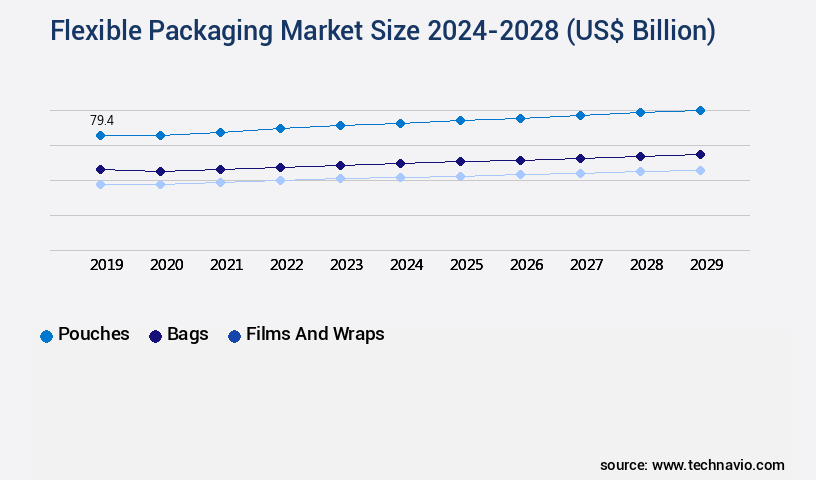
The Pouches segment was valued at USD 76.90 billion in 2018 and showed a gradual increase during the forecast period.
Flexible Packaging Market Size

Request Free Sample

Regional Analysis

APAC is estimated to contribute 51% to the growth of the global market during the forecast period.Technavio's analysts have elaborately explained the regional trends and drivers that shape the market during the forecast period.
Flexible Packaging Market Share by Geography

See How Flexible Packaging Market Demand is Rising in APAC Request Free Sample

The market in APAC is experiencing significant growth, driven by the expanding end-user industries, particularly in developing economies like China and India. This region is projected to become a major contributor to The market's revenue growth. The rapid expansion of sectors such as e-commerce, fast-moving consumer goods (FMCG), and Personal Care is a primary factor fueling market growth. Notably, countries like China, India, and Japan have a burgeoning e-commerce sector, with Alibaba Group Holdings Ltd. Being a prominent player. This trend is further propelled by the increasing customer preference for convenient shopping experiences and the growing popularity of online retailers.

Additionally, flexible packaging offers operational efficiency gains and cost reductions, making it a preferred choice for businesses seeking to comply with evolving sustainability regulations. According to estimates, the market in APAC is expected to grow at a compound annual rate of over 6%, reaching a value of around USD70 billion by 2025.

Market Dynamics

Our researchers analyzed the data with 2023 as the base year, along with the key drivers, trends, and challenges. A holistic analysis of drivers will help companies refine their marketing strategies to gain a competitive advantage.

The market is experiencing significant growth due to its numerous advantages over traditional Rigid Packaging. Seal strength testing methods are crucial in ensuring the reliability and efficiency of flexible packaging solutions. Flexible packaging material selection plays a vital role in achieving the desired properties, such as high barrier film lamination processes for extended shelf life and sustainable flexible packaging materials for eco-conscious consumers. Sustainability is a key trend in the market, with recyclable flexible packaging solutions gaining popularity. Modified atmosphere packaging techniques and oxygen scavenger film effectiveness are essential for maintaining product freshness and prolonging shelf life, particularly in the food industry. E-commerce is driving innovation in flexible packaging design, with the need for lightweight and compact packaging that can withstand transportation and handling. Package design software capabilities, digital printing for flexible packaging, and gravure printing for high-volume packaging enable customization and cost-effectiveness. Flexible packaging automation systems and supply chain optimization strategies are essential for improving efficiency and reducing costs. UV protection in flexible packaging films and barrier coating application methods are critical for ensuring regulatory compliance with food packaging standards. Polymer properties and barrier performance are crucial factors in the selection of flexible packaging materials. Lightweight flexible packaging design is a growing trend, with the focus on reducing waste and transportation costs. Package integrity testing procedures are essential to ensure the reliability and safety of the final product. Overall, the market offers numerous benefits and continues to evolve to meet the changing needs of consumers and industries.
Flexible Packaging Market Size

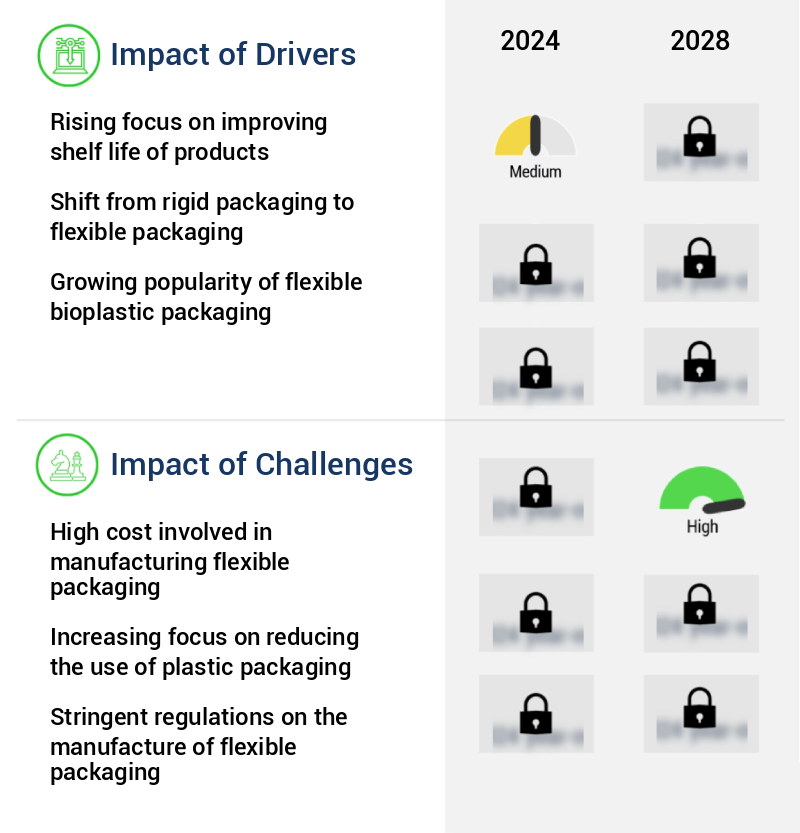
What are the key market drivers leading to the rise in the adoption of Flexible Packaging Industry?

  • The increasing prioritization of extending product shelf life serves as the primary market catalyst. 
  • Flexible packaging has emerged as a game-changer in various industries by enhancing product shelf life and ensuring product protection. According to recent studies, flexible packaging can extend the shelf life of perishable goods, such as food and beverages, by up to 30%. For instance, fruits like bananas ripen more slowly in flexible packaging, increasing their marketability and reducing wastage. In the pharmaceutical sector, flexible packaging helps maintain the efficacy of medicines by shielding them from environmental factors. Additionally, the use of flexible packaging in the transportation and export of these products minimizes damage due to its adaptability to different shapes and sizes.
  • This not only improves business efficiency but also enhances decision-making capabilities by providing real-time insights into inventory levels and product freshness.

What are the market trends shaping the Flexible Packaging Industry?

  • The flexible packaging industry is experiencing significant advancements, which represents the latest market trend.
  • The market is undergoing significant transformation, with a growing emphasis on sustainability, innovation, and advanced functionality. One key trend is the adoption of eco-friendly materials, such as recyclable and compostable options, to address environmental concerns and cater to consumers' increasing preference for sustainable packaging solutions. Manufacturers are focusing on producing packaging films and pouches using bio-based plastics derived from renewable sources like Corn Starch or sugarcane, thereby reducing reliance on traditional petroleum-based plastics. For instance, in July 2023, Berry Global introduced NordiVent, a high-performance form-fill-seal film containing 50% recycled content. This innovative film, which offers waterproof properties and resistance to dust and moisture, is an ideal choice for powdered products and aligns with customers' sustainability objectives.
  • Another significant development is the integration of smart technologies into flexible packaging, enabling enhanced product protection, extended shelf life, and improved supply chain visibility. These advancements are expected to drive growth and innovation within the market.

What challenges does the Flexible Packaging Industry face during its growth?

  • The high cost of manufacturing flexible packaging is a significant challenge that hinders growth in the industry. This issue, which is mandatory for industry professionals to address, stems from the complex production processes and materials required to create flexible packaging solutions. 
  • Flexible packaging, a global market characterized by continuous evolution, primarily utilizes plastics such as PE and PP as its primary raw materials. Recent research indicates a notable increase in the prices of these materials, with PP experiencing a rise of approximately 6.2% in the first quarter of 2022. This trend poses a significant challenge for market participants, as the escalating production costs threaten to erode profit margins.
  • Despite these challenges, the market remains a robust and dynamic industry, catering to diverse applications in various sectors, including food, pharmaceuticals, and consumer goods.

Exclusive Technavio Analysis on Customer Landscape

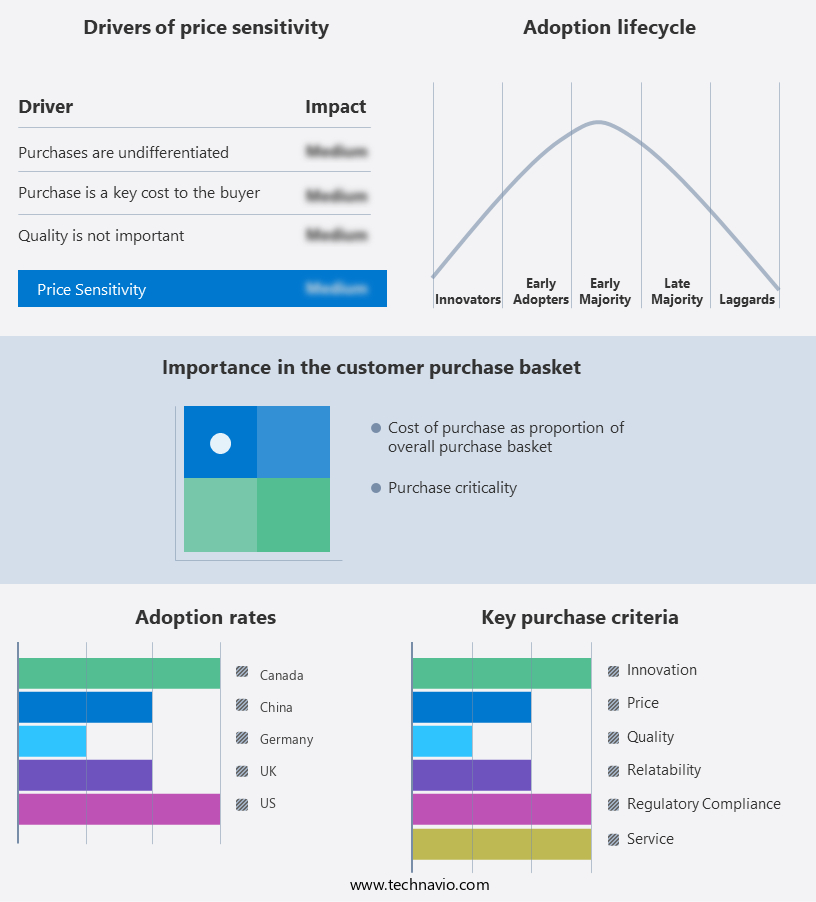
The flexible packaging market forecasting report includes the adoption lifecycle of the market, covering from the innovator's stage to the laggard's stage. It focuses on adoption rates in different regions based on penetration. Furthermore, the flexible packaging market report also includes key purchase criteria and drivers of price sensitivity to help companies evaluate and develop their market growth analysis strategies.
Flexible Packaging Market Share by Geography

 Customer Landscape of Flexible Packaging Industry

Competitive Landscape

Companies are implementing various strategies, such as strategic alliances, flexible packaging market forecast, partnerships, mergers and acquisitions, geographical expansion, and product/service launches, to enhance their presence in the industry.

Aluflexpack AG - This company specializes in the development and distribution of innovative sports products, leveraging advanced technology and research to enhance athlete performance and consumer experience. Their offerings cater to various sports and fitness categories, setting industry standards for quality and functionality.

The industry research and growth report includes detailed analyses of the competitive landscape of the market and information about key companies, including:

  • Aluflexpack AG
  • Amcor Plc
  • Berry Global Inc.
  • Bischof Klein SE and Co. KG
  • CCL Industries Inc.
  • Clondalkin Group Holdings BV
  • Constantia Flexibles Group GmbH
  • Coveris Management GmbH
  • DS Smith Plc
  • DuPont de Nemours Inc.
  • Glenroy Inc.
  • Huhtamaki Oyj
  • Mondi Plc
  • Parkside Flexibles Ltd.
  • Printpack Inc.
  • ProAmpac Holdings Inc.
  • Reynolds Packaging
  • Sealed Air Corp.
  • Sonoco Products Co.
  • UFlex Ltd.

Qualitative and quantitative analysis of companies has been conducted to help clients understand the wider business environment as well as the strengths and weaknesses of key industry players. Data is qualitatively analyzed to categorize companies as pure play, category-focused, industry-focused, and diversified; it is quantitatively analyzed to categorize companies as dominant, leading, strong, tentative, and weak.

Recent Development and News in Flexible Packaging Market

  • In January 2025, Amcor, a global leader in flexible packaging, announced the launch of its new plant-based flexible packaging material, named "Bio-based PET," in Europe. This innovation is expected to reduce the carbon footprint of the packaging industry by up to 74% (Amcor press release).
  • In March 2025, Sealed Air and Dow announced a strategic collaboration to develop and commercialize recyclable, flexible packaging solutions using Dow's polyolefin resins. This partnership aims to address the growing demand for sustainable packaging solutions (Dow press release).
  • In May 2025, Berry Global, a leading flexible packaging solutions provider, completed the acquisition of AEP Industries, a US-based manufacturer of flexible packaging products. This acquisition is expected to strengthen Berry Global's position in the North American market and expand its product offerings (Berry Global press release).
  • In August 2025, the European Union approved the use of biodegradable and compostable flexible packaging for fresh Fruits And Vegetables. This decision is a significant step towards reducing plastic waste and promoting sustainable packaging solutions in the region (European Commission press release).

Dive into Technavio's robust research methodology, blending expert interviews, extensive data synthesis, and validated models for unparalleled Flexible Packaging Market insights. See full methodology.

Market Scope

Report Coverage

Details

Page number

179

Base year

2023

Historic period

2018-2022

Forecast period

2024-2028

Growth momentum & CAGR

Accelerate at a CAGR of 3.93%

Market growth 2024-2028

USD 45.1 billion

Market structure

Fragmented

YoY growth 2023-2024(%)

3.63

Key countries

US, China, UK, Germany, and Canada

Competitive landscape

Leading Companies, Market Positioning of Companies, Competitive Strategies, and Industry Risks

Request Free Sample

Research Analyst Overview

  • The market continues to evolve, driven by advancements in material science and technology. Form-fill-seal machines enable the production of recyclable packaging solutions, such as flexible pouches, which are increasingly popular due to their lightweight nature and compatibility with various materials. Sustainable materials, like plant-based plastics, are gaining traction as consumers demand eco-friendly alternatives. Stand-up pouches, a prominent application of flexible packaging, are expected to grow by 5% annually, driven by supply chain optimization and printing technologies like gravure printing and lamination techniques. Quality control testing ensures product protection and compliance with food packaging regulations, while moisture barriers and UV protection films extend shelf life.
  • Package design software and printing technologies, including digital printing and flexographic printing, enhance customization and design flexibility. High barrier films, modified atmosphere packaging, and oxygen scavengers further improve product protection and shelf life. An example of the market's continuous unfolding is the adoption of e-commerce packaging, which has seen a significant increase in demand due to the surge in online shopping. This shift necessitates the development of new packaging solutions, such as lightweight and recyclable materials, and automation in packaging machinery. Waste reduction strategies, like the use of barrier coatings and seal strength testing, are essential as the industry strives for more sustainable practices.
  • Polymer properties and lamination techniques continue to be explored, offering potential for further innovation in the market.

What are the Key Data Covered in this Flexible Packaging Market Research and Growth Report?

  • What is the expected growth of the Flexible Packaging Market between 2024 and 2028?

    • USD 45.1 billion, at a CAGR of 3.93%

  • What segmentation does the market report cover?

    • The report is segmented by Product (Pouches, Bags, Films and wraps, and Others), Type (Food and beverage, Healthcare, and Others), and Geography (APAC, Europe, North America, South America, and Middle East and Africa)

  • Which regions are analyzed in the report?

    • APAC, Europe, North America, South America, and Middle East and Africa

  • What are the key growth drivers and market challenges?

    • Rising focus on improving shelf life of products, High cost involved in manufacturing flexible packaging

  • Who are the major players in the Flexible Packaging Market?

    • Aluflexpack AG, Amcor Plc, Berry Global Inc., Bischof Klein SE and Co. KG, CCL Industries Inc., Clondalkin Group Holdings BV, Constantia Flexibles Group GmbH, Coveris Management GmbH, DS Smith Plc, DuPont de Nemours Inc., Glenroy Inc., Huhtamaki Oyj, Mondi Plc, Parkside Flexibles Ltd., Printpack Inc., ProAmpac Holdings Inc., Reynolds Packaging, Sealed Air Corp., Sonoco Products Co., and UFlex Ltd.

Market Research Insights

  • The market is a dynamic and ever-evolving industry, characterized by continuous innovation and adaptation to consumer preferences and regulatory requirements. With a global production capacity of over one million metric tons annually, this market caters to various sectors, including food, beverages, pharmaceuticals, and industrial applications. One notable trend is the increasing emphasis on sustainability metrics, with an industry-wide growth expectation of over 4% per annum.
  • For instance, a leading food manufacturer reported a 25% increase in sales by transitioning to flexible packaging solutions that utilized thinner films and reduced material usage. This shift not only improved product differentiation but also contributed to waste minimization and cost optimization.

We can help! Our analysts can customize this flexible packaging market research report to meet your requirements.

Get in touch

1 Executive Summary

  • 1.1 Market overview
    • Executive Summary - Chart on Market Overview
    • Executive Summary - Data Table on Market Overview
    • Executive Summary - Chart on Global Market Characteristics
    • Executive Summary - Chart on Market by Geography
    • Executive Summary - Chart on Market Segmentation by Product
    • Executive Summary - Chart on Market Segmentation by Type
    • Executive Summary - Chart on Incremental Growth
    • Executive Summary - Data Table on Incremental Growth
    • Executive Summary - Chart on Company Market Positioning

2 Market Landscape

  • 2.1 Market ecosystem
    • Parent Market
    • Data Table on - Parent Market
  • 2.2 Market characteristics
    • Market characteristics analysis
  • 2.3 Value chain analysis
    • Value Chain Analysis

3 Market Sizing

  • 3.1 Market definition
    • Offerings of companies included in the market definition
  • 3.2 Market segment analysis
    • Market segments
  • 3.3 Market size 2023
    • 3.4 Market outlook: Forecast for 2023-2028
      • Chart on Global - Market size and forecast 2023-2028 ($ billion)
      • Data Table on Global - Market size and forecast 2023-2028 ($ billion)
      • Chart on Global Market: Year-over-year growth 2023-2028 (%)
      • Data Table on Global Market: Year-over-year growth 2023-2028 (%)

    4 Historic Market Size

    • 4.1 Global Flexible Packaging Market 2018 - 2022
      • Historic Market Size - Data Table on Global Flexible Packaging Market 2018 - 2022 ($ billion)
    • 4.2 Product segment analysis 2018 - 2022
      • Historic Market Size - Product Segment 2018 - 2022 ($ billion)
    • 4.3 Type segment analysis 2018 - 2022
      • Historic Market Size - Type Segment 2018 - 2022 ($ billion)
    • 4.4 Geography segment analysis 2018 - 2022
      • Historic Market Size - Geography Segment 2018 - 2022 ($ billion)
    • 4.5 Country segment analysis 2018 - 2022
      • Historic Market Size - Country Segment 2018 - 2022 ($ billion)

    5 Five Forces Analysis

    • 5.1 Five forces summary
      • Five forces analysis - Comparison between 2023 and 2028
    • 5.2 Bargaining power of buyers
      • Bargaining power of buyers - Impact of key factors 2023 and 2028
    • 5.3 Bargaining power of suppliers
      • Bargaining power of suppliers - Impact of key factors in 2023 and 2028
    • 5.4 Threat of new entrants
      • Threat of new entrants - Impact of key factors in 2023 and 2028
    • 5.5 Threat of substitutes
      • Threat of substitutes - Impact of key factors in 2023 and 2028
    • 5.6 Threat of rivalry
      • Threat of rivalry - Impact of key factors in 2023 and 2028
    • 5.7 Market condition
      • Chart on Market condition - Five forces 2023 and 2028

    6 Market Segmentation by Product

    • 6.1 Market segments
      • Chart on Product - Market share 2023-2028 (%)
      • Data Table on Product - Market share 2023-2028 (%)
    • 6.2 Comparison by Product
      • Chart on Comparison by Product
      • Data Table on Comparison by Product
    • 6.3 Pouches - Market size and forecast 2023-2028
      • Chart on Pouches - Market size and forecast 2023-2028 ($ billion)
      • Data Table on Pouches - Market size and forecast 2023-2028 ($ billion)
      • Chart on Pouches - Year-over-year growth 2023-2028 (%)
      • Data Table on Pouches - Year-over-year growth 2023-2028 (%)
    • 6.4 Bags - Market size and forecast 2023-2028
      • Chart on Bags - Market size and forecast 2023-2028 ($ billion)
      • Data Table on Bags - Market size and forecast 2023-2028 ($ billion)
      • Chart on Bags - Year-over-year growth 2023-2028 (%)
      • Data Table on Bags - Year-over-year growth 2023-2028 (%)
    • 6.5 Films and wraps - Market size and forecast 2023-2028
      • Chart on Films and wraps - Market size and forecast 2023-2028 ($ billion)
      • Data Table on Films and wraps - Market size and forecast 2023-2028 ($ billion)
      • Chart on Films and wraps - Year-over-year growth 2023-2028 (%)
      • Data Table on Films and wraps - Year-over-year growth 2023-2028 (%)
    • 6.6 Others - Market size and forecast 2023-2028
      • Chart on Others - Market size and forecast 2023-2028 ($ billion)
      • Data Table on Others - Market size and forecast 2023-2028 ($ billion)
      • Chart on Others - Year-over-year growth 2023-2028 (%)
      • Data Table on Others - Year-over-year growth 2023-2028 (%)
    • 6.7 Market opportunity by Product
      • Market opportunity by Product ($ billion)
      • Data Table on Market opportunity by Product ($ billion)

    7 Market Segmentation by Type

    • 7.1 Market segments
      • Chart on Type - Market share 2023-2028 (%)
      • Data Table on Type - Market share 2023-2028 (%)
    • 7.2 Comparison by Type
      • Chart on Comparison by Type
      • Data Table on Comparison by Type
    • 7.3 Food and beverage - Market size and forecast 2023-2028
      • Chart on Food and beverage - Market size and forecast 2023-2028 ($ billion)
      • Data Table on Food and beverage - Market size and forecast 2023-2028 ($ billion)
      • Chart on Food and beverage - Year-over-year growth 2023-2028 (%)
      • Data Table on Food and beverage - Year-over-year growth 2023-2028 (%)
    • 7.4 Healthcare - Market size and forecast 2023-2028
      • Chart on Healthcare - Market size and forecast 2023-2028 ($ billion)
      • Data Table on Healthcare - Market size and forecast 2023-2028 ($ billion)
      • Chart on Healthcare - Year-over-year growth 2023-2028 (%)
      • Data Table on Healthcare - Year-over-year growth 2023-2028 (%)
    • 7.5 Others - Market size and forecast 2023-2028
      • Chart on Others - Market size and forecast 2023-2028 ($ billion)
      • Data Table on Others - Market size and forecast 2023-2028 ($ billion)
      • Chart on Others - Year-over-year growth 2023-2028 (%)
      • Data Table on Others - Year-over-year growth 2023-2028 (%)
    • 7.6 Market opportunity by Type
      • Market opportunity by Type ($ billion)
      • Data Table on Market opportunity by Type ($ billion)

    8 Customer Landscape

    • 8.1 Customer landscape overview
      • Analysis of price sensitivity, lifecycle, customer purchase basket, adoption rates, and purchase criteria

    9 Geographic Landscape

    • 9.1 Geographic segmentation
      • Chart on Market share by geography 2023-2028 (%)
      • Data Table on Market share by geography 2023-2028 (%)
    • 9.2 Geographic comparison
      • Chart on Geographic comparison
      • Data Table on Geographic comparison
    • 9.3 APAC - Market size and forecast 2023-2028
      • Chart on APAC - Market size and forecast 2023-2028 ($ billion)
      • Data Table on APAC - Market size and forecast 2023-2028 ($ billion)
      • Chart on APAC - Year-over-year growth 2023-2028 (%)
      • Data Table on APAC - Year-over-year growth 2023-2028 (%)
    • 9.4 Europe - Market size and forecast 2023-2028
      • Chart on Europe - Market size and forecast 2023-2028 ($ billion)
      • Data Table on Europe - Market size and forecast 2023-2028 ($ billion)
      • Chart on Europe - Year-over-year growth 2023-2028 (%)
      • Data Table on Europe - Year-over-year growth 2023-2028 (%)
    • 9.5 North America - Market size and forecast 2023-2028
      • Chart on North America - Market size and forecast 2023-2028 ($ billion)
      • Data Table on North America - Market size and forecast 2023-2028 ($ billion)
      • Chart on North America - Year-over-year growth 2023-2028 (%)
      • Data Table on North America - Year-over-year growth 2023-2028 (%)
    • 9.6 South America - Market size and forecast 2023-2028
      • Chart on South America - Market size and forecast 2023-2028 ($ billion)
      • Data Table on South America - Market size and forecast 2023-2028 ($ billion)
      • Chart on South America - Year-over-year growth 2023-2028 (%)
      • Data Table on South America - Year-over-year growth 2023-2028 (%)
    • 9.7 Middle East and Africa - Market size and forecast 2023-2028
      • Chart on Middle East and Africa - Market size and forecast 2023-2028 ($ billion)
      • Data Table on Middle East and Africa - Market size and forecast 2023-2028 ($ billion)
      • Chart on Middle East and Africa - Year-over-year growth 2023-2028 (%)
      • Data Table on Middle East and Africa - Year-over-year growth 2023-2028 (%)
    • 9.8 US - Market size and forecast 2023-2028
      • Chart on US - Market size and forecast 2023-2028 ($ billion)
      • Data Table on US - Market size and forecast 2023-2028 ($ billion)
      • Chart on US - Year-over-year growth 2023-2028 (%)
      • Data Table on US - Year-over-year growth 2023-2028 (%)
    • 9.9 China - Market size and forecast 2023-2028
      • Chart on China - Market size and forecast 2023-2028 ($ billion)
      • Data Table on China - Market size and forecast 2023-2028 ($ billion)
      • Chart on China - Year-over-year growth 2023-2028 (%)
      • Data Table on China - Year-over-year growth 2023-2028 (%)
    • 9.10 UK - Market size and forecast 2023-2028
      • Chart on UK - Market size and forecast 2023-2028 ($ billion)
      • Data Table on UK - Market size and forecast 2023-2028 ($ billion)
      • Chart on UK - Year-over-year growth 2023-2028 (%)
      • Data Table on UK - Year-over-year growth 2023-2028 (%)
    • 9.11 Germany - Market size and forecast 2023-2028
      • Chart on Germany - Market size and forecast 2023-2028 ($ billion)
      • Data Table on Germany - Market size and forecast 2023-2028 ($ billion)
      • Chart on Germany - Year-over-year growth 2023-2028 (%)
      • Data Table on Germany - Year-over-year growth 2023-2028 (%)
    • 9.12 Canada - Market size and forecast 2023-2028
      • Chart on Canada - Market size and forecast 2023-2028 ($ billion)
      • Data Table on Canada - Market size and forecast 2023-2028 ($ billion)
      • Chart on Canada - Year-over-year growth 2023-2028 (%)
      • Data Table on Canada - Year-over-year growth 2023-2028 (%)
    • 9.13 Market opportunity by geography
      • Market opportunity by geography ($ billion)
      • Data Tables on Market opportunity by geography ($ billion)

    10 Drivers, Challenges, and Opportunity/Restraints

    • 10.1 Market drivers
      • 10.2 Market challenges
        • 10.3 Impact of drivers and challenges
          • Impact of drivers and challenges in 2023 and 2028
        • 10.4 Market opportunities/restraints

          11 Competitive Landscape

          • 11.1 Overview
            • 11.2 Competitive Landscape
              • Overview on criticality of inputs and factors of differentiation
            • 11.3 Landscape disruption
              • Overview on factors of disruption
            • 11.4 Industry risks
              • Impact of key risks on business

            12 Competitive Analysis

            • 12.1 Companies profiled
              • Companies covered
            • 12.2 Market positioning of companies
              • Matrix on companies position and classification
            • 12.3 Aluflexpack AG
              • Aluflexpack AG - Overview
              • Aluflexpack AG - Product / Service
              • Aluflexpack AG - Key offerings
            • 12.4 CCL Industries Inc.
              • CCL Industries Inc. - Overview
              • CCL Industries Inc. - Business segments
              • CCL Industries Inc. - Key news
              • CCL Industries Inc. - Key offerings
              • CCL Industries Inc. - Segment focus
            • 12.5 Constantia Flexibles Group GmbH
              • Constantia Flexibles Group GmbH - Overview
              • Constantia Flexibles Group GmbH - Product / Service
              • Constantia Flexibles Group GmbH - Key news
              • Constantia Flexibles Group GmbH - Key offerings
            • 12.6 DS Smith Plc
              • DS Smith Plc - Overview
              • DS Smith Plc - Business segments
              • DS Smith Plc - Key news
              • DS Smith Plc - Key offerings
              • DS Smith Plc - Segment focus
            • 12.7 DuPont de Nemours Inc.
              • DuPont de Nemours Inc. - Overview
              • DuPont de Nemours Inc. - Business segments
              • DuPont de Nemours Inc. - Key news
              • DuPont de Nemours Inc. - Key offerings
              • DuPont de Nemours Inc. - Segment focus
            • 12.8 Glenroy Inc.
              • Glenroy Inc. - Overview
              • Glenroy Inc. - Product / Service
              • Glenroy Inc. - Key offerings
            • 12.9 Huhtamaki Oyj
              • Huhtamaki Oyj - Overview
              • Huhtamaki Oyj - Business segments
              • Huhtamaki Oyj - Key news
              • Huhtamaki Oyj - Key offerings
              • Huhtamaki Oyj - Segment focus
            • 12.10 Mondi Plc
              • Mondi Plc - Overview
              • Mondi Plc - Business segments
              • Mondi Plc - Key news
              • Mondi Plc - Key offerings
              • Mondi Plc - Segment focus
            • 12.11 Parkside Flexibles Ltd.
              • Parkside Flexibles Ltd. - Overview
              • Parkside Flexibles Ltd. - Product / Service
              • Parkside Flexibles Ltd. - Key offerings
            • 12.12 Printpack Inc.
              • Printpack Inc. - Overview
              • Printpack Inc. - Product / Service
              • Printpack Inc. - Key offerings
            • 12.13 ProAmpac Holdings Inc.
              • ProAmpac Holdings Inc. - Overview
              • ProAmpac Holdings Inc. - Product / Service
              • ProAmpac Holdings Inc. - Key news
              • ProAmpac Holdings Inc. - Key offerings
            • 12.14 Reynolds Packaging
              • Reynolds Packaging - Overview
              • Reynolds Packaging - Product / Service
              • Reynolds Packaging - Key offerings
            • 12.15 Sealed Air Corp.
              • Sealed Air Corp. - Overview
              • Sealed Air Corp. - Business segments
              • Sealed Air Corp. - Key news
              • Sealed Air Corp. - Key offerings
              • Sealed Air Corp. - Segment focus
            • 12.16 Sonoco Products Co.
              • Sonoco Products Co. - Overview
              • Sonoco Products Co. - Business segments
              • Sonoco Products Co. - Key news
              • Sonoco Products Co. - Key offerings
              • Sonoco Products Co. - Segment focus
            • 12.17 UFlex Ltd.
              • UFlex Ltd. - Overview
              • UFlex Ltd. - Business segments
              • UFlex Ltd. - Key offerings
              • UFlex Ltd. - Segment focus

            13 Appendix

            • 13.1 Scope of the report
              • 13.2 Inclusions and exclusions checklist
                • Inclusions checklist
                • Exclusions checklist
              • 13.3 Currency conversion rates for US$
                • Currency conversion rates for US$
              • 13.4 Research methodology
                • Research methodology
              • 13.5 Data procurement
                • Information sources
              • 13.6 Data validation
                • Data validation
              • 13.7 Validation techniques employed for market sizing
                • Validation techniques employed for market sizing
              • 13.8 Data synthesis
                • Data synthesis
              • 13.9 360 degree market analysis
                • 360 degree market analysis
              • 13.10 List of abbreviations
                • List of abbreviations

              Research Methodology

              Technavio presents a detailed picture of the market by way of study, synthesis, and summation of data from multiple sources. The analysts have presented the various facets of the market with a particular focus on identifying the key industry influencers. The data thus presented is comprehensive, reliable, and the result of extensive research, both primary and secondary.

              INFORMATION SOURCES

              Primary sources

              • Manufacturers and suppliers
              • Channel partners
              • Industry experts
              • Strategic decision makers

              Secondary sources

              • Industry journals and periodicals
              • Government data
              • Financial reports of key industry players
              • Historical data
              • Press releases

              DATA ANALYSIS

              Data Synthesis

              • Collation of data
              • Estimation of key figures
              • Analysis of derived insights

              Data Validation

              • Triangulation with data models
              • Reference against proprietary databases
              • Corroboration with industry experts

              REPORT WRITING

              Qualitative

              • Market drivers
              • Market challenges
              • Market trends
              • Five forces analysis

              Quantitative

              • Market size and forecast
              • Market segmentation
              • Geographical insights
              • Competitive landscape

              Interested in this report?

              Get your sample now to see our research methodology and insights!

              Download Now

              Frequently Asked Questions

              Flexible Packaging market growth will increase by $ 45.1 bn during 2024-2028.

              The Flexible Packaging market is expected to grow at a CAGR of 3.93% during 2024-2028.

              Flexible Packaging market is segmented by Product( Pouches, Bags, Films and wraps, Others) Type( Food and beverage, Healthcare, Others, South America, MEA)

              Aluflexpack AG, Amcor Plc, Berry Global Inc., Bischof Klein SE and Co. KG, CCL Industries Inc., Clondalkin Group Holdings BV, Constantia Flexibles Group GmbH, Coveris Management GmbH, DS Smith Plc, DuPont de Nemours Inc., Glenroy Inc., Huhtamaki Oyj, Mondi Plc, Parkside Flexibles Ltd., Printpack Inc., ProAmpac Holdings Inc., Reynolds Packaging, Sealed Air Corp., Sonoco Products Co., UFlex Ltd. are a few of the key vendors in the Flexible Packaging market.

              APAC will register the highest growth rate of 51% among the other regions. Therefore, the Flexible Packaging market in APAC is expected to garner significant business opportunities for the vendors during the forecast period.

              US, China, UK, Germany, Canada

              • Rising focus on improving shelf life of productsShelf life is the extent to which a product can be stored before it is used or consumed. The increase in the shelf life of products helps manufacturers to keep them for sale for a longer time is the driving factor this market.
              • thereby is the driving factor this market.
              • reduces the wastage of the product. The increase in shelf life also aids in the transportation and export of perishable products such as food is the driving factor this market.
              • beverages is the driving factor this market.
              • medicines is the driving factor this market.
              • and others to different places without any damage. Flexible packaging is effective in improving the shelf life of products. For instance is the driving factor this market.
              • bananas packaged in flexible packaging ripen more slowly and have a prolonged shelf life. Also is the driving factor this market.
              • coffee products are packaged in pouches to ensure that they are protected from oxygen and moisture. The barrier packaging also helps to prevent spoilage of food products by creating a tight seal that keeps air is the driving factor this market.
              • moisture is the driving factor this market.
              • and other substances from entering the packaging.  In the case of flexible packaging is the driving factor this market.
              • the extension of shelf life is achieved using MAP. The use of MAP allows the air in the package to be replaced with a different is the driving factor this market.
              • fixed mixture of gases is the driving factor this market.
              • while the use of flexible films prevents the gas from leaking out of the package. Some vendors of flexible packaging are focusing on offering new products that have an extended shelf life. The packaging helps maintain the freshness of food and extend the shelf life due to the reduction of drip from food during storage. Furthermore is the driving factor this market.
              • the need to extend the shelf life of food items and reduce their waste has led to the emergence of resealable flexible packaging. Resealable packaging is a type of packaging that allows the consumer to reseal or reclose the packaging after use. Reseal technology allows consumers to snack from the same bag or pouch over and over again and then properly secure the package for later use. The rise in the availability of such new products with added features is likely to increase the demand for flexible packaging is the driving factor this market.
              • thereby driving global flexible packaging market growth during the forecast period. is the driving factor this market.

              The Flexible Packaging market vendors should focus on grabbing business opportunities from the Pouches segment as it accounted for the largest market share in the base year.
