


Data Warehouse As A Service (Dwaas) Market Analysis North America, Europe, APAC, Middle East and Africa, South America - US, Germany, France, China, Japan - Size and Forecast 2024-2028

Data Warehouse As A Service (Dwaas) Market Analysis North America, Europe, APAC, Middle East and Africa, South America - US, Germany, France, China, Japan - Size and Forecast 2024-2028

Published: Aug 2024 177 Pages SKU: IRTNTR75912

Market Overview at a Glance

$12.32 B
Market Opportunity
24.49%
CAGR
23.17
YoY growth 2023-2024(%)

Data Warehouse As A Service Market Size 2024-2028

The data warehouse as a service market size is forecast to increase by USD 12.32 billion at a CAGR of 24.49% between 2023 and 2028.

  • The market is experiencing significant growth due to several key trends. One major trend is the shift from traditional on-premises data warehouses to cloud-based DWaaS solutions. Advanced storage technologies, such as columnar databases, in-memory storage, and cloud storage, are also driving market growth. 
  • However, data privacy and security risks are challenges that need to be addressed, as organizations move their data to the cloud. DWaaS providers are responding by implementing data security and data encryption techniques to mitigate these risks. Overall, the DWaaS market is poised for continued growth as more businesses seek to leverage the benefits of cloud-based data warehousing solutions.

What will be the Size of the Data Warehouse As A Service Market During the Forecast Period?
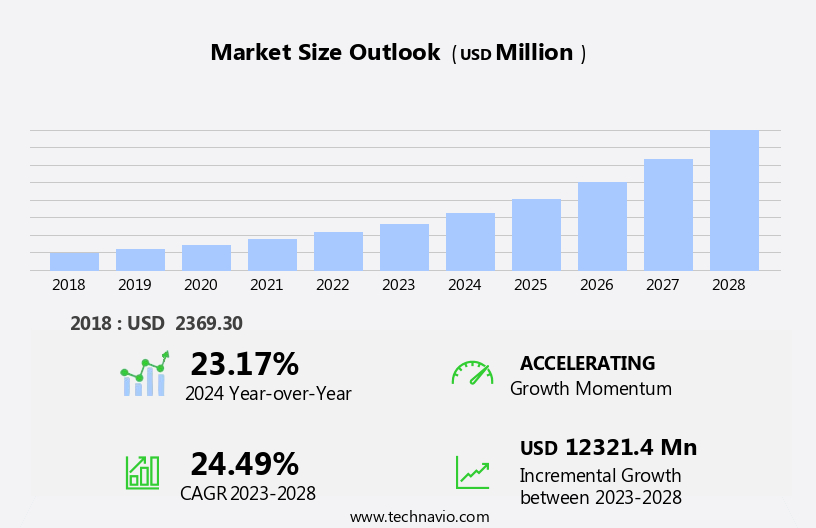
Data Warehouse As A Service (Dwaas) Market Size

 Request Free Sample

  • The market represents a significant shift in how businesses manage their data environments. DWaaS offers flexibility and scalability, enabling organizations to focus on their core competencies while leveraging cloud computing for their data warehousing needs. This market is driven by the increasing demand for Business Intelligence (BI) that can handle large data volumes and provide advanced analytics capabilities. 
  • Technological developments in cloud computing, software, computing, and storage have made DWaaS a viable alternative to traditional on-premises data warehouses. However, the adoption of DWaaS is not without challenges. Security issues and integration complexities are key concerns for businesses considering a move to the cloud.
  • Restricted customization is another challenge, as some organizations require specific configurations for their data warehouses. Despite these challenges, the benefits of DWaaS, such as reduced IT infrastructure complexity and improved data accessibility, continue to drive market growth. The DWaaS market is expected to expand as more businesses seek to harness the power of their data for enterprise management, visualization, and data analytics.

How is this Data Warehouse As A Service Industry segmented and which is the largest segment?

The DWaaS industry research report provides comprehensive data (region-wise segment analysis), with forecasts and estimates in "USD billion" for the period 2024-2028, as well as historical data from 2018-2022 for the following segments.

  • End-user
    • BFSI
    • Government
    • Healthcare
    • E-commerce and retail
    • Others
  • Type
    • Enterprise DWaaS
    • Operational data storage
  • Geography
    • North America
      • US
    • Europe
      • Germany
      • France
    • APAC
      • China
      • Japan
    • Middle East and Africa
    • South America

By End-user Insights

  • The BFSI segment is estimated to witness significant growth during the forecast period.

The BFSI sector's reliance on managing and analyzing large financial data volumes has fueled the adoption of Data Warehouse as a Service (DWaaS) solutions. DWaaS offers flexibility and scalability, enabling BFSI companies to efficiently manage data from retail banking institutions, lending operations, credit underwriting procedures, and financial consulting firms. DWaaS solutions provide core competencies in cloud computing, business intelligence (BI), data analytics, enterprise management, visualization, and BI solutions. Technological developments, such as IoT technology and AI technology, further enhance DWaaS capabilities. However, challenges persist, including security issues, integration challenges, and restricted customization. Cloud solutions, including cloud data warehouses, offer a data environment that is software, computing, and storage-intensive.

DWaaS companies address concerns with service disruptions, latency, data integration, and data access. Security measures, such as data encryption and data masking, ensure data privacy. Despite these challenges, DWaaS adoption continues to grow, offering decision support services, data categorization, and data assessment to mid-size businesses and large enterprises.
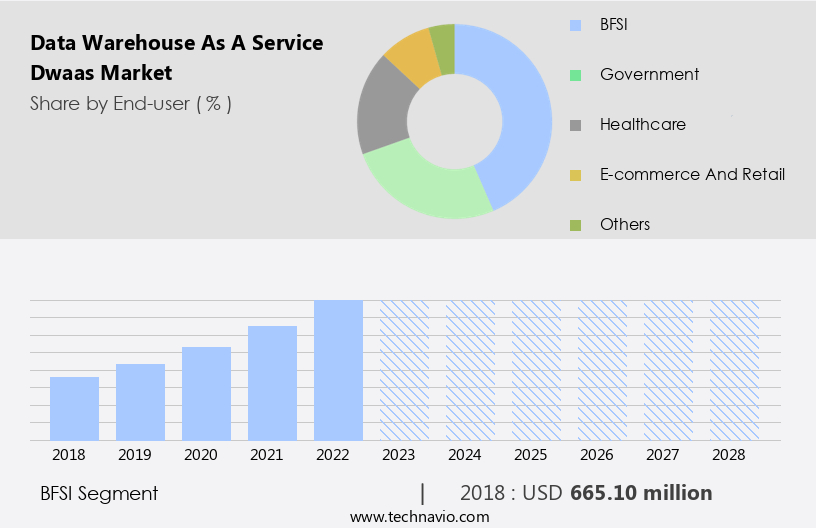
Data Warehouse As A Service (Dwaas) Market Size

Get a glance at the Data Warehouse As A Service Industry report of share of various segments Request Free Sample

The BFSI segment was valued at USD 665.10 million in 2018 and showed a gradual increase during the forecast period.

Regional Analysis

  • North America is estimated to contribute 35% to the growth of the global market during the forecast period.

Technavio’s analysts have elaborately explained the regional trends and drivers that shape the market during the forecast period.
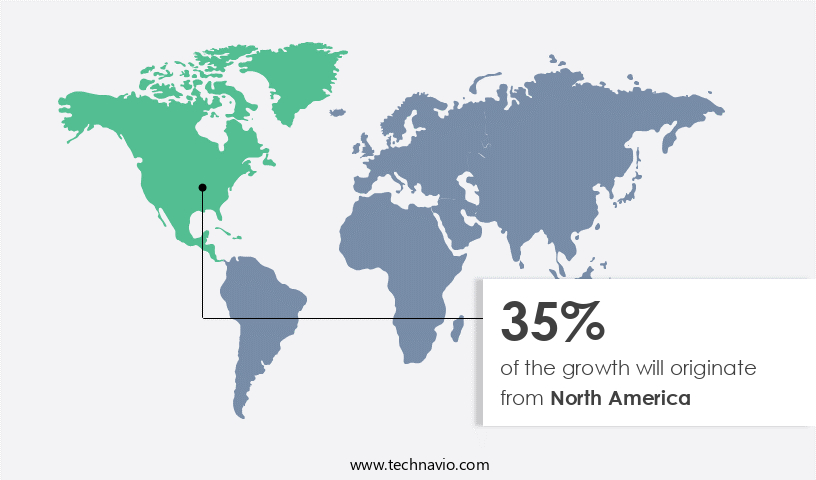
Data Warehouse As A Service (Dwaas) Market Share by Geography

For more insights on the market share of various regions, Request Free Sample

The North American market for Data Warehouse as a Service (DWaaS) is experiencing significant growth due to the region's early adoption of advanced technologies in industries such as manufacturing, retail, and banking, financial services and insurance (BFSI). The presence of leading companies In the region contributes to market expansion. Additionally, the integration of cloud-based services, automation solutions, and AI with operational and supply chain processes is driving the adoption of data warehousing in North America. With several advanced economies located In the region, the demand for data processing, outsourcing, and infrastructure services is increasing. Businesses in North America are leveraging DWaaS to manage and analyze large data volumes, improve enterprise management, and enhance business intelligence and data analytics capabilities.

Technological developments, including virtual data warehousing, IoT technology, and AI technology, are also fueling market growth. However, concerns around data security, service disruptions, and integration challenges persist, necessitating robust security measures, such as data encryption and masking, and effective data access management.

Market Dynamics

Our  researchers analyzed the data with 2023 as the base year, along with the key drivers, trends, and challenges. A holistic analysis of drivers will help companies refine their marketing strategies to gain a competitive advantage.

What are the key market drivers leading to the rise In the adoption of Data Warehouse As A Service (Dwaas) Industry?

Shift from on-premises to SaaS model is the key driver of the market.

  • Cloud-based Data Warehouse as a Service (DWaaS) is transforming the business landscape by providing flexible and scalable data management solutions. companies offer intuitive services with drag-and-drop functionalities and mobile accessibility, catering to businesses of all sizes. The pay-per-use pricing model allows clients to pay only for their utilized resources, while the flexibility in deployment models enables clients to build customized cloud-based infrastructures. Cloud-based data warehouses reduce the Total Cost of Ownership (TCO) by eliminating the need for extensive IT infrastructure. Technological developments, such as Business Intelligence (BI), data analytics, virtual data warehousing, IoT technology, and AI technology, are seamlessly integrated into these solutions.
  • However, concerns around security issues and integration challenges persist. Security measures, including data encryption and masking, are implemented by DWaaS companies to mitigate risks. Service disruptions, latency, and data access are addressed through reliable cloud solutions. Data integration is streamlined, enabling real-time decision support services. The adoption of cloud data warehouses is driven by the increasing data volumes and IT infrastructure complexity. Various industries, such as retail banking institutions, lending operations, credit underwriting procedures, financial consulting firms, e-commerce, and mid-size businesses, are leveraging these solutions for improved employee and organizational productivity. Despite these benefits, challenges remain, including data categorization, assessment, and the impact of consumerization trends, such as mobile devices, social networking, and data searches.
  • Cyberattacks and data transmission concerns are also areas of focus for businesses considering DWaaS adoption.

What are the market trends shaping the Data Warehouse As A Service (Dwaas) Industry?

Emergence of advanced storage technologies is the upcoming market trend.

  • Data Warehouse as a Service (DWaaS) has emerged as a significant solution for businesses seeking flexibility and scalability In their data storage needs. With the increasing reliance on business intelligence (BI), data analytics, and enterprise management, the data volumes and IT infrastructure complexity have grown exponentially. DWaaS offers cloud solutions that cater to these requirements, providing advanced software, computing, and storage capabilities. Technological developments in areas like IoT technology, AI technology, and virtual data warehousing have further fueled DWaaS adoption. However, concerns around security issues and integration challenges persist. DWaaS companies offer data encryption, data masking, and other security measures to mitigate risks.
  • Service disruptions, latency, and data integration remain key areas of focus. Businesses in various sectors, including retail banking institutions, lending operations, credit underwriting procedures, financial consulting firms, mid-size businesses, and e-commerce, are adopting DWaaS to enhance decision support services. The cloud data warehouse market continues to grow, offering a data environment that can cater to the informational data needs of organizations. Moreover, consumerization trends, such as the use of mobile devices, social networking, and data searches, have led to increased employee and organizational productivity. DWaaS solutions enable seamless access to data from these devices, facilitating analytics solutions and improving overall productivity.
  • Despite these benefits, challenges such as data categorization, data assessment, and data access remain. Cyberattacks pose a significant threat to data security, necessitating robust security measures. DWaaS companies play a crucial role in addressing these challenges and ensuring a secure and reliable data environment for their clients.

What challenges does the Data Warehouse As A Service (Dwaas) Industry face during its growth?

Data privacy and security risks is a key challenge affecting the industry growth.

  • Data Warehouse as a Service (DWaaS) is a cloud-based solution that offers businesses flexibility and scalability in managing their data warehouses. This technological development enables organizations to focus on their core competencies while leveraging the benefits of cloud computing. However, the adoption of DWaaS is not without challenges. Security issues, such as data encryption, data masking, and data security measures, are major concerns for businesses. Service disruptions due to latency and data integration challenges can also impact decision-making processes. Moreover, the integration of DWaaS with IoT technology, AI technology, and virtual data warehousing requires careful consideration. Data transmission and cyberattacks pose significant risks to data security.
  • Businesses must ensure that their chosen DWaaS company has robust security measures in place to mitigate these risks. The adoption of DWaaS is particularly relevant for industries such as retail banking institutions, lending operations, credit underwriting procedures, financial consulting firms, and mid-size businesses. These organizations generate vast amounts of informational data that require efficient management and analysis for improved employee and organizational productivity. However, the move towards DWaaS adoption also brings challenges such as data categorization, data assessment, and data access. On-premise software and IT infrastructure complexity can hinder the transition to cloud solutions. Additionally, consumerization trends, such as mobile devices and social networking, require businesses to adapt to new data searches and analytics solutions.
  • In conclusion, the DWaaS market offers businesses significant benefits in terms of flexibility, scalability, and technological improvement. However, it also presents challenges related to security, integration, and data management. Businesses must carefully evaluate these factors before adopting DWaaS to ensure they reap the maximum benefits while mitigating potential risks.

Exclusive Customer Landscape

The data warehouse as a service (dwaas) market forecasting report includes the adoption lifecycle of the market, covering from the innovator’s stage to the laggard’s stage. It focuses on adoption rates in different regions based on penetration. Furthermore, the data warehouse as a service (dwaas) market report also includes key purchase criteria and drivers of price sensitivity to help companies evaluate and develop their market growth analysis strategies.
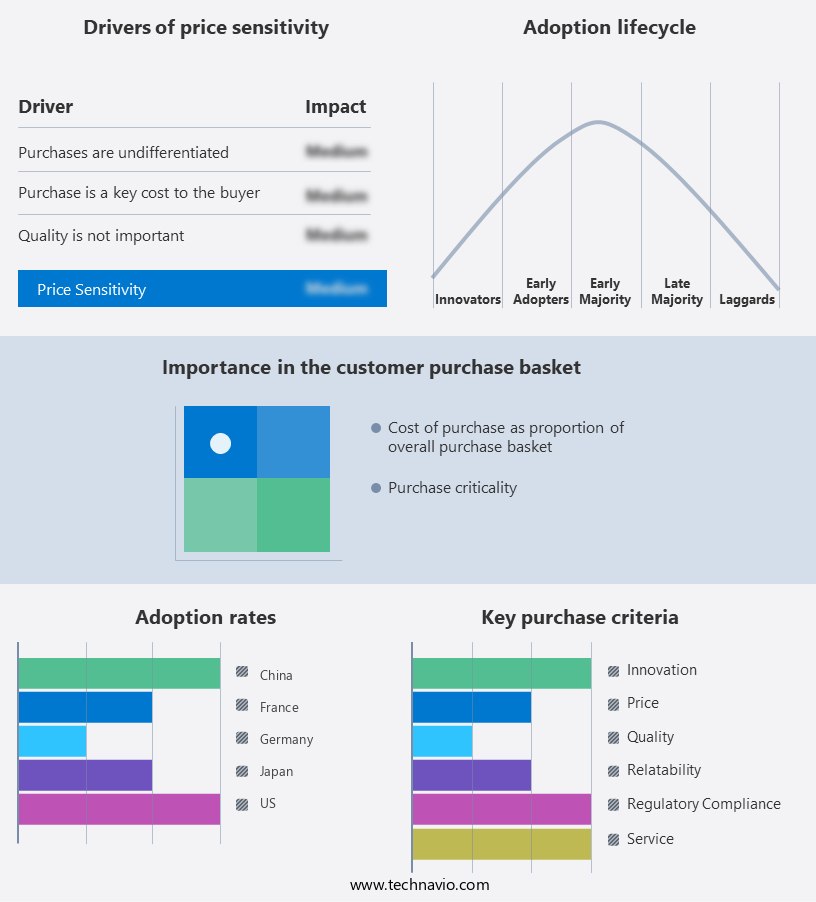
Data Warehouse As A Service (Dwaas) Market Share by Geography

 Customer Landscape

Key Companies & Market Insights

Companies are implementing various strategies, such as strategic alliances, data warehouse as a service (dwaas) market forecast, partnerships, mergers and acquisitions, geographical expansion, and product/service launches, to enhance their presence In the industry.

Alphabet Inc. - Data Warehouse as a Service (DWaaS) is a cloud-based data management solution that enables businesses to store, manage, and analyze large volumes of data without the need for on-premises infrastructure. Google BigQuery is an exemplary DWaaS offering from a leading technology company.

The industry research and growth report includes detailed analyses of the competitive landscape of the market and information about key companies, including:

  • Alphabet Inc.
  • Amazon.com Inc.
  • AtScale Inc.
  • Cloudera Inc.
  • HCL Technologies Ltd.
  • International Business Machines Corp.
  • Microsoft Corp.
  • Netavis Software GmbH
  • Open Text Corporation
  • Oracle Corp.
  • Panoply Ltd. 
  • Progress Software Corp.
  • SAP SE
  • Snowflake Inc.
  • Solver Inc.
  • Teradata Corp.
  • Transwarp Information Technology Shanghai Co. Ltd.
  • Veeva Systems Inc.
  • VMware Inc.
  • Yellowbrick Data Inc.

Qualitative and quantitative analysis of companies has been conducted to help clients understand the wider business environment as well as the strengths and weaknesses of key industry players. Data is qualitatively analyzed to categorize companies as pure play, category-focused, industry-focused, and diversified; it is quantitatively analyzed to categorize companies as dominant, leading, strong, tentative, and weak.

Research Analyst Overview

Data warehouses have become an essential component of modern business intelligence (BI) and data analytics strategies. With the increasing adoption of cloud computing, Data Warehouse as a Service (DWaaS) has emerged as a popular solution for enterprises seeking flexibility and scalability In their data environments. DWaaS offers several core competencies that differentiate it from traditional on-premise data warehouses. These include the ability to quickly scale up or down based on business needs, reduced IT infrastructure complexity, and access to advanced BI solutions and analytics tools. Cloud computing has played a significant role In the growth of DWaaS. Cloud data warehouses provide enterprises with the benefits of cloud solutions, such as computing and storage resources on demand, without the need for extensive IT infrastructure.

Moreover, cloud data warehouses offer advanced features like virtualization, data categorization, and data assessment, enabling businesses to make informed decisions based on their data. However, the adoption of DWaaS is not without challenges. Security issues, such as data encryption, data masking, and data security measures, are critical concerns for businesses. Service disruptions, latency, and data integration challenges can also impact the effectiveness of DWaaS. Moreover, restricted customization can be a limitation for some businesses, particularly those with complex data environments. Integration with Internet of Things (IoT) technology and Artificial Intelligence (AI) solutions can also pose challenges. Despite these challenges, the DWaaS market continues to grow, driven by technological developments and the increasing demand for decision support services.

Retail banking institutions, lending operations, credit underwriting procedures, financial consulting firms, and mid-size businesses are among the sectors that have embraced DWaaS to enhance their BI capabilities. The use of DWaaS is also influenced by consumerization trends, such as the increasing use of mobile devices, social networking, and data searches. Employee and organizational productivity are other key drivers, as businesses seek to leverage their data to gain a competitive edge. E-commerce is another sector that has seen significant growth in DWaaS adoption. The ability to process large data volumes and provide real-time insights is crucial for businesses in this sector to remain competitive.

In conclusion, DWaaS offers several benefits, including flexibility, scalability, and access to advanced BI solutions and analytics tools. However, it also presents challenges related to security, integration, and customization. Despite these challenges, the DWaaS market continues to grow, driven by technological improvement and the increasing demand for data-driven decision making.

Market Scope

Report Coverage

Details

Page number

177

Base year

2023

Historic period

2018-2022

Forecast period

2024-2028

Growth momentum & CAGR

Accelerate at a CAGR of 24.49%

Market growth 2024-2028

USD 12.32 billion

Market structure

Fragmented

YoY growth 2023-2024(%)

23.17

Key countries

US, Germany, France, China, and Japan

Competitive landscape

Leading Companies, Market Positioning of Companies, Competitive Strategies, and Industry Risks

Request Free Sample

What are the Key Data Covered in this Data Warehouse As A Service (Dwaas) Market Research and Growth Report?

  • CAGR of the Data Warehouse As A Service (Dwaas) industry during the forecast period
  • Detailed information on factors that will drive the growth and forecasting between 2024 and 2028
  • Precise estimation of the size of the market and its contribution of the industry in focus to the parent market
  • Accurate predictions about upcoming growth and trends and changes in consumer behaviour
  • Growth of the market across North America, Europe, APAC, Middle East and Africa, and South America
  • Thorough analysis of the market’s competitive landscape and detailed information about companies
  • Comprehensive analysis of factors that will challenge the data warehouse as a service (dwaas) market growth of industry companies

We can help! Our analysts can customize this data warehouse as a service (dwaas) market research report to meet your requirements.

Get in touch

1 Executive Summary

  • 1.1 Market overview
    • Executive Summary - Chart on Market Overview
    • Executive Summary - Data Table on Market Overview
    • Executive Summary - Chart on Global Market Characteristics
    • Executive Summary - Chart on Market by Geography
    • Executive Summary - Chart on Market Segmentation by End-user
    • Executive Summary - Chart on Market Segmentation by Type
    • Executive Summary - Chart on Incremental Growth
    • Executive Summary - Data Table on Incremental Growth
    • Executive Summary - Chart on Company Market Positioning

2 Market Landscape

  • 2.1 Market ecosystem
    • Parent Market
    • Data Table on - Parent Market
  • 2.2 Market characteristics
    • Market characteristics analysis
  • 2.3 Value chain analysis
    • Value Chain Analysis

3 Market Sizing

  • 3.1 Market definition
    • Offerings of companies included in the market definition
  • 3.2 Market segment analysis
    • Market segments
  • 3.3 Market size 2023
    • 3.4 Market outlook: Forecast for 2023-2028
      • Chart on Global - Market size and forecast 2023-2028 ($ million)
      • Data Table on Global - Market size and forecast 2023-2028 ($ million)
      • Chart on Global Market: Year-over-year growth 2023-2028 (%)
      • Data Table on Global Market: Year-over-year growth 2023-2028 (%)

    4 Historic Market Size

    • 4.1 Global Data Warehouse As A Service (DWaaS) Market 2018 - 2022
      • Historic Market Size - Data Table on Global Data Warehouse As A Service (DWaaS) Market 2018 - 2022 ($ million)
    • 4.2 End-user segment analysis 2018 - 2022
      • Historic Market Size - End-user Segment 2018 - 2022 ($ million)
    • 4.3 Type segment analysis 2018 - 2022
      • Historic Market Size - Type Segment 2018 - 2022 ($ million)
    • 4.4 Geography segment analysis 2018 - 2022
      • Historic Market Size - Geography Segment 2018 - 2022 ($ million)
    • 4.5 Country segment analysis 2018 - 2022
      • Historic Market Size - Country Segment 2018 - 2022 ($ million)

    5 Five Forces Analysis

    • 5.1 Five forces summary
      • Five forces analysis - Comparison between 2023 and 2028
    • 5.2 Bargaining power of buyers
      • Bargaining power of buyers - Impact of key factors 2023 and 2028
    • 5.3 Bargaining power of suppliers
      • Bargaining power of suppliers - Impact of key factors in 2023 and 2028
    • 5.4 Threat of new entrants
      • Threat of new entrants - Impact of key factors in 2023 and 2028
    • 5.5 Threat of substitutes
      • Threat of substitutes - Impact of key factors in 2023 and 2028
    • 5.6 Threat of rivalry
      • Threat of rivalry - Impact of key factors in 2023 and 2028
    • 5.7 Market condition
      • Chart on Market condition - Five forces 2023 and 2028

    6 Market Segmentation by End-user

    • 6.1 Market segments
      • Chart on End-user - Market share 2023-2028 (%)
      • Data Table on End-user - Market share 2023-2028 (%)
    • 6.2 Comparison by End-user
      • Chart on Comparison by End-user
      • Data Table on Comparison by End-user
    • 6.3 BFSI - Market size and forecast 2023-2028
      • Chart on BFSI - Market size and forecast 2023-2028 ($ million)
      • Data Table on BFSI - Market size and forecast 2023-2028 ($ million)
      • Chart on BFSI - Year-over-year growth 2023-2028 (%)
      • Data Table on BFSI - Year-over-year growth 2023-2028 (%)
    • 6.4 Government - Market size and forecast 2023-2028
      • Chart on Government - Market size and forecast 2023-2028 ($ million)
      • Data Table on Government - Market size and forecast 2023-2028 ($ million)
      • Chart on Government - Year-over-year growth 2023-2028 (%)
      • Data Table on Government - Year-over-year growth 2023-2028 (%)
    • 6.5 Healthcare - Market size and forecast 2023-2028
      • Chart on Healthcare - Market size and forecast 2023-2028 ($ million)
      • Data Table on Healthcare - Market size and forecast 2023-2028 ($ million)
      • Chart on Healthcare - Year-over-year growth 2023-2028 (%)
      • Data Table on Healthcare - Year-over-year growth 2023-2028 (%)
    • 6.6 E-commerce and retail - Market size and forecast 2023-2028
      • Chart on E-commerce and retail - Market size and forecast 2023-2028 ($ million)
      • Data Table on E-commerce and retail - Market size and forecast 2023-2028 ($ million)
      • Chart on E-commerce and retail - Year-over-year growth 2023-2028 (%)
      • Data Table on E-commerce and retail - Year-over-year growth 2023-2028 (%)
    • 6.7 Others - Market size and forecast 2023-2028
      • Chart on Others - Market size and forecast 2023-2028 ($ million)
      • Data Table on Others - Market size and forecast 2023-2028 ($ million)
      • Chart on Others - Year-over-year growth 2023-2028 (%)
      • Data Table on Others - Year-over-year growth 2023-2028 (%)
    • 6.8 Market opportunity by End-user
      • Market opportunity by End-user ($ million)
      • Data Table on Market opportunity by End-user ($ million)

    7 Market Segmentation by Type

    • 7.1 Market segments
      • Chart on Type - Market share 2023-2028 (%)
      • Data Table on Type - Market share 2023-2028 (%)
    • 7.2 Comparison by Type
      • Chart on Comparison by Type
      • Data Table on Comparison by Type
    • 7.3 Enterprise DWaaS - Market size and forecast 2023-2028
      • Chart on Enterprise DWaaS - Market size and forecast 2023-2028 ($ million)
      • Data Table on Enterprise DWaaS - Market size and forecast 2023-2028 ($ million)
      • Chart on Enterprise DWaaS - Year-over-year growth 2023-2028 (%)
      • Data Table on Enterprise DWaaS - Year-over-year growth 2023-2028 (%)
    • 7.4 Operational data storage - Market size and forecast 2023-2028
      • Chart on Operational data storage - Market size and forecast 2023-2028 ($ million)
      • Data Table on Operational data storage - Market size and forecast 2023-2028 ($ million)
      • Chart on Operational data storage - Year-over-year growth 2023-2028 (%)
      • Data Table on Operational data storage - Year-over-year growth 2023-2028 (%)
    • 7.5 Market opportunity by Type
      • Market opportunity by Type ($ million)
      • Data Table on Market opportunity by Type ($ million)

    8 Customer Landscape

    • 8.1 Customer landscape overview
      • Analysis of price sensitivity, lifecycle, customer purchase basket, adoption rates, and purchase criteria

    9 Geographic Landscape

    • 9.1 Geographic segmentation
      • Chart on Market share by geography 2023-2028 (%)
      • Data Table on Market share by geography 2023-2028 (%)
    • 9.2 Geographic comparison
      • Chart on Geographic comparison
      • Data Table on Geographic comparison
    • 9.3 North America - Market size and forecast 2023-2028
      • Chart on North America - Market size and forecast 2023-2028 ($ million)
      • Data Table on North America - Market size and forecast 2023-2028 ($ million)
      • Chart on North America - Year-over-year growth 2023-2028 (%)
      • Data Table on North America - Year-over-year growth 2023-2028 (%)
    • 9.4 Europe - Market size and forecast 2023-2028
      • Chart on Europe - Market size and forecast 2023-2028 ($ million)
      • Data Table on Europe - Market size and forecast 2023-2028 ($ million)
      • Chart on Europe - Year-over-year growth 2023-2028 (%)
      • Data Table on Europe - Year-over-year growth 2023-2028 (%)
    • 9.5 APAC - Market size and forecast 2023-2028
      • Chart on APAC - Market size and forecast 2023-2028 ($ million)
      • Data Table on APAC - Market size and forecast 2023-2028 ($ million)
      • Chart on APAC - Year-over-year growth 2023-2028 (%)
      • Data Table on APAC - Year-over-year growth 2023-2028 (%)
    • 9.6 Middle East and Africa - Market size and forecast 2023-2028
      • Chart on Middle East and Africa - Market size and forecast 2023-2028 ($ million)
      • Data Table on Middle East and Africa - Market size and forecast 2023-2028 ($ million)
      • Chart on Middle East and Africa - Year-over-year growth 2023-2028 (%)
      • Data Table on Middle East and Africa - Year-over-year growth 2023-2028 (%)
    • 9.7 South America - Market size and forecast 2023-2028
      • Chart on South America - Market size and forecast 2023-2028 ($ million)
      • Data Table on South America - Market size and forecast 2023-2028 ($ million)
      • Chart on South America - Year-over-year growth 2023-2028 (%)
      • Data Table on South America - Year-over-year growth 2023-2028 (%)
    • 9.8 US - Market size and forecast 2023-2028
      • Chart on US - Market size and forecast 2023-2028 ($ million)
      • Data Table on US - Market size and forecast 2023-2028 ($ million)
      • Chart on US - Year-over-year growth 2023-2028 (%)
      • Data Table on US - Year-over-year growth 2023-2028 (%)
    • 9.9 Germany - Market size and forecast 2023-2028
      • Chart on Germany - Market size and forecast 2023-2028 ($ million)
      • Data Table on Germany - Market size and forecast 2023-2028 ($ million)
      • Chart on Germany - Year-over-year growth 2023-2028 (%)
      • Data Table on Germany - Year-over-year growth 2023-2028 (%)
    • 9.10 France - Market size and forecast 2023-2028
      • Chart on France - Market size and forecast 2023-2028 ($ million)
      • Data Table on France - Market size and forecast 2023-2028 ($ million)
      • Chart on France - Year-over-year growth 2023-2028 (%)
      • Data Table on France - Year-over-year growth 2023-2028 (%)
    • 9.11 China - Market size and forecast 2023-2028
      • Chart on China - Market size and forecast 2023-2028 ($ million)
      • Data Table on China - Market size and forecast 2023-2028 ($ million)
      • Chart on China - Year-over-year growth 2023-2028 (%)
      • Data Table on China - Year-over-year growth 2023-2028 (%)
    • 9.12 Japan - Market size and forecast 2023-2028
      • Chart on Japan - Market size and forecast 2023-2028 ($ million)
      • Data Table on Japan - Market size and forecast 2023-2028 ($ million)
      • Chart on Japan - Year-over-year growth 2023-2028 (%)
      • Data Table on Japan - Year-over-year growth 2023-2028 (%)
    • 9.13 Market opportunity by geography
      • Market opportunity by geography ($ million)
      • Data Tables on Market opportunity by geography ($ million)

    10 Drivers, Challenges, and Opportunity/Restraints

    • 10.1 Market drivers
      • 10.2 Market challenges
        • 10.3 Impact of drivers and challenges
          • Impact of drivers and challenges in 2023 and 2028
        • 10.4 Market opportunities/restraints

          11 Competitive Landscape

          • 11.1 Overview
            • 11.2 Competitive Landscape
              • Overview on criticality of inputs and factors of differentiation
            • 11.3 Landscape disruption
              • Overview on factors of disruption
            • 11.4 Industry risks
              • Impact of key risks on business

            12 Competitive Analysis

            • 12.1 Companies profiled
              • Companies covered
            • 12.2 Market positioning of companies
              • Matrix on companies position and classification
            • 12.3 Alphabet Inc.
              • Alphabet Inc. - Overview
              • Alphabet Inc. - Business segments
              • Alphabet Inc. - Key offerings
              • Alphabet Inc. - Segment focus
            • 12.4 Amazon.com Inc.
              • Amazon.com Inc. - Overview
              • Amazon.com Inc. - Business segments
              • Amazon.com Inc. - Key news
              • Amazon.com Inc. - Key offerings
              • Amazon.com Inc. - Segment focus
            • 12.5 Cloudera Inc.
              • Cloudera Inc. - Overview
              • Cloudera Inc. - Product / Service
              • Cloudera Inc. - Key offerings
            • 12.6 HCL Technologies Ltd.
              • HCL Technologies Ltd. - Overview
              • HCL Technologies Ltd. - Business segments
              • HCL Technologies Ltd. - Key news
              • HCL Technologies Ltd. - Key offerings
              • HCL Technologies Ltd. - Segment focus
            • 12.7 International Business Machines Corp.
              • International Business Machines Corp. - Overview
              • International Business Machines Corp. - Business segments
              • International Business Machines Corp. - Key news
              • International Business Machines Corp. - Key offerings
              • International Business Machines Corp. - Segment focus
            • 12.8 Microsoft Corp.
              • Microsoft Corp. - Overview
              • Microsoft Corp. - Business segments
              • Microsoft Corp. - Key news
              • Microsoft Corp. - Key offerings
              • Microsoft Corp. - Segment focus
            • 12.9 Open Text Corporation
              • Open Text Corporation - Overview
              • Open Text Corporation - Business segments
              • Open Text Corporation - Key news
              • Open Text Corporation - Key offerings
              • Open Text Corporation - Segment focus
            • 12.10 Oracle Corp.
              • Oracle Corp. - Overview
              • Oracle Corp. - Business segments
              • Oracle Corp. - Key news
              • Oracle Corp. - Key offerings
              • Oracle Corp. - Segment focus
            • 12.11 Progress Software Corp.
              • Progress Software Corp. - Overview
              • Progress Software Corp. - Product / Service
              • Progress Software Corp. - Key news
              • Progress Software Corp. - Key offerings
            • 12.12 SAP SE
              • SAP SE - Overview
              • SAP SE - Business segments
              • SAP SE - Key news
              • SAP SE - Key offerings
              • SAP SE - Segment focus
            • 12.13 Snowflake Inc.
              • Snowflake Inc. - Overview
              • Snowflake Inc. - Product / Service
              • Snowflake Inc. - Key news
              • Snowflake Inc. - Key offerings
            • 12.14 Teradata Corp.
              • Teradata Corp. - Overview
              • Teradata Corp. - Business segments
              • Teradata Corp. - Key news
              • Teradata Corp. - Key offerings
              • Teradata Corp. - Segment focus
            • 12.15 Veeva Systems Inc.
              • Veeva Systems Inc. - Overview
              • Veeva Systems Inc. - Business segments
              • Veeva Systems Inc. - Key offerings
              • Veeva Systems Inc. - Segment focus
            • 12.16 VMware Inc.
              • VMware Inc. - Overview
              • VMware Inc. - Product / Service
              • VMware Inc. - Key news
              • VMware Inc. - Key offerings
            • 12.17 Yellowbrick Data Inc.
              • Yellowbrick Data Inc. - Overview
              • Yellowbrick Data Inc. - Product / Service
              • Yellowbrick Data Inc. - Key offerings

            13 Appendix

            • 13.1 Scope of the report
              • 13.2 Inclusions and exclusions checklist
                • Inclusions checklist
                • Exclusions checklist
              • 13.3 Currency conversion rates for US$
                • Currency conversion rates for US$
              • 13.4 Research methodology
                • Research methodology
              • 13.5 Data procurement
                • Information sources
              • 13.6 Data validation
                • Data validation
              • 13.7 Validation techniques employed for market sizing
                • Validation techniques employed for market sizing
              • 13.8 Data synthesis
                • Data synthesis
              • 13.9 360 degree market analysis
                • 360 degree market analysis
              • 13.10 List of abbreviations
                • List of abbreviations

              Research Methodology

              Technavio presents a detailed picture of the market by way of study, synthesis, and summation of data from multiple sources. The analysts have presented the various facets of the market with a particular focus on identifying the key industry influencers. The data thus presented is comprehensive, reliable, and the result of extensive research, both primary and secondary.

              INFORMATION SOURCES

              Primary sources

              • Manufacturers and suppliers
              • Channel partners
              • Industry experts
              • Strategic decision makers

              Secondary sources

              • Industry journals and periodicals
              • Government data
              • Financial reports of key industry players
              • Historical data
              • Press releases

              DATA ANALYSIS

              Data Synthesis

              • Collation of data
              • Estimation of key figures
              • Analysis of derived insights

              Data Validation

              • Triangulation with data models
              • Reference against proprietary databases
              • Corroboration with industry experts

              REPORT WRITING

              Qualitative

              • Market drivers
              • Market challenges
              • Market trends
              • Five forces analysis

              Quantitative

              • Market size and forecast
              • Market segmentation
              • Geographical insights
              • Competitive landscape

              Interested in this report?

              Get your sample now to see our research methodology and insights!

              Download Now

              Frequently Asked Questions

              Data Warehouse As A Service (Dwaas) market growth will increase by $ 12321.4 mn during 2024-2028 .

              The Data Warehouse As A Service (Dwaas) market is expected to grow at a CAGR of 24.49% during 2024-2028 .

              Data Warehouse As A Service (Dwaas) market is segmented by End-user( BFSI, Government, Healthcare, E-commerce and retail, Others) Type( Enterprise DWaaS, Operational data storage)

              Alphabet Inc., Amazon.com Inc., AtScale Inc., Cloudera Inc., HCL Technologies Ltd., International Business Machines Corp., Microsoft Corp., Netavis Software GmbH, Open Text Corporation, Oracle Corp., Panoply Ltd. , Progress Software Corp., SAP SE, Snowflake Inc., Solver Inc., Teradata Corp., Transwarp Information Technology Shanghai Co. Ltd., Veeva Systems Inc., VMware Inc., Yellowbrick Data Inc. are a few of the key vendors in the Data Warehouse As A Service (Dwaas) market.

              North America will register the highest growth rate of 35% among the other regions. Therefore, the Data Warehouse As A Service (Dwaas) market in North America is expected to garner significant business opportunities for the vendors during the forecast period.

              US, Germany, France, China, Japan

              • Shift from on-premises to SaaS modelVendors are gradually moving from on-premises to cloud-based solutions is the driving factor this market.
              • which offer drag-and-drop functionalities is the driving factor this market.
              • mobile accessibility is the driving factor this market.
              • and more intuitive services. Vendors are targeting companies of all sizes by offering affordable options for all business users and their data needs. These solutions offer low-cost options and rapid deployment of services. The key benefit of implementing cloud-based data warehousing solutions is the availability of the pay-per-use pricing model is the driving factor this market.
              • where clients pay only for what they use. Cloud-based solutions are also flexible in terms of deployment models. Clients can build their cloud-based infrastructure as per their business requirements. Cloud-based infrastructure helps clients reduce the total cost of ownership (TCO) of software and hardware.Cloud computing solutions provide flexibility to increase or decrease enterprise data and storage capacity as per the requirements. Based on their requirements is the driving factor this market.
              • organizations can choose storage capacity to store digital data in servers and data centers hosted by data warehouse solution providers. Cloud-based storage solutions have attracted many firms operating in multiple industry verticals to choose a storage facility for digital files is the driving factor this market.
              • depending on their business requirements.Organizations are leveraging cloud-based storage solutions as the providers manage digital files and offer disaster recovery solutions as well. Thus is the driving factor this market.
              • firms can recover their enterprise data at any point in time in case of a technical failure. Enterprises generate a massive amount of data from social media and other sources is the driving factor this market.
              • which require efficient cloud storage systems with centralized access to documents. Therefore is the driving factor this market.
              • cloud storage solutions allow organizations to use cloud-based storage data warehouse solutions as per their storage requirements. This is expected to be a major driver for data warehouse in return fueling the growth of the global data warehouse as a service market during the forecast period. is the driving factor this market.

              The Data Warehouse As A Service (Dwaas) market vendors should focus on grabbing business opportunities from the BFSI segment as it accounted for the largest market share in the base year.
