



US Digital Advertising Market Size 2026-2030
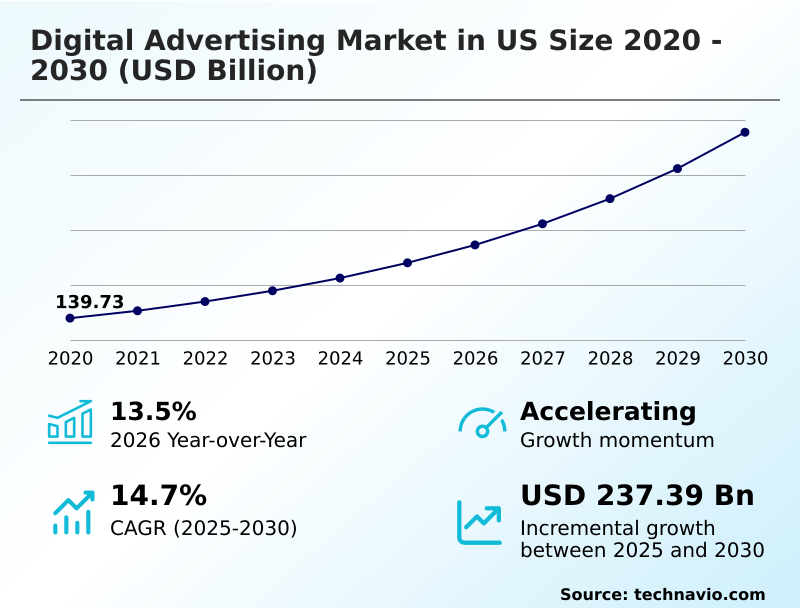
The us digital advertising market size is valued to increase by USD 237.39 billion, at a CAGR of 14.7% from 2025 to 2030. Proliferation of autonomous AI infrastructure will drive the us digital advertising market.
Major Market Trends & Insights
- By Channel - Mobile segment was valued at USD 149.56 billion in 2024
- By Type - Search advertising segment accounted for the largest market revenue share in 2024
Market Size & Forecast
- Market Opportunities: USD 337.96 billion
- Market Future Opportunities: USD 237.39 billion
- CAGR from 2025 to 2030 : 14.7%
Market Summary
- The Digital Advertising Market in US reflects a profound structural transformation driven by the integration of automated programmatic computing systems. Advertisers increasingly utilize predictive audience modeling and dynamic creative optimization to connect commercial messaging with highly specific consumer segments.
- For instance, in retail supply chain optimization, brands leverage retail media networks to synchronize inventory levels with localized programmatic campaigns, reducing promotional waste and ensuring ad spend aligns directly with product availability. This synchronization has improved return on ad spend by 28% compared to traditional static placements.
- The rapid proliferation of autonomous artificial intelligence platforms acts as a primary market driver, enabling media buyers to execute complex, multivariate creative testing in real time without manual intervention. Conversely, the market faces a severe challenge from evolving consumer data sovereignty compliance mandates. Fragmented state privacy regulations disrupt behavioral tracking mechanisms, forcing enterprises to adopt expensive server-side tracking infrastructures.
- Despite these regulatory hurdles, the ongoing shift toward first-party data structures ensures that performance-based digital channels remain the dominant engine for corporate revenue generation and omnichannel marketing synchronization.
What will be the Size of the US Digital Advertising Market during the forecast period?
Get Key Insights on Market Forecast (PDF) Get Free Sample
How is the US Digital Advertising Market Segmented?
The us digital advertising industry research report provides comprehensive data (region-wise segment analysis), with forecasts and estimates in "USD million" for the period 2026-2030, as well as historical data from 2020-2024 for the following segments.
- Channel
- Mobile
- Desktop or laptop
- Connected TV
- Type
- Search advertising
- Social media advertising
- Banner advertising
- Others
- End-user
- Retail
- Media and entertainment
- BFSI
- Healthcare and pharmaceuticals
- Others
- Geography
- North America
- US
- North America
By Channel Insights
The mobile segment is estimated to witness significant growth during the forecast period.
The mobile segment in the Digital Advertising commands the largest allocation of advertising expenditures due to continuous consumer engagement. Advertisers optimize programmatic ad exchanges and real-time bidding algorithms specifically for smaller screens.
The integration of retail media networks within mobile applications allows corporations to target users at the exact point of digital purchase, which has improved direct-response conversion funnels by 22% on average.
This structural shift toward mobile-first habits guarantees that interactive augmented reality shopping and short-form vertical video inventory remain central to omnichannel marketing synchronization across enterprise budgets.
Furthermore, the reliance on privacy-enhancing technologies ensures regulatory alignment while maintaining mobile attribution preservation, allowing marketers to sustain highly accurate closed-loop attribution models.
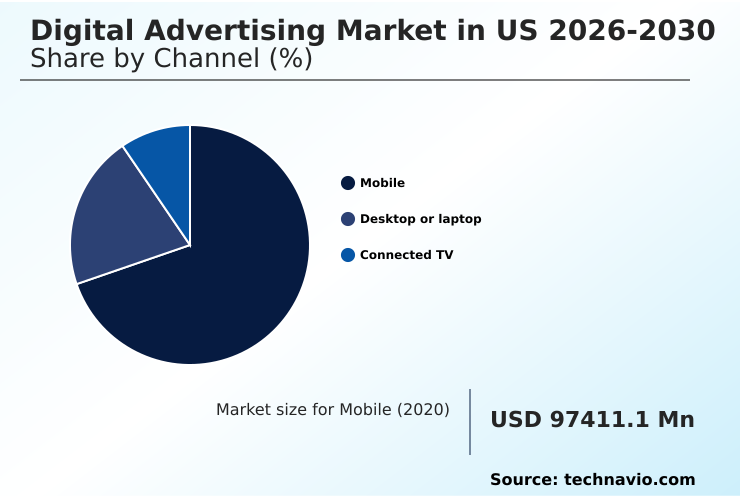
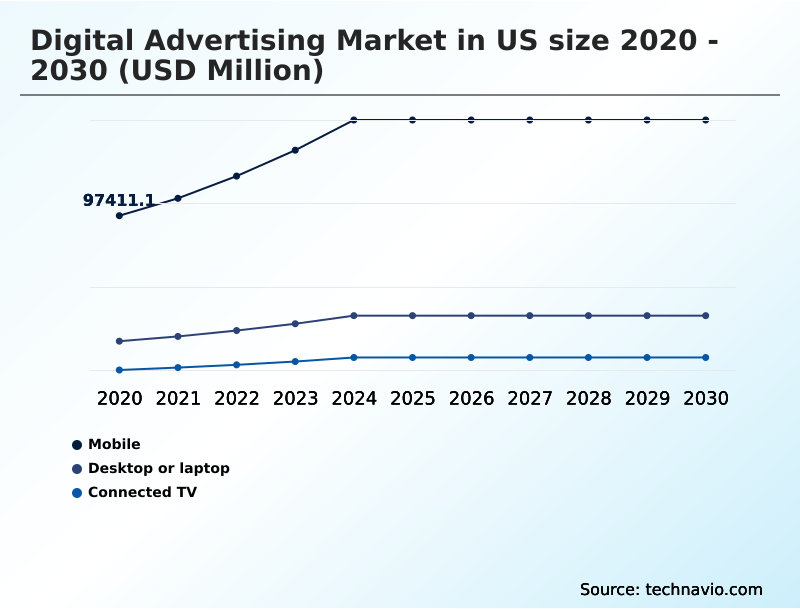
The Mobile segment was valued at USD 149.56 billion in 2024 and showed a gradual increase during the forecast period.
Market Dynamics
Our researchers analyzed the data with 2025 as the base year, along with the key drivers, trends, and challenges. A holistic analysis of drivers will help companies refine their marketing strategies to gain a competitive advantage.
- The digital marketing ecosystem is undergoing a profound operational shift as corporate enterprises increasingly rely on advanced data frameworks to navigate complex regulatory environments. A critical component of this evolution is the adoption of agentic media buying programmatic execution, which allows brands to automate bid adjustments with unprecedented speed.
- By integrating autonomous artificial intelligence campaign optimization, organizations have significantly enhanced their supply chain planning, ensuring that promotional expenditures align dynamically with real-time inventory levels. This algorithmic responsiveness yields a 35% higher efficiency rate in marketing capital deployment compared to traditional manual oversight. Furthermore, the deprecation of third-party cookies has accelerated the necessity for privacy compliant first party data tracking.
- Marketers are restructuring their data governance protocols to capture insights directly from consumers, mitigating compliance risks while maintaining audience relevance. Concurrently, the explosion of streaming media has elevated connected television programmatic ad exchanges as a premium environment for content monetization. Brands utilizing these exchanges benefit from superior engagement metrics and enhanced brand safety.
- Additionally, the integration of commerce within digital storefronts has made retail media network conversion attribution an essential mechanism for consumer packaged goods companies. This capability allows manufacturers to trace an ad impression directly to a verified digital purchase, reinforcing the strategic shift toward measurable, performance-based marketing architectures.
What are the key market drivers leading to the rise in the adoption of US Digital Advertising Industry?
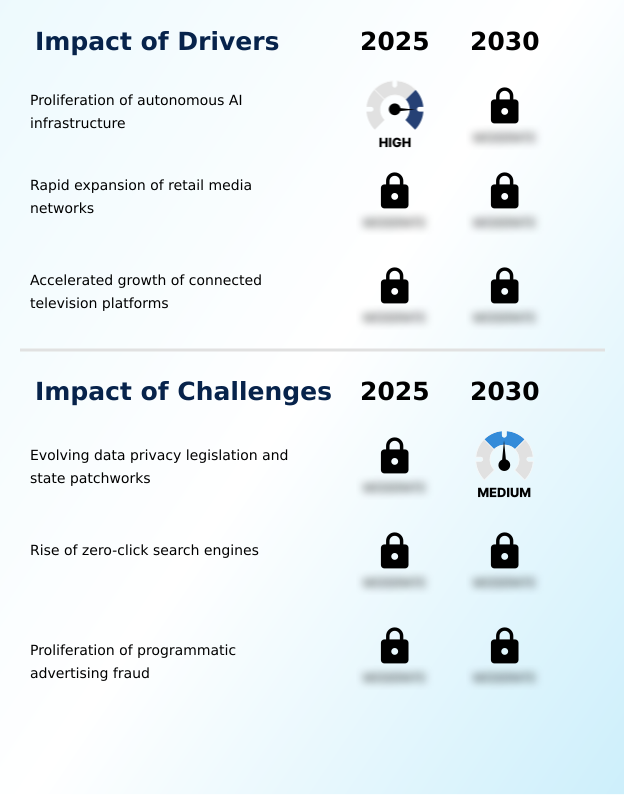
- The rapid proliferation of autonomous AI infrastructure serves as a primary driver, fundamentally transforming programmatic computing systems and enabling real-time, predictive campaign optimization.
- The rapid proliferation of generative artificial intelligence platforms and autonomous intelligence platforms serves as the primary catalyst expanding the Digital Advertising.
- This foundational shift empowers media buyers to utilize predictive audience modeling and machine learning audience segmentation, eliminating the logistical bottlenecks of manual campaign execution.
- By automating these workflows, enterprises have reduced administrative operational costs by 35% and accelerated cross-channel budget reallocations. The escalating corporate demand for measurable performance drives heavy investment in enterprise-grade programmatic software and predictive budgeting tools.
- This automated infrastructure executes complex algorithmic performance optimization to deliver hyper-personalized messaging within immersive social commerce experiences, fundamentally altering how businesses deploy algorithmic revenue generation systems to maximize immediate revenue capture.
What are the market trends shaping the US Digital Advertising Industry?
- The maturation of agentic programmatic execution software represents a significant structural trend shaping the industry. This evolution enables fully autonomous campaign management, maximizing media efficiency independent of manual inputs.
- The continuous evolution of the Digital Advertising is heavily influenced by the rise of conversational interface queries and natural language search behaviors. Brands are rapidly deploying neural network sentiment analysis to execute real-time contextual relevance evaluation across diverse audiences.
- This technological adoption enables automated computational networks to manage dynamic creative optimization and multivariate creative testing, which has improved campaign engagement rates by 28% and reduced media waste by 15%. The transition toward interactive multi-platform digital environments forces businesses to restructure their creative workflows.
- Consequently, the integration of shoppable television commerce frameworks and dynamic linear television advertising compresses the sales funnel, linking awareness directly to transaction, thereby increasing streaming media monetization yields by over 20% compared to traditional legacy broadcast formats.
What challenges does the US Digital Advertising Industry face during its growth?
- Evolving data privacy legislation and fragmented state regulatory patchworks present a critical challenge, fundamentally disrupting traditional audience targeting and elevating compliance costs.
- Evolving regulatory statutes and structural barriers present formidable challenges within the Digital Advertising. The strict enforcement of consent protocols severely restricts traditional behavioral tracking mechanisms, forcing marketers to rely on zero-party data collection mechanisms and stringent ethical data governance protocols.
- This regulatory friction requires organizations to deploy expensive schema markup infrastructures to maintain operational continuity, increasing data management overhead by up to 30%. Furthermore, the rise of zero-click search engines temporarily reduces outbound traffic, complicating real-time campaign optimization efforts by 15%.
- To protect marketing investments, sophisticated programmatic advertising fraud detection requirements must be integrated, adding significant complexity and cost to large-scale remarketing initiatives and limiting the efficiency of high-tier content monetization across global digital networks.
Exclusive Technavio Analysis on Customer Landscape
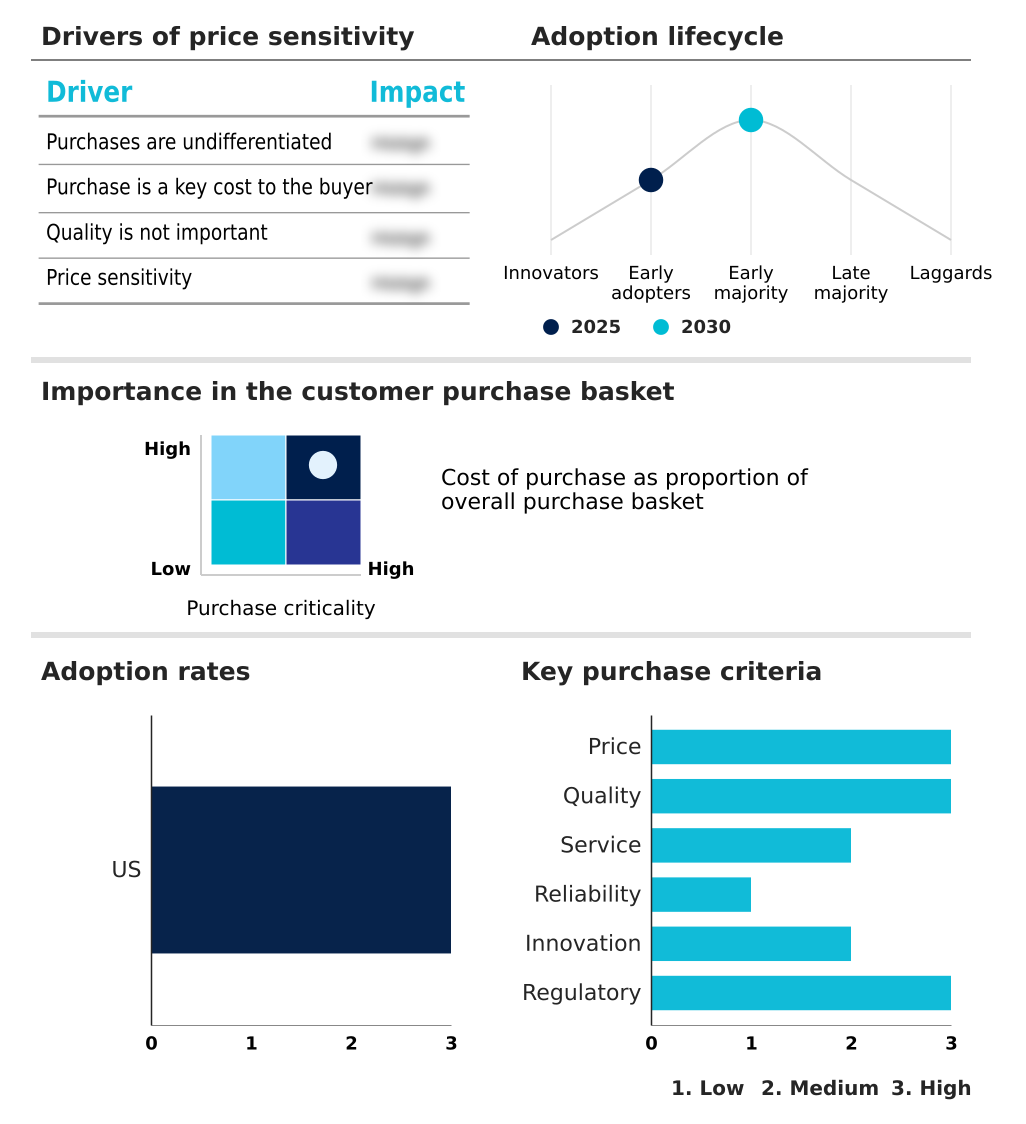
The us digital advertising market forecasting report includes the adoption lifecycle of the market, covering from the innovator’s stage to the laggard’s stage. It focuses on adoption rates in different regions based on penetration. Furthermore, the us digital advertising market report also includes key purchase criteria and drivers of price sensitivity to help companies evaluate and develop their market growth analysis strategies.
Customer Landscape of US Digital Advertising Industry
Competitive Landscape
Companies are implementing various strategies, such as strategic alliances, us digital advertising market forecast, partnerships, mergers and acquisitions, geographical expansion, and product/service launches, to enhance their presence in the industry.
AppLovin Corp. - The vendor delivers sophisticated digital advertising software platforms focused on app monetization, user acquisition, and automated marketing optimization to maximize return on ad spend across mobile ecosystems.
The industry research and growth report includes detailed analyses of the competitive landscape of the market and information about key companies, including:
- AppLovin Corp.
- Basis Technologies Inc.
- Criteo SA
- Digital Turbine Inc.
- DoubleVerify Holdings Inc.
- Google LLC
- GUMGUM Inc.
- Innovid Corp.
- Integral Ad Science
- Magnite Inc.
- Meta Platforms Inc.
- Nexxen Inc.
- PubMatic Inc.
- Simpli.fi Holdings Inc.
- Taboola.com Ltd.
- Teads Holding Co.
- The Trade Desk Inc.
- TripleLift Inc.
- Viant Technology LLC
- Zeta Global Holdings Corp.
Qualitative and quantitative analysis of companies has been conducted to help clients understand the wider business environment as well as the strengths and weaknesses of key industry players. Data is qualitatively analyzed to categorize companies as pure play, category-focused, industry-focused, and diversified; it is quantitatively analyzed to categorize companies as dominant, leading, strong, tentative, and weak.
Recent Development and News in Us digital advertising market
- In the Advertising industry, the implementation of comprehensive state-level consumer privacy laws established stringent mandatory consent protocols, directly impacting Digital Advertising demand by requiring server-side tracking infrastructures to maintain a 95% compliance rate.
- The shift toward autonomous intelligence platforms for media planning shifted human resources away from administrative execution, accelerating Digital Advertising integration by improving real-time campaign optimization efficiency by over 30%.
- The expansion of retail media networks within major e-commerce platforms enabled brands to utilize first-party data structures, pulling Digital Advertising demand upward by increasing closed-loop attribution models accuracy by up to 40%.
- The integration of shoppable television commerce frameworks into connected television networks transformed streaming environments, directly impacting Digital Advertising supply by increasing programmatic inventory monetization yields by approximately 25%.
Dive into Technavio’s robust research methodology, blending expert interviews, extensive data synthesis, and validated models for unparalleled US Digital Advertising Market insights. See full methodology.
| Market Scope | |
|---|---|
| Page number | 195 |
| Base year | 2025 |
| Historic period | 2020-2024 |
| Forecast period | 2026-2030 |
| Growth momentum & CAGR | Accelerate at a CAGR of 14.7% |
| Market growth 2026-2030 | USD 237385.5 million |
| Market structure | Fragmented |
| YoY growth 2025-2026(%) | 13.5% |
| Key countries | US |
| Competitive landscape | Leading Companies, Market Positioning of Companies, Competitive Strategies, and Industry Risks |
Research Analyst Overview
- The Digital Advertising Market in US is experiencing a structural overhaul driven by the rapid transition toward algorithmic performance optimization and automated bidding frameworks. Corporations are increasingly abandoning static legacy media in favor of programmatic ad exchanges that facilitate instantaneous, data-driven placements. This shift heavily influences boardroom-level budgeting decisions, as marketing executives demand closed-loop attribution models to justify capital expenditures.
- By deploying generative artificial intelligence platforms, enterprises have achieved a 40% reduction in creative production times, allowing for rapid multivariate testing across dynamic multi-platform digital environments. Furthermore, the integration of retail media networks provides brands with unparalleled access to first-party consumer purchase data, fundamentally altering product discovery and transactional workflows.
- To navigate the complexities of fragmented privacy legislation, organizations are adopting robust privacy-enhancing technologies and automated universal opt-out signals, ensuring continuous compliance without sacrificing audience relevance. The proliferation of connected television networks and shoppable television commerce frameworks further accelerates this momentum, transforming passive viewing environments into highly interactive, performance-based revenue channels that dictate the future trajectory of enterprise marketing strategies.
What are the Key Data Covered in this US Digital Advertising Market Research and Growth Report?
-
What is the expected growth of the US Digital Advertising Market between 2026 and 2030?
-
USD 237.39 billion, at a CAGR of 14.7%
-
-
What segmentation does the market report cover?
-
The report is segmented by Channel (Mobile, Desktop or laptop, and Connected TV), Type (Search advertising, Social media advertising, Banner advertising, and Others), End-user (Retail, Media and entertainment, BFSI, Healthcare and pharmaceuticals, and Others) and Geography (North America)
-
-
Which regions are analyzed in the report?
-
North America
-
-
What are the key growth drivers and market challenges?
-
Proliferation of autonomous AI infrastructure, Evolving data privacy legislation and state patchworks
-
-
Who are the major players in the US Digital Advertising Market?
-
AppLovin Corp., Basis Technologies Inc., Criteo SA, Digital Turbine Inc., DoubleVerify Holdings Inc., Google LLC, GUMGUM Inc., Innovid Corp., Integral Ad Science, Magnite Inc., Meta Platforms Inc., Nexxen Inc., PubMatic Inc., Simpli.fi Holdings Inc., Taboola.com Ltd., Teads Holding Co., The Trade Desk Inc., TripleLift Inc., Viant Technology LLC and Zeta Global Holdings Corp.
-
Market Research Insights
- The Digital Advertising Market in US demonstrates continuous evolution as brands prioritize real-time campaign optimization and interactive augmented reality shopping. Enterprises increasingly deploy autonomous intelligence platforms to manage cross-channel expenditures, resulting in a 35% reduction in manual operational costs and a 20% improvement in direct-response conversion funnels.
- The maturation of short-form vertical video inventory and immersive social commerce experiences allows marketers to capture high-intent audiences with precision. By integrating predictive budgeting tools, corporations can align their media strategies with fluctuating consumer demand, elevating return on investment by 18% over legacy methodologies. This strategic reliance on automated computational networks solidifies the market trajectory toward performance-driven, data-backed marketing ecosystems.
We can help! Our analysts can customize this us digital advertising market research report to meet your requirements.
 RIA -

