



Entertainment And Amusement Market Size 2026-2030
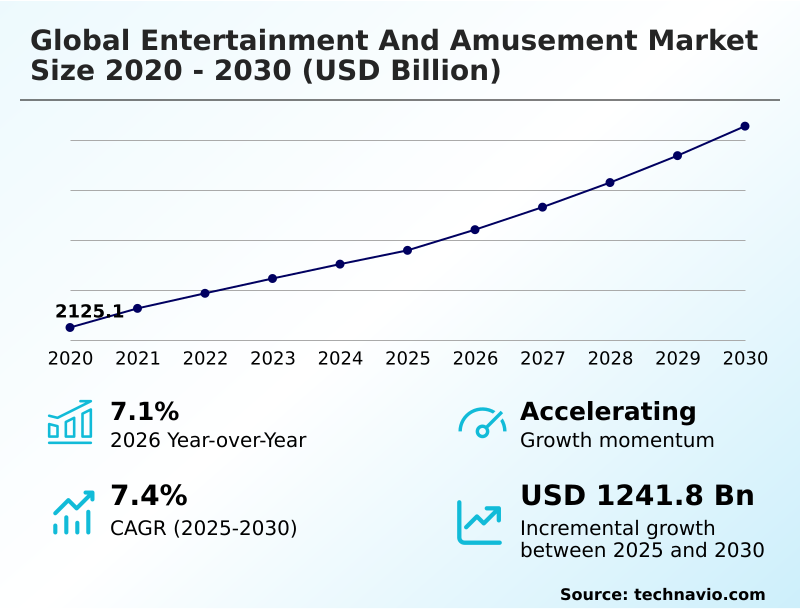
The Entertainment And Amusement Market size was valued at USD 2896.6 billion in 2025, growing at a CAGR of 7.4% during the forecast period 2026-2030.
Major Market Trends & Insights
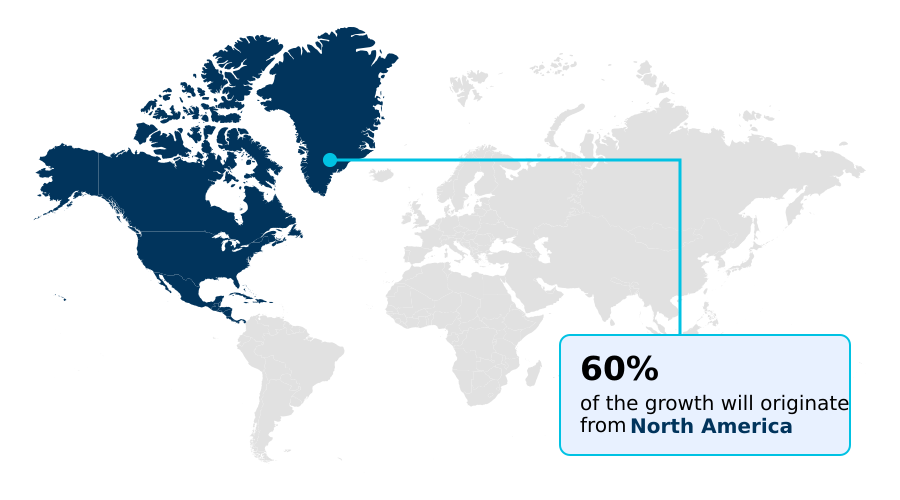
- North America dominated the market and accounted for a 59.8% growth during the forecast period.
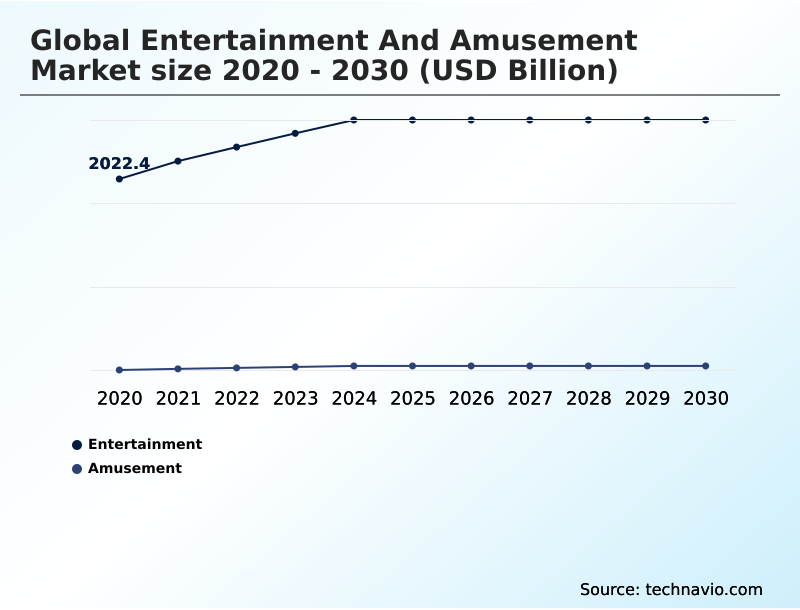
- By Type - Entertainment segment was valued at USD 2615.4 billion in 2024
- By Age Group - 13 to 20 years segment accounted for the largest market revenue share in 2024
Market Size & Forecast
- Historic Market Opportunities 2020-2024: USD 2013.3 billion
- Market Future Opportunities 2025-2030: USD 1241.8 billion
- CAGR from 2025 to 2030 : 7.4%
Market Summary
- The entertainment and amusement market is defined by a strategic push toward developing large-scale, immersive destinations that leverage high-value intellectual property. For instance, operators are focusing on creating entire themed lands instead of single attractions, a business strategy that can increase average guest spending by over 30% due to longer dwell times and integrated retail.
- The market is primarily driven by the 'experience economy,' where consumers prioritize spending on memorable activities over material goods. A key challenge, however, is the immense capital expenditure required, with new developments often costing 50% more than projects from a decade prior, straining balance sheets.
- The North American market is more than double the size of the European market, reflecting higher consumer spending and a denser concentration of major theme park resorts. This dynamic requires a sophisticated approach to revenue and guest experience management to ensure profitability.
What will be the Size of the Entertainment And Amusement Market during the forecast period?
Get Key Insights on Market Forecast (PDF) Request Free Sample
How is the Entertainment And Amusement Market Segmented?
The entertainment and amusement industry research report provides comprehensive data (region-wise segment analysis), with forecasts and analysis for the period 2026-2030, as well as historical data from 2020-2024 for the following segments.
- Type
- Entertainment
- Amusement
- Age group
- 13 to 20 years
- Above 20 years
- Below 12 years
- User experience
- Active experiences
- Interactive experiences
- Passive experiences
- Themed experiences
- Educational experiences
- Geography
- North America
- US
- Canada
- Mexico
- Europe
- Germany
- France
- UK
- APAC
- China
- Japan
- India
- South America
- Brazil
- Argentina
- Middle East and Africa
- UAE
- Saudi Arabia
- South Africa
- Rest of World (ROW)
- North America
How is the Entertainment And Amusement Market Segmented by Type?
The entertainment segment is estimated to witness significant growth during the forecast period.
The global entertainment and amusement market is segmented by type and age group, reflecting a highly concentrated value proposition.
The entertainment segment, including cinema exhibition and streaming content, constitutes over 94% of the market, demonstrating its dominance over the physical amusement segment. This disparity underscores the scalability of digital content versus capital-intensive physical attractions.
For instance, market segmentation strategy for a regional theme park must now account for competition from at-home entertainment.
In segmentation by age, the 13-to-20-year-old demographic is approximately 25% larger than the above-20 segment, driving demand for social entertainment concepts and experiences with gamification elements.
Effective customer relationship management (CRM) and data-driven operations are essential to cater to these distinct, high-value consumer groups and optimize offerings in family entertainment centers (FEC).
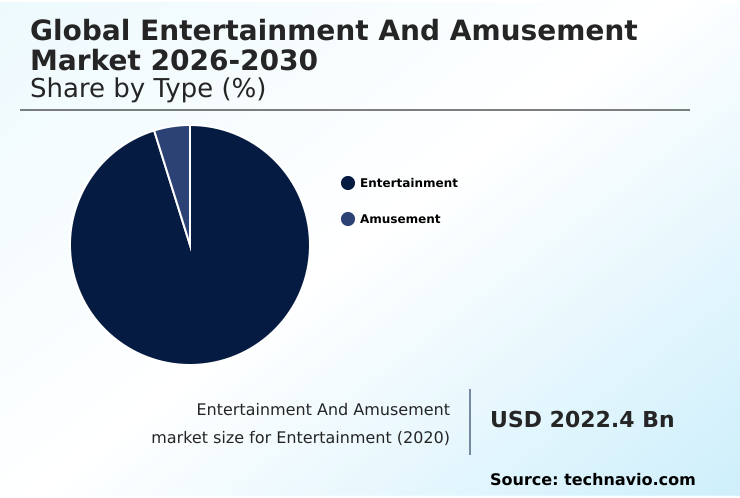
The Entertainment segment was valued at USD 2615.4 billion in 2024 and showed a gradual increase during the forecast period.
How demand for the Entertainment And Amusement market is rising in the leading region?
North America is estimated to contribute 59.8% to the growth of the global market during the forecast period.Technavio’s analysts have elaborately explained the regional trends and drivers that shape the market during the forecast period.
See How Entertainment And Amusement Market demand is rising in North America Request Free Sample
The geographic landscape of the entertainment and amusement market is led by North America, which accounts for nearly 60% of the incremental growth, yet APAC demonstrates the highest regional growth rate at 8.2%, slightly outpacing North America's 8.0%.
This indicates a dual dynamic of mature-market monetization and emerging-market expansion. North America's dominance is anchored by the US, whose market size is more than six times that of Germany, the largest European market.
In contrast, the rapid growth in APAC is driven by rising disposable incomes and significant investments in new location-based entertainment (LBE) and branded entertainment venues.
Operators must adapt revenue management systems and dynamic pricing models to account for these regional differences in consumer spending habits and competitive intensity, particularly in developing new marine life theme park or franchise partnership ventures.
What are the key Drivers, Trends, and Challenges in the Entertainment And Amusement Market?
Our researchers analyzed the data with 2025 as the base year, along with the key drivers, trends, and challenges. A holistic analysis of drivers will help companies refine their marketing strategies to gain a competitive advantage.
- Strategic decision-making in the global entertainment and amusement market requires a nuanced understanding of how to balance capital investment with evolving consumer preferences. Key questions revolve around the ROI of virtual reality in amusement parks, where initial outlays for hardware and software development can be substantial. Firms must weigh this against the potential for premium-priced tickets and increased guest engagement.
- Concurrently, understanding best practices for theme park crowd management is critical for operational efficiency and guest satisfaction, as poor visitor flow can directly impact spending and repeat visit intentions. Another core consideration is integrating food and beverage with entertainment, which has evolved from a secondary revenue stream to a primary experiential component, with themed dining experiences driving significant profit margins.
- Analyzing trends in family entertainment center design reveals a shift toward smaller, more flexible formats that can adapt to local demographics. Finally, developing effective strategies for reducing attraction downtime through predictive maintenance is essential, as every hour of non-operation results in lost revenue and diminished guest satisfaction.
- For example, active experiences represent a market segment more than three times larger than educational experiences, while themed experiences are nearly 70% larger, guiding investment toward proven formats while still exploring niche opportunities in measuring guest satisfaction in entertainment venues.
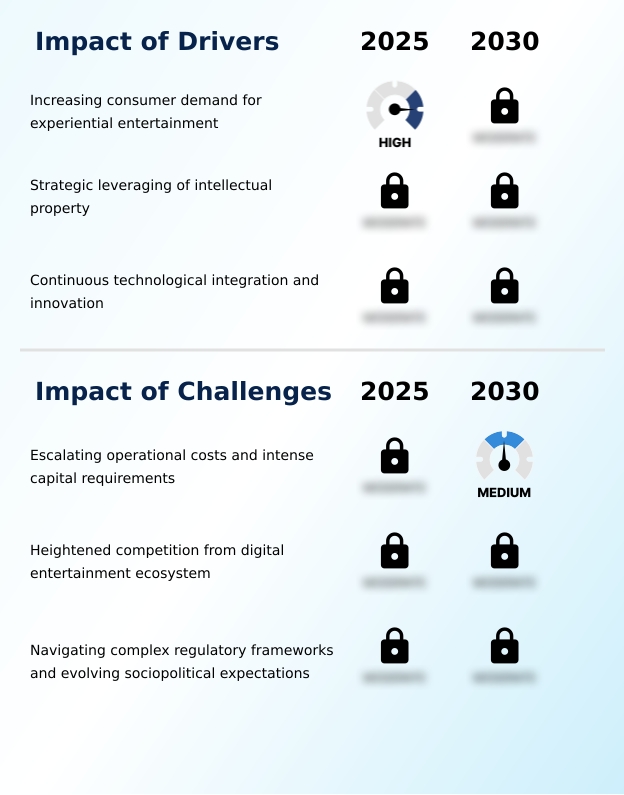
What are the key market drivers leading to the rise in the adoption of Entertainment And Amusement Industry?
- The primary market driver is the increasing consumer demand for experiential entertainment, reflecting a cultural shift in spending from material goods toward creating memorable, shareable moments.
- The fundamental driver of the entertainment and amusement market is the consumer-led shift toward an experience economy, where spending on memorable activities is prioritized over purchasing goods.
- This behavioral change fuels demand for unique, shareable moments found in eatertainment venues and other social entertainment concepts.
- For example, attractions designed with social media shareability in mind can see up to 40% more organic marketing reach through user-generated content compared to traditional rides.
- The strategic use of intellectual property (IP) integration amplifies this effect, as it provides a powerful brand storytelling platform that resonates with existing fanbases.
- Effective guest experience management, focusing on creating these compelling live acrobatic circus shows and immersive worlds, is critical for driving a high repeat visitation rate in this competitive landscape.
What are the market trends shaping the Entertainment And Amusement Industry?
- A definitive market trend is the ascendancy of hyper-personalized and immersive experiences, shifting the industry from standardized offerings to individually crafted, interactive journeys.
- A primary trend transforming the entertainment and amusement market is the move toward hyper-personalized, immersive experiences powered by data-driven operations. Consumers now expect interactive storytelling and narrative-driven environments rather than passive attractions.
- This shift is enabled by technologies like augmented reality (AR) overlays, which can increase guest dwell times in specific zones by up to 25% by adding digital layers of gamification elements. Leveraging mobile app integration for a personalized guest journey allows operators to offer targeted promotions, which can lift in-park spending by over 15%.
- This focus on creating a unique experience for each visitor is a direct response to the broader experience economy, where brand storytelling and deep consumer engagement metrics are paramount for success.
What challenges does the Entertainment And Amusement Industry face during its growth?
- A key market challenge is the escalating operational costs and intense capital requirements needed to develop and maintain competitive, technologically advanced attractions.
- A significant challenge facing the entertainment and amusement market is the severe pressure from escalating operational costs coupled with immense capital expenditure planning. Labor costs can represent up to 45% of a venue's operating budget, while the capital required for a new, technologically advanced ride system engineering project is often 50% higher than its predecessor.
- This financial strain is compounded by the need for continuous innovation to meet consumer expectations. To mitigate these pressures, operators are adopting predictive maintenance to reduce costly attraction downtime and implementing sophisticated workforce management software to optimize staffing.
- However, the high fixed costs associated with theming and fabrication, along with complex supply chain logistics, remain formidable barriers to profitability and require superior operational efficiency.
Exclusive Technavio Analysis on Customer Landscape
The entertainment and amusement market forecasting report includes the adoption lifecycle of the market, covering from the innovator’s stage to the laggard’s stage. It focuses on adoption rates in different regions based on penetration. Furthermore, the entertainment and amusement market report also includes key purchase criteria and drivers of price sensitivity to help companies evaluate and develop their market growth analysis strategies.
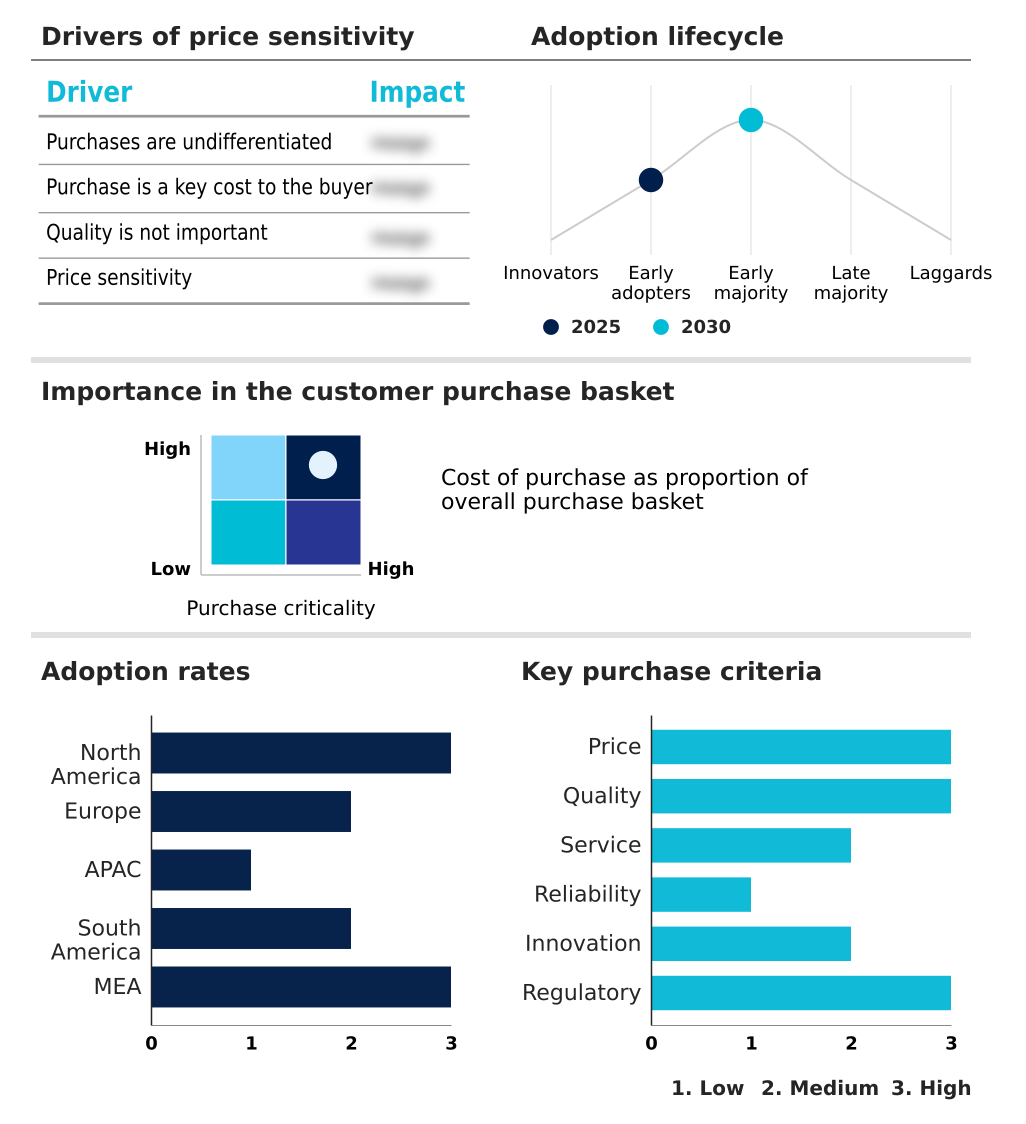
Customer Landscape of Entertainment And Amusement Industry
Competitive Landscape
Companies are implementing various strategies, such as strategic alliances, entertainment and amusement market forecast, partnerships, mergers and acquisitions, geographical expansion, and product/service launches, to enhance their presence in the industry.
AMC Entertainment Holdings Inc. - Offerings focus on leveraging high-value intellectual property to develop immersive resort destinations and narrative-driven attractions, maximizing guest engagement and ancillary revenue streams.
The industry research and growth report includes detailed analyses of the competitive landscape of the market and information about key companies, including:
- AMC Entertainment Holdings Inc.
- Bowlero Corp.
- Chimelong Group Co. Ltd.
- Cinemark Holdings Inc.
- Cirque du Soleil Entertainment
- Comcast Corp.
- Dave and Busters Entertainment
- Herschend Family Entertainment
- Meow Wolf
- Merlin Entertainments Ltd.
- Parques Reunidos SAU
- Raw Thrills Inc.
- Regal Entertainment Group
- Six Flags Entertainment Corp.
- The Walt Disney Co.
- Topgolf International Inc
- Trio Tech International Pte Ltd
- United Parks and Resorts Inc.
- Vail Resorts Inc
- WhiteWater West Industries Ltd
Qualitative and quantitative analysis of companies has been conducted to help clients understand the wider business environment as well as the strengths and weaknesses of key industry players. Data is qualitatively analyzed to categorize companies as pure play, category-focused, industry-focused, and diversified; it is quantitatively analyzed to categorize companies as dominant, leading, strong, tentative, and weak.
Market Intelligence Radar: High-Impact Developments & Growth Signals
- In the Leisure Facilities industry, the widespread adoption of digital platforms for ticketing and reservations has compelled entertainment and amusement operators to invest heavily in mobile app integration and dynamic pricing models to manage visitor flow analysis and enhance the personalized guest journey.
- The increasing emphasis on technological innovation within leisure facilities, including the use of AI and VR, directly fuels the development of more immersive virtual reality (VR) attractions and augmented reality (AR) overlay experiences, which are becoming critical for competitive differentiation.
- Rising operational costs, particularly for labor and energy across all leisure facilities, present a significant challenge, forcing entertainment and amusement venues to implement predictive maintenance and advanced workforce management software to improve operational efficiency and protect margins.
- A growing consumer preference for boutique and niche leisure activities, such as escape rooms and specialized fitness, is creating competition for consumer leisure time, prompting large-scale amusement operators to diversify by incorporating more social entertainment concepts and unique seasonal event programming.
Dive into Technavio’s robust research methodology, blending expert interviews, extensive data synthesis, and validated models for unparalleled Entertainment And Amusement Market insights. See full methodology.
| Market Scope | |
|---|---|
| Page number | 296 |
| Base year | 2025 |
| Historic period | 2020-2024 |
| Forecast period | 2026-2030 |
| Growth momentum & CAGR | Accelerate at a CAGR of 7.4% |
| Market growth 2026-2030 | USD 1241.8 billion |
| Market structure | Fragmented |
| YoY growth 2025-2026(%) | 7.1% |
| Key countries | US, Canada, Mexico, Germany, France, UK, Spain, Italy, The Netherlands, China, Japan, India, South Korea, Australia, Indonesia, Brazil, Argentina, Chile, UAE, Saudi Arabia, South Africa, Egypt and Israel |
| Competitive landscape | Leading Companies, Market Positioning of Companies, Competitive Strategies, and Industry Risks |
Research Analyst Overview
- The entertainment and amusement market ecosystem is a complex network where intellectual property holders, technology suppliers, and global operators interact to deliver consumer experiences. This value chain begins with creative content and IP, which is then licensed to operators like theme parks and cinema exhibitors.
- Specialized vendors provide critical inputs, from advanced ride system engineering to theming and fabrication services, forming a crucial supply layer. For example, the entertainment segment, dominated by content and media, accounts for over 94% of the market, highlighting the power of scalable digital distribution over capital-intensive physical amusement.
- A key trend is the rise of location-based entertainment (LBE), which blends physical and digital elements. The entire ecosystem is supported by a workforce of creative and technical professionals and is governed by rigorous safety and compliance standards, which can add 5-10% to a project's initial development cost.
What are the Key Data Covered in this Entertainment And Amusement Market Research and Growth Report?
-
What is the expected growth of the Entertainment And Amusement Market between 2026 and 2030?
-
The Entertainment And Amusement Market is expected to grow by USD 1241.8 billion during 2026-2030, registering a CAGR of 7.4%. Year-over-year growth in 2026 is estimated at 7.1%%. This acceleration is shaped by increasing consumer demand for experiential entertainment, which is intensifying demand across multiple end-use verticals covered in the report.
-
-
What segmentation does the market report cover?
-
The report is segmented by Type (Entertainment, and Amusement), Age Group (13 to 20 years, Above 20 years, and Below 12 years), User Experience (Active experiences, Interactive experiences, Passive experiences, Themed experiences, and Educational experiences) and Geography (North America, Europe, APAC, South America, Middle East and Africa). Among these, the Entertainment segment is estimated to witness significant growth during the forecast period, driven by rising adoption across key application areas. Each segment includes detailed qualitative and quantitative analysis, along with historical data from 2020-2024 and forecasts through 2030 with year-over-year growth rates.
-
-
Which regions are analyzed in the report?
-
The report covers North America, Europe, APAC, South America and Middle East and Africa. North America is estimated to contribute 59.8% to market growth during the forecast period. Country-level analysis includes US, Canada, Mexico, Germany, France, UK, Spain, Italy, The Netherlands, China, Japan, India, South Korea, Australia, Indonesia, Brazil, Argentina, Chile, UAE, Saudi Arabia, South Africa, Egypt and Israel, with dedicated market size tables and year-over-year growth for each.
-
-
What are the key growth drivers and market challenges?
-
The primary driver is increasing consumer demand for experiential entertainment, which is accelerating investment and industry demand. The main challenge is escalating operational costs and intense capital requirements, creating operational barriers for key market participants. The report quantifies the impact of each driver and challenge across 2026 and 2030 with comparative analysis.
-
-
Who are the major players in the Entertainment And Amusement Market?
-
Key vendors include AMC Entertainment Holdings Inc., Bowlero Corp., Chimelong Group Co. Ltd., Cinemark Holdings Inc., Cirque du Soleil Entertainment, Comcast Corp., Dave and Busters Entertainment, Herschend Family Entertainment, Meow Wolf, Merlin Entertainments Ltd., Parques Reunidos SAU, Raw Thrills Inc., Regal Entertainment Group, Six Flags Entertainment Corp., The Walt Disney Co., Topgolf International Inc, Trio Tech International Pte Ltd, United Parks and Resorts Inc., Vail Resorts Inc and WhiteWater West Industries Ltd. The report provides qualitative and quantitative analysis categorizing companies as dominant, leading, strong, tentative, and weak based on their market positioning. Company profiles include business segment analysis, SWOT assessment, key offerings, and recent strategic developments.
-
Market Research Insights
- The competitive landscape of the entertainment and amusement market is marked by significant consolidation and the dominance of global media conglomerates, with the North American region accounting for nearly 60% of the market's incremental growth. Major players such as The Walt Disney Co. and Comcast Corp. leverage their vast intellectual property portfolios to drive attendance and merchandise sales.
- Recent strategic moves include major mergers between regional park operators, creating entities with enhanced scale and pricing power. These consolidated companies can achieve operational efficiencies that reduce procurement costs by an estimated 10-15%. In response to competition from digital entertainment, vendors are heavily investing in unique location-based entertainment (LBE) that cannot be replicated at home.
- This includes the development of technologically advanced ride systems and immersive, narrative-driven environments to attract and retain visitors.
We can help! Our analysts can customize this entertainment and amusement market research report to meet your requirements.
 RIA -
RIA - 
