

Environmental Control Systems Market Analysis, Size, and Forecast 2026-2030: North America (US, Canada, and Mexico), Europe (Germany, UK, and France), APAC (China, Japan, and India), South America (Brazil, Argentina, and Colombia), Middle East and Africa (Saudi Arabia, UAE, and South Africa), and Rest of World (ROW)

Environmental Control Systems Market Analysis, Size, and Forecast 2026-2030:
North America (US, Canada, and Mexico), Europe (Germany, UK, and France), APAC (China, Japan, and India), South America (Brazil, Argentina, and Colombia), Middle East and Africa (Saudi Arabia, UAE, and South Africa), and Rest of World (ROW)

Published: May 2026 330 Pages SKU: IRTNTR81469

Market Overview at a Glance

$1.66 B
Market Opportunity
5.4%
CAGR 2025 - 2030
40.8%
North America Growth
$1.94 B
HVAC systems segment 2024

Environmental Control Systems Market Size 2026-2030

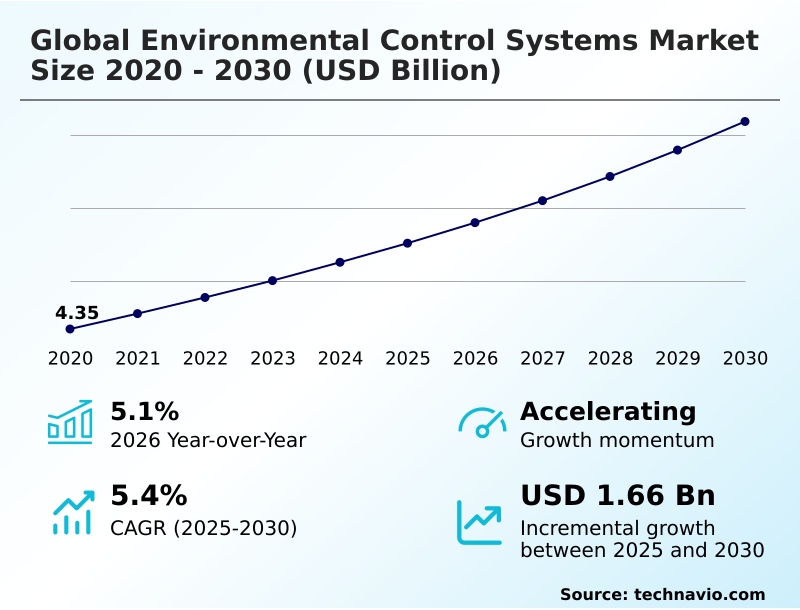
The environmental control systems market size is valued to increase by USD 1.66 billion, at a CAGR of 5.4% from 2025 to 2030. Transition toward more electric aircraft architectures will drive the environmental control systems market.

Major Market Trends & Insights

  • North America dominated the market and accounted for a 40.8% growth during the forecast period.
  • By Component - HVAC systems segment was valued at USD 1.94 billion in 2024
  • By Product - Water treatment systems segment accounted for the largest market revenue share in 2024

Market Size & Forecast

  • Market Opportunities: USD 2.83 billion
  • Market Future Opportunities: USD 1.66 billion
  • CAGR from 2025 to 2030 : 5.4%

Market Summary

  • The environmental control systems market is undergoing a significant transformation, moving beyond traditional pneumatic configurations to highly integrated, electrified networks. This evolution is driven by the need for greater fuel efficiency, reduced maintenance, and compliance with stringent cabin air quality regulations.
  • Modern systems are designed not only for passenger comfort but also for critical thermal management of advanced avionics and power electronics. For instance, in a fleet management scenario, airlines are leveraging integrated sensors and predictive analytics to monitor the health of environmental control components in real-time.
  • This allows them to transition from a reactive repair model to a proactive maintenance strategy, scheduling component replacements during planned service intervals. This approach minimizes the risk of in-flight malfunctions, reduces costly aircraft-on-ground situations by over 15%, and optimizes the supply chain for spare parts, directly enhancing operational reliability and financial performance in a competitive landscape.

What will be the Size of the Environmental Control Systems Market during the forecast period?
Get Key Insights on Market Forecast (PDF) Get Free Sample

How is the Environmental Control Systems Market Segmented?

The environmental control systems industry research report provides comprehensive data (region-wise segment analysis), with forecasts and estimates in "USD million" for the period 2026-2030, as well as historical data from 2020-2024 for the following segments.

  • Component
    • HVAC systems
    • Air purification and filtration systems
    • Sensors
    • Controllers
    • Others
  • Product
    • Water treatment systems
    • Air quality control systems
    • Energy management systems
    • Waste management systems
    • Others
  • End-user
    • Commercial and residential buildings
    • Industrial and manufacturing
    • Aerospace and defense
    • Healthcare
    • Others
  • Geography
    • North America
      • US
      • Canada
      • Mexico
    • Europe
      • Germany
      • UK
      • France
    • APAC
      • China
      • Japan
      • India
    • South America
      • Brazil
      • Argentina
      • Colombia
    • Middle East and Africa
      • Saudi Arabia
      • UAE
      • South Africa
    • Rest of World (ROW)

By Component Insights

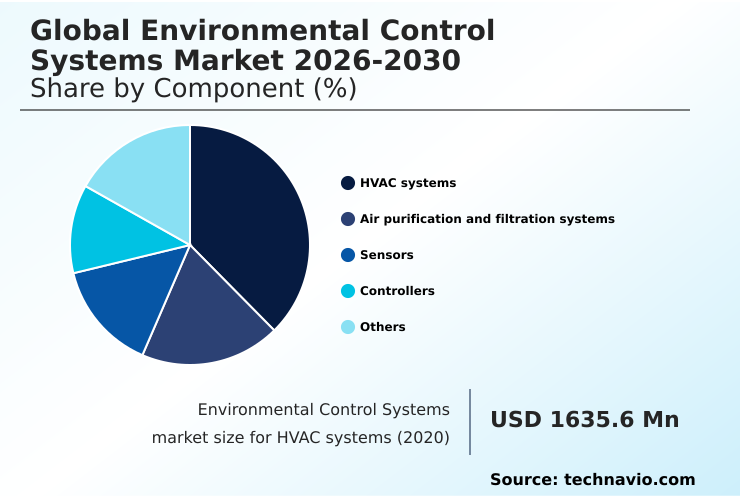
The hvac systems segment is estimated to witness significant growth during the forecast period.

The HVAC systems segment is fundamental to environmental control, evolving into integrated thermal management system solutions focused on energy efficiency. The shift toward heat pump technology and electrification, driven by regulations, is accelerating.

Variable refrigerant flow technology enables precise zone control, reducing energy waste by up to 30%. In specialized applications, air-cycle cooling and advanced de-icing technology are critical.

Modern systems incorporate demand-controlled ventilation and AI-native controller logic, optimizing performance based on real-time air quality monitoring. On-board oxygen generation capabilities are also integrated into advanced systems, showcasing the convergence of life support and climate control.

These intelligent environmental control unit designs, supported by heat recovery ventilation, are defining next-generation performance standards.
Get Free Sample

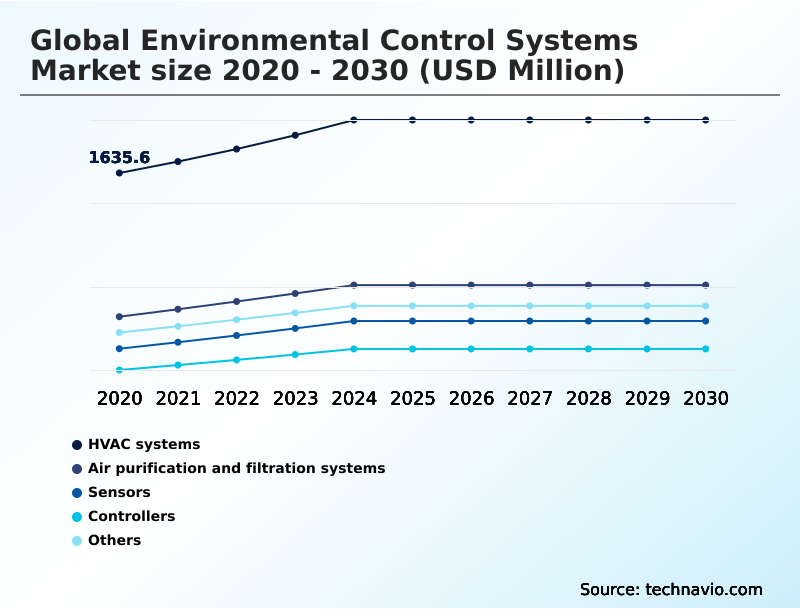
The HVAC systems segment was valued at USD 1.94 billion in 2024 and showed a gradual increase during the forecast period.
Get Free Sample

Regional Analysis

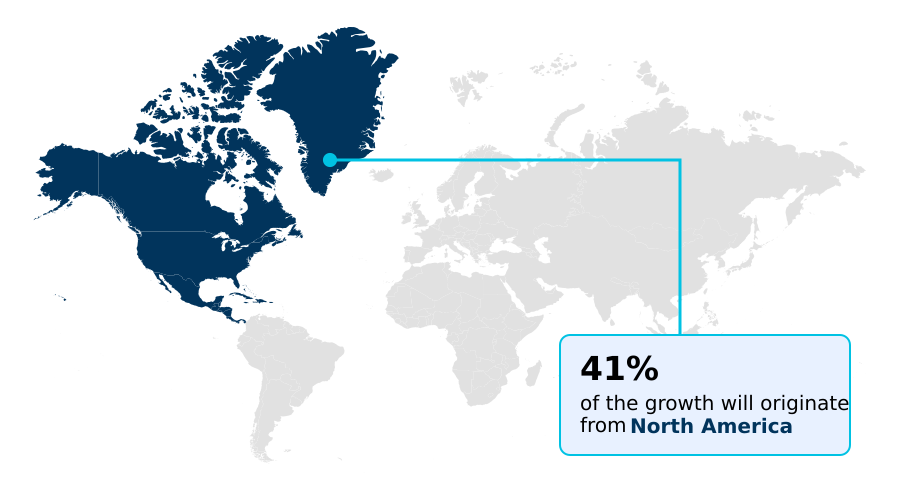
North America is estimated to contribute 40.8% to the growth of the global market during the forecast period.Technavio’s analysts have elaborately explained the regional trends and drivers that shape the market during the forecast period.
See How Environmental Control Systems Market Demand is Rising in North America Get Free Sample

The geographic landscape of the environmental control systems market is dominated by North America, which accounts for over 40% of the market due to its large aerospace and defense manufacturing base.

This region is a primary consumer of advanced solutions for cabin pressurization and avionics cooling, often requiring high-efficiency particulate air filtration.

In contrast, the APAC region is the fastest-growing market, driven by the expansion of commercial aviation and domestic airframe programs.

The demand here is for robust air distribution system designs and vapor cycle cooling units capable of performing in diverse climates. The localization of supply chains in APAC has reduced component lead times by up to 20%, enhancing manufacturing agility.

Innovations in this region focus on mitigating volatile organic compounds and integrating advanced ozone converter technologies to meet rising environmental standards.

Market Dynamics

Our researchers analyzed the data with 2025 as the base year, along with the key drivers, trends, and challenges. A holistic analysis of drivers will help companies refine their marketing strategies to gain a competitive advantage.

  • The evolution of the global environmental control systems market 2026-2030 is increasingly defined by specialized applications and advanced engineering challenges. The development of environmental control systems for eVTOL aircraft, for instance, demands novel approaches to lightweighting and energy efficiency. Similarly, the focus on thermal management for high-power electronics is critical for the reliability of modern military and commercial platforms.
  • A key area of innovation is the bleedless environmental control system design, which decouples the system from engine pneumatics, offering significant fuel savings. This is closely linked to the impact of more electric aircraft on ECS.
  • As the industry moves toward zero-emission flight, hydrogen aircraft thermal regulation challenges, particularly related to the thermal management of cryogenic fuel systems, come to the forefront. Innovations in 3D printed heat exchanger aerospace performance are addressing weight and efficiency issues. This has led to the adoption of advanced liquid cooling solutions for aircraft batteries in urban air mobility vehicles.
  • Firms investing in next-generation air cycle machine technology report system efficiency gains more than double those of competitors using legacy hardware, directly impacting operational costs. Furthermore, stringent cabin air quality standards for commercial aircraft are driving the development of advanced filtration technologies for aircraft cabins, including real-time monitoring of cabin air contaminants and high-efficiency particulate air filter retrofitting.
  • The design of avionics cooling system for military aircraft and environmental control for high-altitude platforms continues to push the boundaries of technology, while the market also addresses challenges in sustainable refrigerants in aviation ECS and predictive maintenance for aircraft ECS components, including vapor cycle system design with low-GWP refrigerants.
What are the key market drivers leading to the rise in the adoption of Environmental Control Systems Industry?

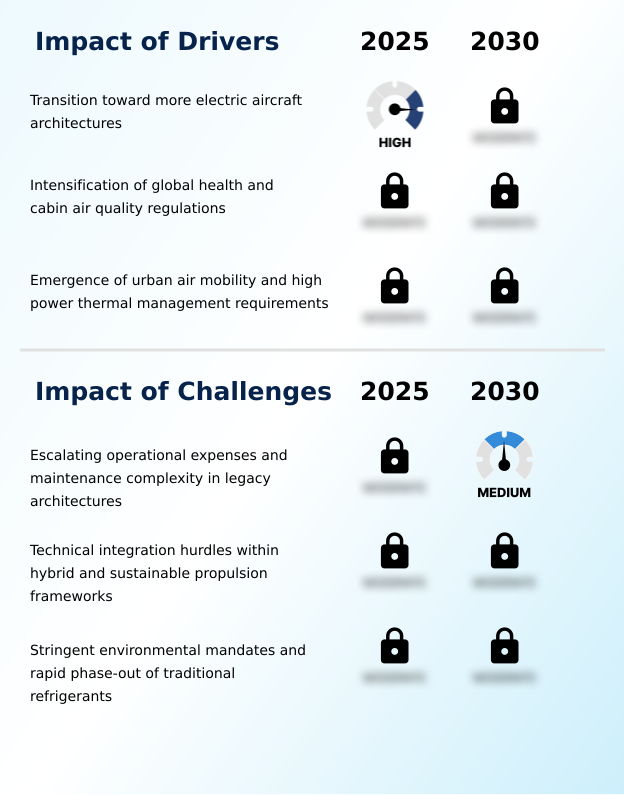
  • The fundamental shift within the aerospace industry toward more electric aircraft architectures is the primary driver for advancements in the environmental control systems market.

  • The market's growth is propelled by three core drivers. The shift to a more electric aircraft, utilizing high-voltage DC architecture and a bleed-free architecture, enhances fuel efficiency by up to 5%.
  • This transition necessitates advanced avionics cooling and integrated thermal management solutions. Secondly, stringent regulations mandating real-time air quality monitoring sensors are driving innovation in filtration and cabin safety.
  • The emergence of the urban air mobility sector is the third driver, creating demand for specialized systems like multi-zone liquid cooling to manage high-density battery packs and support hydrogen-electric propulsion.
  • This new segment requires compact, quiet, and highly efficient systems to manage fuel cell cooling and address extended producer responsibility considerations for component lifecycles.

What are the market trends shaping the Environmental Control Systems Industry?

  • The integration of advanced digital diagnostics and predictive maintenance represents a pivotal trend. This shift enables proactive strategies to identify potential component failures before they occur.

  • Key trends are reshaping the environmental control systems market, driven by digitalization and sustainability. The integration of digital twin simulation in the design phase accelerates development cycles by over 30%, allowing for rapid prototyping of components like a compact heat exchanger. Concurrently, predictive health monitoring, enabled by advanced sensors, reduces unscheduled maintenance by up to 25%.
  • On the hardware side, additive manufacturing is creating lighter and more complex parts, including integrated manifolds. The industry is also moving toward sustainability with the adoption of low GWP refrigerants and the development of a refrigerant-agnostic compressor and thermo-acoustic systems.
  • These eco-friendly hydrofluoroolefins are critical for regulatory compliance, while the efficiency of the cooling turbine remains a focus for performance optimization.

What challenges does the Environmental Control Systems Industry face during its growth?

  • Escalating operational expenses and the inherent maintenance complexity associated with legacy pneumatic architectures present a significant challenge for the industry.

  • The market faces significant technical and operational hurdles. Overcoming the limitations of legacy pneumatic architectures, which can contribute to 15% higher maintenance costs compared to modern electric systems, is a primary challenge. The integration of thermal management solutions for next-generation propulsion, such as a liquid cooling loop for a cryogenic fuel system, presents complex engineering problems in weight and efficiency.
  • Direct-to-chip liquid cooling and other advanced techniques are being explored. Additionally, the mandated phase-out of traditional refrigerants requires a complete redesign of vapor cycle systems. This transition, coupled with the need for enhanced sub-micron particle filtration and innovations like photocatalytic oxidation and chemical scrubbing system technologies, is driving up development costs.
  • The need for a sophisticated integrated thermal management framework and multi-modal sensor array adds another layer of complexity.

Exclusive Technavio Analysis on Customer Landscape

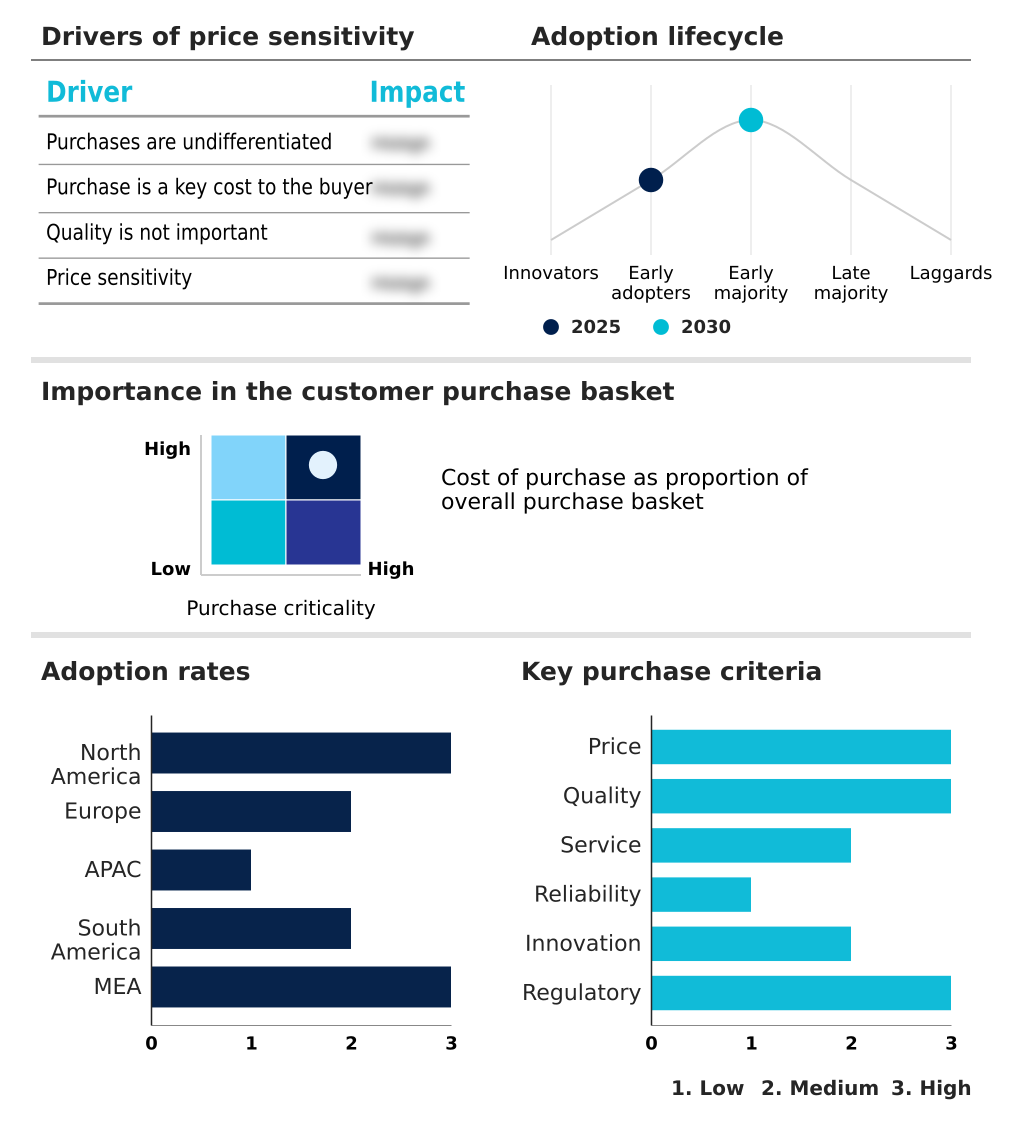
The environmental control systems market forecasting report includes the adoption lifecycle of the market, covering from the innovator’s stage to the laggard’s stage. It focuses on adoption rates in different regions based on penetration. Furthermore, the environmental control systems market report also includes key purchase criteria and drivers of price sensitivity to help companies evaluate and develop their market growth analysis strategies.
Customer Landscape of Environmental Control Systems Industry

Competitive Landscape

Companies are implementing various strategies, such as strategic alliances, environmental control systems market forecast, partnerships, mergers and acquisitions, geographical expansion, and product/service launches, to enhance their presence in the industry.

ABB Ltd. - Specialized engineering dedicated to managing internal atmospheres, ensuring operational integrity and human safety in critical environments through advanced thermal management and life support technologies.

The industry research and growth report includes detailed analyses of the competitive landscape of the market and information about key companies, including:

  • ABB Ltd.
  • Astronics Corp.
  • Carrier Global Corp.
  • Daikin Industries Ltd.
  • Emerson Electric Co.
  • FlaktGroup Holding GmbH
  • Honeywell International Inc.
  • Johnson Controls International
  • Liebherr International AG
  • Mitsubishi Heavy Industries
  • Munters Group AB
  • Safran SA
  • Schneider Electric SE
  • Siemens AG
  • Thermotron Industries
  • Trane Technologies Plc
  • TROX SE
  • Vertiv Holdings Co.
  • Weiss Umwelttechnik GmbH.
  • ZIEHL ABEGG SE

Qualitative and quantitative analysis of companies has been conducted to help clients understand the wider business environment as well as the strengths and weaknesses of key industry players. Data is qualitatively analyzed to categorize companies as pure play, category-focused, industry-focused, and diversified; it is quantitatively analyzed to categorize companies as dominant, leading, strong, tentative, and weak.

Recent Development and News in Environmental control systems market

  • In March, 2025, Airbus successfully conducted a series of flight tests on an experimental platform that utilized an entirely bleed-free environmental control system powered by high-voltage direct-current architecture.
  • In August, 2025, the European Union Aviation Safety Agency introduced a revised set of certification specifications that mandated the integration of real-time air quality monitoring sensors in all newly certified commercial transport aircraft.
  • In April, 2025, Lufthansa Technik inaugurated a new digital platform that integrates health data from the environmental control systems of several wide-body aircraft fleets, enabling predictive maintenance.
  • In May, 2025, Boeing announced a strategic partnership with a clean-energy research institute in Washington to validate and test the integration of new high-efficiency air filtration systems for its future sustainable flight demonstrator.

Dive into Technavio’s robust research methodology, blending expert interviews, extensive data synthesis, and validated models for unparalleled Environmental Control Systems Market insights. See full methodology.

Market Scope
Page number 330
Base year 2025
Historic period 2020-2024
Forecast period 2026-2030
Growth momentum & CAGR Accelerate at a CAGR of 5.4%
Market growth 2026-2030 USD 1657.3 million
Market structure Fragmented
YoY growth 2025-2026(%) 5.1%
Key countries US, Canada, Mexico, Germany, UK, France, Italy, Spain, The Netherlands, China, Japan, India, South Korea, Australia, Indonesia, Brazil, Argentina, Colombia, Saudi Arabia, UAE, South Africa, Israel and Turkey
Competitive landscape Leading Companies, Market Positioning of Companies, Competitive Strategies, and Industry Risks

Request Free Sample

Research Analyst Overview

  • The environmental control systems market is defined by a relentless push toward efficiency and electrification, fundamentally altering system architecture. The transition to a more electric aircraft framework necessitates a strategic pivot in boardroom decisions, compelling firms to allocate significant R&D capital toward developing compact, high-performance components. An integrated thermal management system, supported by predictive health monitoring, is no longer optional.
  • This shift is exemplified by the use of additive manufacturing to create lightweight parts like a compact heat exchanger, which has led to a 30% reduction in the weight of some environmental control unit components. Innovations in multi-zone liquid cooling and air-cycle cooling are crucial for managing heat loads from advanced avionics cooling systems.
  • The market is also adapting to new demands from emerging sectors, requiring specialized solutions like AI-native controller logic and sub-micron particle filtration. The development of a refrigerant-agnostic compressor and multi-modal sensor array technology ensures compliance with future regulations while improving reliability through demand-controlled ventilation.

What are the Key Data Covered in this Environmental Control Systems Market Research and Growth Report?

  • What is the expected growth of the Environmental Control Systems Market between 2026 and 2030?

    • USD 1.66 billion, at a CAGR of 5.4%

  • What segmentation does the market report cover?

    • The report is segmented by Component (HVAC systems, Air purification and filtration systems, Sensors, Controllers, and Others), Product (Water treatment systems, Air quality control systems, Energy management systems, Waste management systems, and Others), End-user (Commercial and residential buildings, Industrial and manufacturing, Aerospace and defense, Healthcare, and Others) and Geography (North America, Europe, APAC, South America, Middle East and Africa)

  • Which regions are analyzed in the report?

    • North America, Europe, APAC, South America and Middle East and Africa

  • What are the key growth drivers and market challenges?

    • Transition toward more electric aircraft architectures, Escalating operational expenses and maintenance complexity in legacy architectures

  • Who are the major players in the Environmental Control Systems Market?

    • ABB Ltd., Astronics Corp., Carrier Global Corp., Daikin Industries Ltd., Emerson Electric Co., FlaktGroup Holding GmbH, Honeywell International Inc., Johnson Controls International, Liebherr International AG, Mitsubishi Heavy Industries, Munters Group AB, Safran SA, Schneider Electric SE, Siemens AG, Thermotron Industries, Trane Technologies Plc, TROX SE, Vertiv Holdings Co., Weiss Umwelttechnik GmbH. and ZIEHL ABEGG SE

Market Research Insights

  • The market's dynamic is shaped by a convergence of efficiency mandates and technological innovation. The adoption of bleed-free architecture in new aircraft improves fuel efficiency by up to 4%, while real-time air quality monitoring technologies reduce incidents of cabin contamination.
  • Advanced de-icing technology ensures operational safety in extreme conditions, contributing to a 10% reduction in weather-related ground delays for equipped fleets. The push for sustainability necessitates the use of hydrofluoroolefins and other low-GWP refrigerants.
  • Furthermore, innovations like extended producer responsibility frameworks are altering lifecycle management, while integrated systems now incorporate on-board oxygen generation and chemical scrubbing system capabilities, showcasing a shift toward multi-functional, high-performance designs.

We can help! Our analysts can customize this environmental control systems market research report to meet your requirements.

Get in touch

1. Executive Summary

1.1 Market overview

Executive Summary - Chart on Market Overview
Executive Summary - Data Table on Market Overview
Executive Summary - Chart on Global Market Characteristics
Executive Summary - Chart on Market by Geography
Executive Summary - Chart on Market Segmentation by Component
Executive Summary - Chart on Market Segmentation by Product
Executive Summary - Chart on Market Segmentation by End-user
Executive Summary - Chart on Incremental Growth
Executive Summary - Data Table on Incremental Growth
Executive Summary - Chart on Company Market Positioning

2. Technavio Analysis

2.1 Analysis of price sensitivity, lifecycle, customer purchase basket, adoption rates, and purchase criteria

2.2 Criticality of inputs and Factors of differentiation

Chart on Overview on criticality of inputs and factors of differentiation

2.3 Factors of disruption

Chart on Overview on factors of disruption

2.4 Impact of drivers and challenges

Chart on Impact of drivers and challenges in 2025 and 2030

3. Market Landscape

3.1 Market ecosystem

Chart on Parent Market
Data Table on - Parent Market

3.2 Market characteristics

Chart on Market characteristics analysis

3.3 Value chain analysis

Chart on Value chain analysis

4. Market Sizing

4.1 Market definition

Data Table on Offerings of companies included in the market definition

4.2 Market segment analysis

Market segments

4.3 Market size 2025

4.4 Market outlook: Forecast for 2025-2030

Chart on Global - Market size and forecast 2025-2030 ($ million)
Data Table on Global - Market size and forecast 2025-2030 ($ million)
Chart on Global Market: Year-over-year growth 2025-2030 (%)
Data Table on Global Market: Year-over-year growth 2025-2030 (%)

5. Historic Market Size

5.1 Global Environmental Control Systems Market 2020 - 2024

Historic Market Size - Data Table on Global Environmental Control Systems Market 2020 - 2024 ($ million)

5.2 Component segment analysis 2020 - 2024

Historic Market Size - Component Segment 2020 - 2024 ($ million)

5.3 Product segment analysis 2020 - 2024

Historic Market Size - Product Segment 2020 - 2024 ($ million)

5.4 End-user segment analysis 2020 - 2024

Historic Market Size - End-user Segment 2020 - 2024 ($ million)

5.5 Geography segment analysis 2020 - 2024

Historic Market Size - Geography Segment 2020 - 2024 ($ million)

5.6 Country segment analysis 2020 - 2024

Historic Market Size - Country Segment 2020 - 2024 ($ million)

6. Qualitative Analysis

6.1 Impact of AI on Global Environmental Control Systems Market

6.2 Impact of geopolitical conflicts on Global Environmental Control Systems Market

7. Five Forces Analysis

7.1 Five forces summary

Five forces analysis - Comparison between 2025 and 2030

7.2 Bargaining power of buyers

Bargaining power of buyers - Impact of key factors 2025 and 2030

7.3 Bargaining power of suppliers

Bargaining power of suppliers - Impact of key factors in 2025 and 2030

7.4 Threat of new entrants

Threat of new entrants - Impact of key factors in 2025 and 2030

7.5 Threat of substitutes

Threat of substitutes - Impact of key factors in 2025 and 2030

7.6 Threat of rivalry

Threat of rivalry - Impact of key factors in 2025 and 2030

7.7 Market condition

Chart on Market condition - Five forces 2025 and 2030

8. Market Segmentation by Component

8.1 Market segments

Chart on Component - Market share 2025-2030 (%)
Data Table on Component - Market share 2025-2030 (%)

8.2 Comparison by Component

Chart on Comparison by Component
Data Table on Comparison by Component

8.3 HVAC systems - Market size and forecast 2025-2030

Chart on HVAC systems - Market size and forecast 2025-2030 ($ million)
Data Table on HVAC systems - Market size and forecast 2025-2030 ($ million)
Chart on HVAC systems - Year-over-year growth 2025-2030 (%)
Data Table on HVAC systems - Year-over-year growth 2025-2030 (%)

8.4 Air purification and filtration systems - Market size and forecast 2025-2030

Chart on Air purification and filtration systems - Market size and forecast 2025-2030 ($ million)
Data Table on Air purification and filtration systems - Market size and forecast 2025-2030 ($ million)
Chart on Air purification and filtration systems - Year-over-year growth 2025-2030 (%)
Data Table on Air purification and filtration systems - Year-over-year growth 2025-2030 (%)

8.5 Sensors - Market size and forecast 2025-2030

Chart on Sensors - Market size and forecast 2025-2030 ($ million)
Data Table on Sensors - Market size and forecast 2025-2030 ($ million)
Chart on Sensors - Year-over-year growth 2025-2030 (%)
Data Table on Sensors - Year-over-year growth 2025-2030 (%)

8.6 Controllers - Market size and forecast 2025-2030

Chart on Controllers - Market size and forecast 2025-2030 ($ million)
Data Table on Controllers - Market size and forecast 2025-2030 ($ million)
Chart on Controllers - Year-over-year growth 2025-2030 (%)
Data Table on Controllers - Year-over-year growth 2025-2030 (%)

8.7 Others - Market size and forecast 2025-2030

Chart on Others - Market size and forecast 2025-2030 ($ million)
Data Table on Others - Market size and forecast 2025-2030 ($ million)
Chart on Others - Year-over-year growth 2025-2030 (%)
Data Table on Others - Year-over-year growth 2025-2030 (%)

8.8 Market opportunity by Component

Market opportunity by Component ($ million)
Data Table on Market opportunity by Component ($ million)

9. Market Segmentation by Product

9.1 Market segments

Chart on Product - Market share 2025-2030 (%)
Data Table on Product - Market share 2025-2030 (%)

9.2 Comparison by Product

Chart on Comparison by Product
Data Table on Comparison by Product

9.3 Water treatment systems - Market size and forecast 2025-2030

Chart on Water treatment systems - Market size and forecast 2025-2030 ($ million)
Data Table on Water treatment systems - Market size and forecast 2025-2030 ($ million)
Chart on Water treatment systems - Year-over-year growth 2025-2030 (%)
Data Table on Water treatment systems - Year-over-year growth 2025-2030 (%)

9.4 Air quality control systems - Market size and forecast 2025-2030

Chart on Air quality control systems - Market size and forecast 2025-2030 ($ million)
Data Table on Air quality control systems - Market size and forecast 2025-2030 ($ million)
Chart on Air quality control systems - Year-over-year growth 2025-2030 (%)
Data Table on Air quality control systems - Year-over-year growth 2025-2030 (%)

9.5 Energy management systems - Market size and forecast 2025-2030

Chart on Energy management systems - Market size and forecast 2025-2030 ($ million)
Data Table on Energy management systems - Market size and forecast 2025-2030 ($ million)
Chart on Energy management systems - Year-over-year growth 2025-2030 (%)
Data Table on Energy management systems - Year-over-year growth 2025-2030 (%)

9.6 Waste management systems - Market size and forecast 2025-2030

Chart on Waste management systems - Market size and forecast 2025-2030 ($ million)
Data Table on Waste management systems - Market size and forecast 2025-2030 ($ million)
Chart on Waste management systems - Year-over-year growth 2025-2030 (%)
Data Table on Waste management systems - Year-over-year growth 2025-2030 (%)

9.7 Others - Market size and forecast 2025-2030

Chart on Others - Market size and forecast 2025-2030 ($ million)
Data Table on Others - Market size and forecast 2025-2030 ($ million)
Chart on Others - Year-over-year growth 2025-2030 (%)
Data Table on Others - Year-over-year growth 2025-2030 (%)

9.8 Market opportunity by Product

Market opportunity by Product ($ million)
Data Table on Market opportunity by Product ($ million)

10. Market Segmentation by End-user

10.1 Market segments

Chart on End-user - Market share 2025-2030 (%)
Data Table on End-user - Market share 2025-2030 (%)

10.2 Comparison by End-user

Chart on Comparison by End-user
Data Table on Comparison by End-user

10.3 Commercial and residential buildings - Market size and forecast 2025-2030

Chart on Commercial and residential buildings - Market size and forecast 2025-2030 ($ million)
Data Table on Commercial and residential buildings - Market size and forecast 2025-2030 ($ million)
Chart on Commercial and residential buildings - Year-over-year growth 2025-2030 (%)
Data Table on Commercial and residential buildings - Year-over-year growth 2025-2030 (%)

10.4 Industrial and manufacturing - Market size and forecast 2025-2030

Chart on Industrial and manufacturing - Market size and forecast 2025-2030 ($ million)
Data Table on Industrial and manufacturing - Market size and forecast 2025-2030 ($ million)
Chart on Industrial and manufacturing - Year-over-year growth 2025-2030 (%)
Data Table on Industrial and manufacturing - Year-over-year growth 2025-2030 (%)

10.5 Aerospace and defense - Market size and forecast 2025-2030

Chart on Aerospace and defense - Market size and forecast 2025-2030 ($ million)
Data Table on Aerospace and defense - Market size and forecast 2025-2030 ($ million)
Chart on Aerospace and defense - Year-over-year growth 2025-2030 (%)
Data Table on Aerospace and defense - Year-over-year growth 2025-2030 (%)

10.6 Healthcare - Market size and forecast 2025-2030

Chart on Healthcare - Market size and forecast 2025-2030 ($ million)
Data Table on Healthcare - Market size and forecast 2025-2030 ($ million)
Chart on Healthcare - Year-over-year growth 2025-2030 (%)
Data Table on Healthcare - Year-over-year growth 2025-2030 (%)

10.7 Others - Market size and forecast 2025-2030

Chart on Others - Market size and forecast 2025-2030 ($ million)
Data Table on Others - Market size and forecast 2025-2030 ($ million)
Chart on Others - Year-over-year growth 2025-2030 (%)
Data Table on Others - Year-over-year growth 2025-2030 (%)

10.8 Market opportunity by End-user

Market opportunity by End-user ($ million)
Data Table on Market opportunity by End-user ($ million)

11. Customer Landscape

11.1 Customer landscape overview

Analysis of price sensitivity, lifecycle, customer purchase basket, adoption rates, and purchase criteria

12. Geographic Landscape

12.1 Geographic segmentation

Chart on Market share by geography 2025-2030 (%)
Data Table on Market share by geography 2025-2030 (%)

12.2 Geographic comparison

Chart on Geographic comparison
Data Table on Geographic comparison

12.3 North America - Market size and forecast 2025-2030

Chart on North America - Market size and forecast 2025-2030 ($ million)
Data Table on North America - Market size and forecast 2025-2030 ($ million)
Chart on North America - Year-over-year growth 2025-2030 (%)
Data Table on North America - Year-over-year growth 2025-2030 (%)
Chart on Regional Comparison - North America
Data Table on Regional Comparison - North America

12.3.1 US - Market size and forecast 2025-2030

Chart on US - Market size and forecast 2025-2030 ($ million)
Data Table on US - Market size and forecast 2025-2030 ($ million)
Chart on US - Year-over-year growth 2025-2030 (%)
Data Table on US - Year-over-year growth 2025-2030 (%)

12.3.2 Canada - Market size and forecast 2025-2030

Chart on Canada - Market size and forecast 2025-2030 ($ million)
Data Table on Canada - Market size and forecast 2025-2030 ($ million)
Chart on Canada - Year-over-year growth 2025-2030 (%)
Data Table on Canada - Year-over-year growth 2025-2030 (%)

12.3.3 Mexico - Market size and forecast 2025-2030

Chart on Mexico - Market size and forecast 2025-2030 ($ million)
Data Table on Mexico - Market size and forecast 2025-2030 ($ million)
Chart on Mexico - Year-over-year growth 2025-2030 (%)
Data Table on Mexico - Year-over-year growth 2025-2030 (%)

12.4 Europe - Market size and forecast 2025-2030

Chart on Europe - Market size and forecast 2025-2030 ($ million)
Data Table on Europe - Market size and forecast 2025-2030 ($ million)
Chart on Europe - Year-over-year growth 2025-2030 (%)
Data Table on Europe - Year-over-year growth 2025-2030 (%)
Chart on Regional Comparison - Europe
Data Table on Regional Comparison - Europe

12.4.1 Germany - Market size and forecast 2025-2030

Chart on Germany - Market size and forecast 2025-2030 ($ million)
Data Table on Germany - Market size and forecast 2025-2030 ($ million)
Chart on Germany - Year-over-year growth 2025-2030 (%)
Data Table on Germany - Year-over-year growth 2025-2030 (%)

12.4.2 UK - Market size and forecast 2025-2030

Chart on UK - Market size and forecast 2025-2030 ($ million)
Data Table on UK - Market size and forecast 2025-2030 ($ million)
Chart on UK - Year-over-year growth 2025-2030 (%)
Data Table on UK - Year-over-year growth 2025-2030 (%)

12.4.3 France - Market size and forecast 2025-2030

Chart on France - Market size and forecast 2025-2030 ($ million)
Data Table on France - Market size and forecast 2025-2030 ($ million)
Chart on France - Year-over-year growth 2025-2030 (%)
Data Table on France - Year-over-year growth 2025-2030 (%)

12.4.4 Italy - Market size and forecast 2025-2030

Chart on Italy - Market size and forecast 2025-2030 ($ million)
Data Table on Italy - Market size and forecast 2025-2030 ($ million)
Chart on Italy - Year-over-year growth 2025-2030 (%)
Data Table on Italy - Year-over-year growth 2025-2030 (%)

12.4.5 Spain - Market size and forecast 2025-2030

Chart on Spain - Market size and forecast 2025-2030 ($ million)
Data Table on Spain - Market size and forecast 2025-2030 ($ million)
Chart on Spain - Year-over-year growth 2025-2030 (%)
Data Table on Spain - Year-over-year growth 2025-2030 (%)

12.4.6 The Netherlands - Market size and forecast 2025-2030

Chart on The Netherlands - Market size and forecast 2025-2030 ($ million)
Data Table on The Netherlands - Market size and forecast 2025-2030 ($ million)
Chart on The Netherlands - Year-over-year growth 2025-2030 (%)
Data Table on The Netherlands - Year-over-year growth 2025-2030 (%)

12.5 APAC - Market size and forecast 2025-2030

Chart on APAC - Market size and forecast 2025-2030 ($ million)
Data Table on APAC - Market size and forecast 2025-2030 ($ million)
Chart on APAC - Year-over-year growth 2025-2030 (%)
Data Table on APAC - Year-over-year growth 2025-2030 (%)
Chart on Regional Comparison - APAC
Data Table on Regional Comparison - APAC

12.5.1 China - Market size and forecast 2025-2030

Chart on China - Market size and forecast 2025-2030 ($ million)
Data Table on China - Market size and forecast 2025-2030 ($ million)
Chart on China - Year-over-year growth 2025-2030 (%)
Data Table on China - Year-over-year growth 2025-2030 (%)

12.5.2 Japan - Market size and forecast 2025-2030

Chart on Japan - Market size and forecast 2025-2030 ($ million)
Data Table on Japan - Market size and forecast 2025-2030 ($ million)
Chart on Japan - Year-over-year growth 2025-2030 (%)
Data Table on Japan - Year-over-year growth 2025-2030 (%)

12.5.3 India - Market size and forecast 2025-2030

Chart on India - Market size and forecast 2025-2030 ($ million)
Data Table on India - Market size and forecast 2025-2030 ($ million)
Chart on India - Year-over-year growth 2025-2030 (%)
Data Table on India - Year-over-year growth 2025-2030 (%)

12.5.4 South Korea - Market size and forecast 2025-2030

Chart on South Korea - Market size and forecast 2025-2030 ($ million)
Data Table on South Korea - Market size and forecast 2025-2030 ($ million)
Chart on South Korea - Year-over-year growth 2025-2030 (%)
Data Table on South Korea - Year-over-year growth 2025-2030 (%)

12.5.5 Australia - Market size and forecast 2025-2030

Chart on Australia - Market size and forecast 2025-2030 ($ million)
Data Table on Australia - Market size and forecast 2025-2030 ($ million)
Chart on Australia - Year-over-year growth 2025-2030 (%)
Data Table on Australia - Year-over-year growth 2025-2030 (%)

12.5.6 Indonesia - Market size and forecast 2025-2030

Chart on Indonesia - Market size and forecast 2025-2030 ($ million)
Data Table on Indonesia - Market size and forecast 2025-2030 ($ million)
Chart on Indonesia - Year-over-year growth 2025-2030 (%)
Data Table on Indonesia - Year-over-year growth 2025-2030 (%)

12.6 South America - Market size and forecast 2025-2030

Chart on South America - Market size and forecast 2025-2030 ($ million)
Data Table on South America - Market size and forecast 2025-2030 ($ million)
Chart on South America - Year-over-year growth 2025-2030 (%)
Data Table on South America - Year-over-year growth 2025-2030 (%)
Chart on Regional Comparison - South America
Data Table on Regional Comparison - South America

12.6.1 Brazil - Market size and forecast 2025-2030

Chart on Brazil - Market size and forecast 2025-2030 ($ million)
Data Table on Brazil - Market size and forecast 2025-2030 ($ million)
Chart on Brazil - Year-over-year growth 2025-2030 (%)
Data Table on Brazil - Year-over-year growth 2025-2030 (%)

12.6.2 Argentina - Market size and forecast 2025-2030

Chart on Argentina - Market size and forecast 2025-2030 ($ million)
Data Table on Argentina - Market size and forecast 2025-2030 ($ million)
Chart on Argentina - Year-over-year growth 2025-2030 (%)
Data Table on Argentina - Year-over-year growth 2025-2030 (%)

12.6.3 Colombia - Market size and forecast 2025-2030

Chart on Colombia - Market size and forecast 2025-2030 ($ million)
Data Table on Colombia - Market size and forecast 2025-2030 ($ million)
Chart on Colombia - Year-over-year growth 2025-2030 (%)
Data Table on Colombia - Year-over-year growth 2025-2030 (%)

12.7 Middle East and Africa - Market size and forecast 2025-2030

Chart on Middle East and Africa - Market size and forecast 2025-2030 ($ million)
Data Table on Middle East and Africa - Market size and forecast 2025-2030 ($ million)
Chart on Middle East and Africa - Year-over-year growth 2025-2030 (%)
Data Table on Middle East and Africa - Year-over-year growth 2025-2030 (%)
Chart on Regional Comparison - Middle East and Africa
Data Table on Regional Comparison - Middle East and Africa

12.7.1 Saudi Arabia - Market size and forecast 2025-2030

Chart on Saudi Arabia - Market size and forecast 2025-2030 ($ million)
Data Table on Saudi Arabia - Market size and forecast 2025-2030 ($ million)
Chart on Saudi Arabia - Year-over-year growth 2025-2030 (%)
Data Table on Saudi Arabia - Year-over-year growth 2025-2030 (%)

12.7.2 UAE - Market size and forecast 2025-2030

Chart on UAE - Market size and forecast 2025-2030 ($ million)
Data Table on UAE - Market size and forecast 2025-2030 ($ million)
Chart on UAE - Year-over-year growth 2025-2030 (%)
Data Table on UAE - Year-over-year growth 2025-2030 (%)

12.7.3 South Africa - Market size and forecast 2025-2030

Chart on South Africa - Market size and forecast 2025-2030 ($ million)
Data Table on South Africa - Market size and forecast 2025-2030 ($ million)
Chart on South Africa - Year-over-year growth 2025-2030 (%)
Data Table on South Africa - Year-over-year growth 2025-2030 (%)

12.7.4 Israel - Market size and forecast 2025-2030

Chart on Israel - Market size and forecast 2025-2030 ($ million)
Data Table on Israel - Market size and forecast 2025-2030 ($ million)
Chart on Israel - Year-over-year growth 2025-2030 (%)
Data Table on Israel - Year-over-year growth 2025-2030 (%)

12.7.5 Turkey - Market size and forecast 2025-2030

Chart on Turkey - Market size and forecast 2025-2030 ($ million)
Data Table on Turkey - Market size and forecast 2025-2030 ($ million)
Chart on Turkey - Year-over-year growth 2025-2030 (%)
Data Table on Turkey - Year-over-year growth 2025-2030 (%)

12.8 Market opportunity by geography

Market opportunity by geography ($ million)
Data Tables on Market opportunity by geography ($ million)

13. Drivers, Challenges, and Opportunity

13.1 Market drivers

Transition toward more electric aircraft architectures
Intensification of global health and cabin air quality regulations
Emergence of urban air mobility and high power thermal management requirements

13.2 Market challenges

Escalating operational expenses and maintenance complexity in legacy architectures
Technical integration hurdles within hybrid and sustainable propulsion frameworks
Stringent environmental mandates and rapid phase-out of traditional refrigerants

13.3 Impact of drivers and challenges

Impact of drivers and challenges in 2025 and 2030

13.4 Market opportunities

Integration of advanced digital diagnostics and predictive maintenance
Adoption of sustainable refrigerants and eco-friendly cooling technologies
Lightweighting and additive manufacturing for system optimization

14. Competitive Landscape

14.1 Overview

14.2

Overview on criticality of inputs and factors of differentiation

14.3 Landscape disruption

Overview on factors of disruption

14.4 Industry risks

Impact of key risks on business

15. Competitive Analysis

15.1 Companies profiled

Companies covered

15.2 Company ranking index

15.3 Market positioning of companies

Matrix on companies position and classification

15.4 ABB Ltd.

ABB Ltd. - Overview
ABB Ltd. - Business segments
ABB Ltd. - Key news
ABB Ltd. - Key offerings
ABB Ltd. - Segment focus
SWOT

15.5 Astronics Corp.

Astronics Corp. - Overview
Astronics Corp. - Business segments
Astronics Corp. - Key offerings
Astronics Corp. - Segment focus
SWOT

15.6 Carrier Global Corp.

Carrier Global Corp. - Overview
Carrier Global Corp. - Business segments
Carrier Global Corp. - Key news
Carrier Global Corp. - Key offerings
Carrier Global Corp. - Segment focus
SWOT

15.7 Daikin Industries Ltd.

Daikin Industries Ltd. - Overview
Daikin Industries Ltd. - Business segments
Daikin Industries Ltd. - Key offerings
Daikin Industries Ltd. - Segment focus
SWOT

15.8 Emerson Electric Co.

Emerson Electric Co. - Overview
Emerson Electric Co. - Business segments
Emerson Electric Co. - Key news
Emerson Electric Co. - Key offerings
Emerson Electric Co. - Segment focus
SWOT

15.9 Honeywell International Inc.

Honeywell International Inc. - Overview
Honeywell International Inc. - Business segments
Honeywell International Inc. - Key news
Honeywell International Inc. - Key offerings
Honeywell International Inc. - Segment focus
SWOT

15.10 Johnson Controls International

Johnson Controls International - Overview
Johnson Controls International - Business segments
Johnson Controls International - Key news
Johnson Controls International - Key offerings
Johnson Controls International - Segment focus
SWOT

15.11 Liebherr International AG

Liebherr International AG - Overview
Liebherr International AG - Product / Service
Liebherr International AG - Key offerings
SWOT

15.12 Mitsubishi Heavy Industries

Mitsubishi Heavy Industries - Overview
Mitsubishi Heavy Industries - Business segments
Mitsubishi Heavy Industries - Key offerings
Mitsubishi Heavy Industries - Segment focus
SWOT

15.13 Munters Group AB

Munters Group AB - Overview
Munters Group AB - Product / Service
Munters Group AB - Key offerings
SWOT

15.14 Safran SA

Safran SA - Overview
Safran SA - Business segments
Safran SA - Key offerings
Safran SA - Segment focus
SWOT

15.15 Schneider Electric SE

Schneider Electric SE - Overview
Schneider Electric SE - Business segments
Schneider Electric SE - Key news
Schneider Electric SE - Key offerings
Schneider Electric SE - Segment focus
SWOT

15.16 Siemens AG

Siemens AG - Overview
Siemens AG - Business segments
Siemens AG - Key news
Siemens AG - Key offerings
Siemens AG - Segment focus
SWOT

15.17 Trane Technologies Plc

Trane Technologies Plc - Overview
Trane Technologies Plc - Business segments
Trane Technologies Plc - Key offerings
Trane Technologies Plc - Segment focus
SWOT

15.18 Vertiv Holdings Co.

Vertiv Holdings Co. - Overview
Vertiv Holdings Co. - Business segments
Vertiv Holdings Co. - Key news
Vertiv Holdings Co. - Key offerings
Vertiv Holdings Co. - Segment focus
SWOT

16. Appendix

16.1 Scope of the report

Market definition
Objectives
Notes and caveats

16.2 Inclusions and exclusions checklist

Inclusions checklist
Exclusions checklist

16.3 Currency conversion rates for US$

16.4 Research methodology

16.5 Data procurement

Information sources

16.6 Data validation

16.7 Validation techniques employed for market sizing

16.8 Data synthesis

16.9 360 degree market analysis

16.10 List of abbreviations

Research Methodology

Technavio presents a detailed picture of the market by way of study, synthesis, and summation of data from multiple sources. The analysts have presented the various facets of the market with a particular focus on identifying the key industry influencers. The data thus presented is comprehensive, reliable, and the result of extensive research, both primary and secondary.

INFORMATION SOURCES

Primary sources

  • Manufacturers and suppliers
  • Channel partners
  • Industry experts
  • Strategic decision makers

Secondary sources

  • Industry journals and periodicals
  • Government data
  • Financial reports of key industry players
  • Historical data
  • Press releases

DATA ANALYSIS

Data Synthesis

  • Collation of data
  • Estimation of key figures
  • Analysis of derived insights

Data Validation

  • Triangulation with data models
  • Reference against proprietary databases
  • Corroboration with industry experts

REPORT WRITING

Qualitative

  • Market drivers
  • Market challenges
  • Market trends
  • Five forces analysis

Quantitative

  • Market size and forecast
  • Market segmentation
  • Geographical insights
  • Competitive landscape

Interested in this report?

Get your sample now to see our research methodology and insights!

Download Now

Frequently Asked Questions

Environmental Control Systems market growth will increase by USD 1657.3 million during 2026-2030.

The Environmental Control Systems market is expected to grow at a CAGR of 5.4% during 2026-2030.

Environmental Control Systems market is segmented by Component (HVAC systems, Air purification and filtration systems, Sensors, Controllers, Others) Product (Water treatment systems, Air quality control systems, Energy management systems, Waste management systems, Others) End-user (Commercial and residential buildings, Industrial and manufacturing, Aerospace and defense, Healthcare, Others)

ABB Ltd., Astronics Corp., Carrier Global Corp., Daikin Industries Ltd., Emerson Electric Co., FlaktGroup Holding GmbH, Honeywell International Inc., Johnson Controls International, Liebherr International AG, Mitsubishi Heavy Industries, Munters Group AB, Safran SA, Schneider Electric SE, Siemens AG, Thermotron Industries, Trane Technologies Plc, TROX SE, Vertiv Holdings Co., Weiss Umwelttechnik GmbH., ZIEHL ABEGG SE are a few of the key vendors in the Environmental Control Systems market.

North America will register the highest growth rate of 40.8% among the other regions. Therefore, the Environmental Control Systems market in North America is expected to garner significant business opportunities for the vendors during the forecast period.

US, Canada, Mexico, Germany, UK, France, Italy, Spain, The Netherlands, China, Japan, India, South Korea, Australia, Indonesia, Brazil, Argentina, Colombia, Saudi Arabia, UAE, South Africa, Israel, Turkey

  • Transition toward more electric aircraft architectures is the driving factor this market.

The Environmental Control Systems market vendors should focus on grabbing business opportunities from the Component segment as it accounted for the largest market share in the base year.
RIA - Research AI Assistant
Ask RIA
