

Femoral Prostheses Market Analysis North America, Europe, Asia, Rest of World (ROW) - US, Germany, China, France, Canada - Size and Forecast 2024-2028

Femoral Prostheses Market Analysis North America, Europe, Asia, Rest of World (ROW) - US, Germany, China, France, Canada - Size and Forecast 2024-2028

Published: Jul 2024 136 Pages SKU: IRTNTR73563

Market Overview at a Glance

$768.1 Mn
Market Opportunity
4.5%
CAGR
4.23
YoY growth 2023-2024(%)

Femoral Prostheses Market Size 2024-2028

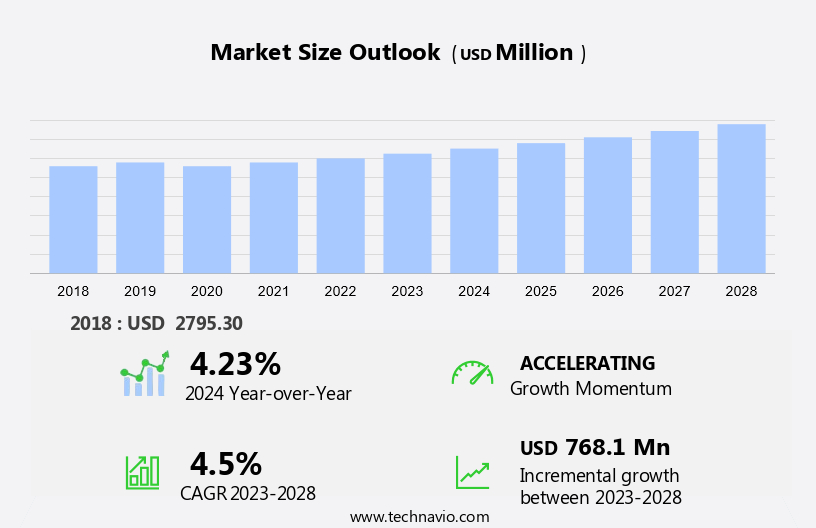
The femoral prostheses market size is forecast to increase by USD 768.1 million, at a CAGR of 4.5% between 2023 and 2028.

  • The market is witnessing significant growth due to several key factors. The rising prevalence of orthopedic diseases and associated risk factors are driving the market growth. Additionally, there is an increasing focus on robotic hip replacement surgeries, which offer enhanced precision and accuracy, leading to better patient outcomes. However, the high costs of hip replacement surgeries and declining reimbursements pose challenges to market growth. Manufacturers are responding by developing cost-effective solutions and exploring collaboration opportunities with healthcare providers to offer affordable financing options. Overall, the market is expected to experience steady growth In the coming years.

What will be the Size of the Femoral Prostheses Market During the Forecast Period?
Femoral Prostheses Market Size

 Request Free Sample

  • The market encompasses the production and distribution of hip prosthetic implants, specifically those designed for the femoral head. This market caters to various indications, including osteoarthritis, rheumatoid arthritis, hip dislocations, and trauma. Hip replacement surgeries, a primary application for femoral prostheses, continue to increase due to an aging population and the rising prevalence of arthritis. Robotic hip replacement technology has gained traction, offering enhanced precision and improved patient outcomes. Orthopaedic surgeons are increasingly adopting this technology to streamline procedures and reduce complications. Capacity expansions and strategic decisions by key players are driving market growth.
  • Market dynamics are influenced by several factors, including technological advancements, consumer behavior, and regulatory policies. Technological innovations, such as spherical head prostheses, are gaining popularity due to their enhanced durability and biocompatibility. The market is expected to maintain a positive growth trajectory, driven by the increasing demand for hip replacement surgeries and advancements in technology. However, challenges such as regulatory requirements and economic factors may impact market growth. Overall, the market presents significant opportunities for growth and innovation in the orthopaedic industry.

How is this Femoral Prostheses Industry segmented and which is the largest segment?

The femoral prostheses industry research report provides comprehensive data (region-wise segment analysis), with forecasts and estimates in "USD million" for the period 2024-2028, as well as historical data from 2018-2022 for the following segments.

  • Product
    • Femoral heads
    • Femoral stems
  • Geography
    • North America
      • Canada
      • US
    • Europe
      • Germany
      • France
    • Asia
      • China
    • Rest of World (ROW)

By Product Insights

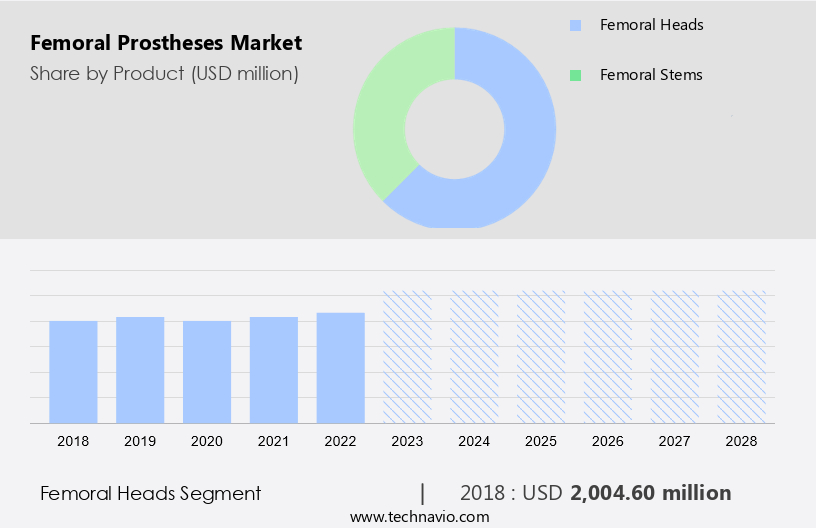
  • The femoral heads segment is estimated to witness significant growth during the forecast period. The femoral head, a crucial component in total hip replacement (THR) and partial hip replacement procedures, is the spherical portion of the femoral component. This market segment is categorized into metal, ceramic, and ceramicized materials. Metal femoral heads, primarily made of cobalt-chromium (CoCr), have historically held the largest market share in the US, accounting for approximately 47% of hip arthroplasty procedures in 2017. 
  • Although ceramic femoral heads exhibit similar wear rates to CoCr heads, the latter's lower cost has been a significant factor in its widespread use. Other metals, such as aluminum oxide (Al2O3) and stainless steel, are also utilized in specific patient cases. Orthopaedic surgeons continue to make strategic decisions based on capacity expansions, plant turnarounds, competitor analysis, ESG analysis, Porters Analysis, and consumer behavior analysis.
Femoral Prostheses Market Size

Get a glance at the market report of share of various segments Request Free Sample

The femoral heads segment was valued at USD 2 billion in 2018 and showed a gradual increase during the forecast period.

Regional Analysis

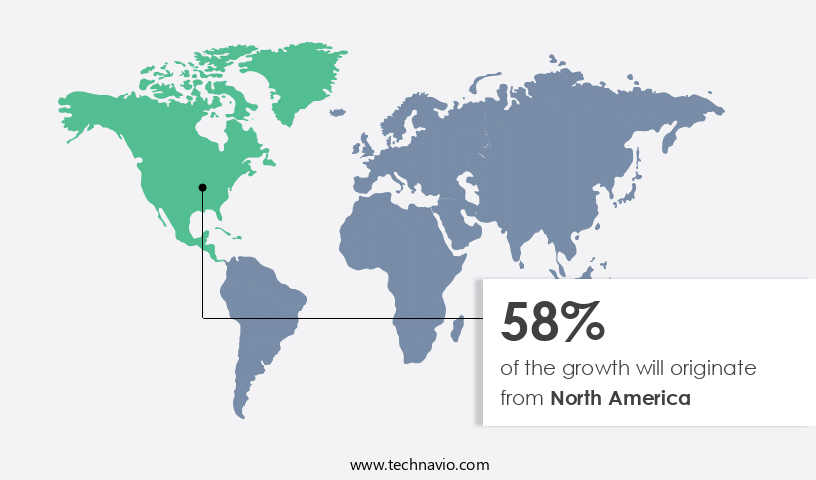
  • North America is estimated to contribute 58% to the growth of the global market during the forecast period. Technavio's analysts have elaborately explained the regional trends and drivers that shape the market during the forecast period.
Femoral Prostheses Market Share by Geography

For more insights on the market size of various regions, Request Free Sample

The North American market is experiencing significant growth, with the US and Canada being the primary revenue contributors. Factors driving this expansion include the increasing adoption of advanced femoral prostheses, enhanced healthcare infrastructure, and the high prevalence of orthopedic conditions such as osteoarthritis and rheumatoid arthritis. Furthermore, the number of hip replacement surgeries is on the rise, with estimates suggesting that annual utilization rates for primary and revision procedures will reach approximately 1.45 million and 147,000, respectively, by 2035. 

Robotic hip replacement surgeries and the entrance of orthopaedic surgeons into the market are also contributing to the market's growth. Capacity expansions, plant turnarounds, and strategic decisions are key areas of focus for market participants. Market fragmentation dominance, amalgamation traits, and consumer behavior analysis are also vital components of market analysis. The technological landscape is dynamic, with ongoing research and development efforts aimed at improving sphericalhead prostheses and femoral head prostheses.

Market Dynamics

Our researchers analyzed the data with 2023 as the base year, along with the key drivers, trends, and challenges. A holistic analysis of drivers will help companies refine their marketing strategies to gain a competitive advantage.

What are the key market drivers leading to the rise In the adoption of Femoral Prostheses Industry?

  • The rising prevalence of orthopedic diseases and associated risk factors is the key driver of the market. The global market is driven by the rising prevalence of orthopedic conditions, such as osteoarthritis and rheumatoid arthritis. Osteoarthritis, a leading cause of disability, affects over 300 million people worldwide, while rheumatoid arthritis, an inflammatory disease, impacts approximately 54 million individuals. Hip dislocations and traumas also contribute to the demand for femoral prostheses. Hip replacement surgeries, a common solution for hip-related issues, involve the use of prosthetic implants, including spherical head prostheses. The market is expected to grow due to the increasing number of hip replacement surgeries.
  • Orthopaedic surgeons perform these surgeries, and capacity expansions and plant turnarounds are strategic decisions they consider. Patent analysis and technological advancements, such as robotic hip replacement, are vital factors shaping the market. Consumer behavior analysis, including product satisfaction, is crucial for market success. The market is competitive, with fragmentation dominance, amalgamation traits, and accumulation characteristics. Expansion through mergers and joint ventures is a common strategy. The market is expected to remain dynamic, with continuous innovations and improvements.

What are the market trends shaping the Femoral Prostheses Industry?

  • Increasing focus on robotic hip replacement surgeries is the upcoming market trend. The market is experiencing significant growth due to the increasing adoption of robotic platforms for hip replacement surgeries. These systems offer customized procedures based on a patient's unique anatomy, resulting in implants with precise fits. Robotic surgeries also minimize blood loss, reduce tissue damage, and enable smaller incisions. companies are investing heavily in research and development to create surgical robots for optimal component positioning during hip replacement procedures. This R&D focus, along with inorganic growth strategies like acquisitions, is driving market expansion.
  • Key market dynamics include the rising prevalence of hip dislocations, hip replacement surgeries due to conditions like osteoarthritis and rheumatoid arthritis, and trauma. Product satisfaction, capacity expansions, plant turnarounds, and strategic decisions are essential considerations for market players. Technological advancements and consumer behavior analysis also impact market trends. The market landscape features various quadrants, including the Forfront, Pathfinder, Niche, Vital, Competitive nature, Accumulation, Fragmentation dominance, and Amalgamation traits.

What challenges does the Femoral Prostheses Industry face during its growth?

  • High cost of hip replacement surgeries and declining reimbursements is a key challenge affecting the industry growth. The market is influenced by several factors. Hip replacement surgeries, a primary application for these prosthetics, are on the rise due to the increasing prevalence of conditions such as osteoarthritis and rheumatoid arthritis. However, the high cost of these surgeries, which can be attributed to factors like the type of implant used, surgical expertise, hospital fees, and post-operative care, restricts their widespread adoption. Moreover, hip dislocations and trauma can necessitate revision surgeries, leading to additional financial burden. The cost of revision surgeries includes expenses for perioperative investigations, blood transfusions, surgical instruments, implants, and extended operating time.
  • Orthopaedic surgeons are making strategic decisions to expand capacity and improve efficiency through plant turnarounds and technological advancements, such as robotic hip replacement. The competitive nature of the market is characterized by fragmentation dominance, amalgamation traits, and accumulation. Companies are exploring mergers, joint ventures, and product satisfaction strategies to gain a competitive edge. The technological landscape is evolving rapidly, with spherical head prostheses and other advanced implant designs gaining popularity.

Exclusive Customer Landscape

The femoral prostheses market forecasting report includes the adoption lifecycle of the market, covering from the innovator's stage to the laggard's stage. It focuses on adoption rates in different regions based on penetration. Furthermore, the femoral prostheses market report also includes key purchase criteria and drivers of price sensitivity to help companies evaluate and develop their market growth analysis strategies.
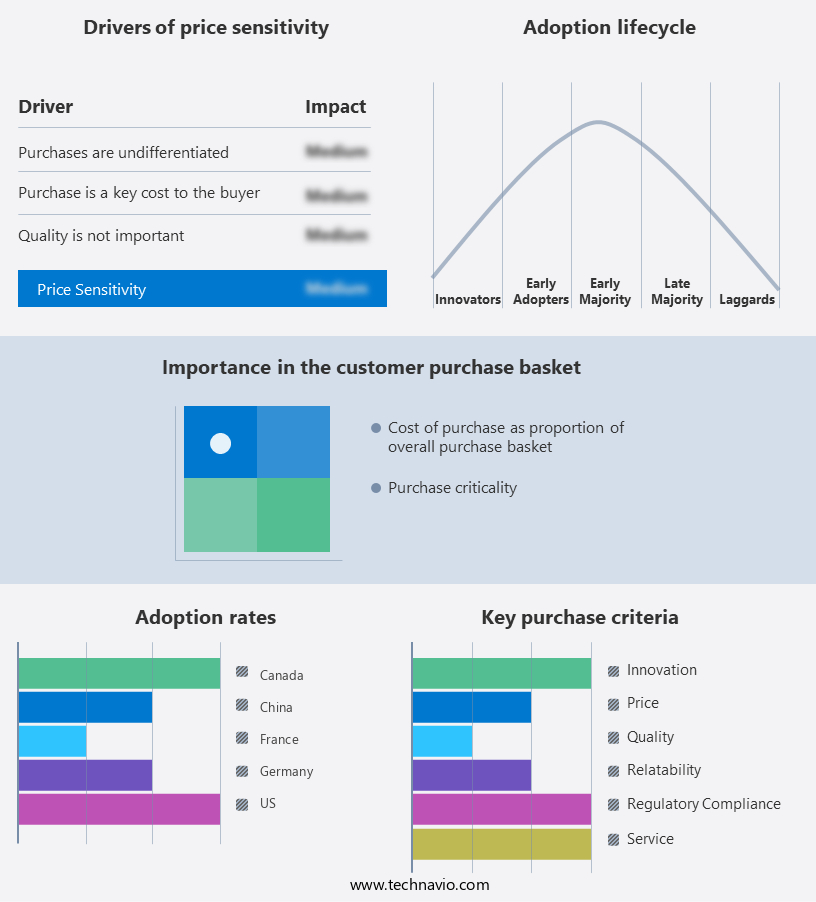
Femoral Prostheses Market Share by Geography

 Customer Landscape

Key Companies & Market Insights

Companies are implementing various strategies, such as strategic alliances, femoral prostheses market forecast, partnerships, mergers and acquisitions, geographical expansion, and product/service launches, to enhance their presence In the industry.

The industry research and growth report includes detailed analyses of the competitive landscape of the market and information about key companies, including:

  • AK Medical Holding Ltd.
  • Altimed JSC
  • Amplitude SAS
  • B.Braun SE
  • Baumer Holding AG
  • Beijing Chunlizhengda Medical Instruments Co. Ltd.
  • Corentec Co. Ltd.
  • Exactech Inc.
  • Gruppo Bioimpianti Srl
  • Johnson and Johnson Services Inc.
  • Lepine Group
  • Limacorporate SpA
  • Medacta International SA
  • Meril Life Sciences Pvt. Ltd.
  • Olympus Corp.
  • PETER BREHM GmbH
  • SERF
  • Smith and Nephew plc
  • Stryker Corp.
  • Surgival Co.
  • Zimmer Biomet Holdings Inc.

Qualitative and quantitative analysis of companies has been conducted to help clients understand the wider business environment as well as the strengths and weaknesses of key industry players. Data is qualitatively analyzed to categorize companies as pure play, category-focused, industry-focused, and diversified; it is quantitatively analyzed to categorize companies as dominant, leading, strong, tentative, and weak.

Research Analyst Overview

The market encompasses a broad range of hip replacement solutions designed to address various conditions leading to the need for surgical intervention. These conditions include but are not limited to, osteoarthritis, rheumatoid arthritis, and trauma. Hip dislocations, a potential complication following hip replacement surgeries, can also necessitate the use of prosthetic implants, specifically spherical head prostheses. The demand for hip prostheses continues to grow due to the increasing prevalence of degenerative joint diseases and the aging population. Orthopaedic surgeons increasingly turn to advanced technologies, such as robotic hip replacement, to enhance the accuracy and efficiency of surgical procedures. Capacity expansions and strategic decisions are common themes In the market.

Further, companies may invest in plant turnarounds to optimize production processes and improve overall efficiency. Mergers and joint ventures are also prevalent, as market players seek to expand their offerings and broaden their reach. Competitor analysis plays a crucial role In the market. Companies closely monitor their competitors to identify trends, strengths, and weaknesses. Environmental, social, and governance (ESG) analysis, Porter's Five Forces analysis, and PESTEL analysis are essential tools in this regard. The attractiveness of the market is influenced by various factors, including technological advancements, consumer behavior, and patent landscape. Technological innovations, such as the development of more durable materials and minimally invasive surgical techniques, are driving growth In the market.

Consumer preferences, influenced by factors such as product satisfaction and cost, also impact market dynamics. Patent analysis is another critical aspect of the market. Companies invest heavily in research and development to secure intellectual property rights and maintain a competitive edge. The market is characterized by a combination of fragmentation, dominance, and amalgamation traits. Niche players and pathfinders coexist with more established market leaders. The competitive nature of the market necessitates a focus on product innovation, operational efficiency, and customer satisfaction to maintain market share. Accumulation of knowledge and expertise is key to success in the market.

Market Scope

Report Coverage

Details

Page number

136

Base year

2023

Historic period

2018-2022

Forecast period

2024-2028

Growth momentum & CAGR

Accelerate at a CAGR of 4.5%

Market Growth 2024-2028

USD 768.1 million

Market structure

Fragmented

YoY growth 2023-2024(%)

4.23

Key countries

US, Germany, China, France, and Canada

Competitive landscape

Leading Companies, Market Positioning of Companies, Competitive Strategies, and Industry Risks

Request Free Sample

What are the Key Data Covered in this Femoral Prostheses Market Research and Growth Report?

  • CAGR of the Femoral Prostheses industry during the forecast period
  • Detailed information on factors that will drive the market growth and forecasting between 2024 and 2028
  • Precise estimation of the size of the market and its contribution of the industry in focus to the parent market
  • Accurate predictions about upcoming growth and trends and changes in consumer behaviour
  • Growth of the market across North America, Europe, Asia, and Rest of World (ROW)
  • Thorough analysis of the market's competitive landscape and detailed information about companies
  • Comprehensive analysis of factors that will challenge the femoral prostheses market growth of industry companies

We can help! Our analysts can customize this femoral prostheses market research report to meet your requirements.

Get in touch

1 Executive Summary

  • 1.1 Market overview
    • Executive Summary - Chart on Market Overview
    • Executive Summary - Data Table on Market Overview
    • Executive Summary - Chart on Global Market Characteristics
    • Executive Summary - Chart on Market by Geography
    • Executive Summary - Chart on Market Segmentation by Product
    • Executive Summary - Chart on Incremental Growth
    • Executive Summary - Data Table on Incremental Growth
    • Executive Summary - Chart on Company Market Positioning

2 Market Landscape

  • 2.1 Market ecosystem
    • Parent Market
    • Data Table on - Parent Market
  • 2.2 Market characteristics
    • Market characteristics analysis
  • 2.3 Value chain analysis
    • Value Chain Analysis

3 Market Sizing

  • 3.1 Market definition
    • Offerings of companies included in the market definition
  • 3.2 Market segment analysis
    • Market segments
  • 3.3 Market size 2023
    • 3.4 Market outlook: Forecast for 2023-2028
      • Chart on Global - Market size and forecast 2023-2028 ($ million)
      • Data Table on Global - Market size and forecast 2023-2028 ($ million)
      • Chart on Global Market: Year-over-year growth 2023-2028 (%)
      • Data Table on Global Market: Year-over-year growth 2023-2028 (%)

    4 Historic Market Size

    • 4.1 Global Femoral Prostheses Market 2018 - 2022
      • Historic Market Size - Data Table on Global Femoral Prostheses Market 2018 - 2022 ($ million)
    • 4.2 Product segment analysis 2018 - 2022
      • Historic Market Size - Product Segment 2018 - 2022 ($ million)
    • 4.3 Geography segment analysis 2018 - 2022
      • Historic Market Size - Geography Segment 2018 - 2022 ($ million)
    • 4.4 Country segment analysis 2018 - 2022
      • Historic Market Size - Country Segment 2018 - 2022 ($ million)

    5 Five Forces Analysis

    • 5.1 Five forces summary
      • Five forces analysis - Comparison between 2023 and 2028
    • 5.2 Bargaining power of buyers
      • Bargaining power of buyers - Impact of key factors 2023 and 2028
    • 5.3 Bargaining power of suppliers
      • Bargaining power of suppliers - Impact of key factors in 2023 and 2028
    • 5.4 Threat of new entrants
      • Threat of new entrants - Impact of key factors in 2023 and 2028
    • 5.5 Threat of substitutes
      • Threat of substitutes - Impact of key factors in 2023 and 2028
    • 5.6 Threat of rivalry
      • Threat of rivalry - Impact of key factors in 2023 and 2028
    • 5.7 Market condition
      • Chart on Market condition - Five forces 2023 and 2028

    6 Market Segmentation by Product

    • 6.1 Market segments
      • Chart on Product - Market share 2023-2028 (%)
      • Data Table on Product - Market share 2023-2028 (%)
    • 6.2 Comparison by Product
      • Chart on Comparison by Product
      • Data Table on Comparison by Product
    • 6.3 Femoral heads - Market size and forecast 2023-2028
      • Chart on Femoral heads - Market size and forecast 2023-2028 ($ million)
      • Data Table on Femoral heads - Market size and forecast 2023-2028 ($ million)
      • Chart on Femoral heads - Year-over-year growth 2023-2028 (%)
      • Data Table on Femoral heads - Year-over-year growth 2023-2028 (%)
    • 6.4 Femoral stems - Market size and forecast 2023-2028
      • Chart on Femoral stems - Market size and forecast 2023-2028 ($ million)
      • Data Table on Femoral stems - Market size and forecast 2023-2028 ($ million)
      • Chart on Femoral stems - Year-over-year growth 2023-2028 (%)
      • Data Table on Femoral stems - Year-over-year growth 2023-2028 (%)
    • 6.5 Market opportunity by Product
      • Market opportunity by Product ($ million)
      • Data Table on Market opportunity by Product ($ million)

    7 Customer Landscape

    • 7.1 Customer landscape overview
      • Analysis of price sensitivity, lifecycle, customer purchase basket, adoption rates, and purchase criteria

    8 Geographic Landscape

    • 8.1 Geographic segmentation
      • Chart on Market share by geography 2023-2028 (%)
      • Data Table on Market share by geography 2023-2028 (%)
    • 8.2 Geographic comparison
      • Chart on Geographic comparison
      • Data Table on Geographic comparison
    • 8.3 North America - Market size and forecast 2023-2028
      • Chart on North America - Market size and forecast 2023-2028 ($ million)
      • Data Table on North America - Market size and forecast 2023-2028 ($ million)
      • Chart on North America - Year-over-year growth 2023-2028 (%)
      • Data Table on North America - Year-over-year growth 2023-2028 (%)
    • 8.4 Europe - Market size and forecast 2023-2028
      • Chart on Europe - Market size and forecast 2023-2028 ($ million)
      • Data Table on Europe - Market size and forecast 2023-2028 ($ million)
      • Chart on Europe - Year-over-year growth 2023-2028 (%)
      • Data Table on Europe - Year-over-year growth 2023-2028 (%)
    • 8.5 Asia - Market size and forecast 2023-2028
      • Chart on Asia - Market size and forecast 2023-2028 ($ million)
      • Data Table on Asia - Market size and forecast 2023-2028 ($ million)
      • Chart on Asia - Year-over-year growth 2023-2028 (%)
      • Data Table on Asia - Year-over-year growth 2023-2028 (%)
    • 8.6 Rest of World (ROW) - Market size and forecast 2023-2028
      • Chart on Rest of World (ROW) - Market size and forecast 2023-2028 ($ million)
      • Data Table on Rest of World (ROW) - Market size and forecast 2023-2028 ($ million)
      • Chart on Rest of World (ROW) - Year-over-year growth 2023-2028 (%)
      • Data Table on Rest of World (ROW) - Year-over-year growth 2023-2028 (%)
    • 8.7 US - Market size and forecast 2023-2028
      • Chart on US - Market size and forecast 2023-2028 ($ million)
      • Data Table on US - Market size and forecast 2023-2028 ($ million)
      • Chart on US - Year-over-year growth 2023-2028 (%)
      • Data Table on US - Year-over-year growth 2023-2028 (%)
    • 8.8 Germany - Market size and forecast 2023-2028
      • Chart on Germany - Market size and forecast 2023-2028 ($ million)
      • Data Table on Germany - Market size and forecast 2023-2028 ($ million)
      • Chart on Germany - Year-over-year growth 2023-2028 (%)
      • Data Table on Germany - Year-over-year growth 2023-2028 (%)
    • 8.9 China - Market size and forecast 2023-2028
      • Chart on China - Market size and forecast 2023-2028 ($ million)
      • Data Table on China - Market size and forecast 2023-2028 ($ million)
      • Chart on China - Year-over-year growth 2023-2028 (%)
      • Data Table on China - Year-over-year growth 2023-2028 (%)
    • 8.10 France - Market size and forecast 2023-2028
      • Chart on France - Market size and forecast 2023-2028 ($ million)
      • Data Table on France - Market size and forecast 2023-2028 ($ million)
      • Chart on France - Year-over-year growth 2023-2028 (%)
      • Data Table on France - Year-over-year growth 2023-2028 (%)
    • 8.11 Canada - Market size and forecast 2023-2028
      • Chart on Canada - Market size and forecast 2023-2028 ($ million)
      • Data Table on Canada - Market size and forecast 2023-2028 ($ million)
      • Chart on Canada - Year-over-year growth 2023-2028 (%)
      • Data Table on Canada - Year-over-year growth 2023-2028 (%)
    • 8.12 Market opportunity by geography
      • Market opportunity by geography ($ million)
      • Data Tables on Market opportunity by geography ($ million)

    9 Drivers, Challenges, and Opportunity/Restraints

    • 9.1 Market drivers
      • 9.2 Market challenges
        • 9.3 Impact of drivers and challenges
          • Impact of drivers and challenges in 2023 and 2028
        • 9.4 Market opportunities/restraints

          10 Competitive Landscape

          • 10.1 Overview
            • 10.2 Competitive Landscape
              • Overview on criticality of inputs and factors of differentiation
            • 10.3 Landscape disruption
              • Overview on factors of disruption
            • 10.4 Industry risks
              • Impact of key risks on business

            11 Competitive Analysis

            • 11.1 Companies profiled
              • Companies covered
            • 11.2 Market positioning of companies
              • Matrix on companies position and classification
            • 11.3 AK Medical Holding Ltd.
              • AK Medical Holding Ltd. - Overview
              • AK Medical Holding Ltd. - Product / Service
              • AK Medical Holding Ltd. - Key offerings
            • 11.4 Altimed JSC
              • Altimed JSC - Overview
              • Altimed JSC - Product / Service
              • Altimed JSC - Key offerings
            • 11.5 Amplitude SAS
              • Amplitude SAS - Overview
              • Amplitude SAS - Product / Service
              • Amplitude SAS - Key offerings
            • 11.6 B.Braun SE
              • B.Braun SE - Overview
              • B.Braun SE - Business segments
              • B.Braun SE - Key news
              • B.Braun SE - Key offerings
              • B.Braun SE - Segment focus
            • 11.7 Baumer Holding AG
              • Baumer Holding AG - Overview
              • Baumer Holding AG - Product / Service
              • Baumer Holding AG - Key offerings
            • 11.8 Beijing Chunlizhengda Medical Instruments Co. Ltd.
              • Beijing Chunlizhengda Medical Instruments Co. Ltd. - Overview
              • Beijing Chunlizhengda Medical Instruments Co. Ltd. - Product / Service
              • Beijing Chunlizhengda Medical Instruments Co. Ltd. - Key offerings
            • 11.9 Corentec Co. Ltd.
              • Corentec Co. Ltd. - Overview
              • Corentec Co. Ltd. - Product / Service
              • Corentec Co. Ltd. - Key offerings
            • 11.10 Exactech Inc.
              • Exactech Inc. - Overview
              • Exactech Inc. - Product / Service
              • Exactech Inc. - Key offerings
            • 11.11 Olympus Corp.
              • Olympus Corp. - Overview
              • Olympus Corp. - Business segments
              • Olympus Corp. - Key news
              • Olympus Corp. - Key offerings
              • Olympus Corp. - Segment focus
            • 11.12 SERF
              • SERF - Overview
              • SERF - Product / Service
              • SERF - Key offerings

            12 Appendix

            • 12.1 Scope of the report
              • 12.2 Inclusions and exclusions checklist
                • Inclusions checklist
                • Exclusions checklist
              • 12.3 Currency conversion rates for US$
                • Currency conversion rates for US$
              • 12.4 Research methodology
                • Research methodology
              • 12.5 Data procurement
                • Information sources
              • 12.6 Data validation
                • Data validation
              • 12.7 Validation techniques employed for market sizing
                • Validation techniques employed for market sizing
              • 12.8 Data synthesis
                • Data synthesis
              • 12.9 360 degree market analysis
                • 360 degree market analysis
              • 12.10 List of abbreviations
                • List of abbreviations

              Research Methodology

              Technavio presents a detailed picture of the market by way of study, synthesis, and summation of data from multiple sources. The analysts have presented the various facets of the market with a particular focus on identifying the key industry influencers. The data thus presented is comprehensive, reliable, and the result of extensive research, both primary and secondary.

              INFORMATION SOURCES

              Primary sources

              • Manufacturers and suppliers
              • Channel partners
              • Industry experts
              • Strategic decision makers

              Secondary sources

              • Industry journals and periodicals
              • Government data
              • Financial reports of key industry players
              • Historical data
              • Press releases

              DATA ANALYSIS

              Data Synthesis

              • Collation of data
              • Estimation of key figures
              • Analysis of derived insights

              Data Validation

              • Triangulation with data models
              • Reference against proprietary databases
              • Corroboration with industry experts

              REPORT WRITING

              Qualitative

              • Market drivers
              • Market challenges
              • Market trends
              • Five forces analysis

              Quantitative

              • Market size and forecast
              • Market segmentation
              • Geographical insights
              • Competitive landscape

              Interested in this report?

              Get your sample now to see our research methodology and insights!

              Download Now

              Frequently Asked Questions

              Femoral Prostheses market growth will increase by $ 768.1 mn during 2024-2028.

              The Femoral Prostheses market is expected to grow at a CAGR of 4.5% during 2024-2028.

              Femoral Prostheses market is segmented by Product( Femoral heads, Femoral stems)

              AK Medical Holding Ltd., Altimed JSC, Amplitude SAS, B.Braun SE, Baumer Holding AG, Beijing Chunlizhengda Medical Instruments Co. Ltd., Corentec Co. Ltd., Exactech Inc., Gruppo Bioimpianti Srl, Johnson and Johnson Services Inc., Lepine Group, Limacorporate SpA, Medacta International SA, Meril Life Sciences Pvt. Ltd., Olympus Corp., PETER BREHM GmbH, SERF, Smith and Nephew plc, Stryker Corp., Surgival Co., Zimmer Biomet Holdings Inc. are a few of the key vendors in the Femoral Prostheses market.

              North America will register the highest growth rate of 58% among the other regions. Therefore, the Femoral Prostheses market in North America is expected to garner significant business opportunities for the vendors during the forecast period.

              US, Germany, China, France, Canada

              • Rising prevalence of orthopedic diseases and associated risk factorsGlobally is the driving factor this market.
              • there is an increasing prevalence of orthopedic diseases such as osteoarthritis is the driving factor this market.
              • osteoporosis is the driving factor this market.
              • and rheumatoid arthritis. Osteoarthritis ranks fifth among all forms of disability worldwide. Osteoporosis is a leading cause of morbidity and mortality in older people. Every year is the driving factor this market.
              • osteoporosis causes about nine million fractures worldwide. The three main types of osteoporosis fractures are hip is the driving factor this market.
              • wrist is the driving factor this market.
              • and vertebral fractures. This is expected to increase the demand for femoral prostheses during the forecast period.Rheumatoid arthritis is one of the most common chronic diseases is the driving factor this market.
              • affecting one in every 100 individuals worldwide. According to the Centers for Disease Control and Prevention (CDC) is the driving factor this market.
              • as of 2017 is the driving factor this market.
              • 54.4 million US adults (25% of the population) were affected by arthritis is the driving factor this market.
              • and by 2025 is the driving factor this market.
              • approximately 60 million US adults are estimated to have doctor-diagnosed arthritis. In Australia is the driving factor this market.
              • the number of people with rheumatoid arthritis is expected to increase from approximately 2.30 million in 2017 to more than 2.55 million in 2022. The risk factors associated with osteoarthritis is the driving factor this market.
              • osteoporosis is the driving factor this market.
              • and rheumatoid arthritis are also rising. For instance is the driving factor this market.
              • the prevalence of osteoarthritis is the driving factor this market.
              • osteoporosis is the driving factor this market.
              • and rheumatoid arthritis significantly increases with age. Globally is the driving factor this market.
              • the older population is also growing rapidly is the driving factor this market.
              • owing to the rise in average life expectancy. In 2018 is the driving factor this market.
              • approximately 650 million people were aged 65 and above across the world is the driving factor this market.
              • and the number is expected to increase to approximately 810 million by 2025. All these factors are expected to increase the demand for femoral prostheses during the forecast period. is the driving factor this market.

              The Femoral Prostheses market vendors should focus on grabbing business opportunities from the Femoral heads segment as it accounted for the largest market share in the base year.
