


High-Integrity Pressure Protection System Market Size 2025-2029
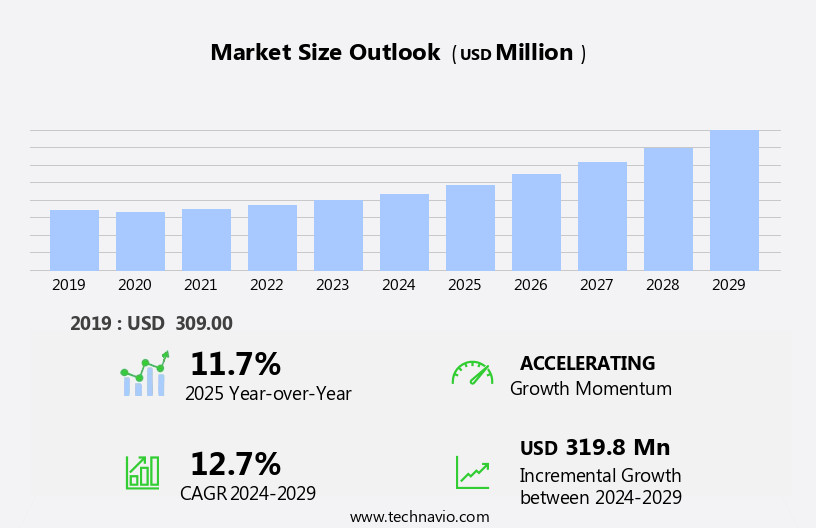
The high-integrity pressure protection system market size is forecast to increase by USD 319.8 million, at a CAGR of 12.7% between 2024 and 2029.
- The High-Integrity Pressure Protection System (HIPPS) market is driven by stringent safety and environmental regulations, which mandate the use of advanced protection systems in various industries, including oil and gas, power generation, and water treatment. These regulations ensure the safe operation of critical infrastructure and prevent potential catastrophic incidents. Another key trend in the market is the focus on new product launches, as companies invest in research and development to introduce innovative solutions that offer improved performance, reliability, and ease of use. However, the market also faces challenges, primarily in the form of higher operations and maintenance costs.
- The complexity of HIPPS systems and the need for regular inspections, testing, and calibration contribute to these costs. Companies must effectively manage these expenses to maintain profitability and remain competitive in the market. To capitalize on opportunities and navigate challenges, market participants should stay informed about regulatory requirements, invest in R&D, and explore cost-effective maintenance strategies. Computed tomography (CT) and digital radiography (DR) are offering high-definition imaging and 3D reconstruction.
What will be the Size of the High-Integrity Pressure Protection System Market during the forecast period?
- The High-Integrity Pressure Protection System (HIPPS) market encompasses a range of technologies and services designed to ensure safety in industrial processes involving high-pressure systems. This market is driven by stringent safety regulations and the need for reliable risk management. Safety software plays a crucial role in HIPPS, providing real-time monitoring and analysis to prevent potential hazards. Certification bodies oversee the implementation of safety training programs and safety case development, while safety lifecycle management ensures continuous improvement. Safety relief valves, pressure switches, trip amplifiers, safety logic solvers, and safety controllers are essential components of HIPPS, working in conjunction with safety management systems and redundant control systems to maintain pressure stability.
- Human factors and safety culture are integral to effective HIPPS operation, with safety audits and third-party inspections ensuring adherence to industry best practices. Pressure transducers, pressure regulators, safety PLCs, pressure safety valves, and blowdown systems are other critical elements of HIPPS. Process safety engineering and reliability engineering are essential disciplines in designing and implementing these systems, with process hazard analysis and SIL verification ensuring safety standards are met. Rupture discs provide an additional layer of protection against catastrophic failures. In the dynamic industrial landscape, HIPPS continues to evolve, with a focus on continuous improvement and the integration of advanced technologies. Safety inspections and safety standards remain key drivers, as industries strive to minimize risks and ensure the safety of their workforce and the public.
How is this High-Integrity Pressure Protection System Industry segmented?
The high-integrity pressure protection system industry research report provides comprehensive data (region-wise segment analysis), with forecasts and estimates in "USD million" for the period 2025-2029, as well as historical data from 2019-2023 for the following segments.
- Type
- Components
- Services
- Product Type
- Electronic HIPPS
- Mechanical HIPPS
- End-user
- Oil and gas
- Chemicals and petrochemicals
- Pharmaceuticals
- Others
- Geography
- North America
- US
- Canada
- Europe
- France
- Germany
- Italy
- UK
- APAC
- China
- India
- Japan
- South Korea
- Rest of World (ROW)
- North America
By Type Insights
The components segment is estimated to witness significant growth during the forecast period. The high-integrity pressure protection system (HIPPS) market encompasses a range of components that collaboratively form a comprehensive solution for safeguarding industrial processes against overpressure conditions. These components, which include pressure sensors and transmitters, logic solvers, and safety instrumented systems, function in unison to ensure process safety and reliability. Pressure sensors and transmitters serve as the primary detection devices, continuously monitoring pressure levels and transmitting real-time data to the logic solver. The logic solver, often a programmable safety controller or dedicated hardware, acts as the decision-making unit, evaluating the data and initiating appropriate responses based on predefined safety functions.
Safety instrumented functions, emergency response plans, and operating procedures are integral to the effective implementation of HIPPS. These elements facilitate the timely and efficient response to overpressure events, minimizing potential harm to personnel and equipment. Reliability analysis, condition monitoring, and fault tolerance further enhance the performance and safety of HIPPS. Redundant systems, safety interlocks, and trip systems provide additional layers of protection, ensuring the system maintains the required safety integrity level. HIPPS components are employed across various industries, including power generation, industrial control systems, and chemical processing, where the handling of hazardous materials and the potential for catastrophic events necessitate robust safety measures.
Pressure relief valves and independent protection layers serve as critical components in these applications, ensuring the safe containment and release of pressure. Safety integrity levels and SIL certification are essential considerations in the design and implementation of HIPPS. These standards ensure the system's ability to reliably and consistently meet safety requirements under various operating conditions. In the context of power generation, HIPPS plays a crucial role in the protection of high-pressure piping and turbines. Remote monitoring and process automation enable continuous system monitoring and optimization, further enhancing the overall safety and efficiency of the power generation process. The integration of data acquisition systems and process control systems within HIPPS facilitates the seamless exchange of information between various components, enabling real-time decision-making and response.
Pressure transmitters and safety instrumented systems work in tandem to maintain optimal pressure levels and prevent potential hazards. The market represents a vital segment of the industrial safety landscape. Its components, including pressure sensors, logic solvers, safety instrumented functions, and emergency response plans, work together to ensure the safe and reliable operation of critical industrial processes. The ongoing advancements in technology continue to enhance the performance and capabilities of HIPPS, further solidifying its role as a cornerstone of process safety management.
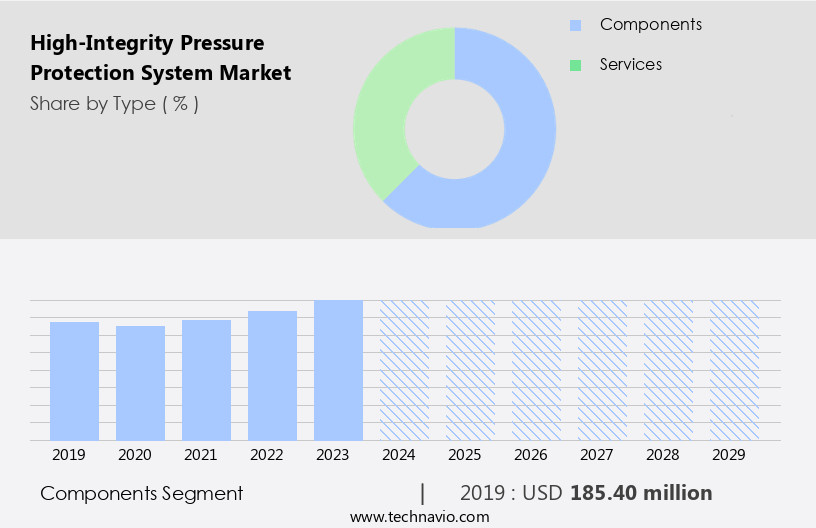
The Components segment was valued at USD 185.40 million in 2019 and showed a gradual increase during the forecast period.
Regional Analysis
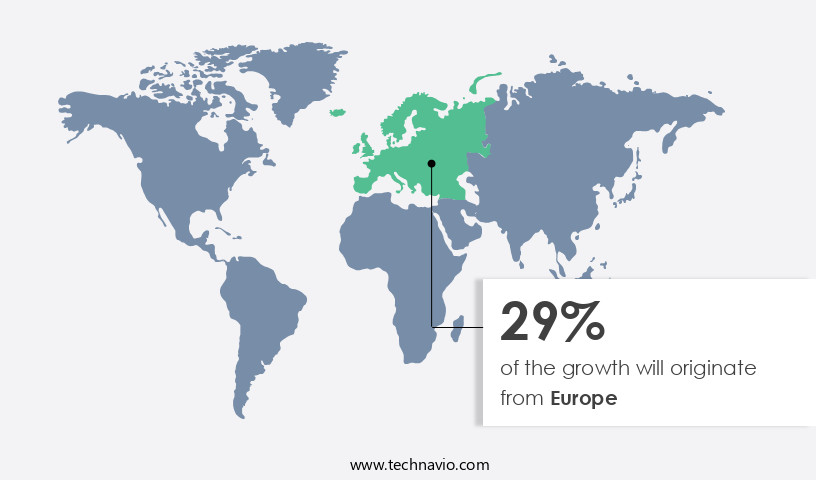
Europe is estimated to contribute 29% to the growth of the global market during the forecast period. Technavio's analysts have elaborately explained the regional trends and drivers that shape the market during the forecast period.
The Asia-Pacific (APAC) region is undergoing a significant shift in its industrial and energy sectors, fueled by economic growth, strategic investments, and policy reforms. This transformation is driving the demand for advanced safety and operational technologies, particularly High-Integrity Pressure Protection Systems (HIPPS). HIPPS play a crucial role in securing oil, gas, and chemical infrastructure by preventing over-pressurization, thereby ensuring operational safety, environmental protection, and regulatory compliance. In China, the industrial sector has shown remarkable growth, with a 5% increase in production capacity. This expansion necessitates the implementation of advanced safety systems like HIPPS to maintain operational efficiency and adhere to stringent safety regulations. Furthermore, the increasing popularity of consumer electronics and smart devices in APAC is fueling the demand
India and Indonesia are also investing heavily in their infrastructure, focusing on process safety management, functional safety, and hazardous materials handling. Australia and Japan are at the forefront of technological innovation in the energy sector. They are integrating data acquisition systems, process control systems, and remote monitoring into their industrial processes to optimize performance and enhance safety. Condition monitoring, fault tolerance, and redundant systems are essential components of these advanced technologies. The market in APAC is further boosted by the adoption of safety instrumented functions, safety interlocks, and emergency response plans. Power generation and industrial control systems are also integrating HIPPS to ensure the reliability and safety of their operations.
Market Dynamics
Our researchers analyzed the data with 2024 as the base year, along with the key drivers, trends, and challenges. A holistic analysis of drivers will help companies refine their marketing strategies to gain a competitive advantage.
What are the High-Integrity Pressure Protection System market drivers leading to the rise in the adoption of Industry?
- Strict safety and environmental regulations serve as the primary market catalyst, driving industry compliance and growth. The market is driven by the increasing enforcement of stringent safety and environmental regulations. Regulatory bodies, such as the Occupational Safety and Health Administration (OSHA) and the Environmental Protection Agency (EPA) in the US, have established comprehensive frameworks mandating advanced safety systems in industrial operations dealing with hazardous materials. OSHA's Process Safety Management (PSM) Standard, specifically 29 CFR 1910.119, requires facilities handling hazardous chemicals to identify, evaluate, and control process-related risks. Mechanical integrity, which includes the maintenance and reliability of safety-critical systems like HIPPS, is a critical component of this standard.
- Redundant systems, safety interlocks, safety instrumented systems, trip systems, remote monitoring, and process automation are essential elements of HIPPS that contribute to maintaining mechanical integrity and ensuring safety in power generation and industrial control systems.
What are the High-Integrity Pressure Protection System market trends shaping the Industry?
- The focus on new product launches is a significant market trend. It is essential for businesses to stay informed and prepared for introducing innovative offerings to remain competitive. The market is witnessing significant growth due to the increasing demand for enhanced safety and operational control in various industries. One of the latest developments in this market is the introduction of a high-integrity pressure protection system by IMI, designed specifically for hydrogen post-production processes on May 30, 2024. This system is engineered to isolate high-pressure hydrogen sources instead of simply venting excess flow, which is crucial for safe storage and transport in hydrogen infrastructure. This trend signifies a broader industry shift towards creating HIPPS solutions that cater to the unique safety challenges posed by alternative energy sources and advanced manufacturing environments. The market is further driven by the integration of deep learning.
- Independent protection layers, such as pressure transmitters, pressure relief valves, and emergency shutdown systems, play a vital role in ensuring safety integrity level (SIL) certification in these systems. Sil certification is a mandatory requirement for critical applications where safety is paramount. This focus on safety and operational control is expected to drive the growth of the market.
How does High-Integrity Pressure Protection System market face challenges during its growth?
- The escalating costs of operations and maintenance represent a significant challenge to the industry's growth trajectory. The high-integrity pressure protection system (HIPPS) market encompasses advanced safety systems utilized in chemical processing industries. These systems, which consist of pressure sensors, data acquisition systems, process control systems, and functional safety components like logic solvers and final control elements, offer enhanced performance compared to traditional mechanical relief valves. However, their complexity necessitates rigorous oversight throughout their lifecycle. The deployment of HIPPS involves precise integration, detailed documentation, and adherence to international safety standards, such as IEC 61508 and IEC 61511.
- These standards mandate comprehensive design, installation, and testing procedures, often requiring specialized engineering expertise and extended project timelines. The high cost associated with these operations and maintenance is a significant challenge for market growth. Despite the complexities, HIPPS provide superior process safety management, ensuring the reliable and safe operation of pressure vessels in chemical processing applications.
Exclusive Customer Landscape
The high-integrity pressure protection system market forecasting report includes the adoption lifecycle of the market, covering from the innovator's stage to the laggard's stage. It focuses on adoption rates in different regions based on penetration. Furthermore, the high-integrity pressure protection system market report also includes key purchase criteria and drivers of price sensitivity to help companies evaluate and develop their market growth analysis strategies.
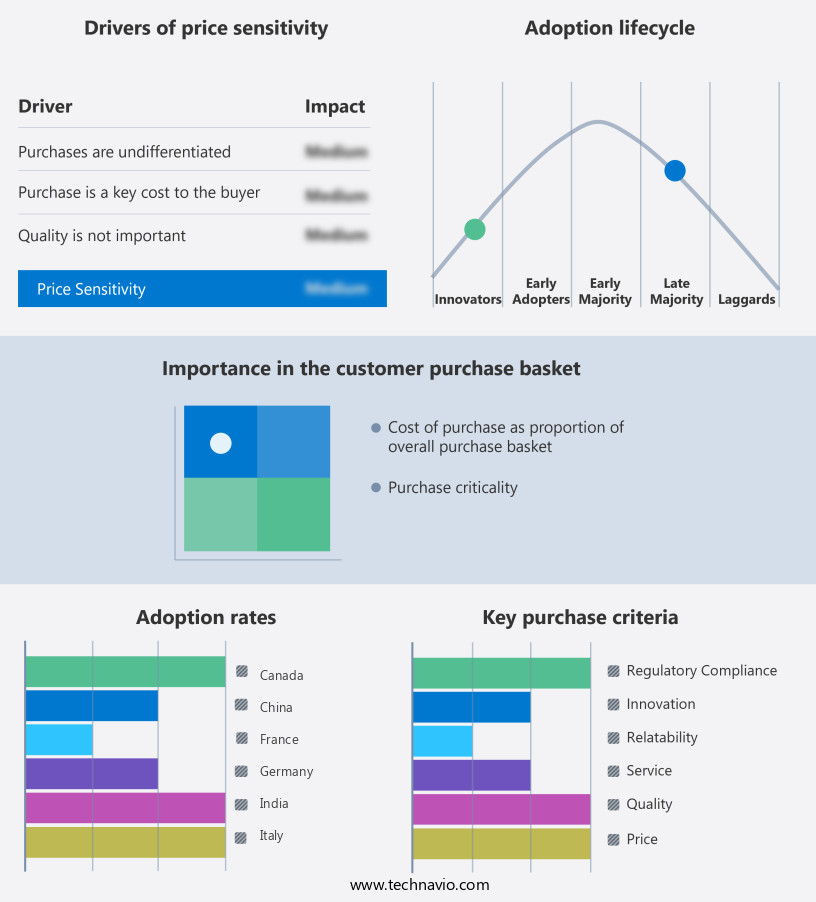
Customer Landscape
Key Companies & Market Insights
Companies are implementing various strategies, such as strategic alliances, high-integrity pressure protection system market forecast, partnerships, mergers and acquisitions, geographical expansion, and product/service launches, to enhance their presence in the industry.
ABB Ltd. - The company provides advanced pressure protection solutions, including 800xA High Integrity systems.
The industry research and growth report includes detailed analyses of the competitive landscape of the market and information about key companies, including:
- ABB Ltd.
- Ampo
- Baker Hughes Co.
- BEL Valves Ltd
- Emerson Electric Co.
- HIMA Paul Hildebrandt GmbH
- Honeywell International Inc.
- IMI Plc
- Maverick Valves
- MOGAS Industries Inc.
- Mokveld Valves BV
- PETROLVALVES S.P.A
- Rockwell Automation Inc.
- Schlumberger Ltd.
- Schneider Electric SE
- Severn Glocon UK Valves ltd
- Siemens AG
- Velan Inc.
- Yokogawa Electric Corp.
Qualitative and quantitative analysis of companies has been conducted to help clients understand the wider business environment as well as the strengths and weaknesses of key industry players. Data is qualitatively analyzed to categorize companies as pure play, category-focused, industry-focused, and diversified; it is quantitatively analyzed to categorize companies as dominant, leading, strong, tentative, and weak.
Recent Development and News in High-Integrity Pressure Protection System Market
- In February 2023, Emerson Electric Company announced the launch of its new Rosemount 3051S Transmitter, a high-integrity pressure protection system designed for the oil and gas industry. This innovative solution offers enhanced safety features and improved reliability, making it a significant addition to Emerson's portfolio (Emerson Electric Company Press Release).
- In October 2022, Baker Hughes, a GE company, entered into a strategic collaboration with ABB to integrate ABB's Ability⢠Digital Twin technology with Baker Hughes' high-integrity pressure protection systems. This partnership aims to provide customers with advanced digital solutions for predictive maintenance and improved operational efficiency (Baker Hughes, a GE company Press Release).
- In July 2021, Honeywell International Inc. completed the acquisition of Intergraph, a leading provider of engineering and geospatial software. This acquisition will enable Honeywell to expand its offerings in the market and strengthen its position in the process automation industry (Honeywell International Inc. Press Release).
- In March 2020, the US Department of Transportation's Pipeline and Hazardous Materials Safety Administration issued a final rule mandating the implementation of high-integrity pressure protection systems in certain segments of the natural gas transmission pipeline system. This regulatory initiative is expected to enhance pipeline safety and reduce the risk of catastrophic incidents (US Department of Transportation Press Release).
Research Analyst Overview
The market is characterized by its continuous evolution and dynamic nature, driven by the ever-changing requirements of various sectors such as chemical processing, power generation, and industrial control systems. These systems play a crucial role in ensuring the safety and reliability of operations involving hazardous materials handling, high-pressure piping, and pressure vessels. Functional safety and process safety management are integral components of these systems, with Hazop studies and reliability analysis playing key roles in identifying potential hazards and mitigating risks. Data acquisition systems and process control systems enable real-time monitoring and remote control, while safety instrumented functions and emergency response plans provide essential safety measures.
Pressure sensors, trip systems, and safety interlocks are critical elements of safety instrumented systems, ensuring fault tolerance and redundant systems are in place to maintain operational continuity. Pressure transmitters and relief valves are essential components of independent protection layers, providing an additional layer of safety to prevent catastrophic failures. Safety integrity levels and SIL certification are crucial for ensuring the reliability and safety of these systems, with continuous condition monitoring and emergency shutdown systems providing critical backup measures. The ongoing development of advanced technologies, such as remote monitoring and process automation, is driving innovation in this market, with a focus on improving efficiency, reliability, and safety.
Dive into Technavio's strong research methodology, blending expert interviews, extensive data synthesis, and validated models for unparalleled High-Integrity Pressure Protection System Market insights. See full methodology.
|
Market Scope |
|
|
Report Coverage |
Details |
|
Page number |
230 |
|
Base year |
2024 |
|
Historic period |
2019-2023 |
|
Forecast period |
2025-2029 |
|
Growth momentum & CAGR |
Accelerate at a CAGR of 12.7% |
|
Market growth 2025-2029 |
USD 319.8 million |
|
Market structure |
Fragmented |
|
YoY growth 2024-2025(%) |
11.7 |
|
Key countries |
US, China, Japan, UK, India, South Korea, Germany, Canada, France, and Italy |
|
Competitive landscape |
Leading Companies, Market Positioning of Companies, Competitive Strategies, and Industry Risks |
What are the Key Data Covered in this High-Integrity Pressure Protection System Market Research and Growth Report?
- CAGR of the High-Integrity Pressure Protection System industry during the forecast period
- Detailed information on factors that will drive the growth and forecasting between 2025 and 2029
- Precise estimation of the size of the market and its contribution of the industry in focus to the parent market
- Accurate predictions about upcoming growth and trends and changes in consumer behaviour
- Growth of the market across APAC, North America, Europe, Middle East and Africa, and South America
- Thorough analysis of the market's competitive landscape and detailed information about companies
- Comprehensive analysis of factors that will challenge the high-integrity pressure protection system market growth of industry companies
We can help! Our analysts can customize this high-integrity pressure protection system market research report to meet your requirements.
 RIA -
RIA - 
