


India UPS Market Size 2026-2030
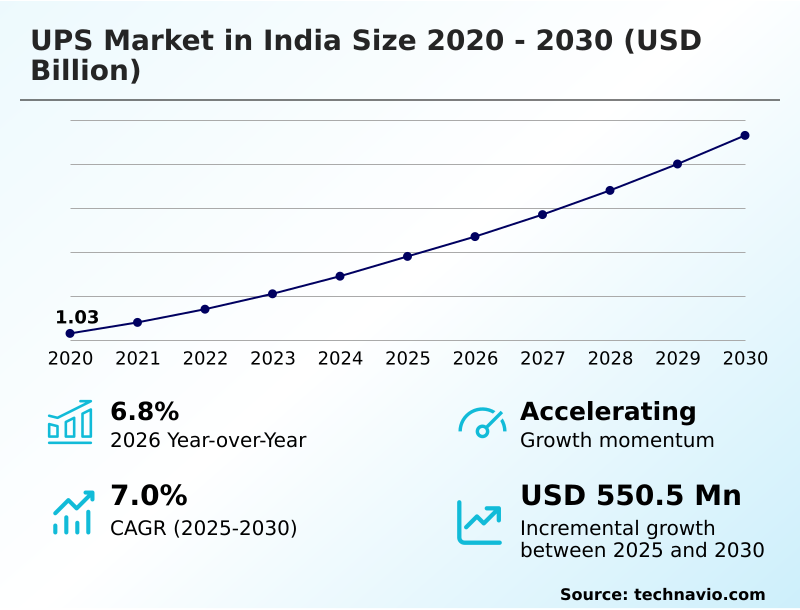
The india ups market size is valued to increase by USD 550.5 million, at a CAGR of 7% from 2025 to 2030. Proliferation of data centers and digital infrastructure will drive the india ups market.
Major Market Trends & Insights
- By End-user - Non-residential segment was valued at USD 978.2 million in 2024
- By Type - Double conversion segment accounted for the largest market revenue share in 2024
Market Size & Forecast
- Market Opportunities: USD 897.2 million
- Market Future Opportunities: USD 550.5 million
- CAGR from 2025 to 2030 : 7%
Market Summary
- The UPS market in India is integral to the nation's digital transformation, ensuring operational continuity across critical sectors. The exponential growth of data centers, driven by data localization policies and the adoption of cloud computing, fuels demand for high-capacity, high-efficiency power backup systems.
- In parallel, the Industry 4.0 revolution in manufacturing requires uninterruptible power for automated and precision-controlled processes, where even a momentary disruption can lead to significant financial loss. A key business scenario involves a pharmaceutical company using a sophisticated UPS network to maintain a sterile environment and protect data integrity during batch production, ensuring compliance with regulatory standards.
- This demand extends to healthcare, finance, and telecommunications. However, the market grapples with intense price sensitivity, particularly in the SME and SOHO segments, which fosters a large unorganized sector. Concurrently, manufacturers must navigate stringent e-waste management regulations and the technological shift toward more efficient but costlier lithium-ion batteries, balancing innovation with market affordability.
What will be the Size of the India UPS Market during the forecast period?
Get Key Insights on Market Forecast (PDF) Get Free Sample
How is the India UPS Market Segmented?
The india ups industry research report provides comprehensive data (region-wise segment analysis), with forecasts and estimates in "USD million" for the period 2026-2030, as well as historical data from 2020-2024 for the following segments.
- End-user
- Non-residential
- Residential
- Type
- Double conversion
- Line-interactive
- Standby
- Application
- Industrial
- Data centers
- Telecommunications
- Healthcare
- Others
- Geography
- APAC
- India
- APAC
By End-user Insights
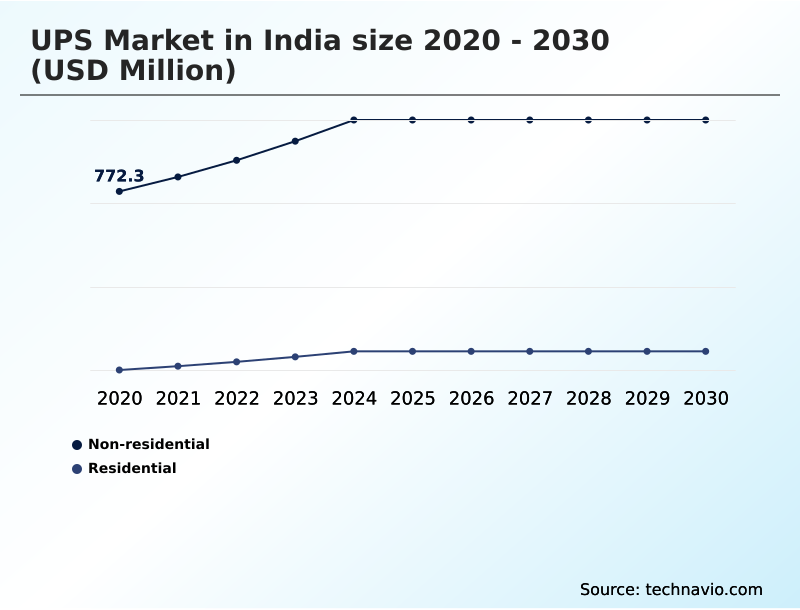
The non-residential segment is estimated to witness significant growth during the forecast period.
The non-residential segment is the cornerstone of the UPS market in India, driven by relentless digitalization. Demand is overwhelmingly for high-capacity, three-phase UPS systems, especially those employing double conversion technology for ultimate fault tolerance.
Industries such as data center power infrastructure, finance, and advanced manufacturing mandate robust power conditioning to safeguard mission-critical applications and ensure business continuity planning.
The focus is on achieving operational resilience through intelligent power management and architectures like N+1 redundancy, which protect sensitive IT infrastructure protection. For hyperscale data center solutions, a pure sine wave output is non-negotiable.
Modern systems in this segment improve power usage effectiveness by over 5%, directly impacting operational costs and supporting sustainable business goals.
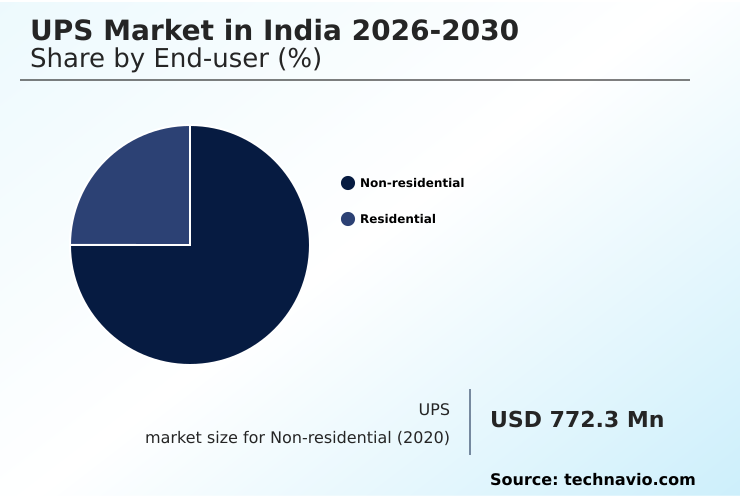
The Non-residential segment was valued at USD 978.2 million in 2024 and showed a gradual increase during the forecast period.
Market Dynamics
Our researchers analyzed the data with 2025 as the base year, along with the key drivers, trends, and challenges. A holistic analysis of drivers will help companies refine their marketing strategies to gain a competitive advantage.
- Strategic decision-making in power infrastructure requires a nuanced understanding of evolving technologies and applications. A primary consideration is the lithium-ion vs VRLA battery UPS debate, where lifecycle value often outweighs initial costs. For large-scale facilities, modular UPS systems for datacenters offer scalability and efficiency, while three-phase UPS for industrial automation is essential for robust process control.
- In contrast, line-interactive UPS for SME servers provides a cost-effective balance of protection. For remote work scenarios, choosing UPS for home office setup has become a critical productivity decision. Technologically, an energy efficient double conversion UPS delivers the highest level of protection for sensitive electronics. The growing need for oversight makes a UPS with remote monitoring capabilities a standard requirement.
- Application-specific demands are also surging, with a defined need for a UPS for 5G network infrastructure and online UPS for critical healthcare equipment. Even consumer-level applications like finding the best UPS for gaming PC protection have gained importance.
- A detailed cost analysis of modular vs monolithic UPS often reveals that modular systems can lower TCO by over 15% through optimized scaling. Understanding UPS redundancy levels explained N+1 2N is vital for mission-critical availability. Reducing TCO with high-efficiency UPS is a key management goal, closely tied to the impact of power factor on UPS sizing.
- For smaller commercial needs, a standby UPS for POS system backup is sufficient. Advanced smart UPS features for network management and integrating UPS with solar power systems are shaping future-ready infrastructures. Finally, ensuring compliance with battery waste management rules and understanding high-density UPS for edge computing are crucial for sustainable and distributed deployments.
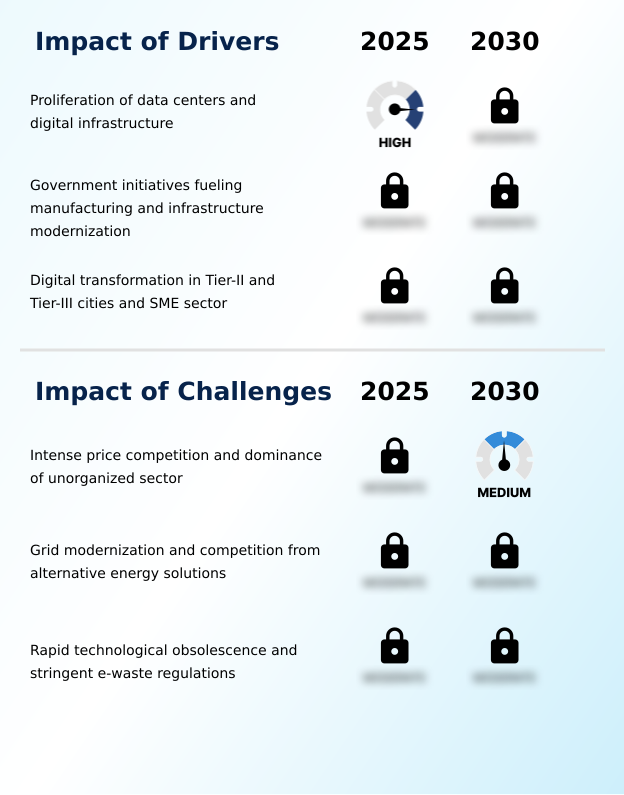
What are the key market drivers leading to the rise in the adoption of India UPS Industry?
- The proliferation of data centers and the broader expansion of digital infrastructure across the nation serve as the primary drivers for market growth.
- Market growth is fundamentally driven by industrial modernization and the decentralization of digital infrastructure, creating a need for resilient power infrastructure.
- The push for digital transformation enablement in manufacturing has increased demand for industrial power backup solutions by over 20%, safeguarding manufacturing process continuity and precision-controlled processes.
- This requires robust single-phase UPS and line-interactive systems featuring an autotransformer and automatic voltage regulation (AVR) to manage grid instability. The expansion of telecommunication power systems, particularly for 5G, necessitates widespread deployment of units with advanced remote management capabilities.
- The inverter technology in these systems ensures stable power, while effective power factor correction improves overall grid health, supporting a broad range of industrial automation power applications.
What are the market trends shaping the India UPS Industry?
- The market is significantly shaped by the unprecedented surge in hyperscale data center construction. This boom is fueled by the growing demands of the artificial intelligence infrastructure ecosystem.
- Key market trends are centered on achieving higher efficiency and sustainability, directly impacting total cost of ownership (TCO). The adoption of modular UPS architecture is accelerating, as it allows data center operators to scale their power infrastructure in line with IT load, improving capital efficiency by up to 30%.
- There is a decisive shift toward lithium-ion batteries, which offer a longer lifespan and smaller footprint compared to traditional technologies. This move supports circular economy objectives and is crucial for high-availability power systems. Advanced eco-mode operations in new systems can achieve over 99% efficiency, significantly reducing power usage effectiveness (PUE).
- The integration of an energy storage system (ESS) with the grid, facilitated by advanced silicon carbide components, is an emerging trend, enabling smart grid integration and supporting cloud computing power needs with higher power density.
What challenges does the India UPS Industry face during its growth?
- Intense price competition, compounded by the dominance of the unorganized sector, presents a significant challenge to the market's structured growth and profitability.
- The market faces persistent challenges from price commoditization and a complex regulatory environment. The prevalence of basic standby and valve-regulated lead-acid (VRLA) based systems in the SOHO power protection market is driven by intense price pressure, with unorganized players often undercutting established brands by 25% or more. This dynamic hinders the adoption of superior technologies for sensitive electronic equipment protection.
- Simultaneously, grid modernization impacts purchasing cycles, while increasingly strict e-waste management rules, particularly around extended producer responsibility (EPR), add significant compliance costs. These regulations, which can increase operational overheads by up to 15%, necessitate investment in bidirectional converter technologies for battery recycling and managing the entire electrical infrastructure lifecycle to ensure power continuity and compliance.
Exclusive Technavio Analysis on Customer Landscape
The india ups market forecasting report includes the adoption lifecycle of the market, covering from the innovator’s stage to the laggard’s stage. It focuses on adoption rates in different regions based on penetration. Furthermore, the india ups market report also includes key purchase criteria and drivers of price sensitivity to help companies evaluate and develop their market growth analysis strategies.
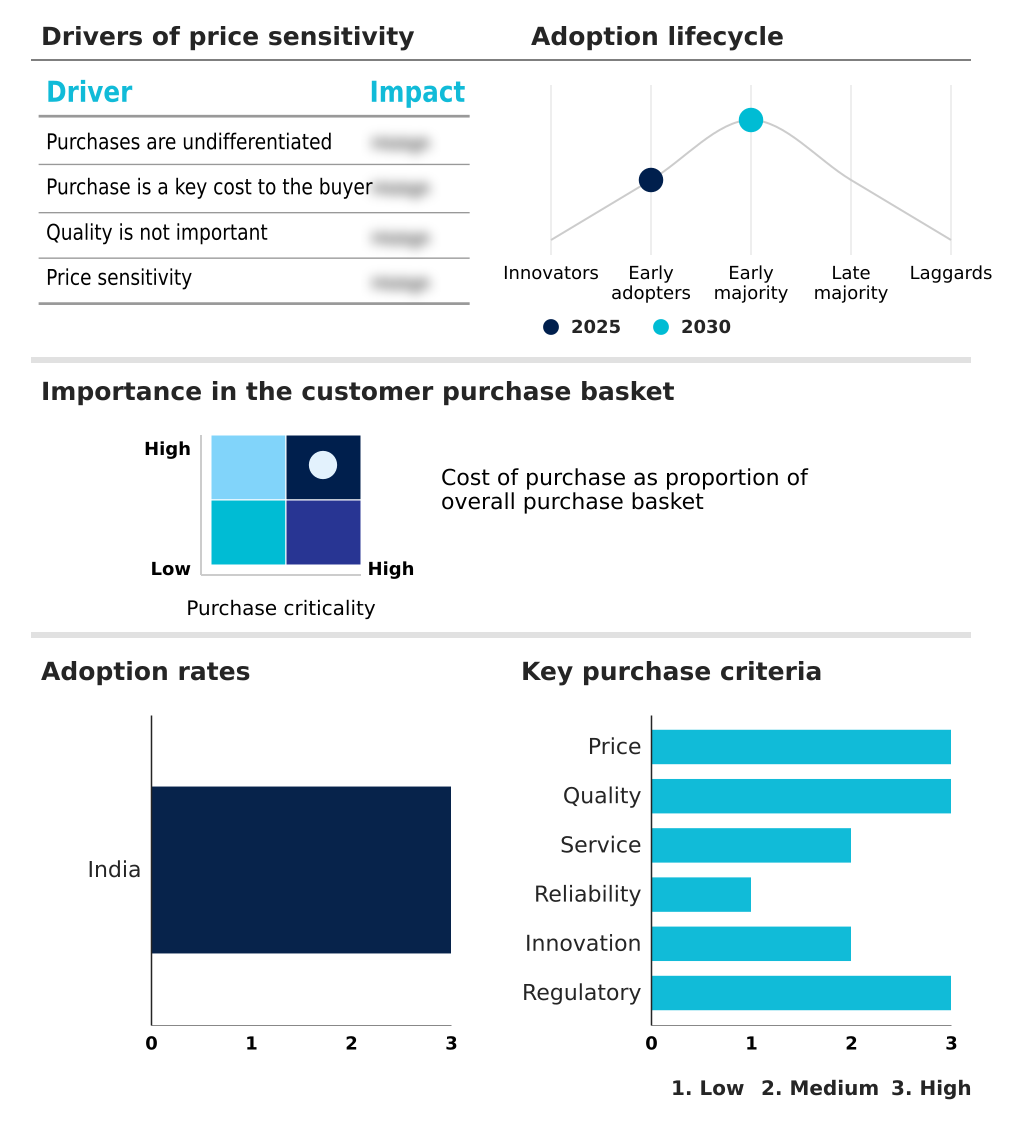
Customer Landscape of India UPS Industry
Competitive Landscape
Companies are implementing various strategies, such as strategic alliances, india ups market forecast, partnerships, mergers and acquisitions, geographical expansion, and product/service launches, to enhance their presence in the industry.
ABB Ltd. - Offers a comprehensive portfolio of power protection solutions engineered for mission-critical industrial, data center, and commercial applications.
The industry research and growth report includes detailed analyses of the competitive landscape of the market and information about key companies, including:
- ABB Ltd.
- Aplab Ltd
- CHAMPION UPS
- Cyber Power Systems Inc.
- Delta Electronics Inc.
- Eaton Corp. Plc
- Fuji Electric Co. Ltd.
- General Electric Co.
- Hewlett Packard
- Hitachi Hi-Rel Power Electronics
- Legrand SA
- Microtek
- Mitsubishi Electric Corp.
- Riello Power India Pvt Ltd
- Schneider Electric SE
- SOCOMEC Group
- Su-Kam Power Systems Ltd
- Uniline Energy India
- V Guard Industries Ltd.
- Vertiv Holdings Co.
Qualitative and quantitative analysis of companies has been conducted to help clients understand the wider business environment as well as the strengths and weaknesses of key industry players. Data is qualitatively analyzed to categorize companies as pure play, category-focused, industry-focused, and diversified; it is quantitatively analyzed to categorize companies as dominant, leading, strong, tentative, and weak.
Recent Development and News in India ups market
- In September 2024, Vertiv Holdings Co. announced a strategic partnership with a leading AI chip designer to co-develop high-density power solutions for next-generation AI data centers in India.
- In November 2024, Delta Electronics Inc. launched its new line of modular, lithium-ion-based three-phase UPS systems, achieving over 97% efficiency and targeting the hyperscale data center market.
- In February 2025, Schneider Electric SE secured a major contract to supply its industrial-grade UPS solutions for the power infrastructure of a new semiconductor fabrication plant in Gujarat.
- In April 2025, Eaton Corp. Plc announced the acquisition of a regional power electronics firm to strengthen its service network and expand its footprint in India's rapidly growing Tier-II and Tier-III cities.
Dive into Technavio’s robust research methodology, blending expert interviews, extensive data synthesis, and validated models for unparalleled India UPS Market insights. See full methodology.
| Market Scope | |
|---|---|
| Page number | 195 |
| Base year | 2025 |
| Historic period | 2020-2024 |
| Forecast period | 2026-2030 |
| Growth momentum & CAGR | Accelerate at a CAGR of 7% |
| Market growth 2026-2030 | USD 550.5 million |
| Market structure | Fragmented |
| YoY growth 2025-2026(%) | 6.8% |
| Key countries | India |
| Competitive landscape | Leading Companies, Market Positioning of Companies, Competitive Strategies, and Industry Risks |
Research Analyst Overview
- The UPS market in India is undergoing a significant technological evolution, compelling a strategic shift in procurement from capital expenditure to total cost of ownership (TCO) models. The transition from legacy valve-regulated lead-acid (VRLA) to advanced lithium-ion batteries is central to this change, influencing system design toward higher power density.
- Architectures are advancing with modular UPS designs that facilitate scalable N+1 redundancy or full 2N redundancy for absolute fault tolerance. The choice between double conversion, line-interactive, or standby systems is now dictated by the criticality of the load, with a pure sine wave output from the inverter being a prerequisite for sensitive electronics.
- Modern systems feature advanced power conditioning, automatic voltage regulation (AVR), and power factor correction. The adoption of eco-mode functionalities can improve energy efficiency by up to 4%, directly impacting operational expenditures. This trend is amplified by the use of silicon carbide and gallium nitride components.
- Furthermore, the integration of an energy storage system (ESS) with a bidirectional converter, along with features like hot-swappable batteries and intelligent power management with remote management, is becoming standard for ensuring uptime and mitigating issues like harmonic distortion.
What are the Key Data Covered in this India UPS Market Research and Growth Report?
-
What is the expected growth of the India UPS Market between 2026 and 2030?
-
USD 550.5 million, at a CAGR of 7%
-
-
What segmentation does the market report cover?
-
The report is segmented by End-user (Non-residential, and Residential), Type (Double conversion, Line-interactive, and Standby), Application (Industrial, Data centers, Telecommunications, Healthcare, and Others) and Geography (APAC)
-
-
Which regions are analyzed in the report?
-
APAC
-
-
What are the key growth drivers and market challenges?
-
Proliferation of data centers and digital infrastructure, Intense price competition and dominance of unorganized sector
-
-
Who are the major players in the India UPS Market?
-
ABB Ltd., Aplab Ltd, CHAMPION UPS, Cyber Power Systems Inc., Delta Electronics Inc., Eaton Corp. Plc, Fuji Electric Co. Ltd., General Electric Co., Hewlett Packard, Hitachi Hi-Rel Power Electronics, Legrand SA, Microtek, Mitsubishi Electric Corp., Riello Power India Pvt Ltd, Schneider Electric SE, SOCOMEC Group, Su-Kam Power Systems Ltd, Uniline Energy India, V Guard Industries Ltd. and Vertiv Holdings Co.
-
Market Research Insights
- The market dynamics are increasingly shaped by the push for digital transformation enablement and operational resilience in areas with less stable power grids. The expansion of financial services has seen a 25% increase in the deployment of IT infrastructure protection in Tier-II cities, driving demand for reliable power quality management.
- As businesses prioritize manufacturing process continuity, investments in high-availability power systems that ensure precision-controlled processes are rising. This focus on industrial power backup solutions is critical, as modern energy-efficient UPS systems can lower operational expenditures by up to 15% compared to legacy equipment.
- Furthermore, the adoption of resilient power infrastructure is a core component of business continuity planning, essential for safeguarding against disruptions and supporting telecommunication power systems and industrial automation power needs.
We can help! Our analysts can customize this india ups market research report to meet your requirements.
 RIA -
RIA - 
