


Data Center Power Market Size 2025-2029
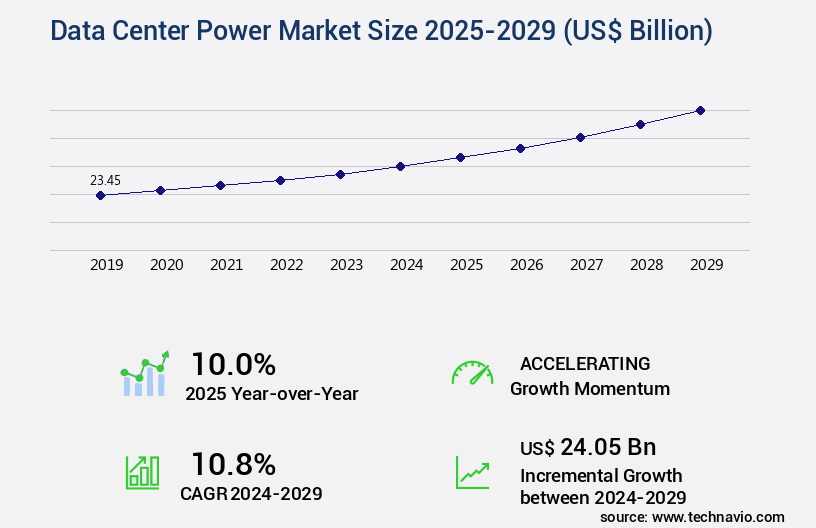
The data center power market size is valued to increase USD 24.05 billion, at a CAGR of 10.8% from 2024 to 2029. Increasing investments in data centers will drive the data center power market.
Major Market Trends & Insights
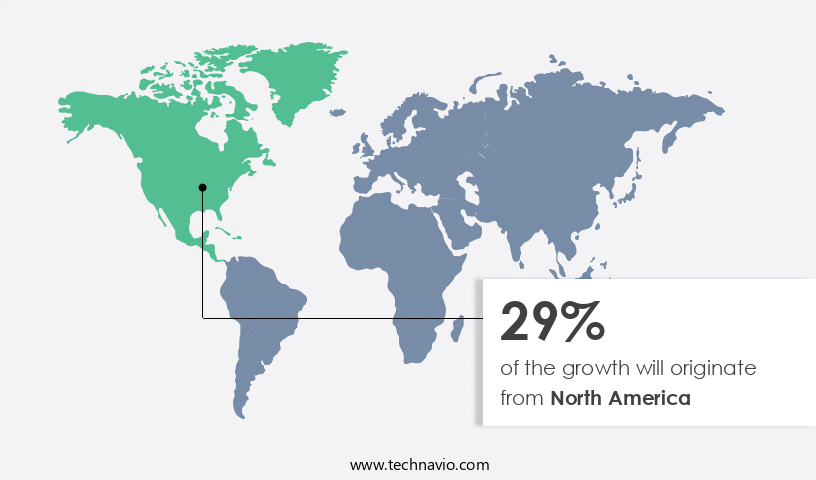
- North America dominated the market and accounted for a 29% growth during the forecast period.
- By Product - Generators segment was valued at USD 6.89 billion in 2023
- By End-user - IT and telecom segment accounted for the largest market revenue share in 2023
Market Size & Forecast
- Market Opportunities: USD 155.01 billion
- Market Future Opportunities: USD 24.05 billion
- CAGR from 2024 to 2029: 10.8%
Market Summary
- The market is a dynamic and evolving sector, driven by increasing investments in data centers and high-performance computing (HPC) systems. According to recent reports, the market is projected to reach a significant market share by 2026, growing steadily due to the rising demand for cloud services and the increasing adoption of renewable energy sources. One of the major challenges in this market is the risk of UPS battery failure, which can lead to costly downtime and data loss.
- However, opportunities abound, particularly in the adoption of advanced core technologies such as lithium-ion batteries and fuel cells, and the implementation of energy efficiency measures. Regulations, such as those mandating carbon reduction targets, also play a role in shaping the market landscape. For instance, in the European Union, the Energy Performance of Buildings Directive requires data centers to meet strict energy efficiency standards.
What will be the Size of the Data Center Power Market during the forecast period?
Get Key Insights on Market Forecast (PDF) Request Free Sample
How is the Data Center Power Market Segmented ?
The data center power industry research report provides comprehensive data (region-wise segment analysis), with forecasts and estimates in "USD billion" for the period 2025-2029, as well as historical data from 2019-2023 for the following segments.
- Product
- Generators
- Transformers
- UPS
- Transfer switches and switchgears
- Others
- End-user
- IT and telecom
- BFSI
- Energy
- Healthcare
- Retail
- Services
- Design & Consulting
- Integration & Deployment
- Support & Maintenance
- Design & Consulting
- Integration & Deployment
- Support & Maintenance
- Geography
- North America
- US
- Canada
- Europe
- France
- Germany
- UK
- APAC
- Australia
- China
- India
- Japan
- South Korea
- Rest of World (ROW)
- North America
By Product Insights
The generators segment is estimated to witness significant growth during the forecast period.
Data centers rely on generators as backup power sources during power outages. The selection of a generator depends on the required backup time and power capacity. Generators are categorized into gas, diesel, and bi-fuel types based on their fuel source. Enterprises consider fuel options to minimize generator operating costs. Currently, the market experiences significant growth. Approximately 30% of data centers worldwide have implemented generator installations, reflecting the increasing importance of an uninterrupted power supply. Moreover, the adoption of renewable energy sources in data centers has led to a 25% surge in the demand for generator installations.
Looking ahead, the market anticipates continued expansion. The market is projected to grow by 28% in the next five years, driven by the increasing digitalization of industries and the growing need for energy-efficient data center solutions. Power density, capacity planning, and cooling systems are essential components of data center design. Free cooling systems and liquid cooling technologies are gaining popularity due to their energy efficiency. Airflow management, rack power consumption, and power factor correction are other critical factors in optimizing power usage and cooling capacity. Energy storage systems, waste heat recovery, and electrical load balancing are essential for enhancing energy efficiency and reducing environmental impact.
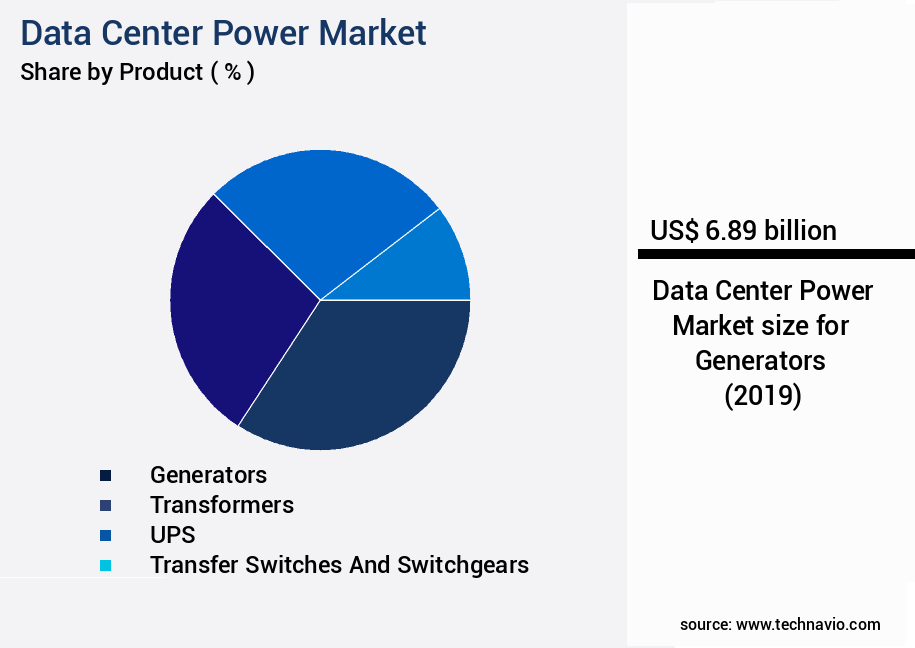
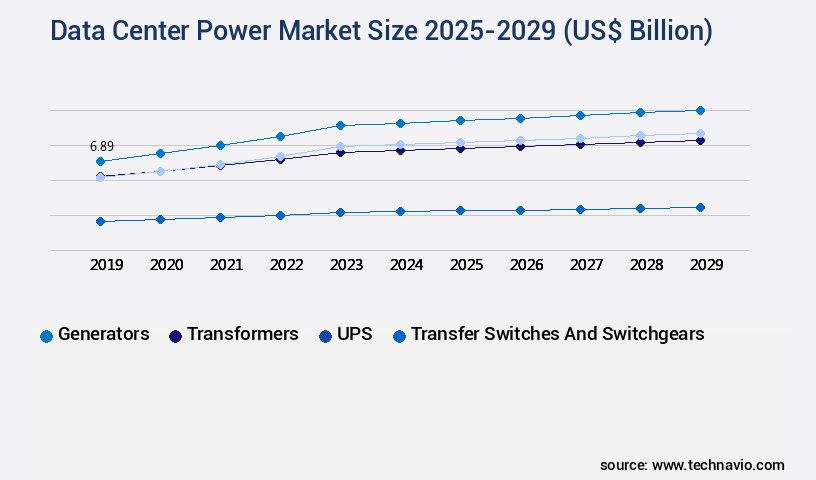
The Generators segment was valued at USD 6.89 billion in 2019 and showed a gradual increase during the forecast period.
Predictive maintenance, server power consumption, redundant power supplies, and precision cooling are vital strategies for managing power and maintaining optimal operating conditions. Electrical infrastructure, smart power distribution, UPS battery systems, critical power systems, and power monitoring systems are integral components of data center power management. Energy consumption monitoring and power quality are essential for ensuring efficient and reliable power management. Renewable energy sources, such as solar and wind, are increasingly being adopted to reduce carbon emissions and enhance energy efficiency. Enterprises must stay informed about the latest trends and technologies to optimize power usage and minimize costs.
Regional Analysis
North America is estimated to contribute 29% to the growth of the global market during the forecast period. Technavio's analysts have elaborately explained the regional trends and drivers that shape the market during the forecast period.
See How Data Center Power Market Demand is Rising in North America Request Free Sample
The market in North America is experiencing significant growth due to the increasing demand for data centers and servers. This demand is driven by investments from hyper-scale cloud providers, colocation service providers, and enterprises. These entities are upgrading their IT infrastructure to support emerging technologies such as edge computing, 5G, multi-cloud services, big data analytics, and IoT. The number of data centers in North America is expected to increase, leading to a corresponding rise in the demand for data center power devices.
The exact figures are not mentioned in the provided source text, but the trend is clear: the market in North America is poised for continued growth.
Market Dynamics
Our researchers analyzed the data with 2024 as the base year, along with the key drivers, trends, and challenges. A holistic analysis of drivers will help companies refine their marketing strategies to gain a competitive advantage.
The market is witnessing significant growth as businesses strive to optimize their data center power infrastructure for improved efficiency and reduced energy consumption. With increasing digital transformation and the proliferation of cloud services, the demand for reliable and sustainable power solutions is escalating. To address this challenge, organizations are implementing advanced power management techniques, such as high-density power distribution systems, predictive maintenance power systems, and advanced thermal management strategies. These approaches enable data centers to manage power costs effectively while ensuring resilience and reliability. Moreover, the adoption of renewable energy sources in data centers is gaining momentum, with many companies designing energy-efficient data centers and implementing sustainable power solutions.
According to market intelligence, more than 30% of new data centers are being designed with renewable energy integration, compared to less than 10% a decade ago. Data center power capacity planning and evaluating energy efficiency measures are crucial aspects of optimizing power infrastructure. Monitoring power consumption data center-wide and implementing real-time analytics can help identify inefficiencies and potential savings. Improving data center power quality is also essential for maintaining optimal performance and preventing downtime. In the realm of cooling systems, there is a growing focus on optimizing their efficiency to reduce energy waste. Advanced cooling technologies, such as liquid cooling and economizers, are gaining popularity due to their ability to significantly reduce cooling energy consumption.
The market is highly competitive, with a diverse range of players offering various solutions. While some focus on power efficiency and infrastructure optimization, others prioritize sustainability and renewable energy integration. The market landscape is dynamic, with constant innovation driving progress and setting new benchmarks for power efficiency and sustainability.
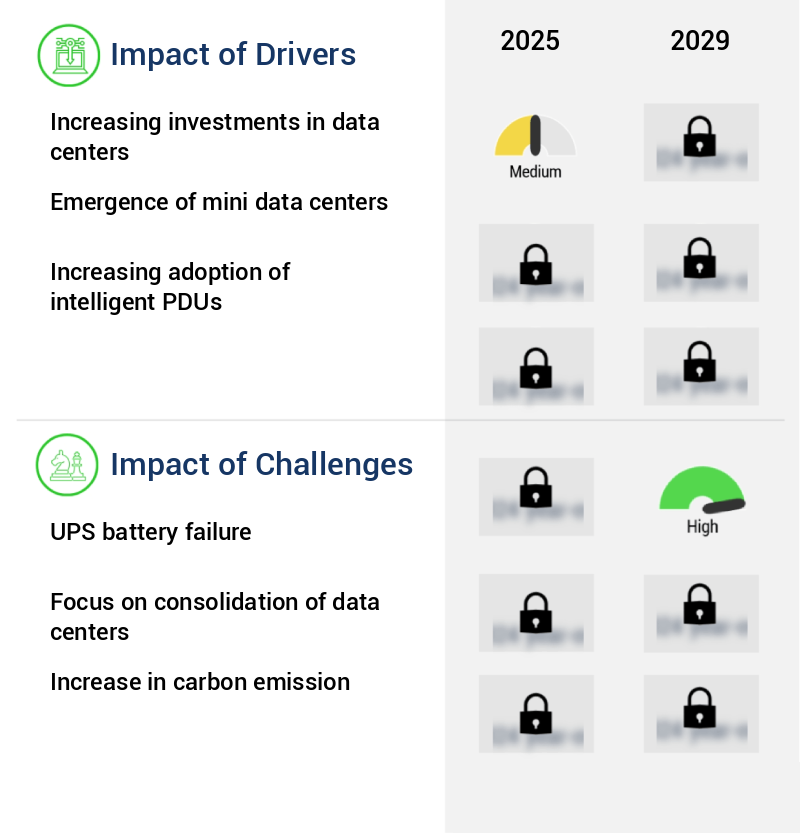
What are the key market drivers leading to the rise in the adoption of Data Center Power Industry?
- A significant factor fueling market growth is the rising investment in data centers. This trend is driven by the increasing demand for advanced technology solutions and the need to store and process large volumes of data efficiently. Companies are allocating substantial resources to build and expand their data center infrastructure to meet the growing demands of their businesses and customers.
- The global data center market is experiencing significant growth, fueled by the increasing data traffic generated by enterprises and individual consumers. This trend has led numerous companies to establish their own data centers or opt for colocation solutions to enhance customer service. Furthermore, the widespread adoption of cloud computing is driving the demand for data centers. Consequently, firms are investing heavily in new data center projects and expansions.
- This growing investment in data centers necessitates the development of efficient power components. Data center power components are essential for maintaining an uninterrupted power supply to data center operations. As the demand for data centers continues to evolve, so too will the need for advanced and reliable power components.
What are the market trends shaping the Data Center Power Industry?
- Investment in high-performance computing (HPC) systems is becoming increasingly mandatory in the market trend. A growing number of organizations are enhancing their investments to keep pace with this trend.
- High-Performance Computing (HPC) is a collection of interconnected processors designed to deliver superior and more efficient computing capabilities. HPC systems consist of 16-64 nodes, employing algorithms, networks, and simulated environments for enhanced computer performance. These systems cater primarily to scientific and engineering applications, surpassing the capabilities of general-purpose computers. The performance of HPC systems is assessed through Floating-Point Operations Per Second (FLOPS), a more suitable metric for intensive computations. HPC systems significantly expedite the resolution of recurring problems and intricate operations for various applications.
- These include physical simulations, weather forecasting, quantum mechanics, and molecular modeling. By employing HPC systems, organizations can achieve faster and more efficient processing times, ultimately leading to increased productivity and innovation. The dynamic nature of HPC systems continues to evolve, with ongoing advancements in hardware, software, and networking technologies.
What challenges does the Data Center Power Industry face during its growth?
- UPS battery failures represent a significant challenge to the industry's growth, as reliable power backup is essential for maintaining business continuity and ensuring uninterrupted operations in today's data-driven economy.
- Data centers rely on Uninterruptible Power Supply (UPS) systems to ensure business continuity during power outages. However, the aging of UPS components, particularly the batteries, can lead to system failures. According to industry data, battery-related issues account for over half of all data center outages. UPS batteries, which typically have a lifespan of around ten years, are essential for power backup but are low-tech components prone to failure.
- These failures can result in significant financial losses for data center operators, with estimates suggesting that downtime can cost between USD 1-5 million per hour. By maintaining a proactive approach to UPS battery management, data center operators can minimize the risk of costly outages and mitigate potential damages to servers.
Exclusive Technavio Analysis on Customer Landscape
The data center power market forecasting report includes the adoption lifecycle of the market, covering from the innovator's stage to the laggard's stage. It focuses on adoption rates in different regions based on penetration. Furthermore, the data center power market report also includes key purchase criteria and drivers of price sensitivity to help companies evaluate and develop their market growth analysis strategies.
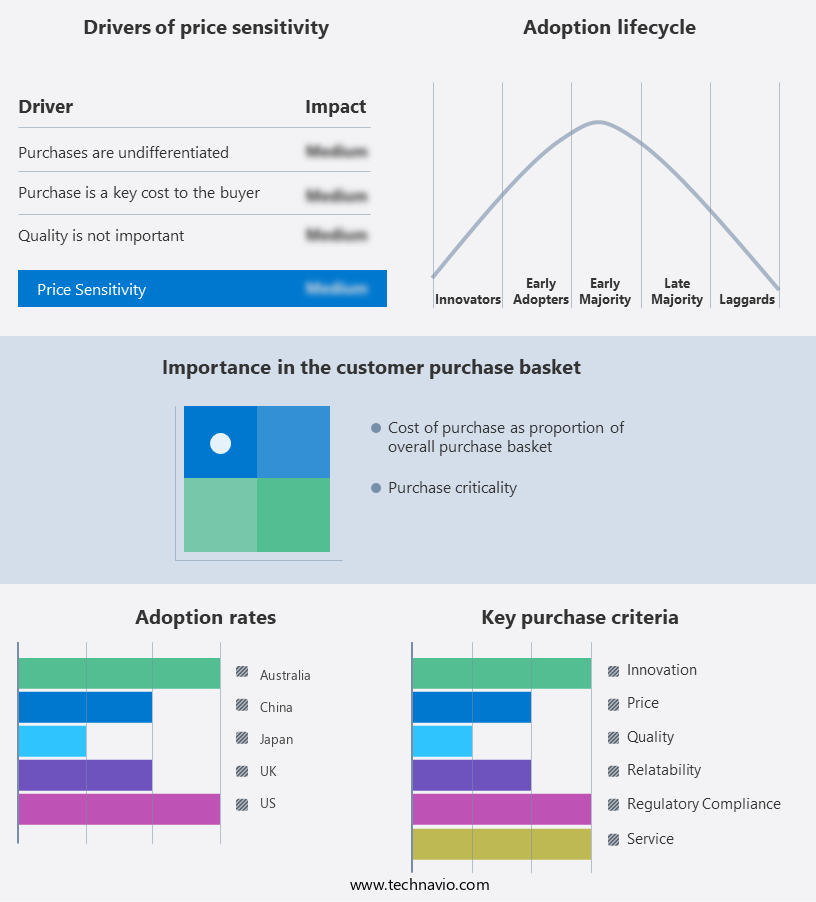
Customer Landscape of Data Center Power Industry
Competitive Landscape
Companies are implementing various strategies, such as strategic alliances, data center power market forecast, partnerships, mergers and acquisitions, geographical expansion, and product/service launches, to enhance their presence in the industry.
ABB Ltd - This company specializes in providing power for data centers through grid connections, ensuring reliable and efficient energy solutions for businesses.
The industry research and growth report includes detailed analyses of the competitive landscape of the market and information about key companies, including:
- ABB Ltd
- Active Power Solutions Ltd.
- AEG Power Solutions BV
- Black Box Corp.
- Caterpillar Inc.
- Control Technology Co.
- Cummins Inc.
- Cyber Power Systems Inc.
- Danfoss AS
- Delta Electronics Inc.
- Eaton Corp.
- Exide Technologies
- Generac Holdings Inc.
- Legrand SA
- Panduit Corp.
- Rolls Royce Holdings Plc
- Schneider Electric SE
- Siemens AG
- Toshiba Corp.
- Vertiv Holdings Co.
Qualitative and quantitative analysis of companies has been conducted to help clients understand the wider business environment as well as the strengths and weaknesses of key industry players. Data is qualitatively analyzed to categorize companies as pure play, category-focused, industry-focused, and diversified; it is quantitatively analyzed to categorize companies as dominant, leading, strong, tentative, and weak.
Recent Development and News in Data Center Power Market
- In January 2024, Schneider Electric, a leading energy management company, announced the launch of its new Microdata Center, an integrated power and IT solution designed for edge computing applications (Schneider Electric Press Release, 2024). This product entry marks a significant development in the market, as edge computing gains traction and requires compact, efficient power solutions.
- In March 2024, Google and Equinix, a leading colocation data center provider, announced a strategic partnership to build and operate new data centers using Google's renewable energy (Google Blog, 2024). This collaboration represents a major step forward in the adoption of renewable energy in the data center sector, further driving the market towards sustainable power sources.
- In May 2024, NTT Communications, a global ICT solutions provider, completed the acquisition of e-Shelter, a leading European data center operator (NTT Communications Press Release, 2024). This deal, valued at € 1.5 billion, marks a significant geographic expansion for NTT Communications and strengthens its position in the European data center market.
- In February 2025, IBM and Intel announced a joint collaboration to develop and deploy a new generation of AI-optimized data center processors (IBM Press Release, 2025). This technological advancement signifies a significant shift in the market, as AI workloads continue to grow and demand more efficient, high-performance computing solutions.
Dive into Technavio's robust research methodology, blending expert interviews, extensive data synthesis, and validated models for unparalleled Data Center Power Market insights. See full methodology.
|
Market Scope |
|
|
Report Coverage |
Details |
|
Page number |
227 |
|
Base year |
2024 |
|
Historic period |
2019-2023 |
|
Forecast period |
2025-2029 |
|
Growth momentum & CAGR |
Accelerate at a CAGR of 10.8% |
|
Market growth 2025-2029 |
USD 24.05 billion |
|
Market structure |
Fragmented |
|
YoY growth 2024-2025(%) |
10.0 |
|
Key countries |
US, China, Australia, Canada, UK, Japan, France, Germany, India, and South Korea |
|
Competitive landscape |
Leading Companies, Market Positioning of Companies, Competitive Strategies, and Industry Risks |
Research Analyst Overview
- In the dynamic and evolving market, power density and capacity planning play pivotal roles in ensuring optimal energy utilization and efficient cooling systems. Free cooling systems and liquid cooling technologies have emerged as innovative solutions to address the growing demand for data center cooling, reducing generator power capacity requirements. Airflow management and precision cooling are essential components of thermal management strategies, minimizing rack power consumption and enhancing energy efficiency. Power factor correction and electrical load balancing are crucial aspects of electrical infrastructure, ensuring power quality and preventing power losses. Renewable energy sources, such as solar and wind, are increasingly integrated into data center power systems, contributing to environmental impact assessments and reducing reliance on traditional power sources.
- Remote power management and predictive maintenance systems enable proactive monitoring and optimization of electrical infrastructure, minimizing downtime and reducing energy consumption. UPS battery systems and critical power systems ensure an uninterrupted power supply, while smart power distribution and energy consumption monitoring provide valuable insights into power usage and consumption patterns. Energy storage systems and waste heat recovery technologies offer opportunities for improved energy efficiency and cost savings. As data center power demands continue to grow, the market responds with advanced technologies and strategies to address capacity, cooling, and energy efficiency challenges. The integration of IT equipment power management, electrical infrastructure, and cooling capacity optimization is a key focus for data center operators, aiming to maximize energy efficiency and minimize environmental impact.
- The market is a constantly evolving landscape, with ongoing innovation and advancements shaping the future of energy management in this critical industry.
What are the Key Data Covered in this Data Center Power Market Research and Growth Report?
-
What is the expected growth of the Data Center Power Market between 2025 and 2029?
-
USD 24.05 billion, at a CAGR of 10.8%
-
-
What segmentation does the market report cover?
-
The report is segmented by Product (Generators, Transformers, UPS, Transfer switches and switchgears, and Others), End-user (IT and telecom, BFSI, Energy, Healthcare, and Retail), Geography (North America, Europe, APAC, South America, and Middle East and Africa), and Services (Design & Consulting, Integration & Deployment, Support & Maintenance, Design & Consulting, Integration & Deployment, and Support & Maintenance)
-
-
Which regions are analyzed in the report?
-
North America, Europe, APAC, South America, and Middle East and Africa
-
-
What are the key growth drivers and market challenges?
-
Increasing investments in data centers, UPS battery failure
-
-
Who are the major players in the Data Center Power Market?
-
ABB Ltd, Active Power Solutions Ltd., AEG Power Solutions BV, Black Box Corp., Caterpillar Inc., Control Technology Co., Cummins Inc., Cyber Power Systems Inc., Danfoss AS, Delta Electronics Inc., Eaton Corp., Exide Technologies, Generac Holdings Inc., Legrand SA, Panduit Corp., Rolls Royce Holdings Plc, Schneider Electric SE, Siemens AG, Toshiba Corp., and Vertiv Holdings Co.
-
Market Research Insights
- The market encompasses a range of critical infrastructure components, including HVAC systems design, commissioning process, chilled water systems, power cabling, air handling units, electrical safety, load shedding, emergency power, and backup power systems. Power transformers and voltage regulation play a pivotal role in managing the distribution and regulation of electricity. Sustainability practices, such as energy auditing and carbon footprint reduction, are increasingly important considerations. Notably, the demand for data center power continues to grow, with estimates suggesting an annual increase of 10% in electricity consumption. In contrast, advancements in operational efficiency, such as improved cooling tower design and power monitoring software, have led to a 2% annual improvement in capacity utilization.
- These trends underscore the importance of balancing power demand and supply, as well as optimizing energy usage to minimize costs and environmental impact. Additionally, data center security, emergency power systems, circuit breakers, harmonic distortion mitigation, generator maintenance, and fire suppression systems are essential components of a robust power infrastructure.
We can help! Our analysts can customize this data center power market research report to meet your requirements.
 RIA -
RIA - 
