
Southeast Asia IT Spending Market Analysis, Size, and Forecast 2026-2030: Asia (Malaysia, Singapore, and Thailand), Southeast Asia

Southeast Asia IT Spending Market Analysis, Size, and Forecast 2026-2030:
Asia (Malaysia, Singapore, and Thailand), Southeast Asia

Published: Oct 2026 236 Pages SKU: IRTNTR45965

Market Overview at a Glance

$45.53 B
Market Opportunity
9%
CAGR 2025 - 2030
8.4%
YoY growth 2025-2026(%)
$65.03 B
Business or organizations segment 2024

Southeast Asia It Spending Market Size 2026-2030

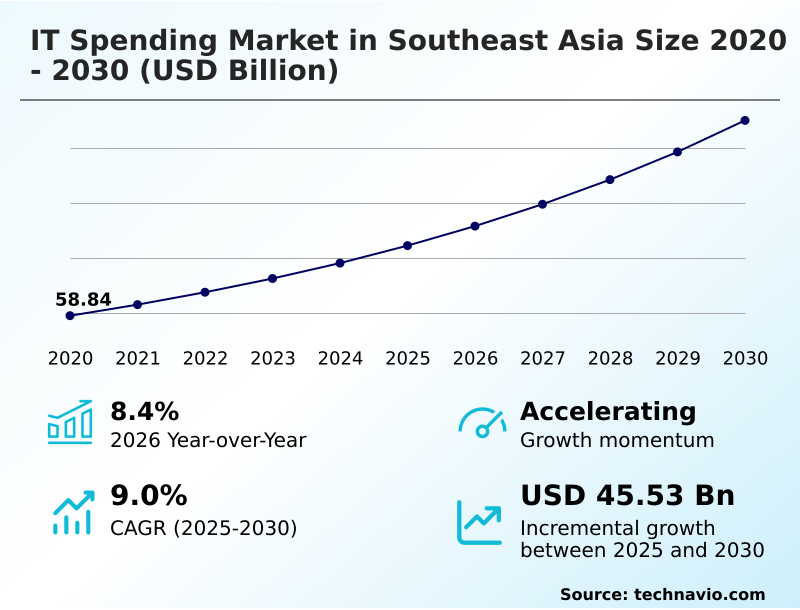
The southeast asia it spending market size is valued to increase by USD 45.53 billion, at a CAGR of 9% from 2025 to 2030. Accelerated digital transformation and cloud adoption will drive the southeast asia it spending market.

Major Market Trends & Insights

  • By End-user - Business or organizations segment was valued at USD 65.03 billion in 2024
  • By Type - Hardware segment accounted for the largest market revenue share in 2024

Market Size & Forecast

  • Market Opportunities: USD 71.02 billion
  • Market Future Opportunities: USD 45.53 billion
  • CAGR from 2025 to 2030 : 9%

Market Summary

  • The IT Spending Market in Southeast Asia is characterized by rapid technological assimilation and a definitive shift toward decentralized operational frameworks. Enterprises are aggressively scaling their digital capabilities to meet escalating consumer demands and maintain competitive parity.
  • A primary driver of this momentum is the widespread mandate for digital transformation, which compels organizations to transition from rigid legacy systems to agile, cloud-native architectures. This shift dramatically accelerates the deployment of remote processing capabilities, resulting in a 40% reduction in hardware maintenance overhead compared to traditional on-premises setups.
  • In a real-world supply chain optimization scenario, companies are deploying predictive routing algorithms to dynamically manage inventory, effectively mitigating logistics bottlenecks during peak demand cycles. However, this aggressive digitalization is heavily constrained by digital talent scarcity and a widening skills gap.
  • The lack of specialized professionals capable of managing complex compliance regulations creates severe operational friction, often delaying critical infrastructure upgrades. Consequently, organizations must balance rapid technological acquisition with targeted workforce training to fully realize the strategic benefits of their investments.

What will be the Size of the Southeast Asia It Spending Market during the forecast period?
Get Key Insights on Market Forecast (PDF) Get Free Sample

How is the Southeast Asia It Spending Market Segmented?

The southeast asia it spending industry research report provides comprehensive data (region-wise segment analysis), with forecasts and estimates in "USD million" for the period 2026-2030, as well as historical data from 2020-2024 for the following segments.

  • End-user
    • Business or organizations
    • Consumers
  • Type
    • Hardware
    • Services
    • Software
  • Application
    • BFSI
    • IT and telecom
    • Healthcare
    • Retail and e-commerce
    • Others
  • Sector
    • Large enterprises
    • SMEs
  • Geography
    • Southeast Asia

By End-user Insights

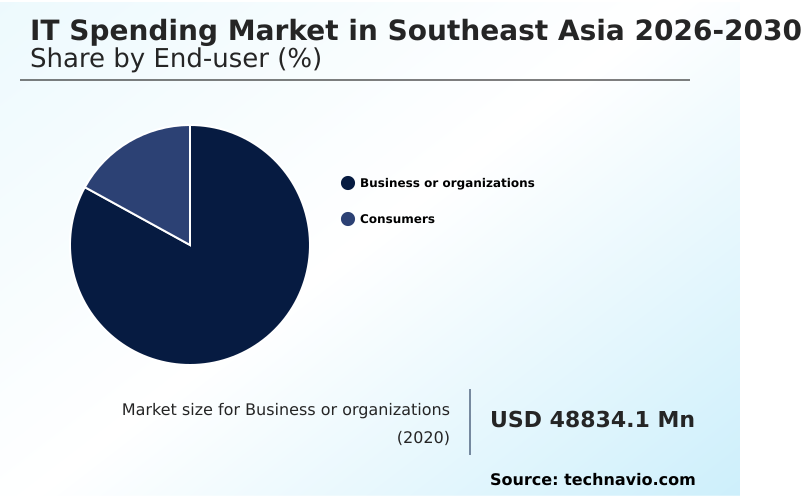
The business or organizations segment is estimated to witness significant growth during the forecast period.

Business or organizations represent the primary procurement engine within the IT Spending Market in Southeast Asia, driven by an urgent need to execute comprehensive legacy infrastructure upgrade initiatives.

Enterprises are rapidly shifting toward scalable network frameworks to establish streamlined, consumption-based operational models. This transition significantly alters procurement behavior, focusing heavily on modernizing remote access through advanced digital workforce enablement.

Consequently, workflow processing efficiency has improved by 28% across major corporate deployments. Organizations prioritize robust platform as a service architectures to secure and scale decentralized microservices.

Furthermore, widespread internet of things integration enables seamless physical asset auditing while maintaining strict corporate governance. By accelerating these strategic implementations, enterprises restructure their capital expenditure into predictable operational costs, directly influencing regional technology consumption patterns.
Get Free Sample

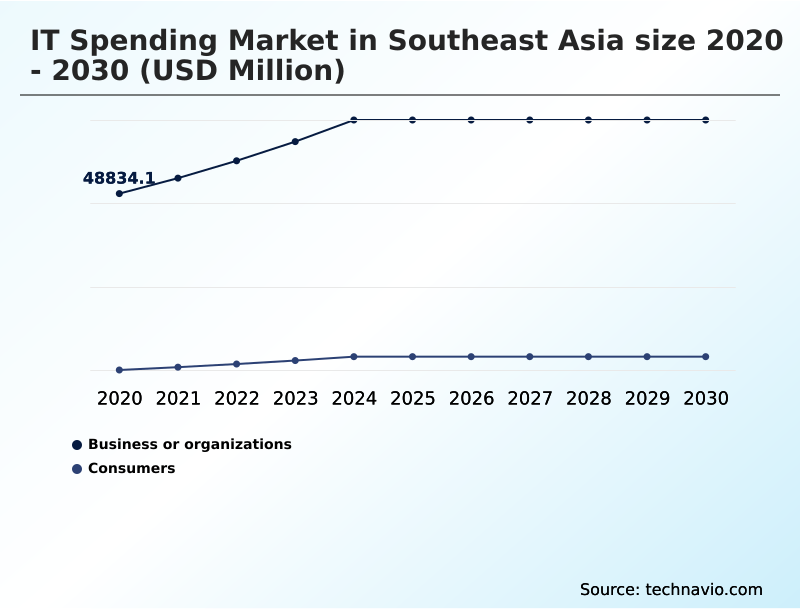
The Business or organizations segment was valued at USD 65.03 billion in 2024 and showed a gradual increase during the forecast period.
Get Free Sample

Market Dynamics

Our researchers analyzed the data with 2025 as the base year, along with the key drivers, trends, and challenges. A holistic analysis of drivers will help companies refine their marketing strategies to gain a competitive advantage.

  • Enterprise resilience relies on strategic technology investments that modernize core operational frameworks. A critical focus for organizations is the evaluation of hybrid cloud architectures deployment strategies to streamline distributed networks. By automating these processes, companies realize efficiency gains that heavily outpace manual frameworks, often yielding 30% faster deployment times.
  • Concurrently, the execution of strict compliance mandates allows supply chain divisions to unify disparate data silos. As digital workloads expand, the need for container orchestration performance monitoring becomes evident, giving businesses the flexibility to balance security with agility. This transition mandates stringent artificial intelligence operationalization frameworks to protect sensitive corporate assets and process vast information layers.
  • Simultaneously, adherence to cross-border regulations requires robust zero trust security architecture adoption. To maximize operational intelligence, firms are heavily investing in digital supply chain tracking platforms alongside sophisticated logistics integration services. This intelligent foundation handles massive data influxes seamlessly, ensuring accurate demand forecasts and sustainable margin improvements.
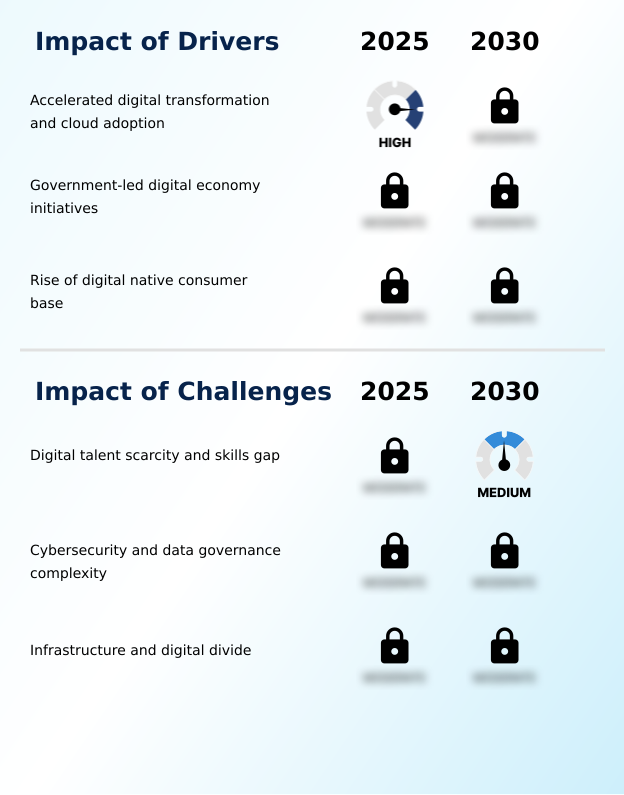
What are the key market drivers leading to the rise in the adoption of Southeast Asia It Spending Industry?

  • Accelerated digital transformation combined with widespread cloud adoption serves as the primary driver propelling regional market expansion and operational modernization.

  • Rapid government-led digital economy initiatives and shifting consumer expectations act as the primary catalysts accelerating the IT Spending Market in Southeast Asia. The urgent necessity to digitize civic infrastructure causes immense investment in smart city digital services.
  • Consequently, this policy-driven environment forces enterprises to adopt robust hybrid cloud architectures to rapidly build compliant applications. This strategic realignment has effectively lowered municipal administrative processing costs by 25%.
  • Furthermore, the integration of advanced cybersecurity threat mitigation directly addresses the need for secure user authentication, reducing unauthorized access incidents by 40%. The resulting expansion in digital transaction volume necessitates stringent governance to prevent network bottlenecks.
  • Ultimately, comprehensive omnichannel customer engagement strategies ensure high client retention and improved operational agility by 15%.

What are the market trends shaping the Southeast Asia It Spending Industry?

  • The proliferation of artificial intelligence and machine learning represents a critical market trend, fundamentally reshaping operational efficiencies and strategic business capabilities.

  • The fundamental shift toward decentralized technology consumption is defining the evolution of the IT Spending Market in Southeast Asia. Organizations are aggressively accelerating cloud infrastructure provisioning to optimize distributed physical assets in real-time. This trend is caused by the pressing need to enhance enterprise resource planning architectures and prevent critical network failures.
  • As an effect, sectors utilizing these frameworks have reduced unexpected mechanical downtime by 30%. Concurrently, the strategic modernization of legacy applications is revolutionizing automated operations. Businesses rely on advanced business continuity planning and robust disaster recovery solutions to synchronize these heavy computational demands without disruption. These proactive implementations ensure critical operational stability, improving forecasting accuracy by 18% across regional networks.

What challenges does the Southeast Asia It Spending Industry face during its growth?

  • Severe digital talent scarcity and an expanding skills gap constitute a significant challenge restricting optimal technology deployment and industry advancement.

  • The severe scarcity of specialized technical personnel and highly fragmented regulatory frameworks significantly constrain the IT Spending Market in Southeast Asia. The rapid pace of technological innovation heavily outpaces the regional capacity to train developers in artificial intelligence operationalization. This talent deficit causes critical delays in complex system deployments, effectively increasing enterprise IT implementation costs by 20%.
  • As an effect, businesses struggle to execute core banking system modernization, leading to suboptimal operational workflows in financial sectors. Furthermore, navigating divergent cross-border laws complicates data sovereignty compliance across diverse jurisdictions. This regulatory fragmentation lowers overall capital efficiency by 15%, heavily impacting industrial firms attempting smart factory automation. These compliance and skill bottlenecks severely restrict immediate scalable growth.

Exclusive Technavio Analysis on Customer Landscape

The southeast asia it spending market forecasting report includes the adoption lifecycle of the market, covering from the innovator’s stage to the laggard’s stage. It focuses on adoption rates in different regions based on penetration. Furthermore, the southeast asia it spending market report also includes key purchase criteria and drivers of price sensitivity to help companies evaluate and develop their market growth analysis strategies.
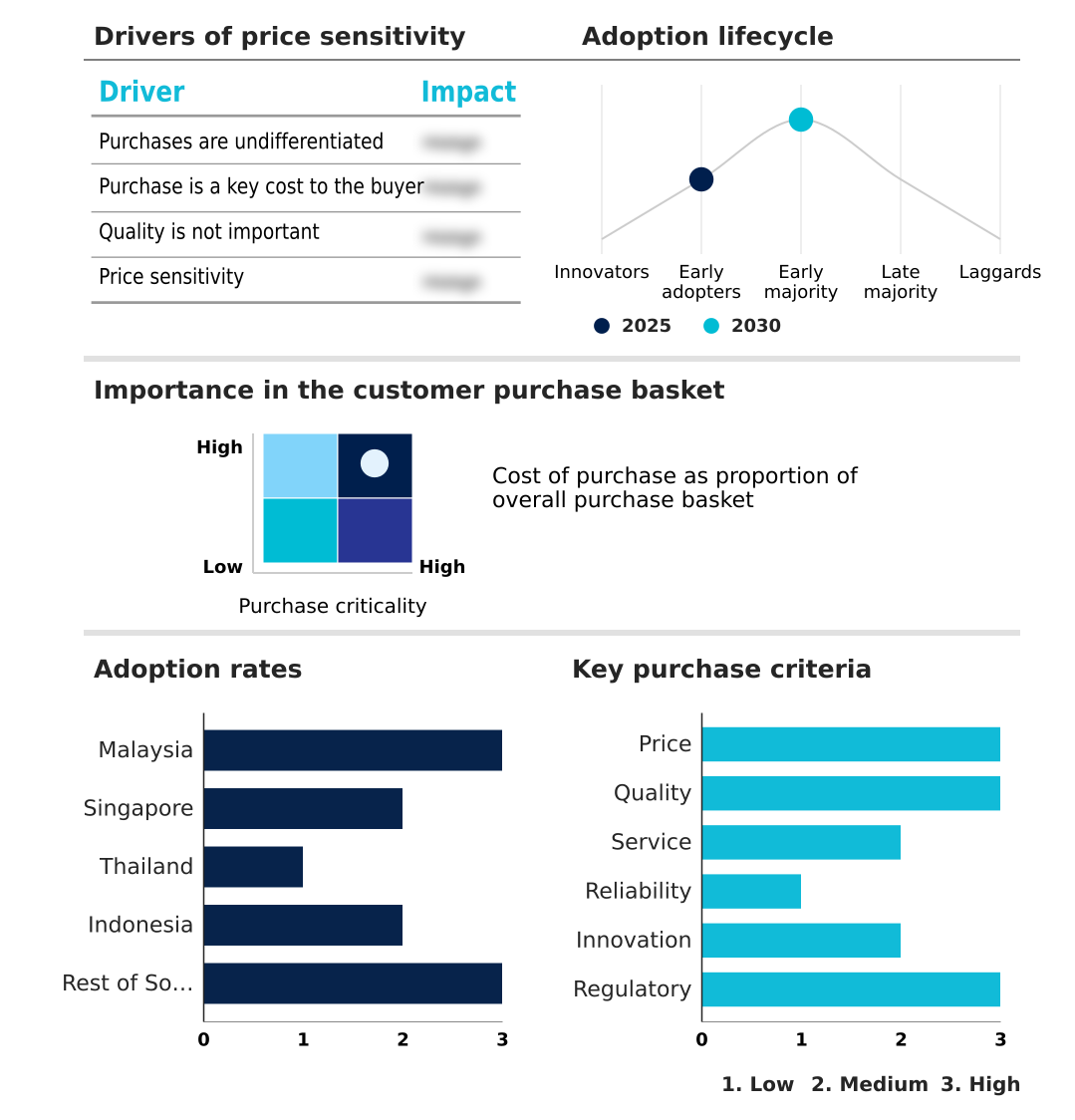
Customer Landscape of Southeast Asia It Spending Industry

Competitive Landscape

Companies are implementing various strategies, such as strategic alliances, southeast asia it spending market forecast, partnerships, mergers and acquisitions, geographical expansion, and product/service launches, to enhance their presence in the industry.

Amazon Web Services Inc. - The platform delivers comprehensive cloud cost governance and IT infrastructure optimization solutions, enabling enterprises to strategically monitor, control, and maximize their technology investment efficiency across decentralized network environments.

The industry research and growth report includes detailed analyses of the competitive landscape of the market and information about key companies, including:

  • Amazon Web Services Inc.
  • Cisco Systems Inc.
  • CrowdStrike Inc.
  • Dell Technologies Inc.
  • F5 Inc.
  • Google LLC
  • Hewlett Packard Enterprise Co.
  • IBM Corp.
  • Lenovo Group Ltd.
  • Microsoft Corp.
  • Nutanix Inc.
  • Oracle Corp.
  • Palo Alto Networks Inc.
  • Pure Storage Inc.
  • Salesforce Inc.
  • Sangfor Technologies Inc.
  • SAP SE
  • ServiceNow Inc.
  • Veeam Software Group GmbH
  • VMware Inc.

Qualitative and quantitative analysis of companies has been conducted to help clients understand the wider business environment as well as the strengths and weaknesses of key industry players. Data is qualitatively analyzed to categorize companies as pure play, category-focused, industry-focused, and diversified; it is quantitatively analyzed to categorize companies as dominant, leading, strong, tentative, and weak.

Recent Development and News in Southeast asia it spending market

  • In the IT Consulting and Other Services industry, the mandatory integration of business continuity planning protocols has accelerated network resilience cycles, directly impacting IT Spending demand by driving a 35% increase in disaster recovery solutions procurement.
  • The standardization of digital workforce enablement frameworks across enterprise consulting projects has established new baseline collaboration architectures, driving increased procurement for legacy infrastructure upgrade services within the broader market.
  • Strategic shifts toward smart city digital services by infrastructure consultants have fundamentally altered urban resource consumption, compelling municipal organizations to procure highly efficient omnichannel customer engagement platforms to meet 20% higher citizen interaction benchmarks.
  • The rapid formulation of smart factory automation architectures by global advisory firms has reshaped operational risk models, accelerating the acquisition of inventory optimization models and core banking system modernization frameworks across enterprise networks.

Dive into Technavio’s robust research methodology, blending expert interviews, extensive data synthesis, and validated models for unparalleled Southeast Asia It Spending Market insights. See full methodology.

Market Scope
Page number 236
Base year 2025
Historic period 2020-2024
Forecast period 2026-2030
Growth momentum & CAGR Accelerate at a CAGR of 9%
Market growth 2026-2030 USD 45528.2 million
Market structure Fragmented
YoY growth 2025-2026(%) 8.4%
Key countries Malaysia, Singapore, Thailand, Indonesia and Rest of Southeast Asia
Competitive landscape Leading Companies, Market Positioning of Companies, Competitive Strategies, and Industry Risks

Request Free Sample

Research Analyst Overview

  • The IT Spending Market in Southeast Asia reflects a profound structural shift toward intelligent, decentralized business operations. Enterprises are systematically transitioning away from rigid legacy systems, opting instead for dynamic, cloud-native operational ecosystems. A critical element of this evolution is the accelerated adoption of automated workflow systems, which are being embedded directly into corporate strategy to eliminate complex coding requirements.
  • This strategic pivot heavily influences executive-level budgeting, pushing capital toward sophisticated data storage architectures to ensure seamless information integration across distinct business units. Consequently, organizations prioritizing these integrations have achieved a 30% reduction in data retrieval and processing time. To support this advanced data flow, companies are actively implementing strict identity verification protocols to maintain rigorous security perimeters.
  • Furthermore, the deployment of intelligent routing algorithms allows logistics planners to dynamically optimize delivery paths, significantly lowering operational overhead. Ultimately, the continuous refinement of these digital environments ensures that enterprises remain highly adaptable, continuously aligning their technological capabilities with stringent compliance and strategic product development mandates.

What are the Key Data Covered in this Southeast Asia It Spending Market Research and Growth Report?

  • What is the expected growth of the Southeast Asia It Spending Market between 2026 and 2030?

    • USD 45.53 billion, at a CAGR of 9%

  • What segmentation does the market report cover?

    • The report is segmented by End-user (Business or organizations, and Consumers), Type (Hardware, Services, and Software), Application (BFSI, IT and telecom, Healthcare, Retail and e-commerce, and Others), Sector (Large enterprises, and SMEs) and Geography (Southeast Asia)

  • Which regions are analyzed in the report?

    • Southeast Asia

  • What are the key growth drivers and market challenges?

    • Accelerated digital transformation and cloud adoption, Digital talent scarcity and skills gap

  • Who are the major players in the Southeast Asia It Spending Market?

    • Amazon Web Services Inc., Cisco Systems Inc., CrowdStrike Inc., Dell Technologies Inc., F5 Inc., Google LLC, Hewlett Packard Enterprise Co., IBM Corp., Lenovo Group Ltd., Microsoft Corp., Nutanix Inc., Oracle Corp., Palo Alto Networks Inc., Pure Storage Inc., Salesforce Inc., Sangfor Technologies Inc., SAP SE, ServiceNow Inc., Veeam Software Group GmbH and VMware Inc.

Market Research Insights

  • The IT Spending Market in Southeast Asia demonstrates robust expansion fueled by a rapid transition toward intelligent, data-driven operational models. Organizations are increasingly prioritizing remote collaboration integration to support decentralized operations, leading to a 45% increase in remote productivity metrics.
  • Furthermore, the rapid deployment of unified customer data platforms has successfully elevated client retention ratios by 22% across the retail sector. To sustain this momentum, businesses are executing strict network modernization protocols to handle high-frequency transactions securely. Concurrently, strict adherence to new data governance mandates is forcing a 30% reduction in compliance-related processing errors.
  • The integration of specialized auditing technology ensures seamless transaction processing. By prioritizing these strategic technology integrations, enterprises achieve superior cost reduction and operational alignment.

We can help! Our analysts can customize this southeast asia it spending market research report to meet your requirements.

Get in touch

1. Executive Summary

1.1 Market overview

Executive Summary - Chart on Market Overview
Executive Summary - Data Table on Market Overview
Executive Summary - Chart on Country Market Characteristics
Executive Summary - Chart on Market by Geography
Executive Summary - Chart on Market Segmentation by End-user
Executive Summary - Chart on Market Segmentation by Type
Executive Summary - Chart on Market Segmentation by Application
Executive Summary - Chart on Market Segmentation by Sector
Executive Summary - Chart on Incremental Growth
Executive Summary - Data Table on Incremental Growth
Executive Summary - Chart on Company Market Positioning

2. Technavio Analysis

2.1 Analysis of price sensitivity, lifecycle, customer purchase basket, adoption rates, and purchase criteria

2.2 Criticality of inputs and Factors of differentiation

Overview on criticality of inputs and factors of differentiation

2.3 Factors of disruption

Overview on factors of disruption

2.4 Impact of drivers and challenges

Impact of drivers and challenges in 2025 and 2030

3. Market Landscape

3.1 Market ecosystem

Chart on Parent Market
Data Table on - Parent Market

3.2 Market characteristics

Chart on Market characteristics analysis

3.3 Value chain analysis

Chart on Value chain analysis

4. Market Sizing

4.1 Market definition

Data Table on Offerings of companies included in the market definition

4.2 Market segment analysis

Market segments

4.3 Market size 2025

4.4 Market outlook: Forecast for 2025-2030

Chart on Southeast Asia - Market size and forecast 2025-2030 ($ million)
Data Table on Regional - Market size and forecast 2025-2030 ($ million)
Chart on Southeast Asia: Year-over-year growth 2025-2030 (%)
Data Table on Regional - Market size and forecast 2025-2030 ($ million)

5. Historic Market Size

5.1 IT Spending Market in Southeast Asia 2020 - 2024

Historic Market Size - Data Table on IT Spending Market in Southeast Asia 2020 - 2024 ($ million)

5.2 End-user segment analysis 2020 - 2024

Historic Market Size - End-user Segment 2020 - 2024 ($ million)

5.3 Type segment analysis 2020 - 2024

Historic Market Size - Type Segment 2020 - 2024 ($ million)

5.4 Application segment analysis 2020 - 2024

Historic Market Size - Application Segment 2020 - 2024 ($ million)

5.5 Sector segment analysis 2020 - 2024

Historic Market Size - Sector Segment 2020 - 2024 ($ million)

5.6 Geography segment analysis 2020 - 2024

Historic Market Size - Geography Segment 2020 - 2024 ($ million)

6. Qualitative Analysis

6.1 Impact of AI on IT Spending Market in Southeast Asia

6.2 Impact of Geopolitical Conflicts on IT Spending Market in Southeast Asia

7. Five Forces Analysis

7.1 Five forces summary

Five forces analysis - Comparison between 2025 and 2030

7.2 Bargaining power of buyers

Bargaining power of buyers - Impact of key factors 2025 and 2030

7.3 Bargaining power of suppliers

Bargaining power of suppliers - Impact of key factors in 2025 and 2030

7.4 Threat of new entrants

Threat of new entrants - Impact of key factors in 2025 and 2030

7.5 Threat of substitutes

Threat of substitutes - Impact of key factors in 2025 and 2030

7.6 Threat of rivalry

Threat of rivalry - Impact of key factors in 2025 and 2030

7.7 Market condition

Chart on Market condition - Five forces 2025 and 2030

8. Market Segmentation by End-user

8.1 Market segments

Chart on End-user - Market share 2025-2030 (%)
Data Table on End-user - Market share 2025-2030 (%)

8.2 Comparison by End-user

Chart on Comparison by End-user
Data Table on Comparison by End-user

8.3 Business or organizations - Market size and forecast 2025-2030

Chart on Business or organizations - Market size and forecast 2025-2030 ($ million)
Data Table on Business or organizations - Market size and forecast 2025-2030 ($ million)
Chart on Business or organizations - Year-over-year growth 2025-2030 (%)
Data Table on Business or organizations - Year-over-year growth 2025-2030 (%)

8.4 Consumers - Market size and forecast 2025-2030

Chart on Consumers - Market size and forecast 2025-2030 ($ million)
Data Table on Consumers - Market size and forecast 2025-2030 ($ million)
Chart on Consumers - Year-over-year growth 2025-2030 (%)
Data Table on Consumers - Year-over-year growth 2025-2030 (%)

8.5 Market opportunity by End-user

Market opportunity by End-user ($ million)
Data Table on Market opportunity by End-user ($ million)

9. Market Segmentation by Type

9.1 Market segments

Chart on Type - Market share 2025-2030 (%)
Data Table on Type - Market share 2025-2030 (%)

9.2 Comparison by Type

Chart on Comparison by Type
Data Table on Comparison by Type

9.3 Hardware - Market size and forecast 2025-2030

Chart on Hardware - Market size and forecast 2025-2030 ($ million)
Data Table on Hardware - Market size and forecast 2025-2030 ($ million)
Chart on Hardware - Year-over-year growth 2025-2030 (%)
Data Table on Hardware - Year-over-year growth 2025-2030 (%)

9.4 Services - Market size and forecast 2025-2030

Chart on Services - Market size and forecast 2025-2030 ($ million)
Data Table on Services - Market size and forecast 2025-2030 ($ million)
Chart on Services - Year-over-year growth 2025-2030 (%)
Data Table on Services - Year-over-year growth 2025-2030 (%)

9.5 Software - Market size and forecast 2025-2030

Chart on Software - Market size and forecast 2025-2030 ($ million)
Data Table on Software - Market size and forecast 2025-2030 ($ million)
Chart on Software - Year-over-year growth 2025-2030 (%)
Data Table on Software - Year-over-year growth 2025-2030 (%)

9.6 Market opportunity by Type

Market opportunity by Type ($ million)
Data Table on Market opportunity by Type ($ million)

10. Market Segmentation by Application

10.1 Market segments

Chart on Application - Market share 2025-2030 (%)
Data Table on Application - Market share 2025-2030 (%)

10.2 Comparison by Application

Chart on Comparison by Application
Data Table on Comparison by Application

10.3 BFSI - Market size and forecast 2025-2030

Chart on BFSI - Market size and forecast 2025-2030 ($ million)
Data Table on BFSI - Market size and forecast 2025-2030 ($ million)
Chart on BFSI - Year-over-year growth 2025-2030 (%)
Data Table on BFSI - Year-over-year growth 2025-2030 (%)

10.4 IT and telecom - Market size and forecast 2025-2030

Chart on IT and telecom - Market size and forecast 2025-2030 ($ million)
Data Table on IT and telecom - Market size and forecast 2025-2030 ($ million)
Chart on IT and telecom - Year-over-year growth 2025-2030 (%)
Data Table on IT and telecom - Year-over-year growth 2025-2030 (%)

10.5 Healthcare - Market size and forecast 2025-2030

Chart on Healthcare - Market size and forecast 2025-2030 ($ million)
Data Table on Healthcare - Market size and forecast 2025-2030 ($ million)
Chart on Healthcare - Year-over-year growth 2025-2030 (%)
Data Table on Healthcare - Year-over-year growth 2025-2030 (%)

10.6 Retail and e-commerce - Market size and forecast 2025-2030

Chart on Retail and e-commerce - Market size and forecast 2025-2030 ($ million)
Data Table on Retail and e-commerce - Market size and forecast 2025-2030 ($ million)
Chart on Retail and e-commerce - Year-over-year growth 2025-2030 (%)
Data Table on Retail and e-commerce - Year-over-year growth 2025-2030 (%)

10.7 Others - Market size and forecast 2025-2030

Chart on Others - Market size and forecast 2025-2030 ($ million)
Data Table on Others - Market size and forecast 2025-2030 ($ million)
Chart on Others - Year-over-year growth 2025-2030 (%)
Data Table on Others - Year-over-year growth 2025-2030 (%)

10.8 Market opportunity by Application

Market opportunity by Application ($ million)
Data Table on Market opportunity by Application ($ million)

11. Market Segmentation by Sector

11.1 Market segments

Chart on Sector - Market share 2025-2030 (%)
Data Table on Sector - Market share 2025-2030 (%)

11.2 Comparison by Sector

Chart on Comparison by Sector
Data Table on Comparison by Sector

11.3 Large enterprises - Market size and forecast 2025-2030

Chart on Large enterprises - Market size and forecast 2025-2030 ($ million)
Data Table on Large enterprises - Market size and forecast 2025-2030 ($ million)
Chart on Large enterprises - Year-over-year growth 2025-2030 (%)
Data Table on Large enterprises - Year-over-year growth 2025-2030 (%)

11.4 SMEs - Market size and forecast 2025-2030

Chart on SMEs - Market size and forecast 2025-2030 ($ million)
Data Table on SMEs - Market size and forecast 2025-2030 ($ million)
Chart on SMEs - Year-over-year growth 2025-2030 (%)
Data Table on SMEs - Year-over-year growth 2025-2030 (%)

11.5 Market opportunity by Sector

Market opportunity by Sector ($ million)
Data Table on Market opportunity by Sector ($ million)

12. Customer Landscape

12.1 Customer landscape overview

Analysis of price sensitivity, lifecycle, customer purchase basket, adoption rates, and purchase criteria

13. Geographic Landscape

13.1 Geographic segmentation

Chart on Market share by geography - 2025-2030 (%)
Data Table on Market share by geography - 2025-2030 (%)

13.2 Geographic comparison

Chart on Geographic comparison
Data Table on Geographic comparison

13.3 Malaysia - Market size and forecast 2025-2030

Chart on Malaysia - Market size and forecast 2025-2030 ($ million)
Data Table on Malaysia - Market size and forecast 2025-2030 ($ million)
Chart on Malaysia - Year-over-year growth 2025-2030 (%)
Data Table on Malaysia - Year-over-year growth 2025-2030 (%)

13.4 Singapore - Market size and forecast 2025-2030

Chart on Singapore - Market size and forecast 2025-2030 ($ million)
Data Table on Singapore - Market size and forecast 2025-2030 ($ million)
Chart on Singapore - Year-over-year growth 2025-2030 (%)
Data Table on Singapore - Year-over-year growth 2025-2030 (%)

13.5 Thailand - Market size and forecast 2025-2030

Chart on Thailand - Market size and forecast 2025-2030 ($ million)
Data Table on Thailand - Market size and forecast 2025-2030 ($ million)
Chart on Thailand - Year-over-year growth 2025-2030 (%)
Data Table on Thailand - Year-over-year growth 2025-2030 (%)

13.6 Indonesia - Market size and forecast 2025-2030

Chart on Indonesia - Market size and forecast 2025-2030 ($ million)
Data Table on Indonesia - Market size and forecast 2025-2030 ($ million)
Chart on Indonesia - Year-over-year growth 2025-2030 (%)
Data Table on Indonesia - Year-over-year growth 2025-2030 (%)

13.7 Rest of Southeast Asia - Market size and forecast 2025-2030

Chart on Rest of Southeast Asia - Market size and forecast 2025-2030 ($ million)
Data Table on Rest of Southeast Asia - Market size and forecast 2025-2030 ($ million)
Chart on Rest of Southeast Asia - Year-over-year growth 2025-2030 (%)
Data Table on Rest of Southeast Asia - Year-over-year growth 2025-2030 (%)

13.8 Market opportunity by geography

Market opportunity by geography ($ million)
Data Table on Market opportunity by geography ($ million)

14. Drivers, Challenges, and Opportunity

14.1 Market drivers

Accelerated digital transformation and cloud adoption
Government-led digital economy initiatives
Rise of digital native consumer base

14.2 Market challenges

Digital talent scarcity and skills gap
Cybersecurity and data governance complexity
Infrastructure and digital divide

14.3 Impact of drivers and challenges

Impact of drivers and challenges in 2025 and 2030

14.4 Market opportunities

Proliferation of AI and machine learning
Ascendancy of hybrid and multi-cloud strategies
Heightened focus on sustainability in IT operations

15. Competitive Landscape

15.1 Overview

15.2

Overview on criticality of inputs and factors of differentiation

15.3 Landscape disruption

Overview on factors of disruption

15.4 Industry risks

Impact of key risks on business

16. Competitive Analysis

16.1 Companies profiled

Companies covered

16.2 Company ranking index

16.3 Market positioning of companies

Matrix on companies position and classification

16.4 Amazon Web Services Inc.

Amazon Web Services Inc. - Overview
Amazon Web Services Inc. - Product / Service
Amazon Web Services Inc. - Key offerings
SWOT

16.5 Cisco Systems Inc.

Cisco Systems Inc. - Overview
Cisco Systems Inc. - Business segments
Cisco Systems Inc. - Key news
Cisco Systems Inc. - Key offerings
Cisco Systems Inc. - Segment focus
SWOT

16.6 Dell Technologies Inc.

Dell Technologies Inc. - Overview
Dell Technologies Inc. - Business segments
Dell Technologies Inc. - Key news
Dell Technologies Inc. - Key offerings
Dell Technologies Inc. - Segment focus
SWOT

16.7 F5 Inc.

F5 Inc. - Overview
F5 Inc. - Product / Service
F5 Inc. - Key offerings
SWOT

16.8 Google LLC

Google LLC - Overview
Google LLC - Product / Service
Google LLC - Key offerings
SWOT

16.9 Hewlett Packard Enterprise Co.

Hewlett Packard Enterprise Co. - Overview
Hewlett Packard Enterprise Co. - Business segments
Hewlett Packard Enterprise Co. - Key news
Hewlett Packard Enterprise Co. - Key offerings
Hewlett Packard Enterprise Co. - Segment focus
SWOT

16.10 IBM Corp.

IBM Corp. - Overview
IBM Corp. - Business segments
IBM Corp. - Key news
IBM Corp. - Key offerings
IBM Corp. - Segment focus
SWOT

16.11 Lenovo Group Ltd.

Lenovo Group Ltd. - Overview
Lenovo Group Ltd. - Business segments
Lenovo Group Ltd. - Key offerings
Lenovo Group Ltd. - Segment focus
SWOT

16.12 Microsoft Corp.

Microsoft Corp. - Overview
Microsoft Corp. - Business segments
Microsoft Corp. - Key news
Microsoft Corp. - Key offerings
Microsoft Corp. - Segment focus
SWOT

16.13 Nutanix Inc.

Nutanix Inc. - Overview
Nutanix Inc. - Product / Service
Nutanix Inc. - Key offerings
SWOT

16.14 Oracle Corp.

Oracle Corp. - Overview
Oracle Corp. - Business segments
Oracle Corp. - Key news
Oracle Corp. - Key offerings
Oracle Corp. - Segment focus
SWOT

16.15 Palo Alto Networks Inc.

Palo Alto Networks Inc. - Overview
Palo Alto Networks Inc. - Business segments
Palo Alto Networks Inc. - Key offerings
Palo Alto Networks Inc. - Segment focus
SWOT

16.16 Salesforce Inc.

Salesforce Inc. - Overview
Salesforce Inc. - Business segments
Salesforce Inc. - Key news
Salesforce Inc. - Key offerings
Salesforce Inc. - Segment focus
SWOT

16.17 SAP SE

SAP SE - Overview
SAP SE - Business segments
SAP SE - Key news
SAP SE - Key offerings
SAP SE - Segment focus
SWOT

16.18 ServiceNow Inc.

ServiceNow Inc. - Overview
ServiceNow Inc. - Product / Service
ServiceNow Inc. - Key news
ServiceNow Inc. - Key offerings
SWOT

17. Appendix

17.1 Scope of the report

Market definition
Objectives
Notes and caveats

17.2 Inclusions and exclusions checklist

Inclusions checklist
Exclusions checklist

17.3 Currency conversion rates for US$

17.4 Research methodology

17.5 Data procurement

Information sources

17.6 Data validation

17.7 Validation techniques employed for market sizing

17.8 Data synthesis

17.9 360 degree market analysis

17.10 List of abbreviations

Research Methodology

Technavio presents a detailed picture of the market by way of study, synthesis, and summation of data from multiple sources. The analysts have presented the various facets of the market with a particular focus on identifying the key industry influencers. The data thus presented is comprehensive, reliable, and the result of extensive research, both primary and secondary.

INFORMATION SOURCES

Primary sources

  • Manufacturers and suppliers
  • Channel partners
  • Industry experts
  • Strategic decision makers

Secondary sources

  • Industry journals and periodicals
  • Government data
  • Financial reports of key industry players
  • Historical data
  • Press releases

DATA ANALYSIS

Data Synthesis

  • Collation of data
  • Estimation of key figures
  • Analysis of derived insights

Data Validation

  • Triangulation with data models
  • Reference against proprietary databases
  • Corroboration with industry experts

REPORT WRITING

Qualitative

  • Market drivers
  • Market challenges
  • Market trends
  • Five forces analysis

Quantitative

  • Market size and forecast
  • Market segmentation
  • Geographical insights
  • Competitive landscape

Interested in this report?

Get your sample now to see our research methodology and insights!

Download Now

Frequently Asked Questions

Southeast Asia It Spending market growth will increase by USD 45528.2 million during 2026-2030.

The Southeast Asia It Spending market is expected to grow at a CAGR of 9% during 2026-2030.

Southeast Asia It Spending market is segmented by End-user (Business or organizations, Consumers) Type (Hardware, Services, Software) Application (BFSI, IT and telecom, Healthcare, Retail and e-commerce, Others) Sector (Large enterprises, SMEs)

Amazon Web Services Inc., Cisco Systems Inc., CrowdStrike Inc., Dell Technologies Inc., F5 Inc., Google LLC, Hewlett Packard Enterprise Co., IBM Corp., Lenovo Group Ltd., Microsoft Corp., Nutanix Inc., Oracle Corp., Palo Alto Networks Inc., Pure Storage Inc., Salesforce Inc., Sangfor Technologies Inc., SAP SE, ServiceNow Inc., Veeam Software Group GmbH, VMware Inc. are a few of the key vendors in the Southeast Asia It Spending market.

Southeast Asia will register the highest growth rate of 100% among the other regions. Therefore, the Southeast Asia It Spending market in Southeast Asia is expected to garner significant business opportunities for the vendors during the forecast period.

Malaysia, Singapore, Thailand, Indonesia, Rest of Southeast Asia

  • Accelerated digital transformation and cloud adoption is the driving factor this market.

The Southeast Asia It Spending market vendors should focus on grabbing business opportunities from the End-user segment as it accounted for the largest market share in the base year.
RIA - Research AI Assistant
Ask RIA
