Laboratory Centrifuge Market Size 2024-2028
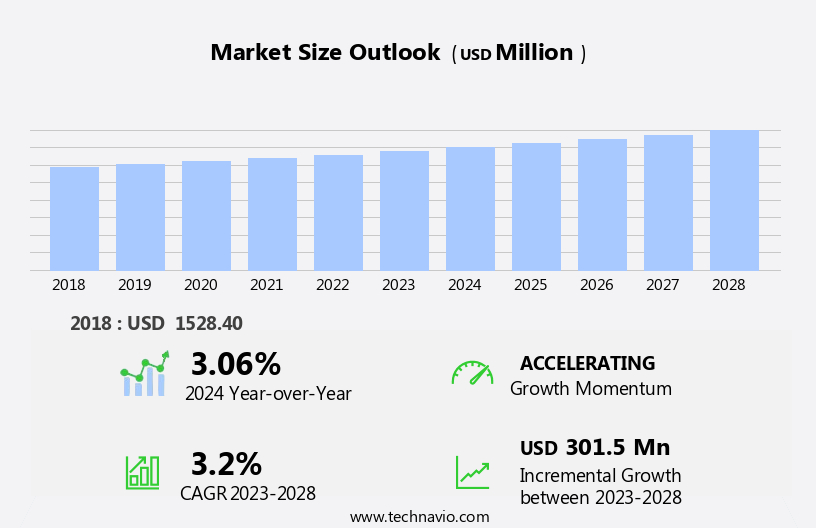
The laboratory centrifuge market size is forecast to increase by USD 301.5 million at a CAGR of 3.2% between 2023 and 2028.
The market is witnessing significant growth due to the increasing number of biotechnology and pharmaceutical research studies. This trend is driven by the need for efficient and accurate sample preparation techniques In these industries. Furthermore, the emergence of next-generation centrifuge systems, which offer enhanced features and capabilities, is also fueling market growth. However, the high cost associated with maintenance and post-purchase service remains a challenge for market participants. These factors are expected to shape the dynamics of the market In the coming years. The report provides a comprehensive analysis of these trends and challenges, offering valuable insights for stakeholders looking to capitalize on the opportunities in this market.
What will be the Size of the Laboratory Centrifuge Market During the Forecast Period?
Request Free Sample
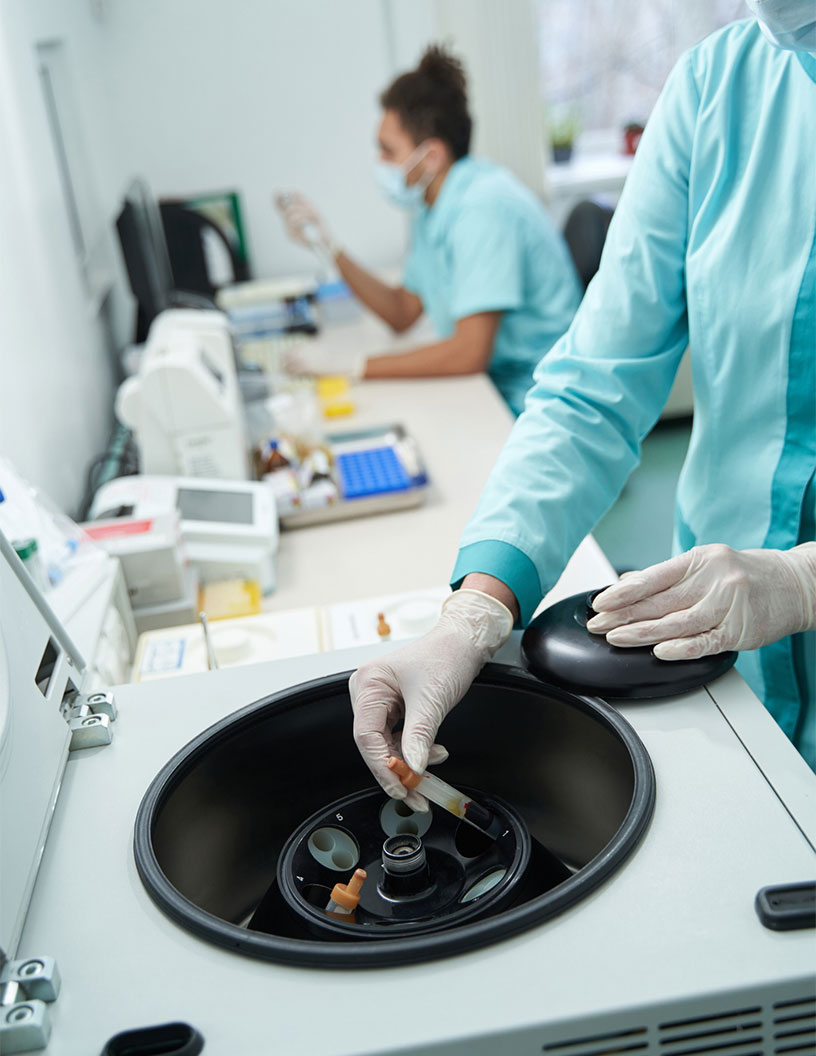
The market encompasses motor-driven devices used for separating substances based on their mass and density. These centrifuges are essential tools in various industries, including hospitals, nursing homes, and research laboratories. They find extensive applications In the separation of cells, organelles, viruses, proteins, and nucleic acids from whole-blood components. The market offers diverse centrifuge types, such as microcentrifuges, refrigerated centrifuges, ultracentrifuges, preparative ultracentrifuges, and analytical ultracentrifuges. Centrifuges operate based on the sedimentation principle, utilizing centripetal force to accelerate the separation process. Rotors, available in various designs like swinging bucket, fixed angle, elutriator, corrosion-free, and vertical tube, cater to different application requirements.The centrifugation process relies on the interplay of buoyant force, frictional force, and centripetal force to achieve separation. Major applications of laboratory centrifuges include the separation of cells and organelles, protein and nucleic acid purification, and virus and particle concentration. The market is driven by factors such as increasing research and development activities, growing demand for automation in laboratories, and the need for rapid and accurate results.
How is this Laboratory Centrifuge Industry segmented and which is the largest segment?
The laboratory centrifuge industry research report provides comprehensive data (region-wise segment analysis), with forecasts and estimates in "USD million" for the period 2024-2028, as well as historical data from 2018-2022 for the following segments.
- End-user
- Hospitals and clinics
- Academia and research institutes
- Biotech companies
- Pharmaceutical companies
- Others
- Product
- Benchtop centrifuges
- Floor standing centrifuges
- Geography
- North America
- Europe
- Asia
- Rest of World (ROW)
By End-user Insights
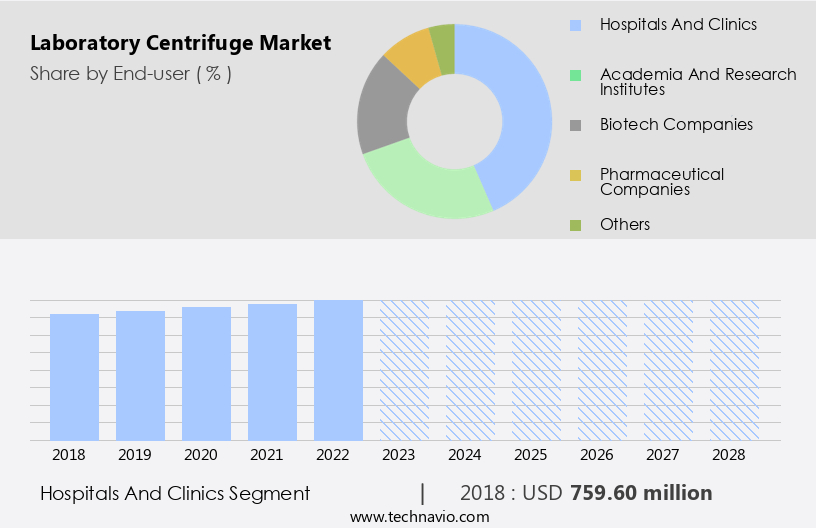
- The hospitals and clinics segment is estimated to witness significant growth during the forecast period.
Laboratory centrifuges play a crucial role in hospitals, nursing homes, and laboratories for the separation and preparation of various substances, including cells, organelles, viruses, proteins, nucleic acids, and whole-blood components. Centrifuges employ the sedimentation principle, utilizing centripetal force to accelerate the separation process. The rotor design varies, with options including swinging bucket rotors, fixed angle rotors, and vertical tube rotors. Motors and axes are motor-driven, and rotational speeds can range from low for microcentrifuges to high for ultracentrifuges. Refrigerated centrifuges maintain optimal temperatures for sensitive samples, while ultracentrifuges provide higher centrifugal forces for separating heavy molecules. Optical detection systems enhance analysis capabilities.
The growth of the market is driven by the increasing number of hospitals, diagnostic centers, and the rising preference for advanced diagnostic techniques. The market is expected to expand due to the need for efficient separation and preparation of various substances in biochemistry and cell biology.
Get a glance at the Laboratory Centrifuge Industry report of share of various segments Request Free Sample
The Hospitals and clinics segment was valued at USD 759.60 million in 2018 and showed a gradual increase during the forecast period.
Regional Analysis
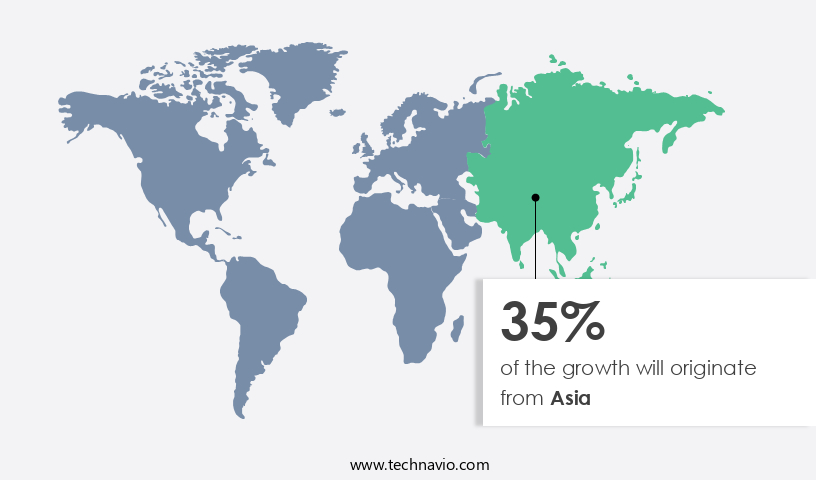
- Asia is estimated to contribute 35% to the growth of the global market during the forecast period.
Technavio’s analysts have elaborately explained the regional trends and drivers that shape the market during the forecast period.
For more insights on the market share of various regions, Request Free Sample
The North American the market is driven by the presence of numerous laboratories, hospitals, and nursing homes In the US and Canada. These institutions require centrifuges for various applications, including cell, organelle, virus, protein, nucleic acid, and whole-blood component separations. The market is characterized by a diverse range of centrifuge types, including gas and liquid centrifuges, axis-driven devices, motor-driven devices, refrigerated centrifuges, microcentrifuges, preparative ultracentrifuges, analytical ultracentrifuges, and blood centrifuges. The centrifugation principle relies on centripetal force, which separates substances based on their mass, density, and viscosity. Rotors, such as swinging bucket rotors, vertical tube rotors, and zonal rotors, are essential components of centrifuges.
Key factors driving market growth include advancements in molecular biology and cellular diagnosis, increasing healthcare expenditure, and the availability of sophisticated centrifuge designs, such as optical detection systems and PRP/PRF centrifuges.
Market Dynamics
Our researchers analyzed the data with 2023 as the base year, along with the key drivers, trends, and challenges. A holistic analysis of drivers will help companies refine their marketing strategies to gain a competitive advantage.
What are the key market drivers leading to the rise In the adoption of Laboratory Centrifuge Industry?
Increasing number of biotechnology and pharmaceutical research studies is the key driver of the market.
Laboratory centrifuges are essential tools In the biotechnology and pharmaceutical sectors, facilitating research in medical, plant, animal-based, genetics, proteomics, and drug development. These motor-driven devices apply centripetal force to accelerate liquids or gases along an axis to induce sedimentation. The separation of substances based on their mass, density, viscosity, and size occurs due to the interplay of buoyant force, frictional force, and centrifugal force. Centrifuges come in various types, including microcentrifuges, refrigerated centrifuges, ultracentrifuges, preparative ultracentrifuges, analytical ultracentrifuges, and blood centrifuges. Rotors, such as swinging bucket rotors, fixed angle rotors, vertical tube rotors, and zonal rotors, are used to accommodate different sample types and sizes.Microcentrifuges are used for small sample volumes, while refrigerated centrifuges maintain temperature control for temperature-sensitive samples. Ultracentrifuges, with their high rotational speeds and large centrifugal forces, are used for separating organelles, viruses, proteins, nucleic acids, and molecular isotopes. Centrifuges have applications in various industries, including hospitals, nursing homes, and laboratories. They are used for preparing whole-blood components, such as platelet-rich plasma (PRP) and platelet-rich fibrin (PRF), and for isolating cells, organelles, and molecules. The sedimentation principle is used to separate substances based on their density, making centrifuges an indispensable tool in research and diagnostics. Centrifuges are designed with various features, such as corrosion-free rotors, cover, centrifuge tubes made of plastic or glass, bench-top units, and floor standing units.They operate at different rotational speeds, accommodating sample tubes of various sizes and shapes. The use of advanced technology, such as optical detection systems, ensures accurate and efficient separation. Despite their importance, centrifuges require proper maintenance to prevent catastrophic failure due to factors like vibration, cracking, and corrosion. Regular inspection and timely replacement of parts, such as hinges and balance tubes, are essential to ensure their longevity and optimal performance.
What are the market trends shaping the Laboratory Centrifuge Industry?
Emergence of next-generation centrifuge systems is the upcoming market trend.
Laboratory centrifuges are motor-driven devices used in hospitals, nursing homes, and laboratories for separating substances based on their mass, density, or size. These centrifuges operate on the sedimentation principle, utilizing centripetal force to accelerate the separation process. Gas and liquid mixtures, whole-blood components, and organelles, viruses, proteins, and nucleic acids are common substances separated using centrifugation. Centrifuges come in various types, including microcentrifuges, refrigerated centrifuges, ultracentrifuges, and blood centrifuges. Microcentrifuges are suitable for small sample volumes and high-speed centrifugation, while refrigerated centrifuges maintain temperature control during the centrifugation process. Ultracentrifuges offer high-speed centrifugation and are used for separating particles with a size range of 0.01to 10 microns. Centrifuges have rotors of different designs, such as swinging bucket rotors, fixed angle rotors, and vertical tube rotors. Rotors come in various materials, including corrosion-free and glass, to ensure longevity and compatibility with different sample types. Optical detection systems and balance tubes are additional features in some centrifuges to monitor the separation process and ensure sample integrity. Next-generation centrifuges, also known as smart centrifuges, are equipped with microprocessors for automatic indications and assistance to users. They offer improved efficiency in terms of speed, volume, and space occupied. For instance, the Agilent Microplate Centrifuge is a compact, robot-accessible automated centrifuge that ensures stable high-speed centrifugation with minimal vibration and noise.Centrifuges operate based on the principle of centrifugation, where the application of a centrifugal force causes the separation of substances based on their mass, density, or size. The centrifuge's motor drives the rotor, which rotates at high speeds around a vertical motorized axis. The centrifugal force generated causes the separation of heavier substances towards the bottom and lighter substances towards the top. Centrifuges are used extensively in various industries, including biochemistry and cell biology, for applications such as differential centrifugation, organelle isolation, virus purification, protein precipitation, and nucleic acid extraction. The separation process is based on the principle of buoyant force and frictional force, where the denser substances settle towards the bottom due to the centrifugal force, while the lighter substances remain suspended In the supernatant.Centrifuges come in various sizes and designs, including bench-top units and floor-standing units, to cater to different sample volumes and centrifugation requirements. Sample tubes are made of plastic or glass and have a cover to prevent contamination during the centrifugation process. Swinging bucket rotors have hinges that allow the buckets to swing out during the centrifugation process, while zonal rotors have a stationary inner bowl and a rotating outer bowl to create a zonal flow of the sample. Centrifugation is a critical process in various industries, and the use of advanced centrifuge technologies has led to improved efficiency, accuracy, and sample integrity.Next-generation centrifuges offer features such as automatic electric brakes, speed control mechanisms, and safety features to ensure optimal sample handling and user convenience. These advanced features have made centrifuges an essential tool in research and diagnostic laboratories, hospitals, and other industries where sample separation is required. Centrifuges operate based on the principle of centrifugation, where the application of a centripetal force causes the separation of substances based on their mass, density, or size. The centrifuge's motor drives the rotor, which rotates at high speeds around a vertical motorized axis. The centrifugal force generated causes the separation of heavier substances towards the bottom and lighter substances towards the top.Centrifuges are used extensively in various industries, including biochemistry and cell biology, for applications such as differential centrifugation, organelle isolation, virus purification, protein precipitation, and nucleic acid extraction. The separation process is based on the principle of buoyant force and frictional force, where the denser substances settle towards the bottom due to the centrifugal force, while the lighter substances remain suspended In the supernatant. Centrifuges come in various sizes and designs, including bench-top units and floor-standing units, to cater to different sample volumes and centrifugation requirements. Sample tubes are made of plastic or glass and have a cover to prevent contamination during the centrifugation process.Swinging bucket rotors have hinges that allow the buckets to swing out during the centrifugation process, while zonal rotors have a stationary inner bowl and a rotating outer bowl to create a zonal flow of the sample. Next-generation centrifuges, also known as smart centrifuges, are equipped with microprocessors for automatic indications and assistance to users. They offer improved efficiency in terms of speed, volume, and space occupied. For instance, the Agilent Microplate Centrifuge is a compact, robot-accessible automated centrifuge that ensures stable high-speed centrifugation with minimal vibration and noise. Centrifuges are essential tools in various industries, including biochemistry and cell biology, for applications such as differential centrifugation, organelle isolation, virus purification, protein precipitation, and nucleic acid extraction.These applications require the separation of substances based on their mass, density, or size, and centrifuges offer a reliable and efficient solution to achieve this separation. Centrifuges operate based on the principle of centrifugation, where the application of a centripetal force causes the separation of substances based on their mass, density, or size. The centrifuge's motor drives the rotor, which rotates at high speeds around a vertical motorized axis. The centrifugal force generated causes the separation of heavier substances towards the bottom and lighter substances towards the top. Centrifuges are used extensively in various industries, including biochemistry and cell biology, for applications such as differential centrifugation, organelle isolation, virus purification, protein precipitation, and nucleic acid extraction.The separation process is based on the principle of buoyant force and frictional force, where the denser substances settle towards the bottom due to the centrifugal force, while the lighter substances remain suspended In the supernatant. Centrifuges come in various sizes and designs, including bench-top units and floor-standing units, to cater to different sample volumes and centrifugation requirements. Sample tubes are made of plastic or glass and have a cover to prevent contamination during the centrifugation process. Swinging bucket rotors have hinges that allow the buckets to swing out during the centrifugation process, while zonal rotors have a stationary inner bowl and a rotating outer bowl to create a zonal flow of the sample.Next-generation centrifuges, also known as smart centrifuges, are equipped with microprocessors for automatic indications and assistance to users. They offer improved efficiency in terms of speed, volume, and space occupied. For instance, the Agilent Microplate Centrifuge is a compact, robot-accessible automated centrifuge that ensures stable high-speed centrifugation with minimal vibration and noise. Centrifuges are essential tools in various industries, including biochemistry and cell biology, for applications such as differential centrifugation, organelle isolation, virus purification, protein precipitation, and nucleic acid extraction. These applications require the separation of substances based on their mass, density, or size, and centrifuges offer a reliable and efficient solution to achieve this separation.Centrifuges operate based on the principle of centrifugation, where the application of a centripetal force causes the separation of substances based on their mass, density, or size. The centrifuge's motor drives the rotor, which rotates at high speeds around a vertical motorized axis. The centrifugal force generated causes the separation of heavier substances towards the bottom and lighter substances towards the top. Centrifuges are used extensively in various industries, including biochemistry and cell biology, for applications such as differential centrifugation, organelle isolation, virus purification, protein precipitation, and nucleic acid extraction. The separation process is based on the principle of buoyant force and frictional force, where the denser substances settle towards the bottom due to the centrifugal force, while the lighter substances remain suspended In the supernatant.Centrifuges come in various sizes and designs, including bench-top units and floor-standing units, to cater to different sample volumes and centrifugation requirements. Sample tubes are made of plastic or glass and have a cover to prevent contamination during the centrifugation process. Swinging bucket rotors have hinges that allow the buckets to swing out during the centrifugation process, while zonal rotors have a stationary inner bowl and a rotating outer bowl to create a zonal flow of the sample. Next-generation centrifuges, also known as smart centrifuges, are equipped with microprocessors for automatic indications and assistance to users. They offer improved efficiency in terms of speed, volume, and space occupied.For instance, the Agilent Microplate Centrifuge is a compact, robot-accessible automated centrifuge that ensures stable high-speed centrifugation with minimal vibration and noise. Centrifuges are essential tools in various industries, including biochemistry and cell biology, for applications such as differential centrifugation, organelle isolation, virus purification, protein precipitation, and nucleic acid extraction. These applications require the separation of substances based on their mass, density, or size, and centrifuges offer a reliable and efficient solution to achieve this separation. Centrifuges operate based on the principle of centrifugation, where the application of a centripetal force causes the separation of substances based on their mass, density, or size.The centrifuge's motor drives the rotor, which rotates at high speeds around a vertical motorized axis. The centrifugal force generated causes the separation of heavier substances towards the bottom and lighter substances towards the top. Centrifuges are used extensively in various industries, including biochemistry and cell biology, for applications such as differential centrifugation, organelle isolation, virus purification, protein precipitation, and nucleic acid extraction. The separation process is based on the principle of buoyant force and frictional force, where the denser substances settle towards the bottom due to the centrifugal force, while the lighter substances remain suspended In the supernatant.Centrifuges come in various sizes and designs, including bench-top units and floor-standing units, to cater to different sample volumes and centrifugation requirements. Sample tubes are made of plastic or glass and have a cover to prevent contamination during the centrifugation process. Swinging bucket rotors have hinges that allow the buckets to swing out during the centrifugation process, while zonal rotors have a stationary inner bowl and a rotating outer bowl to create a zonal flow of the sample. Next-generation centrifuges, also known as smart centrifuges, are equipped with microprocessors for automatic indications and assistance to users. They offer improved efficiency in terms of speed, volume, and space occupied.For instance, the Agilent Microplate Centrifuge is a compact, robot-accessible automated centrifuge that ensures stable high-speed centrifugation with minimal vibration and noise. Centrifuges are essential tools in various industries, including biochemistry and cell biology, for applications such as differential centrifugation, organelle isolation, virus purification, protein precipitation, and nucleic acid extraction. These applications require the separation of substances based on their mass, density, or size, and centrifuges offer a reliable and efficient solution to achieve this separation. Centrifuges operate based on the principle of centrifugation, where the application of a centripetal force causes the separation of substances based on their mass, density, or size.The centrifuge's motor drives the rotor, which rotates at high speeds around a vertical motorized axis. The centrifugal force generated causes the separation of heavier substances towards the bottom and lighter substances towards the top. Centrifuges are used extensively in various industries, including biochemistry and cell biology, for applications such as differential centrifugation, organelle isolation, virus purification, protein precipitation, and nucleic acid extraction. The separation process is based on the principle of buoyant force and frictional force, where the denser substances settle towards the bottom due to the centrifugal force, while the lighter substances remain suspended In the supernatant.Centrifuges come in various sizes and designs, including bench-top units and floor-standing units, to cater to different sample volumes and centrifugation requirements. Sample tubes are made of plastic or glass and have a cover to prevent contamination during the centrifugation process. Swinging bucket rotors have hinges that allow the buckets to swing out during the centrifugation process, while zonal rotors have a stationary inner bowl and a rotating outer bowl to create a zonal flow of the sample. Next-generation centrifuges, also known as smart centrifuges, are equipped with microprocessors for automatic indications and assistance to users. They offer improved efficiency in terms of speed, volume, and space occupied.For instance, the Agilent Microplate Centrifuge is a compact, robot-accessible automated centrifuge that ensures stable high-speed centrifugation with minimal vibration and noise. Centrifuges are essential tools in various industries, including biochemistry and cell biology, for applications such as differential centrifugation, organelle isolation, virus purification, protein precipitation, and nucleic acid extraction. These applications require the separation of substances based on their mass, density, or size, and centrifuges offer a reliable and efficient solution to achieve this separation. Centrifuges operate based on the principle of centrifugation, where the application of a centripetal force causes the separation of substances based on their mass, density, or size.The centrifuge's motor drives the rotor, which rotates at high speeds around a vertical motorized axis. The centrifugal force generated causes the separation of heavier substances towards the bottom and lighter substances towards the top. Centrifuges are used extensively in various industries, including biochemistry and cell biology, for applications such as differential centrifugation, organelle isolation, virus purification, protein precipitation, and nucleic acid extraction. The separation process is based on the principle of buoyant force and frictional force, where the denser substances settle towards the bottom due to the centrifugal force, while the lighter substances remain suspended In the supernatant.Centrifuges come in various sizes and designs, including bench-top units and floor-standing units, to cater to different sample volumes and centrifugation requirements. Sample tubes are made of plastic or
What challenges does the Laboratory Centrifuge Industry face during its growth?
Cost associated with maintenance and post-purchase service is a key challenge affecting the industry growth.
Laboratory centrifuges are essential tools in hospitals, nursing homes, and research laboratories for separating gas, liquid, or suspended particles based on their mass, density, or size. Motor-driven devices with vertical motorized axes, rotors, and cover come in various types, including bench-top units and floor standing models. Centrifuges operate based on the sedimentation principle, using centripetal force to overcome buoyant and frictional forces, allowing for the separation of substances such as cell organelles, viruses, proteins, nucleic acids, whole-blood components, and molecular isotopes. Centrifuges come in different designs, including swinging bucket rotors, fixed angle rotors, and zonal rotors. Swinging bucket rotors have hinges that allow samples to swing out during centrifugation, while zonal rotors create zones of different densities for separating particles.Centrifuges also vary in rotational speeds and sizes of sample tubes, which can be made of plastic or glass. Microcentrifuges, refrigerated centrifuges, ultracentrifuges, preparative ultracentrifuges, and analytical ultracentrifuges are some types of centrifuges with specific applications. For instance, microcentrifuges are used for small samples, while ultracentrifuges can separate particles at high speeds and are used in biochemistry and cell biology. Centrifuges must be maintained to prevent catastrophic failure, which can lead to costly repairs or replacement. Regular inspections and proper handling are necessary to prevent corrosion, cracking, and vibration. Balance tubes can help distribute the weight evenly, reducing the risk of damage.In summary, laboratory centrifuges are indispensable tools for separating substances based on their mass, density, or size. With various designs, types, and applications, centrifuges play a crucial role in hospitals, nursing homes, and research laboratories, requiring regular maintenance to ensure their optimal performance and longevity.
Exclusive Customer Landscape
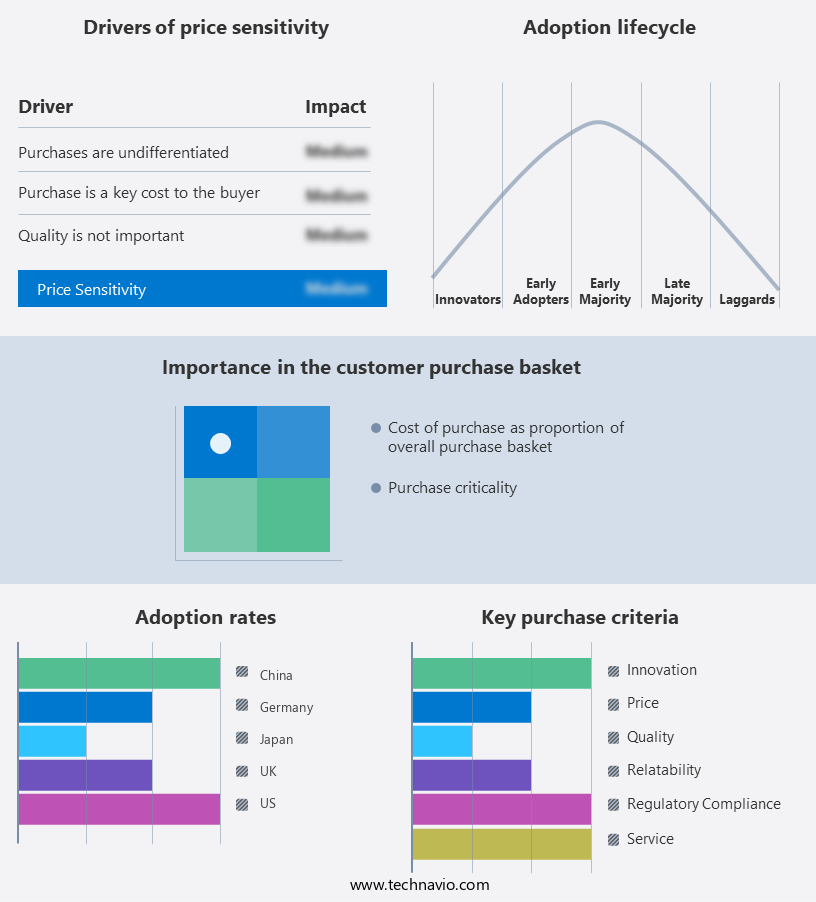
The laboratory centrifuge market forecasting report includes the adoption lifecycle of the market, covering from the innovator’s stage to the laggard’s stage. It focuses on adoption rates in different regions based on penetration. Furthermore, the laboratory centrifuge market report also includes key purchase criteria and drivers of price sensitivity to help companies evaluate and develop their market growth analysis strategies.
Customer Landscape
Key Companies & Market Insights
Companies are implementing various strategies, such as strategic alliances, laboratory centrifuge market forecast, partnerships, mergers and acquisitions, geographical expansion, and product/service launches, to enhance their presence In the industry.
Accumax Lab Devices Pvt. Ltd. - The market encompasses advanced equipment designed for separating mixtures based on their different densities. Our company contributes to this market with innovative centrifuges, such as the iFuge FX2P and iFuge L400P models. These centrifuges deliver high-performance and versatility, catering to various laboratory applications. Engineered for precision and reliability, they ensure consistent results, making them indispensable tools for researchers and scientists.
The industry research and growth report includes detailed analyses of the competitive landscape of the market and information about key companies, including:
- Accumax Lab Devices Pvt. Ltd.
- Agilent Technologies Inc.
- Andreas Hettich GmbH and Co. KG
- Avantor Inc.
- Azer Scientific Inc.
- Benchmark Scientific Inc.
- Bio Rad Laboratories Inc.
- Biosan
- Cardinal Health Inc.
- Centurion Scientific Ltd.
- Corning Inc.
- Danaher Corp.
- Eppendorf SE
- HERMLE Labortechnik GmbH
- Kubota Corp.
- NuAire Inc.
- QIAGEN NV
- Sartorius AG
- Sigma Laborzentrifugen GmbH
- Thermo Fisher Scientific Inc.
Qualitative and quantitative analysis of companies has been conducted to help clients understand the wider business environment as well as the strengths and weaknesses of key industry players. Data is qualitatively analyzed to categorize companies as pure play, category-focused, industry-focused, and diversified; it is quantitatively analyzed to categorize companies as dominant, leading, strong, tentative, and weak.
Research Analyst Overview
The market encompasses a diverse range of motor-driven devices designed to separate substances based on their mass and density through the application of centripetal force. These devices are essential tools in various research and diagnostic applications, particularly in biochemistry and cell biology. Motor-driven centrifuges come in various designs, including microcentrifuges, refrigerated centrifuges, ultracentrifuges, and preparative and analytical ultracentrifuges. Each type caters to specific requirements, such as the size and type of samples, desired separation speeds, and temperature control. Microcentrifuges are compact, bench-top units used for separating small volumes of samples, such as nucleic acids, proteins, and molecular isotopes.
Refrigerated centrifuges maintain a cool temperature during operation, ensuring temperature-sensitive samples remain stable during the separation process. Ultracentrifuges, on the other hand, generate high centrifugal forces to separate large particles, organelles, viruses, and even molecular isotopes and DNA sequences. Centrifuges employ different rotor designs, including swinging bucket rotors, fixed angle rotors, and vertical tube rotors. Swinging bucket rotors are suitable for separating samples of varying densities, while fixed angle rotors are ideal for separating samples with similar densities. Vertical tube rotors are used for high-speed centrifugation, enabling the separation of particles based on their size and density. Centrifuge tubes are an essential component of these devices, available in materials such as plastic and glass.
The design of the tubes varies depending on the application, with top-loading wells and covers ensuring sample containment and ease of use. Centrifuges operate based on the sedimentation principle, where the centrifugal force generated by the motor-driven vertical motorized axis causes denser substances to move towards the bottom of the tube, while less dense substances remain at the top. The balance tubes withIn the rotor help distribute the sample evenly during centrifugation, preventing vibration and ensuring consistent results. Centrifuges are essential tools in various industries, including hospitals, nursing homes, and research laboratories. They are used in applications such as differential centrifugation, where organelles and viruses are separated based on their densities, and In the preparation of PRP/PRF for blood samples.
The market dynamics of the market are influenced by factors such as the increasing demand for advanced centrifuges with improved performance and features, the growing need for automation, and the rising adoption of microcentrifuges for research applications. Additionally, the development of corrosion-free rotors and the integration of optical detection systems have further enhanced the capabilities of these devices. However, the market also faces challenges such as the risk of catastrophic failure due to factors like corrosion, cracking, and vibration. Proper maintenance and regular inspections are crucial to ensure the longevity and optimal performance of these devices. In conclusion, the market is a dynamic and evolving industry, driven by the growing demand for advanced separation technologies and the increasing importance of research and diagnostic applications.
Motor-driven centrifuges continue to play a crucial role in various industries, enabling the separation of substances based on their mass, density, and other properties.
|
Market Scope
|
|
Report Coverage
|
Details
|
|
Page number
|
181
|
|
Base year
|
2023
|
|
Historic period
|
2018-2022 |
|
Forecast period
|
2024-2028
|
|
Growth momentum & CAGR
|
Accelerate at a CAGR of 3.2%
|
|
Market growth 2024-2028
|
USD 301.5 million
|
|
Market structure
|
Fragmented
|
|
YoY growth 2023-2024(%)
|
3.06
|
|
Key countries
|
US, Germany, China, UK, and Japan
|
|
Competitive landscape
|
Leading Companies, Market Positioning of Companies, Competitive Strategies, and Industry Risks
|
Request Free Sample
What are the Key Data Covered in this Laboratory Centrifuge Market Research and Growth Report?
- CAGR of the Laboratory Centrifuge industry during the forecast period
- Detailed information on factors that will drive the growth and forecasting between 2024 and 2028
- Precise estimation of the size of the market and its contribution of the industry in focus to the parent market
- Accurate predictions about upcoming growth and trends and changes in consumer behaviour
- Growth of the market across North America, Europe, Asia, and Rest of World (ROW)
- Thorough analysis of the market’s competitive landscape and detailed information about companies
- Comprehensive analysis of factors that will challenge the laboratory centrifuge market growth of industry companies
We can help! Our analysts can customize this laboratory centrifuge market research report to meet your requirements.
Get in touch



 RIA -
RIA - 
