


Laser Welding Machine Market Size 2026-2030
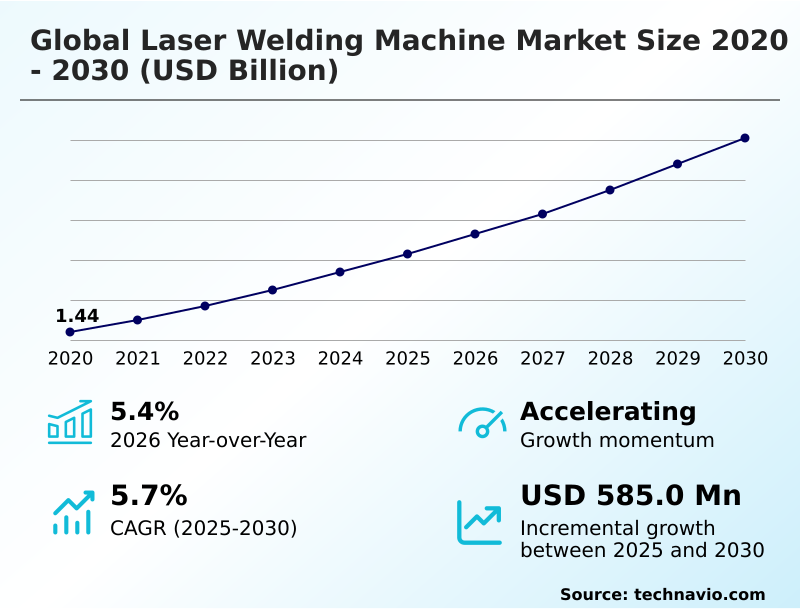
The laser welding machine market size is valued to increase by USD 585 million, at a CAGR of 5.7% from 2025 to 2030. High-precision laser welding over conventional methods will drive the laser welding machine market.
Major Market Trends & Insights
- APAC dominated the market and accounted for a 50.9% growth during the forecast period.
- By End-user - Automotive segment was valued at USD 485.5 million in 2024
- By Technology - Fiber laser segment accounted for the largest market revenue share in 2024
Market Size & Forecast
- Market Opportunities: USD 974.2 million
- Market Future Opportunities: USD 585 million
- CAGR from 2025 to 2030 : 5.7%
Market Summary
- The laser welding machine market is undergoing a significant transformation, driven by the industrial imperative to enhance manufacturing precision, efficiency, and automation. A primary catalyst for this shift is the superior performance of laser-based systems over traditional joining methods, offering cleaner welds, minimal thermal distortion, and faster production cycles.
- This technological superiority is critical in sectors such as automotive and electronics, where product miniaturization and the use of advanced materials are standard. For instance, an electric vehicle manufacturer can leverage automated laser welding to assemble battery packs, ensuring the structural integrity and electrical conductivity of hundreds of individual cells with a level of consistency unattainable through manual processes.
- However, the market's trajectory is moderated by operational headwinds, including the high initial capital investment required for advanced equipment and a persistent shortage of skilled technicians capable of programming and maintaining these complex systems. The integration of robotics and AI-powered quality control is a key trend, helping to mitigate labor gaps while simultaneously elevating production standards across the industry.
What will be the Size of the Laser Welding Machine Market during the forecast period?
Get Key Insights on Market Forecast (PDF) Get Free Sample
How is the Laser Welding Machine Market Segmented?
The laser welding machine industry research report provides comprehensive data (region-wise segment analysis), with forecasts and estimates in "USD million" for the period 2026-2030, as well as historical data from 2020-2024 for the following segments.
- End-user
- Automotive
- Healthcare
- Aerospace and defense
- Electronics
- Others
- Technology
- Fiber laser
- Solid-state laser
- CO2 laser
- Others
- Distribution channel
- Direct sales
- Indirect sales
- Geography
- APAC
- China
- India
- Japan
- Europe
- Germany
- UK
- France
- North America
- US
- Canada
- Mexico
- South America
- Brazil
- Argentina
- Middle East and Africa
- Saudi Arabia
- UAE
- South Africa
- Rest of World (ROW)
- APAC
By End-user Insights
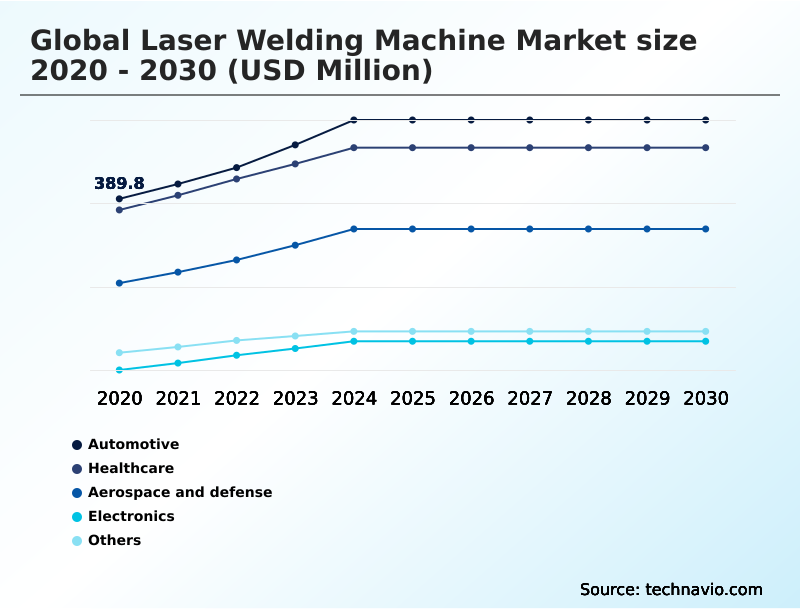
The automotive segment is estimated to witness significant growth during the forecast period.
The automotive sector is a primary driver for laser welding, propelled by the industry-wide shift toward electric mobility and vehicle lightweighting. Key applications include electric vehicle battery fabrication and body-in-white assembly, where precision joining of lightweight materials is critical.
The adoption of robotic welding systems for processes like laser brazing facilitates high-volume production, with some automated lines achieving a 25% reduction in cycle times compared to manual methods.
While advanced systems with dual-ring beam technology are used for high-strength steels, versatile handheld laser welding units are gaining traction for smaller-scale metal joining applications.
Technologies such as pulsed welding with Nd:YAG lasers and laser cladding for part repair further illustrate the diverse use cases supporting this segment's robust demand.
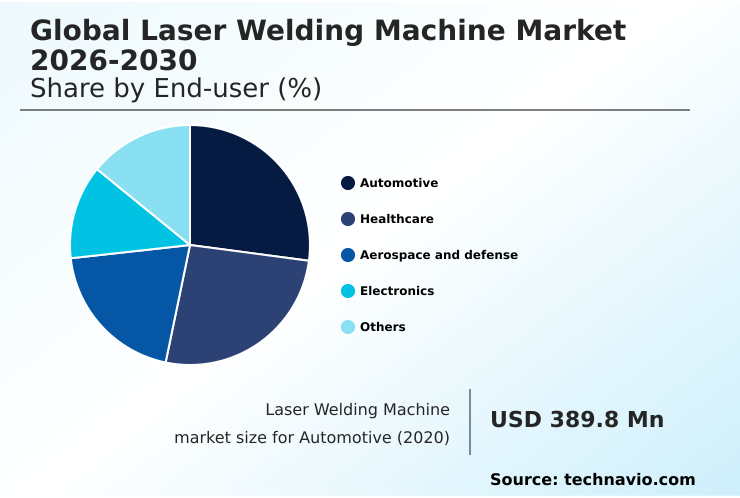
The Automotive segment was valued at USD 485.5 million in 2024 and showed a gradual increase during the forecast period.
Regional Analysis
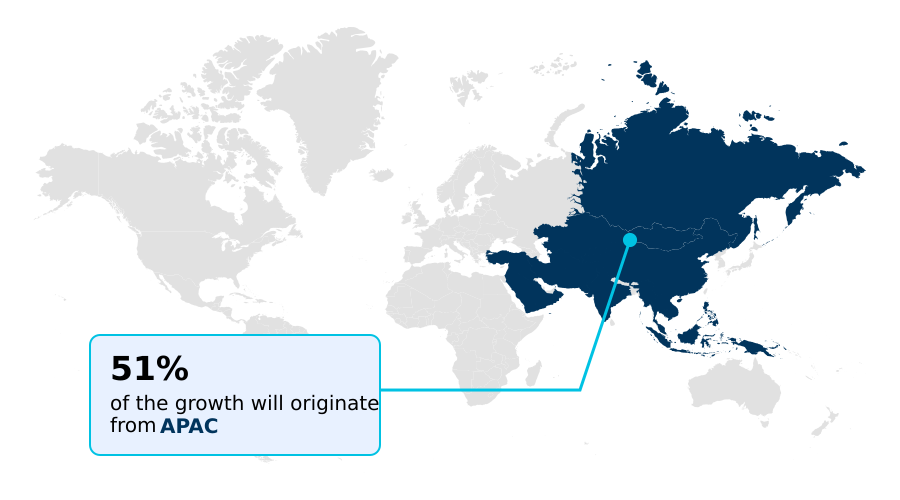
APAC is estimated to contribute 50.9% to the growth of the global market during the forecast period.Technavio’s analysts have elaborately explained the regional trends and drivers that shape the market during the forecast period.
See How Laser Welding Machine Market Demand is Rising in APAC Get Free Sample
The geographic landscape of the market is led by the APAC region, which accounts for over 50% of the total market share, driven by its expansive manufacturing base in automotive and electronics.
In this region, the adoption of robotic welding cells and advanced high-power photonics is standard. In contrast, North America is focused on high-value applications, such as aerospace component fabrication and medical device manufacturing.
Companies in this region are leveraging laser metal deposition for maintenance, repair, and overhaul (MRO), achieving cost savings of up to 30% by extending the life of critical parts.
Europe remains a hub for innovation, particularly in high-power diode-laser systems and green laser sources. The use of optical coherence tomography is also prevalent for quality control in heavy-duty industrial applications and electronics assembly.
Market Dynamics
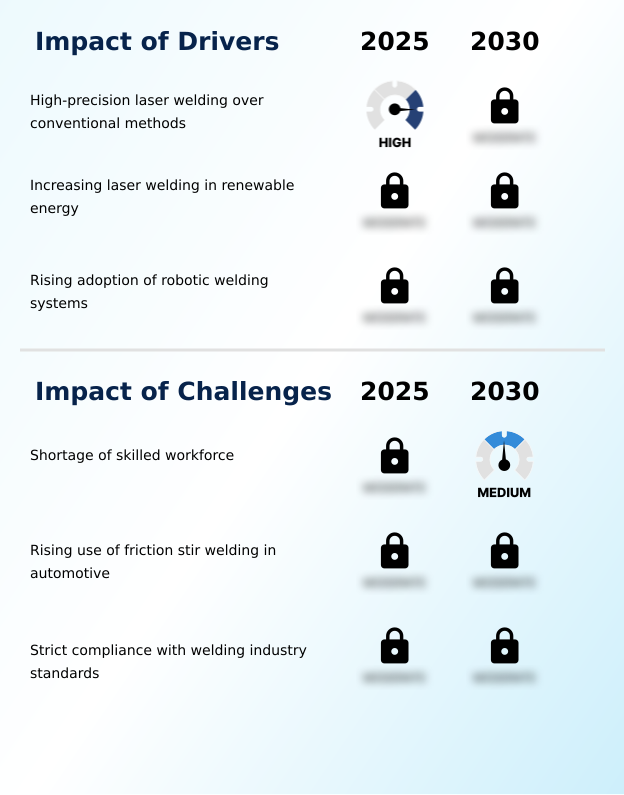
Our researchers analyzed the data with 2025 as the base year, along with the key drivers, trends, and challenges. A holistic analysis of drivers will help companies refine their marketing strategies to gain a competitive advantage.
- Strategic investment in advanced joining technologies is reshaping manufacturing across key sectors. The debate over fiber laser vs CO2 laser welding continues, though fiber's efficiency often wins for applications like robotic laser welding for automotive manufacturing.
- The rising demand for laser welding for electric vehicle batteries highlights the need for specialized techniques such as green laser welding for copper components to manage conductivity and heat. This precision is mirrored in high-precision welding for medical devices, where laser welding for hermetic sealing of implants is critical.
- The cost-effectiveness of automated laser welding is a key driver, though firms must consider the training requirements for advanced laser welders to operate these systems. One key operational benefit is enhanced quality control; systems incorporating optical coherence tomography in weld monitoring have demonstrated a defect detection rate over 99%, significantly improving upon manual inspection methods.
- Other critical applications include laser metal deposition for aerospace repair of turbine blades and laser welding for high-strength superalloys. In electronics, micro welding for electronics assembly is standard, while the benefits of IoT in laser welding include predictive maintenance and process optimization. The impact of beam shaping on weld quality is profound, helping to overcome laser welding dissimilar metals challenges.
- While facing competition from technologies like friction stir welding vs laser welding, laser remains superior for its versatility, from the use of a handheld laser welder for metal fabrication to the precision needed in laser welding in tool and mold making.
- The advances in plastic laser welding technology are opening new markets, but all applications must ensure compliance with ISO and AWS welding standards.
What are the key market drivers leading to the rise in the adoption of Laser Welding Machine Industry?
- The increasing preference for high-precision laser welding over conventional methods serves as a primary driver for market growth.
- The market is propelled by the industry-wide adoption of high-precision laser welding, which offers significant advantages over conventional welding equipment.
- Modern fiber laser and CO2 laser systems, often integrated with laser welding robots, deliver superior weld quality and reduce material waste by up to 15%.
- This high level of accuracy makes the laser welding technology essential for demanding applications in automotive and aerospace, particularly for sheet metal processing.
- The push for automated laser welding is also driven by efficiency gains, as techniques like remote laser welding and advanced laser beam welding can increase throughput by more than 50%.
- The continuous evolution of photonic technologies, including beam oscillation and variable beam control, is expanding application possibilities.
What are the market trends shaping the Laser Welding Machine Industry?
- The rising adoption of additive manufacturing is a significant market trend, driving innovation in laser welding processes. This synergy enhances production capabilities for complex and customized components.
- Key market trends are centered on the convergence of additive manufacturing and IoT integration to create highly efficient, automated production ecosystems. The use of custom laser systems within smart factory environments allows for rapid prototyping, with some firms reporting a 40% reduction in development lead times.
- Advanced laser welding solutions, including the versatile four-in-one laser welding machine, are being deployed for a wide array of laser welding applications. These laser systems utilize technologies such as ultra-short pulse lasers and advanced disk lasers to ensure a stable keyhole weld in complex geometries.
- Innovations in laser processing solutions, such as wobble heads, are improving joint quality and expanding the range of compatible materials, further driving adoption across industries.
What challenges does the Laser Welding Machine Industry face during its growth?
- A significant challenge affecting industry growth is the persistent shortage of a skilled workforce capable of operating advanced welding systems.
- The market faces significant challenges, including the rise of alternative technologies like friction stir welding, which is gaining traction for joining certain lightweight alloys. This competitive pressure forces providers of laser welding services to innovate continually.
- Another constraint is the complexity of joining dissimilar materials, where precise beam shaping technology and control over deep weld keyholes are essential but difficult to master. The market for micro-welding solutions, especially for semiconductor components joining, demands adherence to stringent welding industry standards, adding to compliance costs.
- Furthermore, the development of reliable solid-state laser and diode lasers requires substantial R&D investment, and ensuring consistent performance from beam delivery systems and various laser sources remains a persistent technical hurdle for manufacturers.
Exclusive Technavio Analysis on Customer Landscape
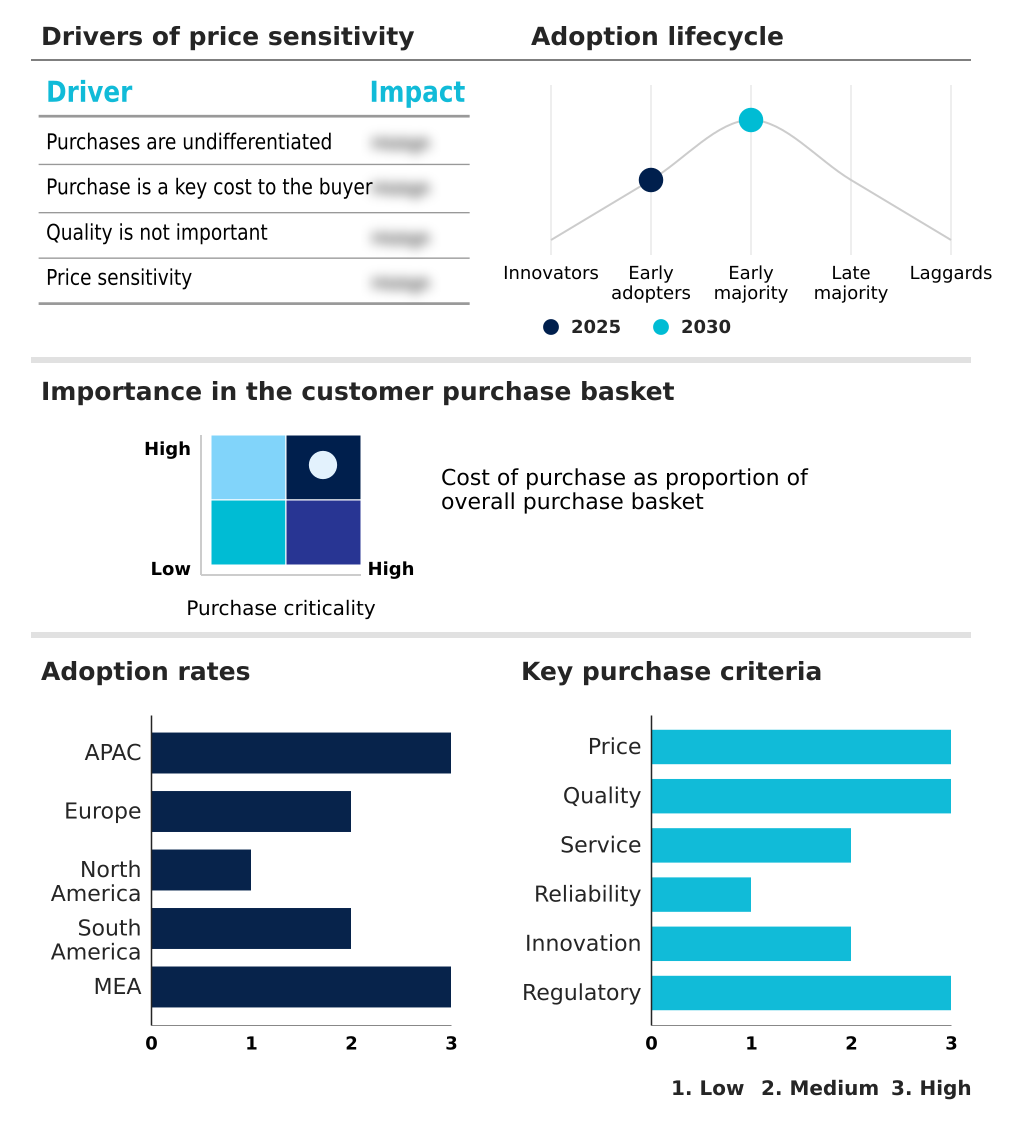
The laser welding machine market forecasting report includes the adoption lifecycle of the market, covering from the innovator’s stage to the laggard’s stage. It focuses on adoption rates in different regions based on penetration. Furthermore, the laser welding machine market report also includes key purchase criteria and drivers of price sensitivity to help companies evaluate and develop their market growth analysis strategies.
Customer Landscape of Laser Welding Machine Industry
Competitive Landscape
Companies are implementing various strategies, such as strategic alliances, laser welding machine market forecast, partnerships, mergers and acquisitions, geographical expansion, and product/service launches, to enhance their presence in the industry.
Amada Co. Ltd. - Offerings include precision fiber-based systems engineered for high-demand electronics and advanced metal joining applications.
The industry research and growth report includes detailed analyses of the competitive landscape of the market and information about key companies, including:
- Amada Co. Ltd.
- Bystronic Laser AG
- Coherent Corp.
- Emerson Electric Co.
- FANUC Corp.
- Hans Laser Technology Co. Ltd.
- HGLaser Engineering Co. Ltd.
- IPG Photonics Corp.
- Jenoptik AG
- Jinan Xintian Technology Co.
- Keyence Corp.
- Laserline GmbH
- Laserstar Technologies Corp.
- Penta Laser Wenzhou Co. Ltd.
- Perfect Laser Co. Ltd.
- SLTL Group
- Suzhou Prato Laser Co. Ltd.
- Suzhou Tianhong Laser Co. Ltd.
- TRUMPF SE Co. KG
- Wuhan Golden Laser Co. Ltd.
Qualitative and quantitative analysis of companies has been conducted to help clients understand the wider business environment as well as the strengths and weaknesses of key industry players. Data is qualitatively analyzed to categorize companies as pure play, category-focused, industry-focused, and diversified; it is quantitatively analyzed to categorize companies as dominant, leading, strong, tentative, and weak.
Recent Development and News in Laser welding machine market
- In August 2024, TRUMPF unveiled a new green laser technology engineered to enhance the welding of copper components, a critical process for manufacturing electric vehicle parts.
- In October 2024, Coherent Corp. introduced the ARM FL20D, a twenty-kilowatt fiber laser system featuring dual-ring beam technology designed to optimize welding speeds for electric vehicle production.
- In November 2024, Amada showcased its FLW 6000 ENSIS laser welding machine at the JIMTOF exhibition, which utilizes variable beam control to adapt its beam mode for different materials and thicknesses.
- In March 2025, TRUMPF is scheduled to present a new AI-assisted laser machine tool at the InTech 2025 trade fair, integrating algorithmic precision to enhance weld quality autonomously.
Dive into Technavio’s robust research methodology, blending expert interviews, extensive data synthesis, and validated models for unparalleled Laser Welding Machine Market insights. See full methodology.
| Market Scope | |
|---|---|
| Page number | 302 |
| Base year | 2025 |
| Historic period | 2020-2024 |
| Forecast period | 2026-2030 |
| Growth momentum & CAGR | Accelerate at a CAGR of 5.7% |
| Market growth 2026-2030 | USD 585.0 million |
| Market structure | Fragmented |
| YoY growth 2025-2026(%) | 5.4% |
| Key countries | China, India, Japan, South Korea, Australia, Indonesia, Germany, UK, France, Italy, Spain, The Netherlands, US, Canada, Mexico, Brazil, Argentina, Chile, Saudi Arabia, UAE, South Africa, Israel and Turkey |
| Competitive landscape | Leading Companies, Market Positioning of Companies, Competitive Strategies, and Industry Risks |
Research Analyst Overview
- The laser welding machine market's evolution is driven by boardroom decisions to invest in advanced manufacturing capabilities that deliver verifiable ROI. Companies are achieving up to a 15% reduction in production cycle times by replacing legacy systems with modern solutions.
- The technological landscape is diverse, spanning high-power fiber laser, solid-state laser, including Nd:YAG laser and disk lasers, and legacy CO2 laser systems. Integration with robotic welding systems is standard, creating automated robotic welding cells. Key process innovations include high-precision laser welding and high-speed remote laser welding.
- For specialized applications, laser metal deposition and laser cladding are used for repair, while advanced laser beam welding techniques are common. The market is also seeing a shift toward green laser sources and blue laser sources for reflective materials. Techniques like pulsed welding with ultra-short pulse lasers enable precision micromachining systems and delicate micro-welding solutions.
- The competition from friction stir welding is being met by innovations like laser arc hybrid welding and versatile handheld laser welding tools. Advanced features such as wobble heads, beam oscillation, and sophisticated beam shaping technology with variable beam control enhance weld quality. Diode-based systems range from powerful high-power diode-laser systems to specialized diode lasers for plastic welding.
- Technologies like optical coherence tomography for monitoring deep weld keyholes and ensuring a stable keyhole weld are becoming critical. This is complemented by specialized solutions like the four-in-one laser welding machine and systems with dual-ring beam technology, pushing the boundaries of what is possible in additive manufacturing and traditional fabrication, including specialized processes like laser brazing.
What are the Key Data Covered in this Laser Welding Machine Market Research and Growth Report?
-
What is the expected growth of the Laser Welding Machine Market between 2026 and 2030?
-
USD 585 million, at a CAGR of 5.7%
-
-
What segmentation does the market report cover?
-
The report is segmented by End-user (Automotive, Healthcare, Aerospace and defense, Electronics, and Others), Technology (Fiber laser, Solid-state laser, CO2 laser, and Others), Distribution Channel (Direct sales, and Indirect sales) and Geography (APAC, Europe, North America, South America, Middle East and Africa)
-
-
Which regions are analyzed in the report?
-
APAC, Europe, North America, South America and Middle East and Africa
-
-
What are the key growth drivers and market challenges?
-
High-precision laser welding over conventional methods, Shortage of skilled workforce
-
-
Who are the major players in the Laser Welding Machine Market?
-
Amada Co. Ltd., Bystronic Laser AG, Coherent Corp., Emerson Electric Co., FANUC Corp., Hans Laser Technology Co. Ltd., HGLaser Engineering Co. Ltd., IPG Photonics Corp., Jenoptik AG, Jinan Xintian Technology Co., Keyence Corp., Laserline GmbH, Laserstar Technologies Corp., Penta Laser Wenzhou Co. Ltd., Perfect Laser Co. Ltd., SLTL Group, Suzhou Prato Laser Co. Ltd., Suzhou Tianhong Laser Co. Ltd., TRUMPF SE Co. KG and Wuhan Golden Laser Co. Ltd.
-
Market Research Insights
- Market dynamics are shaped by a strategic push toward operational excellence, with companies leveraging advanced laser welding applications to achieve measurable business outcomes. The adoption of laser welding technology in smart factory environments reduces rework by over 20% compared to conventional methods.
- Investment in custom laser systems and comprehensive laser welding solutions for specialized tasks like semiconductor components joining and MRO delivers a superior return. Firms are integrating sophisticated beam delivery systems and laser sources to enable precision joining of dissimilar materials.
- This focus on efficiency is evident in automated laser welding, where laser welding robots enhance throughput in demanding processes like body-in-white assembly and sheet metal processing. The result is a highly competitive landscape where photonic technologies are central to success.
We can help! Our analysts can customize this laser welding machine market research report to meet your requirements.
 RIA -
RIA - 
