


South Korea LED Lighting Market Size 2026-2030
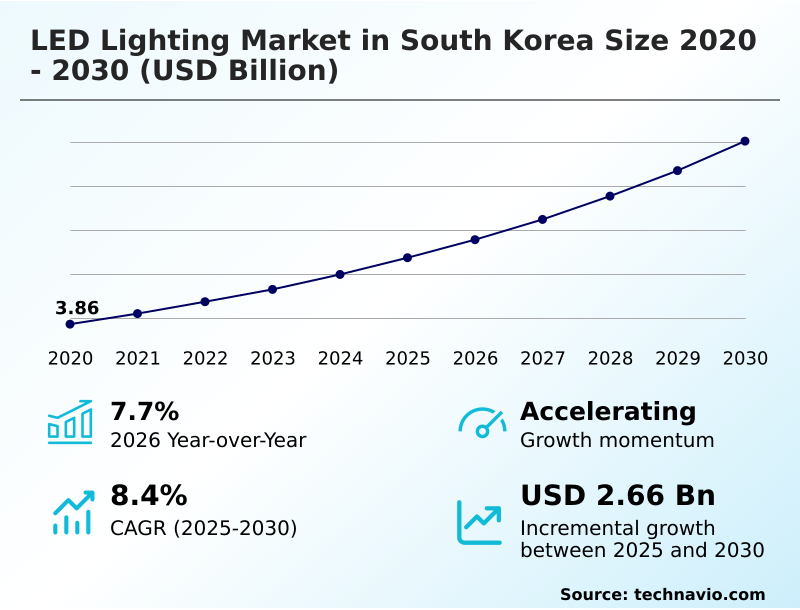
The south korea led lighting market size is valued to increase by USD 2.66 billion, at a CAGR of 8.4% from 2025 to 2030. Supportive government policies and national focus on energy efficiency will drive the south korea led lighting market.
Major Market Trends & Insights
- By Application - Residential segment was valued at USD 2.12 billion in 2024
- By Product - LED lamps segment accounted for the largest market revenue share in 2024
Market Size & Forecast
- Market Opportunities: USD 4.16 billion
- Market Future Opportunities: USD 2.66 billion
- CAGR from 2025 to 2030 : 8.4%
Market Summary
- The LED lighting market in South Korea is undergoing a significant transformation, propelled by robust government energy efficiency initiatives and rapid technological innovation. The transition extends beyond replacing legacy systems, focusing on the integration of smart lighting with the internet of things (IoT).
- This convergence is creating intelligent lighting networks that form the backbone of smart city and smart building projects. These systems utilize an array of sensors and wireless connectivity modules, enabling functionalities such as daylight harvesting and dynamic occupancy sensing.
- In a common business scenario, commercial real estate managers leverage data from networked lighting controls to analyze space utilization patterns, which informs decisions to reconfigure office layouts and optimize operational workflows, leading to significant cost savings.
- However, the market also grapples with intense price competition, which pressures manufacturers to innovate in high-value niche applications like horticultural lighting and adaptive driving beam systems to maintain profitability and differentiation.
What will be the Size of the South Korea LED Lighting Market during the forecast period?
Get Key Insights on Market Forecast (PDF) Get Free Sample
How is the South Korea LED Lighting Market Segmented?
The south korea led lighting industry research report provides comprehensive data (region-wise segment analysis), with forecasts and estimates in "USD million" for the period 2026-2030, as well as historical data from 2020-2024 for the following segments.
- Application
- Residential
- Commercial
- Industrial
- Outdoor
- Others
- Product
- LED lamps
- LED luminaires
- Distribution channel
- Offline
- Online
- Geography
- APAC
- South Korea
- APAC
By Application Insights
The residential segment is estimated to witness significant growth during the forecast period.
The residential segment is evolving beyond simple bulb replacement, driven by the deep integration of LED technology into the smart home ecosystem. Technologically adept consumers are demanding integrated lighting solutions that offer personalization, connectivity, and advanced energy management.
A key trend is the adoption of human-centric lighting systems, which utilize tunable white LED technology with advanced smart lighting controls to support natural circadian rhythm lighting.
These connected lighting platform solutions, featuring flicker-free operation and wireless connectivity modules, are designed to enhance wellness and productivity.
The market is shifting from standalone products to holistic platforms where lighting acts as a core component of the home's energy management system, capable of optimizing energy use by up to 15% through intelligent automation and integration with other internet of things (IoT) devices, thereby building significant brand equity.
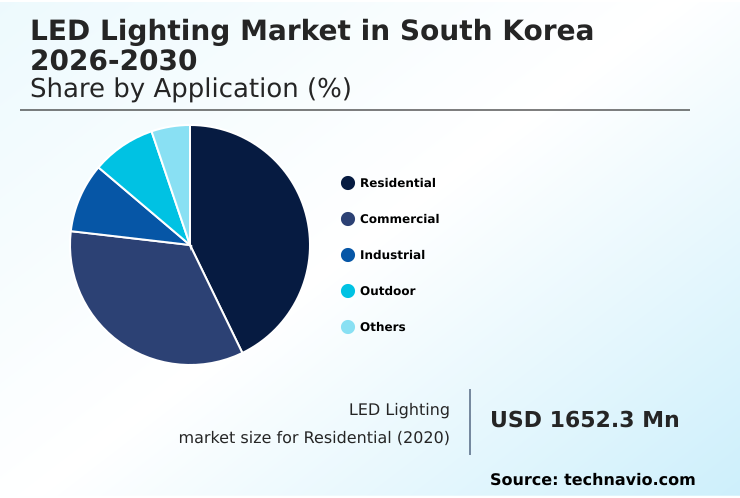
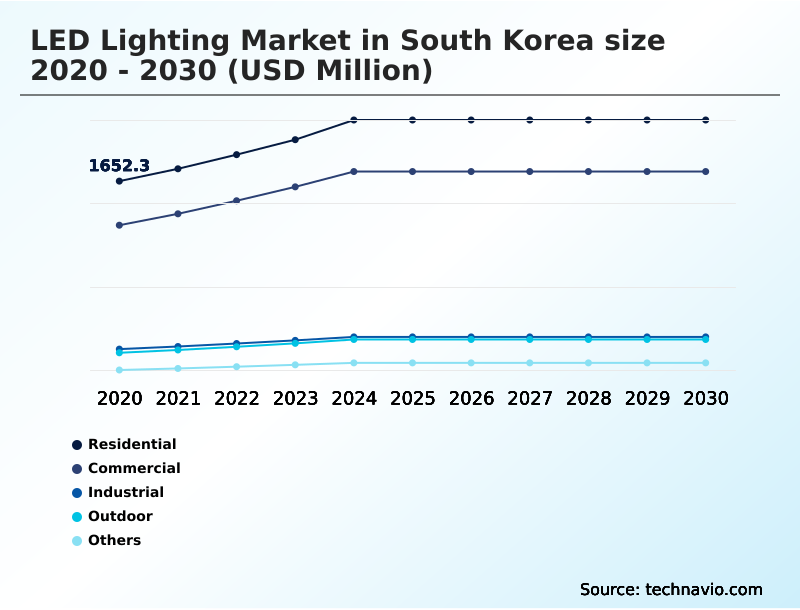
The Residential segment was valued at USD 2.12 billion in 2024 and showed a gradual increase during the forecast period.
Market Dynamics
Our researchers analyzed the data with 2025 as the base year, along with the key drivers, trends, and challenges. A holistic analysis of drivers will help companies refine their marketing strategies to gain a competitive advantage.
- Strategic positioning in the market requires a nuanced understanding of its bifurcated structure, where firms must navigate between high-volume, low-margin segments and high-value, specialized niches. Evaluating the led lighting total cost of ownership is fundamental for customers, making a compelling roi of commercial led retrofit projects a key sales driver.
- However, companies focusing solely on commoditized products face intense margin pressure. A more resilient strategy involves developing specialized solutions, such as human-centric lighting for productivity in corporate settings or specialized led for vertical farming, which leverages advanced technology in controlled environment agriculture.
- This pivot requires addressing the challenges of led lighting standardization and investing in R&D for applications like adaptive lighting in automotive headlamps and uv-c led for public health disinfection. The future of micro-led in display technology and power over ethernet in smart buildings represents high-growth frontiers.
- Success depends on navigating complex dynamics, from government subsidies on led adoption and cybersecurity risks in connected lighting systems to optimizing color rendering index in retail.
- Profit margins in these specialized sectors can be over 50% higher than in the general illumination market, highlighting the strategic importance of innovation in areas like iot integration in commercial lighting and smart lighting for energy management.
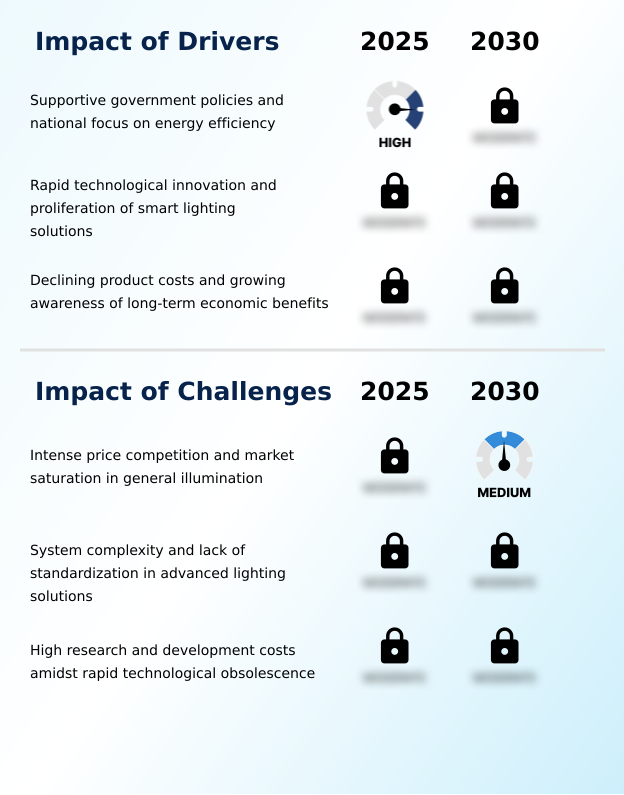
What are the key market drivers leading to the rise in the adoption of South Korea LED Lighting Industry?
- Supportive government policies and a national focus on energy efficiency are key drivers for the market's expansion.
- Market expansion is primarily fueled by a compelling economic rationale and supportive government energy efficiency initiatives.
- The significantly lower total cost of ownership (TCO) of LED technology, which can reduce energy expenditures by over 70% compared to legacy systems, is a powerful motivator for adoption across all sectors.
- Government mandates, such as stringent minimum energy performance standards (meps), compel manufacturers to continuously improve luminous efficacy. Technological advancements in phosphor materials and other high-performance led components enhance light quality and product longevity, bolstering the return on investment (roi).
- In specialized sectors like controlled agriculture, the development of optimized light recipes drives productivity gains, while the integration of occupancy sensing and daylight harvesting into smart building technologies further maximizes energy savings.
- This combination of economic benefit and regulatory push creates a self-reinforcing cycle of growth and innovation.
What are the market trends shaping the South Korea LED Lighting Industry?
- The emergence and adoption of human-centric lighting (HCL) represents a significant market trend. This approach leverages the biological and psychological effects of light to enhance human health and performance.
- Key market trends are shifting the value proposition from simple illumination to integrated, experience-oriented systems. The adoption of application-specific lighting is accelerating, with a focus on specialized lighting solutions that deliver tangible benefits in high-value sectors.
- For instance, in healthcare, phototherapy applications using precise spectral power distribution are becoming more common, while commercial buildings are leveraging intelligent lighting systems for data-driven insights, with some firms adopting light-as-a-service (laas) models. This trend has improved operational efficiency by over 20% in certain applications. Architectural lighting design is increasingly incorporating dynamic media facades and advanced controls.
- The development of quantum dot technology is enabling superior color fidelity in premium luminaires, setting new standards for light quality. Despite these advancements, achieving seamless system interoperability remains a persistent challenge for market-wide integration.
What challenges does the South Korea LED Lighting Industry face during its growth?
- Intense price competition and market saturation in the general illumination segment present a key challenge affecting industry growth.
- The primary challenge restraining the market is the dual pressure of intense price competition and increasing system complexity. The commoditization of standard components like driver integrated circuits forces companies to absorb high research and development investment to create differentiated, high-value niche applications, such as explosion-proof lighting and advanced automotive lighting systems.
- However, the fast pace of technological obsolescence shortens product lifecycles, making it difficult to recoup these investments. The shift toward networked lighting controls and integration with building management systems (BMS) introduces significant complexity, including system interoperability issues and cybersecurity vulnerabilities.
- Deploying advanced solutions like power over ethernet infrastructure requires specialized skills, and a notable skills gap among installers, estimated at around 25%, can lead to improper implementation and underperformance, thereby hindering the adoption of more sophisticated systems.
Exclusive Technavio Analysis on Customer Landscape
The south korea led lighting market forecasting report includes the adoption lifecycle of the market, covering from the innovator’s stage to the laggard’s stage. It focuses on adoption rates in different regions based on penetration. Furthermore, the south korea led lighting market report also includes key purchase criteria and drivers of price sensitivity to help companies evaluate and develop their market growth analysis strategies.
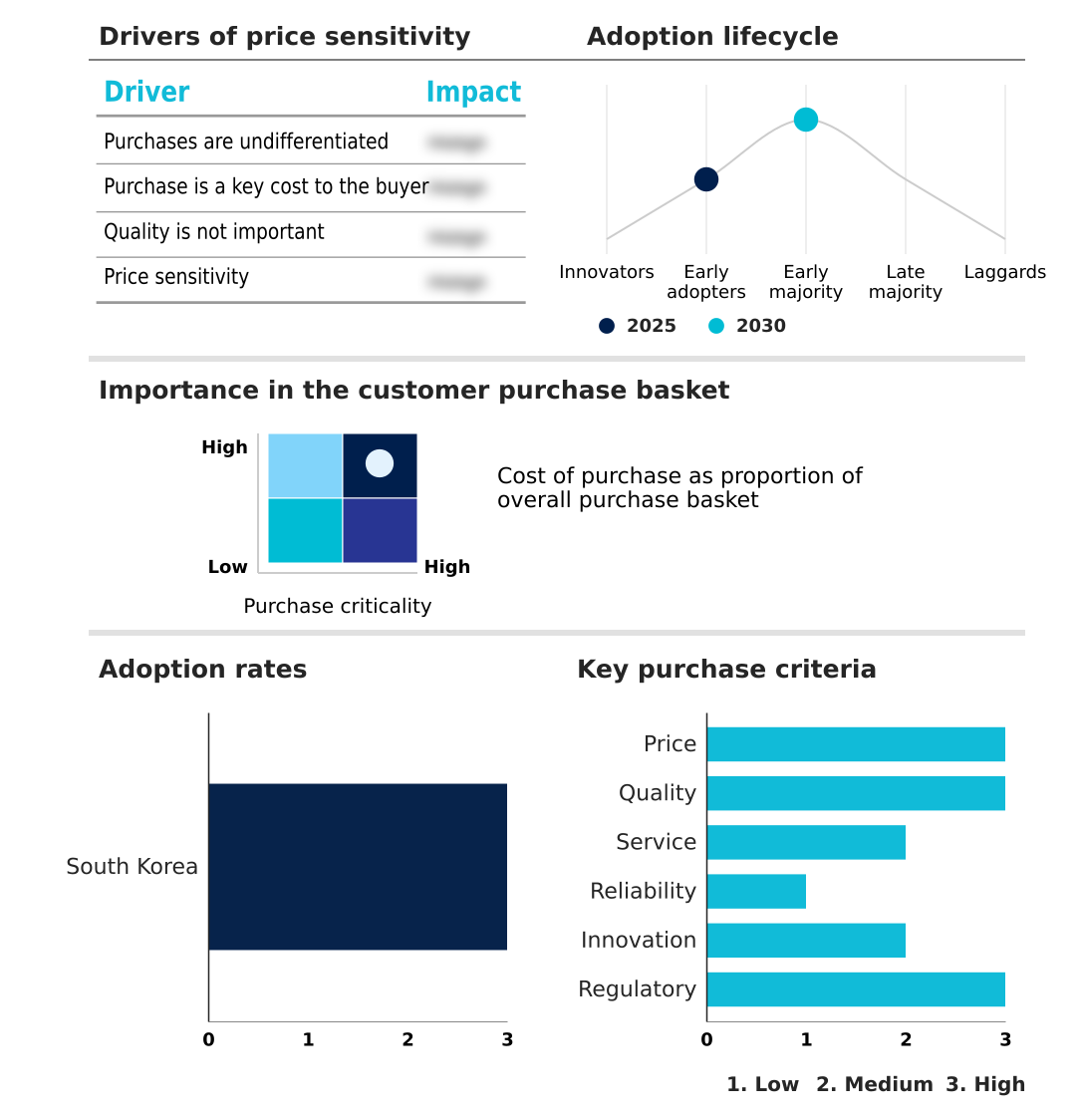
Customer Landscape of South Korea LED Lighting Industry
Competitive Landscape
Companies are implementing various strategies, such as strategic alliances, south korea led lighting market forecast, partnerships, mergers and acquisitions, geographical expansion, and product/service launches, to enhance their presence in the industry.
Acuity Brands Inc. - Offers a comprehensive portfolio of integrated LED lighting fixtures and intelligent control systems for diverse commercial, residential, and industrial applications.
The industry research and growth report includes detailed analyses of the competitive landscape of the market and information about key companies, including:
- Acuity Brands Inc.
- ams OSRAM AG
- DH LIGHTING CO. LTD.
- FEELUX Co Ltd
- GeumVit Co. Ltd.
- Heesung Electronics
- Hubbell Inc.
- Koninklijke Philips NV
- Kumho Electric, Inc.
- LEDVANCE GmbH
- LG Innotek Co. Ltd.
- Lumens Co. Ltd.
- MALTANI
- MISONICS
- SAMJINLND.CO.LTD
- Samsung Electronics Co. Ltd.
- Seoul Semiconductor Co. Ltd.
- Signify NV
- Woori Enterprise Co., Ltd.
Qualitative and quantitative analysis of companies has been conducted to help clients understand the wider business environment as well as the strengths and weaknesses of key industry players. Data is qualitatively analyzed to categorize companies as pure play, category-focused, industry-focused, and diversified; it is quantitatively analyzed to categorize companies as dominant, leading, strong, tentative, and weak.
Recent Development and News in South korea led lighting market
- In May, 2025, the Korea Land and Housing Corp. (LH) announced a new mandate requiring all future commercial projects to include interconnected, smart LED lighting systems with advanced sensor technology integrated into a central building management system.
- In April, 2025, the Rural Development Administration (RDA) launched a new initiative in partnership with domestic technology firms to develop and subsidize the deployment of next-generation horticultural LED systems for the nation's vertical farm industry.
- In March, 2025, the Ministry of Land, Infrastructure and Transport announced the '2025 Smart City Creation and Expansion Project,' allocating significant government support to foster the integration of smart technologies, including advanced LED lighting, into urban environments nationwide.
- In January, 2025, the Ministry of Land, Infrastructure and Transport launched the '2025 K-City Network Global Cooperation Program' to export South Korean smart city expertise and technologies, including advanced lighting solutions, to international partners.
Dive into Technavio’s robust research methodology, blending expert interviews, extensive data synthesis, and validated models for unparalleled South Korea LED Lighting Market insights. See full methodology.
| Market Scope | |
|---|---|
| Page number | 192 |
| Base year | 2025 |
| Historic period | 2020-2024 |
| Forecast period | 2026-2030 |
| Growth momentum & CAGR | Accelerate at a CAGR of 8.4% |
| Market growth 2026-2030 | USD 2656.4 million |
| Market structure | Fragmented |
| YoY growth 2025-2026(%) | 7.7% |
| Key countries | South Korea |
| Competitive landscape | Leading Companies, Market Positioning of Companies, Competitive Strategies, and Industry Risks |
Research Analyst Overview
- The market is characterized by a high-stakes competitive environment where continuous innovation in solid state lighting is paramount for survival. Boardroom-level decisions are increasingly focused on shifting R&D investment away from commoditized segments toward high-margin applications.
- This involves mastering complex technologies like human-centric lighting (HCL), which modulates light based on circadian rhythm, and advancing core performance metrics like luminous efficacy and color rendering index (CRI). The integration of lighting into the internet of things (IoT) is critical, with technologies such as power over ethernet (poe) lighting and visible light communication (vlc) enabling smart building functionalities.
- Specialization is key, with significant opportunities in horticultural lighting for vertical farming, adaptive driving beam systems, and uv-c led disinfection. Success hinges on developing proprietary technologies like tunable white led and superior phosphor materials to differentiate from competitors.
- Firms that successfully navigate this landscape can achieve a total cost of ownership (tco) for their customers that is up to 60% lower than their less innovative counterparts.
What are the Key Data Covered in this South Korea LED Lighting Market Research and Growth Report?
-
What is the expected growth of the South Korea LED Lighting Market between 2026 and 2030?
-
USD 2.66 billion, at a CAGR of 8.4%
-
-
What segmentation does the market report cover?
-
The report is segmented by Application (Residential, Commercial, Industrial, Outdoor, and Others), Product (LED lamps, and LED luminaires), Distribution Channel (Offline, and Online) and Geography (APAC)
-
-
Which regions are analyzed in the report?
-
APAC
-
-
What are the key growth drivers and market challenges?
-
Supportive government policies and national focus on energy efficiency, Intense price competition and market saturation in general illumination
-
-
Who are the major players in the South Korea LED Lighting Market?
-
Acuity Brands Inc., ams OSRAM AG, DH LIGHTING CO. LTD., FEELUX Co Ltd, GeumVit Co. Ltd., Heesung Electronics, Hubbell Inc., Koninklijke Philips NV, Kumho Electric, Inc., LEDVANCE GmbH, LG Innotek Co. Ltd., Lumens Co. Ltd., MALTANI, MISONICS, SAMJINLND.CO.LTD, Samsung Electronics Co. Ltd., Seoul Semiconductor Co. Ltd., Signify NV and Woori Enterprise Co., Ltd.
-
Market Research Insights
- The market's dynamics are shaped by a definitive shift toward intelligent lighting systems and integrated lighting solutions, which deliver significant business value beyond simple illumination. The adoption of advanced lighting controls enables commercial facilities to achieve energy savings exceeding 50% compared to legacy installations.
- Furthermore, the extended lifespan of high-performance LED components drastically reduces maintenance costs, contributing to a compelling return on investment (ROI) that can be realized in fewer than 24 months for large-scale retrofits. The integration with building management systems provides data-driven insights that are crucial for optimizing operational workflows.
- These smart building technologies are central to national smart city initiatives, positioning intelligent lighting as a critical enabler of energy management and operational efficiency across urban infrastructure.
We can help! Our analysts can customize this south korea led lighting market research report to meet your requirements.
 RIA -
RIA - 
