
Low-Cost Carrier (LCC) Market Analysis, Size, and Forecast 2025-2029: APAC (Australia, China, India, Japan), North America (US and Canada), Europe (Germany, Italy, Spain, UK), Middle East and Africa , and South America

Low-Cost Carrier (LCC) Market Analysis, Size, and Forecast 2025-2029:
APAC (Australia, China, India, Japan), North America (US and Canada), Europe (Germany, Italy, Spain, UK), Middle East and Africa , and South America

Published: Jan 2025 193 Pages SKU: IRTNTR70566

Market Overview at a Glance

$348.2 B
Market Opportunity
15.4%
CAGR
15.2
YoY growth 2024-2025(%)

Low-Cost Carrier (LCC) Market Size 2025-2029

The low-cost carrier (LCC) market size is forecast to increase by USD 348.2 billion, at a CAGR of 15.4% between 2024 and 2029.

  • The market is experiencing significant growth, driven by the increasing air passenger traffic worldwide. This trend is fueled by the rising preference for affordable travel options, making LCCs an attractive choice for price-sensitive consumers. However, this market is not without challenges. Operating expenses for LCC companies continue to rise, putting pressure on their profitability. The need to maintain low fares while managing these costs presents a significant challenge. Moreover, the increasing adoption of smart airports and advanced technologies, such as contactless check-in and mobile applications, is transforming the industry landscape. LCCs must adapt to these trends to remain competitive and provide a seamless travel experience for their customers.
  • In summary, the LCC market is characterized by robust growth, fueled by increasing passenger traffic and cost-conscious consumers, while facing challenges from rising operating expenses and the need to innovate to stay competitive in a rapidly evolving industry. Companies seeking to capitalize on market opportunities and navigate challenges effectively must focus on optimizing their operational costs, leveraging technology to enhance the customer experience, and continuously adapting to changing market dynamics.

What will be the Size of the Low-Cost Carrier (LCC) Market during the forecast period?
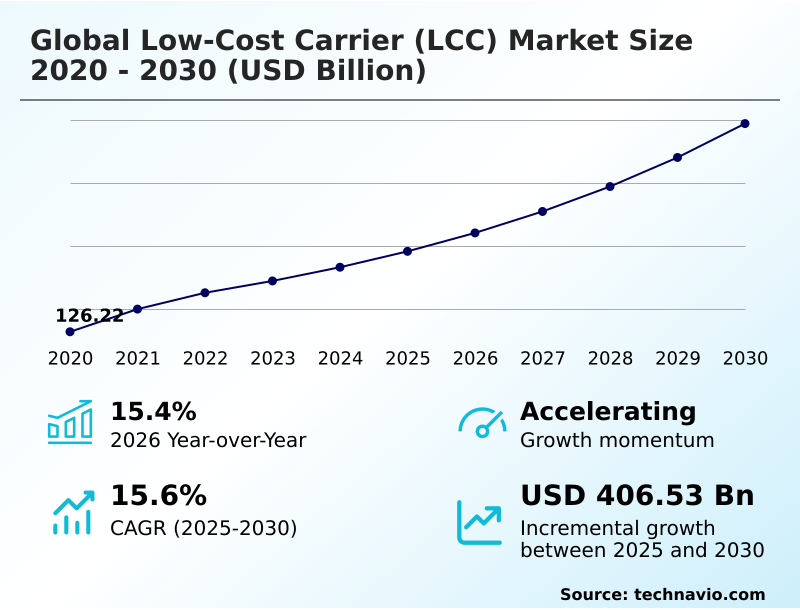
Low-Cost Carrier (LCC) Market Size

Explore in-depth regional segment analysis with market size data - historical 2019-2023 and forecasts 2025-2029 - in the full report.  
Request Free Sample

In the market, dynamics continue to evolve, shaping various sectors with ongoing activities and patterns. Ground handling processes are streamlined through self-service kiosks and digital platforms, optimizing distribution channels and reservation systems. Yield management software and pricing strategies adapt to passenger demand, while route planning and seat allocation are fine-tuned for maximum load factor and capacity utilization. Revenue management and passenger loyalty programs are leveraged to generate ancillary revenue through dynamic pricing and slot allocation. Risk management and airline alliances are essential for cost optimization and fuel efficiency, as LCCs navigate the complexities of turnaround time and fleet management.

Passenger experience is a top priority, with in-flight entertainment, cabin crew training, and customer service enhancing the overall journey. Safety regulations, airport infrastructure, technical maintenance, and sustainability initiatives are continually addressed to ensure operational efficiency and regulatory compliance. Cargo operations, charter flights, aircraft leasing, and digital transformation are additional areas of focus for LCCs, as they adapt to the ever-changing market landscape. Code sharing agreements, unaccompanied minors, online check-in, and web check-in are integral components of the LCC business model, further emphasizing the continuous dynamism of this sector. In this competitive environment, LCCs must remain agile, addressing the challenges of aviation safety, flight scheduling, inventory management, and aircraft maintenance, while maintaining a focus on passenger experience and cost optimization.

How is this Low-Cost Carrier (LCC) Industry segmented?

The low-cost carrier (LCC) industry research report provides comprehensive data (region-wise segment analysis), with forecasts and estimates in "USD billion" for the period 2025-2029, as well as historical data from 2019-2023 for the following segments.

  • Service
    • Passenger service
    • Cargo service
  • Type
    • Narrow body
    • Wide body
  • Haul
    • Short Haul
    • Long Haul
  • Geography
    • North America
      • US
      • Canada
    • Europe
      • Germany
      • Italy
      • Spain
      • UK
    • APAC
      • Australia
      • China
      • India
      • Japan
    • Rest of World (ROW)

By Service Insights

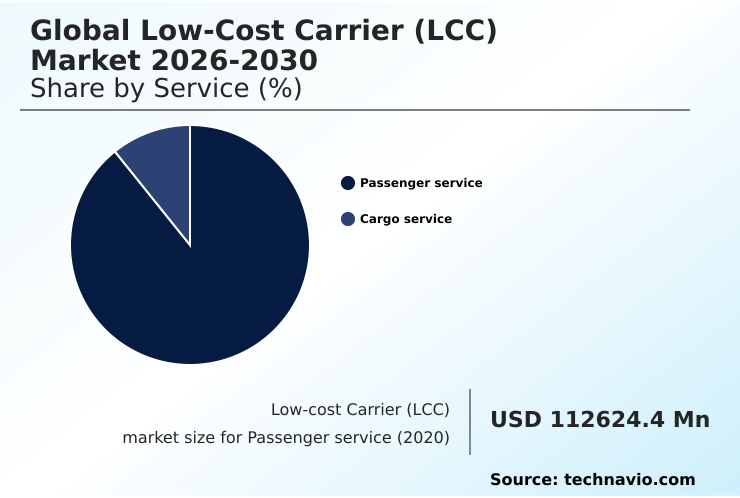
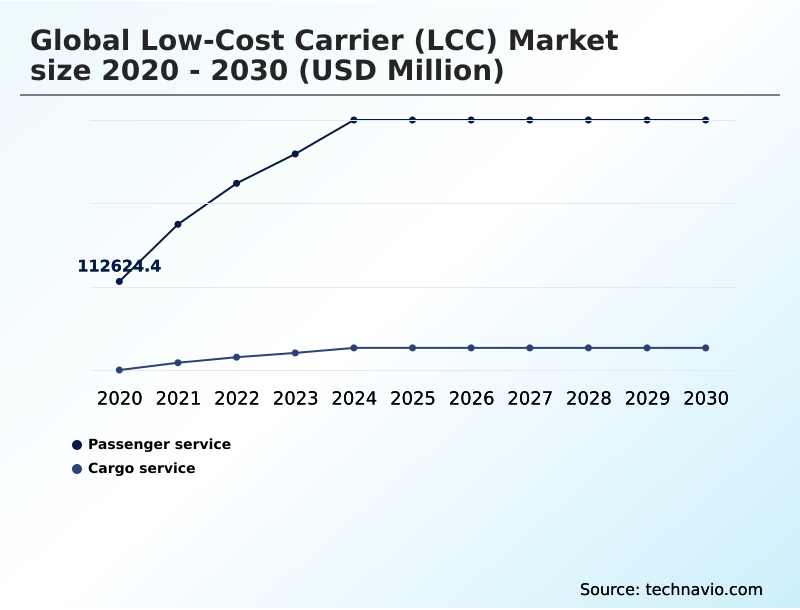
The passenger service segment is estimated to witness significant growth during the forecast period.

The market has experienced significant growth due to the rising number of air passengers. According to the International Air Transport Association (IATA), global passenger demand, measured in revenue passenger kilometers (RPKs), increased by 8.1% year-on-year in November 2024, while capacity, measured in available seat kilometers (ASK), grew by 5.7%. This led to a load factor of 83.4%, an improvement of 1.9 percentage points. International passenger demand surged by 11.6% compared to November 2023, with capacity expanding by 8.6%, resulting in a higher load factor. LCCs face substantial fuel costs, which can significantly impact their profitability, as they already offer lower fares than traditional carriers.

Self-service kiosks and online check-in have become common practices in the LCC industry, streamlining the distribution channels and reservation systems. Yield management software and dynamic pricing help optimize revenue management. Marketing campaigns and passenger loyalty programs are essential tools for attracting and retaining customers. Safety regulations are strictly adhered to, ensuring aviation safety. Hub-and-spoke models, route planning, and fleet management are crucial elements of LCC operations. In-flight entertainment, passenger experience, and seat allocation contribute to customer satisfaction. Pricing strategies, baggage fees, and ancillary revenue are essential revenue streams. Ground handling, turnaround time, and cost optimization are vital for operational efficiency.

Risk management, airline alliances, and code sharing agreements are essential for managing uncertainties and expanding reach. Scheduled flights, capacity utilization, and load factor are key performance indicators. Cabin crew training, airport infrastructure, and technical maintenance ensure high-quality services. Sustainability initiatives, cargo operations, and regulatory compliance are essential for long-term growth. In conclusion, the LCC market is dynamic and evolving, with various entities shaping its trends and patterns. From self-service kiosks and reservation systems to safety regulations and sustainability initiatives, each component plays a crucial role in the industry's growth and success.

Low-Cost Carrier (LCC) Market Size

Request Free Sample

The Passenger service segment was valued at USD 187.60 billion in 2019 and showed a gradual increase during the forecast period.
Regional Analysis

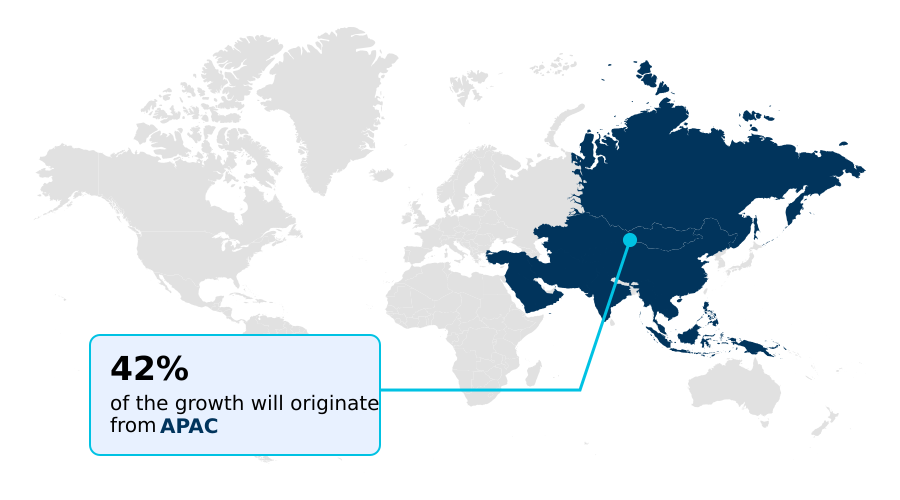
APAC is estimated to contribute 47% to the growth of the global market during the forecast period. Technavio's analysts have elaborately explained the regional trends and drivers that shape the market during the forecast period.
Low-Cost Carrier (LCC) Market Share by Geography

 Request Free Sample

The market in the Asia-Pacific (APAC) region is experiencing significant growth due to the increasing passenger traffic in the area. This trend has led to investments in new airport constructions and upgrades of existing facilities in countries like China, Japan, India, South Korea, Singapore, and Australia. The rapid expansion of the LCC market in APAC can be largely attributed to the rising air passenger transportation in the region, catering to the growing middle-class population. Self-service kiosks and online check-in have become the norm in the LCC industry, streamlining the distribution channels and reservation systems. Yield management software and dynamic pricing strategies enable airlines to optimize capacity utilization and revenue management.

Marketing campaigns and route planning are crucial for attracting passengers and expanding network coverage. Safety regulations, crew scheduling, and cabin crew training ensure a harmonious passenger experience. Ground handling, turnaround time, and fuel efficiency are essential components of cost optimization. Alliances and code sharing agreements facilitate collaboration and growth. In-flight entertainment, ancillary revenue, and frequent flyer programs add value to the passenger experience. Hub-and-spoke models and point-to-point flights cater to diverse travel needs. Seat allocation, baggage fees, and ticket pricing are critical aspects of passenger yield management. Risk management, aircraft maintenance, and inventory management are essential for operational efficiency. Aviation safety, regulatory compliance, and air traffic control are vital for maintaining a harmonious and secure environment.

Digital transformation, cargo operations, and sustainability initiatives are shaping the future of the LCC industry. Charter flights and aircraft leasing offer flexibility and cost savings. Fleet management, route planning, and revenue management are key areas for continuous improvement. Passenger loyalty programs and customer service are essential for retaining passengers and building brand loyalty. Boarding processes, capacity utilization, and aircraft maintenance are crucial elements of a successful LCC operation.

Market Dynamics

Our researchers analyzed the data with 2024 as the base year, along with the key drivers, trends, and challenges. A holistic analysis of drivers will help companies refine their marketing strategies to gain a competitive advantage.

In the dynamic and competitive market, innovative business models and agile operations set these airlines apart. LCCs prioritize cost efficiency through streamlined services, such as self-service check-in, online booking, and ancillary revenue streams. Fuel surcharges are minimized, and base fares remain affordable due to reduced overhead costs. LCCs focus on point-to-point routes, optimizing aircraft utilization and fleet size. Seat density is maximized for high load factors, while frequent flyer programs are often simplified or non-existent. LCCs' nimble business strategies enable them to adapt quickly to market trends and consumer demands, offering value-conscious travelers affordable airfare options. These airlines' success lies in their ability to deliver a lean, cost-effective flying experience without compromising safety or essential services.

What are the key market drivers leading to the rise in the adoption of Low-Cost Carrier (LCC) Industry?

  • Air passenger traffic represents the primary growth factor in the market, with continually rising numbers driving market expansion. 
  • The market has experienced significant growth due to the increasing number of air passengers worldwide. Economic development in emerging countries like India, China, and Indonesia, as well as the expansion of the global tourism industry, are primary drivers of this trend. The rise in international tourism has led to increased investments in new airport construction and upgrades in countries such as Spain, China, Italy, the UK, Germany, and Thailand. As a result, LCCs have seen an increase in demand for their services. To meet this demand, they have implemented various strategies, including the use of self-service kiosks and reservation systems to streamline operations and improve efficiency.
  • Yield management software and pricing strategies have also been employed to optimize passenger yield and maximize revenue. Safety regulations remain a top priority for LCCs, ensuring a harmonious passenger experience. In-flight entertainment and crew scheduling are other areas where LCCs have made strides, offering passengers a more immersive experience while maintaining operational efficiency. Marketing campaigns and fleet management are essential components of LCC success. Effective marketing efforts help attract passengers, while fleet management ensures the optimal use of resources. The hub-and-spoke model is a common strategy used by LCCs to connect passengers to their destinations efficiently and cost-effectively.
  • In conclusion, the LCC market is driven by the increasing number of air passengers, primarily due to economic development and the global tourism industry's growth. LCCs have responded to this demand by implementing various strategies, including the use of technology, efficient operations, and effective marketing efforts, to meet passenger needs while maintaining safety regulations and maximizing revenue.

What are the market trends shaping the Low-Cost Carrier (LCC) Industry?

  • The increasing demand for smart airports represents a significant market trend. Intelligent airport systems, characterized by advanced technology and enhanced passenger experience, are becoming increasingly preferred.
  • The market is characterized by scheduled flights offering point-to-point services, focusing on seat allocation, route planning, revenue management, and passenger loyalty programs to generate ancillary revenue. LCCs employ dynamic pricing strategies and slot allocation for effective risk management. Airline alliances are crucial for expanding networks and enhancing operational efficiency. Smart airports, a collaborative initiative between the International Air Transport Association (IATA) and the Airports Council International (ACI), play a significant role in optimizing airport operations. These airports integrate all systems into a single digital grid, enabling real-time information sharing and cross-functional collaborations. This results in improved operational efficiency, an enhanced passenger experience, and the delivery of personalized services.
  • LCCs operate on a high-speed broadband IP platform, ensuring ground handling processes are streamlined and turnaround times are minimized. Key market dynamics include route planning, seat allocation, revenue management, and the implementation of passenger loyalty programs. Ancillary revenue, dynamic pricing, and slot allocation are essential strategies for managing risk and increasing profitability. Airline alliances contribute to network expansion and operational synergies.

What challenges does the Low-Cost Carrier (LCC) Industry face during its growth?

  • The escalating operating expenses of Low-Cost Carrier (LCC) companies pose a significant challenge to the industry's growth trajectory. 
  • The market is experiencing increased operational expenses due to rising fuel prices and labor costs. Fuel efficiency has become a critical focus area for LCCs as crude oil prices continue to fluctuate, with geopolitical events such as US sanctions on oil exports and OPEC production cuts contributing to these price increases. In 2023, labor costs accounted for approximately one-third of operational costs in the aviation industry. Although labor costs have historically been stable, they are now rising significantly, putting pressure on unit costs and negatively impacting profit margins. To mitigate these costs, LCCs are exploring various strategies, including charter flights, aircraft leasing, and digital transformation.
  • Cargo operations and cabin crew training are also being optimized to generate additional revenue streams. Airport infrastructure and technical maintenance are undergoing improvements to enhance efficiency and reduce costs. Sustainability initiatives are also gaining traction, as LCCs seek to reduce their carbon footprint and appeal to environmentally-conscious consumers. Customer service remains a priority, with code sharing agreements and unaccompanied minor services being offered to enhance the travel experience. Online check-in and other digital services are also being implemented to streamline the customer journey and reduce operational costs. Overall, the LCC market is adapting to these cost pressures through a combination of operational efficiency, strategic partnerships, and digital transformation.

Exclusive Customer Landscape

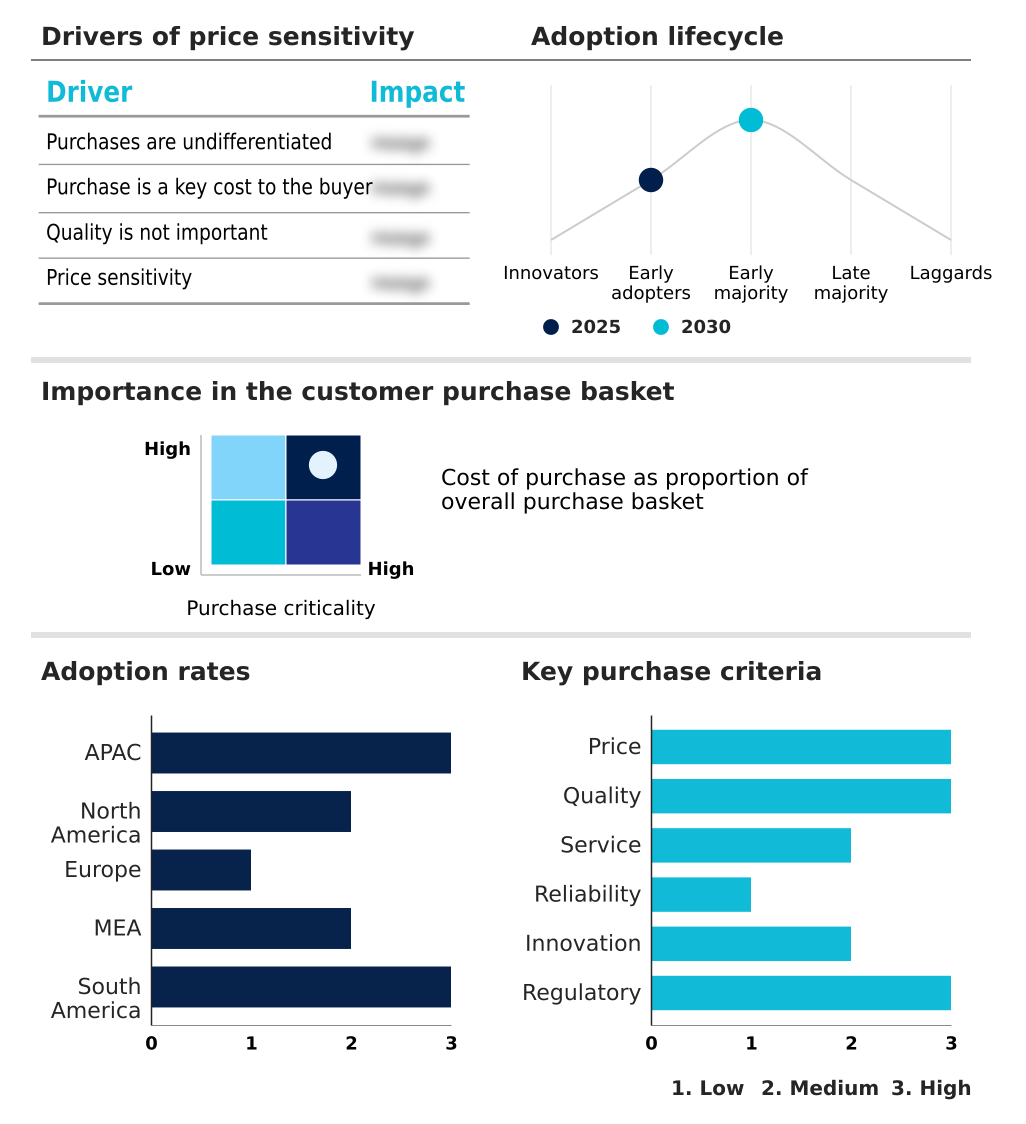
The low-cost carrier (LCC) market forecasting report includes the adoption lifecycle of the market, covering from the innovator's stage to the laggard's stage. It focuses on adoption rates in different regions based on penetration. Furthermore, the low-cost carrier (LCC) market report also includes key purchase criteria and drivers of price sensitivity to help companies evaluate and develop their market growth analysis strategies.
Low-Cost Carrier (LCC) Market Share by Geography

 Customer Landscape

Key Companies & Market Insights

Companies are implementing various strategies, such as strategic alliances, low-cost carrier (LCC) market forecast, partnerships, mergers and acquisitions, geographical expansion, and product/service launches, to enhance their presence in the industry.

Air Arabia PJSC - This company specializes in budget air travel, providing an economical alternative for consumers. 

The industry research and growth report includes detailed analyses of the competitive landscape of the market and information about key companies, including:

  • Air Arabia PJSC
  • Air Canada
  • Capital A Berhad
  • Cebu Pacific
  • easyJet plc
  • Fly LEVEL SL
  • FLYPOP Ltd.
  • Frontier Group Holdings Inc.
  • InterGlobe Aviation Ltd.
  • JetBlue Airways Corp.
  • Lion Air
  • Norwegian Air Shuttle ASA
  • Qantas Airways Ltd.
  • Ryanair Holdings plc
  • Singapore Airlines Ltd.
  • Southwest Airlines Co.
  • Spicejet Ltd.
  • Spirit Airlines Inc.
  • Vueling Airlines SA
  • WestJet Encore Ltd.

Qualitative and quantitative analysis of companies has been conducted to help clients understand the wider business environment as well as the strengths and weaknesses of key industry players. Data is qualitatively analyzed to categorize companies as pure play, category-focused, industry-focused, and diversified; it is quantitatively analyzed to categorize companies as dominant, leading, strong, tentative, and weak.

Recent Development and News in Low-Cost Carrier (LCC) Market

  • In January 2024, Ryanair, Europe's leading low-cost carrier (LCC), announced the launch of its new long-haul service, "Ryanair Sun," with its first flights scheduled for summer 2025 (Ryanair Press Release, 2024). This expansion marked a significant shift in the business model for the Irish airline, aiming to compete with traditional long-haul carriers.
  • In March 2024, Wizz Air and Lufthansa Group's low-cost subsidiary, Eurowings Discover, formed a strategic partnership to expand their networks and improve connectivity between Central and Eastern Europe and Germany (Bloomberg, 2024). This collaboration allowed both carriers to leverage each other's strengths and broaden their market reach.
  • In May 2024, IndiGo, India's largest LCC, raised USD1.5 billion through a qualified institutional placement (QIP) to fund fleet expansion and network growth (IndiGo Press Release, 2024). This substantial investment positioned the airline for further growth and market dominance in India's rapidly expanding aviation sector.
  • In April 2025, the European Commission approved the merger of EasyJet and Norwegian Air Shuttle's low-cost long-haul subsidiary, Norwegian Air UK (European Commission Press Release, 2025). The approval paved the way for the creation of a stronger competitor in the European LCC market, offering more routes and increased competition against traditional carriers.

Research Analyst Overview

  • In the dynamic market, customer segmentation plays a crucial role in catering to diverse traveler needs. Regional airlines adjust their offerings based on customer feedback and brand perception, with business class and premium economy seats prioritizing passenger comfort. Travel agencies and mobile booking apps facilitate sales conversion, while data analytics and marketing analytics inform strategic decisions. Aviation technology advances, such as airport security and in-flight wi-fi, enhance the overall travel experience. Employee engagement is vital for maintaining high service levels, especially during periods of airline consolidation. Economy class travelers seek affordable fares, while corporate travel and business travelers require reliable, efficient services.
  • Ultra-low-cost carriers (ULCC) attract price-sensitive leisure travelers, while loyalty program management and travel insurance offer additional value. Social media marketing and baggage handling also influence customer satisfaction. Seat comfort and premium amenities, such as first class and business class offerings, differentiate LCCs, ensuring a competitive edge in the evolving travel technology landscape.

Dive into Technavio's robust research methodology, blending expert interviews, extensive data synthesis, and validated models for unparalleled Low-Cost Carrier (LCC) Market insights. See full methodology.

Market Scope

Report Coverage

Details

Page number

193

Base year

2024

Historic period

2019-2023

Forecast period

2025-2029

Growth momentum & CAGR

Accelerate at a CAGR of 15.4%

Market growth 2025-2029

USD 348.2 billion

Market structure

Fragmented

YoY growth 2024-2025(%)

15.2

Key countries

US, China, India, Japan, Canada, UK, Germany, Australia, Spain, and Italy

Competitive landscape

Leading Companies, Market Positioning of Companies, Competitive Strategies, and Industry Risks

Request Free Sample

What are the Key Data Covered in this Low-Cost Carrier (LCC) Market Research and Growth Report?

  • CAGR of the Low-Cost Carrier (LCC) industry during the forecast period
  • Detailed information on factors that will drive the growth and forecasting between 2025 and 2029
  • Precise estimation of the size of the market and its contribution of the industry in focus to the parent market
  • Accurate predictions about upcoming growth and trends and changes in consumer behaviour
  • Growth of the market across APAC, North America, Europe, Middle East and Africa, and South America
  • Thorough analysis of the market's competitive landscape and detailed information about companies
  • Comprehensive analysis of factors that will challenge the low-cost carrier (LCC) market growth of industry companies

We can help! Our analysts can customize this low-cost carrier (LCC) market research report to meet your requirements.

Get in touch

1 Executive Summary

  • 1.1 Market overview
    • Executive Summary - Chart on Market Overview
    • Executive Summary - Data Table on Market Overview
    • Executive Summary - Chart on Global Market Characteristics
    • Executive Summary - Chart on Market by Geography
    • Executive Summary - Chart on Market Segmentation by Service
    • Executive Summary - Chart on Market Segmentation by Type
    • Executive Summary - Chart on Incremental Growth
    • Executive Summary - Data Table on Incremental Growth
    • Executive Summary - Chart on Company Market Positioning

2 Technavio Analysis

  • 2.1 Analysis of price sensitivity, lifecycle, customer purchase basket, adoption rates, and purchase criteria
    • Analysis of price sensitivity, lifecycle, customer purchase basket, adoption rates, and purchase criteria
  • 2.2 Criticality of inputs and Factors of differentiation
    • Overview on criticality of inputs and factors of differentiation
  • 2.3 Factors of disruption
    • Overview on factors of disruption
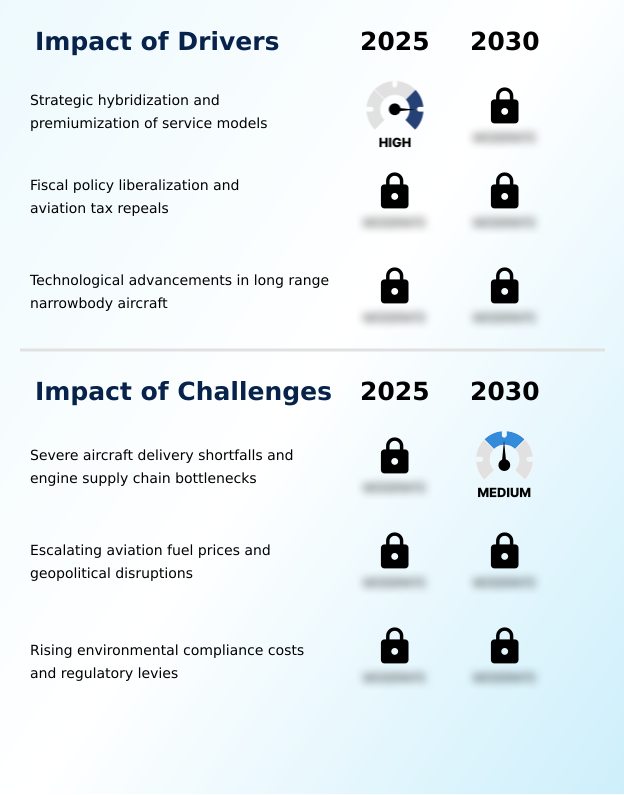
  • 2.4 Impact of drivers and challenges
    • Impact of drivers and challenges in 2024 and 2029

3 Market Landscape

  • 3.1 Market ecosystem
    • Parent Market
    • Data Table on - Parent Market
  • 3.2 Market characteristics
    • Market characteristics analysis
  • 3.3 Value chain analysis
    • Value chain analysis

4 Market Sizing

  • 4.1 Market definition
    • Offerings of companies included in the market definition
  • 4.2 Market segment analysis
    • Market segments
  • 4.3 Market size 2024
    • 4.4 Market outlook: Forecast for 2024-2029
      • Chart on Global - Market size and forecast 2024-2029 ($ billion)
      • Data Table on Global - Market size and forecast 2024-2029 ($ billion)
      • Chart on Global Market: Year-over-year growth 2024-2029 (%)
      • Data Table on Global Market: Year-over-year growth 2024-2029 (%)

    5 Historic Market Size

    • 5.1 Global Low-Cost Carrier (LCC) Market 2019 - 2023
      • Historic Market Size - Data Table on Global Low-Cost Carrier (LCC) Market 2019 - 2023 ($ billion)
    • 5.2 Service segment analysis 2019 - 2023
      • Historic Market Size - Service Segment 2019 - 2023 ($ billion)
    • 5.3 Type segment analysis 2019 - 2023
      • Historic Market Size - Type Segment 2019 - 2023 ($ billion)
    • 5.4 Geography segment analysis 2019 - 2023
      • Historic Market Size - Geography Segment 2019 - 2023 ($ billion)
    • 5.5 Country segment analysis 2019 - 2023
      • Historic Market Size - Country Segment 2019 - 2023 ($ billion)

    6 Qualitative Analysis

    • 6.1 Impact of AI in the global low-cost carrier (LCC) market

      7 Five Forces Analysis

      • 7.1 Five forces summary
        • Five forces analysis - Comparison between 2024 and 2029
      • 7.2 Bargaining power of buyers
        • Bargaining power of buyers - Impact of key factors 2024 and 2029
      • 7.3 Bargaining power of suppliers
        • Bargaining power of suppliers - Impact of key factors in 2024 and 2029
      • 7.4 Threat of new entrants
        • Threat of new entrants - Impact of key factors in 2024 and 2029
      • 7.5 Threat of substitutes
        • Threat of substitutes - Impact of key factors in 2024 and 2029
      • 7.6 Threat of rivalry
        • Threat of rivalry - Impact of key factors in 2024 and 2029
      • 7.7 Market condition
        • Chart on Market condition - Five forces 2024 and 2029

      8 Market Segmentation by Service

      • 8.1 Market segments
        • Chart on Service - Market share (2024-2029) (%)
        • Data Table on Service - Market share (2024-2029) (%)
      • 8.2 Comparison by Service
        • Chart on Comparison by Service
        • Data Table on Comparison by Service
      • 8.3 Passenger service - Market size and forecast (2024-2029)
        • Chart on Passenger service - Market size and forecast (2024-2029) ($ billion)
        • Data Table on Passenger service - Market size and forecast (2024-2029) ($ billion)
        • Chart on Passenger service - Year-over-year growth (2024-2029) (%)
        • Data Table on Passenger service - Year-over-year growth (2024-2029) (%)
      • 8.4 Cargo service - Market size and forecast (2024-2029)
        • Chart on Cargo service - Market size and forecast (2024-2029) ($ billion)
        • Data Table on Cargo service - Market size and forecast (2024-2029) ($ billion)
        • Chart on Cargo service - Year-over-year growth (2024-2029) (%)
        • Data Table on Cargo service - Year-over-year growth (2024-2029) (%)
      • 8.5 Market opportunity by Service
        • Market opportunity by Service ($ billion)
        • Data Table on Market opportunity by Service ($ billion)

      9 Market Segmentation by Type

      • 9.1 Market segments
        • Chart on Type - Market share (2024-2029) (%)
        • Data Table on Type - Market share (2024-2029) (%)
      • 9.2 Comparison by Type
        • Chart on Comparison by Type
        • Data Table on Comparison by Type
      • 9.3 Narrow body - Market size and forecast (2024-2029)
        • Chart on Narrow body - Market size and forecast (2024-2029) ($ billion)
        • Data Table on Narrow body - Market size and forecast (2024-2029) ($ billion)
        • Chart on Narrow body - Year-over-year growth (2024-2029) (%)
        • Data Table on Narrow body - Year-over-year growth (2024-2029) (%)
      • 9.4 Wide body - Market size and forecast (2024-2029)
        • Chart on Wide body - Market size and forecast (2024-2029) ($ billion)
        • Data Table on Wide body - Market size and forecast (2024-2029) ($ billion)
        • Chart on Wide body - Year-over-year growth (2024-2029) (%)
        • Data Table on Wide body - Year-over-year growth (2024-2029) (%)
      • 9.5 Market opportunity by Type
        • Market opportunity by Type ($ billion)
        • Data Table on Market opportunity by Type ($ billion)

      10 Market Segmentation by Haul

      • 10.1 Market segments
        • Chart on Haul - Market share (2024-2029) (%)
        • Data Table on Haul - Market share (2024-2029) (%)
      • 10.2 Comparison by Haul
        • Chart on Comparison by Haul
        • Data Table on Comparison by Haul
      • 10.3 Short Haul - Market size and forecast (2024-2029)
        • Chart on Short Haul - Market size and forecast (2024-2029) ($ billion)
        • Data Table on Short Haul - Market size and forecast (2024-2029) ($ billion)
        • Chart on Short Haul - Year-over-year growth (2024-2029) (%)
        • Data Table on Short Haul - Year-over-year growth (2024-2029) (%)
      • 10.4 Long Haul - Market size and forecast (2024-2029)
        • Chart on Long Haul - Market size and forecast (2024-2029) ($ billion)
        • Data Table on Long Haul - Market size and forecast (2024-2029) ($ billion)
        • Chart on Long Haul - Year-over-year growth (2024-2029) (%)
        • Data Table on Long Haul - Year-over-year growth (2024-2029) (%)
      • 10.5 Market opportunity by Haul
        • Market opportunity by Haul ($ billion)
        • Data Table on Market opportunity by Haul ($ billion)

      11 Customer Landscape

      • 11.1 Customer landscape overview
        • Analysis of price sensitivity, lifecycle, customer purchase basket, adoption rates, and purchase criteria

      12 Geographic Landscape

      • 12.1 Geographic segmentation
        • Chart on Market share by geography 2024-2029 (%)
        • Data Table on Market share by geography 2024-2029 (%)
      • 12.2 Geographic comparison
        • Chart on Geographic comparison
        • Data Table on Geographic comparison
      • 12.3 APAC - Market size and forecast 2024-2029
        • Chart on APAC - Market size and forecast 2024-2029 ($ billion)
        • Data Table on APAC - Market size and forecast 2024-2029 ($ billion)
        • Chart on APAC - Year-over-year growth 2024-2029 (%)
        • Data Table on APAC - Year-over-year growth 2024-2029 (%)
      • 12.4 North America - Market size and forecast 2024-2029
        • Chart on North America - Market size and forecast 2024-2029 ($ billion)
        • Data Table on North America - Market size and forecast 2024-2029 ($ billion)
        • Chart on North America - Year-over-year growth 2024-2029 (%)
        • Data Table on North America - Year-over-year growth 2024-2029 (%)
      • 12.5 Europe - Market size and forecast 2024-2029
        • Chart on Europe - Market size and forecast 2024-2029 ($ billion)
        • Data Table on Europe - Market size and forecast 2024-2029 ($ billion)
        • Chart on Europe - Year-over-year growth 2024-2029 (%)
        • Data Table on Europe - Year-over-year growth 2024-2029 (%)
      • 12.6 Middle East and Africa - Market size and forecast 2024-2029
        • Chart on Middle East and Africa - Market size and forecast 2024-2029 ($ billion)
        • Data Table on Middle East and Africa - Market size and forecast 2024-2029 ($ billion)
        • Chart on Middle East and Africa - Year-over-year growth 2024-2029 (%)
        • Data Table on Middle East and Africa - Year-over-year growth 2024-2029 (%)
      • 12.7 South America - Market size and forecast 2024-2029
        • Chart on South America - Market size and forecast 2024-2029 ($ billion)
        • Data Table on South America - Market size and forecast 2024-2029 ($ billion)
        • Chart on South America - Year-over-year growth 2024-2029 (%)
        • Data Table on South America - Year-over-year growth 2024-2029 (%)
      • 12.8 US - Market size and forecast 2024-2029
        • Chart on US - Market size and forecast 2024-2029 ($ billion)
        • Data Table on US - Market size and forecast 2024-2029 ($ billion)
        • Chart on US - Year-over-year growth 2024-2029 (%)
        • Data Table on US - Year-over-year growth 2024-2029 (%)
      • 12.9 China - Market size and forecast 2024-2029
        • Chart on China - Market size and forecast 2024-2029 ($ billion)
        • Data Table on China - Market size and forecast 2024-2029 ($ billion)
        • Chart on China - Year-over-year growth 2024-2029 (%)
        • Data Table on China - Year-over-year growth 2024-2029 (%)
      • 12.10 India - Market size and forecast 2024-2029
        • Chart on India - Market size and forecast 2024-2029 ($ billion)
        • Data Table on India - Market size and forecast 2024-2029 ($ billion)
        • Chart on India - Year-over-year growth 2024-2029 (%)
        • Data Table on India - Year-over-year growth 2024-2029 (%)
      • 12.11 Japan - Market size and forecast 2024-2029
        • Chart on Japan - Market size and forecast 2024-2029 ($ billion)
        • Data Table on Japan - Market size and forecast 2024-2029 ($ billion)
        • Chart on Japan - Year-over-year growth 2024-2029 (%)
        • Data Table on Japan - Year-over-year growth 2024-2029 (%)
      • 12.12 Canada - Market size and forecast 2024-2029
        • Chart on Canada - Market size and forecast 2024-2029 ($ billion)
        • Data Table on Canada - Market size and forecast 2024-2029 ($ billion)
        • Chart on Canada - Year-over-year growth 2024-2029 (%)
        • Data Table on Canada - Year-over-year growth 2024-2029 (%)
      • 12.13 UK - Market size and forecast 2024-2029
        • Chart on UK - Market size and forecast 2024-2029 ($ billion)
        • Data Table on UK - Market size and forecast 2024-2029 ($ billion)
        • Chart on UK - Year-over-year growth 2024-2029 (%)
        • Data Table on UK - Year-over-year growth 2024-2029 (%)
      • 12.14 Australia - Market size and forecast 2024-2029
        • Chart on Australia - Market size and forecast 2024-2029 ($ billion)
        • Data Table on Australia - Market size and forecast 2024-2029 ($ billion)
        • Chart on Australia - Year-over-year growth 2024-2029 (%)
        • Data Table on Australia - Year-over-year growth 2024-2029 (%)
      • 12.15 Germany - Market size and forecast 2024-2029
        • Chart on Germany - Market size and forecast 2024-2029 ($ billion)
        • Data Table on Germany - Market size and forecast 2024-2029 ($ billion)
        • Chart on Germany - Year-over-year growth 2024-2029 (%)
        • Data Table on Germany - Year-over-year growth 2024-2029 (%)
      • 12.16 Spain - Market size and forecast 2024-2029
        • Chart on Spain - Market size and forecast 2024-2029 ($ billion)
        • Data Table on Spain - Market size and forecast 2024-2029 ($ billion)
        • Chart on Spain - Year-over-year growth 2024-2029 (%)
        • Data Table on Spain - Year-over-year growth 2024-2029 (%)
      • 12.17 Italy - Market size and forecast 2024-2029
        • Chart on Italy - Market size and forecast 2024-2029 ($ billion)
        • Data Table on Italy - Market size and forecast 2024-2029 ($ billion)
        • Chart on Italy - Year-over-year growth 2024-2029 (%)
        • Data Table on Italy - Year-over-year growth 2024-2029 (%)
      • 12.18 Market opportunity by geography
        • Market opportunity by geography ($ billion)
        • Data Tables on Market opportunity by geography ($ billion)
      • 12.19 Rest of World (ROW) - Market size and forecast (2024-2029)
        • Chart on Rest of World (ROW) - Market size and forecast (2024-2029) ($ billion)
        • Data Table on Rest of World (ROW) - Market size and forecast (2024-2029) ($ billion)
        • Chart on Rest of World (ROW) - Year-over-year growth (2024-2029) (%)
        • Data Table on Rest of World (ROW) - Year-over-year growth (2024-2029) (%)

      13 Drivers, Challenges, and Opportunity/Restraints

      • 13.1 Market drivers
        • 13.2 Market challenges
          • 13.3 Impact of drivers and challenges
            • Impact of drivers and challenges in 2024 and 2029
          • 13.4 Market opportunities/restraints

            14 Competitive Landscape

            • 14.1 Overview
              • 14.2 Competitive Landscape
                • Overview on criticality of inputs and factors of differentiation
              • 14.3 Landscape disruption
                • Overview on factors of disruption
              • 14.4 Industry risks
                • Impact of key risks on business

              15 Competitive Analysis

              • 15.1 Companies profiled
                • Companies covered
              • 15.2 Company ranking index
                • Company ranking index
              • 15.3 Market positioning of companies
                • Matrix on companies position and classification
              • 15.4 Air Arabia PJSC
                • Air Arabia PJSC - Overview
                • Air Arabia PJSC - Product / Service
                • Air Arabia PJSC - Key offerings
                • SWOT
              • 15.5 Capital A Berhad
                • Capital A Berhad - Overview
                • Capital A Berhad - Business segments
                • Capital A Berhad - Key offerings
                • Capital A Berhad - Segment focus
                • SWOT
              • 15.6 easyJet plc
                • easyJet plc - Overview
                • easyJet plc - Business segments
                • easyJet plc - Key offerings
                • easyJet plc - Segment focus
                • SWOT
              • 15.7 FLYPOP Ltd.
                • FLYPOP Ltd. - Overview
                • FLYPOP Ltd. - Product / Service
                • FLYPOP Ltd. - Key offerings
                • SWOT
              • 15.8 Frontier Group Holdings Inc.
                • Frontier Group Holdings Inc. - Overview
                • Frontier Group Holdings Inc. - Business segments
                • Frontier Group Holdings Inc. - Key offerings
                • Frontier Group Holdings Inc. - Segment focus
                • SWOT
              • 15.9 InterGlobe Aviation Ltd.
                • InterGlobe Aviation Ltd. - Overview
                • InterGlobe Aviation Ltd. - Product / Service
                • InterGlobe Aviation Ltd. - Key news
                • InterGlobe Aviation Ltd. - Key offerings
                • SWOT
              • 15.10 JetBlue Airways Corp.
                • JetBlue Airways Corp. - Overview
                • JetBlue Airways Corp. - Business segments
                • JetBlue Airways Corp. - Key offerings
                • JetBlue Airways Corp. - Segment focus
                • SWOT
              • 15.11 Lion Air
                • Lion Air - Overview
                • Lion Air - Product / Service
                • Lion Air - Key offerings
                • SWOT
              • 15.12 Norwegian Air Shuttle ASA
                • Norwegian Air Shuttle ASA - Overview
                • Norwegian Air Shuttle ASA - Business segments
                • Norwegian Air Shuttle ASA - Key offerings
                • Norwegian Air Shuttle ASA - Segment focus
                • SWOT
              • 15.13 Qantas Airways Ltd.
                • Qantas Airways Ltd. - Overview
                • Qantas Airways Ltd. - Business segments
                • Qantas Airways Ltd. - Key offerings
                • Qantas Airways Ltd. - Segment focus
                • SWOT
              • 15.14 Ryanair Holdings plc
                • Ryanair Holdings plc - Overview
                • Ryanair Holdings plc - Product / Service
                • Ryanair Holdings plc - Key offerings
                • SWOT
              • 15.15 Southwest Airlines Co.
                • Southwest Airlines Co. - Overview
                • Southwest Airlines Co. - Product / Service
                • Southwest Airlines Co. - Key offerings
                • SWOT
              • 15.16 Spicejet Ltd.
                • Spicejet Ltd. - Overview
                • Spicejet Ltd. - Business segments
                • Spicejet Ltd. - Key offerings
                • Spicejet Ltd. - Segment focus
                • SWOT
              • 15.17 Spirit Airlines Inc.
                • Spirit Airlines Inc. - Overview
                • Spirit Airlines Inc. - Business segments
                • Spirit Airlines Inc. - Key offerings
                • Spirit Airlines Inc. - Segment focus
                • SWOT
              • 15.18 WestJet Encore Ltd.
                • WestJet Encore Ltd. - Overview
                • WestJet Encore Ltd. - Product / Service
                • WestJet Encore Ltd. - Key offerings
                • SWOT

              16 Appendix

              • 16.1 Scope of the report
                • 16.2 Inclusions and exclusions checklist
                  • Inclusions checklist
                  • Exclusions checklist
                • 16.3 Currency conversion rates for US$
                  • Currency conversion rates for US$
                • 16.4 Research methodology
                  • Research methodology
                • 16.5 Data procurement
                  • Information sources
                • 16.6 Data validation
                  • Data validation
                • 16.7 Validation techniques employed for market sizing
                  • Validation techniques employed for market sizing
                • 16.8 Data synthesis
                  • Data synthesis
                • 16.9 360 degree market analysis
                  • 360 degree market analysis
                • 16.10 List of abbreviations
                  • List of abbreviations

                Research Methodology

                Technavio presents a detailed picture of the market by way of study, synthesis, and summation of data from multiple sources. The analysts have presented the various facets of the market with a particular focus on identifying the key industry influencers. The data thus presented is comprehensive, reliable, and the result of extensive research, both primary and secondary.

                INFORMATION SOURCES

                Primary sources

                • Manufacturers and suppliers
                • Channel partners
                • Industry experts
                • Strategic decision makers

                Secondary sources

                • Industry journals and periodicals
                • Government data
                • Financial reports of key industry players
                • Historical data
                • Press releases

                DATA ANALYSIS

                Data Synthesis

                • Collation of data
                • Estimation of key figures
                • Analysis of derived insights

                Data Validation

                • Triangulation with data models
                • Reference against proprietary databases
                • Corroboration with industry experts

                REPORT WRITING

                Qualitative

                • Market drivers
                • Market challenges
                • Market trends
                • Five forces analysis

                Quantitative

                • Market size and forecast
                • Market segmentation
                • Geographical insights
                • Competitive landscape

                Interested in this report?

                Get your sample now to see our research methodology and insights!

                Download Now

                Frequently Asked Questions

                Low-Cost Carrier (Lcc) market growth will increase by $ 348.2 bn during 2025-2029.

                The Low-Cost Carrier (Lcc) market is expected to grow at a CAGR of 15.4% during 2025-2029.

                Low-Cost Carrier (Lcc) market is segmented by Service( Passenger service, Cargo service) Type( Narrow body, Wide body)

                Air Arabia PJSC, Air Canada, Capital A Berhad, Cebu Pacific, easyJet plc, Fly LEVEL SL, FLYPOP Ltd., Frontier Group Holdings Inc., InterGlobe Aviation Ltd., JetBlue Airways Corp., Lion Air, Norwegian Air Shuttle ASA, Qantas Airways Ltd., Ryanair Holdings plc, Singapore Airlines Ltd., Southwest Airlines Co., Spicejet Ltd., Spirit Airlines Inc., Vueling Airlines SA, WestJet Encore Ltd. are a few of the key vendors in the Low-Cost Carrier (Lcc) market.

                APAC will register the highest growth rate of 47% among the other regions. Therefore, the Low-Cost Carrier (Lcc) market in APAC is expected to garner significant business opportunities for the vendors during the forecast period.

                US, China, India, Japan, Canada, UK, Germany, Australia, Spain, Italy

                • Increase in air passenger trafficEconomic development in emerging countries such as India is the driving factor this market.
                • China is the driving factor this market.
                • and Indonesia are the primary reasons for the increase in the number of air passengers. In addition is the driving factor this market.
                • the growth in the global tourism industry has increased the number of air passengers globally. An increase in the number of international tourists has led to a surge in investments in new airport construction and upgrades. Spain is the driving factor this market.
                • China is the driving factor this market.
                • Italy is the driving factor this market.
                • the UK is the driving factor this market.
                • Germany is the driving factor this market.
                • and Thailand were among the countries that registered an increase in the number of tourists who arrived in 2022. Hence is the driving factor this market.
                • the growth in the global tourism industry may increase the total number of air passengers and increase the revenue generated by LCCs. Factors such as the expanding middle-class population in emerging economies is the driving factor this market.
                • the inclination of this population group for air travel is the driving factor this market.
                • and the rise in the global working-age population are expected to increase total air passenger traffic. Several aircraft carriers is the driving factor this market.
                • such as IndiGo is the driving factor this market.
                • therefore is the driving factor this market.
                • are expanding their fleet. The rising number of passengers has compelled airport authorities across the world to build large hangars and airport facilities. Furthermore is the driving factor this market.
                • LCCs offer seasonal discounts and frequent flyer concessions to their customers. These factors have been increasing the number of passengers flying with LCCs is the driving factor this market.
                • thus propelling the growth of the market and will also drive the growth of the market in focus during the forecast period. is the driving factor this market.

                The Low-Cost Carrier (Lcc) market vendors should focus on grabbing business opportunities from the Passenger service segment as it accounted for the largest market share in the base year.