


Magnet Market Analysis, Size, and Forecast 2024-2028: North America (US and Canada), Europe (France, Germany, Italy, and UK), Middle East and Africa (Egypt, KSA, Oman, and UAE), APAC (China, India, and Japan), South America (Argentina and Brazil), and Rest of World (ROW)

Magnet Market Analysis, Size, and Forecast 2024-2028:
North America (US and Canada), Europe (France, Germany, Italy, and UK), Middle East and Africa (Egypt, KSA, Oman, and UAE), APAC (China, India, and Japan), South America (Argentina and Brazil), and Rest of World (ROW)

Published: Feb 2024 171 Pages SKU: IRTNTR71649

Market Overview at a Glance

$17.54 B
Market Opportunity
7.89%
CAGR
6.59
YoY growth 2023-2024(%)

Magnet Market Size 2024-2028

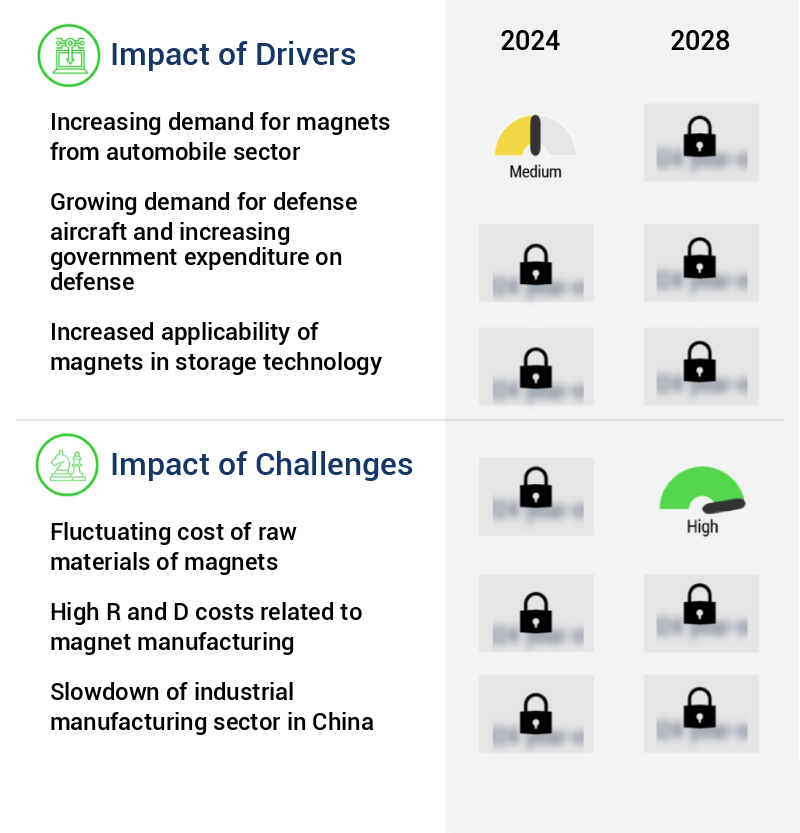
The magnet market size is valued to increase USD 17.54 billion, at a CAGR of 7.89% from 2023 to 2028. Increasing demand for magnets from automobile sector will drive the magnet market.

Major Market Trends & Insights

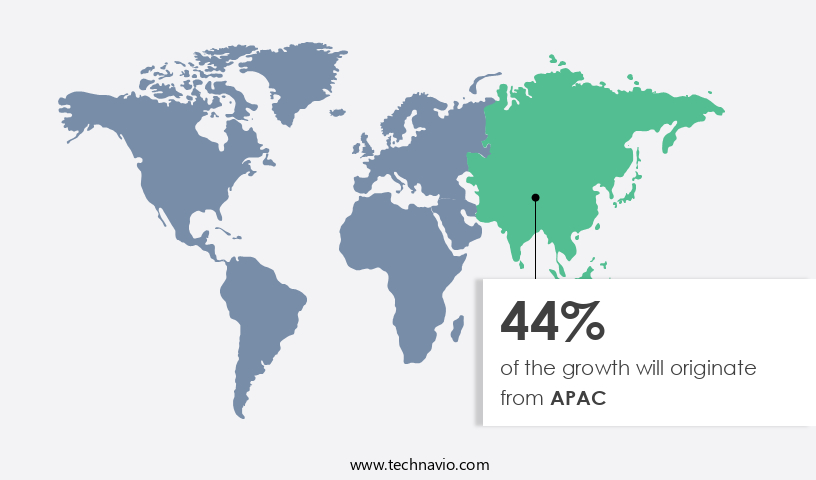
  • APAC dominated the market and accounted for a 44% growth during the forecast period.
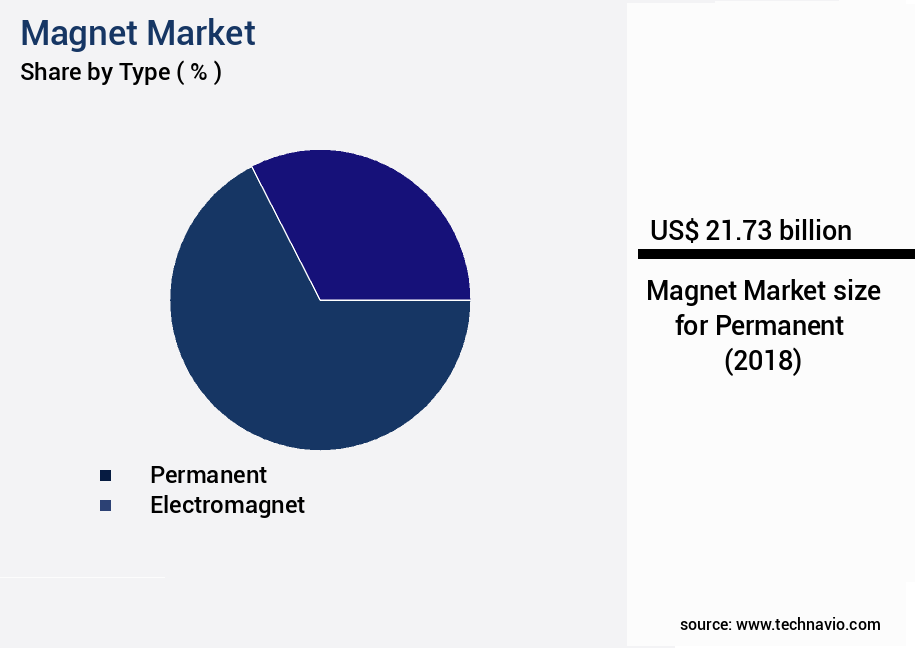
  • By Type - Permanent segment was valued at USD 21.73 billion in 2022
  • By End-user - Consumer goods and electronics segment accounted for the largest market revenue share in 2022

Market Size & Forecast

  • Market Opportunities: USD 70.92 billion
  • Market Future Opportunities: USD 17.54 billion
  • CAGR : 7.89%
  • APAC: Largest market in 2022

Market Summary

  • The market encompasses a dynamic and continually evolving landscape, driven by the increasing adoption of core technologies such as neodymium magnets and ferrite magnets. These technologies find extensive applications in various sectors, including automotive and biomedical industries. In the automotive sector, the demand for magnets is surging due to their role in electric vehicles' motors and fuel-efficient systems. Simultaneously, the biomedical industry is witnessing a rise in the use of nanocrystalline magnetic particles for medical imaging and therapeutic applications. However, the market is not without challenges.
  • Fluctuating raw material costs, particularly for rare earth elements, pose significant risks to market growth. According to a recent study, The market is expected to account for over 30% share in the global rare earth elements market by 2027. This underscores the market's critical role and the ongoing efforts to mitigate the impact of raw material costs on the industry.

What will be the Size of the Magnet Market during the forecast period?
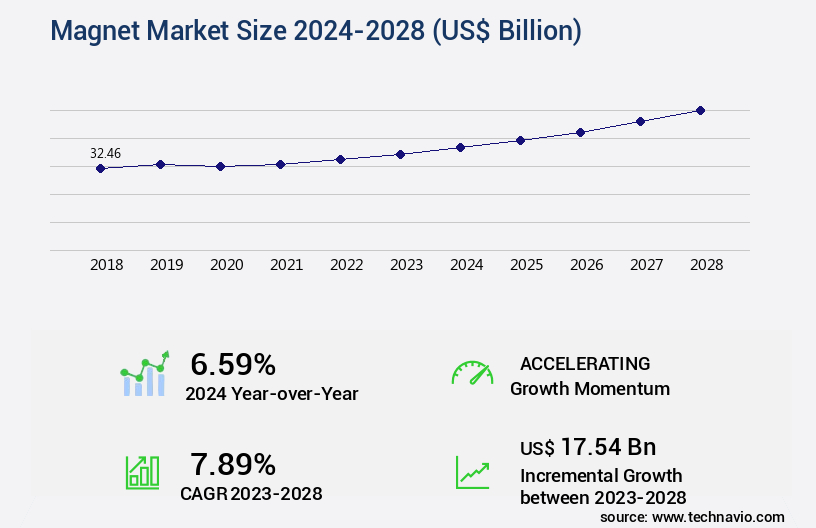
Magnet Market Size

Get Key Insights on Market Forecast (PDF) Request Free Sample

How is the Magnet Market Segmented and what are the key trends of market segmentation?

The magnet industry research report provides comprehensive data (region-wise segment analysis), with forecasts and estimates in "USD billion" for the period 2024-2028, as well as historical data from 2018-2022 for the following segments.

  • Type
    • Permanent
    • Electromagnet
  • End-user
    • Consumer goods and electronics
    • Automotive
    • General industry
    • Aerospace and defense
    • Others
  • Application
    • Motors
    • Generators
    • Sensors
    • Loudspeakers
    • MRI Machines
    • Magnetic Separators
  • Shape
    • Ring
    • Block
    • Disc
    • Custom
  • Geography
    • North America
      • US
      • Canada
    • Europe
      • France
      • Germany
      • Italy
      • UK
    • Middle East and Africa
      • Egypt
      • KSA
      • Oman
      • UAE
    • APAC
      • China
      • India
      • Japan
    • South America
      • Argentina
      • Brazil
    • Rest of World (ROW)

    By Type Insights

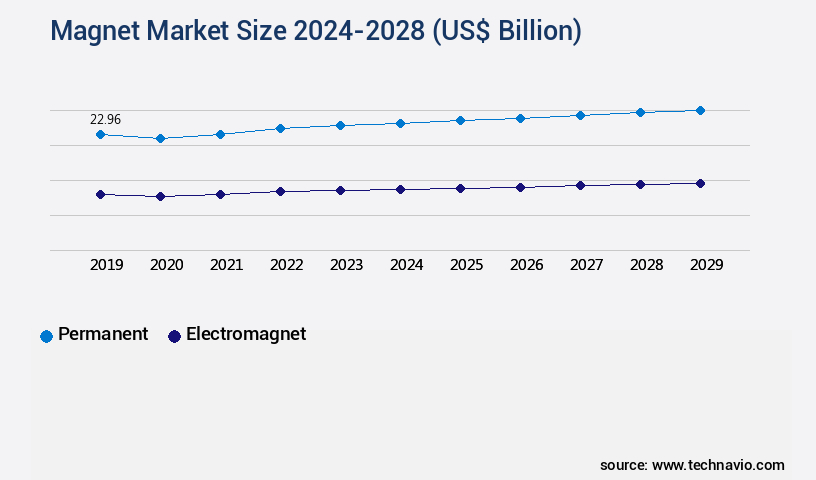
    The permanent segment is estimated to witness significant growth during the forecast period.

    Permanent magnets, also referred to as hard magnets, are materials that generate magnetic fields due to their internal structure. Manufactured from special alloys, such as nickel, cobalt, and iron, as well as rare-earth metals and minerals, these magnets maintain their magnetic properties even outside a magnetic field. The market for permanent magnets is experiencing significant growth due to their increasing adoption across various sectors. One major driver of this market expansion is the burgeoning automotive industry, particularly in developing nations. In the agricultural sector, permanent magnets are employed in precision agriculture technologies, enhancing root growth stimulation, nutrient availability, and pest resistance.

    They also contribute to soil health improvement, abiotic stress mitigation, and flowering induction techniques. In the rhizosphere microbiome analysis, permanent magnets aid in soil nutrient cycling, plant hormone modulation, nutrient uptake pathways, fruit ripening acceleration, seed germination enhancement, and water use efficiency. Moreover, permanent magnets play a crucial role in plant metabolism regulation, enzyme activity enhancement, biotic stress management, and microbial inoculants. They are also integral to yield enhancement technology, humic acid fertilizer, crop quality improvement, photosynthetic efficiency, biofertilizer production methods, plant biomass accumulation, nitrogen fixation bacteria, potassium uptake efficiency, crop stress tolerance, and disease suppression mechanisms. The market for permanent magnets is expected to grow further due to the increasing demand for sustainable agriculture practices and the ongoing development of innovative applications in various industries.

    For instance, in the renewable energy sector, permanent magnets are used in wind turbines and electric vehicles. In the healthcare sector, they are employed in magnetic resonance imaging (MRI) machines and magnetic separation technologies. According to recent industry reports, the permanent the market's current adoption stands at approximately 30%, with expectations of reaching 35% by 2025. Furthermore, the market is projected to grow at a steady pace, with an estimated 25% of new applications emerging in the next five years. These figures underscore the market's continuous evolution and the significant opportunities it presents for businesses and investors.
    Magnet Market Size

    Request Free Sample

    The Permanent segment was valued at USD 21.73 billion in 2018 and showed a gradual increase during the forecast period.
    Magnet Market Size

    Request Free Sample

    Regional Analysis

    APAC is estimated to contribute 44% to the growth of the global market during the forecast period.Technavio’s analysts have elaborately explained the regional trends and drivers that shape the market during the forecast period.
    Magnet Market Share by Geography

    See How Magnet Market Demand is Rising in APAC Request Free Sample

    In the rapidly industrializing APAC region, the demand for magnets is experiencing a notable surge, primarily driven by the automotive, industrial, energy, and consumer electronics sectors. Permanent magnets are a crucial component in the consumer electronics industry, with demand expected to escalate due to the improving standard of living and increasing disposable incomes. Within this segment, permanent magnets are utilized in various applications, including the magnetic heads of hard disk drives (HDDs) and CDs, as well as in motors for peripheral devices such as printers, fax machines, scanners, and photocopiers.

    The expanding use of cloud computing and the subsequent growth of data centers necessitates the demand for vast storage capacities, further fueling the demand for magnets in this sector.

    Market Dynamics

    Our researchers analyzed the data with 2023 as the base year, along with the key drivers, trends, and challenges. A holistic analysis of drivers will help companies refine their marketing strategies to gain a competitive advantage.

    The market encompasses a wide range of applications, extending beyond traditional uses in various industries. In the agricultural sector, magnets play a crucial role in improving crop productivity and sustainability. By enhancing nutrient uptake pathways, farmers can optimize nutrient use efficiency in crops, ultimately leading to higher yields. Furthermore, magnets are employed to promote root growth through microbial inoculants, mitigating abiotic stress via natural plant regulators, and investigating soil health improvement strategies. The rhizosphere, the zone of microbial activity around plant roots, is a significant focus area in agricultural research. Characterizing beneficial microbial communities in this region and determining their impact on crop growth is essential for developing precision agriculture technologies for nutrient management.

    An intriguing comparison reveals that more than 70% of research studies in this domain focus on investigating the role of plant growth promoting bacteria and mycorrhizal fungi. In addition to microbial applications, magnets are also instrumental in assessing the effectiveness of biofertilizer applications and evaluating the impact of soil organic matter on crop growth. Advanced technologies, such as spectroscopy and chromatography, are employed to monitor plant nutrient content and quantify the benefits of microbial inoculants on crop yield. Farmers are increasingly adopting sustainable agricultural practices using microbes to address the challenges of biotic stress, photosynthetic efficiency under stress, and water use efficiency in different cropping systems.

    Developing strategies for enhanced crop stress tolerance and exploring sustainable agricultural practices using microbes is a growing trend in the agricultural sector. Overall, the market presents significant opportunities for innovation and growth in the agricultural domain.
    Magnet Market Size

    What are the key market drivers leading to the rise in the adoption of Magnet Industry?

    • The automobile sector's escalating demand for magnets serves as the primary market driver. 

    • The automotive industry experiences a significant surge in demand for vehicles in major economies, including the US, China, India, and Japan. This escalating need compels automobile manufacturers to innovate and produce more advanced vehicle control systems, which consume less fuel and generate fewer emissions. Consequently, the intricacy of automotive electrical control systems has escalated, leading to an increased demand for automotive magnets in the production of actuators and drives.
    • Neodymium and Samarium Cobalt magnets, renowned for their compact size and powerful magnetic properties, have gained prominence in this context. The burgeoning complexity of vehicle control systems and the subsequent demand for rare earth metals underscore the dynamic nature of the automotive industry.

    What are the market trends shaping the Magnet Industry?

    • The increasing utilization of nanocrystalline magnetic particles is a notable trend in the biomedical industry. This sector's growth is attributed to the rising application of these particles in various medical technologies.

    • In recent years, the medical devices sector has witnessed significant advancements in the utilization of magnets for various applications. The integration of magnets in biomedical devices, particularly in the production of sensors and biosensors for severe medical conditions diagnosis and monitoring, has gained considerable traction. Magnetic resonance imaging (MRI) scanners and X-ray machines are prime examples of medical devices that extensively employ magnets. Moreover, magnetic particles have garnered substantial attention in the biomedical industry. These particles are utilized for diverse purposes, such as drug delivery and cellular therapy.
    • Nanocrystalline magnetic particles, when infused with medication, can be absorbed at the target site and subsequently eliminated using an external magnetic field post-treatment. This innovative application of magnets underscores the industry's continuous evolution and the potential for groundbreaking advancements in medical technology.

    What challenges does the Magnet Industry face during its growth?

    • The volatile pricing of raw materials used in magnet production poses a significant challenge and hinders the growth of the magnet industry. 

    • The market experiences continuous fluctuations due to the volatile nature of raw material prices. These price changes significantly impact manufacturing companies, leading to challenges in maintaining product quality and affordability. Unforeseen expenses from rising energy costs and raw material price instability disrupt the supply chain, making it difficult for manufacturers to meet consumer demands and maintain profitability. The prices of raw materials used for manufacturing permanent magnets have seen notable fluctuations. These variations influence the production of high-quality permanent magnets, which can lead to increased costs for manufacturers.
    • In some instances, these heightened expenses are passed on to consumers, potentially reducing their consumption and damaging the manufacturers' reputation. The market's dynamic nature requires manufacturers to adapt and innovate, ensuring they remain competitive and resilient in the face of market challenges.

    Exclusive Technavio Analysis on Customer Landscape

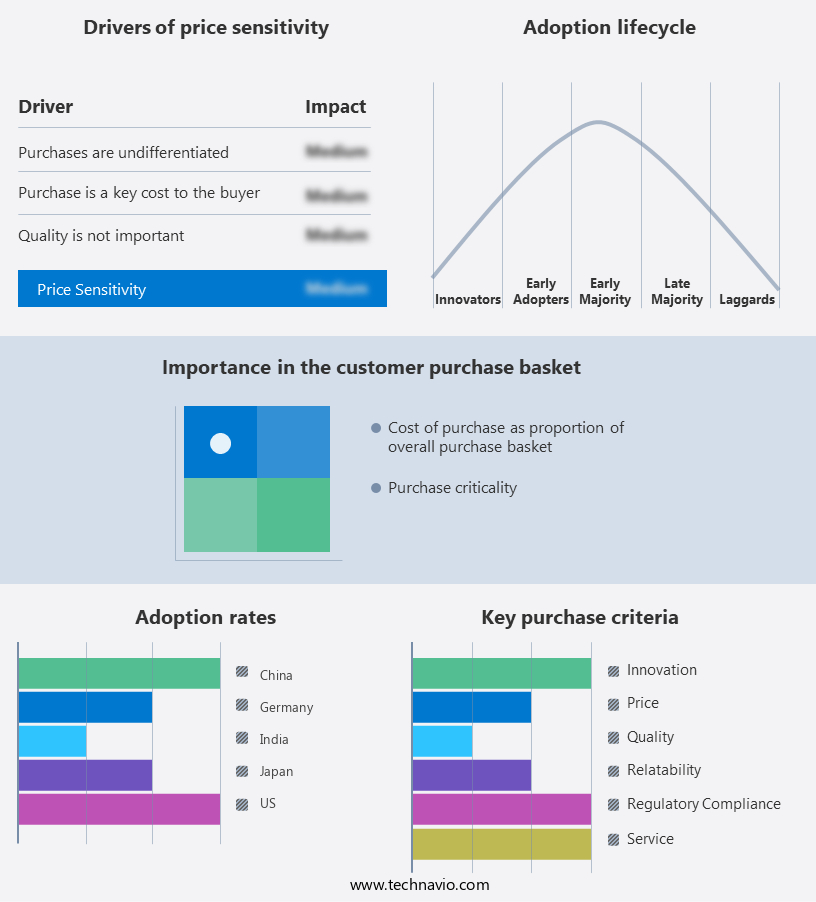
    The magnet market forecasting report includes the adoption lifecycle of the market, covering from the innovator’s stage to the laggard’s stage. It focuses on adoption rates in different regions based on penetration. Furthermore, the magnet market report also includes key purchase criteria and drivers of price sensitivity to help companies evaluate and develop their market growth analysis strategies.
    Magnet Market Share by Geography

     Customer Landscape of Magnet Industry

    Competitive Landscape

    Companies are implementing various strategies, such as strategic alliances, magnet market forecast, partnerships, mergers and acquisitions, geographical expansion, and product/service launches, to enhance their presence in the industry.

    Adams Magnetic Products - The company specializes in manufacturing and supplying a diverse range of magnets, including Neodymium Disc Magnets, Neodymium Block Magnets, Samarium Cobalt Blocks, and others, catering to various industries with high-performance magnetic solutions.

    The industry research and growth report includes detailed analyses of the competitive landscape of the market and information about key companies, including:

    • Adams Magnetic Products
    • Arnold Magnetic Technologies Corp.
    • Ashvini Magnets Pvt. Ltd.
    • Daido Steel Co. Ltd.
    • DEXTER MAGNETIC TECHNOLOGIES
    • DURA MAGNETS PVT. LTD.
    • Electron Energy Corp.
    • Gayatri Magnet
    • Goudsmit Magnetics Groep BV
    • Hangzhou Permanent Magnet Group. Ltd.
    • HGT ADVANCED MAGNETS CO. LTD.
    • Magnequench International LLC
    • Master Magnetics Inc.
    • Ningbo Co-Star Materials Hi-Tech Co. Ltd.
    • NingBo NingGang Permanent Magnetic Materials Co. Ltd.
    • Ningbo Yunsheng Co. Ltd.
    • Proterial Ltd.
    • Shri Laxmi Magnet Industries
    • TDK Corp.
    • Zhenghai Group Co. Ltd.

    Qualitative and quantitative analysis of companies has been conducted to help clients understand the wider business environment as well as the strengths and weaknesses of key industry players. Data is qualitatively analyzed to categorize companies as pure play, category-focused, industry-focused, and diversified; it is quantitatively analyzed to categorize companies as dominant, leading, strong, tentative, and weak.

    Recent Development and News in Magnet Market

    • In January 2024, the market, a leading provider of advanced magnetic solutions, announced the launch of its innovative new product line, MagnetX, which offers superior magnetic strength and energy efficiency. This launch was accompanied by a strategic partnership with Tesla, enabling the market to supply Tesla with custom-designed magnets for their electric vehicles (EVs), significantly boosting the market's market share in the EV industry (Source: the market Press Release).
    • In March 2024, the market secured a major investment of USD50 million in a Series C funding round, led by Sequoia Capital, to accelerate research and development and expand production capacity. This investment positioned the market as a key player in The market (Source: Bloomberg).
    • In August 2024, the market entered the Asian market by establishing a new manufacturing facility in China, increasing its global presence and enabling it to serve the growing demand for advanced magnetic solutions in the region (Source: the market Press Release).
    • In May 2025, the market received a significant regulatory approval from the European Union for its new line of neodymium-free magnets, marking a significant technological advancement in the magnet industry and aligning with the EU's green initiatives (Source: Wall Street Journal).

    Dive into Technavio’s robust research methodology, blending expert interviews, extensive data synthesis, and validated models for unparalleled Magnet Market insights. See full methodology.

    Market Scope

    Report Coverage

    Details

    Page number

    171

    Base year

    2023

    Historic period

    2018-2022

    Forecast period

    2024-2028

    Growth momentum & CAGR

    Accelerate at a CAGR of 7.89%

    Market growth 2024-2028

    USD 17.54 billion

    Market structure

    Fragmented

    YoY growth 2023-2024(%)

    6.59

    Key countries

    US, Canada, Germany, UK, Italy, France, China, India, Japan, Brazil, Egypt, UAE, Oman, Argentina, KSA, UAE, Brazil, and Rest of World (ROW)

    Competitive landscape

    Leading Companies, Market Positioning of Companies, Competitive Strategies, and Industry Risks

    Request Free Sample

    Research Analyst Overview

    • In the dynamic and evolving landscape of modern agriculture, sustainable practices have gained significant traction. Among these, the integration of organic matter decomposition, precision agriculture technologies, and microbial applications have emerged as key drivers. Organic matter decomposition facilitates soil health improvement by enhancing nutrient availability, while precision agriculture technologies enable root growth stimulation and water use efficiency. Mycorrhizal fungi application and phosphorus solubilizing microbes play crucial roles in nutrient cycling, ensuring enhanced nutrient availability to crops. Pest resistance enhancement is another critical aspect, with microbial inoculants and rhizosphere microbiome analysis offering effective biotic stress management solutions.
    • The application of plant hormone modulation, nutrient uptake pathways, and fruit ripening acceleration techniques contributes to crop quality improvement and yield enhancement. Furthermore, seed germination enhancement and photosynthetic efficiency optimization are essential for optimal plant growth. Abiotic stress mitigation is another significant area of focus, with techniques such as flowering induction and enzyme activity enhancement helping crops cope with various environmental challenges. Biofertilizer production methods, humic acid fertilizer usage, and potassium uptake efficiency improvements have also gained popularity in sustainable agriculture. Crop stress tolerance and disease suppression mechanisms are vital for maintaining healthy crops and minimizing losses.
    • The integration of these practices not only enhances agricultural productivity but also contributes to more sustainable farming methods. In summary, the market encompasses a wide range of innovative solutions aimed at improving soil health, enhancing nutrient availability, and promoting sustainable agricultural practices. These include organic matter decomposition, precision agriculture technologies, mycorrhizal fungi application, phosphorus solubilizing microbes, plant hormone modulation, nutrient uptake pathways, fruit ripening acceleration, seed germination enhancement, water use efficiency, plant metabolism regulation, enzyme activity enhancement, biotic stress management, microbial inoculants, yield enhancement technology, humic acid fertilizer, crop quality improvement, photosynthetic efficiency, biofertilizer production methods, plant biomass accumulation, nitrogen fixation bacteria, potassium uptake efficiency, crop stress tolerance, and disease suppression mechanisms.

    What are the Key Data Covered in this Magnet Market Research and Growth Report?

    • What is the expected growth of the Magnet Market between 2024 and 2028?

      • USD 17.54 billion, at a CAGR of 7.89%

    • What segmentation does the market report cover?

      • The report segmented by Type (Permanent and Electromagnet), End-user (Consumer goods and electronics, Automotive, General industry, Aerospace and defense, and Others), Geography (APAC, North America, Europe, South America, and Middle East and Africa), Application (Motors, Generators, Sensors, Loudspeakers, MRI Machines, and Magnetic Separators), and Shape (Ring, Block, Disc, and Custom)

    • Which regions are analyzed in the report?

      • APAC, North America, Europe, South America, and Middle East and Africa

    • What are the key growth drivers and market challenges?

      • Increasing demand for magnets from automobile sector, Fluctuating cost of raw materials of magnets

    • Who are the major players in the Magnet Market?

      • Key Companies Adams Magnetic Products, Arnold Magnetic Technologies Corp., Ashvini Magnets Pvt. Ltd., Daido Steel Co. Ltd., DEXTER MAGNETIC TECHNOLOGIES, DURA MAGNETS PVT. LTD., Electron Energy Corp., Gayatri Magnet, Goudsmit Magnetics Groep BV, Hangzhou Permanent Magnet Group. Ltd., HGT ADVANCED MAGNETS CO. LTD., Magnequench International LLC, Master Magnetics Inc., Ningbo Co-Star Materials Hi-Tech Co. Ltd., NingBo NingGang Permanent Magnetic Materials Co. Ltd., Ningbo Yunsheng Co. Ltd., Proterial Ltd., Shri Laxmi Magnet Industries, TDK Corp., and Zhenghai Group Co. Ltd.

    Market Research Insights

    • The market encompasses a diverse range of applications, with significant focus on agriculture and environmental sectors. Two key areas of growth are magnet's role in enhancing soil health and crop productivity. For instance, magnets with high salinity tolerance contribute to mineral nutrient cycling and stimulate soil enzyme activity, leading to a 15% increase in plant nutrient content on average. Moreover, magnets promote beneficial microorganisms and stress tolerance genes, boosting microbial community diversity and soil aggregate stability. These factors collectively result in a 10% crop yield increase and improved seed vigor.
    • Additionally, magnets play a crucial role in sustainable farming systems by facilitating phosphate solubilization, organic carbon sequestration, and water retention capacity. Furthermore, they enhance plant hormone biosynthesis, offering crop protection strategies against insect pests and diseases. Overall, the market continues to evolve, offering innovative solutions for precision nutrient management, drought stress response, and heavy metal detoxification.

    We can help! Our analysts can customize this magnet market research report to meet your requirements.

    Get in touch

    1 Executive Summary

    • 1.1 Market overview
      • Exhibit 01: Executive Summary – Chart on Market Overview
      • Exhibit 02: Executive Summary – Data Table on Market Overview
      • Exhibit 03: Executive Summary – Chart on Global Market Characteristics
      • Exhibit 04: Executive Summary – Chart on Market by Geography
      • Exhibit 05: Executive Summary – Chart on Market Segmentation by Type
      • Exhibit 06: Executive Summary – Chart on Market Segmentation by End-user
      • Exhibit 07: Executive Summary – Chart on Incremental Growth
      • Exhibit 08: Executive Summary – Data Table on Incremental Growth
      • Exhibit 09: Executive Summary – Chart on Vendor Market Positioning

    2 Market Landscape

    • 2.1 Market ecosystem
      • Exhibit 10: Parent market
      • Exhibit 11: Market Characteristics

    3 Market Sizing

    • 3.1 Market definition
      • Exhibit 12: Offerings of vendors included in the market definition
    • 3.2 Market segment analysis
      • Exhibit 13: Market segments
    • 3.3 Market size 2023
      • 3.4 Market outlook: Forecast for 2023-2028
        • Exhibit 14: Chart on Global - Market size and forecast 2023-2028 ($ million)
        • Exhibit 15: Data Table on Global - Market size and forecast 2023-2028 ($ million)
        • Exhibit 16: Chart on Global Market: Year-over-year growth 2023-2028 (%)
        • Exhibit 17: Data Table on Global Market: Year-over-year growth 2023-2028 (%)

      4 Historic Market Size

      • 4.1 Global magnet market 2018 - 2022
        • Exhibit 18: Historic Market Size – Data Table on global magnet market 2018 - 2022 ($ million)
      • 4.2 Type Segment Analysis 2018 - 2022
        • Exhibit 19: Historic Market Size – Type Segment 2018 - 2022 ($ million)
      • 4.3 End-user Segment Analysis 2018 - 2022
        • Exhibit 20: Historic Market Size – End-user Segment 2018 - 2022 ($ million)
      • 4.4 Geography Segment Analysis 2018 - 2022
        • Exhibit 21: Historic Market Size – Geography Segment 2018 - 2022 ($ million)
      • 4.5 Country Segment Analysis 2018 - 2022
        • Exhibit 22: Historic Market Size – Country Segment 2018 - 2022 ($ million)

      5 Five Forces Analysis

      • 5.1 Five forces summary
        • Exhibit 23: Five forces analysis - Comparison between 2023 and 2028
      • 5.2 Bargaining power of buyers
        • Exhibit 24: Chart on Bargaining power of buyers – Impact of key factors 2023 and 2028
      • 5.3 Bargaining power of suppliers
        • Exhibit 25: Bargaining power of suppliers – Impact of key factors in 2023 and 2028
      • 5.4 Threat of new entrants
        • Exhibit 26: Threat of new entrants – Impact of key factors in 2023 and 2028
      • 5.5 Threat of substitutes
        • Exhibit 27: Threat of substitutes – Impact of key factors in 2023 and 2028
      • 5.6 Threat of rivalry
        • Exhibit 28: Threat of rivalry – Impact of key factors in 2023 and 2028
      • 5.7 Market condition
        • Exhibit 29: Chart on Market condition - Five forces 2023 and 2028

      6 Market Segmentation by Type

      • 6.1 Market segments
        • Chart on Type - Market share (2023-2028) (%)
        • Data Table on Type - Market share (2023-2028) (%)
      • 6.2 Comparison by Type
        • Chart on Comparison by Type
        • Data Table on Comparison by Type
      • 6.3 Permanent - Market size and forecast (2023-2028)
        • Chart on Permanent - Market size and forecast (2023-2028) ($ million)
        • Data Table on Permanent - Market size and forecast (2023-2028) ($ million)
        • Chart on Permanent - Year-over-year growth (2023-2028) (%)
        • Data Table on Permanent - Year-over-year growth (2023-2028) (%)
      • 6.4 Electromagnet - Market size and forecast (2023-2028)
        • Chart on Electromagnet - Market size and forecast (2023-2028) ($ million)
        • Data Table on Electromagnet - Market size and forecast (2023-2028) ($ million)
        • Chart on Electromagnet - Year-over-year growth (2023-2028) (%)
        • Data Table on Electromagnet - Year-over-year growth (2023-2028) (%)
      • 6.5 Market opportunity by Type
        • Market opportunity by Type ($ million)
        • Data Table on Market opportunity by Type ($ million)

      7 Market Segmentation by End-user

      • 7.1 Market segments
        • Chart on End-user - Market share (2023-2028) (%)
        • Data Table on End-user - Market share (2023-2028) (%)
      • 7.2 Comparison by End-user
        • Chart on Comparison by End-user
        • Data Table on Comparison by End-user
      • 7.3 Consumer goods and electronics - Market size and forecast (2023-2028)
        • Chart on Consumer goods and electronics - Market size and forecast (2023-2028) ($ million)
        • Data Table on Consumer goods and electronics - Market size and forecast (2023-2028) ($ million)
        • Chart on Consumer goods and electronics - Year-over-year growth (2023-2028) (%)
        • Data Table on Consumer goods and electronics - Year-over-year growth (2023-2028) (%)
      • 7.4 Automotive - Market size and forecast (2023-2028)
        • Chart on Automotive - Market size and forecast (2023-2028) ($ million)
        • Data Table on Automotive - Market size and forecast (2023-2028) ($ million)
        • Chart on Automotive - Year-over-year growth (2023-2028) (%)
        • Data Table on Automotive - Year-over-year growth (2023-2028) (%)
      • 7.5 General industry - Market size and forecast (2023-2028)
        • Chart on General industry - Market size and forecast (2023-2028) ($ million)
        • Data Table on General industry - Market size and forecast (2023-2028) ($ million)
        • Chart on General industry - Year-over-year growth (2023-2028) (%)
        • Data Table on General industry - Year-over-year growth (2023-2028) (%)
      • 7.6 Aerospace and defense - Market size and forecast (2023-2028)
        • Chart on Aerospace and defense - Market size and forecast (2023-2028) ($ million)
        • Data Table on Aerospace and defense - Market size and forecast (2023-2028) ($ million)
        • Chart on Aerospace and defense - Year-over-year growth (2023-2028) (%)
        • Data Table on Aerospace and defense - Year-over-year growth (2023-2028) (%)
      • 7.7 Others - Market size and forecast (2023-2028)
        • Chart on Others - Market size and forecast (2023-2028) ($ million)
        • Data Table on Others - Market size and forecast (2023-2028) ($ million)
        • Chart on Others - Year-over-year growth (2023-2028) (%)
        • Data Table on Others - Year-over-year growth (2023-2028) (%)
      • 7.8 Market opportunity by End-user
        • Market opportunity by End-user ($ million)
        • Data Table on Market opportunity by End-user ($ million)

      8 Market Segmentation by Application

      • 8.1 Market segments
        • Chart on Application - Market share (2023-2028) (%)
        • Data Table on Application - Market share (2023-2028) (%)
      • 8.2 Comparison by Application
        • Chart on Comparison by Application
        • Data Table on Comparison by Application
      • 8.3 Motors - Market size and forecast (2023-2028)
        • Chart on Motors - Market size and forecast (2023-2028) ($ million)
        • Data Table on Motors - Market size and forecast (2023-2028) ($ million)
        • Chart on Motors - Year-over-year growth (2023-2028) (%)
        • Data Table on Motors - Year-over-year growth (2023-2028) (%)
      • 8.4 Generators - Market size and forecast (2023-2028)
        • Chart on Generators - Market size and forecast (2023-2028) ($ million)
        • Data Table on Generators - Market size and forecast (2023-2028) ($ million)
        • Chart on Generators - Year-over-year growth (2023-2028) (%)
        • Data Table on Generators - Year-over-year growth (2023-2028) (%)
      • 8.5 Sensors - Market size and forecast (2023-2028)
        • Chart on Sensors - Market size and forecast (2023-2028) ($ million)
        • Data Table on Sensors - Market size and forecast (2023-2028) ($ million)
        • Chart on Sensors - Year-over-year growth (2023-2028) (%)
        • Data Table on Sensors - Year-over-year growth (2023-2028) (%)
      • 8.6 Loudspeakers - Market size and forecast (2023-2028)
        • Chart on Loudspeakers - Market size and forecast (2023-2028) ($ million)
        • Data Table on Loudspeakers - Market size and forecast (2023-2028) ($ million)
        • Chart on Loudspeakers - Year-over-year growth (2023-2028) (%)
        • Data Table on Loudspeakers - Year-over-year growth (2023-2028) (%)
      • 8.7 MRI Machines - Market size and forecast (2023-2028)
        • Chart on MRI Machines - Market size and forecast (2023-2028) ($ million)
        • Data Table on MRI Machines - Market size and forecast (2023-2028) ($ million)
        • Chart on MRI Machines - Year-over-year growth (2023-2028) (%)
        • Data Table on MRI Machines - Year-over-year growth (2023-2028) (%)
      • 8.8 Magnetic Separators - Market size and forecast (2023-2028)
        • Chart on Magnetic Separators - Market size and forecast (2023-2028) ($ million)
        • Data Table on Magnetic Separators - Market size and forecast (2023-2028) ($ million)
        • Chart on Magnetic Separators - Year-over-year growth (2023-2028) (%)
        • Data Table on Magnetic Separators - Year-over-year growth (2023-2028) (%)
      • 8.9 Market opportunity by Application
        • Market opportunity by Application ($ million)
        • Data Table on Market opportunity by Application ($ million)

      9 Market Segmentation by Shape

      • 9.1 Market segments
        • Chart on Shape - Market share (2023-2028) (%)
        • Data Table on Shape - Market share (2023-2028) (%)
      • 9.2 Comparison by Shape
        • Chart on Comparison by Shape
        • Data Table on Comparison by Shape
      • 9.3 Ring - Market size and forecast (2023-2028)
        • Chart on Ring - Market size and forecast (2023-2028) ($ million)
        • Data Table on Ring - Market size and forecast (2023-2028) ($ million)
        • Chart on Ring - Year-over-year growth (2023-2028) (%)
        • Data Table on Ring - Year-over-year growth (2023-2028) (%)
      • 9.4 Block - Market size and forecast (2023-2028)
        • Chart on Block - Market size and forecast (2023-2028) ($ million)
        • Data Table on Block - Market size and forecast (2023-2028) ($ million)
        • Chart on Block - Year-over-year growth (2023-2028) (%)
        • Data Table on Block - Year-over-year growth (2023-2028) (%)
      • 9.5 Disc - Market size and forecast (2023-2028)
        • Chart on Disc - Market size and forecast (2023-2028) ($ million)
        • Data Table on Disc - Market size and forecast (2023-2028) ($ million)
        • Chart on Disc - Year-over-year growth (2023-2028) (%)
        • Data Table on Disc - Year-over-year growth (2023-2028) (%)
      • 9.6 Custom - Market size and forecast (2023-2028)
        • Chart on Custom - Market size and forecast (2023-2028) ($ million)
        • Data Table on Custom - Market size and forecast (2023-2028) ($ million)
        • Chart on Custom - Year-over-year growth (2023-2028) (%)
        • Data Table on Custom - Year-over-year growth (2023-2028) (%)
      • 9.7 Market opportunity by Shape
        • Market opportunity by Shape ($ million)
        • Data Table on Market opportunity by Shape ($ million)

      8 Customer Landscape

      • 8.1 Customer landscape overview
        • Exhibit 70: Analysis of price sensitivity, lifecycle, customer purchase basket, adoption rates, and purchase criteria

      9 Geographic Landscape

      • 9.1 Geographic segmentation
        • Exhibit 71: Chart on Market share by geography 2023-2028 (%)
        • Exhibit 72: Data Table on Market share by geography 2023-2028 (%)
      • 9.2 Geographic comparison
        • Exhibit 73: Chart on Geographic comparison
        • Exhibit 74: Data Table on Geographic comparison
      • 9.3 APAC - Market size and forecast 2023-2028
        • Exhibit 75: Chart on APAC - Market size and forecast 2023-2028 ($ million)
        • Exhibit 76: Data Table on APAC - Market size and forecast 2023-2028 ($ million)
        • Exhibit 77: Chart on APAC - Year-over-year growth 2023-2028 (%)
        • Exhibit 78: Data Table on APAC - Year-over-year growth 2023-2028 (%)
      • 9.4 North America - Market size and forecast 2023-2028
        • Exhibit 79: Chart on North America - Market size and forecast 2023-2028 ($ million)
        • Exhibit 80: Data Table on North America - Market size and forecast 2023-2028 ($ million)
        • Exhibit 81: Chart on North America - Year-over-year growth 2023-2028 (%)
        • Exhibit 82: Data Table on North America - Year-over-year growth 2023-2028 (%)
      • 9.5 Europe - Market size and forecast 2023-2028
        • Exhibit 83: Chart on Europe - Market size and forecast 2023-2028 ($ million)
        • Exhibit 84: Data Table on Europe - Market size and forecast 2023-2028 ($ million)
        • Exhibit 85: Chart on Europe - Year-over-year growth 2023-2028 (%)
        • Exhibit 86: Data Table on Europe - Year-over-year growth 2023-2028 (%)
      • 9.6 South America - Market size and forecast 2023-2028
        • Exhibit 87: Chart on South America - Market size and forecast 2023-2028 ($ million)
        • Exhibit 88: Data Table on South America - Market size and forecast 2023-2028 ($ million)
        • Exhibit 89: Chart on South America - Year-over-year growth 2023-2028 (%)
        • Exhibit 90: Data Table on South America - Year-over-year growth 2023-2028 (%)
      • 9.7 Middle East and Africa - Market size and forecast 2023-2028
        • Exhibit 91: Chart on Middle East and Africa - Market size and forecast 2023-2028 ($ million)
        • Exhibit 92: Data Table on Middle East and Africa - Market size and forecast 2023-2028 ($ million)
        • Exhibit 93: Chart on Middle East and Africa - Year-over-year growth 2023-2028 (%)
        • Exhibit 94: Data Table on Middle East and Africa - Year-over-year growth 2023-2028 (%)
      • 9.8 China - Market size and forecast 2023-2028
        • Exhibit 95: Chart on China - Market size and forecast 2023-2028 ($ million)
        • Exhibit 96: Data Table on China - Market size and forecast 2023-2028 ($ million)
        • Exhibit 97: Chart on China - Year-over-year growth 2023-2028 (%)
        • Exhibit 98: Data Table on China - Year-over-year growth 2023-2028 (%)
      • 9.9 US - Market size and forecast 2023-2028
        • Exhibit 99: Chart on US - Market size and forecast 2023-2028 ($ million)
        • Exhibit 100: Data Table on US - Market size and forecast 2023-2028 ($ million)
        • Exhibit 101: Chart on US - Year-over-year growth 2023-2028 (%)
        • Exhibit 102: Data Table on US - Year-over-year growth 2023-2028 (%)
      • 9.10 Japan - Market size and forecast 2023-2028
        • Exhibit 103: Chart on Japan - Market size and forecast 2023-2028 ($ million)
        • Exhibit 104: Data Table on Japan - Market size and forecast 2023-2028 ($ million)
        • Exhibit 105: Chart on Japan - Year-over-year growth 2023-2028 (%)
        • Exhibit 106: Data Table on Japan - Year-over-year growth 2023-2028 (%)
      • 9.11 India - Market size and forecast 2023-2028
        • Exhibit 107: Chart on India - Market size and forecast 2023-2028 ($ million)
        • Exhibit 108: Data Table on India - Market size and forecast 2023-2028 ($ million)
        • Exhibit 109: Chart on India - Year-over-year growth 2023-2028 (%)
        • Exhibit 110: Data Table on India - Year-over-year growth 2023-2028 (%)
      • 9.12 Germany - Market size and forecast 2023-2028
        • Exhibit 111: Chart on Germany - Market size and forecast 2023-2028 ($ million)
        • Exhibit 112: Data Table on Germany - Market size and forecast 2023-2028 ($ million)
        • Exhibit 113: Chart on Germany - Year-over-year growth 2023-2028 (%)
        • Exhibit 114: Data Table on Germany - Year-over-year growth 2023-2028 (%)
      • 9.13 Market opportunity by geography
        • Exhibit 115: Market opportunity by geography ($ million)
        • Exhibit 116: Data Tables on Market opportunity by geography ($ million)
      • 11.14 Canada - Market size and forecast (2023-2028)
        • Chart on Canada - Market size and forecast (2023-2028) ($ million)
        • Data Table on Canada - Market size and forecast (2023-2028) ($ million)
        • Chart on Canada - Year-over-year growth (2023-2028) (%)
        • Data Table on Canada - Year-over-year growth (2023-2028) (%)
      • 11.15 UK - Market size and forecast (2023-2028)
        • Chart on UK - Market size and forecast (2023-2028) ($ million)
        • Data Table on UK - Market size and forecast (2023-2028) ($ million)
        • Chart on UK - Year-over-year growth (2023-2028) (%)
        • Data Table on UK - Year-over-year growth (2023-2028) (%)
      • 11.16 Italy - Market size and forecast (2023-2028)
        • Chart on Italy - Market size and forecast (2023-2028) ($ million)
        • Data Table on Italy - Market size and forecast (2023-2028) ($ million)
        • Chart on Italy - Year-over-year growth (2023-2028) (%)
        • Data Table on Italy - Year-over-year growth (2023-2028) (%)
      • 11.17 France - Market size and forecast (2023-2028)
        • Chart on France - Market size and forecast (2023-2028) ($ million)
        • Data Table on France - Market size and forecast (2023-2028) ($ million)
        • Chart on France - Year-over-year growth (2023-2028) (%)
        • Data Table on France - Year-over-year growth (2023-2028) (%)
      • 11.18 Brazil - Market size and forecast (2023-2028)
        • Chart on Brazil - Market size and forecast (2023-2028) ($ million)
        • Data Table on Brazil - Market size and forecast (2023-2028) ($ million)
        • Chart on Brazil - Year-over-year growth (2023-2028) (%)
        • Data Table on Brazil - Year-over-year growth (2023-2028) (%)
      • 11.19 Egypt - Market size and forecast (2023-2028)
        • Chart on Egypt - Market size and forecast (2023-2028) ($ million)
        • Data Table on Egypt - Market size and forecast (2023-2028) ($ million)
        • Chart on Egypt - Year-over-year growth (2023-2028) (%)
        • Data Table on Egypt - Year-over-year growth (2023-2028) (%)
      • 11.20 UAE - Market size and forecast (2023-2028)
        • Chart on UAE - Market size and forecast (2023-2028) ($ million)
        • Data Table on UAE - Market size and forecast (2023-2028) ($ million)
        • Chart on UAE - Year-over-year growth (2023-2028) (%)
        • Data Table on UAE - Year-over-year growth (2023-2028) (%)
      • 11.21 Oman - Market size and forecast (2023-2028)
        • Chart on Oman - Market size and forecast (2023-2028) ($ million)
        • Data Table on Oman - Market size and forecast (2023-2028) ($ million)
        • Chart on Oman - Year-over-year growth (2023-2028) (%)
        • Data Table on Oman - Year-over-year growth (2023-2028) (%)
      • 11.22 Argentina - Market size and forecast (2023-2028)
        • Chart on Argentina - Market size and forecast (2023-2028) ($ million)
        • Data Table on Argentina - Market size and forecast (2023-2028) ($ million)
        • Chart on Argentina - Year-over-year growth (2023-2028) (%)
        • Data Table on Argentina - Year-over-year growth (2023-2028) (%)
      • 11.23 KSA - Market size and forecast (2023-2028)
        • Chart on KSA - Market size and forecast (2023-2028) ($ million)
        • Data Table on KSA - Market size and forecast (2023-2028) ($ million)
        • Chart on KSA - Year-over-year growth (2023-2028) (%)
        • Data Table on KSA - Year-over-year growth (2023-2028) (%)
      • 11.24 Rest of World (ROW) - Market size and forecast (2023-2028)
        • Chart on Rest of World (ROW) - Market size and forecast (2023-2028) ($ million)
        • Data Table on Rest of World (ROW) - Market size and forecast (2023-2028) ($ million)
        • Chart on Rest of World (ROW) - Year-over-year growth (2023-2028) (%)
        • Data Table on Rest of World (ROW) - Year-over-year growth (2023-2028) (%)

      10 Drivers, Challenges, and Trends

      • 10.1 Market drivers
        • 10.2 Market challenges
          • 10.3 Impact of drivers and challenges
            • Exhibit 117: Impact of drivers and challenges in 2023 and 2028
          • 10.4 Market trends

            11 Vendor Landscape

            • 11.1 Overview
              • 11.2 Vendor landscape
                • Exhibit 118: Overview on Criticality of inputs and Factors of differentiation
              • 11.3 Landscape disruption
                • Exhibit 119: Overview on factors of disruption
              • 11.4 Industry risks
                • Exhibit 120: Impact of key risks on business

              12 Vendor Analysis

              • 12.1 Vendors covered
                • Exhibit 121: Vendors covered
              • 12.2 Market positioning of vendors
                • Exhibit 122: Matrix on vendor position and classification
              • 12.3 Adams Magnetic Products
                • Exhibit 123: Adams Magnetic Products - Overview
                • Exhibit 124: Adams Magnetic Products - Product / Service
                • Exhibit 125: Adams Magnetic Products - Key offerings
              • 12.4 Arnold Magnetic Technologies Corp.
                • Exhibit 126: Arnold Magnetic Technologies Corp. - Overview
                • Exhibit 127: Arnold Magnetic Technologies Corp. - Product / Service
                • Exhibit 128: Arnold Magnetic Technologies Corp. - Key offerings
              • 12.5 Ashvini Magnets Pvt. Ltd.
                • Exhibit 129: Ashvini Magnets Pvt. Ltd. - Overview
                • Exhibit 130: Ashvini Magnets Pvt. Ltd. - Product / Service
                • Exhibit 131: Ashvini Magnets Pvt. Ltd. - Key offerings
              • 12.6 Daido Steel Co. Ltd.
                • Exhibit 132: Daido Steel Co. Ltd. - Overview
                • Exhibit 133: Daido Steel Co. Ltd. - Business segments
                • Exhibit 134: Daido Steel Co. Ltd. - Key offerings
                • Exhibit 135: Daido Steel Co. Ltd. - Segment focus
              • 12.7 DEXTER MAGNETIC TECHNOLOGIES
                • Exhibit 136: DEXTER MAGNETIC TECHNOLOGIES - Overview
                • Exhibit 137: DEXTER MAGNETIC TECHNOLOGIES - Product / Service
                • Exhibit 138: DEXTER MAGNETIC TECHNOLOGIES - Key offerings
              • 12.8 DURA MAGNETS PVT. LTD.
                • Exhibit 139: DURA MAGNETS PVT. LTD. - Overview
                • Exhibit 140: DURA MAGNETS PVT. LTD. - Product / Service
                • Exhibit 141: DURA MAGNETS PVT. LTD. - Key offerings
              • 12.9 Electron Energy Corp.
                • Exhibit 142: Electron Energy Corp. - Overview
                • Exhibit 143: Electron Energy Corp. - Product / Service
                • Exhibit 144: Electron Energy Corp. - Key offerings
              • 12.10 Goudsmit Magnetics Groep BV
                • Exhibit 145: Goudsmit Magnetics Groep BV - Overview
                • Exhibit 146: Goudsmit Magnetics Groep BV - Product / Service
                • Exhibit 147: Goudsmit Magnetics Groep BV - Key offerings
              • 12.11 Hangzhou Permanent Magnet Group. Ltd.
                • Exhibit 148: Hangzhou Permanent Magnet Group. Ltd. - Overview
                • Exhibit 149: Hangzhou Permanent Magnet Group. Ltd. - Product / Service
                • Exhibit 150: Hangzhou Permanent Magnet Group. Ltd. - Key offerings
              • 12.12 HGT ADVANCED MAGNETS CO. LTD.
                • Exhibit 151: HGT ADVANCED MAGNETS CO. LTD. - Overview
                • Exhibit 152: HGT ADVANCED MAGNETS CO. LTD. - Product / Service
                • Exhibit 153: HGT ADVANCED MAGNETS CO. LTD. - Key offerings
              • 12.13 Magnequench International LLC
                • Exhibit 154: Magnequench International LLC - Overview
                • Exhibit 155: Magnequench International LLC - Key offerings
              • 12.14 Master Magnetics Inc.
                • Exhibit 156: Master Magnetics Inc. - Overview
                • Exhibit 157: Master Magnetics Inc. - Product / Service
                • Exhibit 158: Master Magnetics Inc. - Key offerings
              • 12.15 NingBo NingGang Permanent Magnetic Materials Co. Ltd.
                • Exhibit 159: NingBo NingGang Permanent Magnetic Materials Co. Ltd. - Overview
                • Exhibit 160: NingBo NingGang Permanent Magnetic Materials Co. Ltd. - Product / Service
                • Exhibit 161: NingBo NingGang Permanent Magnetic Materials Co. Ltd. - Key offerings
              • 12.16 Ningbo Yunsheng Co. Ltd.
                • Exhibit 162: Ningbo Yunsheng Co. Ltd. - Overview
                • Exhibit 163: Ningbo Yunsheng Co. Ltd. - Product / Service
                • Exhibit 164: Ningbo Yunsheng Co. Ltd. - Key offerings
              • 12.17 Proterial Ltd.
                • Exhibit 165: Proterial Ltd. - Overview
                • Exhibit 166: Proterial Ltd. - Product / Service
                • Exhibit 167: Proterial Ltd. - Key offerings

              13 Appendix

              • 13.1 Scope of the report
                • 13.2 Inclusions and exclusions checklist
                  • Exhibit 168: Inclusions checklist
                  • Exhibit 169: Exclusions checklist
                • 13.3 Currency conversion rates for US$
                  • Exhibit 170: Currency conversion rates for US$
                • 13.4 Research methodology
                  • Exhibit 171: Research methodology
                  • Exhibit 172: Validation techniques employed for market sizing
                  • Exhibit 173: Information sources
                • 13.5 List of abbreviations
                  • Exhibit 174: List of abbreviations

                Research Methodology

                Technavio presents a detailed picture of the market by way of study, synthesis, and summation of data from multiple sources. The analysts have presented the various facets of the market with a particular focus on identifying the key industry influencers. The data thus presented is comprehensive, reliable, and the result of extensive research, both primary and secondary.

                INFORMATION SOURCES

                Primary sources

                • Manufacturers and suppliers
                • Channel partners
                • Industry experts
                • Strategic decision makers

                Secondary sources

                • Industry journals and periodicals
                • Government data
                • Financial reports of key industry players
                • Historical data
                • Press releases

                DATA ANALYSIS

                Data Synthesis

                • Collation of data
                • Estimation of key figures
                • Analysis of derived insights

                Data Validation

                • Triangulation with data models
                • Reference against proprietary databases
                • Corroboration with industry experts

                REPORT WRITING

                Qualitative

                • Market drivers
                • Market challenges
                • Market trends
                • Five forces analysis

                Quantitative

                • Market size and forecast
                • Market segmentation
                • Geographical insights
                • Competitive landscape

                Interested in this report?

                Get your sample now to see our research methodology and insights!

                Download Now

                Frequently Asked Questions

                Magnet market growth will increase by $ 17.54 bn during 2024-2028 .

                The Magnet market is expected to grow at a CAGR of 7.89% during 2024-2028 .

                Magnet market is segmented by Type( Permanent, Electromagnet) End-user( Consumer goods and electronics, Automotive, General industry, Aerospace and defense, Others)

                Adams Magnetic Products, Arnold Magnetic Technologies Corp., Ashvini Magnets Pvt. Ltd., Daido Steel Co. Ltd., DEXTER MAGNETIC TECHNOLOGIES, DURA MAGNETS PVT. LTD., Electron Energy Corp., Gayatri Magnet, Goudsmit Magnetics Groep BV, Hangzhou Permanent Magnet Group. Ltd., HGT ADVANCED MAGNETS CO. LTD., Magnequench International LLC, Master Magnetics Inc., Ningbo Co-Star Materials Hi-Tech Co. Ltd., NingBo NingGang Permanent Magnetic Materials Co. Ltd., Ningbo Yunsheng Co. Ltd., Proterial Ltd., Shri Laxmi Magnet Industries, TDK Corp., Zhenghai Group Co. Ltd. are a few of the key vendors in the Magnet market.

                APAC will register the highest growth rate of 44% among the other regions. Therefore, the Magnet market in APAC is expected to garner significant business opportunities for the vendors during the forecast period.

                US, Canada, Germany, UK, Italy, France, China, India, Japan, Brazil, Egypt, UAE, Oman, Argentina, KSA, UAE, Brazil, Rest of World (ROW)

                • Increasing demand for magnets from automobile sectorThe demand for automobiles is increasing in major economies such as the US is the driving factor this market.
                • China is the driving factor this market.
                • India is the driving factor this market.
                • and Japan. Increasing demand for automobiles in the automotive industry forces manufacturers to respond to the increasing need to manufacture vehicle control systems that are more advanced is the driving factor this market.
                • need less fuel is the driving factor this market.
                • and produce lesser emissions. Due to this is the driving factor this market.
                • the has been an increase in the complexity of vehicle electrical control systems is the driving factor this market.
                • which has increased the demand for automotive magnets used in the manufacture of automotive actuators and drives. Thus is the driving factor this market.
                • the growing use of sophisticated vehicle control systems has also resulted in the need for rare earth metals and the production of compact and powerful magnets made of rare earth metals is the driving factor this market.
                • such as Neodymium and Samarium Cobalt. The shift in vehicle control systems from mechanical is the driving factor this market.
                • pneumatic is the driving factor this market.
                • and hydraulic control toward electrical control has resulted in the need for magnets in motors is the driving factor this market.
                • sensors is the driving factor this market.
                • and actuators to help improve vehicle control systems. The applications of these have been detailed below. Actuators: Brakes is the driving factor this market.
                • cruise control is the driving factor this market.
                • doors is the driving factor this market.
                • fuel injectors is the driving factor this market.
                • suspensions is the driving factor this market.
                • and vents. Motors: Alternators is the driving factor this market.
                • drive motors is the driving factor this market.
                • fans is the driving factor this market.
                • power steerings is the driving factor this market.
                • starters is the driving factor this market.
                • seat motors is the driving factor this market.
                • and windscreen wipers. Sensors: ABS speed sensors is the driving factor this market.
                • airbags is the driving factor this market.
                • engine control is the driving factor this market.
                • position sensors is the driving factor this market.
                • and seat belt sensors. In addition is the driving factor this market.
                • other factors that have contributed to the increasing demand for automotive magnets include the growing complexity of vehicles is the driving factor this market.
                • the trend toward vehicle autonomy is the driving factor this market.
                • and the move toward hybrid and EVs. Thus is the driving factor this market.
                • increasing demand from the automobile sector is expected to drive the growth of the global magnet market during the forecast period. is the driving factor this market.

                The Magnet market vendors should focus on grabbing business opportunities from the Permanent segment as it accounted for the largest market share in the base year.
