
Metal Additive Manufacturing Market Analysis, Size, and Forecast 2025-2029: North America (US, Canada), Europe (Germany, UK, Italy, France), APAC (China, India, Japan), South America (Brazil), Middle East & Africa

Metal Additive Manufacturing Market Analysis, Size, and Forecast 2025-2029:
North America (US, Canada), Europe (Germany, UK, Italy, France), APAC (China, India, Japan), South America (Brazil), Middle East & Africa

Published: Jan 2025 210 Pages SKU: IRTNTR41666

Market Overview at a Glance

$18.67 B
Market Opportunity
29.7%
CAGR
23.0
YoY growth 2024-2025(%)

Metal Additive Manufacturing Market Size 2025-2029

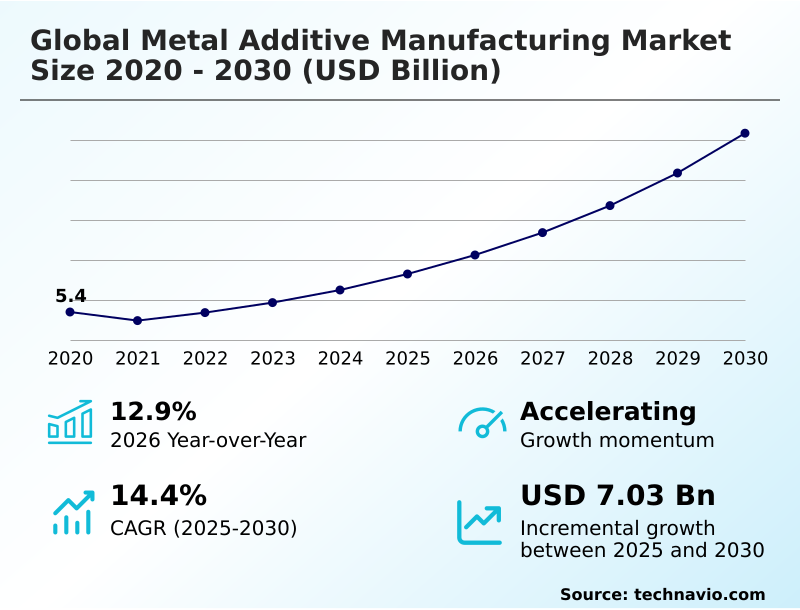
The metal additive manufacturing market size is valued to increase USD 18.67 billion, at a CAGR of 29.7% from 2024 to 2029. Increased preference for additive manufacturing will drive the metal additive manufacturing market.

Major Market Trends & Insights

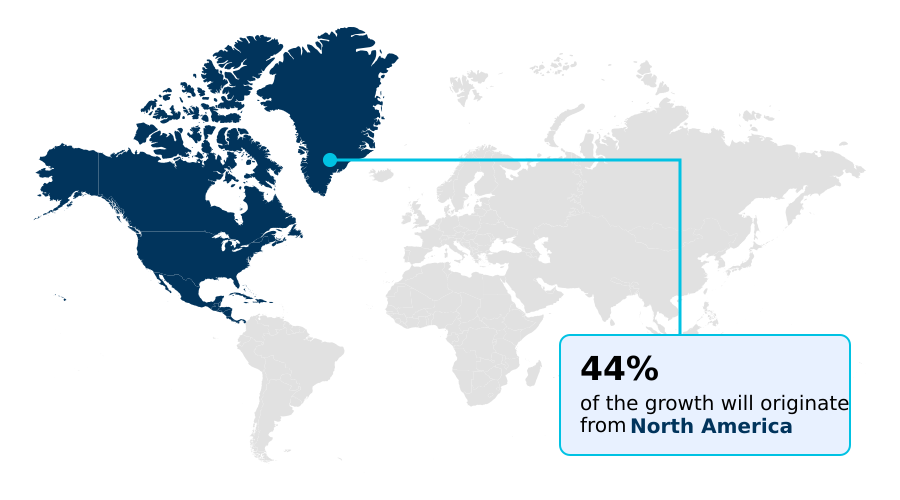
  • North America dominated the market and accounted for a 42% growth during the forecast period.
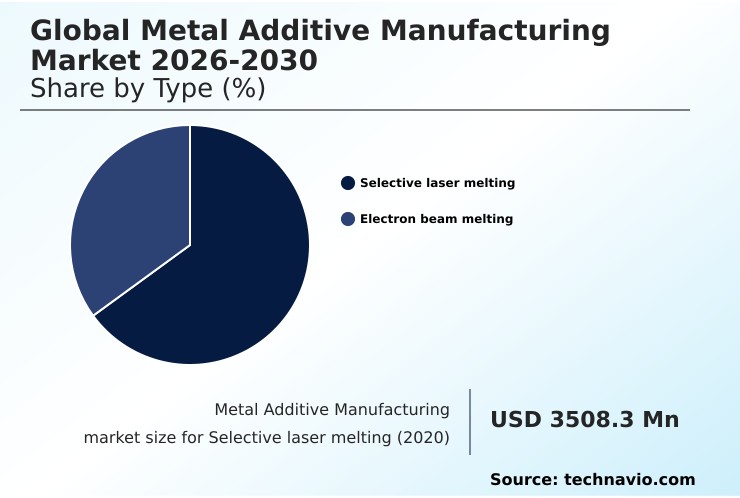
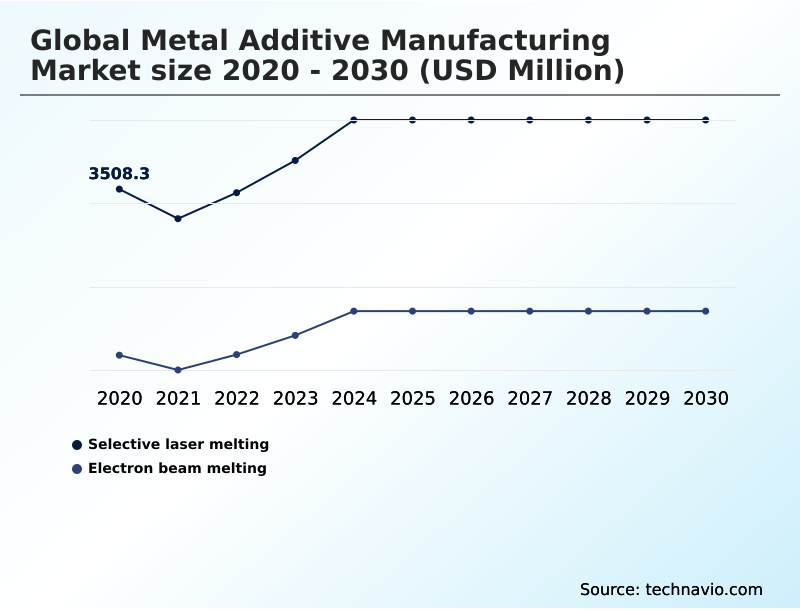
  • By Type - Selective laser melting segment was valued at USD 2.01 billion in 2023
  • By Application - Aerospace segment accounted for the largest market revenue share in 2023

Market Size & Forecast

  • Market Opportunities: USD 771.10 million
  • Market Future Opportunities: USD 18667.90 million
  • CAGR : 29.7%
  • North America: Largest market in 2023

Market Summary

  • The market encompasses the production of three-dimensional metal components using additive manufacturing technologies. This sector is characterized by continuous evolution, driven by advancements in core technologies such as Selective Laser Melting (SLM) and Electron Beam Melting (EBM), which enable the production of complex geometries and high-performance alloys. Applications span industries like aerospace, automotive, and healthcare, with service types including design, engineering, and post-processing gaining traction. Despite the advantages of additive manufacturing, challenges persist, including high production costs. However, the market's potential is vast, with The market share in the industrial 3D printing sector projected to reach 28% by 2025, according to recent market research.
  • The ongoing development of new materials and increased industry adoption further underscores the market's dynamism and potential for growth.

What will be the Size of the Metal Additive Manufacturing Market during the forecast period?
Metal Additive Manufacturing Market Size

Get Key Insights on Market Forecast (PDF) Request Free Sample

How is the Metal Additive Manufacturing Market Segmented and what are the key trends of market segmentation?

The metal additive manufacturing industry research report provides comprehensive data (region-wise segment analysis), with forecasts and estimates in "USD million" for the period 2025-2029, as well as historical data from 2019-2023 for the following segments.

  • Type
    • Selective laser melting
    • Electron beam melting
  • Application
    • Aerospace
    • Healthcare
    • Tools and mold
    • Automobile
    • Others
  • Component
    • Systems
    • Materials
    • Service and parts
  • Geography
    • North America
      • US
      • Canada
    • Europe
      • France
      • Germany
      • Italy
      • UK
    • APAC
      • China
      • India
      • Japan
    • South America
      • Brazil
    • Rest of World (ROW)

By Type Insights

The selective laser melting segment is estimated to witness significant growth during the forecast period.

Metal additive manufacturing, a cutting-edge technology, is revolutionizing industries with its capacity to create complex metal parts layer by layer. The market is currently experiencing significant growth, with selective laser melting (SLM) being the largest segment. SLM, an additive manufacturing process, utilizes a high-powered laser to melt and fuse metal powders, resulting in parts with isotropic thermal and mechanical properties. This method produces strong and durable components, primarily from metals like titanium alloys, nickel alloys, stainless steel, and cobalt chrome alloys. SLM's market dominance is expected to persist due to its ability to create high-strength steel, aluminum alloys, and other advanced materials with superior mechanical properties.

SLM's applications extend across various sectors, including aerospace, automotive, healthcare, and energy. The market for metal additive manufacturing is projected to expand further, with industry experts anticipating a 21.3% increase in demand for metal 3D printing in the automotive sector by 2025. Additionally, the market for aerospace applications is projected to grow by 25.5% during the same period. SLM's process parameters, such as scan speed, energy density, and layer thickness, are crucial in ensuring the quality of the final product. Post-processing techniques, including heat treatment, surface roughness reduction, and microstructure analysis, are essential for optimizing the mechanical properties of the printed parts.

Quality control measures, such as build parameters and defect detection, are also essential to ensure the reliability and consistency of the final product. Emerging technologies, like electron beam melting and binder jetting, are gaining traction in the market due to their unique advantages. For instance, electron beam melting offers higher resolution and better surface finish, making it suitable for producing high-precision components. Binder jetting, on the other hand, uses a liquid binder to bind metal powders, enabling the production of large, complex parts. In conclusion, The market is experiencing robust growth, with selective laser melting leading the charge.

The market's expansion is driven by advancements in process technologies, materials, and applications across various industries. The future of metal additive manufacturing looks promising, with experts anticipating continued growth and innovation in this evolving technology.

Metal Additive Manufacturing Market Size

Request Free Sample

The Selective laser melting segment was valued at USD 2.01 billion in 2019 and showed a gradual increase during the forecast period.
Metal Additive Manufacturing Market Size

Request Free Sample

Regional Analysis

North America is estimated to contribute 42% to the growth of the global market during the forecast period.Technavio's analysts have elaborately explained the regional trends and drivers that shape the market during the forecast period.
Metal Additive Manufacturing Market Share by Geography

See How Metal Additive Manufacturing Market Demand is Rising in North America Request Free Sample

The market in North America: A Key Growth Driver in the Global Industry The North American region dominates the global Metal Additive Manufacturing (AM) market, accounting for a significant revenue share. The US, Canada, and Mexico are major contributors to the market's growth in this region. The aerospace and healthcare industries are primary drivers, with increasing demand for metal AM in these sectors. In the US, the healthcare industry, particularly the demand for dental and implants, is a significant growth factor.

The mature North American economy, with investments in industries like automotive, chemical, and tools and molding, further boosts the market. The US and Canada are expected to maintain their market leadership due to their robust industrial sectors and continuous technological advancements.

Market Dynamics

Our researchers analyzed the data with 2024 as the base year, along with the key drivers, trends, and challenges. A holistic analysis of drivers will help companies refine their marketing strategies to gain a competitive advantage.

The market encompasses various technologies, including titanium alloy laser powder bed fusion, high-strength steel electron beam melting, aluminum alloy directed energy deposition, and stainless steel selective laser melting. These processes offer unique advantages, such as complex part geometry optimization and support structure design strategies, making them increasingly popular in industries like aerospace and automotive for manufacturing components. One significant trend in the market is the optimization of process parameters to influence mechanical properties. For instance, nickel alloy binder jetting process optimization leads to improved microstructure analysis in COCr alloys. Moreover, additive manufacturing design guidelines play a crucial role in ensuring the production of high-quality components.

Defect detection methods in additive manufacturing are continually evolving to address challenges related to real-time monitoring of melt pool dynamics and computational fluid dynamics simulation. These advancements are essential for cost optimization strategies in additive manufacturing, which is crucial as production scaling becomes increasingly challenging. Comparatively, the aerospace industry accounts for a significantly larger share in the adoption of additive manufacturing compared to the automotive sector. More than 70% of new aerospace component developments utilize additive manufacturing technologies, with medical implant manufacturing also showing strong growth. Despite these advancements, the industry faces hurdles, such as material selection criteria for various applications and the optimization of process parameters to achieve desired mechanical properties.

Post-processing heat treatment effects and defect detection methods are critical areas of ongoing research to ensure the production of high-quality, reliable components. In conclusion, the market is experiencing rapid growth, driven by advancements in technology and increasing adoption across various industries. Understanding the market dynamics, including process optimization, material selection, and defect detection, is essential for businesses looking to leverage the benefits of additive manufacturing.

Metal Additive Manufacturing Market Size

What are the key market drivers leading to the rise in the adoption of Metal Additive Manufacturing Industry?

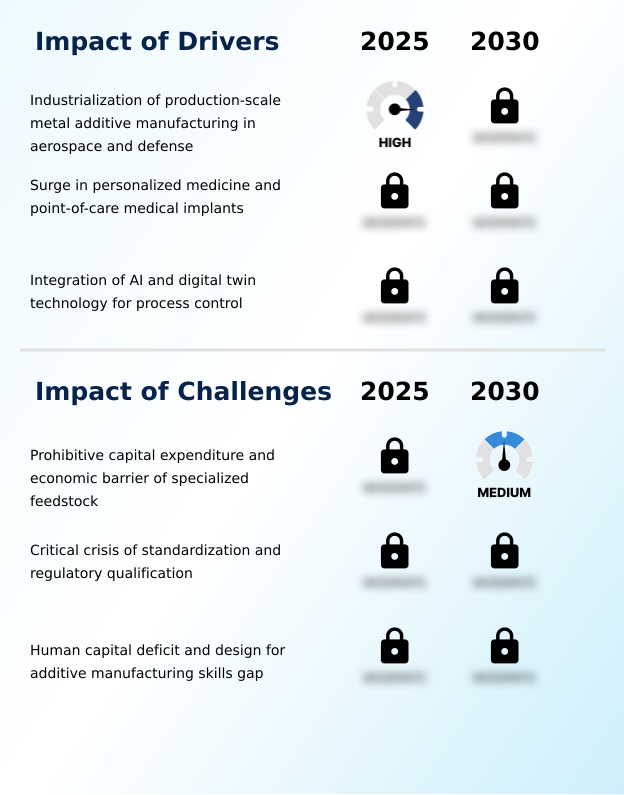
  • The significant surge in the preference for additive manufacturing is the primary factor fueling market growth. Additive manufacturing, also known as 3D printing, is revolutionizing industries by enabling the production of complex components with minimal material waste and customization possibilities. This technology's increasing adoption across various sectors, including automotive, aerospace, healthcare, and consumer goods, is driving market expansion. 
  • Additive manufacturing, also known as 3D printing, is revolutionizing the production of complex engineering structures with its ability to create parts directly from computer-aided design (CAD) models. The market's growth is fueled by the high flexibility and low production costs associated with this technology. By producing fewer parts, less material waste, and reducing assembly time for intricate components, additive manufacturing eliminates the need for tooling. This allows for the creation of components with minimal requirements and any geometry, leading to improved process chains. Metal additive manufacturing is a significant contributor to this market's growth. Its advantages, such as reduced material waste and the ability to produce complex geometries, are driving demand.
  • The process's versatility enables engineers and designers to innovate and optimize existing product designs, making it an essential tool for various industries, including aerospace, automotive, and healthcare. Moreover, additive manufacturing's potential for customization and rapid prototyping has made it a valuable asset in various sectors. It enables businesses to quickly adapt to market demands and produce bespoke solutions, giving them a competitive edge. As the technology continues to evolve, it is expected to disrupt traditional manufacturing processes and create new opportunities. In conclusion, the additive manufacturing market is experiencing significant growth due to its numerous advantages, including flexibility, low production costs, and the ability to create complex components directly from CAD models.
  • The technology's potential for customization and rapid prototyping further enhances its value, making it an essential tool for various industries.

What are the market trends shaping the Metal Additive Manufacturing Industry?

  • Advancements in new materials are currently shaping market trends. The adoption of innovative materials is a significant development in various industries.
  • In 2024, additive manufacturing, also known as 3D printing, experienced significant advancements as innovators continued to explore the boundaries of printable materials. High-performance polymers emerged as a key focus due to their superior quality outcomes in additive manufacturing processes. These polymers offer unparalleled adaptability, making them an attractive option for various applications. Their resistance to extreme heat and stress, coupled with their ability to create intricate geometries, sets them apart. Furthermore, metals like steel and titanium have gained popularity in additive manufacturing for industrial applications. The unique features of these materials have contributed to the growing appeal of additive manufacturing across diverse industries.
  • The potential for producing complex parts with enhanced properties continues to drive the evolution of this technique.

What challenges does the Metal Additive Manufacturing Industry face during its growth?

  • The high production costs associated with metal additive manufacturing represent a significant challenge that can hinder industry growth. To expand, the intricacies and complexities involved in producing metal components using additive manufacturing technologies contribute to increased expenses, which may deter potential investors and hinder the industry from achieving more widespread adoption. 
  • Metal additive manufacturing, or 3D printing with metal powders, is a rapidly evolving industry that presents significant opportunities for businesses seeking innovative production methods. However, the high production costs associated with metal powders and the limited build envelopes of current technologies pose challenges to market growth. For instance, the cost of small coarse-grain metal powders, such as aluminum, steel, and iron, is approximately twice that of materials used in conventional manufacturing processes. This price disparity can hinder market expansion. Furthermore, large components produced through metal additive manufacturing often require additional processes, such as mechanical joining and welding, which can add to the overall production cost.
  • Despite these challenges, the industry continues to advance, with ongoing research and development efforts aimed at reducing costs and expanding build envelope sizes. As a result, businesses across various sectors are increasingly exploring the potential of metal additive manufacturing to improve efficiency, reduce waste, and create complex components that were previously unfeasible with traditional manufacturing methods.

Exclusive Customer Landscape

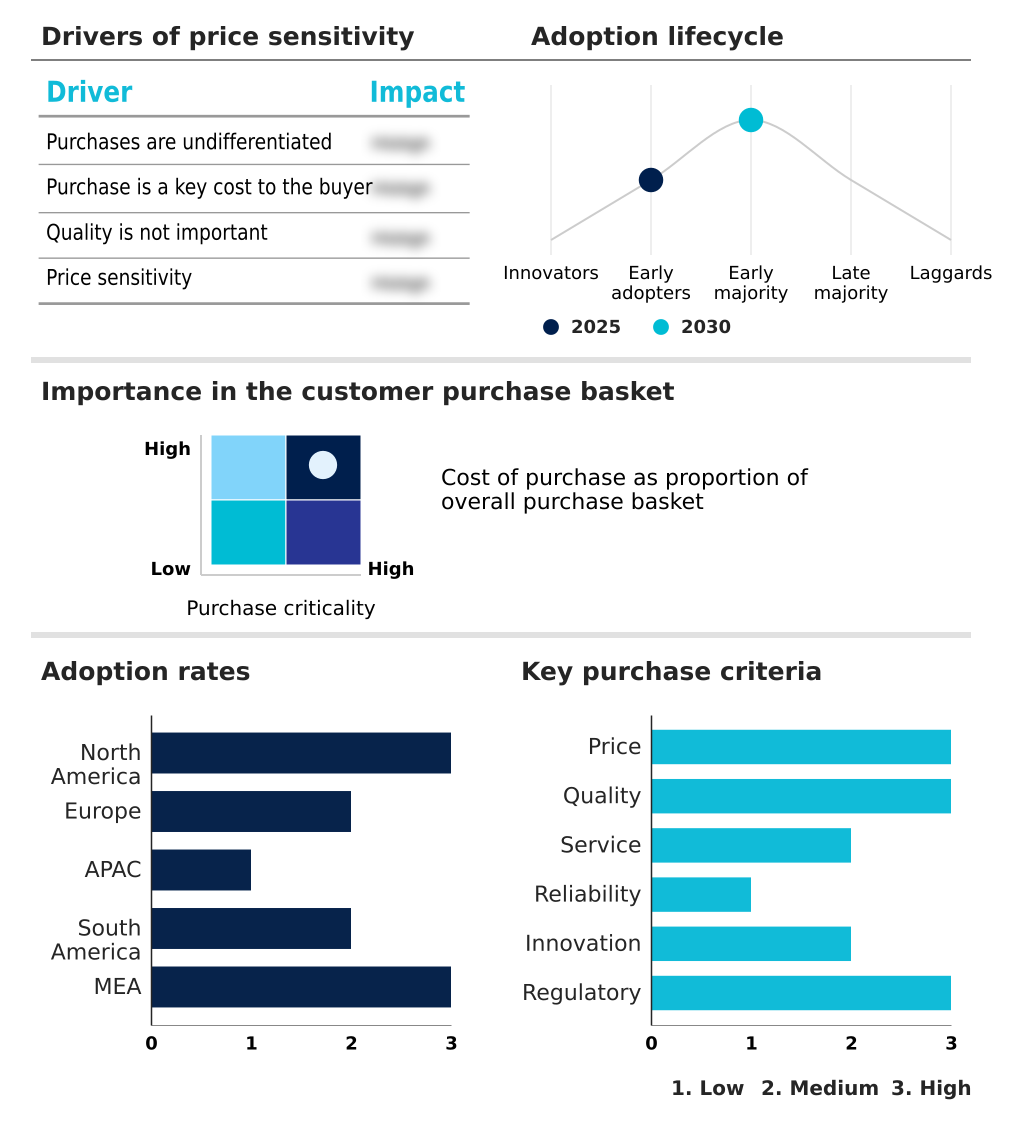
The metal additive manufacturing market forecasting report includes the adoption lifecycle of the market, covering from the innovator's stage to the laggard's stage. It focuses on adoption rates in different regions based on penetration. Furthermore, the metal additive manufacturing market report also includes key purchase criteria and drivers of price sensitivity to help companies evaluate and develop their market growth analysis strategies.
Metal Additive Manufacturing Market Share by Geography

 Customer Landscape of Metal Additive Manufacturing Industry

Competitive Landscape & Market Insights

Companies are implementing various strategies, such as strategic alliances, metal additive manufacturing market forecast, partnerships, mergers and acquisitions, geographical expansion, and product/service launches, to enhance their presence in the industry.

3D Systems Corp. - This company specializes in metal additive manufacturing systems, featuring fully integrated machines with a Removable Print Module. The vacuum-sealed module ensures a controlled print environment, while its mobility between printer and powder modules streamlines continuous production workflows.

The industry research and growth report includes detailed analyses of the competitive landscape of the market and information about key companies, including:

  • 3D Systems Corp.
  • 3DEO Inc.
  • Additive Industries BV
  • Desktop Metal Inc.
  • DMG MORI Co. Ltd.
  • EOS GmbH
  • General Electric Co.
  • Hoganas AB
  • MATERIALISE NV
  • Norsk Titanium AS
  • Optomec Inc.
  • Renishaw Plc
  • Sciaky Inc.
  • SLM Solutions Group AG
  • Stratasys Ltd.
  • The Lincoln Electric Co.
  • Titomic Ltd.
  • TRUMPF SE Co. KG
  • Xjet Ltd.

Qualitative and quantitative analysis of companies has been conducted to help clients understand the wider business environment as well as the strengths and weaknesses of key industry players. Data is qualitatively analyzed to categorize companies as pure play, category-focused, industry-focused, and diversified; it is quantitatively analyzed to categorize companies as dominant, leading, strong, tentative, and weak.

Recent Development and News in Metal Additive Manufacturing Market

  • In January 2024, GE Additive, a leading player in the Metal Additive Manufacturing (AM) market, announced the launch of its new Arcam EBM System, the EBM Q10 Plus, designed for the production of high-performance metal parts in the aerospace and automotive industries. This new product expansion underscores GE Additive's commitment to driving innovation in the AM sector (GE Additive press release).
  • In March 2024, 3D Systems and Desktop Metal, two major players in the AM industry, announced a strategic partnership to combine their respective strengths in metal and polymer additive manufacturing. This collaboration aims to provide a comprehensive additive manufacturing solution for businesses, enabling them to produce both polymer and metal parts under one roof (3D Systems press release).
  • In May 2024, SLM Solutions, a German metal AM technology provider, secured a significant investment of €30 million from Siemens AG to expand its production capacity and accelerate the development of new technologies. This strategic investment underscores Siemens' commitment to the AM market and its belief in SLM Solutions' potential (Reuters).
  • In January 2025, the European Union (EU) approved the Horizon Europe research and innovation program, which includes a focus on additive manufacturing technologies. This €95.5 billion funding initiative will support research and innovation in various sectors, including AM, with the aim of making Europe a global leader in technology development (European Commission press release).

Dive into Technavio's robust research methodology, blending expert interviews, extensive data synthesis, and validated models for unparalleled Metal Additive Manufacturing Market insights. See full methodology.

Market Scope

Report Coverage

Details

Page number

210

Base year

2024

Historic period

2019-2023

Forecast period

2025-2029

Growth momentum & CAGR

Accelerate at a CAGR of 29.7%

Market growth 2025-2029

USD 18667.9 million

Market structure

Fragmented

YoY growth 2024-2025(%)

23.0

Key countries

US, Canada, Germany, China, Japan, UK, France, India, Italy, and Brazil

Competitive landscape

Leading Companies, Market Positioning of Companies, Competitive Strategies, and Industry Risks

Request Free Sample

Research Analyst Overview

  • The market continues to evolve, with key technologies such as Directed Energy Deposition (DED) and Selective Laser Melting (SLM) leading the charge. DED, which includes processes like Laser Engineered Net Shaping (LENS) and Electron Beam Melting (EBM), excels in the production of large, complex components. In contrast, SLM, a form of Powder Bed Fusion, is renowned for its high-resolution capabilities, enabling intricate part geometries and lattice structures. Support structures play a crucial role in both DED and SLM processes, ensuring part stability during manufacturing and reducing the risk of warping or distortion. Topology optimization and part geometry optimization techniques are increasingly being employed to minimize material usage and enhance part performance.
  • Heat treatment, a critical post-processing technique, significantly impacts the mechanical properties of additively manufactured components. Titanium alloys, nickel alloys, stainless steel, and Cocr alloys are popular choices for additive manufacturing due to their high-strength and excellent mechanical properties. Surface roughness and thermal management are ongoing concerns in the metal additive manufacturing industry. Advancements in process parameters, scan speed, energy density, and build parameters are continuously being explored to address these challenges. Material extrusion and binder jetting are alternative additive manufacturing technologies, each offering unique advantages. Aluminum alloys and high-strength steel are common materials used in material extrusion processes, while binder jetting is often employed for the production of sand molds and cores.
  • Microstructure analysis and defect detection techniques are essential for ensuring the quality of additively manufactured components. Process parameters, layer thickness, and electron beam melting are key factors influencing the microstructure and mechanical properties of the final product. In summary, the market is characterized by continuous innovation and technological advancements. From DED and SLM to heat treatment and post-processing techniques, the industry is focused on improving part performance, reducing material usage, and enhancing manufacturing efficiency.

What are the Key Data Covered in this Metal Additive Manufacturing Market Research and Growth Report?

  • What is the expected growth of the Metal Additive Manufacturing Market between 2025 and 2029?

    • USD 18.67 billion, at a CAGR of 29.7%

  • What segmentation does the market report cover?

    • The report segmented by Type (Selective laser melting and Electron beam melting), Application (Aerospace, Healthcare, Tools and mold, Automobile, and Others), Geography (North America, Europe, APAC, South America, and Middle East and Africa), and Component (Systems, Materials, and Service and parts)

  • Which regions are analyzed in the report?

    • North America, Europe, APAC, South America, and Middle East and Africa

  • What are the key growth drivers and market challenges?

    • Increased preference for additive manufacturing, High production costs of metal additive manufacturing

  • Who are the major players in the Metal Additive Manufacturing Market?

    • Key Companies 3D Systems Corp., 3DEO Inc., Additive Industries BV, Desktop Metal Inc., DMG MORI Co. Ltd., EOS GmbH, General Electric Co., Hoganas AB, MATERIALISE NV, Norsk Titanium AS, Optomec Inc., Renishaw Plc, Sciaky Inc., SLM Solutions Group AG, Stratasys Ltd., The Lincoln Electric Co., Titomic Ltd., TRUMPF SE Co. KG, and Xjet Ltd.

Market Research Insights

  • The market encompasses the production of complex geometry parts using real-time monitoring technologies. This industry continues to advance, with significant growth in the production of automotive and aerospace components. According to industry estimates, the market for metal additive manufacturing is projected to reach USD50 billion by 2025, representing a compound annual growth rate of 20%. Dimensional accuracy and surface finish are critical factors in the production of high-quality parts. Advanced process simulation and in-situ monitoring technologies enable part qualification and design validation. Material selection and certification standards are essential considerations in the manufacturing process.
  • Cost optimization is a key driver in the adoption of metal additive manufacturing, particularly for custom designs. Melt pool dynamics and heat transfer modeling are essential in optimizing the manufacturing process. Automated systems with closed-loop control enhance production scaling and improve process monitoring. In the medical field, metal additive manufacturing is revolutionizing the production of implants, with a focus on custom design and improved surface finish. Finite element analysis and computational fluid dynamics are used extensively in the design and testing of aerospace components to ensure safety and efficiency. Two significant advancements in metal additive manufacturing are the integration of AM process simulation and powder characterization.
  • These technologies enable the optimization of manufacturing processes and the improvement of material properties, respectively. With continuous innovation and advancements, the future of metal additive manufacturing is promising.

We can help! Our analysts can customize this metal additive manufacturing market research report to meet your requirements.

Get in touch

1 Executive Summary

  • 1.1 Market overview
    • Executive Summary - Chart on Market Overview
    • Executive Summary - Data Table on Market Overview
    • Executive Summary - Chart on Global Market Characteristics
    • Executive Summary - Chart on Market by Geography
    • Executive Summary - Chart on Market Segmentation by Type
    • Executive Summary - Chart on Market Segmentation by Application
    • Executive Summary - Chart on Incremental Growth
    • Executive Summary - Data Table on Incremental Growth
    • Executive Summary - Chart on Company Market Positioning

2 Technavio Analysis

  • 2.1 Analysis of price sensitivity, lifecycle, customer purchase basket, adoption rates, and purchase criteria
    • Analysis of price sensitivity, lifecycle, customer purchase basket, adoption rates, and purchase criteria
  • 2.2 Criticality of inputs and Factors of differentiation
    • Overview on criticality of inputs and factors of differentiation
  • 2.3 Factors of disruption
    • Overview on factors of disruption
  • 2.4 Impact of drivers and challenges
    • Impact of drivers and challenges in 2024 and 2029

3 Market Landscape

  • 3.1 Market ecosystem
    • Parent Market
    • Data Table on - Parent Market
  • 3.2 Market characteristics
    • Market characteristics analysis
  • 3.3 Value chain analysis
    • Value chain analysis

4 Market Sizing

  • 4.1 Market definition
    • Offerings of companies included in the market definition
  • 4.2 Market segment analysis
    • Market segments
  • 4.3 Market size 2024
    • 4.4 Market outlook: Forecast for 2024-2029
      • Chart on Global - Market size and forecast 2024-2029 ($ million)
      • Data Table on Global - Market size and forecast 2024-2029 ($ million)
      • Chart on Global Market: Year-over-year growth 2024-2029 (%)
      • Data Table on Global Market: Year-over-year growth 2024-2029 (%)

    5 Historic Market Size

    • 5.1 Global Metal Additive Manufacturing Market 2019 - 2023
      • Historic Market Size - Data Table on Global Metal Additive Manufacturing Market 2019 - 2023 ($ million)
    • 5.2 Type segment analysis 2019 - 2023
      • Historic Market Size - Type Segment 2019 - 2023 ($ million)
    • 5.3 Application segment analysis 2019 - 2023
      • Historic Market Size - Application Segment 2019 - 2023 ($ million)
    • 5.4 Geography segment analysis 2019 - 2023
      • Historic Market Size - Geography Segment 2019 - 2023 ($ million)
    • 5.5 Country segment analysis 2019 - 2023
      • Historic Market Size - Country Segment 2019 - 2023 ($ million)

    6 Qualitative Analysis

    • 6.1 Impact Of AI On The Global Metal Additive Manufacturing Market

      7 Five Forces Analysis

      • 7.1 Five forces summary
        • Five forces analysis - Comparison between 2024 and 2029
      • 7.2 Bargaining power of buyers
        • Bargaining power of buyers - Impact of key factors 2024 and 2029
      • 7.3 Bargaining power of suppliers
        • Bargaining power of suppliers - Impact of key factors in 2024 and 2029
      • 7.4 Threat of new entrants
        • Threat of new entrants - Impact of key factors in 2024 and 2029
      • 7.5 Threat of substitutes
        • Threat of substitutes - Impact of key factors in 2024 and 2029
      • 7.6 Threat of rivalry
        • Threat of rivalry - Impact of key factors in 2024 and 2029
      • 7.7 Market condition
        • Chart on Market condition - Five forces 2024 and 2029

      8 Market Segmentation by Type

      • 8.1 Market segments
        • Chart on Type - Market share 2024-2029 (%)
        • Data Table on Type - Market share 2024-2029 (%)
      • 8.2 Comparison by Type
        • Chart on Comparison by Type
        • Data Table on Comparison by Type
      • 8.3 Selective laser melting - Market size and forecast 2024-2029
        • Chart on Selective laser melting - Market size and forecast 2024-2029 ($ million)
        • Data Table on Selective laser melting - Market size and forecast 2024-2029 ($ million)
        • Chart on Selective laser melting - Year-over-year growth 2024-2029 (%)
        • Data Table on Selective laser melting - Year-over-year growth 2024-2029 (%)
      • 8.4 Electron beam melting - Market size and forecast 2024-2029
        • Chart on Electron beam melting - Market size and forecast 2024-2029 ($ million)
        • Data Table on Electron beam melting - Market size and forecast 2024-2029 ($ million)
        • Chart on Electron beam melting - Year-over-year growth 2024-2029 (%)
        • Data Table on Electron beam melting - Year-over-year growth 2024-2029 (%)
      • 8.5 Market opportunity by Type
        • Market opportunity by Type ($ million)
        • Data Table on Market opportunity by Type ($ million)

      9 Market Segmentation by Application

      • 9.1 Market segments
        • Chart on Application - Market share 2024-2029 (%)
        • Data Table on Application - Market share 2024-2029 (%)
      • 9.2 Comparison by Application
        • Chart on Comparison by Application
        • Data Table on Comparison by Application
      • 9.3 Aerospace - Market size and forecast 2024-2029
        • Chart on Aerospace - Market size and forecast 2024-2029 ($ million)
        • Data Table on Aerospace - Market size and forecast 2024-2029 ($ million)
        • Chart on Aerospace - Year-over-year growth 2024-2029 (%)
        • Data Table on Aerospace - Year-over-year growth 2024-2029 (%)
      • 9.4 Healthcare - Market size and forecast 2024-2029
        • Chart on Healthcare - Market size and forecast 2024-2029 ($ million)
        • Data Table on Healthcare - Market size and forecast 2024-2029 ($ million)
        • Chart on Healthcare - Year-over-year growth 2024-2029 (%)
        • Data Table on Healthcare - Year-over-year growth 2024-2029 (%)
      • 9.5 Tools and mold - Market size and forecast 2024-2029
        • Chart on Tools and mold - Market size and forecast 2024-2029 ($ million)
        • Data Table on Tools and mold - Market size and forecast 2024-2029 ($ million)
        • Chart on Tools and mold - Year-over-year growth 2024-2029 (%)
        • Data Table on Tools and mold - Year-over-year growth 2024-2029 (%)
      • 9.6 Automobile - Market size and forecast 2024-2029
        • Chart on Automobile - Market size and forecast 2024-2029 ($ million)
        • Data Table on Automobile - Market size and forecast 2024-2029 ($ million)
        • Chart on Automobile - Year-over-year growth 2024-2029 (%)
        • Data Table on Automobile - Year-over-year growth 2024-2029 (%)
      • 9.7 Others - Market size and forecast 2024-2029
        • Chart on Others - Market size and forecast 2024-2029 ($ million)
        • Data Table on Others - Market size and forecast 2024-2029 ($ million)
        • Chart on Others - Year-over-year growth 2024-2029 (%)
        • Data Table on Others - Year-over-year growth 2024-2029 (%)
      • 9.8 Market opportunity by Application
        • Market opportunity by Application ($ million)
        • Data Table on Market opportunity by Application ($ million)

      10 Market Segmentation by Component

      • 10.1 Market segments
        • Chart on Component - Market share (2024-2029) (%)
        • Data Table on Component - Market share (2024-2029) (%)
      • 10.2 Comparison by Component
        • Chart on Comparison by Component
        • Data Table on Comparison by Component
      • 10.3 Systems - Market size and forecast (2024-2029)
        • Chart on Systems - Market size and forecast (2024-2029) ($ million)
        • Data Table on Systems - Market size and forecast (2024-2029) ($ million)
        • Chart on Systems - Year-over-year growth (2024-2029) (%)
        • Data Table on Systems - Year-over-year growth (2024-2029) (%)
      • 10.4 Materials - Market size and forecast (2024-2029)
        • Chart on Materials - Market size and forecast (2024-2029) ($ million)
        • Data Table on Materials - Market size and forecast (2024-2029) ($ million)
        • Chart on Materials - Year-over-year growth (2024-2029) (%)
        • Data Table on Materials - Year-over-year growth (2024-2029) (%)
      • 10.5 Service and parts - Market size and forecast (2024-2029)
        • Chart on Service and parts - Market size and forecast (2024-2029) ($ million)
        • Data Table on Service and parts - Market size and forecast (2024-2029) ($ million)
        • Chart on Service and parts - Year-over-year growth (2024-2029) (%)
        • Data Table on Service and parts - Year-over-year growth (2024-2029) (%)
      • 10.6 Market opportunity by Component
        • Market opportunity by $segment_name ($ million)
        • Data Table on Market opportunity by $segment_name ($ million)

      11 Customer Landscape

      • 11.1 Customer landscape overview
        • Analysis of price sensitivity, lifecycle, customer purchase basket, adoption rates, and purchase criteria

      12 Geographic Landscape

      • 12.1 Geographic segmentation
        • Chart on Market share by geography 2024-2029 (%)
        • Data Table on Market share by geography 2024-2029 (%)
      • 12.2 Geographic comparison
        • Chart on Geographic comparison
        • Data Table on Geographic comparison
      • 12.3 North America - Market size and forecast 2024-2029
        • Chart on North America - Market size and forecast 2024-2029 ($ million)
        • Data Table on North America - Market size and forecast 2024-2029 ($ million)
        • Chart on North America - Year-over-year growth 2024-2029 (%)
        • Data Table on North America - Year-over-year growth 2024-2029 (%)
      • 12.4 Europe - Market size and forecast 2024-2029
        • Chart on Europe - Market size and forecast 2024-2029 ($ million)
        • Data Table on Europe - Market size and forecast 2024-2029 ($ million)
        • Chart on Europe - Year-over-year growth 2024-2029 (%)
        • Data Table on Europe - Year-over-year growth 2024-2029 (%)
      • 12.5 APAC - Market size and forecast 2024-2029
        • Chart on APAC - Market size and forecast 2024-2029 ($ million)
        • Data Table on APAC - Market size and forecast 2024-2029 ($ million)
        • Chart on APAC - Year-over-year growth 2024-2029 (%)
        • Data Table on APAC - Year-over-year growth 2024-2029 (%)
      • 12.6 South America - Market size and forecast 2024-2029
        • Chart on South America - Market size and forecast 2024-2029 ($ million)
        • Data Table on South America - Market size and forecast 2024-2029 ($ million)
        • Chart on South America - Year-over-year growth 2024-2029 (%)
        • Data Table on South America - Year-over-year growth 2024-2029 (%)
      • 12.7 Middle East and Africa - Market size and forecast 2024-2029
        • Chart on Middle East and Africa - Market size and forecast 2024-2029 ($ million)
        • Data Table on Middle East and Africa - Market size and forecast 2024-2029 ($ million)
        • Chart on Middle East and Africa - Year-over-year growth 2024-2029 (%)
        • Data Table on Middle East and Africa - Year-over-year growth 2024-2029 (%)
      • 12.8 US - Market size and forecast 2024-2029
        • Chart on US - Market size and forecast 2024-2029 ($ million)
        • Data Table on US - Market size and forecast 2024-2029 ($ million)
        • Chart on US - Year-over-year growth 2024-2029 (%)
        • Data Table on US - Year-over-year growth 2024-2029 (%)
      • 12.9 Canada - Market size and forecast 2024-2029
        • Chart on Canada - Market size and forecast 2024-2029 ($ million)
        • Data Table on Canada - Market size and forecast 2024-2029 ($ million)
        • Chart on Canada - Year-over-year growth 2024-2029 (%)
        • Data Table on Canada - Year-over-year growth 2024-2029 (%)
      • 12.10 Germany - Market size and forecast 2024-2029
        • Chart on Germany - Market size and forecast 2024-2029 ($ million)
        • Data Table on Germany - Market size and forecast 2024-2029 ($ million)
        • Chart on Germany - Year-over-year growth 2024-2029 (%)
        • Data Table on Germany - Year-over-year growth 2024-2029 (%)
      • 12.11 China - Market size and forecast 2024-2029
        • Chart on China - Market size and forecast 2024-2029 ($ million)
        • Data Table on China - Market size and forecast 2024-2029 ($ million)
        • Chart on China - Year-over-year growth 2024-2029 (%)
        • Data Table on China - Year-over-year growth 2024-2029 (%)
      • 12.12 Japan - Market size and forecast 2024-2029
        • Chart on Japan - Market size and forecast 2024-2029 ($ million)
        • Data Table on Japan - Market size and forecast 2024-2029 ($ million)
        • Chart on Japan - Year-over-year growth 2024-2029 (%)
        • Data Table on Japan - Year-over-year growth 2024-2029 (%)
      • 12.13 UK - Market size and forecast 2024-2029
        • Chart on UK - Market size and forecast 2024-2029 ($ million)
        • Data Table on UK - Market size and forecast 2024-2029 ($ million)
        • Chart on UK - Year-over-year growth 2024-2029 (%)
        • Data Table on UK - Year-over-year growth 2024-2029 (%)
      • 12.14 France - Market size and forecast 2024-2029
        • Chart on France - Market size and forecast 2024-2029 ($ million)
        • Data Table on France - Market size and forecast 2024-2029 ($ million)
        • Chart on France - Year-over-year growth 2024-2029 (%)
        • Data Table on France - Year-over-year growth 2024-2029 (%)
      • 12.15 India - Market size and forecast 2024-2029
        • Chart on India - Market size and forecast 2024-2029 ($ million)
        • Data Table on India - Market size and forecast 2024-2029 ($ million)
        • Chart on India - Year-over-year growth 2024-2029 (%)
        • Data Table on India - Year-over-year growth 2024-2029 (%)
      • 12.16 Italy - Market size and forecast 2024-2029
        • Chart on Italy - Market size and forecast 2024-2029 ($ million)
        • Data Table on Italy - Market size and forecast 2024-2029 ($ million)
        • Chart on Italy - Year-over-year growth 2024-2029 (%)
        • Data Table on Italy - Year-over-year growth 2024-2029 (%)
      • 12.17 Brazil - Market size and forecast 2024-2029
        • Chart on Brazil - Market size and forecast 2024-2029 ($ million)
        • Data Table on Brazil - Market size and forecast 2024-2029 ($ million)
        • Chart on Brazil - Year-over-year growth 2024-2029 (%)
        • Data Table on Brazil - Year-over-year growth 2024-2029 (%)
      • 12.18 Market opportunity by geography
        • Market opportunity by geography ($ million)
        • Data Tables on Market opportunity by geography ($ million)

      13 Drivers, Challenges, and Opportunity/Restraints

      • 13.1 Market drivers
        • 13.2 Market challenges
          • 13.3 Impact of drivers and challenges
            • Impact of drivers and challenges in 2024 and 2029
          • 13.4 Market opportunities/restraints

            14 Competitive Landscape

            • 14.1 Overview
              • 14.2 Competitive Landscape
                • Overview on criticality of inputs and factors of differentiation
              • 14.3 Landscape disruption
                • Overview on factors of disruption
              • 14.4 Industry risks
                • Impact of key risks on business

              15 Competitive Analysis

              • 15.1 Companies profiled
                • Companies covered
              • 15.2 Company ranking index
                • Company ranking index
              • 15.3 Market positioning of companies
                • Matrix on companies position and classification
              • 3D Systems Corp.
                • 3D Systems Corp. - Overview
                • 3D Systems Corp. - Business segments
                • 3D Systems Corp. - Key news
                • 3D Systems Corp. - Key offerings
                • 3D Systems Corp. - Segment focus
                • SWOT
              • 3DEO Inc.
                • 3DEO Inc. - Overview
                • 3DEO Inc. - Product / Service
                • 3DEO Inc. - Key offerings
                • SWOT
              • 15.6 Additive Industries BV
                • Additive Industries BV - Overview
                • Additive Industries BV - Product / Service
                • Additive Industries BV - Key offerings
                • SWOT
              • 15.7 DMG MORI Co. Ltd.
                • DMG MORI Co. Ltd. - Overview
                • DMG MORI Co. Ltd. - Business segments
                • DMG MORI Co. Ltd. - Key offerings
                • DMG MORI Co. Ltd. - Segment focus
                • SWOT
              • 15.8 EOS GmbH
                • EOS GmbH - Overview
                • EOS GmbH - Product / Service
                • EOS GmbH - Key news
                • EOS GmbH - Key offerings
                • SWOT
              • 15.9 General Electric Co.
                • General Electric Co. - Overview
                • General Electric Co. - Business segments
                • General Electric Co. - Key news
                • General Electric Co. - Key offerings
                • General Electric Co. - Segment focus
                • SWOT
              • 15.10 Hoganas AB
                • Hoganas AB - Overview
                • Hoganas AB - Product / Service
                • Hoganas AB - Key offerings
                • SWOT
              • 15.11 MATERIALISE NV
                • MATERIALISE NV - Overview
                • MATERIALISE NV - Business segments
                • MATERIALISE NV - Key news
                • MATERIALISE NV - Key offerings
                • MATERIALISE NV - Segment focus
                • SWOT
              • 15.12 Norsk Titanium AS
                • Norsk Titanium AS - Overview
                • Norsk Titanium AS - Product / Service
                • Norsk Titanium AS - Key offerings
                • SWOT
              • 15.13 Optomec Inc.
                • Optomec Inc. - Overview
                • Optomec Inc. - Product / Service
                • Optomec Inc. - Key offerings
                • SWOT
              • 15.14 Renishaw Plc
                • Renishaw Plc - Overview
                • Renishaw Plc - Business segments
                • Renishaw Plc - Key offerings
                • Renishaw Plc - Segment focus
                • SWOT
              • 15.15 Sciaky Inc.
                • Sciaky Inc. - Overview
                • Sciaky Inc. - Product / Service
                • Sciaky Inc. - Key offerings
                • SWOT
              • 15.16 SLM Solutions Group AG
                • SLM Solutions Group AG - Overview
                • SLM Solutions Group AG - Business segments
                • SLM Solutions Group AG - Key offerings
                • SLM Solutions Group AG - Segment focus
                • SWOT
              • 15.17 Stratasys Ltd.
                • Stratasys Ltd. - Overview
                • Stratasys Ltd. - Product / Service
                • Stratasys Ltd. - Key news
                • Stratasys Ltd. - Key offerings
                • SWOT
              • 15.18 TRUMPF SE Co. KG
                • TRUMPF SE Co. KG - Overview
                • TRUMPF SE Co. KG - Product / Service
                • TRUMPF SE Co. KG - Key offerings
                • SWOT

              16 Appendix

              • 16.1 Scope of the report
                • 16.2 Inclusions and exclusions checklist
                  • Inclusions checklist
                  • Exclusions checklist
                • 16.3 Currency conversion rates for US$
                  • Currency conversion rates for US$
                • 16.4 Research methodology
                  • Research methodology
                • 16.5 Data procurement
                  • Information sources
                • 16.6 Data validation
                  • Data validation
                • 16.7 Validation techniques employed for market sizing
                  • Validation techniques employed for market sizing
                • 16.8 Data synthesis
                  • Data synthesis
                • 16.9 360 degree market analysis
                  • 360 degree market analysis
                • 16.10 List of abbreviations
                  • List of abbreviations

                Research Methodology

                Technavio presents a detailed picture of the market by way of study, synthesis, and summation of data from multiple sources. The analysts have presented the various facets of the market with a particular focus on identifying the key industry influencers. The data thus presented is comprehensive, reliable, and the result of extensive research, both primary and secondary.

                INFORMATION SOURCES

                Primary sources

                • Manufacturers and suppliers
                • Channel partners
                • Industry experts
                • Strategic decision makers

                Secondary sources

                • Industry journals and periodicals
                • Government data
                • Financial reports of key industry players
                • Historical data
                • Press releases

                DATA ANALYSIS

                Data Synthesis

                • Collation of data
                • Estimation of key figures
                • Analysis of derived insights

                Data Validation

                • Triangulation with data models
                • Reference against proprietary databases
                • Corroboration with industry experts

                REPORT WRITING

                Qualitative

                • Market drivers
                • Market challenges
                • Market trends
                • Five forces analysis

                Quantitative

                • Market size and forecast
                • Market segmentation
                • Geographical insights
                • Competitive landscape

                Interested in this report?

                Get your sample now to see our research methodology and insights!

                Download Now

                Frequently Asked Questions

                Metal Additive Manufacturing market growth will increase by $ 18667.9 mn during 2025-2029 .

                The Metal Additive Manufacturing market is expected to grow at a CAGR of 29.7% during 2025-2029 .

                Metal Additive Manufacturing market is segmented by Type( Selective laser melting, Electron beam melting, tools and mold, automobile, others) Application( Aerospace, Healthcare, Tools and mold, Automobile, Others)

                3D Systems Corp., 3DEO Inc., Additive Industries BV, Desktop Metal Inc., DMG MORI Co. Ltd., EOS GmbH, General Electric Co., Hoganas AB, MATERIALISE NV, Norsk Titanium AS, Optomec Inc., Renishaw Plc, Sciaky Inc., SLM Solutions Group AG, Stratasys Ltd., The Lincoln Electric Co., Titomic Ltd., TRUMPF SE Co. KG, Xjet Ltd. are a few of the key vendors in the Metal Additive Manufacturing market.

                North America will register the highest growth rate of 42% among the other regions. Therefore, the Metal Additive Manufacturing market in North America is expected to garner significant business opportunities for the vendors during the forecast period.

                US, Canada, Germany, China, Japan, UK, France, India, Italy, Brazil

                • Increased preference for additive manufacturingThe rise in demand for additive manufacturing for the production of complex engineering structures is expected to drive market growth. The high flexibility and low production cost of parts in additive manufacturing are expected to drive the demand for metal additive manufacturing. With fewer parts involved is the driving factor this market.
                • less material wasted is the driving factor this market.
                • and reduced assembly time for complex components is the driving factor this market.
                • the production of components or parts directly from the computer-aided design (CAD) model does not need the support of tooling; this allows the additive manufacturing process to design and produce components of any geometry with low cost and minimum requirements. It also allows engineers and designers to improve the existing process chains.Engineering-intensive businesses such as aerospace is the driving factor this market.
                • automotive is the driving factor this market.
                • and medical accelerate prototyping is the driving factor this market.
                • enabling them to explore new design features at no extra cost. The increase in demand for flexible manufacturing processes is the driving factor this market.
                • which require limited assembly lines is the driving factor this market.
                • resulting in the limited wastage of materials is the driving factor this market.
                • and use fewer parts for the production of complex components is the driving factor this market.
                • is expected to drive the growth of the global metal additive manufacturing market during the forecast period. is the driving factor this market.

                The Metal Additive Manufacturing market vendors should focus on grabbing business opportunities from the Selective laser melting segment as it accounted for the largest market share in the base year.