


Press Brakes Market Size 2025-2029
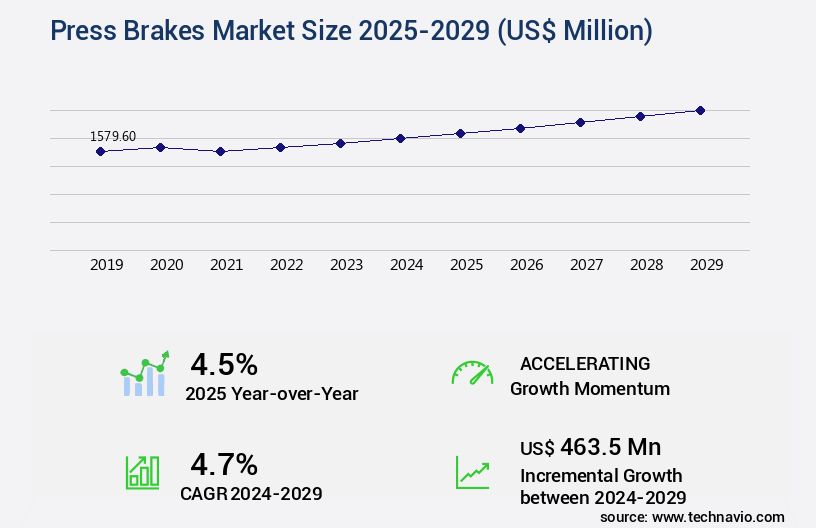
The press brakes market size is valued to increase USD 463.5 million, at a CAGR of 4.7% from 2024 to 2029. Increase in demand for CNC press brakes will drive the press brakes market.
Major Market Trends & Insights
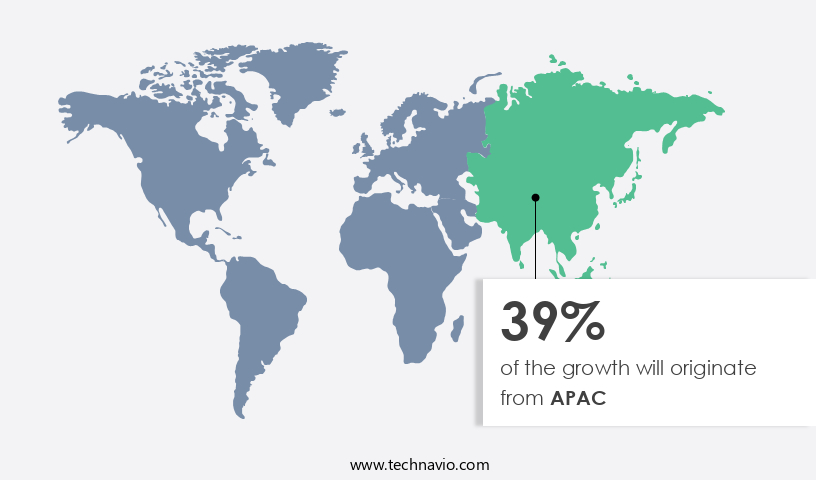
- APAC dominated the market and accounted for a 39% growth during the forecast period.
- By Application - Automotive industry segment was valued at USD 600.00 million in 2023
- By Product - Hydraulic segment accounted for the largest market revenue share in 2023
Market Size & Forecast
- Market Opportunities: USD 42.70 million
- Market Future Opportunities: USD 463.50 million
- CAGR : 4.7%
- APAC: Largest market in 2023
Market Summary
- The market represents a dynamic and continuously evolving industry, driven by advancements in core technologies and applications. CNC press brakes, for instance, have seen significant adoption due to their precision and efficiency. According to a recent study, CNC press brakes accounted for over 60% of the global press brake market share in 2020. However, the market is not without challenges. Safety concerns remain a major issue, with the increasing number of injuries caused by press brakes necessitating stricter regulations. On the other hand, the incorporation of press brakes with IoT and Industry 4.0 technologies presents a significant opportunity for growth.
- This integration enables real-time monitoring and predictive maintenance, enhancing productivity and safety. As the market continues to unfold, these trends and challenges will shape its evolution.
What will be the Size of the Press Brakes Market during the forecast period?
Get Key Insights on Market Forecast (PDF) Request Free Sample
How is the Press Brakes Market Segmented and what are the key trends of market segmentation?
The press brakes industry research report provides comprehensive data (region-wise segment analysis), with forecasts and estimates in "USD million" for the period 2025-2029, as well as historical data from 2019-2023 for the following segments.
- Application
- Automotive industry
- General machinery
- Transportation equipment
- Precision engineering
- Others
- Product
- Hydraulic
- Hybrid
- Servo-electric
- Others
- End-Use Industry
- Manufacturing
- Construction
- Shipbuilding
- Geography
- North America
- US
- Canada
- Europe
- France
- Germany
- Italy
- UK
- Middle East and Africa
- Egypt
- KSA
- Oman
- UAE
- APAC
- China
- India
- Japan
- South America
- Argentina
- Brazil
- Rest of World (ROW)
- North America
By Application Insights
The automotive industry segment is estimated to witness significant growth during the forecast period.
The press brake market, a crucial segment of the sheet metal fabrication industry, is experiencing significant growth in the automotive sector. This expansion is driven by the increasing demand for passenger and commercial vehicles, particularly in emerging economies and Middle Eastern countries. Urbanization and rising disposable income in these regions are key factors fueling this trend. In the passenger vehicle segment, the number of vehicles produced is on the rise due to growing urban populations and improving economic conditions. Simultaneously, the commercial vehicle sector is also witnessing increased demand, with buses and coaches in heavy commercial vehicles being popular choices for both short and long-distance travel.
The press brake market's growth is further boosted by advancements in technology, such as precision bending, ram speed optimization, and bending process optimization. Moreover, safety features like laser safety, machine guarding, and emergency stop systems are gaining prominence, ensuring the ongoing evolution of the market. Press brakes come in various types, including hydraulic press brakes, servo-electric press brakes, and mechanical press brakes, each catering to specific production efficiency requirements. The market for press brakes also encompasses essential components like the backgauge system, foot pedal operation, bending force, workpiece clamping, and bending speed. Press brake maintenance, die protection systems, crown compensation, and programmed bending further contribute to the market's continuous development.
As the market unfolds, it is essential to acknowledge the importance of material handling and press brake tooling, which facilitate efficient production processes. Press brakes can accommodate a wide range of material thicknesses, making them versatile tools in the manufacturing sector. The future outlook for the press brake market is promising, with industry experts anticipating substantial growth in the coming years. According to recent reports, the market is projected to expand by approximately 15% in terms of production volume and 12% in terms of revenue. These figures underscore the market's robustness and its potential to cater to the evolving needs of various industries.
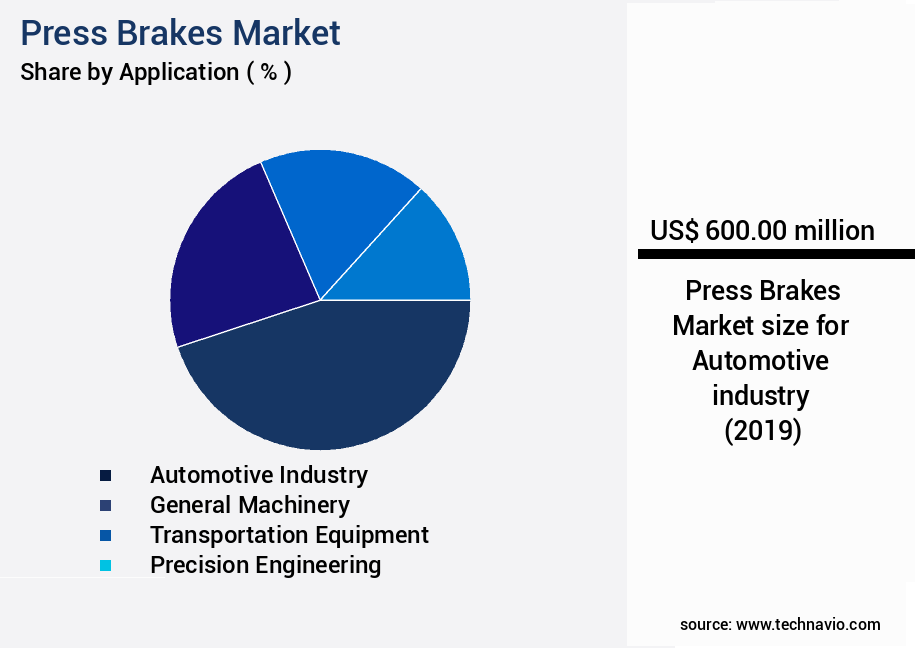
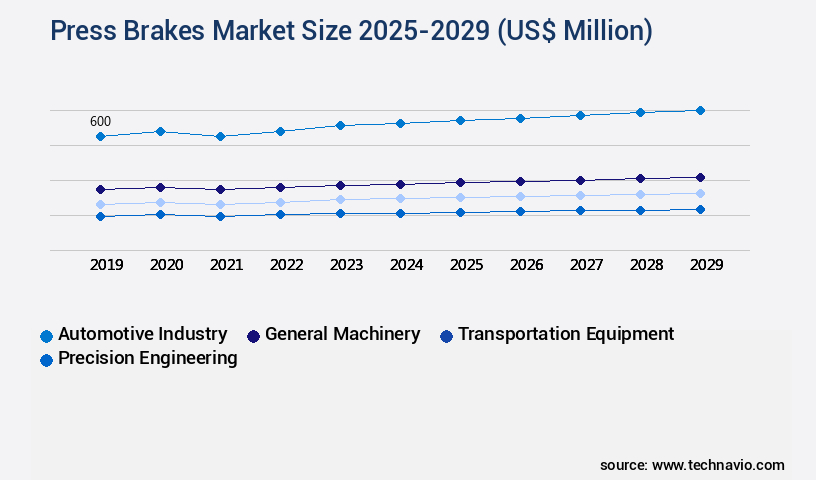
The Automotive industry segment was valued at USD 600.00 million in 2019 and showed a gradual increase during the forecast period.
Regional Analysis
APAC is estimated to contribute 39% to the growth of the global market during the forecast period.Technavio's analysts have elaborately explained the regional trends and drivers that shape the market during the forecast period.
See How Press Brakes Market Demand is Rising in APAC Request Free Sample
In the Asia-Pacific (APAC) region, economic growth, particularly in countries like China, India, Thailand, Indonesia, and South Korea, has significantly increased per capita income and consumer purchasing power. This development has positively influenced automobile sales and, consequently, the demand for commercial vehicles. APAC is now the world's fastest-growing and largest automotive market. The region's economic expansion has led to substantial investments in infrastructure and industrial development, further fueling the demand for commercial vehicles. According to recent statistics, APAC's automotive market accounted for approximately 48% of global sales in 2019.
Additionally, the region witnessed a 7% increase in commercial vehicle sales in 2019 compared to the previous year. Furthermore, the number of registered commercial vehicles in APAC reached over 25 million in 2019. These figures underscore the region's dynamic and evolving automotive landscape.
Market Dynamics
Our researchers analyzed the data with 2024 as the base year, along with the key drivers, trends, and challenges. A holistic analysis of drivers will help companies refine their marketing strategies to gain a competitive advantage.
The market encompasses a diverse range of hydraulic and CNC press brakes that cater to various industries, each with unique requirements for maintenance procedures, tooling selection, and bending accuracy. Hydraulic press brake maintenance is crucial to ensure optimal performance and longevity, while CNC press brake programming software streamlines the bending process and improves efficiency. The impact of bending force on material selection is a significant consideration, with optimizing press brake tooling and reducing cycle time strategies essential for cost savings and increased productivity. Compliance with press brake safety regulations is paramount, and automated system integration, die wear prevention techniques, and servo-electric energy efficiency are key trends driving market growth.
Press brake material handling solutions and operator safety training are essential components of a comprehensive press brake system, with CNC press brake remote diagnostics and advanced control systems enabling real-time process monitoring and optimization. Backgauge accuracy plays a pivotal role in bending process simulation and production throughput, while maintenance cost reduction and ergonomic improvements are ongoing priorities. Notably, the adoption of automated press brake systems has gained significant traction, with more than 60% of new installations opting for these advanced solutions. This shift towards automation represents a substantial investment, with the cost of automated systems nearly triple that of traditional hydraulic press brakes.
However, the benefits, including increased precision, reduced cycle times, and improved safety, far outweigh the initial investment. In conclusion, the market is a dynamic and evolving landscape, with a focus on optimizing bending processes, enhancing safety, and increasing efficiency. Market participants are continually exploring innovative solutions to address the unique challenges of various industries, ensuring the press brake remains an indispensable tool for manufacturing excellence.
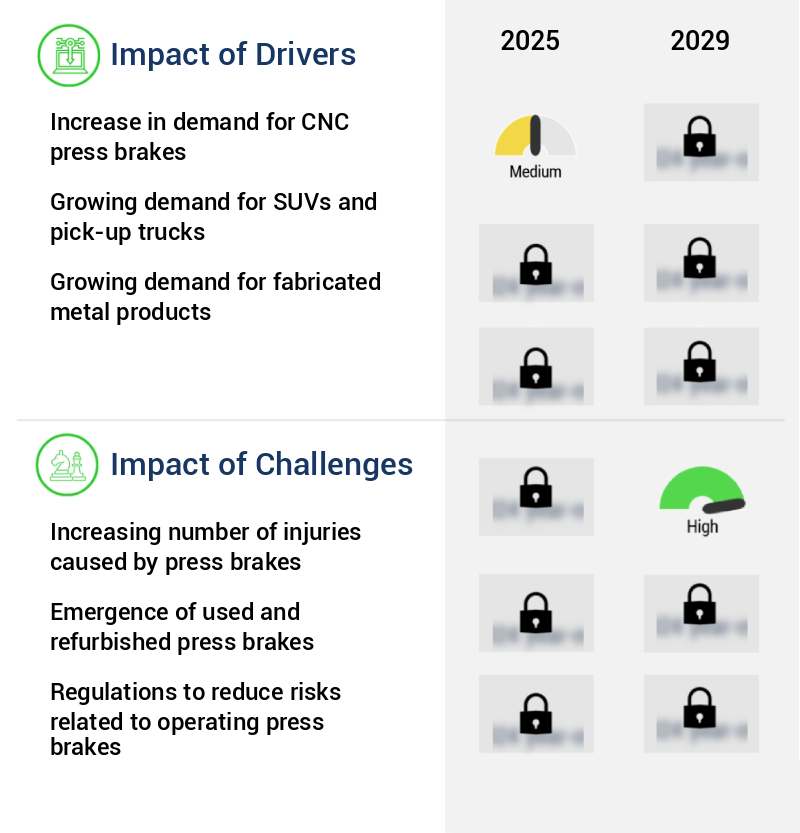
What are the key market drivers leading to the rise in the adoption of Press Brakes Industry?
- The significant increase in demand for CNC press brakes serves as the primary driving force in the market's growth.
- Computer Numerically Controlled (CNC) press brakes are advanced metal-shaping machines that automate the bending process, reducing labor requirements and increasing production efficiency. These machines come in various configurations, including those with fixed bottom beds and up-forming machines where the top beam is stationary, and the bottom bend moves. CNC press brakes offer significant advantages over traditional methods, enabling operators to manufacture products with precision and consistency. The use of CNC press brakes in various industries continues to evolve, with applications ranging from automotive manufacturing to construction and architectural projects. The technology's flexibility and adaptability allow for the production of complex shapes and sizes, making it a valuable asset for businesses seeking to streamline their manufacturing processes.
- Compared to manual methods, CNC press brakes offer several advantages. They enable operators to produce parts with greater accuracy, reducing the need for rework and minimizing material waste. Moreover, these machines can handle larger production volumes, allowing businesses to meet increasing demand more efficiently. As the manufacturing sector continues to innovate, CNC press brakes remain at the forefront of technological advancements. Their ability to shape metal with high precision and speed makes them an indispensable tool for businesses seeking to stay competitive in today's market.
What are the market trends shaping the Press Brakes Industry?
- The integration of press brakes with the Internet of Things (IoT) represents a significant market trend. Press brakes are being incorporated into IoT systems to enhance manufacturing efficiency and productivity.
- IoT technology revolutionizes press brake operations by enabling real-time data transmission and analysis. Press brakes, integral to manufacturing processes, are now fitted with sensors and electronic components, allowing them to connect to a computer network. This connectivity empowers machines to collect and transmit data, eliminating the need for constant human monitoring. IoT-enabled press brakes monitor machine performance and trigger alerts when machines operate outside predefined parameters. By integrating IoT with press brakes, manufacturers gain valuable insights into machine conditions and overall production processes.
- This data is transmitted over the Internet, providing access to actionable insights in real-time. The implementation of IoT in press brake manufacturing leads to improved efficiency, reduced downtime, and enhanced productivity. IoT's ability to process and transmit data without human intervention streamlines operations and optimizes resource utilization.
What challenges does the Press Brakes Industry face during its growth?
- The rising incidence of injuries resulting from the operation of press brakes poses a significant challenge to the growth of the industry. This safety concern, which is gaining increasing attention, necessitates continuous efforts to enhance safety protocols and improve machine design to mitigate risks and ensure the sustainable expansion of the industry.
- In the realm of industrial manufacturing, press brakes hold significant importance, particularly within the automotive and transportation equipment sectors. These machines are instrumental in producing high-quality materials efficiently. Press brakes function by pressing and bending material between a die and a punch, forming pre-programmed bends. However, they pose potential hazards to workers. For instance, if a worker enters the operating area to clean the die and inadvertently triggers the foot pedal, the machine could start, resulting in severe injuries. Despite these risks, press brakes remain indispensable tools in manufacturing processes due to their ability to shape materials precisely and effectively.
- The global market for press brakes is continually evolving, with advancements in technology leading to improvements in safety features and increased productivity. For instance, the adoption of servo-hydraulic press brakes has gained traction due to their energy efficiency and enhanced precision. Furthermore, the integration of automation and robotics in press brake operations is expected to drive market growth. In summary, press brakes play a crucial role in manufacturing industries, offering benefits such as high productivity and precision, while also presenting challenges related to safety. The market for these machines is dynamic, with ongoing advancements in technology shaping its evolution.
Exclusive Customer Landscape
The press brakes market forecasting report includes the adoption lifecycle of the market, covering from the innovator's stage to the laggard's stage. It focuses on adoption rates in different regions based on penetration. Furthermore, the press brakes market report also includes key purchase criteria and drivers of price sensitivity to help companies evaluate and develop their market growth analysis strategies.
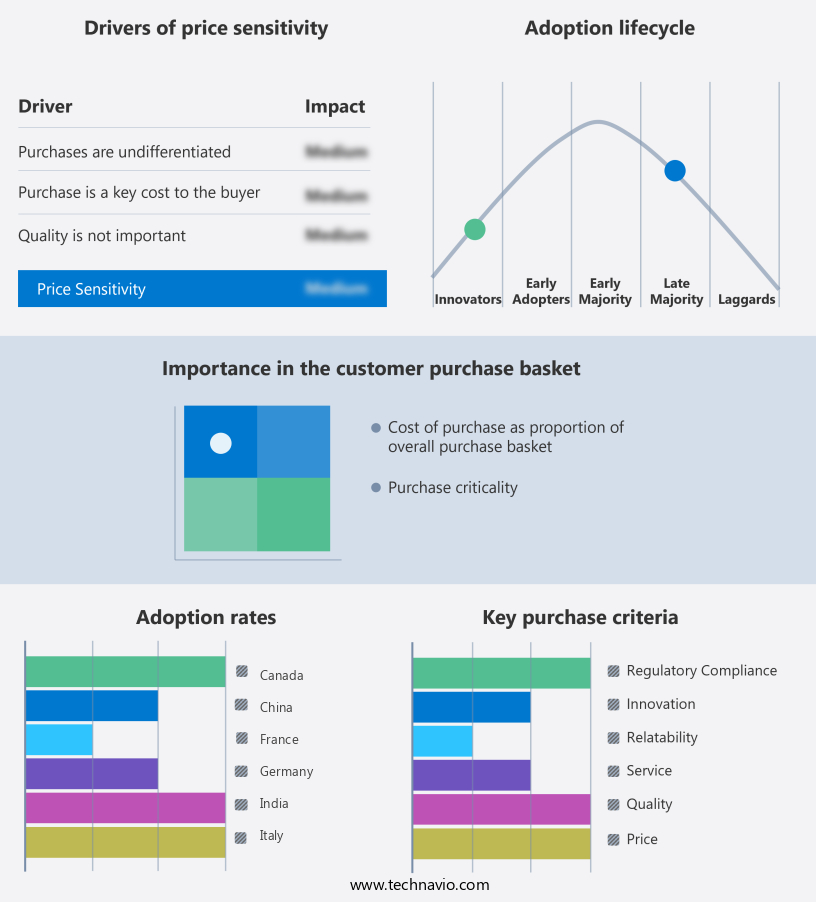
Customer Landscape of Press Brakes Industry
Competitive Landscape & Market Insights
Companies are implementing various strategies, such as strategic alliances, press brakes market forecast, partnerships, mergers and acquisitions, geographical expansion, and product/service launches, to enhance their presence in the industry.
Accurl CNC Machine Anhui Manufactory Co. Ltd. - The company specializes in providing advanced press brake solutions, including the Euro Pro Series and Genius Plus Series, catering to various industries with a focus on innovation, precision, and efficiency. These offerings enable customers to manufacture high-quality metal components, enhancing their production capabilities.
The industry research and growth report includes detailed analyses of the competitive landscape of the market and information about key companies, including:
- Accurl CNC Machine Anhui Manufactory Co. Ltd.
- Accurpress Product Sales
- ADIRA METAL FORMING SOLUTIONS S.A.
- Amada Co. Ltd.
- ATM Deutschland Maschinen u. Werkzeuge Vertriebs GmbH
- Betenbender Manufacturing Inc.
- CINCINNATI Inc.
- Durmazlar Makina AS
- EUROMAC Spa
- Gasparini Industries Srl
- Haco NV
- Hindustan Hydraulics Pvt. Ltd.
- JPW Industries Inc.
- Lodesani and Carreri Srl
- LVD Co. nv
- Mitsubishi Corp.
- Prada Nargesa SL
- SafanDarley BV
- Salvagnini Italia Spa
- TRUMPF SE Co. KG
Qualitative and quantitative analysis of companies has been conducted to help clients understand the wider business environment as well as the strengths and weaknesses of key industry players. Data is qualitatively analyzed to categorize companies as pure play, category-focused, industry-focused, and diversified; it is quantitatively analyzed to categorize companies as dominant, leading, strong, tentative, and weak.
Recent Development and News in Press Brakes Market
- In January 2024, Caterpillar Inc. Announced the launch of its new Caterpillar Intelligent Productivity (CIP) Series press brakes, featuring advanced automation and connectivity technologies. These innovations aim to enhance productivity and improve the overall manufacturing process for metal fabricators (Caterpillar Press Release, 2024).
- In March 2024, Voestalpine Group, a leading global technology and capital goods group, entered into a strategic partnership with Fanuc Corporation, a renowned provider of factory automation solutions. The collaboration focused on integrating Voestalpine's press brake technology with Fanuc's automation systems to create more efficient and intelligent manufacturing processes (Voestalpine Press Release, 2024).
- In May 2024, Amada Holdings, a global leader in metal processing solutions, completed the acquisition of the press brake business of Italian company, C.I.S. Macchine S.R.L. The acquisition expanded Amada's product portfolio and increased its market share in the European press brake market (Amada Holdings Press Release, 2024).
- In February 2025, Schuler Group, a global technology leader in forming technology, received approval from the European Commission for its acquisition of the press brake business of Italian company, Osswald SpA. The acquisition significantly increased Schuler's presence in the Italian market and expanded its product portfolio (European Commission Press Release, 2025).
Dive into Technavio's robust research methodology, blending expert interviews, extensive data synthesis, and validated models for unparalleled Press Brakes Market insights. See full methodology.
|
Market Scope |
|
|
Report Coverage |
Details |
|
Page number |
0 |
|
Base year |
2024 |
|
Historic period |
2019-2023 |
|
Forecast period |
2025-2029 |
|
Growth momentum & CAGR |
Accelerate at a CAGR of 4.7% |
|
Market growth 2025-2029 |
USD 463.5 million |
|
Market structure |
Fragmented |
|
YoY growth 2024-2025(%) |
4.5 |
|
Key countries |
US, Canada, Germany, UK, Italy, France, China, India, Japan, Brazil, Egypt, UAE, Oman, Argentina, KSA, UAE, Brazil, and Rest of World (ROW) |
|
Competitive landscape |
Leading Companies, Market Positioning of Companies, Competitive Strategies, and Industry Risks |
Research Analyst Overview
- The CNC press brake market is characterized by the continuous evolution of fabrication processes, with sheet metal bending remaining a pivotal application. Ram speed and precision bending are crucial factors driving advancements in this sector. The backgauge system, foot pedal operation, emergency stop, and bending process optimization are integral components of press brakes, ensuring efficient production. Safety is a primary concern, with laser safety, bending force, machine guarding, workpiece clamping, and bending speed all playing essential roles in maintaining a secure work environment. Press brake maintenance, including hydraulic press brakes and servo-electric press brakes, is vital for optimal performance and longevity.
- Safety light curtains and two-axis backgauges enhance productivity by improving daylight opening, allowing for more significant bending radii and stroke lengths. Die wear and material handling are ongoing challenges, necessitating advancements in die protection systems, crown compensation, and programmed bending. Bending angle accuracy is a significant differentiator, with automated press brakes offering increased precision. Tonnage capacity and material thickness range continue to expand, catering to various industries and applications. The market dynamics are influenced by advancements in technology, evolving customer requirements, and regulatory compliance. Comparatively, mechanical press brakes have smaller bending radii and lower bending speeds but offer cost-effectiveness for smaller production runs.
- The material thickness range for mechanical press brakes is generally less than that of their CNC counterparts. In summary, the CNC press brake market is marked by ongoing innovation, with a focus on safety, precision, and efficiency. The market's evolution is shaped by technological advancements, customer needs, and regulatory requirements.
What are the Key Data Covered in this Press Brakes Market Research and Growth Report?
-
What is the expected growth of the Press Brakes Market between 2025 and 2029?
-
USD 463.5 million, at a CAGR of 4.7%
-
-
What segmentation does the market report cover?
-
The report segmented by Application (Automotive industry, General machinery, Transportation equipment, Precision engineering, and Others), Product (Hydraulic, Hybrid, Servo-electric, and Others), Geography (APAC, Europe, North America, South America, and Middle East and Africa), and End-Use Industry (Manufacturing, Construction, and Shipbuilding)
-
-
Which regions are analyzed in the report?
-
APAC, Europe, North America, South America, and Middle East and Africa
-
-
What are the key growth drivers and market challenges?
-
Increase in demand for CNC press brakes, Increasing number of injuries caused by press brakes
-
-
Who are the major players in the Press Brakes Market?
-
Key Companies Accurl CNC Machine Anhui Manufactory Co. Ltd., Accurpress Product Sales, ADIRA METAL FORMING SOLUTIONS S.A., Amada Co. Ltd., ATM Deutschland Maschinen u. Werkzeuge Vertriebs GmbH, Betenbender Manufacturing Inc., CINCINNATI Inc., Durmazlar Makina AS, EUROMAC Spa, Gasparini Industries Srl, Haco NV, Hindustan Hydraulics Pvt. Ltd., JPW Industries Inc., Lodesani and Carreri Srl, LVD Co. nv, Mitsubishi Corp., Prada Nargesa SL, SafanDarley BV, Salvagnini Italia Spa, and TRUMPF SE Co. KG
-
Market Research Insights
- The market encompasses the production and distribution of sheet metal forming equipment, a critical component in various industries. Tooling costs and maintenance schedules are significant factors influencing market growth. For instance, advanced tooling designs can reduce wear compensation, lowering overall production costs. Moreover, the integration of CNC control systems, quality control mechanisms, and energy-efficient hydraulic systems contributes to cycle time reduction and process monitoring. The market exhibits a notable relationship between energy consumption and production throughput. For example, a press brake with higher energy efficiency can produce more parts per hour, enhancing overall productivity. Precise bending and safety regulations are essential considerations, ensuring consistent part geometry and operator safety.
- Additionally, the adoption of automated operation, bending simulation, and material deformation technologies improves process accuracy and reduces noise levels. Operator training, remote diagnostics, data acquisition, and part programming are essential aspects of press brake operation. These features enable manufacturers to optimize their production processes, minimize downtime, and maintain consistent product quality. Overall, the market continues to evolve, driven by advancements in technology, increasing demand for customized manufacturing solutions, and the need for efficient and cost-effective production processes.
We can help! Our analysts can customize this press brakes market research report to meet your requirements.
 RIA -
RIA - 
