


Professional Lighting Market Analysis, Size, and Forecast 2025-2029: North America (US and Canada), Europe (France, Germany, and UK), APAC (Australia, China, India, Japan, and South Korea), and Rest of World (ROW)

Professional Lighting Market Analysis, Size, and Forecast 2025-2029:
North America (US and Canada), Europe (France, Germany, and UK), APAC (Australia, China, India, Japan, and South Korea), and Rest of World (ROW)

Published: Jun 2025 222 Pages SKU: IRTNTR76710

Market Overview at a Glance

$48.20 B
Market Opportunity
7.4%
CAGR
6.8
YoY growth 2024-2025(%)

Professional Lighting Market Size 2025-2029

The professional lighting market size is forecast to increase by USD 48.2 billion, at a CAGR of 7.4% between 2024 and 2029.

  • The market is experiencing significant growth, driven by the increasing urbanization and infrastructure development worldwide. As cities expand and modernize, the demand for advanced professional lighting solutions to enhance public spaces, commercial buildings, and outdoor environments is on the rise. This trend is further fueled by technological advancements in lighting, including energy-efficient LED technology and smart lighting systems, which offer improved performance, longevity, and cost savings. Industrial lighting, including low bay and high bay lighting, is adopting advanced ballast technology for improved performance and longevity. However, the high initial cost for professional lighting solutions remains a challenge for market growth. The implementation of these advanced systems can require substantial investment, which may deter some potential buyers. Additionally, the integration of these systems into existing infrastructure can pose complex installation challenges.
  • To capitalize on market opportunities, companies must focus on offering financing options, flexible pricing structures, and turnkey installation services to help clients overcome these barriers. By addressing these challenges and continuing to innovate, the market players can effectively meet the growing demand for advanced, energy-efficient lighting solutions. A greater use of energy-saving characteristics of LEDs, due to their decreasing cost, and compatibility with the existing lighting fixtures will be a major trend in the market in the coming years.

What will be the Size of the Professional Lighting Market during the forecast period?
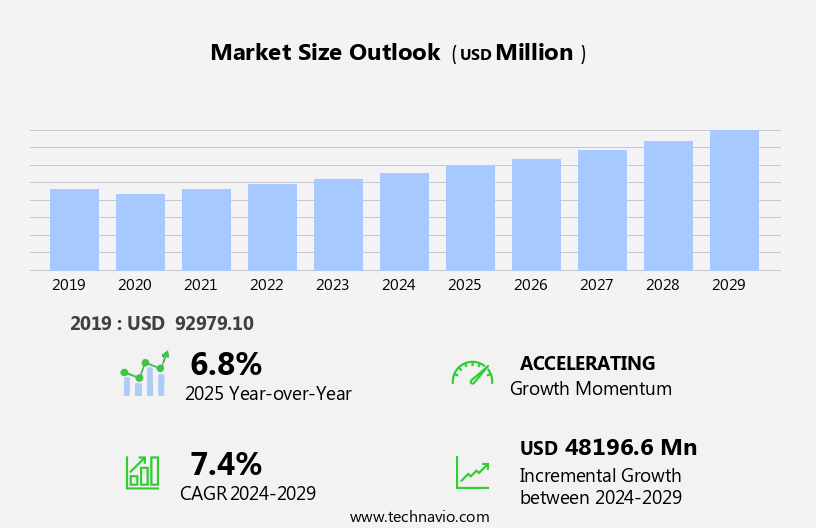
Professional Lighting Market Size

Explore in-depth regional segment analysis with market size data - historical 2019-2023 and forecasts 2025-2029 - in the full report.  
 Request Free Sample

  • The global professional lighting market has experienced a growing demand for architecture and decorative lighting in the commercial and industrial sectors. The market is experiencing significant advancements, driven by the integration of technology and sustainability. LEED certification, a leading certification for green buildings, prioritizes energy efficiency and the use of sustainable lighting solutions. Light and productivity research highlights the importance of optimal lighting conditions for employee performance. Data analytics is revolutionizing the industry, enabling real-time monitoring of lighting performance and energy usage. Sustainability ratings, such as Energy Star, provide benchmarks for evaluating the environmental impact of lighting systems. Lighting control protocols, including DALI, DMX, and WiFi, facilitate automation and remote management. Lumens per watt, a key performance metric, is continually improving with advancements in LED technology, including phosphor-converted LED, light emitting polymer, and remote phosphor.
  • Visual acuity and color temperature control are essential considerations for various applications, from office spaces to healthcare facilities. Monitoring light intensity is crucial for precision, especially in light therapy, which influences light and mood positively. Light and sleep research underscores the importance of proper lighting for circadian rhythms. High intensity discharge (HID) and compact fluorescent lamps (CFL) are being replaced by more energy-efficient alternatives, such as solar-powered lighting and intelligent lighting systems. Lighting automation and wireless mesh networks enable seamless control and optimization of lighting systems. Building codes and regulations, such as Title 24 in California, mandate energy efficiency and the use of lighting management systems. Light harvesting and photovoltaic cells are emerging technologies that harness ambient light and convert it into electricity, further reducing energy consumption.

How is this Professional Lighting Industry segmented?

The professional lighting industry research report provides comprehensive data (region-wise segment analysis), with forecasts and estimates in "USD million" for the period 2025-2029, as well as historical data from 2019-2023 for the following segments.

  • Type
    • LED lighting
    • Conventional lighting
    • Smart lighting
  • Component
    • Luminaries
    • Control systems
  • Distribution Channel
    • Offline
    • Online
  • Geography
    • North America
      • US
      • Canada
    • Europe
      • France
      • Germany
      • UK
    • APAC
      • Australia
      • China
      • India
      • Japan
      • South Korea
    • Rest of World (ROW)

By Type Insights

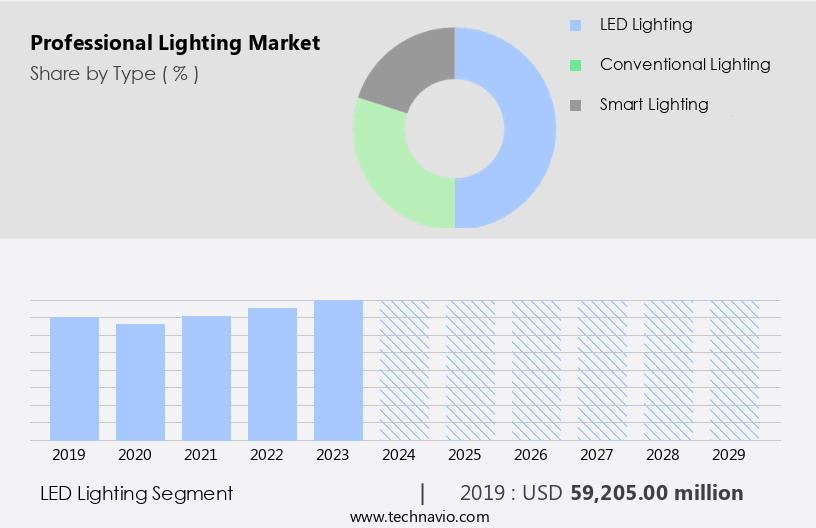
The LED lighting segment is estimated to witness significant growth during the forecast period. The market is experiencing significant growth due to the increasing adoption of energy-efficient LED components and LED-based luminaires. LEDs' energy-saving characteristics and decreasing costs have made them a popular choice among end-users, leading to an increase in demand. The European Commission's decision to ban low-voltage halogen lamps will further accelerate this trend. In Japan, the Fukushima nuclear disaster led to a severe energy crisis, resulting in a notable increase in LED penetration. The replacement market is expected to drive the LED segment's growth during the forecast period, as traditional lighting products are being replaced with more efficient LED lighting systems.

Lighting installation, including commercial, industrial, outdoor, and architectural applications, benefits from LED's energy efficiency and long lifespan. Human-centric lighting, which focuses on improving the quality of light to enhance the human experience, is another emerging trend. Smart lighting systems, which include wireless communication, dimming capabilities, and IoT integration, are gaining popularity due to their energy-saving features and remote control capabilities. Energy audits and lighting design software help optimize lighting systems, ensuring light uniformity and visual comfort while minimizing power consumption. The market also prioritizes glare control, emergency lighting, and maintenance requirements to ensure optimal lighting performance. LED fixtures, including decorative and accent lighting, offer various color temperatures and lumen outputs to cater to diverse applications. Light pollution and circadian rhythms are becoming significant concerns, leading to the development of lighting solutions that minimize negative impacts on the environment and human health. Lighting consultants and engineers play a crucial role in designing and implementing effective lighting systems.
Professional Lighting Market Size

Request Free Sample

The LED lighting segment was valued at USD 59.21 billion in 2019 and showed a gradual increase during the forecast period.

Regional Analysis

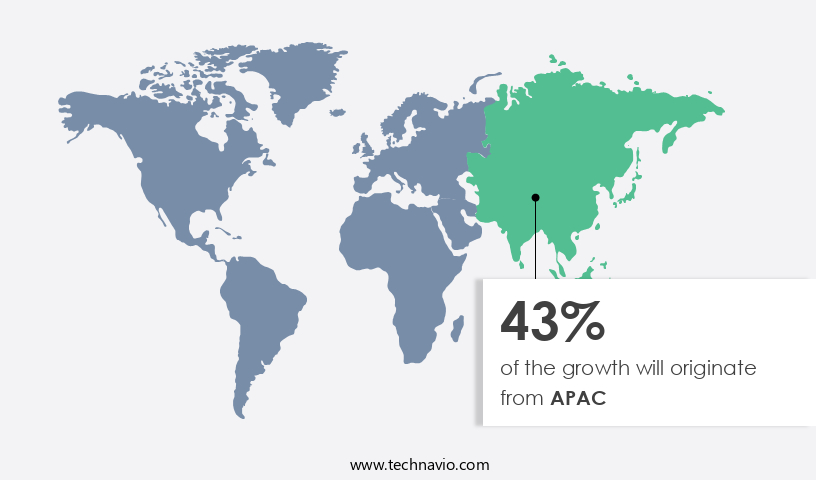
APAC is estimated to contribute 43% to the growth of the global market during the forecast period. Technavio's analysts have elaborately explained the regional trends and drivers that shape the market during the forecast period.
Professional Lighting Market Share by Geography

Download Free Sample Report

The market in APAC is experiencing significant growth due to the expanding industrial and commercial sectors, particularly in countries like India, China, and Japan. This region is attracting numerous multinational companies, leading to an increase in demand for advanced lighting solutions. Urbanization and the development of smart infrastructure are key drivers, as countries invest in energy-efficient technologies and human-centric lighting to enhance visual comfort and productivity. Additionally, the increasing number of international events in developing countries will further boost the market. Lighting solutions that offer energy efficiency, smart functionality, and adherence to lighting standards are in high demand.

These include LED fixtures, smart lighting systems, and lighting design software with dimming capabilities and color temperature controls. Energy audits and retrofit solutions are also gaining popularity to reduce power consumption and improve light uniformity. The integration of IoT, motion sensors, and wireless communication enables remote control and automation, while lighting consultants and engineers ensure proper luminaire design and light simulation. The market encompasses various applications, from architectural and landscape lighting to task and accent lighting, and caters to diverse industries such as retail, healthcare, and hospitality. The focus on energy efficiency and emerging trends like human-centric lighting and circadian rhythms are shaping the market's evolution.

Market Dynamics

Our researchers analyzed the data with 2024 as the base year, along with the key drivers, trends, and challenges. A holistic analysis of drivers will help companies refine their marketing strategies to gain a competitive advantage.

What are the Professional Lighting market drivers leading to the rise in the adoption of Industry?

  • Urbanization and infrastructure development serve as the primary catalyst for market expansion. The market is experiencing significant growth due to the increasing urbanization and infrastructure development worldwide. Urbanization, characterized by population growth and migration to urban areas, necessitates the expansion and development of urban infrastructure, including commercial buildings and public spaces. This trend is driving the demand for professional lighting solutions, as lighting plays a vital role in various urban applications. Commercial buildings, such as offices, shopping centers, hotels, and restaurants, are major consumers of professional lighting. As cities grow, the number of commercial establishments increases, leading to a higher demand for energy-efficient and high-quality lighting systems.
  • Light quality, including color rendering index (CRI) and color temperature, is a crucial factor in the market. Light sources, such as HID lamps and halogen lamps, are being replaced with energy-efficient alternatives, including LED lights. Light scheduling and wireless communication technologies are also gaining popularity in commercial lighting applications. Moreover, energy audits and human-centric lighting are becoming essential components of modern commercial lighting systems. Smart lighting solutions, including exit signs and light uniformity, are also being adopted to optimize energy consumption and enhance user experience. The market is experiencing robust growth due to the increasing demand for energy-efficient and high-quality lighting solutions in urban applications. The market is expected to continue its growth trajectory in the coming years, driven by factors such as urbanization, energy efficiency, and advanced lighting technologies.

What are the Professional Lighting market trends shaping the Industry?

  • Professional lighting is experiencing significant technological advancements, emerging as a notable market trend. This sector's ongoing innovation is crucial for enhancing the quality and efficiency of lighting solutions. The market has experienced significant advancements, driven by technological innovations that boost efficiency, performance, and functionality. LED technology, in particular, has gained widespread adoption, offering a more energy-efficient and durable alternative to traditional lighting sources like incandescent and fluorescent bulbs. LEDs consume less energy, have a longer lifespan, and generate less heat than their predecessors. Moreover, advancements in lighting design software, dimming capabilities, and control systems have enabled customized lighting solutions for various applications. Lighting consultants and architects now have the ability to design deep lighting environments that cater to visual comfort and human needs, such as circadian rhythms. Innovations in ambient lighting and decorative lighting improve aesthetics, while street lighting ensures urban safety.
  • Outdoor lighting, including landscape and stadium lighting, has also seen substantial growth due to energy efficiency concerns and the desire for visually appealing environments. Energy Star certified lighting solutions have gained popularity, contributing to the reduction of light pollution and overall energy savings. The market is undergoing a transformative period, driven by advancements in LED technology, energy efficiency, and control systems. These innovations have led to improved visual comfort, energy savings, and customized lighting solutions for various applications.

How does Professional Lighting market face challenges during its growth?

  • The high initial cost of implementing professional lighting solutions poses a significant challenge to the industry's growth, as businesses must invest substantially upfront to reap the benefits of energy efficiency, improved aesthetics, and enhanced productivity. The market faces a notable challenge due to the high initial investment required for advanced lighting solutions, such as LED fixtures and smart lighting systems. This expense, which includes purchasing and installing professional lighting fixtures and control systems, has hindered their adoption and growth. Many lighting technologies, including industrial LEDs, require rare earth elements, such as phosphor-based LEDs which are limited in supply. Although LED lighting offers energy efficiency and durability over time, its upfront cost can be higher than traditional options like incandescent or fluorescent bulbs. The cost of advanced LED fixtures, including those with color-changing capabilities or remote control features, can be a significant barrier for businesses and individuals, particularly for smaller projects or those with limited budgets.
  • Light simulation, IoT integration, and maintenance requirements are essential considerations in the market. Various lighting standards, such as low bay, high bay, industrial, street, ambient, and natural light, influence the selection of lighting fixtures. Retrofit solutions provide cost-effective alternatives for upgrading existing lighting systems while preserving the original structure and reducing maintenance requirements. Overall, understanding these market dynamics can help businesses make informed decisions when investing in professional lighting solutions.

Exclusive Customer Landscape

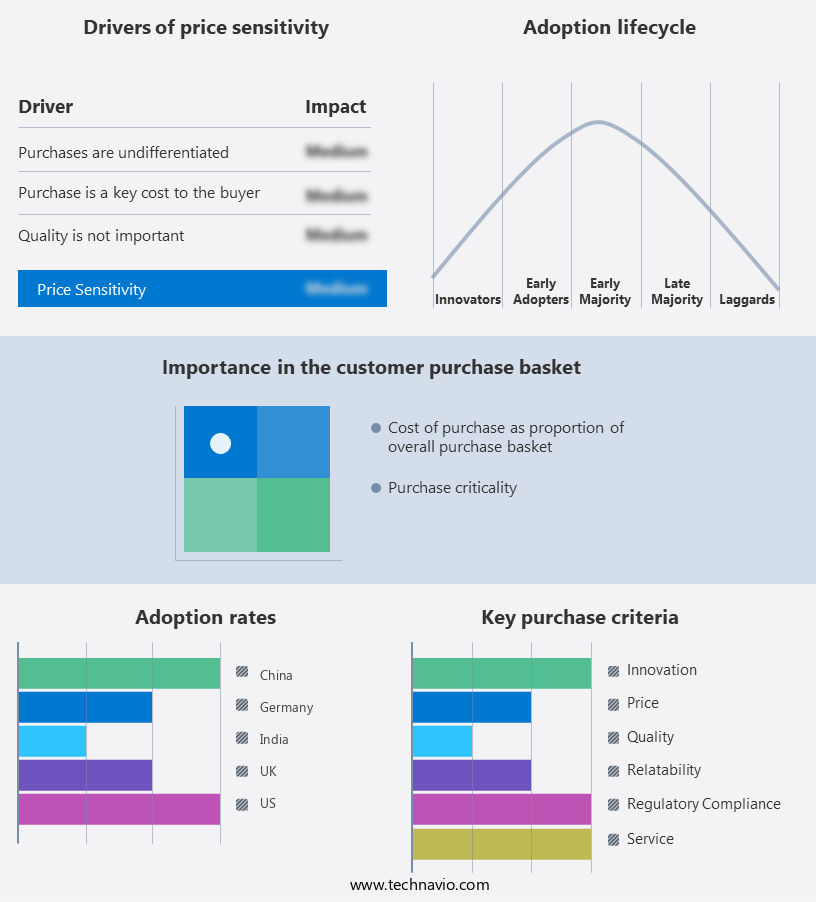
The professional lighting market forecasting report includes the adoption lifecycle of the market, covering from the innovator's stage to the laggard's stage. It focuses on adoption rates in different regions based on penetration. Furthermore, the professional lighting market report also includes key purchase criteria and drivers of price sensitivity to help companies evaluate and develop their market growth analysis strategies.
Professional Lighting Market Share by Geography

 Customer Landscape

Key Companies & Market Insights

Companies are implementing various strategies, such as strategic alliances, professional lighting market forecast, partnerships, mergers and acquisitions, geographical expansion, and product/service launches, to enhance their presence in the industry.

Barco NV - The company specializes in crafted lighting solutions under the brand name Eveready. Notable offerings include the Masterlite Executive N and Masterlite HX models, which deliver superior illumination for various applications. 

The industry research and growth report includes detailed analyses of the competitive landscape of the market and information about key companies, including:

  • Barco NV
  • CHAUVET Professional
  • Dialight PLC
  • Energizer Holdings Inc.
  • Glamox AS
  • Havells India Ltd.
  • Holectron
  • HUAYI Lighting Company Ltd.
  • Hubbell Inc.
  • Leedarson IoT Technology Inc.
  • Lumega
  • MIDEA Group Co. Ltd.
  • NVC Lighting Ltd.
  • Opple Lighting Co. Ltd.
  • Panasonic Holdings Corp.
  • Samsung Electronics Co. Ltd.
  • Signify NV
  • TCL Industries Holdings Co. Ltd.
  • The Feilo Sylvania Group
  • Topstar Inc.
  • Toshiba Corp.
  • TRILUX GmbH and Co. KG
  • US LED Ltd.
  • Wipro Ltd.
  • Zumtobel Group AG

Qualitative and quantitative analysis of companies has been conducted to help clients understand the wider business environment as well as the strengths and weaknesses of key industry players. Data is qualitatively analyzed to categorize companies as pure play, category-focused, industry-focused, and diversified; it is quantitatively analyzed to categorize companies as dominant, leading, strong, tentative, and weak.

Recent Development and News in Professional Lighting Market

  • In February 2024, Signify, a global leader in lighting, introduced the Interact Office v3.0, an advanced connected lighting system that enhances productivity and energy savings in commercial buildings (Signify Press Release, 2024). This innovative solution, which includes Philips Circadian Lighting, can adjust light levels and color temperature to mimic natural daylight, improving employee well-being and focus.
  • In July 2024, Osram and Amazon Web Services (AWS) announced a strategic partnership to accelerate the development and deployment of digital services for smart lighting systems (Osram Press Release, 2024). This collaboration combines Osram's lighting expertise with AWS's cloud capabilities, enabling the creation of new applications and services for energy management, predictive maintenance, and personalized lighting.

Research Analyst Overview

The market continues to evolve, with dynamic market activities unfolding across various sectors. Task lighting and landscape lighting applications are increasingly prioritizing energy efficiency and human-centric design, as evidenced by the growing popularity of energy star certified lighting solutions. Meanwhile, outdoor lighting, stadium lighting, and architectural lighting are adopting advanced technologies such as LED fixtures and lighting design software for enhanced visual comfort and energy savings. Light pollution mitigation efforts are gaining traction, with a focus on reducing power consumption and improving light uniformity through the use of smart lighting systems and dimming capabilities. Lighting consultants and engineers are incorporating circadian rhythms into lighting designs to promote better health and productivity.

The integration of IoT communication and remote control capabilities is revolutionizing lighting installation and maintenance requirements, enabling real-time monitoring and optimization of lighting systems. Lighting standards continue to evolve, with an emphasis on energy efficiency, glare control, and visual comfort. Fluorescent tubes and HID lamps are being replaced by more energy-efficient alternatives, such as LED fixtures and incandescent bulbs. Retail lighting is leveraging accent lighting and daylight harvesting to create inviting and productive spaces, while emergency lighting and exit signs are being upgraded for improved safety and reliability.

The Professional Lighting Market is evolving with advanced light control systems enhancing efficiency and customization. Expert lighting engineers drive advancements in light emitting diode and compact fluorescent lamp technology. Sustainability is prioritized with solar powered lighting, reducing environmental impact. Connectivity through wireless mesh networks enables seamless light management and enhances lighting performance monitoring. 

Light simulation and 3D modeling are becoming essential tools for lighting design and implementation, enabling precise control over lumen output and light distribution. The market for lighting fixtures and luminaire design is expanding, with a focus on sustainability, energy efficiency, and human-centric design. Lighting control systems are being integrated with IoT platforms and LED drivers for enhanced functionality and ease of use. The ongoing evolution of the market reflects the continuous pursuit of energy efficiency, visual comfort, and human-centric design across various applications and sectors.

Dive into Technavio's strong research methodology, blending expert interviews, extensive data synthesis, and validated models for unparalleled Professional Lighting Market insights. See full methodology.

Market Scope

Report Coverage

Details

Page number

222

Base year

2024

Historic period

2019-2023

Forecast period

2025-2029

Growth momentum & CAGR

Accelerate at a CAGR of 7.4%

Market growth 2025-2029

USD 48.2 billion

Market structure

Fragmented

YoY growth 2024-2025(%)

6.8

Key countries

US, China, India, Japan, UK, Canada, Germany, South Korea, France, and Australia

Competitive landscape

Leading Companies, Market Positioning of Companies, Competitive Strategies, and Industry Risks

Request Free Sample

What are the Key Data Covered in this Professional Lighting Market Research and Growth Report?

  • CAGR of the Professional Lighting industry during the forecast period
  • Detailed information on factors that will drive the growth and forecasting between 2025 and 2029
  • Precise estimation of the size of the market and its contribution of the industry in focus to the parent market
  • Accurate predictions about upcoming growth and trends and changes in consumer behaviour
  • Growth of the market across APAC, North America, Europe, South America, and Middle East and Africa
  • Thorough analysis of the market's competitive landscape and detailed information about companies
  • Comprehensive analysis of factors that will challenge the professional lighting market growth of industry companies

We can help! Our analysts can customize this professional lighting market research report to meet your requirements.

Get in touch

1 Executive Summary

  • 1.1 Market overview
    • Executive Summary - Chart on Market Overview
    • Executive Summary - Data Table on Market Overview
    • Executive Summary - Chart on Global Market Characteristics
    • Executive Summary - Chart on Market by Geography
    • Executive Summary - Chart on Market Segmentation by Type
    • Executive Summary - Chart on Market Segmentation by Component
    • Executive Summary - Chart on Market Segmentation by Distribution Channel
    • Executive Summary - Chart on Incremental Growth
    • Executive Summary - Data Table on Incremental Growth
    • Executive Summary - Chart on Company Market Positioning

2 Technavio Analysis

  • 2.1 Analysis of price sensitivity, lifecycle, customer purchase basket, adoption rates, and purchase criteria
    • Analysis of price sensitivity, lifecycle, customer purchase basket, adoption rates, and purchase criteria
  • 2.2 Criticality of inputs and Factors of differentiation
    • Overview on criticality of inputs and factors of differentiation
  • 2.3 Factors of disruption
    • Overview on factors of disruption
  • 2.4 Impact of drivers and challenges
    • Impact of drivers and challenges in 2024 and 2029

3 Market Landscape

  • 3.1 Market ecosystem
    • Parent Market
    • Data Table on - Parent Market
  • 3.2 Market characteristics
    • Market characteristics analysis
  • 3.3 Value chain analysis
    • Value chain analysis

4 Market Sizing

  • 4.1 Market definition
    • Offerings of companies included in the market definition
  • 4.2 Market segment analysis
    • Market segments
  • 4.3 Market size 2024
    • 4.4 Market outlook: Forecast for 2024-2029
      • Chart on Global - Market size and forecast 2024-2029 ($ million)
      • Data Table on Global - Market size and forecast 2024-2029 ($ million)
      • Chart on Global Market: Year-over-year growth 2024-2029 (%)
      • Data Table on Global Market: Year-over-year growth 2024-2029 (%)

    5 Historic Market Size

    • 5.1 Global Professional Lighting Market 2019 - 2023
      • Historic Market Size - Data Table on Global Professional Lighting Market 2019 - 2023 ($ million)
    • 5.2 Type segment analysis 2019 - 2023
      • Historic Market Size - Type Segment 2019 - 2023 ($ million)
    • 5.3 Component segment analysis 2019 - 2023
      • Historic Market Size - Component Segment 2019 - 2023 ($ million)
    • 5.4 Distribution Channel segment analysis 2019 - 2023
      • Historic Market Size - Distribution Channel Segment 2019 - 2023 ($ million)
    • 5.5 Geography segment analysis 2019 - 2023
      • Historic Market Size - Geography Segment 2019 - 2023 ($ million)
    • 5.6 Country segment analysis 2019 - 2023
      • Historic Market Size - Country Segment 2019 - 2023 ($ million)

    6 Qualitative Analysis

    • 6.1 The impact of AI in the global professional lighting market

      7 Five Forces Analysis

      • 7.1 Five forces summary
        • Five forces analysis - Comparison between 2024 and 2029
      • 7.2 Bargaining power of buyers
        • Bargaining power of buyers - Impact of key factors 2024 and 2029
      • 7.3 Bargaining power of suppliers
        • Bargaining power of suppliers - Impact of key factors in 2024 and 2029
      • 7.4 Threat of new entrants
        • Threat of new entrants - Impact of key factors in 2024 and 2029
      • 7.5 Threat of substitutes
        • Threat of substitutes - Impact of key factors in 2024 and 2029
      • 7.6 Threat of rivalry
        • Threat of rivalry - Impact of key factors in 2024 and 2029
      • 7.7 Market condition
        • Chart on Market condition - Five forces 2024 and 2029

      8 Market Segmentation by Type

      • 8.1 Market segments
        • Chart on Type - Market share 2024-2029 (%)
        • Data Table on Type - Market share 2024-2029 (%)
      • 8.2 Comparison by Type
        • Chart on Comparison by Type
        • Data Table on Comparison by Type
      • 8.3 LED lighting - Market size and forecast 2024-2029
        • Chart on LED lighting - Market size and forecast 2024-2029 ($ million)
        • Data Table on LED lighting - Market size and forecast 2024-2029 ($ million)
        • Chart on LED lighting - Year-over-year growth 2024-2029 (%)
        • Data Table on LED lighting - Year-over-year growth 2024-2029 (%)
      • 8.4 Conventional lighting - Market size and forecast 2024-2029
        • Chart on Conventional lighting - Market size and forecast 2024-2029 ($ million)
        • Data Table on Conventional lighting - Market size and forecast 2024-2029 ($ million)
        • Chart on Conventional lighting - Year-over-year growth 2024-2029 (%)
        • Data Table on Conventional lighting - Year-over-year growth 2024-2029 (%)
      • 8.5 Smart lighting - Market size and forecast 2024-2029
        • Chart on Smart lighting - Market size and forecast 2024-2029 ($ million)
        • Data Table on Smart lighting - Market size and forecast 2024-2029 ($ million)
        • Chart on Smart lighting - Year-over-year growth 2024-2029 (%)
        • Data Table on Smart lighting - Year-over-year growth 2024-2029 (%)
      • 8.6 Market opportunity by Type
        • Market opportunity by Type ($ million)
        • Data Table on Market opportunity by Type ($ million)

      9 Market Segmentation by Component

      • 9.1 Market segments
        • Chart on Component - Market share 2024-2029 (%)
        • Data Table on Component - Market share 2024-2029 (%)
      • 9.2 Comparison by Component
        • Chart on Comparison by Component
        • Data Table on Comparison by Component
      • 9.3 Luminaries - Market size and forecast 2024-2029
        • Chart on Luminaries - Market size and forecast 2024-2029 ($ million)
        • Data Table on Luminaries - Market size and forecast 2024-2029 ($ million)
        • Chart on Luminaries - Year-over-year growth 2024-2029 (%)
        • Data Table on Luminaries - Year-over-year growth 2024-2029 (%)
      • 9.4 Control systems - Market size and forecast 2024-2029
        • Chart on Control systems - Market size and forecast 2024-2029 ($ million)
        • Data Table on Control systems - Market size and forecast 2024-2029 ($ million)
        • Chart on Control systems - Year-over-year growth 2024-2029 (%)
        • Data Table on Control systems - Year-over-year growth 2024-2029 (%)
      • 9.5 Market opportunity by Component
        • Market opportunity by Component ($ million)
        • Data Table on Market opportunity by Component ($ million)

      10 Market Segmentation by Distribution Channel

      • 10.1 Market segments
        • Chart on Distribution Channel - Market share 2024-2029 (%)
        • Data Table on Distribution Channel - Market share 2024-2029 (%)
      • 10.2 Comparison by Distribution Channel
        • Chart on Comparison by Distribution Channel
        • Data Table on Comparison by Distribution Channel
      • 10.3 Offline - Market size and forecast 2024-2029
        • Chart on Offline - Market size and forecast 2024-2029 ($ million)
        • Data Table on Offline - Market size and forecast 2024-2029 ($ million)
        • Chart on Offline - Year-over-year growth 2024-2029 (%)
        • Data Table on Offline - Year-over-year growth 2024-2029 (%)
      • 10.4 Online - Market size and forecast 2024-2029
        • Chart on Online - Market size and forecast 2024-2029 ($ million)
        • Data Table on Online - Market size and forecast 2024-2029 ($ million)
        • Chart on Online - Year-over-year growth 2024-2029 (%)
        • Data Table on Online - Year-over-year growth 2024-2029 (%)
      • 10.5 Market opportunity by Distribution Channel
        • Market opportunity by Distribution Channel ($ million)
        • Data Table on Market opportunity by Distribution Channel ($ million)

      11 Customer Landscape

      • 11.1 Customer landscape overview
        • Analysis of price sensitivity, lifecycle, customer purchase basket, adoption rates, and purchase criteria

      12 Geographic Landscape

      • 12.1 Geographic segmentation
        • Chart on Market share by geography 2024-2029 (%)
        • Data Table on Market share by geography 2024-2029 (%)
      • 12.2 Geographic comparison
        • Chart on Geographic comparison
        • Data Table on Geographic comparison
      • 12.3 APAC - Market size and forecast 2024-2029
        • Chart on APAC - Market size and forecast 2024-2029 ($ million)
        • Data Table on APAC - Market size and forecast 2024-2029 ($ million)
        • Chart on APAC - Year-over-year growth 2024-2029 (%)
        • Data Table on APAC - Year-over-year growth 2024-2029 (%)
      • 12.4 North America - Market size and forecast 2024-2029
        • Chart on North America - Market size and forecast 2024-2029 ($ million)
        • Data Table on North America - Market size and forecast 2024-2029 ($ million)
        • Chart on North America - Year-over-year growth 2024-2029 (%)
        • Data Table on North America - Year-over-year growth 2024-2029 (%)
      • 12.5 Europe - Market size and forecast 2024-2029
        • Chart on Europe - Market size and forecast 2024-2029 ($ million)
        • Data Table on Europe - Market size and forecast 2024-2029 ($ million)
        • Chart on Europe - Year-over-year growth 2024-2029 (%)
        • Data Table on Europe - Year-over-year growth 2024-2029 (%)
      • 12.6 South America - Market size and forecast 2024-2029
        • Chart on South America - Market size and forecast 2024-2029 ($ million)
        • Data Table on South America - Market size and forecast 2024-2029 ($ million)
        • Chart on South America - Year-over-year growth 2024-2029 (%)
        • Data Table on South America - Year-over-year growth 2024-2029 (%)
      • 12.7 Middle East and Africa - Market size and forecast 2024-2029
        • Chart on Middle East and Africa - Market size and forecast 2024-2029 ($ million)
        • Data Table on Middle East and Africa - Market size and forecast 2024-2029 ($ million)
        • Chart on Middle East and Africa - Year-over-year growth 2024-2029 (%)
        • Data Table on Middle East and Africa - Year-over-year growth 2024-2029 (%)
      • 12.8 US - Market size and forecast 2024-2029
        • Chart on US - Market size and forecast 2024-2029 ($ million)
        • Data Table on US - Market size and forecast 2024-2029 ($ million)
        • Chart on US - Year-over-year growth 2024-2029 (%)
        • Data Table on US - Year-over-year growth 2024-2029 (%)
      • 12.9 China - Market size and forecast 2024-2029
        • Chart on China - Market size and forecast 2024-2029 ($ million)
        • Data Table on China - Market size and forecast 2024-2029 ($ million)
        • Chart on China - Year-over-year growth 2024-2029 (%)
        • Data Table on China - Year-over-year growth 2024-2029 (%)
      • 12.10 India - Market size and forecast 2024-2029
        • Chart on India - Market size and forecast 2024-2029 ($ million)
        • Data Table on India - Market size and forecast 2024-2029 ($ million)
        • Chart on India - Year-over-year growth 2024-2029 (%)
        • Data Table on India - Year-over-year growth 2024-2029 (%)
      • 12.11 Japan - Market size and forecast 2024-2029
        • Chart on Japan - Market size and forecast 2024-2029 ($ million)
        • Data Table on Japan - Market size and forecast 2024-2029 ($ million)
        • Chart on Japan - Year-over-year growth 2024-2029 (%)
        • Data Table on Japan - Year-over-year growth 2024-2029 (%)
      • 12.12 UK - Market size and forecast 2024-2029
        • Chart on UK - Market size and forecast 2024-2029 ($ million)
        • Data Table on UK - Market size and forecast 2024-2029 ($ million)
        • Chart on UK - Year-over-year growth 2024-2029 (%)
        • Data Table on UK - Year-over-year growth 2024-2029 (%)
      • 12.13 Germany - Market size and forecast 2024-2029
        • Chart on Germany - Market size and forecast 2024-2029 ($ million)
        • Data Table on Germany - Market size and forecast 2024-2029 ($ million)
        • Chart on Germany - Year-over-year growth 2024-2029 (%)
        • Data Table on Germany - Year-over-year growth 2024-2029 (%)
      • 12.14 Canada - Market size and forecast 2024-2029
        • Chart on Canada - Market size and forecast 2024-2029 ($ million)
        • Data Table on Canada - Market size and forecast 2024-2029 ($ million)
        • Chart on Canada - Year-over-year growth 2024-2029 (%)
        • Data Table on Canada - Year-over-year growth 2024-2029 (%)
      • 12.15 South Korea - Market size and forecast 2024-2029
        • Chart on South Korea - Market size and forecast 2024-2029 ($ million)
        • Data Table on South Korea - Market size and forecast 2024-2029 ($ million)
        • Chart on South Korea - Year-over-year growth 2024-2029 (%)
        • Data Table on South Korea - Year-over-year growth 2024-2029 (%)
      • 12.16 France - Market size and forecast 2024-2029
        • Chart on France - Market size and forecast 2024-2029 ($ million)
        • Data Table on France - Market size and forecast 2024-2029 ($ million)
        • Chart on France - Year-over-year growth 2024-2029 (%)
        • Data Table on France - Year-over-year growth 2024-2029 (%)
      • 12.17 Australia - Market size and forecast 2024-2029
        • Chart on Australia - Market size and forecast 2024-2029 ($ million)
        • Data Table on Australia - Market size and forecast 2024-2029 ($ million)
        • Chart on Australia - Year-over-year growth 2024-2029 (%)
        • Data Table on Australia - Year-over-year growth 2024-2029 (%)
      • 12.18 Market opportunity by geography
        • Market opportunity by geography ($ million)
        • Data Tables on Market opportunity by geography ($ million)

      13 Drivers, Challenges, and Opportunity/Restraints

      • 13.1 Market drivers
        • 13.2 Market challenges
          • 13.3 Impact of drivers and challenges
            • Impact of drivers and challenges in 2024 and 2029
          • 13.4 Market opportunities/restraints

            14 Competitive Landscape

            • 14.1 Overview
              • 14.2 Competitive Landscape
                • Overview on criticality of inputs and factors of differentiation
              • 14.3 Landscape disruption
                • Overview on factors of disruption
              • 14.4 Industry risks
                • Impact of key risks on business

              15 Competitive Analysis

              • 15.1 Companies profiled
                • Companies covered
              • 15.2 Company ranking index
                • Company ranking index
              • 15.3 Market positioning of companies
                • Matrix on companies position and classification
              • 15.4 Energizer Holdings Inc.
                • Energizer Holdings Inc. - Overview
                • Energizer Holdings Inc. - Business segments
                • Energizer Holdings Inc. - Key offerings
                • Energizer Holdings Inc. - Segment focus
                • SWOT
              • 15.5 Havells India Ltd.
                • Havells India Ltd. - Overview
                • Havells India Ltd. - Business segments
                • Havells India Ltd. - Key news
                • Havells India Ltd. - Key offerings
                • Havells India Ltd. - Segment focus
                • SWOT
              • 15.6 HUAYI Lighting Company Ltd.
                • HUAYI Lighting Company Ltd. - Overview
                • HUAYI Lighting Company Ltd. - Product / Service
                • HUAYI Lighting Company Ltd. - Key offerings
                • SWOT
              • 15.7 Hubbell Inc.
                • Hubbell Inc. - Overview
                • Hubbell Inc. - Business segments
                • Hubbell Inc. - Key news
                • Hubbell Inc. - Key offerings
                • Hubbell Inc. - Segment focus
                • SWOT
              • 15.8 Lumega
                • Lumega - Overview
                • Lumega - Product / Service
                • Lumega - Key offerings
                • SWOT
              • 15.9 MIDEA Group Co. Ltd.
                • MIDEA Group Co. Ltd. - Overview
                • MIDEA Group Co. Ltd. - Product / Service
                • MIDEA Group Co. Ltd. - Key news
                • MIDEA Group Co. Ltd. - Key offerings
                • SWOT
              • 15.10 NVC Lighting Ltd.
                • NVC Lighting Ltd. - Overview
                • NVC Lighting Ltd. - Product / Service
                • NVC Lighting Ltd. - Key offerings
                • SWOT
              • 15.11 Opple Lighting Co. Ltd.
                • Opple Lighting Co. Ltd. - Overview
                • Opple Lighting Co. Ltd. - Product / Service
                • Opple Lighting Co. Ltd. - Key offerings
                • SWOT
              • 15.12 Panasonic Holdings Corp.
                • Panasonic Holdings Corp. - Overview
                • Panasonic Holdings Corp. - Business segments
                • Panasonic Holdings Corp. - Key news
                • Panasonic Holdings Corp. - Key offerings
                • Panasonic Holdings Corp. - Segment focus
                • SWOT
              • 15.13 Samsung Electronics Co. Ltd.
                • Samsung Electronics Co. Ltd. - Overview
                • Samsung Electronics Co. Ltd. - Business segments
                • Samsung Electronics Co. Ltd. - Key news
                • Samsung Electronics Co. Ltd. - Key offerings
                • Samsung Electronics Co. Ltd. - Segment focus
                • SWOT
              • 15.14 Signify NV
                • Signify NV - Overview
                • Signify NV - Business segments
                • Signify NV - Key news
                • Signify NV - Key offerings
                • Signify NV - Segment focus
                • SWOT
              • 15.15 TCL Industries Holdings Co. Ltd.
                • TCL Industries Holdings Co. Ltd. - Overview
                • TCL Industries Holdings Co. Ltd. - Business segments
                • TCL Industries Holdings Co. Ltd. - Key offerings
                • TCL Industries Holdings Co. Ltd. - Segment focus
                • SWOT
              • 15.16 The Feilo Sylvania Group
                • The Feilo Sylvania Group - Overview
                • The Feilo Sylvania Group - Product / Service
                • The Feilo Sylvania Group - Key offerings
                • SWOT
              • 15.17 Toshiba Corp.
                • Toshiba Corp. - Overview
                • Toshiba Corp. - Business segments
                • Toshiba Corp. - Key news
                • Toshiba Corp. - Key offerings
                • Toshiba Corp. - Segment focus
                • SWOT
              • 15.18 Wipro Ltd.
                • Wipro Ltd. - Overview
                • Wipro Ltd. - Business segments
                • Wipro Ltd. - Key news
                • Wipro Ltd. - Key offerings
                • Wipro Ltd. - Segment focus
                • SWOT

              16 Appendix

              • 16.1 Scope of the report
                • 16.2 Inclusions and exclusions checklist
                  • Inclusions checklist
                  • Exclusions checklist
                • 16.3 Currency conversion rates for US$
                  • Currency conversion rates for US$
                • 16.4 Research methodology
                  • Research methodology
                • 16.5 Data procurement
                  • Information sources
                • 16.6 Data validation
                  • Data validation
                • 16.7 Validation techniques employed for market sizing
                  • Validation techniques employed for market sizing
                • 16.8 Data synthesis
                  • Data synthesis
                • 16.9 360 degree market analysis
                  • 360 degree market analysis
                • 16.10 List of abbreviations
                  • List of abbreviations

                Research Methodology

                Technavio presents a detailed picture of the market by way of study, synthesis, and summation of data from multiple sources. The analysts have presented the various facets of the market with a particular focus on identifying the key industry influencers. The data thus presented is comprehensive, reliable, and the result of extensive research, both primary and secondary.

                INFORMATION SOURCES

                Primary sources

                • Manufacturers and suppliers
                • Channel partners
                • Industry experts
                • Strategic decision makers

                Secondary sources

                • Industry journals and periodicals
                • Government data
                • Financial reports of key industry players
                • Historical data
                • Press releases

                DATA ANALYSIS

                Data Synthesis

                • Collation of data
                • Estimation of key figures
                • Analysis of derived insights

                Data Validation

                • Triangulation with data models
                • Reference against proprietary databases
                • Corroboration with industry experts

                REPORT WRITING

                Qualitative

                • Market drivers
                • Market challenges
                • Market trends
                • Five forces analysis

                Quantitative

                • Market size and forecast
                • Market segmentation
                • Geographical insights
                • Competitive landscape

                Interested in this report?

                Get your sample now to see our research methodology and insights!

                Download Now

                Frequently Asked Questions

                Professional Lighting market growth will increase by $ 48196.6 mn during 2025-2029 .

                The Professional Lighting market is expected to grow at a CAGR of 7.4% during 2025-2029 .

                Professional Lighting market is segmented by Type( LED lighting, Conventional lighting, Smart lighting) Component( Luminaries, Control systems) Distribution Channel( Offline, Online, Europe, South America, Middle East and Africa)

                Barco NV, CHAUVET Professional, Dialight PLC, Energizer Holdings Inc., Glamox AS, Havells India Ltd., Holectron, HUAYI Lighting Company Ltd., Hubbell Inc., Leedarson IoT Technology Inc., Lumega, MIDEA Group Co. Ltd., NVC Lighting Ltd., Opple Lighting Co. Ltd., Panasonic Holdings Corp., Samsung Electronics Co. Ltd., Signify NV, TCL Industries Holdings Co. Ltd., The Feilo Sylvania Group, Topstar Inc., Toshiba Corp., TRILUX GmbH and Co. KG, US LED Ltd., Wipro Ltd., Zumtobel Group AG are a few of the key vendors in the Professional Lighting market.

                APAC will register the highest growth rate of 43% among the other regions. Therefore, the Professional Lighting market in APAC is expected to garner significant business opportunities for the vendors during the forecast period.

                US, China, India, Japan, UK, Canada, Germany, South Korea, France, Australia

                • Growing urbanization and infrastructure developmentThe global professional lighting market is experiencing a positive impact from growing urbanization and infrastructure development. Urbanization refers to the process of population growth and migration from rural areas to urban cities is the driving factor this market.
                • resulting in the expansion and development of urban areas. This trend has significant implications for the global professional lighting market is the driving factor this market.
                • as lighting plays a crucial role in various urban applications such as commercial buildings is the driving factor this market.
                • public spaces is the driving factor this market.
                • roads is the driving factor this market.
                • and transportation. One of the key driving factors behind the growing demand for professional lighting solutions is the need to illuminate commercial buildings and public spaces in urban areas. As cities grow is the driving factor this market.
                • the number of commercial establishments such as offices is the driving factor this market.
                • shopping centers is the driving factor this market.
                • hotels is the driving factor this market.
                • and restaurants increases. These establishments require effective and efficient lighting solutions to provide a safe and visually appealing environment for employees is the driving factor this market.
                • customers is the driving factor this market.
                • and visitors. For example is the driving factor this market.
                • LED lighting is widely used in commercial buildings due to its energy efficiency is the driving factor this market.
                • long lifespan is the driving factor this market.
                • and controllability. The application of professional lighting in commercial buildings enhances productivity is the driving factor this market.
                • promotes better visual comfort is the driving factor this market.
                • and creates a positive atmosphere for occupants. Furthermore is the driving factor this market.
                • the expansion of public spaces in urban areas also creates a demand for professional lighting. Parks is the driving factor this market.
                • plazas is the driving factor this market.
                • walkways is the driving factor this market.
                • and recreational areas need proper lighting to ensure safety is the driving factor this market.
                • security is the driving factor this market.
                • and accessibility for pedestrians is the driving factor this market.
                • cyclists is the driving factor this market.
                • and other users. Professional lighting solutions is the driving factor this market.
                • such as pathway lighting is the driving factor this market.
                • floodlights is the driving factor this market.
                • and decorative lighting is the driving factor this market.
                • enhance visibility in public spaces is the driving factor this market.
                • making them welcoming and attractive for the community. For instance is the driving factor this market.
                • well-designed lighting in parks can create a sense of security is the driving factor this market.
                • encourage nighttime activities is the driving factor this market.
                • and promote community engagement. In addition to commercial buildings and public spaces is the driving factor this market.
                • the growing emphasis on infrastructure development also fuels the demand for professional lighting. Infrastructure projects such as roads is the driving factor this market.
                • highways is the driving factor this market.
                • bridges is the driving factor this market.
                • and tunnels require high-quality lighting solutions to ensure safe and efficient transportation. Street lighting is a critical component of urban infrastructure is the driving factor this market.
                • providing visibility for drivers and pedestrians is the driving factor this market.
                • reducing accidents is the driving factor this market.
                • and enhancing road safety. LED street lighting has gained prominence in the global professional lighting market due to its energy efficiency and long maintenance cycles. By adopting professional lighting solutions in infrastructure projects is the driving factor this market.
                • cities can not only enhance safety but also reduce energy consumption and maintenance costs. Thus is the driving factor this market.
                • such factors are expected to increase the demand for professional lighting is the driving factor this market.
                • which will propel the growth of the global professional lighting market during the forecast period. is the driving factor this market.

                The Professional Lighting market vendors should focus on grabbing business opportunities from the LED lighting segment as it accounted for the largest market share in the base year.
