



Purified Terephthalic Acid (PTA) Market Size 2026-2030
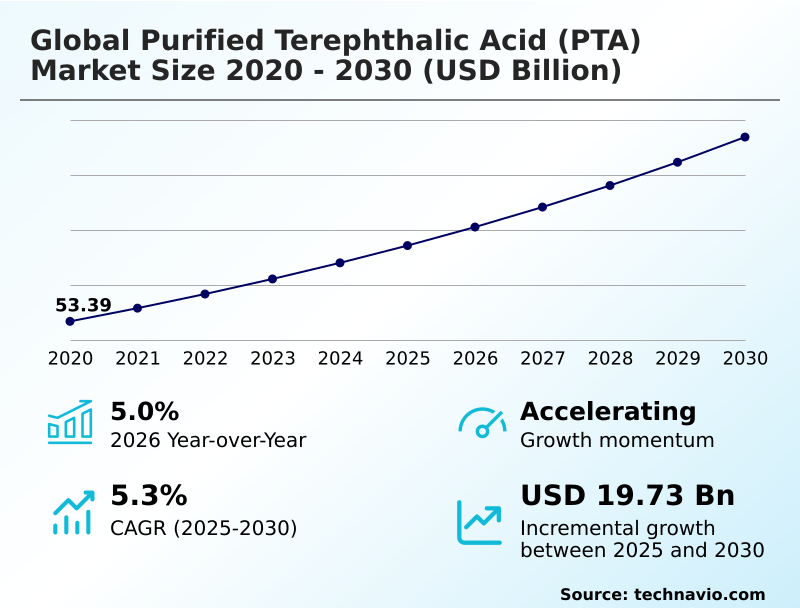
The purified terephthalic acid (pta) market size is valued to increase by USD 19.73 billion, at a CAGR of 5.3% from 2025 to 2030. Increasing demand for polyester fibers in textile industry will drive the purified terephthalic acid (pta) market.
Major Market Trends & Insights
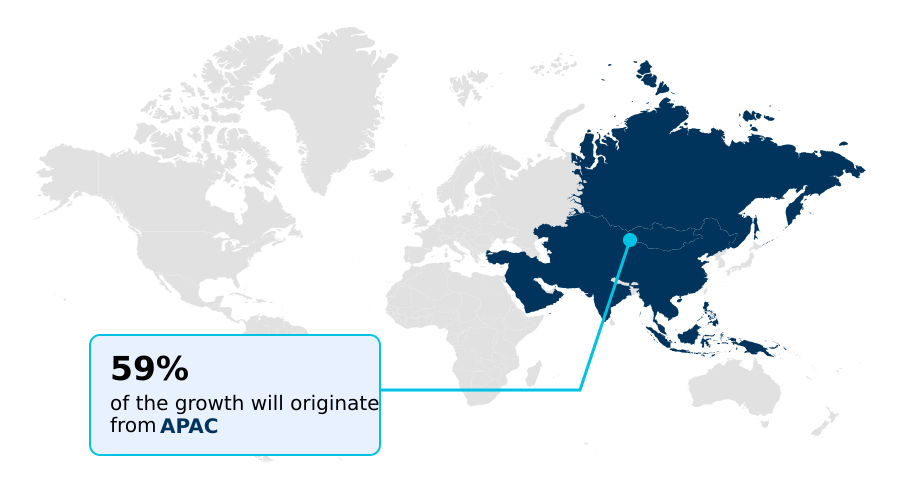
- APAC dominated the market and accounted for a 59% growth during the forecast period.
- By Application - Polyester fiber segment was valued at USD 39.99 billion in 2024
- By End-user - Textile segment accounted for the largest market revenue share in 2024
Market Size & Forecast
- Market Opportunities: USD 33.51 billion
- Market Future Opportunities: USD 19.73 billion
- CAGR from 2025 to 2030 : 5.3%
Market Summary
- The Purified Terephthalic Acid (PTA) market is defined by its essential role as a precursor for polyester polymers, including polyethylene terephthalate (PET) and polybutylene terephthalate. Its trajectory is linked to demand from the textile and packaging industries, which rely on polyester staple fibers and PET resins.
- A significant trend is the push toward a circular economy, with a focus on chemical recycling and the development of bio-based PTA to reduce dependence on fossil fuels. However, producers face the persistent challenge of paraxylene price volatility, driven by geopolitical instability and fluctuations in the crude oil market.
- In response, a key business scenario involves leveraging digital twin technology for process simulation. This allows manufacturers to optimize paraxylene oxidation and improve heat recovery from exothermic energy generation, reducing operational costs and enhancing resilience against market shocks. This strategic adoption of Industry 4.0 principles is becoming critical for maintaining profitability.
- The market is also shaped by stringent environmental regulations, forcing investments in advanced oxidation technologies and more efficient catalyst systems to minimize emissions and secure a competitive advantage in an evolving industrial landscape.
What will be the Size of the Purified Terephthalic Acid (PTA) Market during the forecast period?
Get Key Insights on Market Forecast (PDF) Get Free Sample
How is the Purified Terephthalic Acid (PTA) Market Segmented?
The purified terephthalic acid (pta) industry research report provides comprehensive data (region-wise segment analysis), with forecasts and estimates in "USD million" for the period 2026-2030, as well as historical data from 2020-2024 for the following segments.
- Application
- Polyester fiber
- PET resins
- Films
- Others
- End-user
- Textile
- PET bottles
- Packaging
- Technology
- PX oxidation
- Bio-based PTA
- Chemical recycling-based PTA
- Geography
- APAC
- China
- India
- Japan
- North America
- US
- Mexico
- Canada
- Europe
- Germany
- UK
- France
- South America
- Brazil
- Argentina
- Middle East and Africa
- Saudi Arabia
- UAE
- South Africa
- Rest of World (ROW)
- APAC
By Application Insights
The polyester fiber segment is estimated to witness significant growth during the forecast period.
The polyester fiber segment is foundational, involving the **polyester polymer synthesis** through a **condensation polymerization** reaction between a **high-purity crystalline compound** and **monoethylene glycol**.
This process yields fibers with high **thermal stability** and **high tensile strength**, crucial for both apparel and technical textiles that require features like **moisture-wicking properties**.
The industry is pivoting toward **sustainable polymer solutions** and **closed-loop manufacturing** to meet stricter environmental mandates. This shift is accelerated by advancements in **chemical recycling**, which enables **monomer recovery** from **recycled feedstock**.
This **circular economy integration** is redefining production, with new processes demonstrating over 90% efficiency in converting post-consumer textiles back into valuable raw materials, highlighting a strategic move toward resource security.
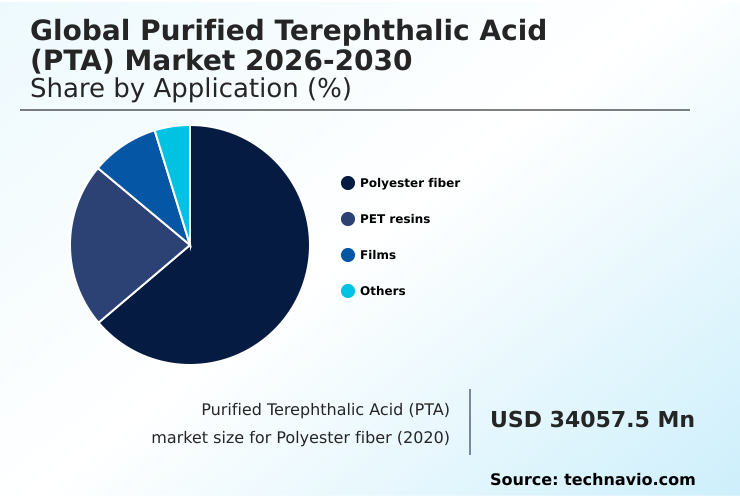
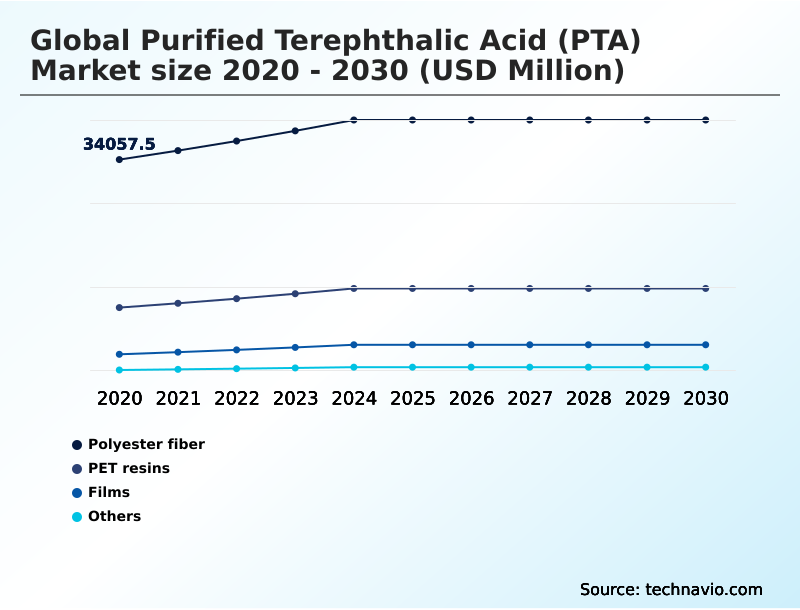
The Polyester fiber segment was valued at USD 39.99 billion in 2024 and showed a gradual increase during the forecast period.
Regional Analysis
APAC is estimated to contribute 59% to the growth of the global market during the forecast period.Technavio’s analysts have elaborately explained the regional trends and drivers that shape the market during the forecast period.
See How Purified Terephthalic Acid (PTA) Market Demand is Rising in APAC Get Free Sample
The global geographic landscape is characterized by a strategic division of labor, with APAC dominating high-volume production of **filament yarns** and standard **polymer-grade PTA** through **liquid-phase oxidation**. This region leverages massive, vertically integrated industrial parks to achieve economies of scale.
In contrast, North America and Europe are pivoting toward high-value applications, such as **high-tenacity industrial yarns** and materials for **polybutylene terephthalate** compounds. These mature markets are early adopters of **digital twin technology** and **AI-driven process optimization**.
For instance, AI-driven scheduling for **coordinated plant turnarounds** has reduced facility downtime by up to 20%.
Furthermore, the use of **blockchain traceability** is becoming a standard to validate sustainability claims, aligning with strict regulatory environments and consumer expectations for transparency in the supply chain.
Market Dynamics
Our researchers analyzed the data with 2025 as the base year, along with the key drivers, trends, and challenges. A holistic analysis of drivers will help companies refine their marketing strategies to gain a competitive advantage.
- Strategic decision-making in the Purified Terephthalic Acid (PTA) market is increasingly complex, balancing commodity scale with high-value specialization. A key focus is **optimizing paraxylene to PTA conversion efficiency** to counter volatile input costs. Concurrently, the industry is heavily invested in sustainability, exploring both **advancements in bio-based PTA production** and various **chemical recycling methods for post-consumer PET**.
- The goal of creating **circular PTA from mixed plastic waste** is driving innovation, supported by digital tools like **digital twin for PTA plant simulation**, which allows for virtual process refinement. For downstream applications, developing **high-purity PTA for advanced polyester films** and specific **PTA grades for technical textile applications** offers margin uplift.
- Firms specializing in **specialty PTA for automotive interior textiles** report margins that are consistently higher than those in standard segments, sometimes by a differential of over 10 percentage points. Managing **feedstock price volatility in PTA** remains a core challenge, addressed through **supply chain regionalization for PTA resilience** and the use of **AI for predictive maintenance in PTA plants**.
- Furthermore, **reducing carbon footprint of PTA manufacturing** is a critical objective, influenced by the **impact of regulations on PTA plant operations**. This involves **improving catalyst performance in PX oxidation** and designing better **energy recovery systems in PTA production**.
- For packaging, the focus is on **integrating recycled content into PET resins**, ensuring **bottle-grade PTA feedstock quality control**, and supporting the **lightweighting of PET bottles with advanced resins**. Finally, technologies like **blockchain for PTA supply chain traceability** are ensuring transparency for **PTA for high-barrier food packaging**.
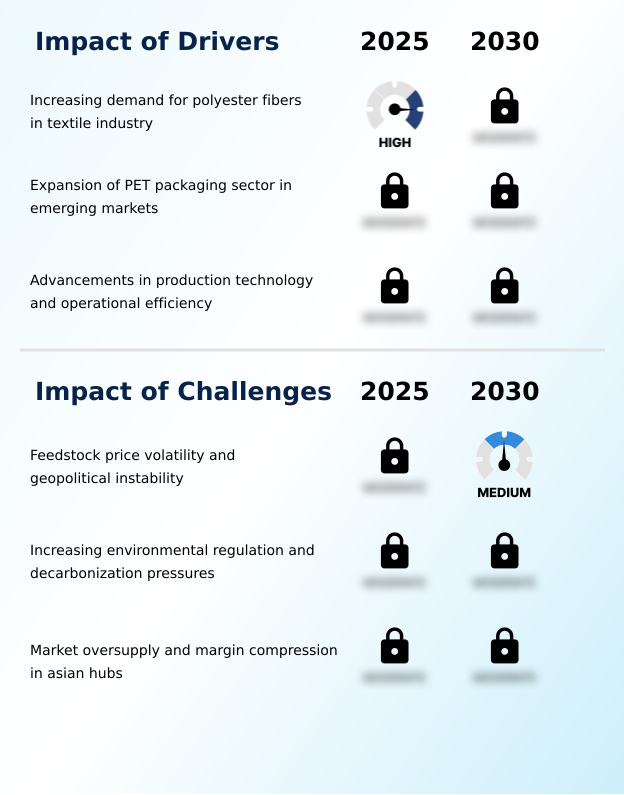
What are the key market drivers leading to the rise in the adoption of Purified Terephthalic Acid (PTA) Industry?
- The increasing demand for polyester fibers within the global textile industry serves as a key driver for market growth.
- Market growth is fundamentally driven by robust demand from end-use industries and continuous process innovations. The surging consumption of **polyethylene terephthalate** for packaging, valued for its **shatter resistance** and use in **food-grade packaging resins**, provides a stable demand base.
- This is complemented by advancements in manufacturing technology, where the optimization of **paraxylene oxidation** through **efficient catalyst systems** is a key focus. These systems are improving **paraxylene conversion yield** by up to 3%, directly enhancing profitability.
- Furthermore, the adoption of **advanced process controls** and the implementation of **operational excellence programs** are mitigating the impact of **feedstock price volatility**.
- In pursuit of greater resilience, many producers are establishing **regionalized supply chains** and exploring **near-shoring operations**, which reduce logistical costs by over 10% and improve **end-to-end supply chain transparency**.
What are the market trends shaping the Purified Terephthalic Acid (PTA) Industry?
- A primary market trend is the acceleration of the circular economy, which is characterized by the increasing integration of recycled feedstocks into production value chains.
- Key trends are reshaping the industry, with a strong focus on sustainability and technological innovation. The exploration of **bio-based PTA** from renewable sources like **biomass-derived isobutanol** is accelerating, driven by a market desire to move away from fossil fuel dependency.
- Concurrently, advanced **depolymerization methods** such as **glycolysis** and **methanolysis** are enabling the chemical recycling of post-consumer waste into high-value raw materials. The use of specialized **PET-degrading enzymes** in these processes is a significant breakthrough, with pilot programs demonstrating monomer recovery rates exceeding 95%.
- This shift toward circularity is creating new value streams from materials previously considered waste, such as **non-woven fabrics** and complex composites. These advancements are critical for producing next-generation materials like high-performance **biaxially oriented films** with superior **dielectric strength**, meeting the evolving demands of the electronics and packaging sectors.
What challenges does the Purified Terephthalic Acid (PTA) Industry face during its growth?
- A key challenge affecting industry growth is the combination of feedstock price volatility and geopolitical instability.
- The market faces significant structural challenges, led by intense **margin compression** and the need for stringent **feedstock security strategy**. The core production process, while efficient, generates significant **exothermic energy generation**, requiring costly **heat recovery systems** to manage.
- Adherence to new environmental standards, such as the **carbon border adjustment mechanism**, is increasing operational expenditures by 5-10% for producers with less efficient **advanced oxidation technologies**. This regulatory pressure is compelling a shift toward cleaner alternatives like **bio-paraxylene**, derived from sources such as **biomass-derived isobutanol** through complex **dehydrocyclization reaction** pathways.
- For companies with a **vertically integrated value chain**, these investments are manageable; however, standalone producers struggle to absorb the costs, impacting the supply of materials like **bottle-grade PTA feedstock** and **industrial-grade PTA**.
Exclusive Technavio Analysis on Customer Landscape
The purified terephthalic acid (pta) market forecasting report includes the adoption lifecycle of the market, covering from the innovator’s stage to the laggard’s stage. It focuses on adoption rates in different regions based on penetration. Furthermore, the purified terephthalic acid (pta) market report also includes key purchase criteria and drivers of price sensitivity to help companies evaluate and develop their market growth analysis strategies.
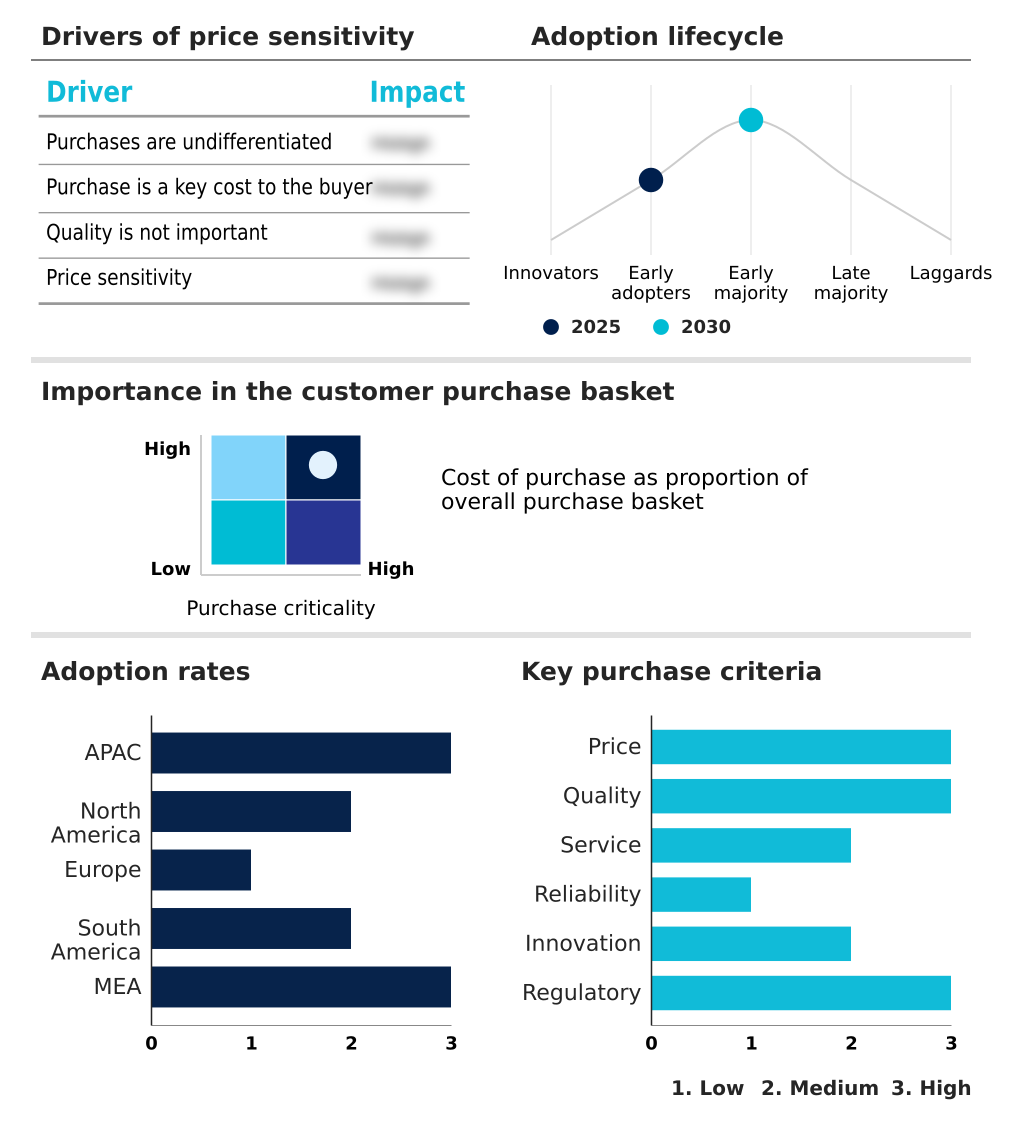
Customer Landscape of Purified Terephthalic Acid (PTA) Industry
Competitive Landscape
Companies are implementing various strategies, such as strategic alliances, purified terephthalic acid (pta) market forecast, partnerships, mergers and acquisitions, geographical expansion, and product/service launches, to enhance their presence in the industry.
Alpek SAB de CV - Analysts observe a competitive landscape defined by integrated petrochemical conglomerates specializing in industrial-grade PTA, polymer-grade PTA, and other polyester intermediates for diverse global applications.
The industry research and growth report includes detailed analyses of the competitive landscape of the market and information about key companies, including:
- Alpek SAB de CV
- Formosa Chemicals and Fibre Corp
- Hanwha Impact Corp
- Hengli Petrochemical Co. Ltd
- Hengyi Petrochemical Co. Ltd.
- Indian Oil Corp. Ltd.
- Indorama Ventures Public Co.
- INEOS Group Holdings S.A.
- Lotte Chemical Corp.
- MCPI Pvt Ltd
- Mitsui Chemicals Inc.
- PTT Global Chemical Public Co.
- Reliance Industries Ltd.
- Saudi Basic Industries
- Sinopec Shanghai Co. Ltd.
- SK geo centric Co Ltd
- SOCAR Turkiye Enerji A.S.
- Taekwang Industrial Co. Ltd.
- The Mitsubishi Chemical Group
- Tongkun Group Co. Ltd.
Qualitative and quantitative analysis of companies has been conducted to help clients understand the wider business environment as well as the strengths and weaknesses of key industry players. Data is qualitatively analyzed to categorize companies as pure play, category-focused, industry-focused, and diversified; it is quantitatively analyzed to categorize companies as dominant, leading, strong, tentative, and weak.
Recent Development and News in Purified terephthalic acid (pta) market
- In April, 2025, Indorama Ventures concluded the installation of a new purification stage at its plant in Poland, designed to enhance product color and purity standards for the high-end cosmetic packaging sector.
- In March, 2025, Reliance Industries in India finalized the commissioning of a significant expansion project at its Dahej facility, which markedly increases the domestic availability of the acid to support the country's burgeoning textile sector.
- In March, 2025, OQ in Oman announced that its aromatics complex reached a record for operational efficiency following the successful testing of a new digital control system that optimizes feedstock ratios.
- In February, 2025, Alpek Polyester announced the successful completion of a comprehensive technological upgrade at its site in South Carolina, integrating advanced filtration systems to improve output quality for specialized film applications.
Dive into Technavio’s robust research methodology, blending expert interviews, extensive data synthesis, and validated models for unparalleled Purified Terephthalic Acid (PTA) Market insights. See full methodology.
| Market Scope | |
|---|---|
| Page number | 306 |
| Base year | 2025 |
| Historic period | 2020-2024 |
| Forecast period | 2026-2030 |
| Growth momentum & CAGR | Accelerate at a CAGR of 5.3% |
| Market growth 2026-2030 | USD 19728.5 million |
| Market structure | Fragmented |
| YoY growth 2025-2026(%) | 5.0% |
| Key countries | China, India, Japan, South Korea, Indonesia, Australia, US, Mexico, Canada, Germany, UK, France, Italy, Spain, The Netherlands, Brazil, Argentina, Chile, Saudi Arabia, UAE, South Africa, Turkey and Israel |
| Competitive landscape | Leading Companies, Market Positioning of Companies, Competitive Strategies, and Industry Risks |
Research Analyst Overview
- The Purified Terephthalic Acid (PTA) market operates at the intersection of commodity chemical manufacturing and advanced material science. Core production relies on the **liquid-phase oxidation** of paraxylene to create a **high-purity crystalline compound**, which serves as the essential building block for **polyester polymer synthesis**.
- This process yields precursors for **polyethylene terephthalate (PET)** and **polybutylene terephthalate**, which are then transformed into **polyester staple fibers**, **filament yarns**, and **PET resins**. Boardroom-level strategy is increasingly focused on navigating the dichotomy between achieving **mega-site economies of scale** and investing in high-margin niches.
- For instance, the demand for materials with exceptional **thermal stability** and **shatter resistance** in electronics and automotive sectors is driving the development of specialized grades. Producers focusing on these high-purity applications are achieving outputs with less than 10 ppm of contaminants like **4-carboxybenzaldehyde**, a critical metric for advanced **biaxially oriented films**.
- This pursuit of quality requires **efficient catalyst systems** and superior **heat recovery systems** to remain cost-competitive while meeting stringent specifications for applications demanding high **dielectric strength**.
What are the Key Data Covered in this Purified Terephthalic Acid (PTA) Market Research and Growth Report?
-
What is the expected growth of the Purified Terephthalic Acid (PTA) Market between 2026 and 2030?
-
USD 19.73 billion, at a CAGR of 5.3%
-
-
What segmentation does the market report cover?
-
The report is segmented by Application (Polyester fiber, PET resins, Films, and Others), End-user (Textile, PET bottles, and Packaging), Technology (PX oxidation, Bio-based PTA, and Chemical recycling-based PTA) and Geography (APAC, North America, Europe, South America, Middle East and Africa)
-
-
Which regions are analyzed in the report?
-
APAC, North America, Europe, South America and Middle East and Africa
-
-
What are the key growth drivers and market challenges?
-
Increasing demand for polyester fibers in textile industry, Feedstock price volatility and geopolitical instability
-
-
Who are the major players in the Purified Terephthalic Acid (PTA) Market?
-
Alpek SAB de CV, Formosa Chemicals and Fibre Corp, Hanwha Impact Corp, Hengli Petrochemical Co. Ltd, Hengyi Petrochemical Co. Ltd., Indian Oil Corp. Ltd., Indorama Ventures Public Co., INEOS Group Holdings S.A., Lotte Chemical Corp., MCPI Pvt Ltd, Mitsui Chemicals Inc., PTT Global Chemical Public Co., Reliance Industries Ltd., Saudi Basic Industries, Sinopec Shanghai Co. Ltd., SK geo centric Co Ltd, SOCAR Turkiye Enerji A.S., Taekwang Industrial Co. Ltd., The Mitsubishi Chemical Group and Tongkun Group Co. Ltd.
-
Market Research Insights
- Market dynamics are increasingly shaped by a strategic pivot toward sustainability and operational resilience. The adoption of advanced process controls and operational excellence programs is enabling producers to mitigate the effects of feedstock price volatility. Firms leveraging end-to-end supply chain transparency are achieving up to 15% improvement in logistical efficiency.
- Concurrently, the push for a circular economy is driving innovation, with new chemical recycling methods achieving over 90% monomer recovery rates. This transition is supported by the exploration of near-shoring operations and the development of regionalized supply chains to enhance feedstock security.
- As environmental pressures mount, forward-thinking companies are proactively preparing for regulations like the carbon border adjustment mechanism, positioning themselves for long-term competitive advantage in a market where sustainability is becoming a key differentiator.
We can help! Our analysts can customize this purified terephthalic acid (pta) market research report to meet your requirements.
 RIA -
RIA - 
