

Roll Forming Machines Market Size 2026-2030
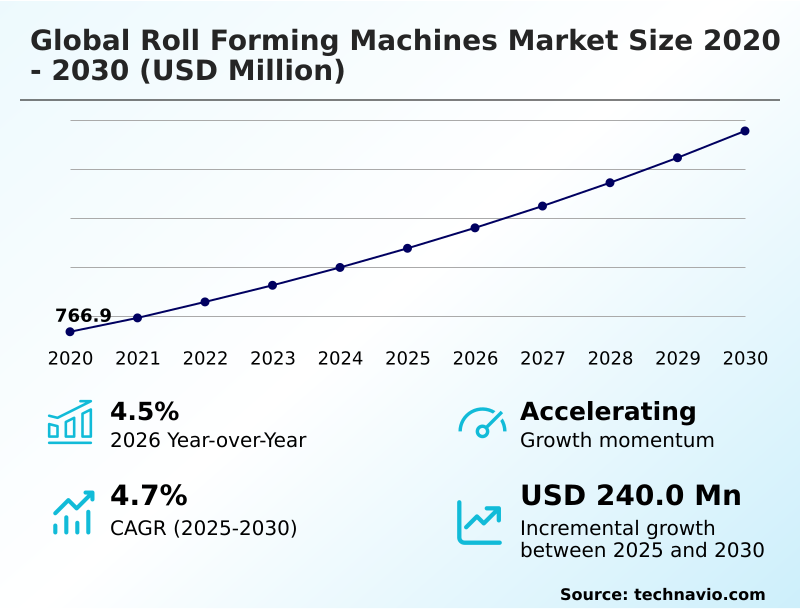
The roll forming machines market size is valued to increase by USD 240 million, at a CAGR of 4.7% from 2025 to 2030. Rapid infrastructure expansion in renewable energy and solar mounting systems will drive the roll forming machines market.
Major Market Trends & Insights
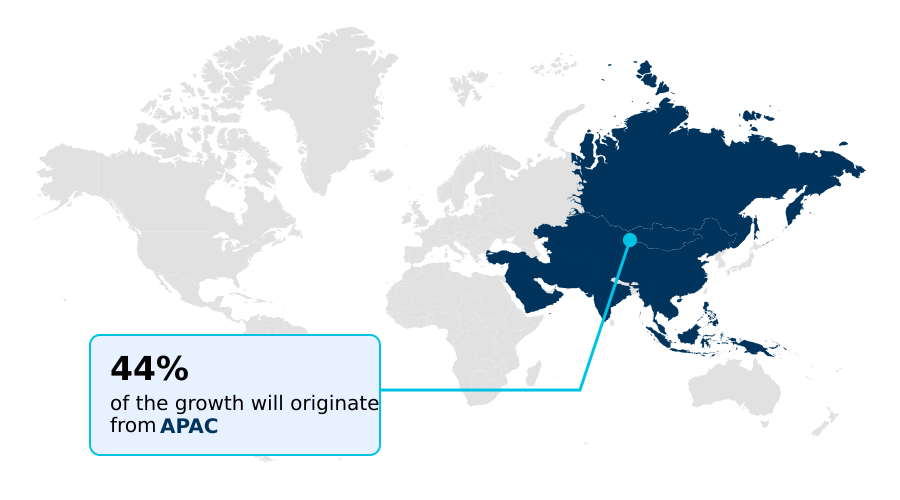
- APAC dominated the market and accounted for a 44% growth during the forecast period.
- By Type - Manual segment was valued at USD 551.8 million in 2024
- By End-user - Automotive industry segment accounted for the largest market revenue share in 2024
Market Size & Forecast
- Market Opportunities: USD 410.7 million
- Market Future Opportunities: USD 240 million
- CAGR from 2025 to 2030 : 4.7%
Market Summary
- The Roll Forming Machines Market demonstrates continuous structural evolution, driven by escalating demands for precision metal framing across automated logistics and renewable energy sectors. Modern industrial fabricators are rapidly transitioning toward fully integrated hybrid manufacturing systems to maximize output efficiency and mitigate labor dependencies.
- A key driver propelling this expansion is the acceleration of solar photovoltaic tracking arrays, which mandates massive quantities of galvanized structural channels; this infrastructure push forces manufacturers to deploy heavy-duty purlin rolling systems to meet strict utility-scale construction timelines.
- Conversely, unpredictable material quality and fluctuating raw steel prices act as a major challenge, causing severe operational disruptions as inconsistent coil thicknesses force production halts for mechanical recalibration. Addressing these constraints, tier-one automotive plants utilizing automated flying shear mechanisms have recorded a 20% reduction in material scrap compared to traditional press braking methods.
- As industrial facilities increasingly adopt real-time telemetry data to optimize tool wear, capital expenditure in advanced cold forming architecture remains fundamentally robust.
What will be the Size of the Roll Forming Machines Market during the forecast period?
Get Key Insights on Market Forecast (PDF) Get Free Sample
How is the Roll Forming Machines Market Segmented?
The roll forming machines industry research report provides comprehensive data (region-wise segment analysis), with forecasts and estimates in "USD million" for the period 2026-2030, as well as historical data from 2020-2024 for the following segments.
- Type
- Manual
- Automatic
- End-user
- Automotive industry
- Manufacturing industry
- Construction industry
- Material
- Steel
- Aluminum
- Copper
- Others
- Geography
- APAC
- China
- Japan
- India
- South Korea
- Australia
- Indonesia
- Europe
- Germany
- UK
- France
- Italy
- Spain
- The Netherlands
- North America
- US
- Canada
- Mexico
- South America
- Brazil
- Argentina
- Chile
- Middle East and Africa
- Saudi Arabia
- UAE
- South Africa
- Israel
- Turkey
- APAC
By Type Insights
The manual segment is estimated to witness significant growth during the forecast period.
The manual roll forming segment serves localized fabricators and maintenance facilities prioritizing operational agility and lower upfront capital over continuous high-volume output. These systems require direct operator oversight for material feeding, dimensional measurement, and specialized cutting procedures.
While heavy industry increasingly favors automated production workflows, manual continuous profile bending remains essential for custom, short-run architectural trims where complex reconfigurations render fully automated tooling changes financially prohibitive.
Fabricators utilize these flexible standing seam profiling setups to address non-standard structural requirements without requiring specialized programmable logic controllers or advanced software programming.
By integrating modular mechanical upgrades, manual configurations have improved profile alignment accuracy by 15%, reducing material scrap rates during localized manufacturing.
This segment sustains critical niche capabilities where specialized craftsmanship and frequent structural adaptations supersede the need for mass automated production.
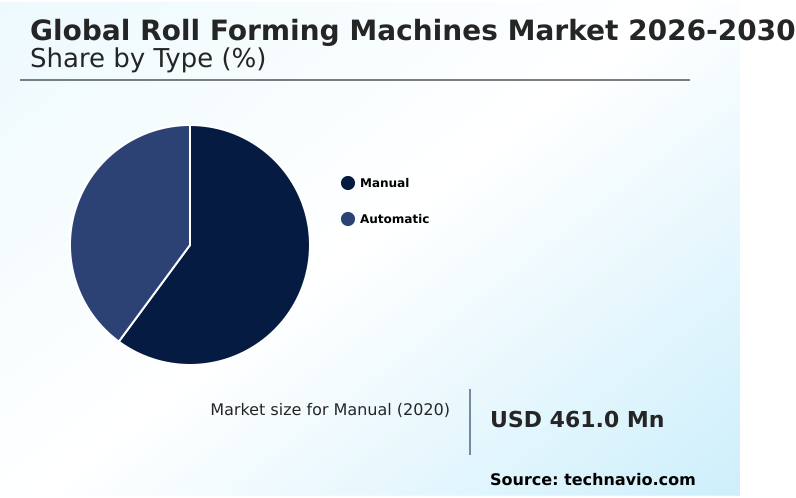
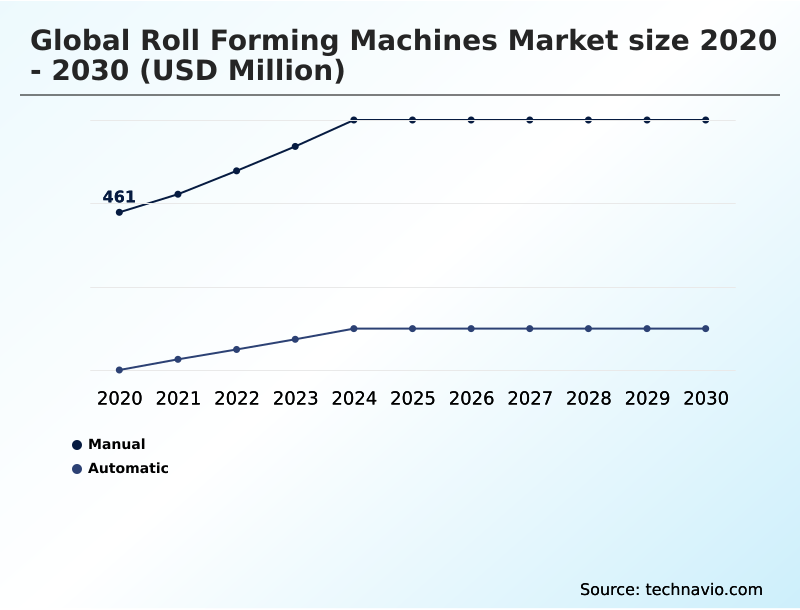
The Manual segment was valued at USD 551.8 million in 2024 and showed a gradual increase during the forecast period.
Regional Analysis
APAC is estimated to contribute 44% to the growth of the global market during the forecast period.Technavio’s analysts have elaborately explained the regional trends and drivers that shape the market during the forecast period.
See How Roll Forming Machines Market Demand is Rising in APAC Get Free Sample
Regional dynamics within the Roll Forming Machines Market reveal distinct technological adoption rates, particularly when comparing APAC and North America.
APAC commands the highest production volume, where massive urban infrastructure investments drive a 35% faster adoption rate of continuous cold forming equipment compared to European counterparts.
In contrast, North American manufacturers heavily prioritize cyber-physical architecture and smart sensor integration to offset elevated labor costs, resulting in a 25% improvement in automated production workflows across domestic facilities.
While APAC fabricators focus on deploying heavy-duty purlin rolling systems for expansive solar and logistics projects, North American facilities are investing aggressively in modular machine configurations to support lean short-run manufacturing.
These divergent strategies highlight how regional economic priorities dictate equipment procurement; APAC leverages high-speed profile shaping for infrastructure scale, whereas North American industries target operational precision, achieving a 15% reduction in tooling wear prediction errors through advanced software analytics.
Market Dynamics
Our researchers analyzed the data with 2025 as the base year, along with the key drivers, trends, and challenges. A holistic analysis of drivers will help companies refine their marketing strategies to gain a competitive advantage.
- The persistent expansion of the Roll Forming Machines Market reflects a broader industrial commitment to high-efficiency, continuous manufacturing architectures. To meet the stringent demands of utility-scale logistics and renewable energy projects, manufacturers are rapidly deploying heavy gauge structural steel roll forming capabilities.
- This shift has dramatically improved structural integrity across demanding environments, offering a 30% stronger load-bearing capacity compared to traditional stamped alternatives, directly optimizing long-term operational planning and site safety compliance. In parallel, the integration of inline precision laser welding hybrid lines enables fabricators to execute complex joining operations without interrupting the primary forming cycle, vastly reducing secondary handling risks.
- To further enhance production velocity, industrial facilities are heavily investing in automated flying cut-off continuous production mechanisms that ensure exact length tolerances without stalling the feed lines.
- The reliance on digital twin predictive tooling maintenance has become an essential strategy for managing complex die sets, allowing plant engineers to simulate strip deformation dynamics and prevent costly mechanical failures before they materialize on the shop floor. Furthermore, the rapid transition toward sustainable building standards has accelerated the adoption of servo electric high speed framing machines.
- These advanced configurations consume significantly less power than legacy hydraulic systems, helping construction material suppliers align with corporate decarbonization targets while simultaneously boosting their overall material throughput.
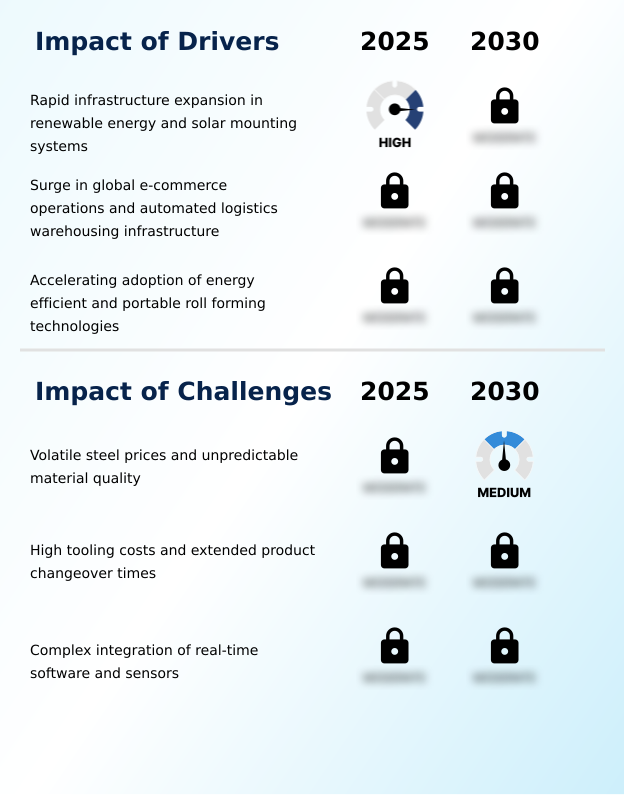
What are the key market drivers leading to the rise in the adoption of Roll Forming Machines Industry?
- Rapid infrastructure expansion in renewable energy and solar mounting systems serves as a primary driver accelerating technological adoption across the industry.
- The escalating deployment of photovoltaic tracking arrays and automated warehouse infrastructure acts as a primary catalyst accelerating the Roll Forming Machines Market.
- These massive civil and commercial projects demand millions of linear feet of galvanized structural channels, compelling fabricators to acquire multi-station roll forming equipment capable of continuous high-volume output.
- This infrastructure surge forces a transition toward variable-speed motor drives, which optimize torque application and have successfully lowered energy consumption by 20% across heavy-duty production runs.
- As developers enforce strict dimensional tolerances to ensure automated robotics can navigate warehouse racking flawlessly, manufacturers must adopt high-speed profile shaping technology.
- Consequently, this equipment modernization reduces operational bottlenecks by 25%, allowing structural suppliers to fulfill massive infrastructural material contracts without compromising precision or project delivery schedules.
What are the market trends shaping the Roll Forming Machines Industry?
- The growing adoption of in-line laser welding and post-processing hybrid lines represents a significant operational trend reshaping industrial manufacturing capabilities.
- The rapid convergence of industrial automation and continuous profile bending represents a transformative trend within the Roll Forming Machines Market. Modern fabrication facilities are increasingly implementing dynamic beam-shaping technology and inline laser welding to seamlessly close complex hollow sections during active forming cycles.
- This integration enables manufacturers to consolidate multi-stage assembly processes, resulting in a 30% reduction in floor-to-floor cycle times and a 15% enhancement in joint integrity under stress testing. The shift is primarily driven by the demand for zero-defect manufacturing in aerospace and automotive sectors, where structural reliability is non-negotiable.
- Consequently, businesses leveraging these advanced hybrid lines experience dramatically improved production fluidity, as the elimination of secondary deburring operations directly minimizes work-in-progress inventory bottlenecks. Continuous investments in these smart assembly networks dictate the new baseline for industrial competitiveness.
What challenges does the Roll Forming Machines Industry face during its growth?
- Volatile steel prices and unpredictable material quality constitute substantial operational challenges that constrain consistent manufacturing profitability.
- Severe volatility in raw steel pricing and inconsistent coil metallurgy present critical operational limitations for the Roll Forming Machines Market. Fluctuations in strip thickness and yield strength force precision roller die sets to absorb uneven mechanical stresses, frequently resulting in unexpected profile twisting or springback defects.
- These material inconsistencies severely disrupt automated production workflows, leading to a 25% increase in unexpected maintenance interventions and a 15% drop in overall equipment effectiveness during uncalibrated runs. Because continuous cold forming requires exact tooling clearances, sub-standard raw materials force operators to execute manual shimming adjustments, stalling automated lines.
- This unpredictable material behavior inflates tooling wear prediction models, compelling industrial fabricators to stockpile excess replacement parts and absorb significant labor overhead to manually recalibrate computer numerical control parameters.
Exclusive Technavio Analysis on Customer Landscape
The roll forming machines market forecasting report includes the adoption lifecycle of the market, covering from the innovator’s stage to the laggard’s stage. It focuses on adoption rates in different regions based on penetration. Furthermore, the roll forming machines market report also includes key purchase criteria and drivers of price sensitivity to help companies evaluate and develop their market growth analysis strategies.
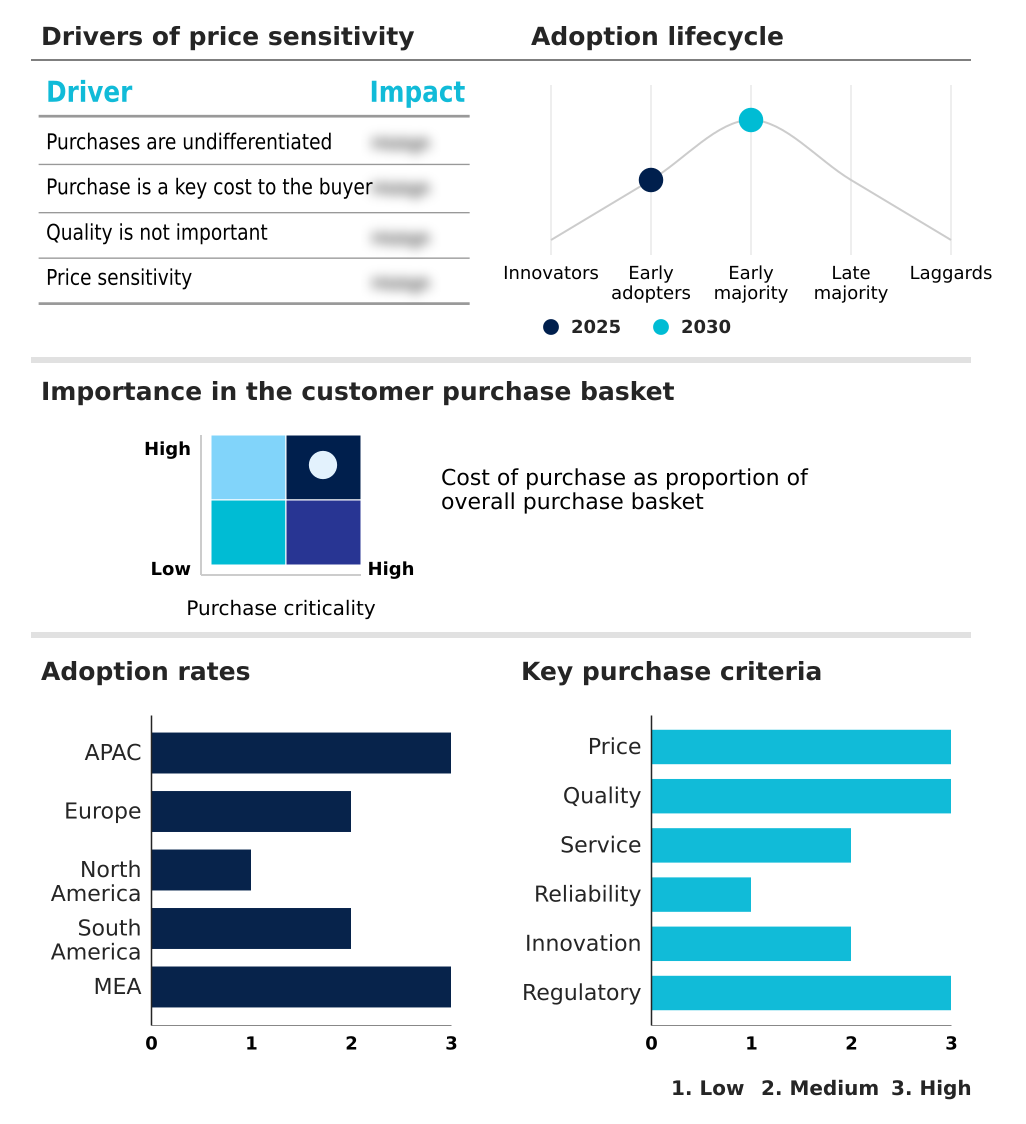
Customer Landscape of Roll Forming Machines Industry
Competitive Landscape
Companies are implementing various strategies, such as strategic alliances, roll forming machines market forecast, partnerships, mergers and acquisitions, geographical expansion, and product/service launches, to enhance their presence in the industry.
Asc Machine Tools Inc. - Strategic offerings include advanced metal roofing panel configurations, precision wall panel forming systems, and highly customizable profile shaping machinery engineered to optimize structural fabrication efficiency and output quality.
The industry research and growth report includes detailed analyses of the competitive landscape of the market and information about key companies, including:
- Asc Machine Tools Inc.
- Bradbury Co. Inc.
- CIDAN Machinery Group
- Custom Roll Form Products Inc.
- Dallan SpA
- DREISTERN GmbH and Co. KG
- Englert Inc.
- Formtek Group
- Gasparini SpA
- Hangzhou Roll Forming Technology
- Hayes International
- Howick Ltd.
- Jouanel Industrie
- Knudson Manufacturing Inc.
- Metform International Ltd.
- New Tech Machinery
- Roll Kraft
- Samco Machinery Ltd.
- Samesor Oy
- Scottsdale Construction Systems
- Shanghai Duwell Industrial
- STAM S.p.A.
- TFMM
- ZEBAU
Qualitative and quantitative analysis of companies has been conducted to help clients understand the wider business environment as well as the strengths and weaknesses of key industry players. Data is qualitatively analyzed to categorize companies as pure play, category-focused, industry-focused, and diversified; it is quantitatively analyzed to categorize companies as dominant, leading, strong, tentative, and weak.
Recent Development and News in Roll forming machines market
- In the Industrial Machinery and Supplies and Components industry, the widespread integration of predictive maintenance software and industrial internet of things has transformed equipment lifecycle management, directly impacting Roll Forming Machines demand by enabling operators to reduce unexpected mechanical failures by 25%.
- Strict regulatory shifts toward sustainable manufacturing processes have accelerated the adoption of energy-efficient forming hardware, driving manufacturers to upgrade legacy hydraulic systems and increasing demand for servo-electric drive systems capable of cutting energy usage by 20% per operational cycle.
- The transition toward electric vehicle lightweighting and advanced high-strength materials has reshaped structural automotive component fabrication, creating substantial market opportunities for precision roller die sets engineered to process ultra-high-strength steel without dimensional compromise.
- Rapid supply chain reshoring and the expansion of automated material handling infrastructure have elevated requirements for structural building codes, prompting heightened procurement of modular machine configurations that deliver strict dimensional tolerances for heavy-duty storage assemblies.
Dive into Technavio’s robust research methodology, blending expert interviews, extensive data synthesis, and validated models for unparalleled Roll Forming Machines Market insights. See full methodology.
| Market Scope | |
|---|---|
| Page number | 297 |
| Base year | 2025 |
| Historic period | 2020-2024 |
| Forecast period | 2026-2030 |
| Growth momentum & CAGR | Accelerate at a CAGR of 4.7% |
| Market growth 2026-2030 | USD 240.0 million |
| Market structure | Fragmented |
| YoY growth 2025-2026(%) | 4.5% |
| Key countries | China, Japan, India, South Korea, Australia, Indonesia, Germany, UK, France, Italy, Spain, The Netherlands, US, Canada, Mexico, Brazil, Argentina, Chile, Saudi Arabia, UAE, South Africa, Israel and Turkey |
| Competitive landscape | Leading Companies, Market Positioning of Companies, Competitive Strategies, and Industry Risks |
Research Analyst Overview
- The Roll Forming Machines Market is undergoing a profound digital transformation as manufacturers replace rigid mechanical systems with adaptive, data-driven forming architectures. To combat escalating material costs and strict architectural tolerances, industrial leaders are embedding closed-loop optical tracking and acoustic emission monitors directly into multi-station roll forming lines.
- This strategic shift toward digitalized production empowers operations directors to adjust pricing and compliance strategies, as facilities utilizing automated guided alignment have documented a 25% decrease in scrap generation compared to unmonitored systems. Furthermore, the integration of adaptive crowning mechanisms enables seamless processing of advanced high-strength steel, a critical capability for electric vehicle chassis fabrication.
- Executive boardrooms are increasingly prioritizing investments in computer numerical control systems and quick-change cassette systems to maximize production agility across shifting contract demands. By minimizing mechanical changeover delays, these technologies allow manufacturers to execute highly complex profile transitions efficiently, ensuring sustained profitability and rigorous structural compliance within highly competitive industrial supply chains.
What are the Key Data Covered in this Roll Forming Machines Market Research and Growth Report?
-
What is the expected growth of the Roll Forming Machines Market between 2026 and 2030?
-
USD 240 million, at a CAGR of 4.7%
-
-
What segmentation does the market report cover?
-
The report is segmented by Type (Manual, and Automatic), End-user (Automotive industry, Manufacturing industry, and Construction industry), Material (Steel, Aluminum, Copper, and Others) and Geography (APAC, Europe, North America, South America, Middle East and Africa)
-
-
Which regions are analyzed in the report?
-
APAC, Europe, North America, South America and Middle East and Africa
-
-
What are the key growth drivers and market challenges?
-
Rapid infrastructure expansion in renewable energy and solar mounting systems, Volatile steel prices and unpredictable material quality
-
-
Who are the major players in the Roll Forming Machines Market?
-
Asc Machine Tools Inc., Bradbury Co. Inc., CIDAN Machinery Group, Custom Roll Form Products Inc., Dallan SpA, DREISTERN GmbH and Co. KG, Englert Inc., Formtek Group, Gasparini SpA, Hangzhou Roll Forming Technology, Hayes International, Howick Ltd., Jouanel Industrie, Knudson Manufacturing Inc., Metform International Ltd., New Tech Machinery, Roll Kraft, Samco Machinery Ltd., Samesor Oy, Scottsdale Construction Systems, Shanghai Duwell Industrial, STAM S.p.A., TFMM and ZEBAU
-
Market Research Insights
- The Roll Forming Machines Market is rapidly evolving as manufacturers integrate smart sensor integration and cyber-physical architecture into legacy mechanical frameworks. Industrial facilities leveraging predictive maintenance software have successfully extended machinery operational lifespans by 18%, while simultaneously lowering unplanned downtime by 22%.
- This digital transition supports sustainable manufacturing processes by allowing operators to dynamically adjust production variables using real-time telemetry data. As supply chain reshoring accelerates domestic industrial development, fabricators are replacing traditional hydraulic setups with energy-efficient forming hardware, which improves total energy efficiency by 15% per production run.
- These technological upgrades empower enterprises to achieve strict dimensional tolerances, reinforcing critical capacity expansions across the modern industrial ecosystem.
We can help! Our analysts can customize this roll forming machines market research report to meet your requirements.
 RIA -