


Rope Market Size 2026-2030
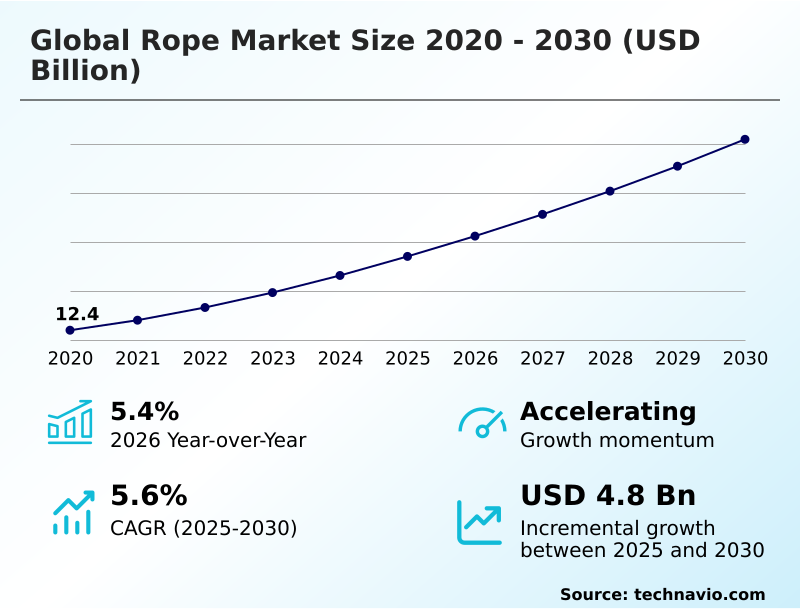
The rope market size is valued to increase by USD 4.80 billion, at a CAGR of 5.6% from 2025 to 2030. Accelerated expansion of renewable energy sector and offshore wind mooring systems will drive the rope market.
Major Market Trends & Insights
- APAC dominated the market and accounted for a 48.3% growth during the forecast period.
- By Product - Steel wire segment was valued at USD 10.53 billion in 2024
- By End-user - Industrial segment accounted for the largest market revenue share in 2024
Market Size & Forecast
- Market Opportunities: USD 7.82 billion
- Market Future Opportunities: USD 4.80 billion
- CAGR from 2025 to 2030 : 5.6%
Market Summary
- The rope market is undergoing a significant transformation, driven by the shift from traditional materials to advanced engineered fibers. This evolution is propelled by industrial demands for higher performance, safety, and operational efficiency across sectors such as maritime, construction, and renewable energy.
- Synthetic ropes, including those made from high-performance polymers, offer a superior strength-to-weight ratio, enhanced durability, and resistance to environmental factors, making them critical for modern applications. The expansion of offshore wind farms, for instance, creates a specialized need for mooring lines that can withstand extreme oceanic conditions.
- A project manager for a deep-sea energy platform must weigh the upfront cost of advanced synthetic fiber ropes against the long-term benefits of reduced maintenance, improved safety compliance, and longer lifecycle, which ultimately lowers the total cost of ownership. Concurrently, the industry grapples with challenges like raw material price volatility, which affects production costs and financial planning.
- The integration of digital technologies, such as embedded sensors for real-time monitoring of rope integrity, represents a key innovation, enabling predictive maintenance and preventing catastrophic failures in high-stakes environments. This convergence of material science and digital innovation defines the future trajectory of the rope market.
What will be the Size of the Rope Market during the forecast period?
Get Key Insights on Market Forecast (PDF) Get Free Sample
How is the Rope Market Segmented?
The rope industry research report provides comprehensive data (region-wise segment analysis), with forecasts and estimates in "USD million" for the period 2026-2030, as well as historical data from 2020-2024 for the following segments.
- Product
- Steel wire
- Synthetic
- Cotton
- Others
- End-user
- Industrial
- Commercial
- Residential
- Distribution channel
- Offline
- Online
- Geography
- APAC
- China
- India
- Japan
- North America
- US
- Canada
- Mexico
- Europe
- Germany
- UK
- France
- Middle East and Africa
- Saudi Arabia
- UAE
- South Africa
- South America
- Brazil
- Argentina
- Rest of World (ROW)
- APAC
By Product Insights
The steel wire segment is estimated to witness significant growth during the forecast period.
The steel wire rope segment is fundamental to industries where extreme load-bearing capacity is non-negotiable. Comprising galvanized steel wire or stainless steel wound around a core, these products deliver superior abrasion resistance and structural integrity.
Key applications for a steel wire rope include industrial hoisting equipment, crane rope systems, and elevator hoist ropes in high-rise construction and port crane cables for maritime logistics.
Innovations focus on advanced polymer encapsulation and specialized coatings to enhance corrosion resistance, extending operational lifecycles in harsh environments. In mining excavation ropes, these products are indispensable for their durability.
The demand is driven by global infrastructure development and stringent safety standards that mandate rigorous rope performance testing, with advanced steel wire rope designs offering up to a 20% improvement in fatigue resistance under cyclical loading, ensuring reliability in critical construction lifting gear.
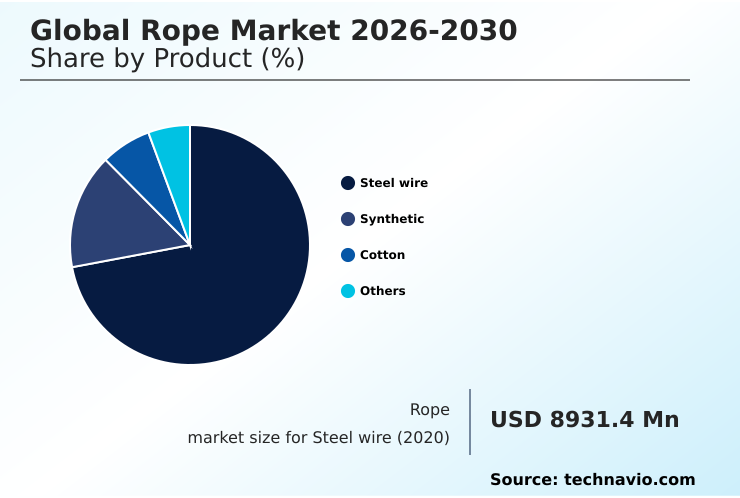
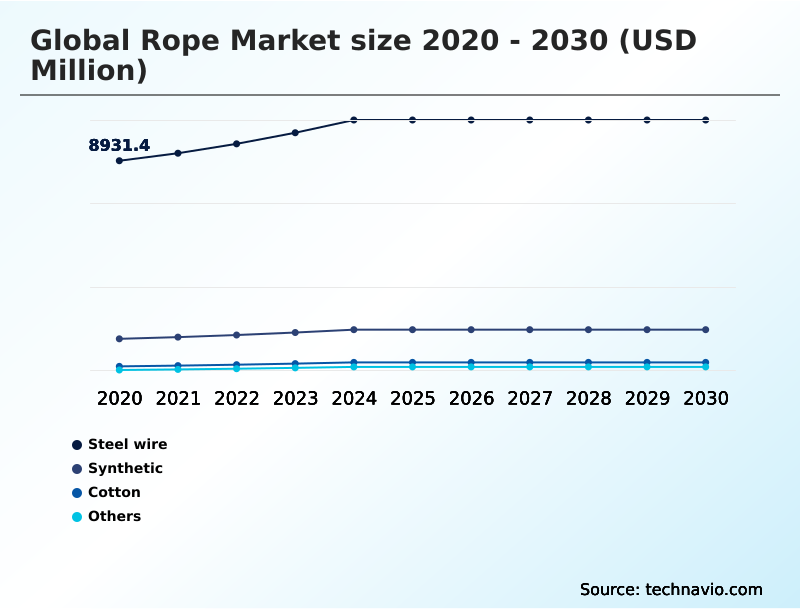
The Steel wire segment was valued at USD 10.53 billion in 2024 and showed a gradual increase during the forecast period.
Regional Analysis
APAC is estimated to contribute 48.3% to the growth of the global market during the forecast period.Technavio’s analysts have elaborately explained the regional trends and drivers that shape the market during the forecast period.
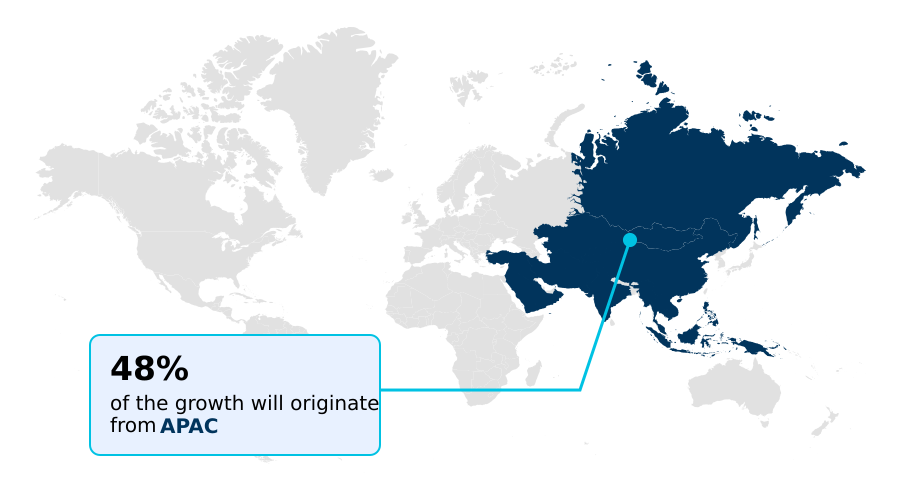
See How Rope Market Demand is Rising in APAC Get Free Sample
The geographic landscape of the rope market is characterized by varied regional growth dynamics, with APAC leading at a projected 6.1% growth rate, fueled by rapid industrialization and major infrastructure projects in China and India.
This region shows strong demand for synthetic fiber rope in maritime mooring solutions and rope for commercial fishing.
North America and Europe, with steady growth rates of 5.1% and 5.8% respectively, are driven by technological adoption and the retrofitting of existing infrastructure.
These markets are pioneering the use of high-modulus polyethylene in deep-water mooring systems and aramid fiber ropes for specialized applications. Demand for heavy-lift slings, industrial safety lines, and polypropylene ropes remains strong.
Emerging applications in aquaculture cage systems, towing and salvage ropes, and arboriculture rigging lines also contribute to market expansion globally, reflecting a diverse and evolving demand structure.
Market Dynamics
Our researchers analyzed the data with 2025 as the base year, along with the key drivers, trends, and challenges. A holistic analysis of drivers will help companies refine their marketing strategies to gain a competitive advantage.
- Strategic decision-making in the global rope market 2026-2030 is increasingly complex, shaped by a confluence of technological, economic, and application-specific factors. The discussion comparing high-performance synthetic vs steel wire ropes is central, particularly for the global rope market 2026-2026 for offshore applications, where weight and corrosion are critical.
- Advancements in smart rope sensor technology are revolutionizing maintenance, with industrial operators reporting that predictive asset management reduces equipment downtime by up to 40% compared to conventional inspection schedules. This technology is vital for the global rope market 2026-2030 for industrial use and the global rope market 2026-2030 for mining operations.
- The global rope market 2026-2030 for renewable energy is a significant driver, with rope demand in deep-water energy projects escalating. Simultaneously, the impact of raw material costs on rope prices remains a persistent challenge across the global rope market 2026-2030 in construction sector and the global rope market 2026-2030 for maritime industry.
- Companies are exploring sustainable and bio-based rope innovations and re-evaluating the lifecycle assessment of industrial rope products to mitigate the environmental impact of synthetic rope production.
- Adherence to safety standards for industrial lifting ropes and best practices for rope maintenance and inspection are paramount, influencing both rope solutions for modern infrastructure projects and the global rope market 2026-2030 for specialty textiles.
- The nuances between comparing braided and twisted rope performance and the overall technological advancements in rope manufacturing will continue to shape procurement strategies for synthetic rope use in commercial shipping.
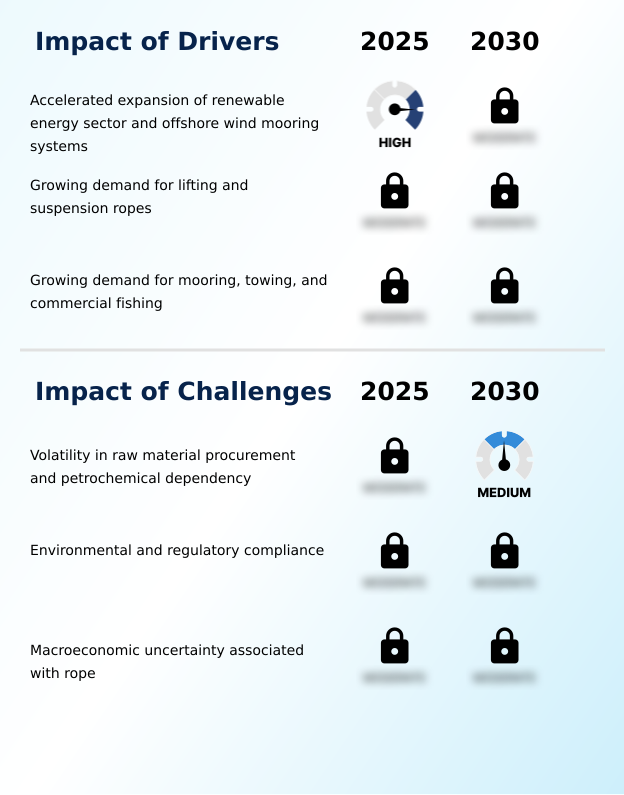
What are the key market drivers leading to the rise in the adoption of Rope Industry?
- The accelerated expansion of the renewable energy sector, especially for offshore wind mooring systems, serves as a key market driver.
- Market growth is significantly propelled by the specialized demands of the renewable energy and maritime sectors. The expansion of offshore wind necessitates advanced offshore tether solutions and subsea lifting applications with exceptional fatigue resistance and uv degradation resistance.
- Advanced synthetic ropes used in these environments show a 30% longer service life compared to traditional alternatives. Innovations in high-performance fiber manufacturing and rope splicing techniques are critical for meeting these requirements.
- In ports, effective rope lifecycle management is crucial, with new synthetic rope retirement criteria driving upgrades. The adoption of materials that support fiber rope circularity and the creation of bio-based plastic ropes are also gaining traction.
- Furthermore, adherence to stringent rope inspection protocols can increase operational uptime by 15% by preventing premature failures in essential equipment such as port crane cables and elevator hoist ropes.
What are the market trends shaping the Rope Industry?
- A primary market trend is the growing demand from the expanding construction and infrastructure sector worldwide, which creates sustained requirements for high-performance lifting and safety equipment.
- Key trends in the rope market are driven by innovation in materials and manufacturing. The development of polyester ropes and nylon ropes with enhanced tensile strength and an optimized strength-to-weight ratio is expanding their use in demanding applications like alpine climbing ropes and industrial hoisting equipment.
- For offshore wind mooring, new braided rope construction techniques are improving durability, with some advanced ropes demonstrating a 20% increase in abrasion resistance. In the construction lifting gear and mining excavation ropes segments, there is a growing focus on a product's entire lifecycle.
- The adoption of sustainable practices, including the use of natural fiber ropes and bio-based materials, can reduce a product's carbon footprint by up to 30%. This shift aligns with evolving regulatory landscapes and corporate sustainability mandates across oil and gas drilling lines.
What challenges does the Rope Industry face during its growth?
- Volatility in raw material procurement and a dependency on petrochemical feedstocks present a significant challenge to industry growth and price stability.
- The primary challenge confronting the rope market is the significant raw material procurement volatility, particularly related to petrochemical polymer pricing. These fluctuations, which can shift by as much as 40% within a single fiscal quarter, create profound instability in production costs and hinder long-term financial planning, impacting everything from electromechanical cables to basic fibers.
- This necessitates a focus on building greater rope supply chain resilience. Firms with diversified sourcing strategies report up to 25% fewer production delays. Ensuring structural integrity monitoring and adherence to regulatory compliance for lifting are also complex challenges, demanding rigorous rope performance testing and the adoption of technologies like embedded sensor monitoring.
- Furthermore, manufacturers must navigate evolving workplace safety regulations while managing costs associated with recycled steel materials and specialized components like sacrificial zinc anodes.
Exclusive Technavio Analysis on Customer Landscape
The rope market forecasting report includes the adoption lifecycle of the market, covering from the innovator’s stage to the laggard’s stage. It focuses on adoption rates in different regions based on penetration. Furthermore, the rope market report also includes key purchase criteria and drivers of price sensitivity to help companies evaluate and develop their market growth analysis strategies.
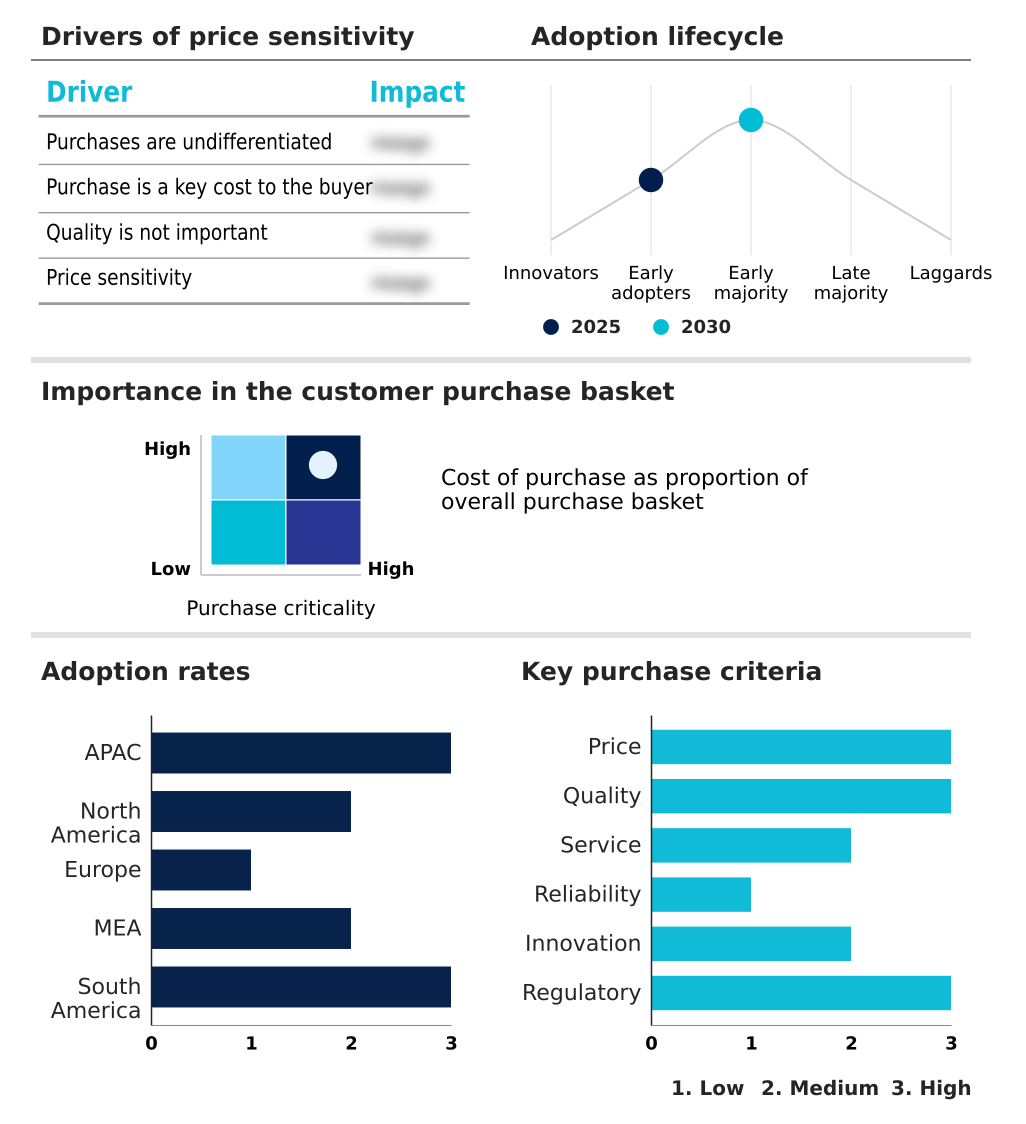
Customer Landscape of Rope Industry
Competitive Landscape
Companies are implementing various strategies, such as strategic alliances, rope market forecast, partnerships, mergers and acquisitions, geographical expansion, and product/service launches, to enhance their presence in the industry.
Cortland Ltd. - Market offerings include specialized synthetic and steel wire ropes, high-performance cables, and integrated systems engineered for demanding industrial, marine, and construction applications.
The industry research and growth report includes detailed analyses of the competitive landscape of the market and information about key companies, including:
- Cortland Ltd.
- CSR Braids
- Donaghys Ltd.
- English Braids Ltd.
- Erin Rope Corp.
- Gottifredi Maffioli Srl
- Great Trango Holdings Inc.
- Hampidjan Group
- Katradis Marine Ropes Ind SA
- Langman Ropes
- Marlow Ropes Ltd.
- Novatec Braids Ltd.
- NV Bekaert SA
- Samson Rope Technologies Inc.
- Southern Ropes
- Teufelberger Holding AG
- Usha Martin Ltd.
- Van Beelen Group BV
- WireCo WorldGroup
Qualitative and quantitative analysis of companies has been conducted to help clients understand the wider business environment as well as the strengths and weaknesses of key industry players. Data is qualitatively analyzed to categorize companies as pure play, category-focused, industry-focused, and diversified; it is quantitatively analyzed to categorize companies as dominant, leading, strong, tentative, and weak.
Recent Development and News in Rope market
- In February 2025, NV Bekaert SA agreed to sell its Steel Wire Solutions businesses in Costa Rica, Ecuador, and Venezuela to Grupo AG for approximately $73 million as part of a strategic portfolio transformation.
- In November 2025, Samson Rope Technologies Inc. launched its CALIBRE line, a new high-performance rope solution specifically engineered to meet the increasing load demands of modern crane operations in the superyacht industry.
- In February 2025, Hampidjan Group acquired a majority stake in India-based manufacturer Kohinoor Ropes to expand its production capacity and optimize its value chain for the fishing and aquaculture sectors.
- In February 2026, Teufelberger Holding AG announced plans to exhibit its latest crane rope portfolio at CONEXPO-CON/AGG 2026, featuring advanced lifting solutions designed to improve lifecycle performance and address rising load demands.
Dive into Technavio’s robust research methodology, blending expert interviews, extensive data synthesis, and validated models for unparalleled Rope Market insights. See full methodology.
| Market Scope | |
|---|---|
| Page number | 285 |
| Base year | 2025 |
| Historic period | 2020-2024 |
| Forecast period | 2026-2030 |
| Growth momentum & CAGR | Accelerate at a CAGR of 5.6% |
| Market growth 2026-2030 | USD 4799.1 million |
| Market structure | Fragmented |
| YoY growth 2025-2026(%) | 5.4% |
| Key countries | China, India, Japan, South Korea, Indonesia, Australia, US, Canada, Mexico, Germany, UK, France, Italy, Spain, Norway, Saudi Arabia, UAE, South Africa, Turkey, Egypt, Brazil, Argentina and Chile |
| Competitive landscape | Leading Companies, Market Positioning of Companies, Competitive Strategies, and Industry Risks |
Research Analyst Overview
- The rope market is defined by continuous material science innovation and a pivot toward application-specific, high-performance solutions. The evolution from standard natural fiber ropes to advanced synthetic fiber rope, including high-modulus polyethylene and aramid fiber ropes, establishes a new performance benchmark.
- This transition influences boardroom decisions regarding capital investment in long-life assets, where the superior strength-to-weight ratio and fatigue resistance of modern fibers are critical. Technologies such as polymer encapsulation are integral, extending the operational life of a steel wire rope by over 25% in corrosive environments by improving corrosion resistance.
- The development of high-tenacity yarns, polypropylene ropes, and polyester ropes underpins this progress. Innovations in braided rope construction and twisted rope structure optimize tensile strength and load-bearing capacity for specialized equipment like crane rope systems and heavy-lift slings.
- Furthermore, the integration of smart fiber technology with embedded sensor monitoring enables real-time structural integrity monitoring, a crucial factor for industrial safety lines and subsea lifting applications. This shift toward intelligent and durable materials like electromechanical cables and solutions with sacrificial zinc anodes is reshaping industry standards.
What are the Key Data Covered in this Rope Market Research and Growth Report?
-
What is the expected growth of the Rope Market between 2026 and 2030?
-
USD 4.80 billion, at a CAGR of 5.6%
-
-
What segmentation does the market report cover?
-
The report is segmented by Product (Steel wire, Synthetic, Cotton, and Others), End-user (Industrial, Commercial, and Residential), Distribution Channel (Offline, and Online) and Geography (APAC, North America, Europe, Middle East and Africa, South America)
-
-
Which regions are analyzed in the report?
-
APAC, North America, Europe, Middle East and Africa and South America
-
-
What are the key growth drivers and market challenges?
-
Accelerated expansion of renewable energy sector and offshore wind mooring systems, Volatility in raw material procurement and petrochemical dependency
-
-
Who are the major players in the Rope Market?
-
Cortland Ltd., CSR Braids, Donaghys Ltd., English Braids Ltd., Erin Rope Corp., Gottifredi Maffioli Srl, Great Trango Holdings Inc., Hampidjan Group, Katradis Marine Ropes Ind SA, Langman Ropes, Marlow Ropes Ltd., Novatec Braids Ltd., NV Bekaert SA, Samson Rope Technologies Inc., Southern Ropes, Teufelberger Holding AG, Usha Martin Ltd., Van Beelen Group BV and WireCo WorldGroup
-
Market Research Insights
- The rope market's dynamics are shaped by a focus on application-specific engineering and lifecycle value. For instance, advanced polymer development for superyacht running rigging enhances performance, while improved rope lifecycle management for maritime mooring solutions is critical for port authorities. Innovations in rope performance testing support new synthetic rope retirement criteria, which can improve operational safety compliance by over 30%.
- In industrial settings, the right construction lifting gear and industrial hoisting equipment are vital. Adherence to updated rope inspection protocols, enabled by smart technologies, reduces manual checks by up to 40%. Meanwhile, raw material procurement volatility and fluctuating petrochemical polymer pricing create significant planning challenges, making rope supply chain resilience a priority.
- Firms are also focused on sustainable rope manufacturing and rope failure analysis to meet regulatory compliance for lifting and stringent workplace safety regulations across all applications.
We can help! Our analysts can customize this rope market research report to meet your requirements.
 RIA -
RIA - 
