


Rotary Steerable Systems Market Size 2026-2030
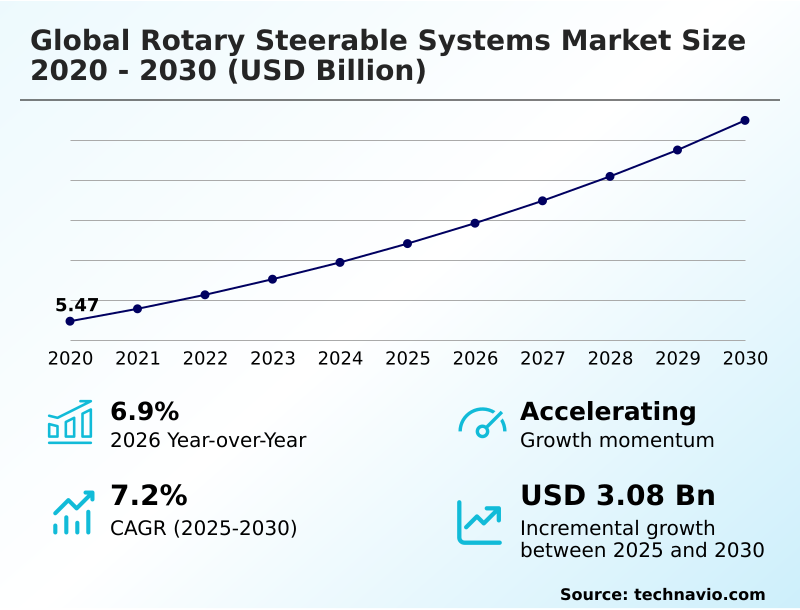
The rotary steerable systems market size is valued to increase by USD 3.08 billion, at a CAGR of 7.2% from 2025 to 2030. Expansion of complex unconventional drilling and extended-reach reservoirs will drive the rotary steerable systems market.
Major Market Trends & Insights
- North America dominated the market and accounted for a 46.1% growth during the forecast period.
- By Application - Onshore segment was valued at USD 3.97 billion in 2024
- By Type - Horizontal segment accounted for the largest market revenue share in 2024
Market Size & Forecast
- Market Opportunities: USD 5.02 billion
- Market Future Opportunities: USD 3.08 billion
- CAGR from 2025 to 2030 : 7.2%
Market Summary
- The rotary steerable systems market is defined by a profound transformation toward high-precision drilling and operational efficiency to unlock resources from increasingly complex reservoirs. These systems, enabling continuous drill string rotation while steering the bit, are indispensable for developing unconventional shale plays, extended-reach offshore wells, and high-pressure, high-temperature environments.
- A primary catalyst is the shift from manual, motor-based directional drilling to integrated, closed-loop automated solutions, driven by the imperative to reduce non-productive time and enhance wellbore quality.
- In a typical scenario, an operator targeting a thin pay zone in a horizontal well leverages real-time geosteering data to make micro-adjustments, ensuring the wellbore remains in the most productive rock layer and maximizing asset value.
- Beyond traditional oil and gas, the technology is expanding into geothermal energy and carbon capture, where precise navigation in hard rock and deep formations is critical. The integration of advanced sensors and data analytics continues to refine system capabilities, ensuring projects remain economically viable amid volatile commodity prices and stringent environmental regulations.
What will be the Size of the Rotary Steerable Systems Market during the forecast period?
Get Key Insights on Market Forecast (PDF) Get Free Sample
How is the Rotary Steerable Systems Market Segmented?
The rotary steerable systems industry research report provides comprehensive data (region-wise segment analysis), with forecasts and estimates in "USD million" for the period 2026-2030, as well as historical data from 2020-2024 for the following segments.
- Application
- Onshore
- Offshore
- Type
- Horizontal
- Directional
- Technology
- Push-the-bit
- Point-the-bit
- Geography
- North America
- US
- Canada
- Mexico
- Europe
- Germany
- UK
- France
- APAC
- China
- Australia
- Japan
- Middle East and Africa
- Saudi Arabia
- UAE
- Turkey
- South America
- Brazil
- Argentina
- Colombia
- Rest of World (ROW)
- North America
By Application Insights
The onshore segment is estimated to witness significant growth during the forecast period.
The onshore segment is pivotal, shaped by the proliferation of unconventional resource plays and the necessity for extended-reach drilling.
Within this sub-segment, the transition from traditional mud motors to sophisticated rotary steerable systems is motivated by the requirement for higher rates of penetration (ROP) and mitigation of wellbore tortuosity, with some autonomous deployments achieving a 15% reduction in trajectory deviations.
Onshore operators focus on reducing total cost of ownership by minimizing non-productive time, which is achieved through continuous drill string rotation.
The integration of real-time data from measurement-while-drilling (MWD) tools and formation evaluation sensors into the steering logic of the bottom-hole assembly (BHA) allows for precise reservoir navigation and drill bit guidance, maximizing the net-to-gross pay ratio in marginal field economics.
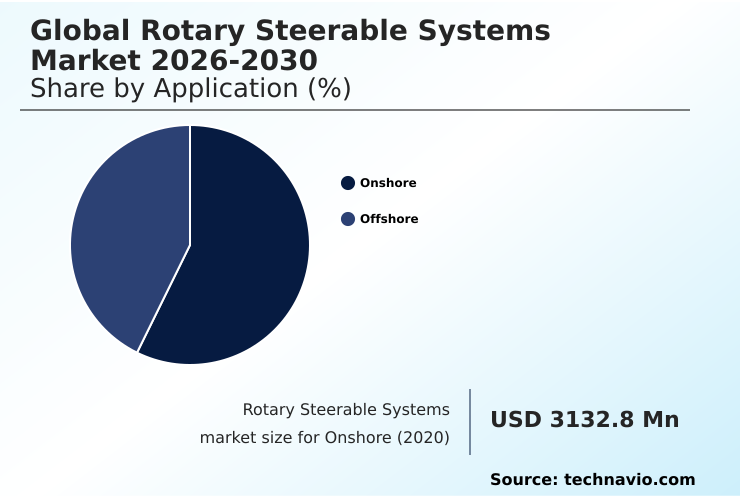
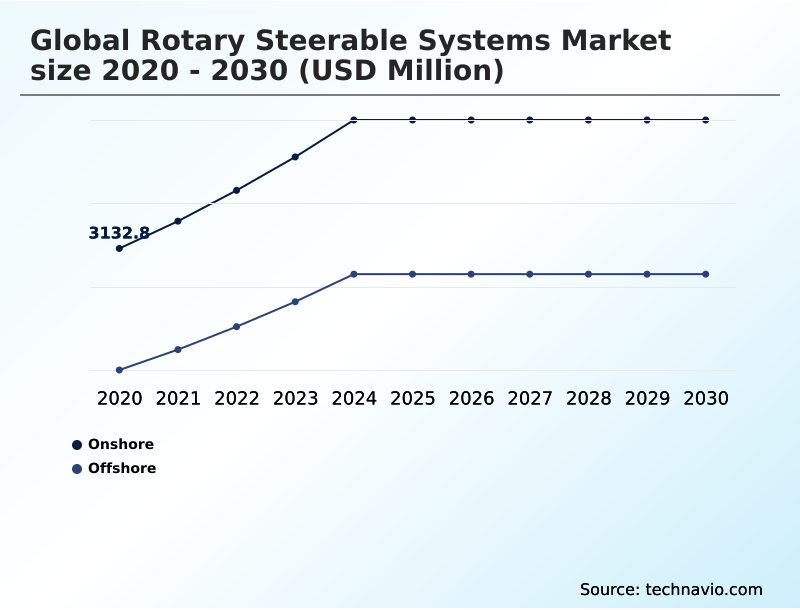
The Onshore segment was valued at USD 3.97 billion in 2024 and showed a gradual increase during the forecast period.
Regional Analysis
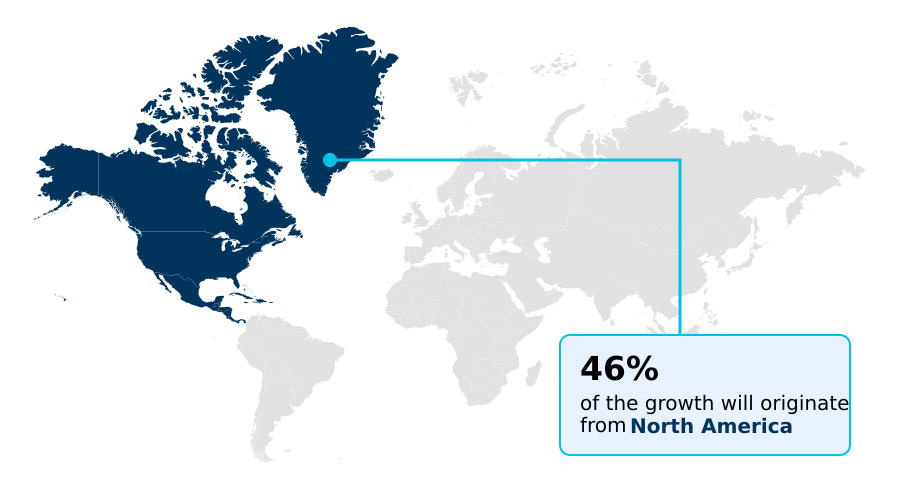
North America is estimated to contribute 46.1% to the growth of the global market during the forecast period.Technavio’s analysts have elaborately explained the regional trends and drivers that shape the market during the forecast period.
See How Rotary Steerable Systems Market Demand is Rising in North America Get Free Sample
The geographic landscape is dominated by North America, which accounts for over 46% of the incremental growth, driven by mature unconventional shale plays.
Operators in this region leverage advanced push-the-bit technology and point-the-bit mechanisms for automated trajectory correction to reduce wellbore tortuosity. The market is also expanding into geothermal energy drilling and carbon capture and storage (CCS) wells.
In contrast, APAC is a rapidly growing region, contributing over 23% to market expansion, fueled by efforts to increase domestic production and ensure energy security.
This has led to a surge in complex projects, including ultra-deep wells, where logging-while-drilling (LWD) and geomechanical stress modeling are critical for formation characterization.
The Middle East and Africa also show strong demand, focusing on gas production and deploying advanced wellbore architecture.
Market Dynamics
Our researchers analyzed the data with 2025 as the base year, along with the key drivers, trends, and challenges. A holistic analysis of drivers will help companies refine their marketing strategies to gain a competitive advantage.
- A comprehensive cost-benefit analysis of rotary steerable systems reveals significant advantages over conventional methods, particularly in complex drilling scenarios. When comparing rotary steerable systems vs conventional mud motors, the primary distinction lies in the ability to achieve a higher rate of penetration with rotary steerable systems while improving wellbore quality.
- The debate over push-the-bit vs point-the-bit performance often centers on the application; push-the-bit excels in maintaining stable control, whereas point-the-bit offers precision in softer formations. The reliability of high-temperature rotary steerable tools is a critical factor in deep, high-pressure environments, where maintenance costs for rotary steerable systems must be weighed against the high expense of non-productive time.
- The autonomous rotary steerable system for deepwater applications is revolutionizing offshore drilling by reducing human error. Moreover, integrating AI with rotary steerable systems enables closed-loop steering for precise well placement. This is crucial for rotary steerable systems for geothermal drilling and rotary steerable systems for carbon capture wells, where accuracy is paramount.
- Telemetry limitations in extended-reach drilling remain a challenge, but advancements in real-time geosteering with rotary steerable systems are mitigating this issue.
- The technology is also fundamental for constructing rotary steerable systems for multilateral wells and is a key enabler for rotary steerable systems for unconventional shale, where optimizing wellbore quality with RSS can lead to production gains exceeding those of older technologies by more than 15%.
- The impact of dogleg severity on RSS performance is a key consideration, as is the use of rotary steerable systems for mature field optimization to extend asset life.
What are the key market drivers leading to the rise in the adoption of Rotary Steerable Systems Industry?
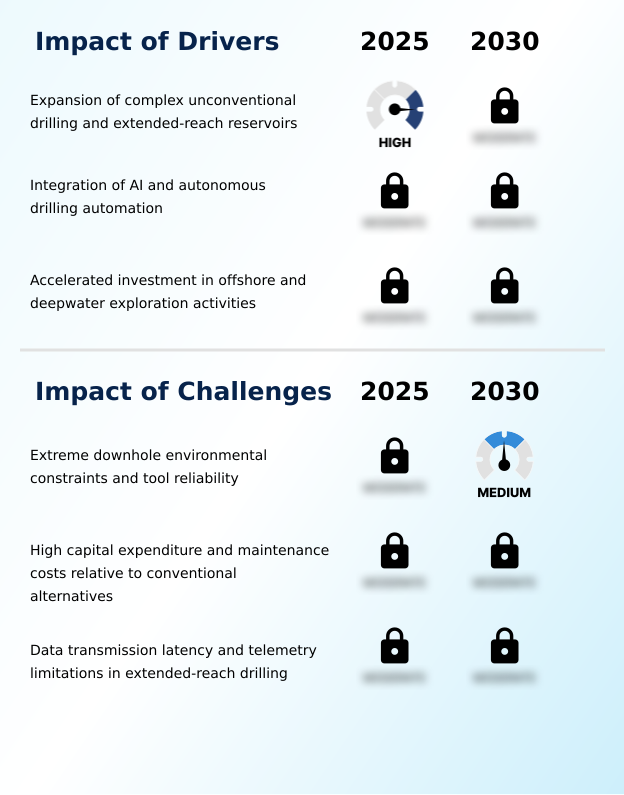
- A key driver for the market is the expansion of complex unconventional drilling and extended-reach reservoirs, which compels operators to target geologically challenging formations requiring high-precision directional drilling.
- The market is propelled by the need to access complex reservoirs through extended-reach drilling (ERD), where directional drilling precision is paramount.
- The use of continuous drill string rotation is a key enabler, significantly reducing non-productive time (NPT) and improving subsea tie-back efficiency in deepwater exploration projects.
- As operators pursue mature field redevelopment and pre-salt reservoir exploitation, the economic case for intelligent drilling systems strengthens. For instance, integrated digital twin simulation allows for optimized well planning, contributing to operational cost optimization.
- The move toward drilling-as-a-service models is also gaining traction, particularly in the context of energy transition drilling, where efficiency gains of up to 15% in tortuosity reduction have been documented on geothermal projects.
What are the market trends shaping the Rotary Steerable Systems Industry?
- The market is increasingly shaped by technological advancements and the digital integration of drilling operations. This shift is driven by the need to enhance the precision of wellbore placement and minimize human error.
- A primary trend transforming the market is the integration of digital technologies, where advanced sensor integration and real-time geosteering are becoming standard. This shift toward autonomous drilling automation and closed-loop steering control enables superior wellbore placement accuracy, which is critical for unconventional resource development and complex horizontal well construction.
- Operators are leveraging these systems to enhance the rate of penetration (ROP) and improve hole cleaning efficiency, directly impacting drilling efficiency metrics. For instance, the adoption of remote drilling operations allows for centralized expertise to manage multiple sites, reducing operational costs.
- This digital evolution supports integrated drilling services and full well lifecycle management, with some automated platforms reducing drilling time by over 10% on complex wells.
What challenges does the Rotary Steerable Systems Industry face during its growth?
- A significant challenge affecting industry growth stems from extreme downhole environmental constraints and ensuring tool reliability in high-pressure, high-temperature conditions.
- A significant market challenge is ensuring downhole tool reliability in extreme conditions, where high-pressure high-temperature (HPHT) tools are essential. Navigating complex reservoirs during tight gas and shale drilling operations exposes systems with hydraulic actuation mechanisms to conditions exceeding 175 degrees Celsius, leading to failures.
- The industry is focused on developing ruggedized downhole electronics and implementing predictive maintenance for drilling tools to mitigate these risks. Another hurdle is data transmission latency, as both mud pulse telemetry and electromagnetic (EM) telemetry face signal degradation in long-reach wells, sometimes causing delays of up to three minutes.
- This impacts asset performance solutions and complicates high-dogleg drilling applications, especially in subsea infrastructure development where real-time control is critical.
Exclusive Technavio Analysis on Customer Landscape
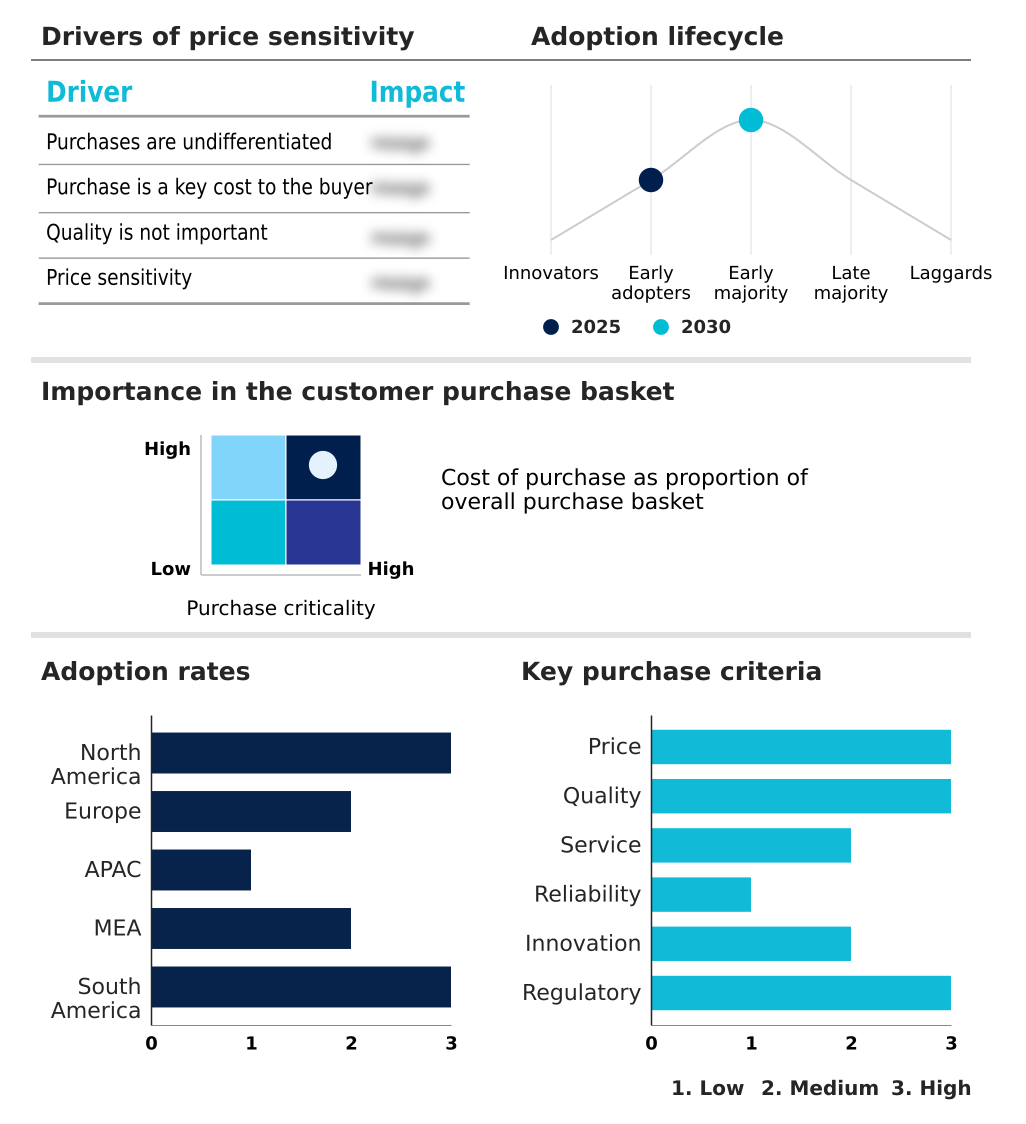
The rotary steerable systems market forecasting report includes the adoption lifecycle of the market, covering from the innovator’s stage to the laggard’s stage. It focuses on adoption rates in different regions based on penetration. Furthermore, the rotary steerable systems market report also includes key purchase criteria and drivers of price sensitivity to help companies evaluate and develop their market growth analysis strategies.
Customer Landscape of Rotary Steerable Systems Industry
Competitive Landscape
Companies are implementing various strategies, such as strategic alliances, rotary steerable systems market forecast, partnerships, mergers and acquisitions, geographical expansion, and product/service launches, to enhance their presence in the industry.
Altitude Energy Partners - Key offerings include advanced electromechanical and sensor products, featuring rotary steerable systems and measurement-while-drilling tools designed for drilling optimization and enhanced performance.
The industry research and growth report includes detailed analyses of the competitive landscape of the market and information about key companies, including:
- Altitude Energy Partners
- APS Technology Inc.
- Baker Hughes Co.
- Burintekh Ltd.
- D Tech Drilling Tools
- DeepFast
- GA Drilling AS
- Halliburton Co.
- Landrill Oil Tools Co. Ltd.
- MorningStar RSS LLC
- NOV Inc.
- Schlumberger Ltd.
- Scientific Drilling Intl.
- Scout Downhole
- SenNavs
- Sinodrills Co. Ltd.
- TAQA KSA
- Weatherford International Plc
Qualitative and quantitative analysis of companies has been conducted to help clients understand the wider business environment as well as the strengths and weaknesses of key industry players. Data is qualitatively analyzed to categorize companies as pure play, category-focused, industry-focused, and diversified; it is quantitatively analyzed to categorize companies as dominant, leading, strong, tentative, and weak.
Recent Development and News in Rotary steerable systems market
- In June 2025, Fervo Energy secured $206 million in financing to advance its geothermal energy project, which relies heavily on autonomous drilling technologies and rotary steerable systems to access geothermal resources.
- In September 2025, Baker Hughes secured a significant contract to provide integrated subsea tree systems and related services for the third phase of the Sakarya Gas Field development in Turkey, highlighting the complexity of modern offshore projects requiring advanced drilling support.
- In February 2025, a North American drilling contractor successfully deployed a next-generation autonomous rotary steerable system in a Haynesville Shale deep-gas project, which performed real-time trajectory corrections and reduced wellbore tortuosity by 15% compared to offset wells.
- In May 2025, SLB introduced a novel at-bit imaging tool designed for integration with its rotary steerable system portfolio, providing drillers with instantaneous, high-resolution visual and geological data from the drill bit.
Dive into Technavio’s robust research methodology, blending expert interviews, extensive data synthesis, and validated models for unparalleled Rotary Steerable Systems Market insights. See full methodology.
| Market Scope | |
|---|---|
| Page number | 282 |
| Base year | 2025 |
| Historic period | 2020-2024 |
| Forecast period | 2026-2030 |
| Growth momentum & CAGR | Accelerate at a CAGR of 7.2% |
| Market growth 2026-2030 | USD 3077.2 million |
| Market structure | Fragmented |
| YoY growth 2025-2026(%) | 6.9% |
| Key countries | US, Canada, Mexico, Germany, UK, France, Italy, Spain, The Netherlands, China, Australia, Japan, India, Indonesia, Thailand, Saudi Arabia, UAE, Oman, Turkey, Israel, Brazil, Argentina and Colombia |
| Competitive landscape | Leading Companies, Market Positioning of Companies, Competitive Strategies, and Industry Risks |
Research Analyst Overview
- The rotary steerable systems market is fundamentally driven by the need for directional drilling precision in increasingly complex geological settings. Technologies enabling continuous drill string rotation, such as push-the-bit technology and point-the-bit mechanisms, are central to enhancing the rate of penetration (ROP) and improving overall wellbore quality.
- The industry is rapidly adopting intelligent drilling systems that leverage digital twin simulation and autonomous drilling automation for real-time geosteering. Key to this is the integration of advanced sensor technologies, including measurement-while-drilling (MWD), logging-while-drilling (LWD), and formation evaluation sensors, into the bottom-hole assembly (BHA) for superior reservoir navigation.
- For boardroom consideration, allocating capital toward closed-loop steering control platforms, which have demonstrated a 15% reduction in wellbore tortuosity, directly correlates to lower non-productive time (NPT) and improved returns. Addressing challenges like downhole tool reliability in high-pressure high-temperature (HPHT) conditions with ruggedized downhole electronics and advanced hydraulic actuation mechanisms is critical.
- Improving downhole telemetry systems, including both mud pulse and electromagnetic (EM) telemetry, is essential for accurate toolface orientation control and automated trajectory correction, especially in extended-reach drilling (ERD) where dogleg severity control ensures precise wellbore placement and enhanced hole cleaning efficiency.
What are the Key Data Covered in this Rotary Steerable Systems Market Research and Growth Report?
-
What is the expected growth of the Rotary Steerable Systems Market between 2026 and 2030?
-
USD 3.08 billion, at a CAGR of 7.2%
-
-
What segmentation does the market report cover?
-
The report is segmented by Application (Onshore, and Offshore), Type (Horizontal, and Directional), Technology (Push-the-bit, and Point-the-bit) and Geography (North America, Europe, APAC, Middle East and Africa, South America)
-
-
Which regions are analyzed in the report?
-
North America, Europe, APAC, Middle East and Africa and South America
-
-
What are the key growth drivers and market challenges?
-
Expansion of complex unconventional drilling and extended-reach reservoirs, Extreme downhole environmental constraints and tool reliability
-
-
Who are the major players in the Rotary Steerable Systems Market?
-
Altitude Energy Partners, APS Technology Inc., Baker Hughes Co., Burintekh Ltd., D Tech Drilling Tools, DeepFast, GA Drilling AS, Halliburton Co., Landrill Oil Tools Co. Ltd., MorningStar RSS LLC, NOV Inc., Schlumberger Ltd., Scientific Drilling Intl., Scout Downhole, SenNavs, Sinodrills Co. Ltd., TAQA KSA and Weatherford International Plc
-
Market Research Insights
- Market dynamics are increasingly shaped by the push for operational cost optimization and the need to navigate complex reservoirs, driving adoption of integrated drilling services. In deepwater exploration projects, for instance, leveraging real-time data analytics can improve decision-making, while predictive maintenance for drilling tools helps mitigate risks associated with high-dogleg drilling applications.
- The industry's move toward drilling-as-a-service models and well lifecycle management is also notable. Advanced wellbore architecture in mature field redevelopment now yields recovery improvements of over 20%, a significant gain. However, telemetry limitations can cause signal delays of up to three minutes in extended-reach wells, impacting efficiency.
- Simultaneously, the focus on environmental footprint reduction is steering investment toward more efficient automated rig platforms and asset performance solutions.
We can help! Our analysts can customize this rotary steerable systems market research report to meet your requirements.
 RIA -
RIA - 
