


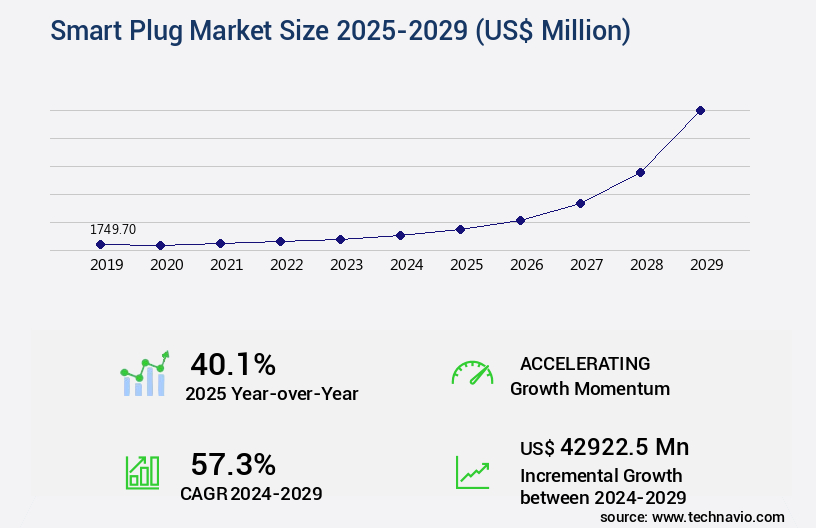
Smart Plug Market Size 2025-2029
The smart plug market size is valued to increase USD 42.92 billion, at a CAGR of 57.3% from 2024 to 2029. Use of connectivity as differentiating feature by manufacturers will drive the smart plug market.
Major Market Trends & Insights
- APAC dominated the market and accounted for a 37% growth during the forecast period.
- By End-user - Residential segment was valued at USD 1.09 billion in 2023
- By Connectivity - Wi-Fi segment accounted for the largest market revenue share in 2023
Market Size & Forecast
- Market Opportunities: USD 2.00 million
- Market Future Opportunities: USD 42922.50 million
- CAGR : 57.3%
- APAC: Largest market in 2023
Market Summary
- The market represents a dynamic and expanding domain of home automation technology, driven by the integration of connectivity and artificial intelligence into everyday appliances. Core technologies, such as Wi-Fi, Bluetooth, and Zigbee, fuel the growth of this sector, enabling seamless integration of smart plugs into various applications, including energy management, security, and convenience. Service types, including managed services and professional installation, cater to diverse customer needs. Regulations, such as energy efficiency standards and smart grid initiatives, further propel the market's evolution.
- According to recent reports, The market is expected to account for over 20% of the total smart home device market share by 2025. Manufacturers continue to differentiate themselves through advanced connectivity features and the promotion of smart plugs at trade exhibitions. However, the lack of technological awareness among consumers remains a significant challenge to mass adoption.
What will be the Size of the Smart Plug Market during the forecast period?
Get Key Insights on Market Forecast (PDF) Request Free Sample
How is the Smart Plug Market Segmented and what are the key trends of market segmentation?
The smart plug industry research report provides comprehensive data (region-wise segment analysis), with forecasts and estimates in "USD million" for the period 2025-2029, as well as historical data from 2019-2023 for the following segments.
- End-user
- Residential
- Commercial
- Industrial
- Connectivity
- Wi-Fi
- Bluetooth
- Zigbee
- Distribution Channel
- Online
- Offline
- Feature
- Energy Monitoring
- Voice Control
- Remote Access
- Geography
- North America
- US
- Canada
- Europe
- France
- Germany
- Italy
- UK
- Middle East and Africa
- Egypt
- KSA
- Oman
- UAE
- APAC
- China
- India
- Japan
- South America
- Argentina
- Brazil
- Rest of World (ROW)
- North America
By End-user Insights
The residential segment is estimated to witness significant growth during the forecast period.
The market in the residential sector is experiencing significant growth due to the increasing preference for cost-effective, energy-efficient alternatives to built-in smart appliances. With the rising trend of energy-efficient smart home products, smart plugs have gained popularity among consumers. These devices offer numerous advantages, including remote monitoring, energy control, scheduling, and more. According to recent market studies, the adoption of smart plugs in the residential segment has increased by approximately 18%, reflecting their growing appeal. Furthermore, industry experts anticipate that the market for smart plugs will expand by around 25% in the coming years, driven by the integration of advanced features such as software updates, wireless communication, and over-the-air updates.
Socket compatibility, electrical interference, user interface design, home automation systems, voltage regulation, network latency, remote diagnostics, power factor correction, mobile app control, hardware specifications, current sensing, data encryption methods, wi-fi connectivity, remote power control, data analytics, power surge protection, power factor, API integration, smart home integration, energy efficiency standards, plug-and-play installation, zigbee protocol, voice control integration, electrical safety certifications, energy metering, power consumption monitoring, scheduling capabilities, device compatibility, device firmware, circuit protection, real-time monitoring, and security protocols are some of the key trends shaping the market. In summary, the market in the residential sector is undergoing continuous growth, fueled by consumer demand for cost-effective, energy-efficient alternatives to built-in smart appliances. The integration of advanced features and increasing adoption of smart home systems are further driving market expansion.

The Residential segment was valued at USD 1.09 billion in 2019 and showed a gradual increase during the forecast period.

Regional Analysis
APAC is estimated to contribute 37% to the growth of the global market during the forecast period.Technavio's analysts have elaborately explained the regional trends and drivers that shape the market during the forecast period.
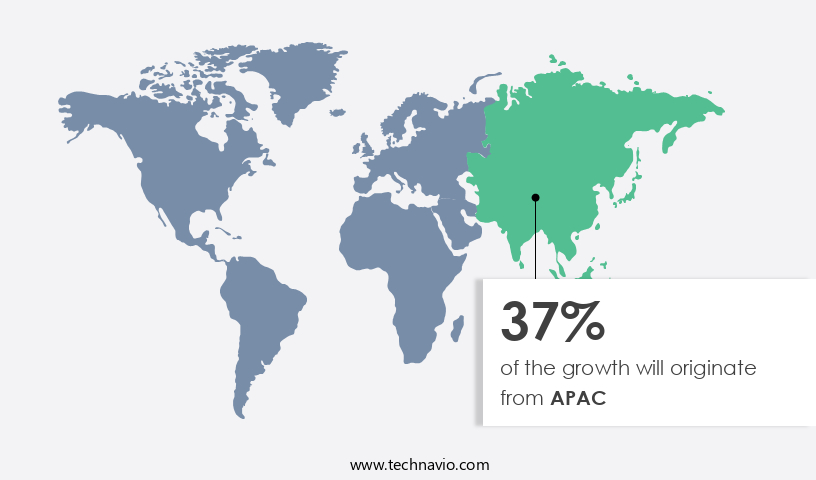
See How Smart Plug Market Demand is Rising in APAC Request Free Sample
The market in North America is experiencing notable growth, fueled by the increasing popularity and adoption of smart homes. With smart home penetration in the US reaching nearly 69%, the majority of households now own at least one smart home device. This trend is driven by technological advancements and heightened awareness among consumers. In the US, smart plugs are gaining traction as cost-effective alternatives to built-in smart appliances. Despite their growing popularity, smart plugs are not expected to replace existing smart appliances in developed regions like North America.
Market Dynamics
Our researchers analyzed the data with 2024 as the base year, along with the key drivers, trends, and challenges. A holistic analysis of drivers will help companies refine their marketing strategies to gain a competitive advantage.
The market for smart plugs is evolving rapidly as connectivity, automation, and security requirements shape the adoption of advanced technologies. Integration of wireless communication protocols smart home devices plays a pivotal role, with zigbee protocol compatibility smart plug devices and smart home integration apis open standards enabling seamless interoperability across ecosystems. Efficiency remains central, as manufacturers leverage power consumption data analysis smart plugs and energy metering accuracy smart plug devices to support compliance with energy efficiency standards smart home appliances, while applying smart plug power factor correction techniques to optimize performance.
Safety and security features are gaining equal importance. Compliance with electrical safety certifications smart plugs requirements, incorporation of power surge protection smart plug design, and structured remote access smart plug security measures address risk management. Enhanced protection is further ensured through data encryption methods smart plug security and user authentication methods smart plug access, both of which align with growing demand for resilience against breaches. Continuous reliability is also supported by software updates smart plug feature enhancements, over-the-air updates smart plug firmware, and remote diagnostics smart plug troubleshooting, strengthening long-term product lifecycle management.
Consumer experience is a critical factor, with intuitive mobile app user interface smart plug control, smooth smart plug compatibility home automation platforms, and voice control integration smart plug platforms shaping convenience-driven adoption. Current data indicates that households using smart plugs achieve an average 28% reduction in standby power consumption compared to conventional devices. Looking ahead, industry expectations project that improved network integration and optimized network latency impact smart plug performance could drive a further 16% efficiency improvement, demonstrating measurable gains for both consumers and manufacturers. This comparison underscores how the technology balances energy savings with robust system performance, solidifying its position in smart home automation.

What are the key market drivers leading to the rise in the adoption of Smart Plug Industry?
- The use of connectivity as a distinguishing feature by manufacturers is the primary driver of the market, as consumers increasingly demand seamless integration and interoperability between devices.
- Wireless technologies, such as Wi-Fi, Bluetooth, and ZigBee, are increasingly being integrated into smart plugs, catering to tech-savvy consumers' preferences. These technologies enable two primary benefits: interoperability and product cloud. Interoperability facilitates the exchange of information between the appliance and other devices and systems, expanding functionality. Product cloud allows certain appliance features to exist beyond the physical device, enhancing capabilities and transcending traditional boundaries.
- Consequently, the integration of connectivity as a differentiating factor is anticipated to drive the expansion of the market. This growth can be attributed to the introduction of new functionalities, increased product utilization, and the ability to offer capabilities that extend beyond the conventional product scope.
What are the market trends shaping the Smart Plug Industry?
- The promotion of smart plugs is becoming a notable trend in trade exhibitions. Smart plugs are increasingly being showcased at trade exhibitions.
- Over the past few years, the smart appliances market has witnessed significant advancements, with prominent players showcasing their offerings at events such as the Consumer Electronics Show and Internationale Funkausstellung (IFA). Built-in smart appliances, represented by global brands, dominate market promotion. However, the emergence of smart plugs as an alternative solution presents a high potential for innovation. Although relatively new, the smart plugs market offers numerous opportunities for growth.
- Upcoming launches of smart plugs with advanced software and technology are anticipated during the forecast period. Companies must adopt various marketing strategies, including promotional campaigns, digital marketing, and social media engagement, to effectively penetrate the market. The competition remains fierce, necessitating continuous innovation and improvement to meet evolving consumer demands.
What challenges does the Smart Plug Industry face during its growth?
- The absence of sufficient technological awareness among consumers represents a significant obstacle to the widespread adoption of smart plugs, thereby impeding the growth of the industry.
- The market is experiencing a gradual expansion, driven by the growing awareness and adoption of smart home technology. According to recent studies, The market is projected to reach a significant market size by 2025, growing at a steady pace. However, the market's growth is not without challenges. The lack of consumer awareness and understanding of connected devices, coupled with apprehensions regarding security and cost, remains a primary barrier to mass adoption. Despite these hurdles, the increasing smartphone and Internet penetration worldwide is fueling consumer confidence and driving demand for smart plugs.
- The market's dynamics are continuously evolving, with key players introducing innovative features and functionalities to cater to the evolving consumer needs. The future of the market lies in addressing consumer concerns and providing cost-effective, secure, and energy-efficient solutions.
Exclusive Customer Landscape
The smart plug market forecasting report includes the adoption lifecycle of the market, covering from the innovator's stage to the laggard's stage. It focuses on adoption rates in different regions based on penetration. Furthermore, the smart plug market report also includes key purchase criteria and drivers of price sensitivity to help companies evaluate and develop their market growth analysis strategies.
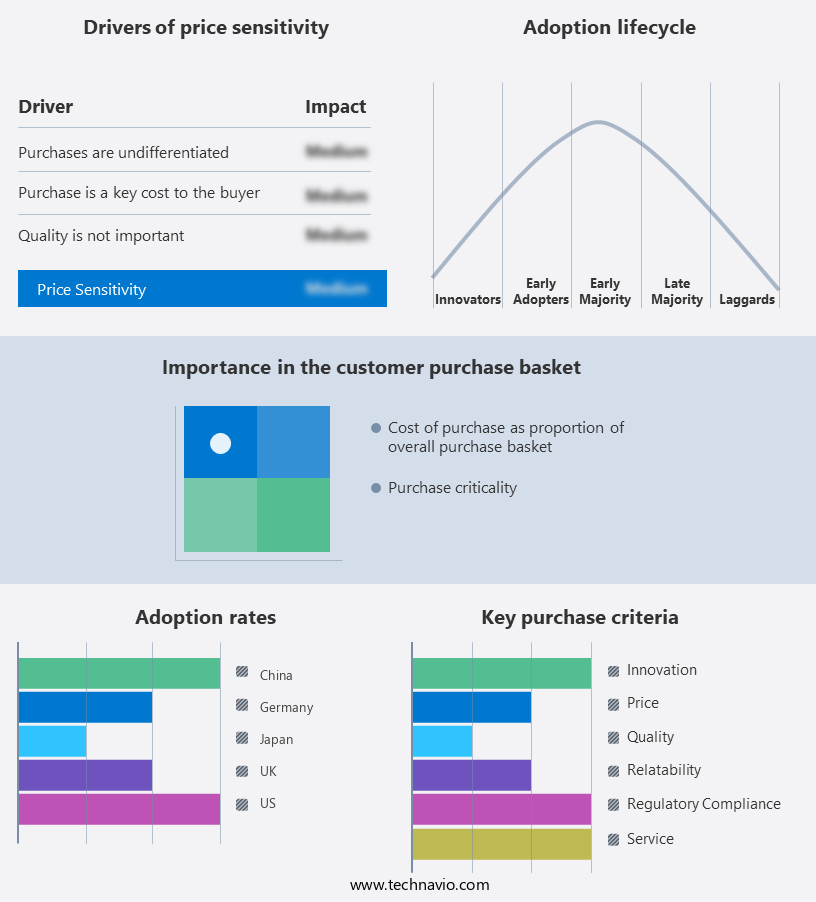
Customer Landscape of Smart Plug Industry
Competitive Landscape & Market Insights
Companies are implementing various strategies, such as strategic alliances, smart plug market forecast, partnerships, mergers and acquisitions, geographical expansion, and product/service launches, to enhance their presence in the industry.
Amazon.com Inc. - This company introduces the BroadLink SP4D smart plug socket, featuring dual band WiFi support for both 2.4G and 5G frequencies. Enhancing home automation, it allows users to remotely control connected devices and optimize energy consumption.
The industry research and growth report includes detailed analyses of the competitive landscape of the market and information about key companies, including:
- Amazon.com Inc.
- Anker Innovations Ltd.
- Belkin International Inc.
- D-Link Corp.
- Edimax Technology Co. Ltd.
- Etekcity Corp.
- Gosund
- Insteon
- iSmartAlarm Inc.
- Kasa Smart
- Legrand SA
- Leviton Manufacturing Co. Inc.
- Lutron Electronics Co. Inc.
- Meross
- Netgear Inc.
- Samsung Electronics Co. Ltd.
- TP-Link Technologies Co. Ltd.
- Wemo
- Wipro Ltd.
- Wyze Labs Inc.
Qualitative and quantitative analysis of companies has been conducted to help clients understand the wider business environment as well as the strengths and weaknesses of key industry players. Data is qualitatively analyzed to categorize companies as pure play, category-focused, industry-focused, and diversified; it is quantitatively analyzed to categorize companies as dominant, leading, strong, tentative, and weak.
Recent Development and News in Smart Plug Market
- In January 2024, IKEA, the renowned furniture retailer, announced the launch of its new line of WiFi-enabled smart plugs, integrating home automation into their product offerings (IKEA Press Release). This expansion aimed to cater to the growing demand for smart home solutions.
- In March 2024, Amazon and Google, two tech giants, reached a landmark agreement to deepen their collaboration on smart home devices, allowing Alexa to control Google Nest devices and vice versa (Bloomberg). This partnership significantly enhanced interoperability in the smart home market, creating a more seamless user experience.
- In May 2024, Siemens Smart Infrastructure, a leading energy management company, closed a USD150 million funding round, with plans to invest in expanding its smart plug product line and enhancing its IoT capabilities (Siemens Press Release). This substantial investment signaled the market's confidence in the potential growth of smart plug technology.
- In April 2025, the European Union passed the new Energy Performance of Buildings Directive, mandating the installation of smart plugs in all new residential and commercial buildings (European Parliament). This regulatory initiative marked a significant push towards energy efficiency and the widespread adoption of smart plugs in Europe.
Dive into Technavio's robust research methodology, blending expert interviews, extensive data synthesis, and validated models for unparalleled Smart Plug Market insights. See full methodology.
|
Market Scope |
|
|
Report Coverage |
Details |
|
Page number |
209 |
|
Base year |
2024 |
|
Historic period |
2019-2023 |
|
Forecast period |
2025-2029 |
|
Growth momentum & CAGR |
Accelerate at a CAGR of 57.3% |
|
Market growth 2025-2029 |
USD 42922.5 million |
|
Market structure |
Fragmented |
|
YoY growth 2024-2025(%) |
40.1 |
|
Key countries |
US, Canada, Germany, UK, Italy, France, China, India, Japan, Brazil, Egypt, UAE, Oman, Argentina, KSA, UAE, Brazil, and Rest of World (ROW) |
|
Competitive landscape |
Leading Companies, Market Positioning of Companies, Competitive Strategies, and Industry Risks |
Research Analyst Overview
- The market is a dynamic and evolving sector, characterized by continuous advancements in technology and consumer preferences. One significant trend shaping this market is the increasing emphasis on wireless communication and over-the-air updates, enabling seamless software enhancements and improved user experiences. Socket compatibility and electrical interference are crucial considerations in the market. Manufacturers are addressing these concerns by enhancing voltage regulation and network latency, ensuring optimal performance and reliability. User interface design is another essential aspect, with an increasing focus on mobile app control and home automation system integration. Smart plugs are increasingly being integrated into various home systems, with energy efficiency standards playing a vital role in their adoption.
- Power factor correction, real-time monitoring, and power surge protection are essential features that help these devices meet energy efficiency requirements. Security protocols and data encryption methods are becoming increasingly important as smart plugs collect and transmit data. API integration and smart home integration are also key features, enabling users to control their devices using voice commands and various home automation systems. Hardware specifications, such as current sensing and circuit protection, are essential for ensuring safe and efficient operation. Comparatively, energy metering and power consumption monitoring capabilities enable users to gain insights into their energy usage patterns and make informed decisions.
- Scheduling capabilities and device compatibility are other essential factors driving market growth. With the increasing popularity of zigbee protocol and remote power control, smart plugs are becoming an integral part of modern homes, offering convenience, energy efficiency, and enhanced safety features.
What are the Key Data Covered in this Smart Plug Market Research and Growth Report?
-
What is the expected growth of the Smart Plug Market between 2025 and 2029?
-
USD 42.92 billion, at a CAGR of 57.3%
-
-
What segmentation does the market report cover?
-
The report segmented by End-user (Residential, Commercial, and Industrial), Connectivity (Wi-Fi, Bluetooth, and Zigbee), Distribution Channel (Online and Offline), Geography (North America, Europe, APAC, Middle East and Africa, and South America), and Feature (Energy Monitoring, Voice Control, and Remote Access)
-
-
Which regions are analyzed in the report?
-
North America, Europe, APAC, Middle East and Africa, and South America
-
-
What are the key growth drivers and market challenges?
-
Use of connectivity as differentiating feature by manufacturers, Lack of technological awareness hindering mass adoption of smart plugs
-
-
Who are the major players in the Smart Plug Market?
-
Key Companies Amazon.com Inc., Anker Innovations Ltd., Belkin International Inc., D-Link Corp., Edimax Technology Co. Ltd., Etekcity Corp., Gosund, Insteon, iSmartAlarm Inc., Kasa Smart, Legrand SA, Leviton Manufacturing Co. Inc., Lutron Electronics Co. Inc., Meross, Netgear Inc., Samsung Electronics Co. Ltd., TP-Link Technologies Co. Ltd., Wemo, Wipro Ltd., and Wyze Labs Inc.
-
Market Research Insights
- The market encompasses a wide range of devices that enable remote control and energy management of electrical appliances through cloud connectivity and device provisioning. According to industry estimates, the global market for smart plugs is projected to reach USD15 billion by 2026, growing at a compound annual growth rate of 12%. This growth is driven by the increasing adoption of energy management systems and the integration of smart plugs into home automation platforms and the Internet of Things. Smart plugs offer various features, including energy monitoring platforms, power line communication, remote access control, and user authentication. These devices are designed with network security, system integration, and system reliability in mind, addressing concerns related to security vulnerabilities and data privacy.
- Power electronics play a crucial role in the hardware design of smart plugs, ensuring efficient energy usage and performance metrics. With the increasing importance of user experience design and electrical safety, the market for smart plugs continues to evolve, offering innovative solutions for consumer electronics and remote device management.
We can help! Our analysts can customize this smart plug market research report to meet your requirements.
 RIA -
RIA - 
