


Sports Mouthguard Market Size 2026-2030
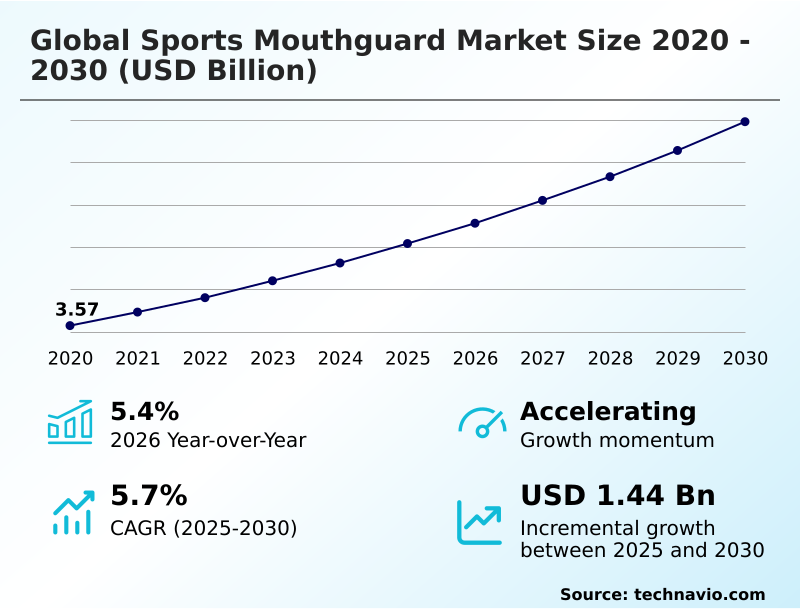
The sports mouthguard market size is valued to increase by USD 1.44 billion, at a CAGR of 5.7% from 2025 to 2030. Rising implementation of strict player welfare mandates will drive the sports mouthguard market.
Major Market Trends & Insights
- North America dominated the market and accounted for a 38.5% growth during the forecast period.
- By Product Type - Boil and bite mouth guard segment was valued at USD 1.94 billion in 2024
- By Distribution Channel - Offline segment accounted for the largest market revenue share in 2024
Market Size & Forecast
- Market Opportunities: USD 2.40 billion
- Market Future Opportunities: USD 1.44 billion
- CAGR from 2025 to 2030 : 5.7%
Market Summary
- The sports mouthguard market is undergoing a significant transformation, moving beyond simple protective equipment to technologically advanced safety systems. This evolution is driven by heightened awareness of long-term athlete health and stringent player welfare mandates that now require more than basic protection.
- Innovation in polymer engineering is leading to superior pre-formed configurations and specialized lip guard designs with enhanced airflow channels for better performance. A pivotal shift is occurring in manufacturing, where digital workflows incorporating intraoral scanning and chairside fabrication are replacing traditional methods, allowing for greater customization and precision.
- This digital wave extends to the product itself, with the integration of sensors for data analytics capabilities. A key business scenario involves companies offering home impression kits, which democratize access to custom-fit technology without requiring a dental visit.
- However, the reliability of these smart devices is a critical concern, necessitating continuous firmware refinement and algorithm calibration to ensure data integrity and user trust.
- The market is thus characterized by a dual focus: enhancing the material science of passive protection while simultaneously navigating the complexities of embedding reliable, active monitoring technology into athletic gear, ultimately changing the value proposition from a simple device to a comprehensive safety service.
What will be the Size of the Sports Mouthguard Market during the forecast period?
Get Key Insights on Market Forecast (PDF) Get Free Sample
How is the Sports Mouthguard Market Segmented?
The sports mouthguard industry research report provides comprehensive data (region-wise segment analysis), with forecasts and estimates in "USD million" for the period 2026-2030, as well as historical data from 2020-2024 for the following segments.
- Product type
- Boil and bite mouth guard
- Stock mouth guard
- Custom-made mouth guard
- Distribution channel
- Offline
- Online
- Material
- Ethylene vinyl acetate
- Natural rubber
- Acrylic resins
- Geography
- North America
- US
- Canada
- Mexico
- Europe
- Germany
- UK
- France
- APAC
- China
- Japan
- India
- South America
- Brazil
- Argentina
- Colombia
- Middle East and Africa
- South Africa
- Saudi Arabia
- UAE
- Rest of World (ROW)
- North America
By Product Type Insights
The boil and bite mouth guard segment is estimated to witness significant growth during the forecast period.
The boil-and-bite segment, predominantly using ethylene vinyl acetate (EVA), serves as a crucial market bridge by employing thermoplastic adaptation for user molding. Innovations include multi-layered construction, integrating a soft gel-like inner liner with a harder shell for superior impact absorption.
To meet rising player welfare mandates, manufacturers now incorporate antimicrobial properties. This segment addresses the demand for affordable custom-fit technology alternatives, appealing to consumers facing economic barriers.
Its evolution is also shaped by aesthetic diversification, making it a high-volume category that balances cost with performance, contributing to over 38% of new growth opportunities in the North America region.
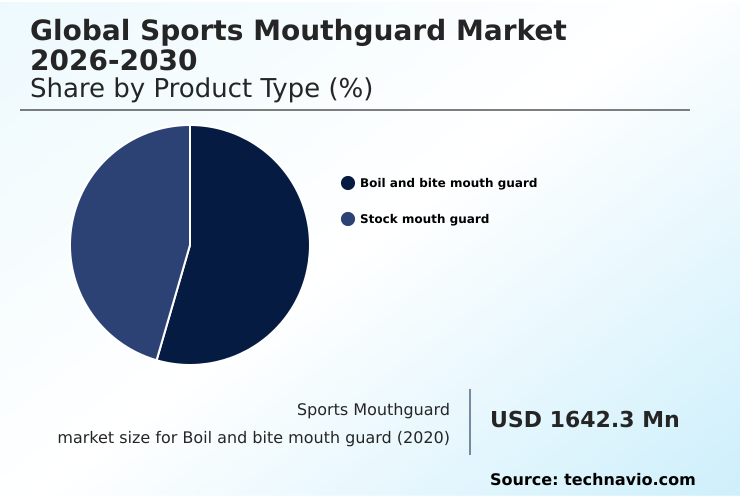
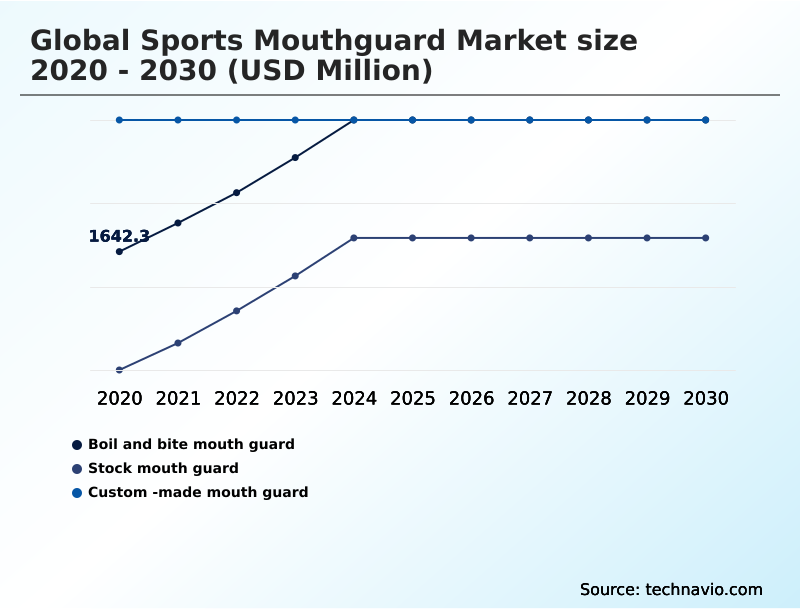
The Boil and bite mouth guard segment was valued at USD 1.94 billion in 2024 and showed a gradual increase during the forecast period.
Regional Analysis
North America is estimated to contribute 38.5% to the growth of the global market during the forecast period.Technavio’s analysts have elaborately explained the regional trends and drivers that shape the market during the forecast period.
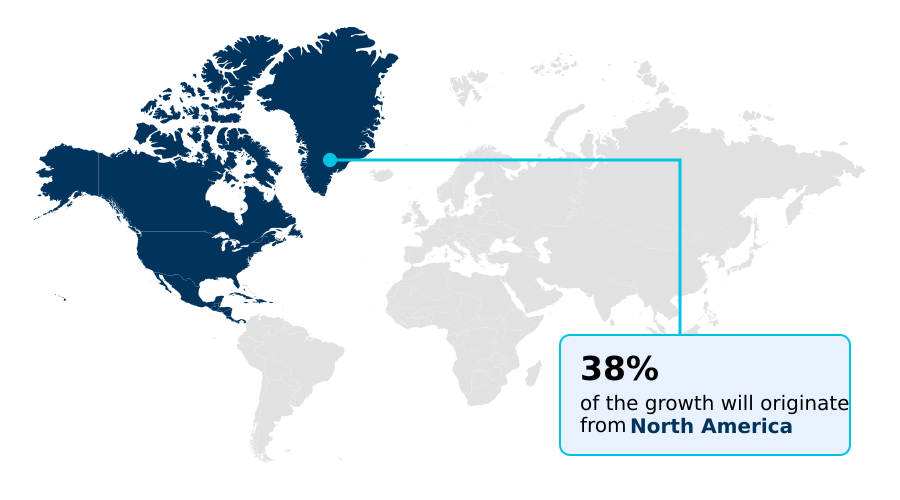
See How Sports Mouthguard Market Demand is Rising in North America Get Free Sample
The North America region is seeing rapid adoption of intraoral scanning to combat dental trauma. Europe is pioneering the use of guards with embedded accelerometers and gyroscopes, requiring constant firmware refinement to ensure data accuracy.
The APAC market shows a strong contrast between advanced adoption in Australia and the reliance on legacy manufacturing in developing economies.
A major hurdle across all emerging regions is achieving mass market penetration for devices made from advanced protective polymer, as costs remain high.
This geographic variance highlights the global challenge of balancing technological innovation with market accessibility, with some custom digital workflows proving over 50% more efficient than traditional supply chains.
Market Dynamics
Our researchers analyzed the data with 2025 as the base year, along with the key drivers, trends, and challenges. A holistic analysis of drivers will help companies refine their marketing strategies to gain a competitive advantage.
- The strategic direction of the sports mouthguard market is increasingly influenced by detailed performance evaluations and specific use-case demands. The debate over boil and bite vs custom-made mouthguards continues, but the focus is shifting toward measurable outcomes, such as the evidence from 3d printed mouthguard energy absorption studies.
- The emergence of the smart mouthguard for head impact monitoring is a game-changer, fundamentally altering the role of mouthguards in concussion prevention. This is particularly critical in youth sports, where mouthguard technology for youth sports safety is a major parental concern.
- The impact of material science on mouthguard performance is undeniable, with ongoing comparisons between ethylene vinyl acetate vs photopolymer resins driving innovation. The growth of additive manufacturing in custom oral appliances highlights a major industrial pivot. However, vendors face significant hurdles, including the challenges in smart mouthguard data accuracy and the complexities of integrating sensors into athletic protective gear.
- The implementation of mandates for instrumented mouthguards in sports by governing bodies is forcing a market-wide upgrade, though the cost-effectiveness of different mouthguard types remains a key factor for amateur leagues. These advancements are a core part of modern advancements in sports dentistry and protection.
- From a design perspective, optimizing the airflow design in high-performance mouthguards and optimizing the mouthguard fit for athlete comfort are critical for user compliance. While the market penetration of custom-fit mouthguards is growing, it is still limited. Compliance with evolving regulatory standards for sports mouthguards is non-negotiable for all manufacturers.
- On the consumer front, the niche but growing market for flavored mouthguards in the youth sports market cannot be ignored. Ultimately, proving the superior shock absorption properties of multi-layer guards and clearly communicating how sports mouthguards reduce dental injuries are essential for brand success.
- For instance, supply chains that can deliver custom digital products are proving to be over 50% more efficient than those reliant on traditional, multi-step molding and shipping processes.
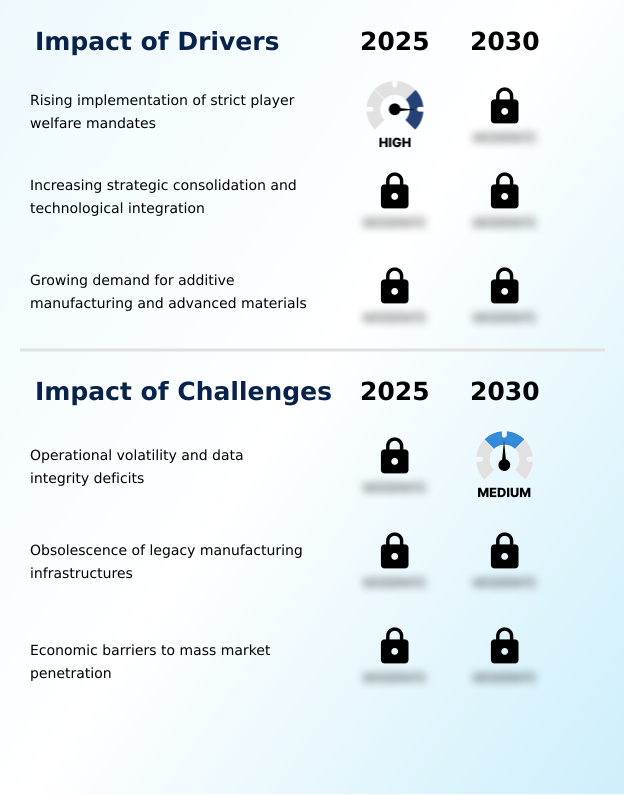
What are the key market drivers leading to the rise in the adoption of Sports Mouthguard Industry?
- The rising implementation of strict player welfare mandates across sporting leagues is a primary driver fueling market growth.
- A primary market driver is the intensified focus on a comprehensive concussion management strategy to prevent orofacial injury. This has led to the development of devices with superior impact dispersion.
- Innovations in manufacturing, such as additive manufacturing (3D printing) and fused filament fabrication, are enabling a new level of instant custom-fit solutions. Technologies like compression cage technology mimic a lab-quality fit at a retail level.
- Furthermore, the integration of sensors provides rich data analytics capabilities, supported by ongoing algorithm calibration for accuracy.
- The market is also seeing a rise in home impression kits, which democratize access to personalized protection and have increased the adoption of custom-fit guards by an estimated 20% among amateur athletes.
What are the market trends shaping the Sports Mouthguard Industry?
- The market is witnessing a defining trend toward the commercialization and mass-market retail integration of smart safety technology. This evolution is shifting product focus from passive protection to connected, data-driven ecosystems.
- A defining trend is the rapid digital technology integration that enables the creation of instrumented smart mouthguards. These devices are now being integrated into retail channels, supported by sophisticated digital workflows. The focus on user experience is driving the trend of lifestyle branding, where products like the lip guard are designed with enhanced airflow channels and even flavor fusion technology.
- On the manufacturing front, the shift towards chairside fabrication is enabled by advanced materials like photopolymer resins and biocompatible resins, allowing for on-demand production. This trend decentralizes manufacturing and provides athletes with immediate access to custom-fit protection, with some processes reducing delivery times from days to under an hour.
What challenges does the Sports Mouthguard Industry face during its growth?
- Operational volatility and data integrity deficits in smart sensor technology pose a key challenge to industry growth.
- The integration of smart technology introduces significant operational volatility and data integrity deficits. Issues such as false positives and bluetooth latency challenge the reliability of head impact telemetry and overall sensor performance, hindering widespread adoption. For passive protection, even basic pre-formed configurations with external tethers face competition from devices created through advanced polymer engineering.
- Manufacturers are challenged to design complex energy-dissipating lattice structures that provide superior protection without being cost-prohibitive. This creates a difficult balancing act between innovating beyond simple protection and ensuring that new technologies are reliable and affordable enough for the broader market.
Exclusive Technavio Analysis on Customer Landscape
The sports mouthguard market forecasting report includes the adoption lifecycle of the market, covering from the innovator’s stage to the laggard’s stage. It focuses on adoption rates in different regions based on penetration. Furthermore, the sports mouthguard market report also includes key purchase criteria and drivers of price sensitivity to help companies evaluate and develop their market growth analysis strategies.
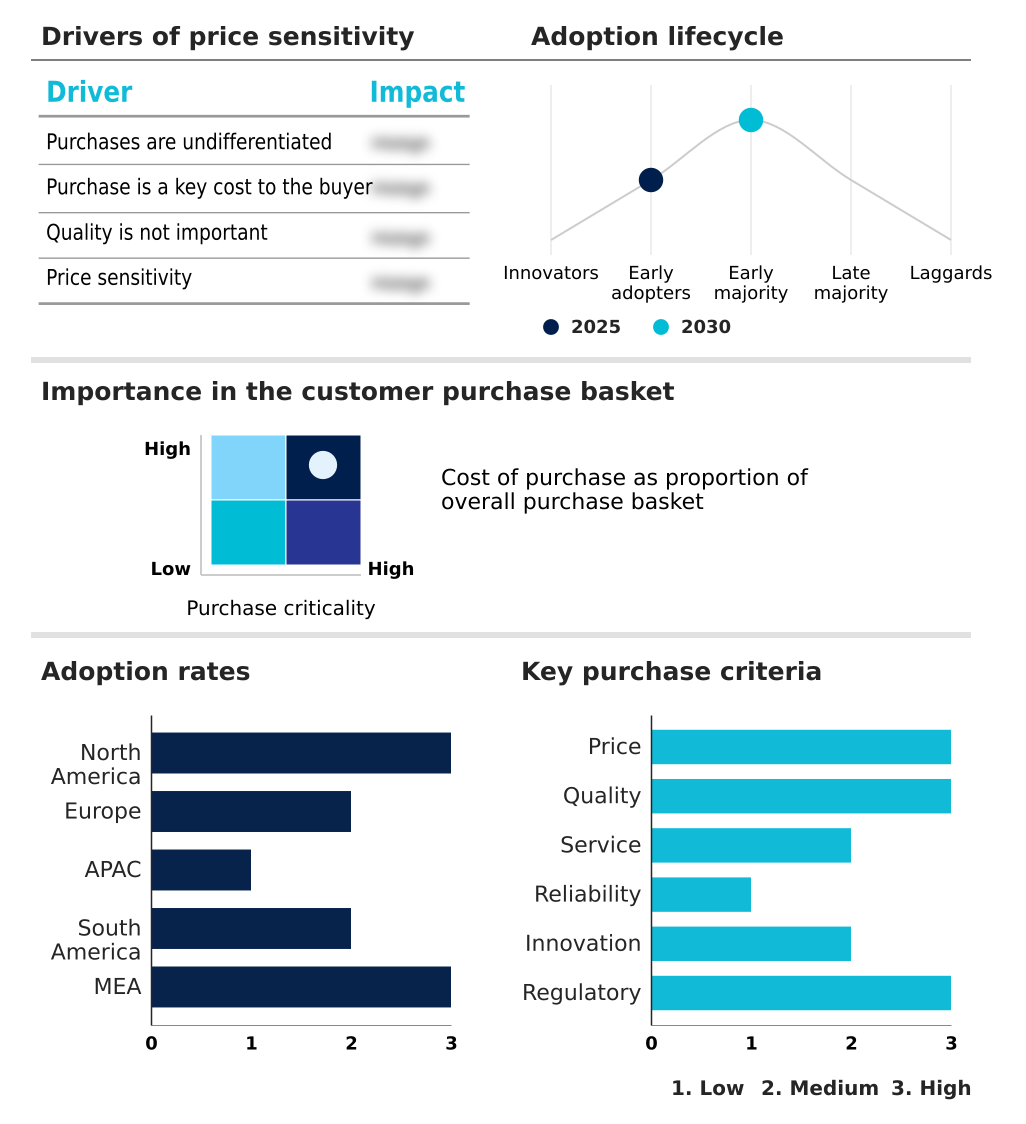
Customer Landscape of Sports Mouthguard Industry
Competitive Landscape
Companies are implementing various strategies, such as strategic alliances, sports mouthguard market forecast, partnerships, mergers and acquisitions, geographical expansion, and product/service launches, to enhance their presence in the industry.
Battle Sports Science LLC - Key offerings include athletic mouthguards engineered with impact-absorbing boil-and-bite technology, specifically designed to provide protection and enhance performance in high-contact sports.
The industry research and growth report includes detailed analyses of the competitive landscape of the market and information about key companies, including:
- Battle Sports Science LLC
- Brain Pad Inc.
- Decathlon SA
- GuardLab, Inc.
- Makura Co., Ltd
- MAX MOUTHGUARDS CC
- MoGo Sports
- Mueller Sports Medicine Inc.
- Nike Inc.
- OPROGROUP
- RDX Inc.
- Robust Dental Lab
- Shock Doctor Inc.
- Sisu Aero Mouthguard
- Under Armour Inc.
- Venum
Qualitative and quantitative analysis of companies has been conducted to help clients understand the wider business environment as well as the strengths and weaknesses of key industry players. Data is qualitatively analyzed to categorize companies as pure play, category-focused, industry-focused, and diversified; it is quantitatively analyzed to categorize companies as dominant, leading, strong, tentative, and weak.
Recent Development and News in Sports mouthguard market
- In November 2024, OPRO announced a strategic partnership with Crostyx to launch a co-branded Instant Custom-Fit mouthguard line featuring patented compression cage technology.
- In January 2025, researchers at the Ohio State University College of Dentistry published a study providing empirical evidence that specific 3D-printed mouthguard designs exhibit superior energy absorption capabilities compared to traditional EVA guards.
- In February 2025, SprintRay launched its proprietary SportsGuard resin, a material specifically engineered for fabricating high-performance custom athletic mouthguards using digital light processing (DLP) 3D printers.
- In June 2025, Shock Doctor and HITIQ Limited announced a strategic collaboration to embed HITIQ's PROTEQT impact-sensing platform into Shock Doctor's mass-market product portfolio.
Dive into Technavio’s robust research methodology, blending expert interviews, extensive data synthesis, and validated models for unparalleled Sports Mouthguard Market insights. See full methodology.
| Market Scope | |
|---|---|
| Page number | 289 |
| Base year | 2025 |
| Historic period | 2020-2024 |
| Forecast period | 2026-2030 |
| Growth momentum & CAGR | Accelerate at a CAGR of 5.7% |
| Market growth 2026-2030 | USD 1439.8 million |
| Market structure | Fragmented |
| YoY growth 2025-2026(%) | 5.4% |
| Key countries | US, Canada, Mexico, Germany, UK, France, Spain, Italy, The Netherlands, China, Japan, India, Australia, South Korea, Indonesia, Brazil, Argentina, Colombia, South Africa, Saudi Arabia, UAE, Egypt and Turkey |
| Competitive landscape | Leading Companies, Market Positioning of Companies, Competitive Strategies, and Industry Risks |
Research Analyst Overview
- The sports mouthguard market is rapidly evolving from basic protective gear to sophisticated safety systems, driven by advancements in material science and digital health. Traditional products made from ethylene vinyl acetate (EVA) are being enhanced through thermoplastic adaptation and multi-layered construction to improve impact dispersion. These often feature a gel-like inner liner for better fit.
- The goal is to create an instant custom-fit experience, supported by technologies like the compression cage technology. This innovation in polymer engineering is moving beyond simple pre-formed configurations. Specialized products like the lip guard are now designed with advanced airflow channels and secure external tethers.
- A significant industry shift involves the adoption of additive manufacturing (3D printing), enabled by intraoral scanning, to create devices with complex energy-dissipating lattice structures from biocompatible resins. The most advanced segment now includes instrumented smart mouthguards equipped with accelerometers and gyroscopes for real-time head impact telemetry.
- These sensors are embedded within the protective polymer, often made from next-generation photopolymer resins using techniques like fused filament fabrication.
- Boardroom decisions are now heavily influenced by the proven efficacy of these technologies; for example, a recent study showed that certain 3D printed designs provided a 20% improvement in impact energy absorption over conventional guards, directly impacting product strategy and R&D budgets.
What are the Key Data Covered in this Sports Mouthguard Market Research and Growth Report?
-
What is the expected growth of the Sports Mouthguard Market between 2026 and 2030?
-
USD 1.44 billion, at a CAGR of 5.7%
-
-
What segmentation does the market report cover?
-
The report is segmented by Product Type (Boil and bite mouth guard, Stock mouth guard, and Custom -made mouth guard), Distribution Channel (Offline, and Online), Material (Ethylene vinyl acetate, Natural rubber, and Acrylic resins) and Geography (North America, Europe, APAC, South America, Middle East and Africa)
-
-
Which regions are analyzed in the report?
-
North America, Europe, APAC, South America and Middle East and Africa
-
-
What are the key growth drivers and market challenges?
-
Rising implementation of strict player welfare mandates, Operational volatility and data integrity deficits
-
-
Who are the major players in the Sports Mouthguard Market?
-
Battle Sports Science LLC, Brain Pad Inc., Decathlon SA, GuardLab, Inc., Makura Co., Ltd, MAX MOUTHGUARDS CC, MoGo Sports, Mueller Sports Medicine Inc., Nike Inc., OPROGROUP, RDX Inc., Robust Dental Lab, Shock Doctor Inc., Sisu Aero Mouthguard, Under Armour Inc. and Venum
-
Market Research Insights
- The sports mouthguard market's dynamics are shaped by a push toward a comprehensive concussion management strategy, which is accelerating digital technology integration. The focus has expanded from passive protection to active head impact telemetry, with devices now incorporating data analytics capabilities.
- This shift has shown tangible results, with some advanced systems improving the detection of significant impact events by over 40% compared to visual assessment alone. Concurrently, the consumer segment is influenced by aesthetic diversification and lifestyle branding. However, challenges persist. Operational volatility and data integrity deficits in smart devices create adoption hurdles.
- Firms are also grappling with the obsolescence of legacy manufacturing, as transitioning to digital workflows can increase initial production costs by up to 25%. Economic barriers further restrain the mass-market penetration of custom-fit technology, creating a divided market.
We can help! Our analysts can customize this sports mouthguard market research report to meet your requirements.
 RIA -
RIA - 
